




Abstract
BACKGROUND:
In most Western countries, senior workers have increased their participation in the workforce. However, at the same time, early retirement also increases. The reasons behind this early exit from the workforce are still unclear.
OBJECTIVE:
This qualitative study aims to explore the antecedents of and experiences with a voluntary exit from working life before the expected retirement age of 65 in Sweden.
METHODS:
Data consist of semi-structured interviews with 18 participants who exited working life between the ages of 61–63. In Sweden, these ages are considered as an early exit from working life since, for many years, the expected retirement age has been 65. Qualitative content analysis with an abductive approach was utilized.
RESULTS:
The analysis revealed four sub-themes: 1) Health benefits with an early exit from working life (with the categories: own health status, the possibility for recovery time, and avoidance of strain); 2) Having economic conditions that enable an early exit from working life (with the categories: offers from the employer and financial compromises); 3) Social benefits with an early exit from working life (with the categories: enabling more time with my social network and avoidance of unsatisfying social work environment); 4) Self-fulfillment activities during the senior years (with the categories: enabling time for activities beyond work and avoidance of decreased job satisfaction.
CONCLUSION:
This variety of antecedents of and experiences with a voluntary early exit from working life before the expected retirement age highlights that the ongoing increased statutory retirement age also increases the risk for extended inequalities among the aging population.
Introduction
The improvements in life expectancy and the greater proportion of people aged 65 or older in populations around the world [1] have led to increasing statutory retirement ages as well as decreasing routes to early retirement [2]. Research on retirement timing has grown during the last decades and is often conceptualized as early retirement, expected (on-time) retirement, and later retirement. What is considered as the expected retirement age depends e.g., on country-specific government retirement legislation and employer-provided pension rules or eventual cultural and organizational norms. Early retirement is that which precedes the expected retirement age and sometimes includes involuntary early retirement e.g., disability pension, and/or voluntary early retirement [3]. In most Western countries, senior workers have increased their participation in the workforce [2]. However, with the higher expected retirement ages, there seems to be an increase in the preference for earlier retirement age, i.e., the difference between what is expected and what is preferred retirement age [4].
In Sweden, there is a flexible retirement age of 62–68 years, but the generally anticipated, i.e., the expected retirement age has been for many years and still is 65 years [5]. A study within a Swedish context showed that 91.3% of the participants thought they would work until age 65 [6]. However, a study with a representative Swedish sample revealed that 57% of the participants preferred to exit working life at age 64 or earlier, 36% at age 65, and 7% at age 66 or later [7]. Furthermore, this expected retirement age seems to be changing since an increasing number of people in Sweden postpone the timing of their retirement [5, 8], while at the same time, early retirement also increases. Whether this early exit from the workforce is due to the individuals being pushed towards retirement e.g., health problems, or pulled towards retirement e.g., being attracted to extended leisure time is still unclear [5].
Background
Antecedents of retirement timing, i.e., circumstances preceding the decision of either exiting or remaining active in working life at an older age have been conceptualized as an interrelated set of multiple factors [3, 3]. These factors include e.g., individual demographics, health status, and work environment [3, 9–11].
Previous research reveals that female workers and workers living with a partner prefer earlier retirement [4]. Among the factors that seem to make retirement more attractive than being employed include financial incitement e.g., beneficial early retirement offers [12] and greater satisfaction with leisure time [13]. Factors impacting early retirement that have a positive pulling attraction to an early exit from working life do not seem to be researched as much as the push factors, and it is suggested that future research should include the pulling factors that may impact the timing of retirement [9].
The most frequently cited reason for an early exit from working life is poor health [3]. Research has revealed that poor physical and mental health are reasons for an early exit from working life [14]. Being diagnosed with multiple chronic diseases [15] and poorer self-rated health [16], are associated with an early exit from working life. Among individuals aged 60–64 chronic health conditions, health-related work limitations and low subjective life expectancy seemed to play a significant mediating role in their retirement preferences [17]. However, health and retirement timing cannot solely be viewed as something linear since good health can also be associated with early retirement [9]. This is especially so among people with a higher socioeconomic status who have economic conditions that enable them to retire [3]. An interview study, with participants who retired early, confirmed that both good and poor health influenced the timing of their retirement. Poor health could imply e.g. a self-perceived decline to work in the future, and good health could be a motive since early retirement enabled the pensioner an opportunity to enjoy life while their health was still good enough to do so [18]. Low job satisfaction also seems to contribute to an early exit from working life due to ill health [19]. Work-related risk factors for an early exit from working life are e.g., heavy physical work [19, 20], physical exhaustion after work [6] and work that was considered restrictive and lacked freedom [21]. Previous research regarding healthcare personnel’s preferences towards retirement timing revealed that strenuous working conditions and/or dissatisfaction with the organization were motives for an early exit from working life [22–24]. A study that explored the views of people aged 55–67 who had been retired for 3–6 years, confirmed that e.g., changes in the workplace that resulted in increased work demands preceded their decision to exit working life early [25] (Stevens et al., 2022).
The swAge-model
As mentioned above, a broad variety of different factors at different levels can be involved in retirement timing. The theoretical model, Sustainable working life for all ages (The swAge-model), offers a comprehensive description of how to deliberate different elements and aspects of the motives behind retirement timing. This model includes four areas of consideration that precede an individual’s decision to stay active in working life or withdraw from the workforce. These considerations are linked to nine essential determining areas impacting whether an individual who is approaching retirement age, can or wants to participate in the workforce. The first consideration is personal health concerning circumstances in the work environment. The areas included are 1) employee self-rated health, medical diagnoses, and functional variance/disability; 2) employee physical work environment and injury prevention; 3) employee mental work environment, stress, effort/reward balance, violence, and threats; 4) employee working hours, the pace at work, and recovery time. The second consideration is the private economy, which includes the area of 5) employee personal finances, i.e., the employee deliberates if their financial situation would be better if still employed or if it would suffice when retired. The third consideration is social inclusion, where the options of participation and social inclusion through participation in working life are compared to extended leisure time. The areas included are 6) employee family situation, partner, leisure interactions; 7) socialization i.e., employee experience of organizational and managerial attitudes, employee social participation in the workgroup, discrimination, and social support. The fourth consideration is self-fulfillment through meaningful, stimulating, and creative activities, i.e., the employee considers if the opportunity for self-fulfillment is best served by being employed or retired, which includes the areas: 8) employee-stimulating and self-crediting tasks, core in work, and work satisfaction; 9) employee competence, skills, knowledge, and development opportunities [10].
The present study
In summation, most of the previous research regarding retirement timing has applied a quantitative approach [26], investigated desired retirement age preferences, or focused on factors that can force people to exit the workforce. To contribute to the field of understanding regarding retirement timing and move towards a deeper understanding of the retirement decision; more qualitative research is desirable [26]. With a qualitative abductive approach and the swAge-model as a theoretical framework to analyze empirical material, this study also responds to earlier suggestions calling for research that addresses both the pushing and pulling factors that might impact an early exit from working life. To contribute to the extensive research landscape regarding retirement timing, this study aims to explore the antecedents of and experiences with a voluntary early exit (i.e., not due to disability pension or unemployment) from working life before the expected retirement age of 65 in Sweden.
Method
This study with a descriptive-interpretative design used qualitative content analysis [27, 28] with an abductive approach [29].
Procedure and participants
Approval was granted by the Swedish Ethical Review Authority (Dnr 2021-04236). The inclusion criteria were persons that had exited working life at least one year before the expected retirement age, i.e., they were not older than 64 years when they voluntarily exited working life. Participants were recruited through snowball sampling, i.e., the first participants were identified within the research group’s circle of acquaintances, and thereafter from referrals made by the previously included participants. This enabled a selection of new participants with a variety of characteristics and experiences regarding voluntary exit from working life. Verbal and written information about the study was provided to presumptive participants before participation and the signing of written informed consent. The final study sample included 18 participants who were aged 63–69 (mean 65.6) and had voluntarily exited from working life less than 1 year –5 years before the collection of the data. See Table 1, for a more detailed presentation of the participants’ characteristics.
Participants characteristics.
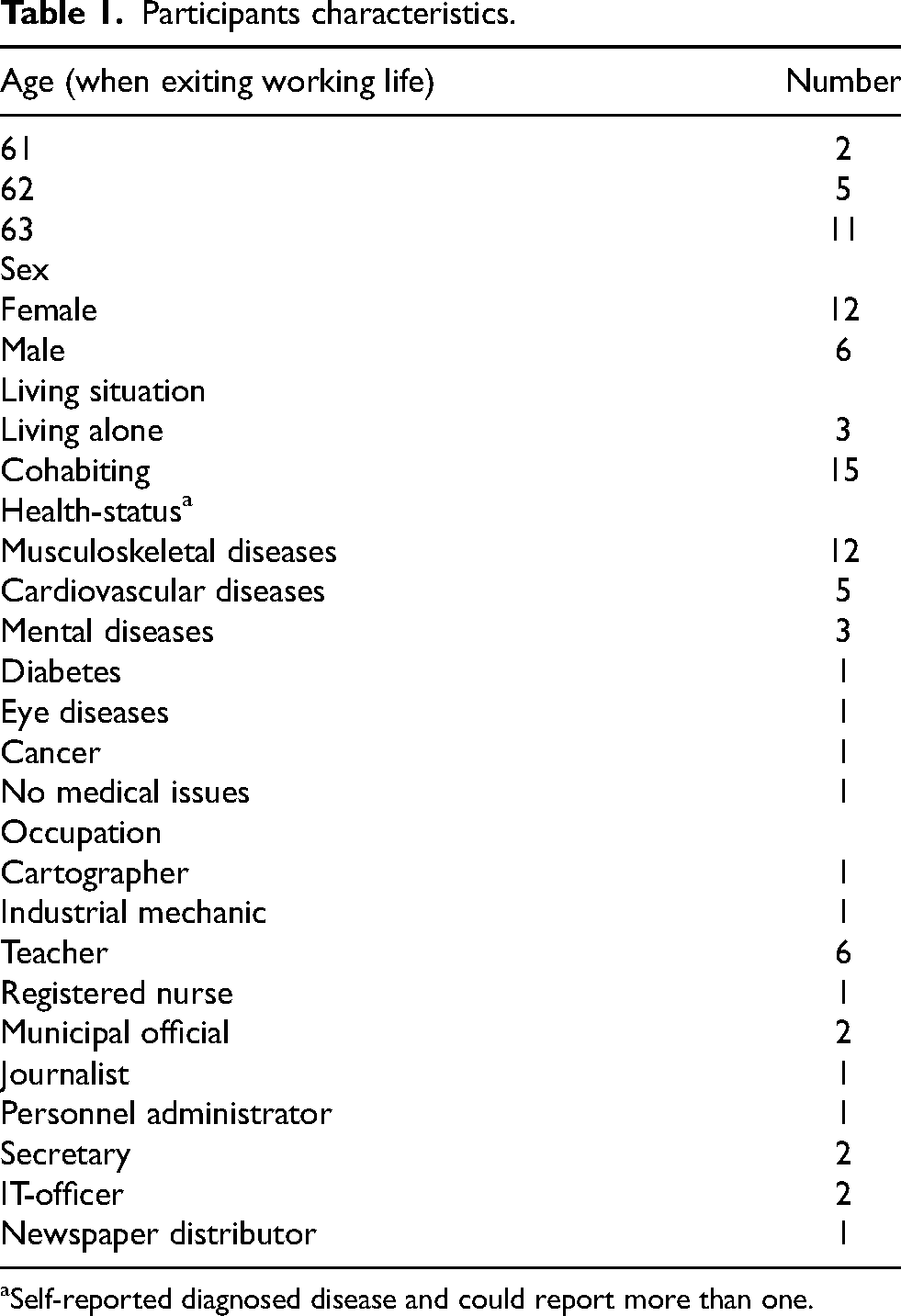
Participants characteristics.
aSelf-reported diagnosed disease and could report more than one.
Data were collected through individual semi-structured interviews, which were conducted in August through October 2022. The participants chose the location of the interview, i.e., either in their home (n = 2), at the first author’s workplace (n = 2), or by telephone (n = 14). The first author conducted all the interviews, which were audio-recorded and lasted 15–45 minutes. The semi-structured interview guide covered the following topics: 1) background data e.g., health status, living circumstances, and occupation at the time of retirement; 2) what preceded their decision to exit working life before the expected retirement age; 3) experiences from their working life during the last years of their employment. These questions were open-ended, and follow-up questions were asked to achieve deeper and more detailed descriptions of the participant’s experiences. Examples of such were: can you give an example of how your health possibly benefits with your exit from working life or could you tell me a little bit more about how your family situation affected your decision to exit from working life? These potential prompts were prepared in advance, to encourage the participant to expand their answers and facilitate the flow of the interview. At the end of each interview, the participants were also asked if they could provide any additional aspects that were not covered in the interview. See the interview guide in Appendix 1.
Following research ethics and to maintain confidentiality, the 18 participants’ names were coded i.e. I1-I18, before the interviews were transcribed verbatim.
Data analysis
Qualitative content analysis inspired by Graneheim and Lundman (2004), with a step-by-step method, was used to analyze the transcripts. An abductive approach that implies a back-and-forth movement between inductive and deductive approaches was also utilized [29].
Initially, to facilitate an overall understanding of the data, the entire text that included all data units, i.e., all transcribed interviews, was read by the first and last authors. The first step in the analysis was performed in an inductive way to identify the meaning units, i.e., statements that relate to the purpose of the present study, and when needed condense these meaning units while still preserving the core [27]. The meaning units were then labeled with descriptive codes that were close to the text on a low level of abstraction and interpretation. The next step of the analysis, the re-contextualization, included sorting the codes and identifying groups of codes that were interrelated or differed from other groups into different sub-themes [28]. This resulted in four groups reminiscent of the four considerations, which according to the SwAge model precedes the decision to stay active in working life vs. exiting working life. From these four groups, sub-themes were named with headings in line with the four considerations in the swAge model. This inspired the change to a deductive approach, that moved from the four considerations in the SwAge-model towards the data, i.e., from a more general level to a more concrete and specific level [29]. In this next step, a concept-driven method based on the nine determinants in the swAge-model, i.e., the areas that are believed to precede the decision to either exit or remain active in working life was used. In this step, categories that expressed the manifest content of the text could be identified and sorted under each sub-theme [27].
In the final step, the abductive approach was finalized through an interpretation of both the inductive and deductive findings. One overarching theme that included all sub-themes and categories was interpreted to be the underlying meaning in the participants’ descriptions of the antecedents and experiences with a voluntary exit from working life before the expected retirement age. Appendix 1 gives examples from the analytical process.
The first steps in the analysis were performed by the first author. The labeling and substance of the codes, sub-themes, and categories were discussed together with the last author several times. Finally, the entire research group was involved and agreed with the results of the analysis process. During the entire process, the focus shifted back and forth between the identified subthemes, the categories, and the entire text.
Results
The overarching theme of the antecedents of and experiences with voluntary early exits from working life before the expected retirement age of 65 was interpreted to be choosing freedom for increased well-being in one’s overall life. The subthemes were: 1) Health benefits with an early exit from working life, which includes the categories of own health status, possibility for recovery time, and avoidance of strain; 2) Having economic conditions that enable an early exit from working life, which includes the categories of offers from the employer and financial compromises; 3) Social benefits with an early exit from working life, which includes the categories of enabling more time with my social network and avoidance of unsatisfying social work environment; and 4) Self-fulfillment activities during the senior years, which includes the categories of enabling time for activities beyond work and avoidance of decreased job satisfaction. See Table 2.
Overview of theme, subthemes, and categories.
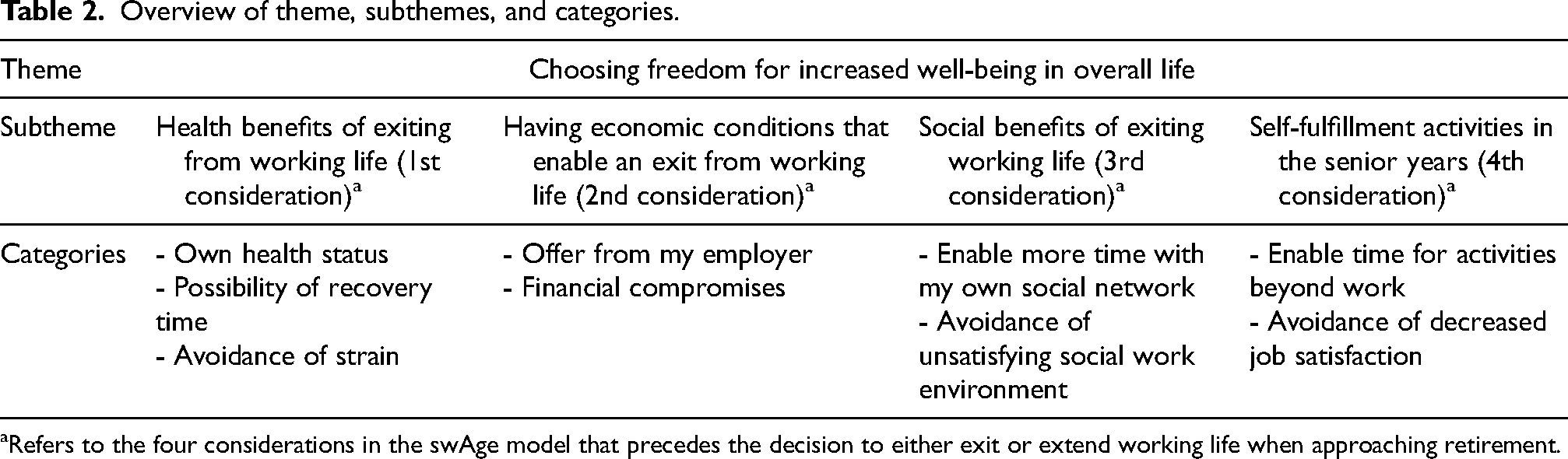
Overview of theme, subthemes, and categories.
aRefers to the four considerations in the swAge model that precedes the decision to either exit or extend working life when approaching retirement.
Considerations over how the participants’ health would benefit from an early exit from working life were among the antecedents of and experiences with ending working life before the expected retirement age. This was partly based on the participants’ experiences with health problems and their possibilities for recovery, as well as the possible health benefits won through the avoidance of physical and mental strain experienced in working life.
The participants’ problems related to their diagnosed diseases were one of the reasons for an early exit from working life. Pain problems related to musculoskeletal diseases, e.g., osteoarthritis, rheumatism, and fibromyalgia are an example of this. The pain problems could also make the working situation more difficult when e.g., pain made it difficult to just get to work or manage physical activities required at work such as climbing stairs. Cardiovascular disease and the health problems associated with it were also described as contributing reasons for wanting to end working life early.
I have rheumatism, but I then even got something wrong with my heart, it is mainly my heart that gives me problems, and I must take medicine for that. That was one reason I quit, yes if I hadn’t had something wrong with my heart, then I probably would have worked a lot longer, I think so (I.6).
A lack of recovery time was another aspect that strengthened the decision to exit working life early due to ill health. The participants described how after work it was difficult to have the time and energy for self-care activities that could improve their underlying diseases or promote better health. The participants had been encouraged to take part in self-care activities such as exercise e.g., aquatic fitness classes and arthritis exercise programs.
I would work and then I’d come home. The doctors thought I should exercise because of my arthritis, but I didn’t have it in me because I had so much pain when I got home, so no, there was like no place in my day for that (I.8).
There were described experiences when, even though they were approved to leave work to participate in rehabilitative activities, they did not, because they did not want to leave their work colleagues with additional workloads.
Stress related to the work environment that the participants described as contributing to the deterioration of their health, was due to a high workload that led to e.g., sleep difficulties or anxiety outside working hours. Other experiences from work-life situations that contributed to illness were when for example, severely high blood pressure developed after some years of enduring an extremely high workload. Negative experiences at the workplace, such as feelings of abusive discrimination and changed working conditions, contributed to clinically diagnosed severe depression and the distress associated with it. Furthermore, it was described how daily destructive alcohol consumption was used to cope with the negative working life situation.
One of my survival strategies was to drink alcohol, and I drank a lot. I didn’t think it was a problem at the time, but when I look back, I understand that I was self-medicating with alcohol. I drank every day, to sort of ease the stress and unwind (I.9).
Having economic conditions that enable an early exit from working life
Considerations over their economic situation and the ability to manage an exit from paid employment were among the antecedents of exiting working life before the expected retirement age. Considerations could include favorable retirement plans or offers from their employers, a previously well-constructed personal pension plan, or the decision that it was worth it for their overall well-being to adjust to a new standard of living based on tighter finances.
A reason for choosing an early exit from working life was the experience of having a favorable retirement plan or offer that made it possible to withdraw from working life without any tangible financial consequences to their private economy, i.e., there would not be a significant financial difference for the participant if they chose to work until the expected retirement age of 65. This could be due to a rather good employer retirement plan, but also favorable early retirement offers in connection with redundancy in the organization.
I was offered severance pay of sorts, they were making cutbacks in the organization, so everyone who was born in or before 1957 was offered this deal to go home early. I said yes, I was 63 years old then. For me, there really wasn’t much to think about (I.2).
Participants described how they had done research and planning regarding their private financial situation in the event of a possible early exit from working life, which was sometimes accomplished with the help of a financial adviser at their bank or counseling at the Swedish pension authority. Participants described that they were willing to prioritize their well-being even though their personal finances would be significantly impaired by an early exit from working life. Before they made the decision to exit working life early, they prepared for the compromises they would have to make e.g., canceling unnecessary subscriptions or opting to no longer own a car.
I thought about what I would get with my pension, but then I thought, no what the heck, I’m not healthy. Had I been, I probably would have continued to work for my economy’s sake. But no, now it is the way it is, so I went two years early (I.13).
Social benefits with an early exit from working life
Considerations regarding the social benefits of leaving working life were also among the antecedents of and experiences with exiting working life before the expected retirement age. The participants described how the exit from working life would enable more time to be spent within their social network. When a decreased social context was experienced at work, participants described how it did not much matter that they lost the social benefits the workplace offered.
One of the reasons why the participants chose to exit from working life before the expected retirement age was to have a greater possibility to arrange their own time, which was described as a feeling of freedom. The participants described that when they were working, they had a rather limited amount of time to take part in social contexts outside of work. They were longing to have more time to spend on leisure activities, as well as family and friends. Participants described how the exit from working life, which enabled more time within their own social network, also increased their well-being.
I like to ski, play golf, ride bikes and things like that. My wife and I do that together. Now that I’m retired, I can pursue my hobbies to a greater extent, and that is wonderful. It is fantastic to be able to go out and play golf with my friend when it is nice weather. It is great. It’s a feeling of freedom that is hard for a person to grasp beforehand (1.14).
Having a partner who was already retired, was also an antecedent of the decision to exit from working life. Participants said that if they had not had a partner, they probably would have preferred to continue to work. Having more time for the family and spending time with children and grandchildren was pointed out as a motivating aspect for an early exit from working life. Having care responsibilities for ill or disabled relatives contributed to the decision to exit working life. Participants perceived the combination of care activities and work as stressful since there was not enough time to support their relatives and stay active in the workforce. Exiting working life was socially beneficial since it enabled more time for their obligations to their relatives, and therefore contributed to the participants’ own overall well-being.
The social benefits of exiting working life were enhanced if the opportunity for social inclusion in the workplace was perceived to be limited. An example is when many of the participant’s former coworkers had quit or retired and the social community with the new coworkers was considered insufficient. There could be an atmosphere of stiffness and impersonality, which led to little association other than professionalism with the other coworkers.
Those co-workers I’ve worked with the longest have quit. I didn’t have so much in common with the new ones that started. It was rather clear that the younger generation is not interested in us old folk (I.11).
Additionally, a lack of opportunities for social inclusion could also depend on the type of work itself e.g., working alone at night made social interactions difficult both privately and professionally.
Enable self-fulfillment activities in senior years
Creating time for self-fulfillment activities during the senior years of one’s life was described as an antecedent of and experience with the early exit from working life. The participants described how, after a long working life, they wanted to have time for activities beyond work and/or their earlier job satisfaction had decreased.
The participants described experiences they had from a long working life of e.g., 40 years with the same occupation/profession. They said that they felt it was time to relinquish their job and were satisfied with their contribution to their occupation/profession. An example of this is when participants described their experience of always having a great commitment and dedication to work, that work took up a great deal of time in their lives, and that they were longing for the opportunity to fill their lives with meaningful non-job-related activities.
But at the same time, I feel I’ve worked over 40 years and so I can feel that now I can allow myself to live a little and enjoy these last years and do things ... And ... yes. I feel like it has been enough for me now, actually (I.1).
One of the reasons the participants chose an early exit from their working life, was that they wanted to make time for meaningful activities besides work while their health was still maintained. This decision was also supported by the fact that they had family members or acquaintances who were afflicted by a debilitating illness or had died. They explained that life was fragile and that no one really knows when it will end, or for how long one’s health will allow one to take part in and enjoy self-fulfillment activities after they have exited the workplace.
Having the opportunity for self-fulfilling activities during their senior years was an argument for exiting working life, and it was further strengthened if the participants felt that their job satisfaction had decreased based on changes in the working conditions. Participants described how their tasks at work had changed due to e.g., digitalization, which was something they were not much interested in and was an aspect that decreased their original job satisfaction. Participants who were employed in the service sector experienced an extended focus on administration. The new tasks involved could be experienced as stressful, which diminished the enjoyment their work gave them. Participants have also experienced that their employer’s conception of what good job performance is has changed, which was also described as one of the reasons for exiting working life. Reorganizations aimed to make work more effective or improve working conditions were perceived as a stressor that reduced job satisfaction. Experiences from resource-saving measures were described as leading to conditions where employees could not do a good job, and this had a negative influence on job satisfaction.
I have always been passionate about my job, it has gone well for me, with good salary increases and relationships with my managers, but I felt that it wasn’t possible to achieve the goals that we work towards anymore. We don’t have the necessary conditions; I really can’t work like that (I.3).
Discussion
Main findings
This study aimed to explore the antecedents of and experiences with a voluntary exit from working life before the expected retirement age of 65 in Sweden. The sub-themes reflected the four considerations that precede the decision behind retirement timing according to the theoretical swAge model. The subthemes were: Health benefits with an early exit from working life, Having economic conditions that enable an early exit from working life, Social benefits with an early exit from working life, and Self-fulfillment activities during the senior years. Choosing freedom for increased well-being in one’s overall life was the overarching theme interpreted from the sub-themes.
The participants included in this study decided to voluntarily exit from working life, however, some of the participants described how this decision was closely linked to their health limitations or a change in their work conditions that caused a deterioration in the participant’s health and/or diminished the participants’ job satisfaction. Research, in a Swedish context, has shown that the changes in the regulations regarding disability pensions seem to have contributed to an overall decrease in the proportion of individuals receiving sickness benefits and disability pensions, while at the same time, the proportion of individuals taking early retirement increased [30, 31]. Previous results have shown that people approaching the expected retirement age might feel pushed to a voluntary exit from working life due to health and/or work-related issues. However, the participants in our study described a combination of antecedents, where both pulling and pushing aspects were involved in their decision to make an early exit from working life.
The first consideration regarding the participants’ decision to exit from working life was based on increased opportunities for health and well-being. An example of this is when participants desired more time for self-care activities, which would help them manage their musculoskeletal disorders, but they needed more recovery time than after-work hours could provide. This is in line with a Dutch study that included workers aged 45–59 where it was revealed that an elevated need for recovery was associated with a higher overall risk of an early exit from working life [32]. Our results also revealed how experiences from working life were seen to lead to the deterioration of the participants’ health, and therefore pushed them towards an early exit from working life. A current report highlighted that 32% of the employed population in Sweden had health-related problems because of work, which were mainly due to strenuous working conditions [33]. Previous research has also concluded that deficiencies in the work environment seem to be a threat to public health and the inability to work until age 65 [6]. On the other hand, previous research has also shown that working life can also contribute to feelings of vitality, which is the innermost dimension of health [34, 35]. This can be seen among workers who are approaching the expected retirement age [34] as well as among workers still active in working life after the expected retirement age [35]. Our results also revealed that strenuous working conditions contributed to the decision to exit early from working life, which was considered to increase the participants’ well-being overall in life. Earlier research has suggested that generally, there is a persistent association between occupation and health and further that workplace conditions may increase health inequalities if workers with initially low socioeconomic status choose harmful occupations [36]. This is a debated issue since pension reforms that aim to increase the public sector retirement age, ignore the heterogeneous circumstances of being able to extend working life into older ages [37].
Economic conditions that enable an early exit from working life were, in our study, described with a great amount of variation. There were early retirement offers given by the employer where the participants were pulled towards an early exit from working life, and there were compromises and adjustments regarding a standard of living based on diminished finances. Recent qualitative research has shown that ambulance personnel, despite a decrease in pension for every year they retired early, preferred to exit their employment well in advance of the statutory retirement age [23]. Earlier research has also pointed out that the new pension systems, with an increased statutory retirement age, increase the risk of extended inequalities among older aged persons. This could also extend the economic gap between those who can prolong their working life beyond the expected retirement age and those who might feel pushed to exit from working life despite the increased risk of economic problems in the future [38].
Our results have revealed experiences where the participants were encouraged by the employer to take an early exit from working life due to redundancy among the workforce in the organization. These workers may not have felt pushed out from working life but rather pulled out with a lucrative early retirement offer. This highlights the fact that the public sector pension systems and other reforms aimed to raise the statutory retirement age and promote active aging [39], are not always in harmony with the employer’s needs and priorities [40].
Our results showed that the decision to take an early exit from working life was described as a desire to enable more time within one’s social network. This has also been the case in previous research where, for example, older workers were attracted to an early exit from working life by the prospect of being able to spend more time with their grandchildren [13]. Greater opportunities to work part-time may contribute to the creation of better conditions and possibilities to remain in working life, which are more in line with the abilities and desires of older workers [10]. Our results also revealed that the decision to make an early exit from working life was preceded by a longing to create an opportunity for self-fulfilling activities outside of work. This decision was further strengthened if the participants felt that their job satisfaction had decreased due to changes made in their work conditions. It has been suggested that a change in attitude by society is needed, in which demands are lowered and it is acceptable to not always perform fully at all levels [10]. However, our results also revealed that despite maintaining job satisfaction, the participants were longing for more time to pursue meaningful and self-fulfillment activities beyond work. This is in line with previous research regarding the views of retired females who had worked within higher professional occupations. The females told how they identified postretirement life as the time of greatest well-being, and that they enjoyed a greater balance between life domains and time to pursue other interests [41].
Implications for practice
The findings highlight subjective descriptions regarding antecedents of a voluntary exit from working life before the expected retirement age. Regardless of an ongoing trend to postpone an exit from working life, there are also tendencies exhibiting an increase in voluntary early withdrawal from working life. An ongoing successive increase in the statutory retirement age craves a greater focus on the creation of a sustainable working life for older people that better enables them to remain active in working life. Policymakers need to meet and accommodate the diversity within the aging population and address the inequalities related to reforms aimed at extending working life and postponing retirement timing. Both governments and employers should prioritize the development of strategies that create a more inclusive and sustainable extended working life in the years ahead. This study’s findings also shed light on how important it is that when, from a public health perspective, the public sector retirement age is raised; society (including the healthcare system) needs to support activities that promote healthy aging in an aging workforce.
Methodological considerations
To facilitate the evaluation of the credibility and the transferability of the findings, we strived to supply a detailed description of the inclusion criteria and the participants’ characteristics [29]. A weakness of the snowball sampling strategy (also known as chain sampling or network sampling) is that the sample may have been restricted to a narrow network of acquaintances, and this may explain why there was a clear majority of women vs. men in the study group. This also challenges the authenticity of this study since this method decreases the range of different realities in the collection of data [42]. However, the sample consisted of participants with varied characteristics that described varied experiences corresponding to the aim of our study. The snowball sampling may also have contributed to the fact that no informant refused to participate. To achieve dependability regarding the method used to gather the data, all interviews were conducted by the first author, who is a registered nurse and a Ph.D. with previous experience in communication and interviewing in clinical practice and research. The interviewer was not directly acquainted with any of the participants. However, a short introduction to the study from the referring person might have made it easier to establish a trusting relationship between the participant and the interviewer [42]. A possible limitation of this study might be what could be considered too short of time for the interviews. However, the participants with shorter interviews were focused on the aim and contributed in a similar degree to the data gathered from the interviews that had a longer duration. Regarding the amount and quality of data in this study, the authors determined that the data was of sufficient significant variation necessary to answer the aim [29]. However, some of the participants had exited working life five years prior, which may have led to a recall bias. To facilitate the evaluation of the transferability of the findings we also strived to enhance a rich presentation of the analysis process through the quotations in the text and the overview in Appendix 2 [27]. However, the nine examples with quotations in the results, only represent half of the participants. The confirmability would have been strengthened with some more quotations from the other half of the group.
Due to the rich variety of experiences given with early exit from working life, and the similarities found with the four considerations preceding the decision regarding retirement timing, the SwAge model was useful in the interpretation and re-contextualization of our data. The abductive approach also enabled us to integrate “the surface” of the four considerations in the SwAge model with the “deeper structures” of “what” the participants experienced [29]. Furthermore, the categories and sub-themes covered the data, and no relevant meaning units had to be excluded. One limitation in qualitative content analysis is that a text likely involves multiple meanings, and the presumption is that there is always some level of interpretation when approaching the text [27]. The advantage of an abductive approach is that it increases the transparency of the presumptions and interpretations of the text, which would also facilitate an assessment of the credibility of the analysis process. Every member of the research group has previous experience in quantitative research methods as well as in research that emphasizes aging and health. By providing representative quotations, the findings are easier to assess concerning credibility and authenticity [29]. Additionally, the COREQ (COnsolidated criteria for REporting Qualitative research) Checklist was used as a tool to assess the items to be included in reports of qualitative studies.
Conclusions
This study aimed to gain a deeper understanding of the subjective experiences with and antecedents of a voluntary exit from working life before the expected retirement age. The results provided insight into the complexity of the different considerations that have a combination of antecedents with both pulling and pushing aspects involved in the decision to exit working life early. Although the decision to make an early exit from working life was considered voluntary and was not due to a disability pension or unemployment, it could be closely linked to deteriorated health in combination with strenuous work. Those circumstances “pushed” the participants to an early exit from working life. The social benefits of exiting working life, as well as a longing to have more space and time for meaningful activities beyond work, were described as attractive incitements that “pulled” the participants towards an early exit from working life.
Supplementary Material
Footnotes

Ethics statement
Initially, the research proposal was submitted to and approved by the Swedish Ethical Review Authority (Dnr 2021-04236).
Informed consent
Before the data collection started, written informed consent was required and collected from all individuals who participated as informants in the study.
Conflict of interest
No potential conflict of interest was reported by the author(s).
Funding
This work was not supported by any funding.