




Abstract
BACKGROUND:
Fear of losing psychological resources can lead to stress, impacting psychological health and behavioral outcomes like burnout, absenteeism, service sabotage, and turnover.
OBJECTIVE:
The study examined the impact of job stressors (time pressure, role ambiguity, role conflict) on employee well-being and turnover intentions. The study also investigated the mediating role of employee well-being between job stressors and turnover intention based on the conservation of resources (COR) theory.
METHODS:
Data from 396 IT executives in Malaysian IT firms were analyzed using the Partial Least Squares - Structural Equation Modeling (PLS-SEM) technique.
RESULTS:
Results confirmed a significant negative correlation between time pressure (–0.296), role ambiguity (–0.423), role conflict (–0.104), and employee well-being. Similarly, employee well-being showed a significant negative relationship with turnover intentions (–0.410). The mediation analysis revealed that employee well-being mediates the relationship between time pressure (0.121), role ambiguity (0.173), role conflict (0.043), and turnover intentions.
CONCLUSION:
This paper aims to manifest the importance of designing employee well-being policies by firms to retain employees. Findings reflect the role of the managerial approach towards ensuring employee well-being for employee retention, thereby reducing recruitment and re-training costs.
Introduction
The rapidly evolving IT industry faces uncertainty related to the business environment, technological changes, remote work, and talent shortage [1]. Considering the global war for talent, organizations need to compete to retain their talent, or else they have to bear high employee turnover [2]. Retaining professionals in the IT industry has been a prevalent issue as attracting, developing, and retaining qualified professionals is costly, and employee turnover is a potential loss for any organization [3]. Although voluntary turnover has decreased, given the COVID-19 pandemic, Employee Movement and Retention report (2021) notes that 61% of Malaysian workers intend to leave their current job seeking new ones [4]. Turnover intention is “the reported willingness of an employee to leave the organization within a given period” [5]. The intention to leave may arise due to various reasons (dissatisfaction, role ambiguity, low level of engagement at work, poor supervisory support, etc.) [6, 7]. According to Zainal et al. [8], the reasons associated with employee turnover often relate to work-related stressors; however, the explanatory mechanism for the stressor-turnover intention link among IT workers’ demands further scholarly attention [9].
Past studies measured employee well-being using scales of life satisfaction, job satisfaction, work engagement, and work-life balance [10]; however, none of them have specifically focused on the broader sense of employee well-being (EWB) [11]. EWB is a multidimensional construct comprising life well-being (LWB), work well-being (WWB), and psychological well-being (PWB). LWB covers employees’ emotions and family-related issues. WWB entails job-related elements, for instance, management style, compensation and benefits, work arrangements, and labor protection. Lastly, PWB emphasizes self-actualization, learning, growth, and work achievement [11]. Overall, our study examines the effects of job stressors (time pressure, role ambiguity, role conflict) on employee well-being and turnover intention among IT employees based on the principle of resource loss. Additionally, this study examines the mediating role of employee well-being between job stressors and turnover intention while using COR theory’s second tenet (resource investment) [12], especially in the context of Malaysian IT executives working in software companies.
The COR theory states that people strive for and protect the resources they value [13]. Stress has remained a notable factor in COR-related studies [13, 14]. When people fear losing psychological resources, they are prone to experiencing stress, with implications for their psychological health or behavioral outcomes such as burnout, absenteeism, service sabotage, turnover, etc. This study considers the job stressors of time pressure, role ambiguity, and role conflict, which negatively affect the well-being of IT executives. Under constant time pressures and workloads, employees experience resource loss in the form of exhaustion and burnout [15]. Such events may also affect employees’ health, increasing the risk of developing illness [16]. Previous studies also reported a negative association between time pressure and job satisfaction and a positive association between time pressure and fatigue [17]. Gärling et al. [18] and Huhtala et al. [19] also found a negative relationship between time pressure and employee well-being.
Role ambiguity arises due to unclear job-related information regarding job responsibilities and work goals [20]. Employees facing role ambiguity may misidentify their responsibilities and what is expected from them, resulting in poor performance and high levels of stress [21]. According to the COR principle, employees facing role ambiguity will use their cognitive resources to deal with it, which results in emotional exhaustion and reduced well-being [22]. Studies by Barling et al. and Pecino et al. [21, 23] also reported a negative association between role ambiguity and employee well-being. Role conflicts are incompatible demands faced by employees at work [21]. Role conflicts in terms of pressure to perform tasks other than job requirements lead to anxiety and fatigue [24]. According to COR theory, role conflicts result in resource depletion as they are an additional burden on the employees, negatively affecting their well-being and performance [25]. A study by Nambisan et al. [26] found a positive association between role conflicts and stress.
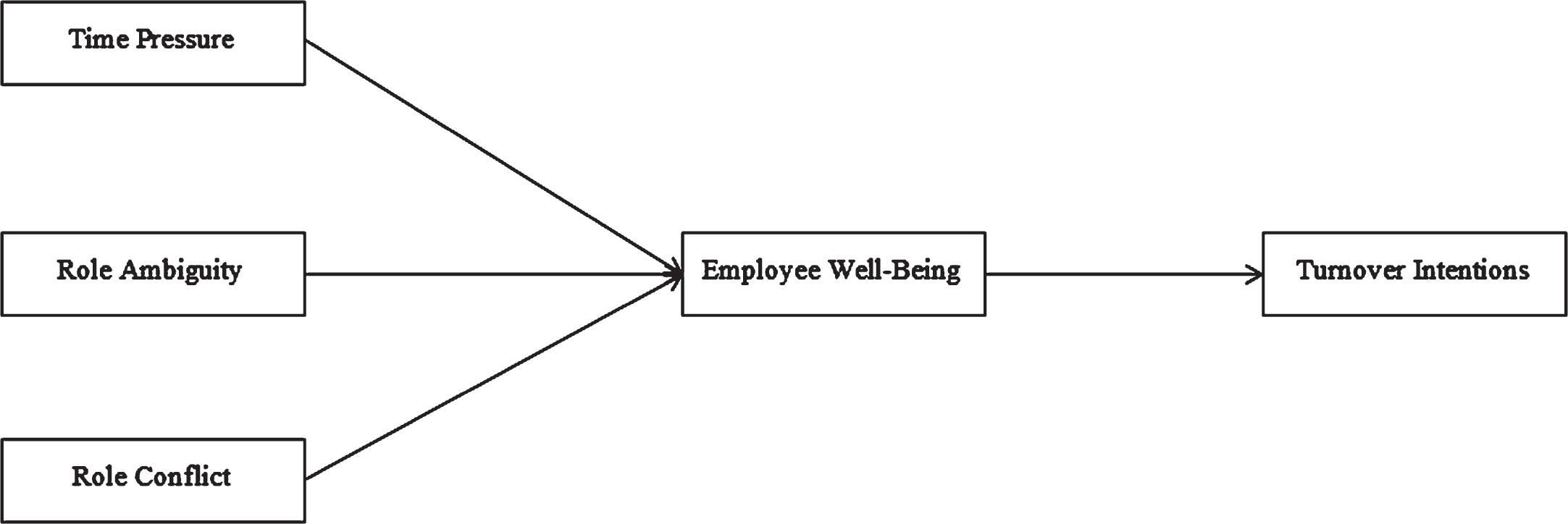
Theoretical framework.
Consequently, resource loss drives turnover intentions [27]. When IT executives work under conditions of time pressure, role ambiguity, and role conflict, they are likely to experience impaired well-being in terms of life well-being (LWB), work well-being (WWB), and psychological well-being (PWB). Wang et al. [28] argued that stressors at the workplace results in resource loss, reducing employee well-being and triggering turnover intentions. In this situation, an individual will avoid further resource loss and start searching for alternative employment, which forms the core of turnover intentions. Belkin et al. [29] and Xue et al. [30] also noted that well-being reduces turnover intentions of employees. According to Halbesleben et al. [31], another principle of the COR theory is termed resource investment, covered only in a few studies. With resource investment, scholars note that individuals invest in building their resources to save against resource loss and expand the resources [13]. The present study also intends to apply the resource investment principle through employee well-being to examine its mediating role between job stressors and turnover intention to protect IT executives from the resource loss they had due to the job stressors.
The rationale for studying the mediating role of employee well-being is, first, that employee well-being is a primary resource that can have reciprocal effects on work-related outcomes [32], such as turnover intention. Second, the COR theory proposes that a lost resource can be reserved by another resource [13]. On this basis, this study aims to study the role of employee well-being to protect the resource loss faced by employees due to job stressors such as role ambiguity and role conflict. Thirdly, prior studies have discussed that employee well-being is an essential factor that works as a retention strategy for any organization [33, 34]. Studies show that well-being is essential for positive work behaviors such as high job performance, whereas reduced well-being associated with job insecurity explains turnover intentions [35]. Wright et al. [36] and Xue et al. [30] also noted that employee well-being helps reduce employee turnover.
H1: Time pressure is negatively related to employee well-being
H2: Role ambiguity is negatively related to employee well-being
H3: Role conflict is negatively related to employee well-being
H4: Employee well-being is negatively related to turnover intention
H5: Employee well-being mediates the relationship between time pressure and turnover intention
H6: Employee well-being mediates the relationship between role ambiguity and turnover intention
H7: Employee well-being mediates the relationship between role conflict and turnover intention
Methods
Study design
This is a cross-sectional study.
Procedure and participants
This paper uses a multi-stage sampling method, enabling sample selection in stages [37] to collect data from IT executives in Malaysia’s ICT sector. According to Department of Statistics Malaysia, it is one of the fastest-growing industries in Malaysia with a growth rate of 10.4% in 2022 [38] and will continue to be among top-five paying industry [39]. The data were collected through self-administered surveys, distributed among 600 respondents in 40 companies (a minimum of 10 IT executives in each). Companies selected for this study were registered in PIKOM, The National Tech Association of Malaysia. The random selection was made based on weightage (55 companies from Kuala Lumpur and assigned 20% weightage to each state company) (55×20% = 11 companies from Kuala Lumpur, 10 Cyberjaya, 7 Selangor, 6 Penang, and 6 Perak). The selected companies were located in Kuala Lumpur, Selangor, and Putrajaya- representing 66% of the organizations [39]. The questionnaires were distributed from February to May 2021. From 600 questionnaires distributed, we received 396 complete surveys. All respondents have voluntarily contributed and given consent of participation. The final sample size was n = 383, IT executives. We analyzed non-response bias by comparing the early and later responses using t-tests [40]. The analysis indicates a non-significant difference indicating, no evidence of non-response bias [40].
Demographic profile of respondents
The demographic profile of the respondents is depicted in Table 1, where males represent (53%) and females (47%) of the study population. Respondents’ age falls between (25–30) and (31–35) representing 41.9% and 30.3%, respectively. Majority of the respondents hold a bachelor’s degree (60.3%), followed by master’s degree (21.7%), diploma holders (19.4%), and lastly, STPM (Sijil Tinggi Persekolahan Malaysia: Malaysian Higher School Certificate) (1.3%). The nature of the job of most respondents was system engineer (24%), programmer (22.5%), web designer (16.4%), and software engineer (15.4%). Most IT executives were single (215), representing 54.3%, while the married (181) showed 47.7%.
Sociodemographic profile of workers
Sociodemographic profile of workers
Independent variables included time pressure, role ambiguity, and role conflict. Time pressure was measured using nine-item scale by Roxburgh et al. [41]. Respondents were asked about their lives over the previous 12 months period. An example of an item is “I never seem to have enough time to get everything done”. Role ambiguity was measured with an established scale comprising five items [42]. An example of role ambiguity item is “Explanation is not clear of what has to be done". Role conflict was measured using seven-item scale by Rizzo et al. [42]. E.g. “I work under incompatible policies and guidelines". The mediating variable, employee well-being, was measured using eighteen-item scale by Zheng et al. [11]. The scale assesses three dimensions of employee well-being: life well-being (LWB), work well-being (WWB), and psychological well-being (PWB). An example of an LWB item is “I feel satisfied with my life.” An example of a WWB item is “I find real enjoyment in my work.” An example of a PWB item is “I handle daily affairs well”. Dependent variable for the study, turnover intention, was measured with five-item scale adopted from Ganesan et al. [43]. E.g. “I do not think I will spend my entire career with this organization”. All the variables for this study were measured using a five-point Likert scale (1 = “strongly disagree” to 5 = “strongly agree”).
Statistical analysis
All statistical analyses were performed using Partial Least Squares - Structural Equation Modeling (PLS-SEM). In SEM, model is divided into: 1) measurement model, and 2) structural model [44].
Results
Measurement model assessment
The measurement model results (Table 2) showed that all items’ loadings in the final model were at or above the accepted threshold of 0.70 [44]. Three items were deleted from the study because of the low factor loading, one from role conflict (RC3) and two from time pressure (TP5, TP7). The values of AVE were higher than 0.50 [45]. The composite reliability (CR) of all the constructs was above the accepted threshold of 0.70, indicating that high internal consistency exists in the scale. Table 3 shows that the Heterotrait-Monotrait ratio of correlations (HTMT) did not exceed the 0.85 threshold [46], thus establishing discriminant validity [47].
Measurement model assessment
Measurement model assessment
Note: RC3, TP5 and TP7 were deleted due to low loadings.
Discriminant validity (HTMT)
Two stages of formative second-order constructs were tested [48]. First-order constructs (LWB, WWB, PWB) of employee well-being were examined through correlations among constructs. Table 4 shows that correlations of employee well-being first order-constructs range from 0.185 to 0.427. The correlation results indicate that employee well-being is a formative second-order construct. A reflective second-order construct shows an extremely high correlation among its lower-order constructs (≥0.8) [49]. Furthermore, the variance inflation factor (VIF) for the first-order construct of employee well-being was analyzed to evaluate multi-collinearity [49]. As depicted in Table 4, the values of VIF for first-order constructs are 1.264, 1.070, and 1.237. All three values are under the 3.3 threshold [49], indicating no multi-collinearity concern exists between the first-order constructs of employee well-being. Lastly, the significance of the relationships between employee well-being and its first-order dimensions was found to be significant at 1% [48].
Assessment of measurement model after generating second-order constructs
Assessment of measurement model after generating second-order constructs
The goodness of fit (GoF) index is recommended by Tenenhaus et al. [50]. The following threshold values are used to assess the (GoF) results in SmartPLS: small (0.10), medium (0.25), and large (0.35) [50]. The results of GoF predict how well data fit the proposed model. Additionally, Henseler et al. [51] recommended using the standardized root mean square residual (SRMR) for the model fit criterion. The SRMR value of (0) generally shows a perfect model fit, while less than (0.08) is considered acceptable for PLS models. The SRMR value in this study is (0.066), which indicates an adequate model fit.
Structural model assessment
The viability of the structural model is assessed by R2, path coefficients (beta values), and the t-values. A bootstrapping method was applied to determine the t-values to confirm the statistical significance [44]. In addition to these basic measures, researchers also reported the effect sizes (f2) and predictive relevance (Q2) [45].
In this paper, we first analyze the relationship of job stressors (time pressure, role ambiguity, role conflict) on employee well-being and turnover intention. Secondly, we analyze the mediating relationship of employee well-being between job stressors and turnover intention. The first, second, and third hypothesis of this study is supported. Time pressure (β= –0.296, p < 0.01), role ambiguity (β= –0.423, p < 0.01), and role conflict (β= –0.104, p < 0.01) are negatively and significantly related to employee well-being. Employee well-being showed a negative relationship to turnover intention (β= –0.410, p < 0.01) and explains 43% and 16.8% of the variance in employee well-being and turnover intention, respectively. Thus, supporting H4. The R2 value of employee well-being is greater than the value of 0.35, as Henseler et al. [52] suggested, indicating a strong model, while the turnover intention R2 value is less than 0.25, indicating a moderate model. We also evaluated the effect sizes (f2), as emphasized by Hair et al. [44], “While a P-value can inform the reader whether an effect exists, the P-value will not reveal the size of the effect, while reporting and interpreting studies, both the substantive significance (effect size) and statistical significance (P-value) are essential results to be reported”.
To assess the effect size, the threshold values recommended by Henseler et al. [52], which are 0.02, 0.15, and 0.35, show small, medium, and large effects, respectively. The effect size (f2) values given in Table 5 showed that all the relationships have small and moderate (0.129, 0.264, 0.016, and 0.202) effect sizes, respectively. Moreover, to assess predictive relevance blindfolding technique was employed. The Q2 value should be larger than 0 for a particular endogenous construct [53]. In Table 5, the Q2 values are 0.203 for employee well-being and 0.103 for turnover intention. Thus, this indicates that the predictive relevance of the model is acceptable. As recommended by Preacher et al. [54], a bootstrapping procedure was employed to test the indirect effects of employee well-being between job stressors and turnover intentions. Table 5 presents the results of mediation analysis, where hypothesis H5 (b = 0.129, t = 4.567, p < 0.05), 95% Boot CI: [LL = 0.075, UL = 0.178] shows a significant supported relationship of employee well-being as a mediator between time pressure and turnover intention. Hypothesis H6 (b = 0.173, t = 6.761, p < 0.05), 95% Boot CI: [LL = 0.124, UL = 0.224] indicates a significant supported relationship of employee well-being between role ambiguity and turnover intention. Last hypothesis H7 (b = 0.043, t = 2.331, p < 0.05), 95% Boot CI: [LL = 0.001, UL = 0.073] shows a significant supported relationship of employee well-being between role conflict and turnover intention. Thus, H5, H6, and H7 of mediation were statistically supported.
Structural model assessment
Structural model assessment
Our findings are similar to previous studies demonstrating a negative relationship between time pressure and employee well-being [17, 55]. According to the resource scarcity argument, within-domain work demands such as time pressures limit the ability of employees to manage their non-work domain responsibilities and lead to adverse psychological and behavioral consequences, affecting psychological well-being [56]. The negative relationship between role ambiguity and employee well-being is consistent with the previous studies that show a similar relationship between both constructs. Role ambiguity among IT professionals might result from a lack of role and job information, various work tasks demanding attention, and focus on completing IT work, etc. According to Maden-Eyiusta [57], role ambiguity makes employees uncertain about their roles, job objectives, and associated responsibilities. Role conflict (H7) showed a significant negative impact on employee well-being. The findings are consistent with previous studies showing that role conflict can affect the well-being of employees [25, 26]. Employee well-being negatively predicted turnover intention among Malaysian IT Executives, and results are in line with the previous studies [29, 30].
According to COR theory, if there is an actual resource loss or a perceived threat of resource loss in the workplace environment, employees will not obtain anticipated returns on investment of resources. In such cases, employees are less likely to put energy into their work to prevent further resource loss [58]. Job stressors (time pressure, role ambiguity, role conflict) threaten and deplete resources, leading to emotional exhaustion and negatively affecting employee well-being [23]. Employee well-being in terms of (LWB), (WWB), and (PWB) mediates the relationship between job stressors and turnover intention among Malaysian IT executives. Low employee well-being precedes turnover intentions, and job stressors precede employee well-being. The results provide empirical evidence for the relationship between job stressors and turnover intentions explained by reduced employee well-being. The findings are consistent with the COR theory, predicting that well-being is a beneficial resource, the loss of which could trigger other resource loss cycles. According to Hobfoll et al. [13], the second principle of COR theory is that people must invest resources to protect against resource loss and gain resources. COR theory states that the prime human motivation is the maintenance and accumulation of resources [31].
Additionally, COR theory suggests that to mitigate or eliminate negative stress responses, an individual is intuitively motivated to protect, retain, and recover these valued resources [59]. According to Siu et al. [60], offsetting the actual loss require people to strive and acquire additional resources. Thus, an employee with job stressors will seek to avoid further resource losses by redirecting the remaining energy towards thinking about alternative employment, which forms the core of turnover intentions. Therefore, when considering a job search, an employee is not only trying to compensate for present job stressors but also directing remaining psychological energy toward weighing up job alternatives. In this case, employee well-being is a resource investment in terms of LWB, WWB, and PWB. Mauno et al. [61] also found the mediating effect of well-being in the job insecurity-turnover intentions relationship. They reported partial mediation of occupational well-being between job insecurity and turnover intention. Another study by Van Der Vaart et al. [34] found the mediating role of employee well-being between psychological contracts and employees’ intention to leave. Earlier studies have shown that employee well-being is among the key factors that work as a retention strategy for any organization [33, 34], while other studies reported employee well-being to be a strong predictor of employee retention [36, 62]. Few other studies have found that employee well-being helps reduce turnover [34, 36]. Therefore, this study includes employee well-being as a mediator because it is a resource that further helps IT executives to mitigate the stressors and turnover intention.
Contributions
There is a lack of research concerning the mediating role of employee well-being between job stressors (time pressure, role ambiguity, role conflict) and turnover intentions. Thus, the present study investigates the mediating effect of employee well-being (LWB, WWB, PWB) for job stressors and turnover intention relationship. Our findings add to existing literature by providing empirical evidence of employee well-being as a mediator between job stressors and turnover intention of IT executives in Malaysia. This study also used employee well-being as a reflective-formative construct based on our findings, provided in Table 3. The correlation results indicate that employee well-being is a formative second-order construct. A reflective second-order construct shows an extremely high correlation among its lower-order constructs (≥0.8) [49]. The previous study used employee well-being as a reflective-reflective construct, but after analysis, the findings showed that employee well-being is a reflective-formative construct.
Managerial implications
Stressors are critical reasons for employees’ intention to leave an organization. Role conflict and ambiguity need to be addressed by the organization along with the job responsibilities and objectives at the beginning of the job. Defining job responsibilities and objectives among employees will increase their performance [63]. Employees working under tight deadlines experience pressure which may prevent them from optimally completing their expected work [64]. In this regard, human resource managers need to pay attention to job stressors to minimize the perception of employees’ intention to leave. The results of this study offer factual evidence for HR practitioners to design a well-being oriented program that addresses employees’ life well-being, workplace well-being, and psychological well-being. Employee well-being intervention is in the best interest of employees and employers [65, 66]. Well-being can be accomplished through advocating and providing a formal development environment. Organizations should support employees in the independent pursuit of knowledge for employee growth and development.
Limitations and future research directions
The first limitation of this study was the cross-sectional approach which can be extended to a longitudinal study to better understand the relationship between the well-being of employees as a mediator between role stressors and turnover intention. Secondly, this study collected data from private software companies among IT executives working in Malaysia. Therefore, the results are not generalizable to other industrial sectors. Thirdly, the design of this study could not rule out the effects of common-method bias since all data used in the study were acquired using the same questionnaire. This procedure might have led to common-method bias that might have inflated or deflated the relationships among factors. However, we conducted a Harman single-factor test for common method variance; it showed that less than 23% of the variance was explained by a single factor, suggesting that common method bias may not be problematic [67]. Future studies can add other job stressors (work-family conflict) to confirm the mediation of employee well-being. Future studies may also focus on the relationship between employees’ perceptions regarding the state of the psychological contract and turnover intention and well-being among IT executives in Malaysia.
Conclusion
This study confirms the direct positive relationship between role stressors and turnover intention and the mediating effect of employee well-being for job stressors-turnover intention relationship. This study adds to exiting literature by studying employee well-being as a mediation link between time pressure, role ambiguity, role conflict, and turnover intention. Based on the conservation of resource theory, the findings indicate that employee well-being as a resource can minimize role stressors. Moreover, the intervention in employee well-being could help employers to retain their employees.
Informed consent
A study participation consent was obtained from all participants before the start of the survey. The consent form was attached at the top of the survey.
Conflict of interest
None declared.
Ethical consideration
Not applicable.
Footnotes
Acknowledgments
None to report.
Funding
None to report.