




Abstract
BACKGROUND:
A sense of compassion has a core importance in health service delivery. Research on the psychological impact of being compassionate on healthcare workers is limited.
OBJECTIVE:
This research aims to examine the effect of compassion levels of healthcare workers on their psychological well-being.
METHODS:
This was a cross-sectional and descriptive study. The population of the research consists of health personnel working throughout Ankara, the capital. The study was carried out with 414 healthcare workers. A personal information form, compassion scale and psychological well-being scale were used in the research questionnaire.
RESULTS:
A positive and significant relationship was found between compassion and psychological well-being scores. It was determined that compassion positively affected psychological well-being levels. The level of compassion showed that there was a significant difference between the groups according to the variables of gender, family structure, job satisfaction and whether they would choose the same profession again. The level of psychological well-being was found to be significantly different between the groups in education, job satisfaction and making the same profession choice again.
CONCLUSION:
It is a professional requirement that health professionals in patient care have a sense of compassion and reflect this feeling in their conduct. Research shows that the greater the compassion, the higher the psychological well-being. Therefore, undertaking training initiatives to make healthcare workers more compassionate can contribute to patient care and at the same time to the psychological well-being of healthcare workers.
Keywords
Introduction
Compassion is defined as “the sensitivity shown in order to understand another person’s suffering, combined with a willingness to help and to promote the wellbeing of that person, in order to find a solution to their situation” [1]. Accordingly, compassion means understanding the pain of others or the troubled process they are experiencing and being willing to be involved in the effort to reduce this pain [2]. It is stated that being compassionate towards others and maintaining this behavior is a reflection of increasing psychological well-being [3]. Accordingly, compassionate behavior contributes to psychological well-being.
Psychological well-being refers to “the realization of human potential and a meaningful life” [4]. Although this concept is simply defined as a feeling of happiness and good life, it describes more than satisfaction and pleasure. Therefore, it is important in terms of expressing that true happiness and virtue can be found by doing things worth doing in life [5]. Psychological well-being includes positive features such as autonomy, self-esteem, subjective well-being, independence, forgiveness, establishing close relationships with people and productivity [6, 7]. Although different conceptualizations of well-being have been made in psychological research, there are two approaches in this field. These are expressed as subjective well-being [8] and psychological well-being [9]. By analyzing the factorial structure behind subjective and psychological well-being, a strong and general factor including the common ground of these two concepts was found. After the general well-being factor was partially removed, it was stated that both concepts should be analyzed separately, but acknowledging the fact that they also have aspects in common [4]. In this context, in a study aimed at examining the predictive effect of university students’ compassion levels on subjective well-being, the findings revealed that there was a positive significant relationship between compassion and subjective well-being scores and that compassion was a significant predictor of subjective well-being [10]. In another study, the effect on self-esteem and happiness was examined over a one-week period of being compassionate towards others. In an online study, participants (n = 719) were recently assigned to a control group that expressed in writing their experiences with a behavior they described as compassion. It was determined that those who act compassionately had continuous gains in happiness and self-esteem [11].
Studies showed that compassionate behavior led to a decrease in depressive symptoms [12, 13], was beneficial in terms of social support, [14, 15] and increased self-esteem [16]. It was also suggested that positive mood was seen in people who showed compassionate behavior [17, 18].
In the field of health care, compassionate behavior is explained as “the service providers consciously trying to get to know their patients, respecting their values and choices, taking them into consideration and communicating with them in a respectful and attentive manner” [19]. Another view in defining compassionate care is expressed as (a) being sensitive to patients’ situations and emotions; (b) listening carefully; (c) involving patients in decision-making; (d) treating them as individuals; (e) respecting patients and their families’ choices and needs; and (f) spending time with patients [20].
Health services, which also function as a care service, require a sense of compassion as a human value and showing the behaviors managed by this feeling. Today, while it is seen that studies on the concept of self-compassion in the field of health services are increasing, studies on the effects of compassion on people who exhibit this behavior are limited and based on past data. In this context, it is thought that this study, which aims to examine the effect of compassion levels of healthcare workers on their psychological well-being levels, will make an important contribution to the field.
Methods
Research model
The model of this research conducted with healthcare workers consists of three variables, namely, sub-dimensions, level of compassion and psychological well-being. The research model is shown in Fig. 1. Within the scope of the research model, the effect of compassion in general and in sub-dimension levels of healthcare workers on psychological well-being was examined.
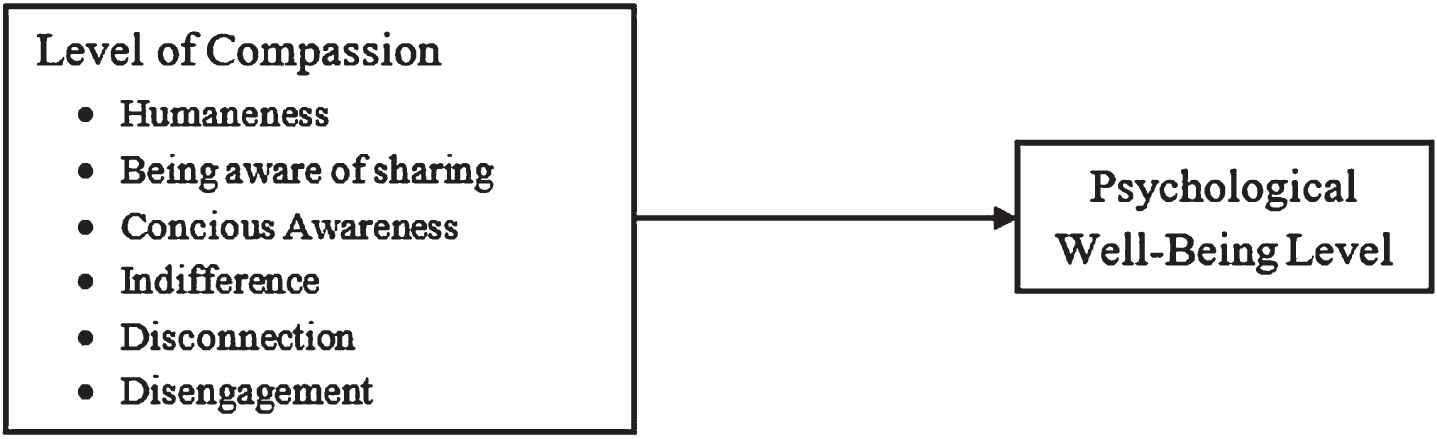
Research model for compassion and psychological well-being.
This cross-sectional study was conducted between 1 July and 21 October 2022. The population of the study consisted of healthcare workers working throughout Ankara. Grouping of the Ministry of Health of the Republic of Turkey was used in the definition of a health worker. Accordingly, the group of healthcare workers includes physicians (specialist, practitioner, assistant), dentist, pharmacist, nurse, midwife, and other healthcare personnel. According to the Ministry of Health’s ‘Health Statistics Yearbook’, the total number of health workers throughout the capital is 76.276 [21]. In calculating the sample size, the formula used was that where the number of people in the population is known. When the number of samples of the study was calculated, the number of samples was found to be 382 where the degree of freedom of t was 1.96, the level of reliability was 95% and the sample margin of error was 0.05. A simple random sampling method was used in the study and 15% was predicted as the rate of not receiving the expected response while reaching the sample. The formula ny = n/(1-response failure rate) was used to calculate the number of samples to be reached by using the non-response rate. Accordingly, the number of samples was re-determined as 449≅450. A total of 450 questionnaires were delivered to official professional communities operating in Ankara province, where healthcare workers were present, and a minimum of 15 days was given to volunteers to respond. After checking the questionnaires collected from the field, it was determined that 36 scales were not suitable for analysis, so the study was completed with 414 data registration forms.
Instrumentation
The questionnaire designed to collect research data consisted of three parts. It was aimed at collecting socio-demographic data with the ‘Personal Information Form’ in the first section. The form included questions to determine variables such as age, gender, marital status, family structure, job satisfaction, and making the same profession choice again. In the second part [22], the ‘Compassion Scale’, developed by Pommier in 2011 and adapted into Turkish by Akdeniz ve Deniz, was used to measure the level of compassion [23]. The scale consists of six sub-dimensions: humaneness, indifference, being aware of sharing, disconnection, conscious awareness and disengagement. The response system is in the form of a five-point Likert scale for each statement as ‘(5) Always, (4) Frequently, (3) Occasionally, (2) Rarely, and (1) Never’. A score of 24-120 is obtained from the scale. The increase in the score obtained from the scale indicates that the level of compassion is high. In this study, the Cronbach Alpha reliability co-efficient was determined as 0.90 for the total of the scale. In the third part, the ‘Psychological Well-Being’ scale developed [9] by Ryff, and the reliability of which was conducted by İmamoğlu in 2004, was used to measure the level of psychological well-being. The lowest score is 10 whereas the highest score is 60. In the five-point Likert scale, psychological well-being increases as the scores increase. In İmamoğlu’s study, Cronbach Alpha was calculated as 0.77 for the total of the scale [24].
Ethical considerations
This study was carried out in accordance with the Declaration of Helsinki. Necessary permissions were obtained from the Social and Human Sciences Research Board of Başkent University (Date: 01.07.2020, Number: 62310889.605.99-140850) for the research. In addition, usage permissions for both scales were obtained via e-mail. In the content of the study questionnaire, there was an approval section indicating the purpose of the study, the nature of the questionnaire, voluntary participation, a confidentiality statement and guarantee of anonymity. Participation in the study was based on voluntary involvement.
Data analysis
The data were evaluated by the researchers. The data obtained were transferred to the SPSS version 25.0 statistical package program and analyzed through statistical techniques suitable for the trials. In the analysis of the data, statistical techniques such as percentage, frequency, t test, ANOVA, post-hoc tests, Pearson correlation and linear and multiple regression analysis were used. The results were tested at a significance level of p < 0.05.
Results
The findings regarding the socio-demographic characteristics of the healthcare workers participating in the study are shown in Table 1.
Numerical and percentage distribution of socio-demographic characteristics of the participants
Numerical and percentage distribution of socio-demographic characteristics of the participants
According to Table 1, 76.6% of the participants were female and 23.4% were male. It was determined that the majority according to age ranges was between 18–30 years (61.6%). When the marital status of the participants was examined, it was determined that 50% of them were single. The majority of the research participants reported that they had a nuclear family structure (84.8%). When the distribution of the participants in terms of educational status was examined, it was seen that undergraduate degree (42.3%) had the highest rate. While the rate of those who are satisfied with the profession covers the vast majority with 70.5%, the rate of those who are not satisfied with the profession is 29.5%. The rate of healthcare workers who answered ‘yes’ to the question of choosing the same profession again was determined as 51.2%.
When the descriptive statistics of the scales were examined, it was determined that the compassion levels of healthcare workers were high (
As seen in Table 2, the aim was to determine whether the compassion and psychological well-being levels of healthcare workers differed according to gender, job satisfaction and making the same choice of profession again. According to the results of the independent sample t-test, it was determined that the difference in compassion levels of the participants (t = 3.722, p = 0.000, p < 0.05) was statistically significant according to their gender. It was found that women (
T-test analysis results of compassion and psychological well-being according to gender, job satisfaction and the same choice of profession again variables
*p < 0.05.
According to the findings shown in Table 2, it was determined that the psychological well-being levels of healthcare workers did not differ significantly according to the gender variable (p = 0.113, p > 0.05). A significant difference was found between the groups according to the findings obtained regarding whether the psychological well-being levels of healthcare workers (t = 3.998, p = 0.000, p < 0.05) differed according to their occupational satisfaction status. It was determined that the psychological well-being levels of healthcare workers who were satisfied with their profession were higher (
In Table 3, the aim was to determine whether the compassion levels of the healthcare workers participating in the study differed according to their age, family structure and education levels. Accordingly, no significant difference was found between the compassion levels of the age (F = 0.725, p = 0.770, p > 0.05) and education level (F = 2.275, p = 0.079, p > 0.05) groups. As a result of the analysis, the difference between the compassion levels of the participants according to their family structure was found to be significant (F = 3.455, p = 0.033, p < 0.05). The compassion levels of healthcare workers with a large family structure (
ANOVA analysis results of compassion and psychological well-being according to age, family structure and education level variables
*p < 0.05.
When Table 3 is examined, no significant difference was found between the age (F = 2.364, p = 0.071, p > 0.05) and family structure (F = 0.232, p = 0.793, p > 0.05) groups regarding their psychological well-being levels. It was seen, however, that there is a significant difference between the groups in terms of psychological well-being levels according to the variable of educational status (F = 2.781, p = 0.041, p < 0.05). It was seen that high school (
The Pearson correlation co-efficient was examined to determine whether there was a significant relationship between the compassion levels of healthcare workers and their psychological well-being levels, and the findings are given in Table 4. According to the results of the correlation analysis, it was determined that there was a statistically significant relationship between compassion levels and psychological well-being levels at 95% confidence level in positive moderate strength (r = 0.431, p = 0.000, p < 0.05).
Correlation table for the relationships between compassion and psychological well-being variables and sub-dimensions
* p < 0.05, ** p < 0.01.
Linear regression analysis was performed to examine the effect of the compassion variable on the psychological well-being variable and the results are shared in Table 5. Accordingly, it was determined that the relationship between compassion and psychological well-being was significant (F = 94.174, p < 0.05, p = 0.000). It was determined that compassion alone explains 18.6% of psychological well-being (R2 = 0.186). It was determined that 81.4% of psychological well-being was explained by variables not included in the model.
Results of linear regression analysis of the effect of compassion on psychological well-being
According to the results of the regression analysis, the regression equation for predicting psychological well-being is given below.
PSYCHOLOGICAL WELL-BEING=38.022 + 0.278*COMPASSION
When compassion was increased by one unit, it was seen that the psychological well-being of the healthcare worker was positively affected by 0.278.
The results of multiple regression analysis of the effect of sub-dimensions of the compassion scale on psychological well-being are given in Table 6. Accordingly, it was determined that the relationship between conscious awareness, indifference and disconnection variables was significant (F = 17.753, p = 0.000, p < 0.05). These three variables explain 19.6% of psychological well-being, but 80.4% of psychological well-being is explained by other variables not included in the model.
Multiple regression analysis results on the effect of sub-dimensions of the compassion scale on psychological well-being
R2 = 0.196; Durbin Watson = 1.967. Independent variables = Compassion, awareness of sharing, conscious awareness, indifference, disconnection, disengagement. Dependent variable = Psychological well-being. F=17.753; p = 0.000.
According to the results of the regression analysis, the regression equation for predicting psychological well-being is given below.
PSYCHOLOGICAL WELL-BEING = 36.325 + 0.277 * CONSCIOUS AWARENESS + 0.145 * INDIFFERENCE + 0.138 * DISCONNECTION
When mindfulness was increased by one unit, it had a positive effect on psychological well-being with a strength of 0.277, when indifference was increased by one unit, it had a positive effect with a strength of 0.145 and when disconnectedness was increased by one unit, it had a positive effect with a strength of 0.138.
This study aimed to examine the effect of compassion levels of healthcare workers on their psychological well-being. A moderate positive relationship was found between the compassion levels of healthcare workers and their psychological well-being scores. In addition, the study found that the compassion levels of healthcare workers had a significant effect on psychological well-being. This result is consistent with studies showing the positive effect of the application of compassion-based activities on mental health [25, 26]. In addition, the results of the research are similar to studies showing that the positive effect of compassionate behaviors positively affects the level of happiness [27–30].
According to the results of the research, it can be thought that the significant effect of compassion on psychological well-being is related to satisfying the feelings of ‘pleasant life’ and ‘meaningful life’ [29], which are the descriptive components of happiness, and contribute positively to a person’s level of happiness. The results of the study seem to be consistent with the [31] studies suggesting that showing compassion to others makes individuals feel positive and valuable in their lives and that this situation can give individuals a sense of meaning and purpose, thus making them feel good.
In the study, it was determined that the ‘compassion’ levels of female participants were higher than those of men. This result of the study is consistent with the results of the study conducted by Sprang et al. with healthcare workers who provide mental health services [32]. It is thought that the difference in the level of compassion of the participants according to their gender is significant because of the higher tendency of women to show compassion due to some gender-specific characteristics.
In the analyses conducted to determine whether the ‘compassion’ levels of the healthcare workers participating in the study differ according to their age, family structure and education levels, no significant difference was found between their age and education levels and their ‘compassion’ levels. Similarly, in a meta-analysis examining the studies conducted with nurses, it was found that there was no difference between the age groups in terms of compassion level [33]. In the study of Arkan et al., it is stated that there is no significant relationship between compassion and age [34]. On the other hand, in a meta-analysis study, it was found that the age of female participants strengthened the relationship between compassion and psychological well-being and the relationship emerged slightly stronger as the age levels of the participants increased [35]. In a study conducted with education groups, no significant difference was found between education levels and compassion levels [36]. Accordingly, the fact that there is no significant difference between age and education levels and ‘compassion’ levels can be based on the assumption that people can prioritize compassion in special areas such as health and education when choosing a profession at an early age. It is thought that starting to work in a sector where a sense of compassion is heavily needed, especially at a young age, and then undergoing further training in the importance of compassion in the sector, as well as supporting all field employees without being subjected to discrimination, prevents significant differences in the groups.
In the study, the compassion levels of healthcare workers with an ‘extended’ family structure were found to be lower than those with ‘nuclear’ and ‘broken’ family structures. It can be thought that emotional deprivation may be more common in nuclear and broken family members, and therefore the likelihood of developing compassion for others may increase. Despite this result, in some studies on compassion, no significant difference was found between family structure and level of compassion [37, 38].
It was determined that there was no significant difference in the ‘psychological well-being’ levels of the participants in the gender, age and family structure groups. In a study, it was found that psychological well-being scores did not differ according to age and gender [39]. This result suggests that the expectation of healthcare professional groups to have robust psychology and strong emotional responses may have ensured that there is no difference between age and gender groups.
A significant difference was found between the groups in terms of the level of psychological well-being of health workers, according to the variable of educational status. It is seen that high school graduates have a lower level of psychological well-being than undergraduates. This finding is not consistent with studies showing that high psychological well-being level is associated with high education level [40–42]. This result may be related to the fact that each of the health profession groups, which includes employees with different educational degrees, receives different levels of health education, provides individuals with expertise that can be sharply distinguished from each other and offers varying opportunities provided by this gain. Expertise in the field of health provides many material and moral gains in the middle and higher steps of the organizational structure of the sector. The difference in the psychological well-being levels of high school graduates and undergraduates may be explained in this context.
Limitations and future research
The main limitation of the study is that the population and the sample are considered as one homogeneous group under the category of healthcare workers. Another limitation is that healthcare workers were included in the sample without distinguishing between the public and private sectors. The study examined the relationship between the two variables and assessed the effect of compassion on psychological well-being. However, this relationship cannot be called a cause-effect relationship and cannot explain causality. The study did not take into account that the level of compassion and psychological well-being may differ among health professionals with different personality traits. New studies can be planned to overcome these limitations. In addition, the effect of compassion on well-being can be studied with other study samples and other variables. Similar studies can be conducted on larger sample groups. For future studies, it may arouse the curiosity of those interested in the subject to address different health professional groups and distinguish between public and private sectors.
Conclusion
Considering the results of this research study, the psychological well-being level of healthcare workers with high levels of compassion was also found to be high. This result relating to the relationship between compassion and psychological well-being can be characterized as an important finding. Based on this finding, studies can be planned to instill a sense of compassion in individuals who work and will work in the field of health services. Such studies can ensure that compassionate behavior helps people working in the field of health services to fulfill their professional responsibility while at the same time making them feel psychologically well themselves.
Ethical considerations
Ethics approval was granted by the Social and Human Sciences Research Board of Başkent University (Approval no. 62310889.605.99-140850).
Informed consent
Informed consent was obtained from all individual participants included in the study.
Conflicts of interest
The authors declare that they have no conflict of interest.
Footnotes
Acknowledgments
We are grateful to the participants who took the time to participate in this study.
Funding
The authors report no funding.