




Abstract
BACKGROUND:
The cockpit of an aircraft is the main place where the pilot controls the aircraft on a mission. An excellent cockpit environment not only ensures the pilot’s basic survival needs but also improves the comfort level and alleviates fatigue when performing missions.
OBJECTIVE:
On the basis of domestic and international airworthiness standards, a top-down refinement method is deployed to determine the initial goal, and the environmental criteria are fully discussed and balanced in a dynamic process to build a comprehensive evaluation system for environmental factors in the aircraft cockpit.
METHODS:
Based on the fuzzy comprehensive evaluation theory, an evaluation model for environmental factors is constructed by combining analytic hierarchical analysis (AHP) and particle swarm optimization (PSO). Then the feasibility of the evaluation model is verified by an illustrative example.
RESULTS:
The results suggest that the light environment gains the highest score among the 4 environmental criteria followed by the thermal environment, while both sound environment and microenvironment have relatively low scores.
CONCLUSION:
As for the 27 environmental sub-criteria, temperature, illumination, lighting clarity, light-color coordination, noise duration and pressure score the highest. The evaluation findings can provide important environmental control criteria for the subsequent environmental control system in the cockpit of the aircraft.
Keywords
Introduction
The cockpit belongs to a special man-environment system because of the particular nature of the job and working environment. For such a special man-environment system, “man” refers to the pilot in the aircraft cab; “environment” refers to the specific operating conditions of the aircraft cab where people and machines coexist, including e.g. noise, illumination and temperature [1]. As the only way of information interaction between the pilot and the aircraft, the cab environment’s comfort level not only has an effect on the pilot’s physical and mental activities but also has a direct impact on one’s work efficiency and the aircraft’s flight safety. At present, domestic and foreign scholars have carried out relevant research on the environmental factors of the aircraft cockpit. For example, scholar Hu Ying by analyzing the temperature, light, ventilation, and noise of the cabin, clarified the influence principle of the cabin environmental factors, upon which the fuzzy mathematics theory is introduced to establish and validate a comprehensive evaluation mathematical model [2]. Hu used a fuzzy comprehensive evaluation method to establish the evaluation model of light environment comfort, and established its relational function according to the various characteristics of different factors [3]. Park investigated the relationship between the local thermal feeling and the overall thermal feeling of passengers in the aircraft cabin [4]. Qu established a human heat regulation based on combined human temperature distribution with cabin thermal environment parameters [5].
Constrained by multiple environmental factors, various environmental indicators are needed to be evaluated comprehensively when assessing the aircraft cockpit. Since the multiple environmental indicators of the aircraft cockpit include both qualitative and quantitative indicators, it is a multi-indicator comprehensive assessment. Therefore, the evaluation method is also integrated with multiple systems. At present, the comprehensive evaluation methods that have been carried out at home and abroad are becoming more complicated, mathematical, and multidisciplinary. The multivariate statistical evaluation method, principal component analysis method [6], cluster analysis [7], fuzzy mathematics comprehensive evaluation method [8], and grey system evaluation method [9–11] have been widely used. In recent years, new comprehensive evaluation methods such as data envelopment analysis (DEA) and artificial neural network (ANN) methods have emerged [12, 13]. In specific research, domestic and foreign scholars have also made relevant exploration. For example, Beijing University of Aeronautics and Astronautics has developed a military aircraft cockpit model and a pilot manikin, studied the modeling of the reachable domain and visual domain of the military aircraft cockpit, designed and analyzed the ergonomic design of the character coding of the display interface, and proposed a comprehensive evaluation index and evaluation method for the adaptability of man-machine control interface [14]. Zhang Hongbin and others established the evaluation index system of helicopter multi aircraft cooperative detection efficiency by using the analytic hierarchy process (AHP) according to the selection principle of efficiency index [15].
In summary, these modern comprehensive evaluation methods have a certain degree of advancement and practicability. However, most can only evaluate qualitative indicators based on the principle of fuzzy transformation and maximum membership because it is difficult to quantify multiple environmental indicators in the aircraft cockpit. Given that the fuzzy comprehensive evaluation method is a comprehensive evaluation method based on fuzzy mathematics theory, it is very suitable for solving vague evaluation problems and non-deterministic problems which are difficult to quantify [16].
Methods
Construction method of multi-environment index evaluation for aircraft cockpit
When it comes to establish a comprehensive evaluation index system for environmental factors in the aircraft cockpit (as shown in Fig. 1), a top-down gradual refinement method is usually used to determine the initial target level, and then gradually refine to finish the complete evaluation index system, so repeated scrutiny and comprehensive balance in the dynamic process [17]. The determination and selection of evaluation indicators are generally carried out by the researchers through the analysis of the various environmental systems of the aircraft to initially determine the evaluation indicators, and then extensively solicit the opinions of design experts and decision-makers in various fields, and carry out iterations, repeated revisions, and continuous improvements. Finally, an evaluation index system for the evaluation problem is established [18].
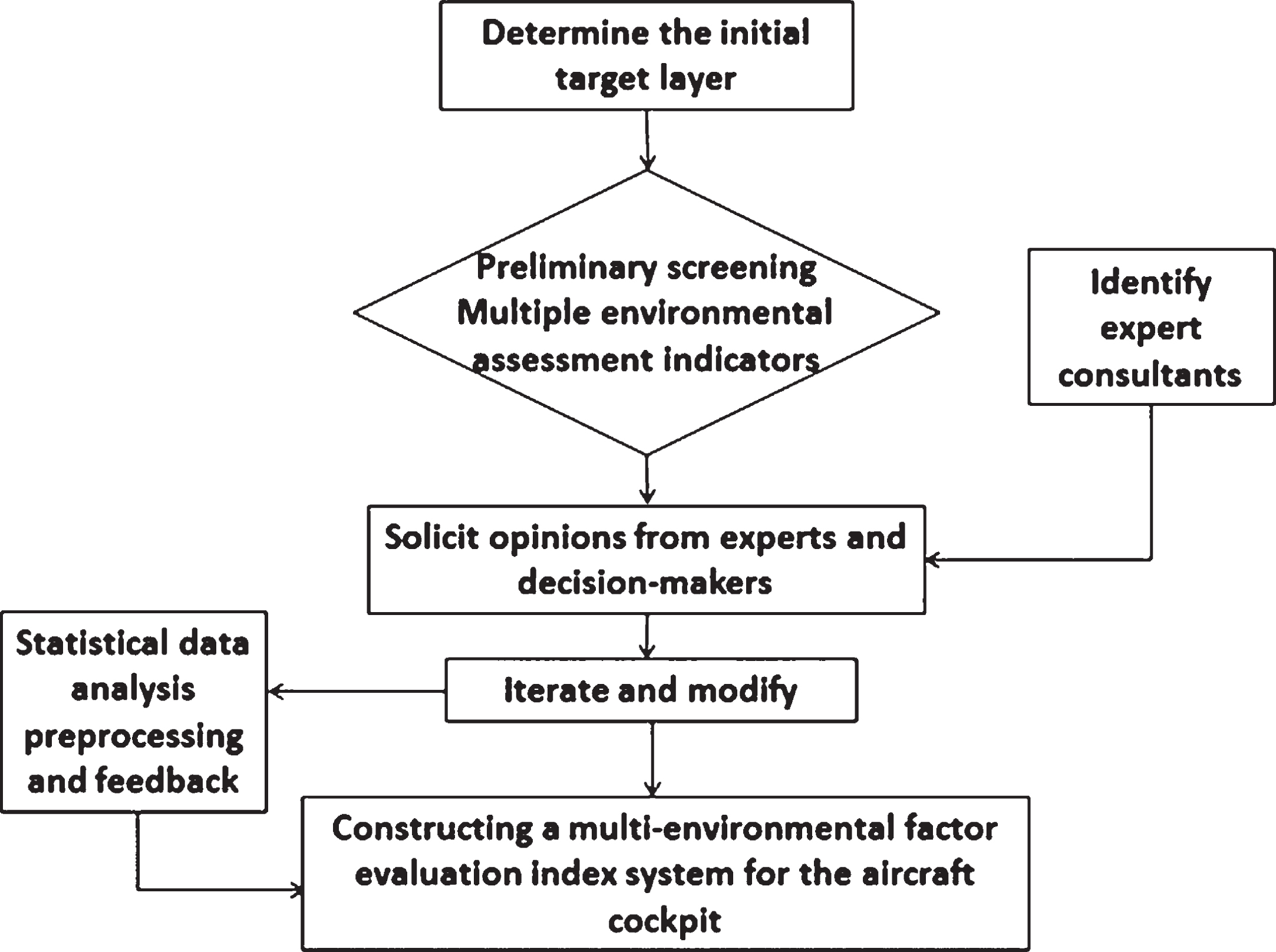
Construction process of multi-environmental index assessment for aircraft cockpit.
For multi-objective decision-making systems, some complex systems usually possess many variables, complex structures and uncertain factors. It is necessary to carry out a correct evaluation of the relative importance of the describing objectives to solve decision-making problems in these complex systems. The importance of each factor is different. In order to reflect the importance of the factor, the relative importance (weight) of each factor needs to be estimated. The weights of various factors compose the weight set. Weight is a relative concept, which refers to a certain index, refers to the relative importance of the index in the entire established evaluation index system, and is the result of subjective and objective comprehensive measurement. The methods for determining index weights mainly include analytic hierarchy process, expert estimation method, factor analysis weighting method, grey relational degree analysis method and more. The Analytic Hierarchy Process (AHP) in system engineering theory is a appropriate way to determine the weight [19]. It is a multi-objective and multi-criteria decision-making method that divides the factors of a complex problem into related and orderly levels to make it organized. It is an effective method that combines quantitative and qualitative analysis. Therefore, this study intends to use the analytic hierarchy process and particle swarm optimization algorithm to determine the index weight of each environmental factor.
Analytic hierarchy process
The analytic hierarchy process first puts the decision-making problem to be carried out in a large system. There are multiple factors that affect each other in this system [20]. These problems are to be hierarchized to form a multi-layered analysis structure model. After that, a combination of mathematical methods and qualitative analysis is used, through layered sorting, and finally calculated according to the weight of each plan to assist decision-making. The steps of AHP to determine the weights are as follows:
(1) Construct a judgment matrix. Let a denote the goal,
(2) Calculate importance ranking. According to the judgment matrix, find the eigenvector w corresponding to the largest eigenvalue λmax. The equation is as follows:
The required feature vector w is normalized, that is, the importance of each evaluation factor is ranked, that is, the weight distribution.
(3) Consistency check. Whether the weight distribution obtained above is reasonable or not, the consistency test of the judgment matrix is also needed.
Test using formula:
CR is the random consistency ratio of the judgment matrix; CI is the consistency index of the judgment matrix. It is given by following formula:
RI is the average random consistency index of the judgment matrix. When the CR of the judgment matrix P is less than 0.1 or λmax = n, and CI = 0, P is considered to have a satisfactory consistency, otherwise the elements in P need to be adjusted to make it have a satisfactory consistency.
The combination of analytic hierarchy process (AHP) and fuzzy theory will lead to non-objectivity in the evaluation because of its strong subjectivity. Because the expert scoring of the analytic hierarchy process will be subjective, the scoring matrix will be inconsistent or omitted. At this time, we can use a particle swarm optimization algorithm to modify the expert scoring matrix. Under the condition that the original information of the decision-maker is maintained to the greatest extent and the judgment matrix is determined, the judgment matrix has better consistency and improves the weight value [21]. Particle Swarm Optimization (PSO) was proposed by Dr. Eberhart and Dr. Kennedy in 1995 [22]. Its basic core is to use the sharing of information by individuals in the group so that the movement of the entire group produces an evolutionary process from disorder to order in the problem-solving space, so as to obtain the optimal solution to the problem [23]. After finding these two optimal values, the particle uses the following formula to update its speed and position.
i = 1, 2, . . . ,M, M is the total number of particles in the group; Vi is the velocity of the particles; pbest is the individual optimal value; gbest is the global optimal value; rand (0∼1) is a random number between (0, 1); xi is the current position of the particle. c1 and c2 are learning factors, usually c1 = c2 = 2. In each dimension, the particle has a maximum speed limit
According to the factors involved in the evaluation, fuzzy comprehensive evaluation can be divided into one-level fuzzy comprehensive evaluation and multi-level fuzzy comprehensive evaluation [24]. Since the multi-environmental factor index system of the aircraft cockpit is multi-layered, the fuzzy comprehensive evaluation results of the lowest-level indicators are integrated together, and the fuzzy comprehensive evaluation is carried out layer by layer from low-level to high-level. The specific evaluation process is shown in Fig. 2.
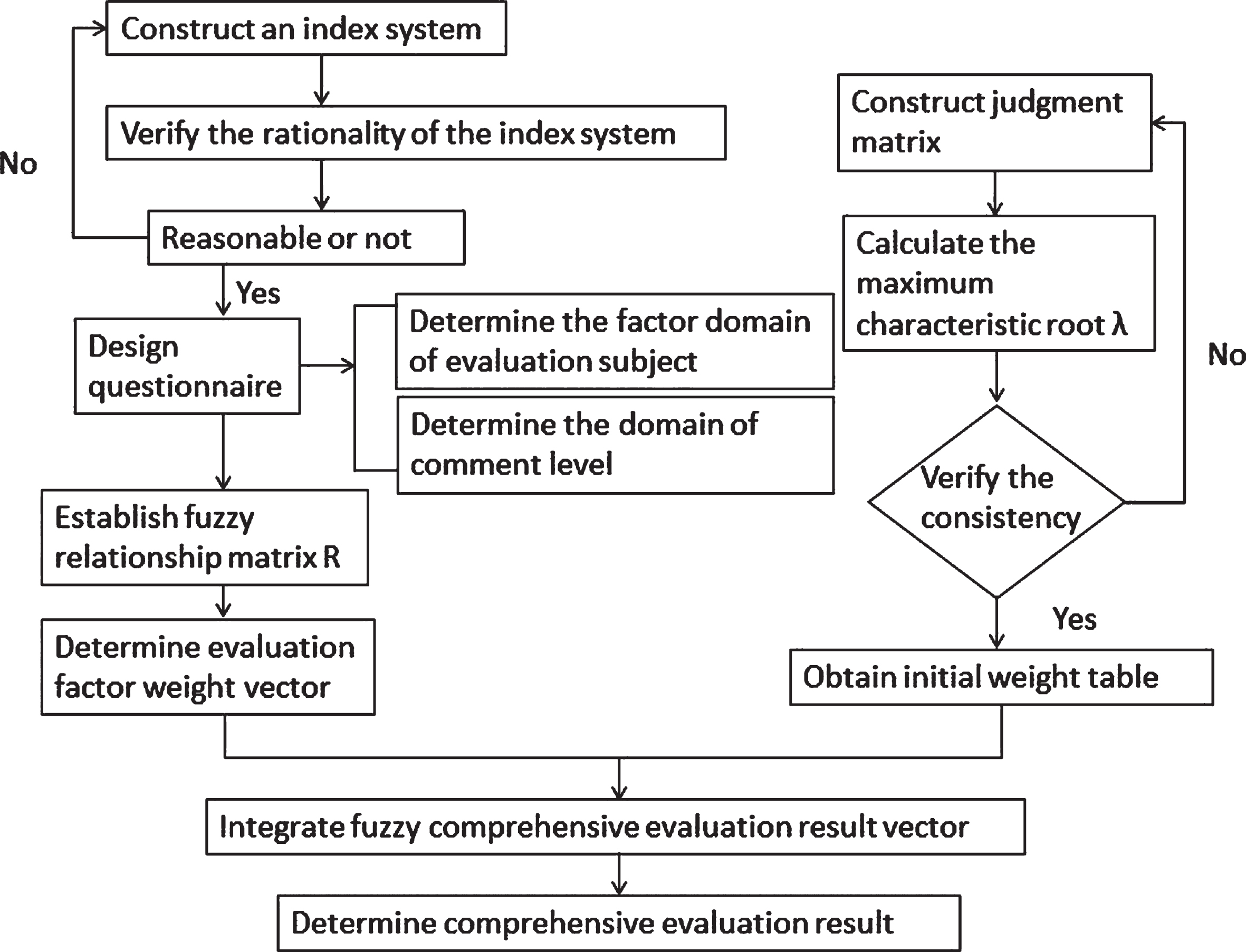
Fuzzy comprehensive evaluation process of multi-environmental factors in aircraft cockpit.
To construct the fuzzy comprehensive evaluation model of multi-environmental factors in the aircraft cockpit, we should first determine the factor universe of the evaluation object, that is, P evaluation indicators u ={ u1, u2, ⋯⋯ , u
p
}; secondly, it is necessary to determine the domain of the review rating, that is, the rating set v ={ v1, v2, ⋯⋯ , v
p
}; each level can correspond to a fuzzy subset; then the fuzzy relationship matrix R is established. After constructing the hierarchical fuzzy subset, we quantify the evaluated items from each factor one by one u
i
(i = 1, 2, ⋯⋯ , p). That is to determine the degree of membership of the rated thing to the fuzzy subset of the grade from the single factor (R|u
i
), and then obtain the fuzzy relationship matrix:
The element in the row and column of the matrix represents the degree of membership of a certain thing to be evaluated to the fuzzy subset of the hierarchy in terms of factors. The performance of an evaluated object in a certain factor is described by the fuzzy vector (R|u
i
) = (ri1, ri2, ⋯⋯ , r
im
), while in other evaluation methods it is mostly described by the actual value of an indicator. Thirdly, the weight vector of the evaluation factor A = (a1, a2, ⋯⋯ , a
p
) is determined. The elements in the weight vector A are essentially the membership degree of the factor to the fuzzy (The importance of the thing being evaluated). Finally, to synthesize the fuzzy comprehensive evaluation result vector, a suitable operator is used to synthesize A and each evaluated object to obtain the fuzzy comprehensive evaluation result vector of each evaluated object, namely:
Among vectors, the result is obtained by the operation of the column, which represents the degree of membership of the rated object to the fuzzy subset of the hierarchy as a whole. According to the above steps, the specific step-by-step framework is shown in Fig. 3.
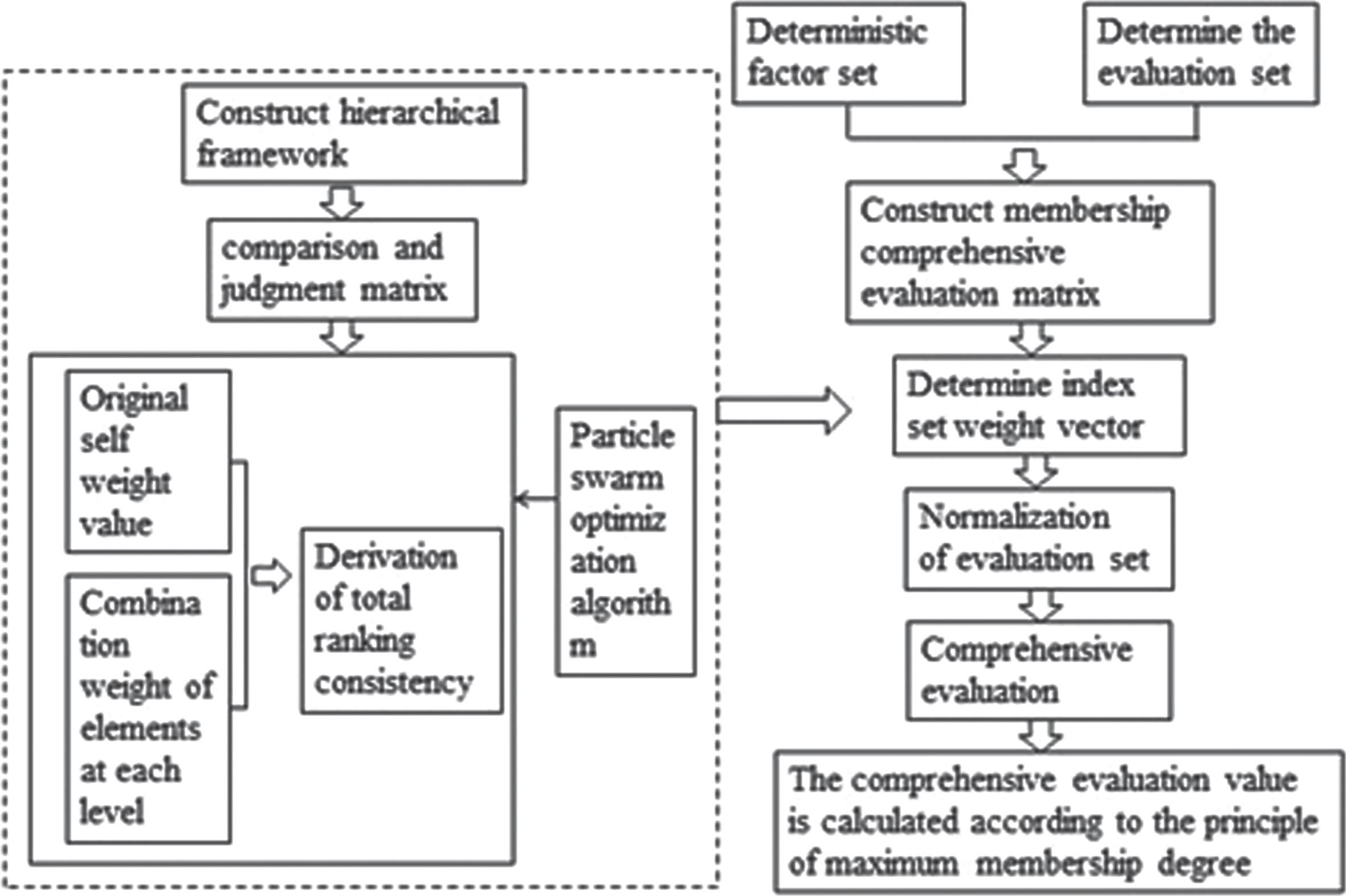
Step by step frame diagram.
The result of index system construction
Since the aircraft cockpit is a special cabin, in addition to following the above principles when constructing the aircraft cockpit multi-environmental factor evaluation system, it is also necessary to refer to relevant standards given at home and abroad. Relevant requirements and guidance are given in national standard, national military standard, U.S. military standard, SAE standard, and ISO standard [26]. These standards are now organized and summarized, as shown in Table 1.
Standard for environmental factors in aircraft cockpit
Standard for environmental factors in aircraft cockpit
The aircraft cockpit environmental factor index evaluation system constructed in this paper first divides the objects that affect the overall comfort of the cabin environment into three components (i.e., subsystems): thermal environment, light environment, and acoustic environment. And then each subsystem is divided into detail. Determine the indicators of each sub-level, including both quantitative indicators and qualitative indicators, and finally get a hierarchical structure diagram. Combined with the above domestic and international airworthiness standards, the first-level indicators of environmental factors in the aircraft cabin such as acoustic environment, light environment, thermal environment, and other micro-environments are summarized. The secondary indicators are summarized as: weighted sound pressure level, noise duration, equivalent continuous A sound level, speech interference level, noise evaluation level, noise pollution level, luminance level, brightness contrast, lighting clarity, lighting uniformity, prevention glare, emergency lighting, color temperature, diffuse reflection, light color coordination, light color adaptability, air temperature, air humidity, radiation temperature, PMV-PPD, air velocity, flow field velocity, airflow direction, pressure, gravity acceleration, ventilation, and air age. Based on the above indicators, an indicator system of environmental factors in the aircraft cockpit is constructed. As shown in Fig. 4.
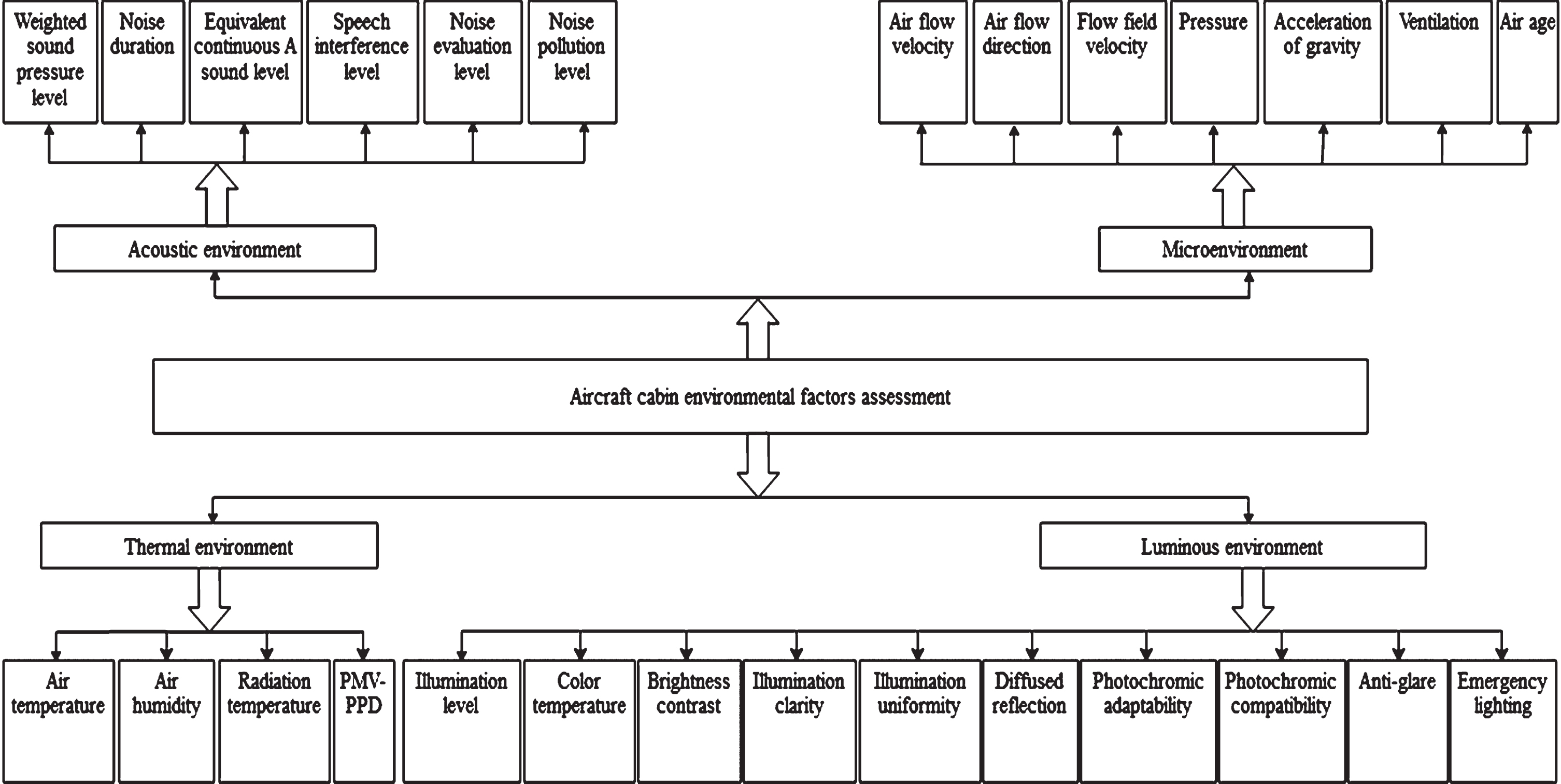
Aircraft cockpit environmental assessment index system.
In the comprehensive evaluation of the environmental factors of the aircraft cockpit, firstly, the weights of the multi-environmental factors in the cockpit are determined according to the analytic hierarchy process. Next, the questionnaires are made and the results are finally calculated by experts to obtain the weights of the various parameters of the multi-environmental factors in the cockpit. Because experts are required to score the relative importance of each index in the process of determining the weight, the members of the expert group for comprehensive evaluation should be determined first. Considering the specific situation of aircraft cockpit environmental assessment, 15 experts were invited from Northwest University of Technology and AVIC first aircraft design and Research Institute to form an expert group to analyze and score each index in the index system. When experts score, we draw the index weight information collection table of each index set for each layer of indicators. When filling in the form, experts should rank the importance of each index listed in the form according to their own understanding, and score the relative importance of each index after ranking according to Table 2 to complete the weight information collection of indicators at all levels.
r
k
assignment
r k assignment
The expert data obtains the bottom element result conclusion value (weight) through statistics as 1, and the matrix dimension n: n = 4. The calculation matrix A is as formula (8):
Normalize matrix A by column to get a new matrix B as formula (9):
Normalize the maximum eigenvector (weight) wT, calculate the geometric mean of each row of matrix A1, and then normalize to get the matrix:
Through the above calculation, the original weight matrix of the multi-environment influencing factor index of the aircraft cockpit is obtained: λmax = 4.7165; CR = 0.2684; CI = 0.2388, the weight matrix used for calculation after correction: λmax = 10.1568; CR = 0.099; CI = 0.1446 after correction. Use the weight matrix as shown in Table 3.
The initial weight value of each environmental factor in the aircraft cockpit
According to the above calculation method, the index of the factors affecting the thermal environment of the aircraft cockpit is obtained: λmax = 4.2561; CR = 0.0959; CI = 0.0854. The weight matrix for calculation after correction is shown in Table 4.
Weights of thermal environment indicators in the aircraft cabin
The index of the factors affecting the light environment of the aircraft cockpit is λmax = 11.3239; CR = 0.0987; CI = 0.1471. The weight matrix for calculation after correction is shown in Table 5.
Weights of light environment indicators in the aircraft cockpit
The index of the factors affecting the acoustic environment in the aircraft cockpit is λmax = 6.5936; CR = 0.0942; CI = 0.1187. The weight matrix for calculation after correction is shown in Table 6.
Weights of acoustic environment indicators in the aircraft cockpit
The microenvironment influencing factor index of the aircraft cockpit is λmax = 7.8146; CR = 0.0998; CI = 0.1358. The weight matrix for calculation after correction is shown in Table 7.
Weights of micro-environment indicators in the aircraft cockpit
Through the above calculation, the weight table of the middle layer can be obtained as shown in Table 8.
Weight table of the middle layer of multiple environmental indicators in the aircraft cockpit
To verify the consistency of the total ranking: the aircraft cockpit environmental impact factor index:
CR = (0.636018*0.0854 + 0.228689*0.1471 +0.0527261*0.1187 + 0.0825672*0.1358)/(0.636018*0.89+ 0.228689*1.49 + 0.0527261*1.26 + 0.0825672* 1.36) = 0.0971. The thermal environment CR = 0.0, the light environment CR = 0.0, the acoustic environment CR = 0.0, and the microenvironment CR = 0.0.
Through the above calculation, the group decision weight table is obtained as shown in Table 9.
Weight table of multi-environmental indexes in aircraft cab
According to the fuzzy comprehensive evaluation method given in 2.2.1 of this study, combined with the evaluation results of 20 questionnaires, the evaluation vector of each environmental factor is obtained. Determining the rating weighting vector is used to distinguish the difference between the good and the bad of the comprehensive evaluation result. This article uses a percentile system to determine (1,20) as unimportant, (20,40) as less important, (40,60) as general, (60,80) as more important, and (80,100) as important; take the median to get the rating weight vector F = (10,30,50,70,90).
The evaluation vector of the thermal environment is obtained by calculation:
Evaluation vector of light environment:
Evaluation vector of acoustic environment:
Evaluation vector of microenvironment:
Evaluation vector of fuzzy comprehensive evaluation:
The fuzzy comprehensive evaluation score is:
The results show that the comprehensive assessment results of the environmental factors in the aircraft cockpit are more important. At the same time raccording to the above method rthe scores of the first-level indicators and the second-level indicators are calculated as shown in Table 10.
Score table of level 1/level 2 environmental indexes of aircraft cockpit
Using the fuzzy comprehensive evaluation method based on AHP rthe scores of various environmental indicators are obtained rand the indicators with higher scores in the second-level indicators are: Air temperature rIllumination level rLight and color coordination. In the first index rthe light environment and thermal environment scored higher. Although the importance of microenvironment in the primary index evaluation is low rthe scores of secondary indexes atmospheric pressure and gravitational acceleration are high rwhich should still be paid attention to in the follow-up research.
Conclusion
This research is based on the fuzzy comprehensive evaluation theory rcombined with analytic hierarchy process (AHP) and particle swarm optimization (PSO) to build an environmental factor evaluation model rand obtain the important environmental impact factors of the aircraft cockpit through calculation rwhich can provide important environmental control indicators for the aircraft cockpit environmental control system. The main conclusions are as follows:
1) The multi environmental factor evaluation system of aircraft cockpit is constructed.
2) From the above evaluation results rit can be seen that it is more important to perform fuzzy comprehensive evaluation of multiple environmental factors in the aircraft cockpit. Among the four first-level environmental indicators rthe light environment is the most important rthe thermal and acoustic environment is second rand the microenvironment is the lowest degree.
3) Among the twenty-seven secondary environmental indicators rair temperature rluminance level rlighting clarity rlight and color coordination rnoise duration rand atmospheric pressure are of higher importance.
4) The results show that the fuzzy comprehensive evaluation method has a good predictive ability to evaluate the multi-environmental factors of the aircraft cockpit.
5) Through the above results rthe importance ranking of the environmental factors in the aircraft cockpit can be obtained rwhich can provide an analytical basis for the subsequent research on the environmental control of the aircraft cockpit rand at the same time can provide an index basis to improve pilot’s comfort and work efficiency.
Inadequacies remain in the consideration of some problems in the construction of the comprehensive evaluation index system and model of the aircraft cab environment rwhich need further study. In view of these deficiencies rthis paper proposes the following prospects: Firstly rthe multi-environment comprehensive evaluation index system of aircraft cab only evaluates the physical environment factors of aircraft cab rit does not consider the human-machine interface (HMI) environmental factors of aircraft cab. Secondly rthe dimension of the selected environmental grade index is low and the calculation amount is small. If there are too many indicators at a certain level rwhether this method can be used for real-time evaluation needs further research and testing. Finally rthe selected evaluation method is affected by the subjective knowledge and experience of experts. Due to persistence limitations in this study rfurther research could focus on optimization and addressing the limitations.
Footnotes
Acknowledgments
The authors have no acknowledgments.
Conflicts of interest
The authors declare that they have no conflict of interest.
Funding
This work was sponsored by the Fundamental Research Funds for the Central Universities (Project No. 31020190504004).
Ethical approval
Not applicable.
Informed consent
Not applicable.