




Abstract
BACKGROUND:
Just culture aspires to prompt organizational learning from enhanced feedback by frontline operators. Just culture requires mechanisms to eliminate fear and sanction but not accountability when reporting safety-related issues. Adopted in sectors such as aviation, just culture remains an underdeveloped field in the maritime sector.
OBJECTIVE:
This study explores how some pre-requisites for a just culture (i.e., ease of reporting, motivation to report, and trust) are perceived and potentially implemented by seafarers’ and shipping company safety representatives in Indonesia.
METHODS:
Semi-structured interviews were used to collect qualitative data in an exploratory study involving eleven active seafarers and four safety managers from shipping companies in Indonesia.
RESULTS:
The conditions for ease of reporting seem present, at least on paper. Shipping companies receive one to two near-miss reports per month. However, incidents seem to be underreported. It appears that companies are unsuccessful in establishing the motivation and trust necessary to enhance safety event reporting.
CONCLUSION:
The study suggests that the concept of a just culture is not well understood among certain Indonesian shipping companies. The main barriers to implementing a just culture relate to hierarchical structures in the industry, frequent crew changes, blame culture, and lack of anonymous reporting for safety concerns.
Introduction
Just culture is a new mindset about safety that involves a questioning attitude, resistance to complacency, and organizational self-regulation in safety matters [1]. If implemented in a safety-sensitive manner, just culture may support the shipping industry to learn from frontline operators and enhance safety at sea [2–5].
Sectors such as healthcare and aviation 1 have adopted a just culture and developed the conditions of trust that are needed to promote the smooth flow of information and then efficient reporting [6–8]. As in other safety-critical industries, just culture in shipping would help create a safe environment where workers, especially those on the frontline, are encouraged to have open and honest communication. The papers submitted by the United Kingdom to the International Maritime Organization (IMO, 2010, 2011) proposed that just culture might significantly contribute to shipping safety [9, 10] by incentivizing seafarers’ feedback and incorporating their views to enhance safety. Further, just culture would support trust between the shore-based company and ships [11, 12], maintain seafarers’ morale and health [4, 13] and enable true learning if well-known habits of blaming the ship are overcome [14–17].
However, the implementation of a just culture in the shipping industry requires establishing trusting relationships between frontline operators (onboard vessels) and managers (both on-board and shore-based) and avoiding blame and sanction, but not accountability [6, 19]. Oltedal and McArthur [14] described that the frequency of reporting safety information at sea is highly influenced by the attention given to reporting from shore personnel. Indeed, it is acknowledged that management has a deep influence on safety [20], meaning that the interaction between shore and onboard management cultures significantly impacts ship safety.
Previous studies have highlighted that seafarers’ fear of losing jobs and blame culture constitute a significant barrier to safety event reporting and just culture in shipping [15, 21–23]. In addition, the strong shipboard hierarchical structure (even if justified by competency, tradition, and the need to respond to emergencies) may also hinder the onboard circulation of information [24] and, as a consequence, reporting. Besides, safety reporting does not often trigger consequent changes and improvements in the maritime sector, which negatively impacts the motivation of reporters to share further feedback [25].
Indonesia is a large maritime country and its economy is highly dependent on shipping and maritime transport [26]. Indonesia is among the 15 leading flags of registration by dead-weight tonnage [27], and the third largest country in the world after China and the Philippines as a supplier of seafarers on foreign ships, both fishing and commercial vessels [28]. Despite its big commercial shipping interest, there is no legal framework in Indonesia about just culture, and the Indonesian national regulations do not require shipping companies to report near-misses or incidents to improve onboard ship safety. In a study of safety management reporting systems in the country, Andry and Yuliani [29] found that these systems are often manipulated in the shipping industry. This implies difficulties in implementing the International Safety Management Code (ISM Code) and complying with rules and regulations, including reporting near-misses and incidents. In other words, in practice, there is little focus on prevention and safety improvement via reporting safety concerns in the maritime industry in Indonesia [30].
The study, the first of its kind in Indonesia, explores just culture by collecting data from those directly involved in the safety of ships, both onboard (seafarers) and onshore (designated person ashore - DPAs). This exploratory research aims to assess three important pre-requisites for implementing just culture: (1) ease of reporting, (2) motivation to report, and (3) trust (Fig. 1) 2 .
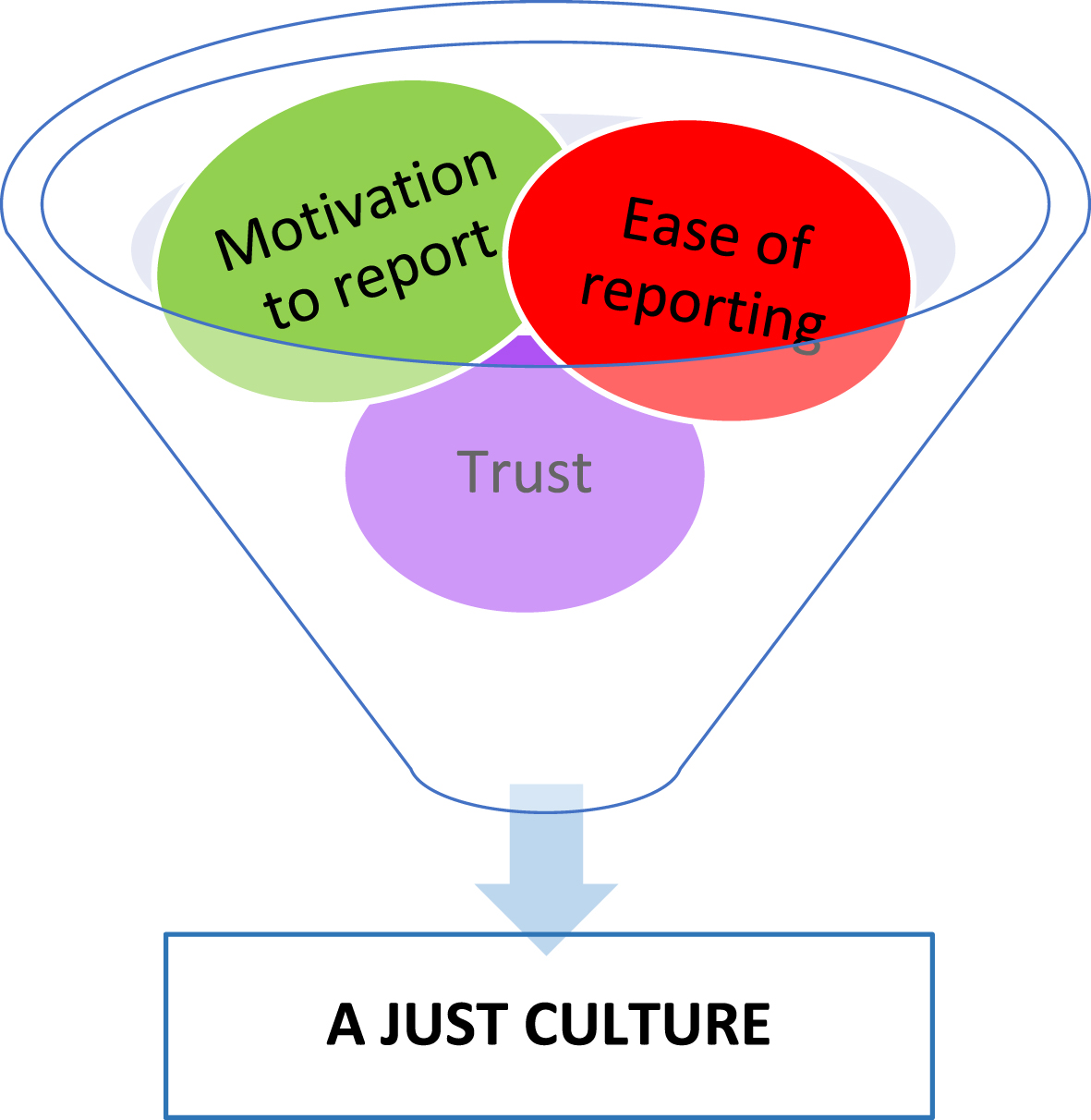
Pre-requisites for a just culture (adapted from EUROCONTROL, 2006).
The study used a qualitative methodology with semi-structured interviews and narrative analysis. Interviews were prepared following “strategies for conducting elite interviews” [32]. The interview questions were validated and approved by an Ethics Committee.
Open questions were designed to assess the three pre-requisites for a just culture and their presence in the organization: (1) ease of reporting; (2) motivation to report; and (3) trust. The pre-requisite of ease of reporting refers to the quality of the safety-related events reporting systems, specifically that they are easy to use and are not perceived by reporters as an extra workload or threat. Motivation to report involves the frontline operators’ willingness to share safety-related information. Finally, trust refers to the reporters’ perception of the value and usefulness of the reporting as well as the potential punitive actions that could result from the reporting of safety concerns. By assessing these three just culture pre-requisites and their presence in shipping companies, the study intended to address the following research questions: 1) is the concept of a just culture “present” in the organization? 2) are there any barriers to implementing a just culture? and (3) how does the hierarchical structure on board ships influence the implementation of a just culture?
The qualitative study employed non-probability convenience and snowball sampling methods. The saturation principle commonly used in qualitative research was applied to assess and ensure the adequacy of the sample size. Active seafarers and DPAs were targeted since they are primarily responsible for the vessel’s safe operation on board (seafarers) and onshore (DPAs). The eleven seafarers interviewed included senior officers (masters, chief engineers and chief officer) and junior officers (third officers and third engineers). Participating seafarers came from several segments of the Indonesian domestic shipping industry, namely cruise, tanker, cargo, and container ships. DPAs (4 in total) represent two large Indonesian shipping companies that focus on gas and oil supply, as well as passenger ships, tankers, and tugboats operating on domestic routes. The Designated Person Ashore (DPA) is the individual (shore-based) designated in any shipping company to ensure the proper implementation of the Company’s Safety Management System (SMS) and maintain the safety culture on board the vessels. Two participants were female (one seafarer and one DPA). The participants had maritime experience ranging from 2 to 33 years. Details of the sociodemographic data of the participants are available in Table 1.
Sociodemographic data of participants
Sociodemographic data of participants
aPseudonyms are assigned to research participants. bMedium-sized enterprise: 50-249 employees, large enterprise: 250 employees or more.
The process of collecting data started on July 7th, 2020 and was finalized by the end of August 2020. After contacting the interviewee, the discussion was conducted in the Indonesian language to capture the right information. Interviews were conducted via video conference (Zoom technology) because interviewees were located in different settings, either in shipping companies or onboard ships in Indonesia. This program enabled the recording of audio and video, which was necessary for further data processing.
The data analysis aimed to identify certain words, themes, and concepts to organize and make sense of the interview text. Due to the size of the sample, a manual method was chosen to code the data [33]. The interview data were then transcribed and grouped based on the similar majority answer. Interview data were analysed in the native language, and the interviewer translated those passages intended to quote into English. The researcher used triangulation data to check data validity. To gain new insights from a social research perspective, this study uses narrative analysis to dissect the content of interview questions.
Concerning the study’s limitations, the main one is the sample size. The participants do not represent all seafarers and DPAs in Indonesia, so further studies are needed to confirm findings and generalize results. A small sample 3 is explained by the limited resources available for the research and the reluctance of many Indonesian seafarers to be interviewed, even though the interviews were confidential. This difficulty indicates a certain fear in the sector. As Kirwan et al. [23] research stated, “Generally seafarers are wary of investigation.” Moreover, due to the nature of the topic, it may result in bias from participants with a positive attitude to the company’s practices (positivity bias). Finally, although six pre-requisites (independence, feedback, acknowledgement, ease of reporting, motivation to report, and trust) for a just culture implementation have been identified in the aviation sector literature, for this first exploration in shipping, it was preferred to reduce the scope of analysis by focusing on three (ease of reporting, motivation to report, and trust) [31]. Hence, the remaining pre-requisites would need to be explored to increase the validity of the study.
Ease of reporting
The results show that the reporting system for safety concerns is mandatory (via SMS). Participants reported an estimated one or two reports per month for near-misses but no incident reports.
The majority of participants stated that the system was normally easy to use: “Uses [the reporting] a computerized system, it is simple and saves time to submit reports” [Coni].
One DPA emphasized that “The reporting is not difficult and it is very easy because the company provided Wi-Fi, which could support a very small aperture terminal (VSAT) satellite phone that facilitates reporting from ships” [Agus].
However, the safety reporting system becomes uncomfortable for some participants (especially highlighted by junior ranks). As junior seafarers said, “The hierarchical organization makes the reporting difficult and sometimes complicated” [Galih]. One DPA [Bagas] pointed out that “The hierarchical structures ( both on board and between the ship and shore) may refrain crew to report.”
Because the safety reporting system follows the hierarchy and has to flow through the senior officers, the identity of the reporter is easily known. This suggests that the requirement to circulate information via hierarchical processes may have detrimental impacts on reporting safety-related events.
To overcome such difficulties, DPAs and seafarers proposed to anonymize reporting. As stated by Johnson [16], anonymous reporting allows reporters to be less concerned about the negative consequences of their reporting. Indeed, anonymous reporting improves the amount and quality of near-miss/incident reports by increasing crew trust when reporting safety concerns.
Motivation to report
The motivation to report was identified by participants as an important factor in increasing the number and quality of reports.
However, most participants claimed to be unfamiliar with reporting procedures, “I do not know what procedure was adopted by the company in reporting because it was never explained” [Eko].
Furthermore, training on reporting systems for safety issues seems to be scarce. One seafarer highlighted that “Familiarization [with the reporting system] was done once at the beginning of joining the company” [Eko].
Furthermore, junior officers stated that company feedback and actions were not always positive. One junior officer said, “[. . .] There is a negative response from the company; it makes the crew lazy and less motivated to report” [Heni].
Seafarers frequently experienced fear and worry about upcoming activities such as the follow-up from reporting “There will be more questions after reporting” [Hendra].
Responses from the participants also reflect an overall feeling that risks outweigh incentives when it comes to reporting. The absence of reward or motivation makes reporting seem like a burden: “If there is a reward, it will make the crew more motivated because we are tired of working but still have to make a report” [Farid].
Even senior officers lack motivation due to the expectation that the company will respond negatively or not at all:
“[I am] not motivated to report because the company is not responsive to what is reported” [Doni].
“The blame culture in the company is still high, and there is no solution [feedback, action] from the company after reporting” [Doni].
Therefore, safety event reporting becomes a serious risk for seafarers.
Trust
Company representatives, especially DPAs or superintendents, communicate with ships through management visits. The majority of junior officers report that such visits usually involve only senior officers. Therefore, junior officers feel excluded because the information they obtain from the company is only through senior officers:
“[...] The senior officers will convey to the junior officers and crew at the [safety] meetings due to the hierarchy systems onboard ships” [Heni].
“If there is training from the company, it only involves senior officers, who are tasked to train the other crew members” [Galih].
A DPA confirmed the previous statements: “Usually, we call the senior officers to the office for information. .. then they return to the ship to share the information with the crews” [Cinta].
Even when the whole crew is involved in meetings, communication is difficult. Doni said, “DPAs’ representative s come every six months to meet with the crews. But, during those meetings , we are afraid to deliver some things related to near miss es or any problems we faced on board. Because we are scared, the company will blame us.” Interestingly, one DPA recognized the issue, “[...] because the condition on board ship is hierarchical, the crews feel afraid and hesitate to speak” [Agus].
The exclusion of junior officers affects the crew’s level of trust and generates a communication gap between the company and the crew. To support the establishment of a just culture, management visits should be inclusive to foster trust and convey that safety is a shared responsibility. This would provide all crew members with the opportunity to participate in safety-related discussions more often. Building trust requires communication and teamwork on board and also more involvement of the lower ranks in the company culture, which can be formed when there is two-way communication.
Just culture implementation: Barriers
The data analysis suggests that both seafarers and DPAs had similar perceptions regarding the challenges faced by the companies in implementing a just culture. The existence of hierarchical systems both onboard and between the ship and shore was highlighted as the main problem.
As seen in Fig. 2, the hierarchical organization raises additional barriers, also indicated by interviewees, such as lack of communication, lack of trust, lack of reward, lack of motivation, and the existence of a blame culture.
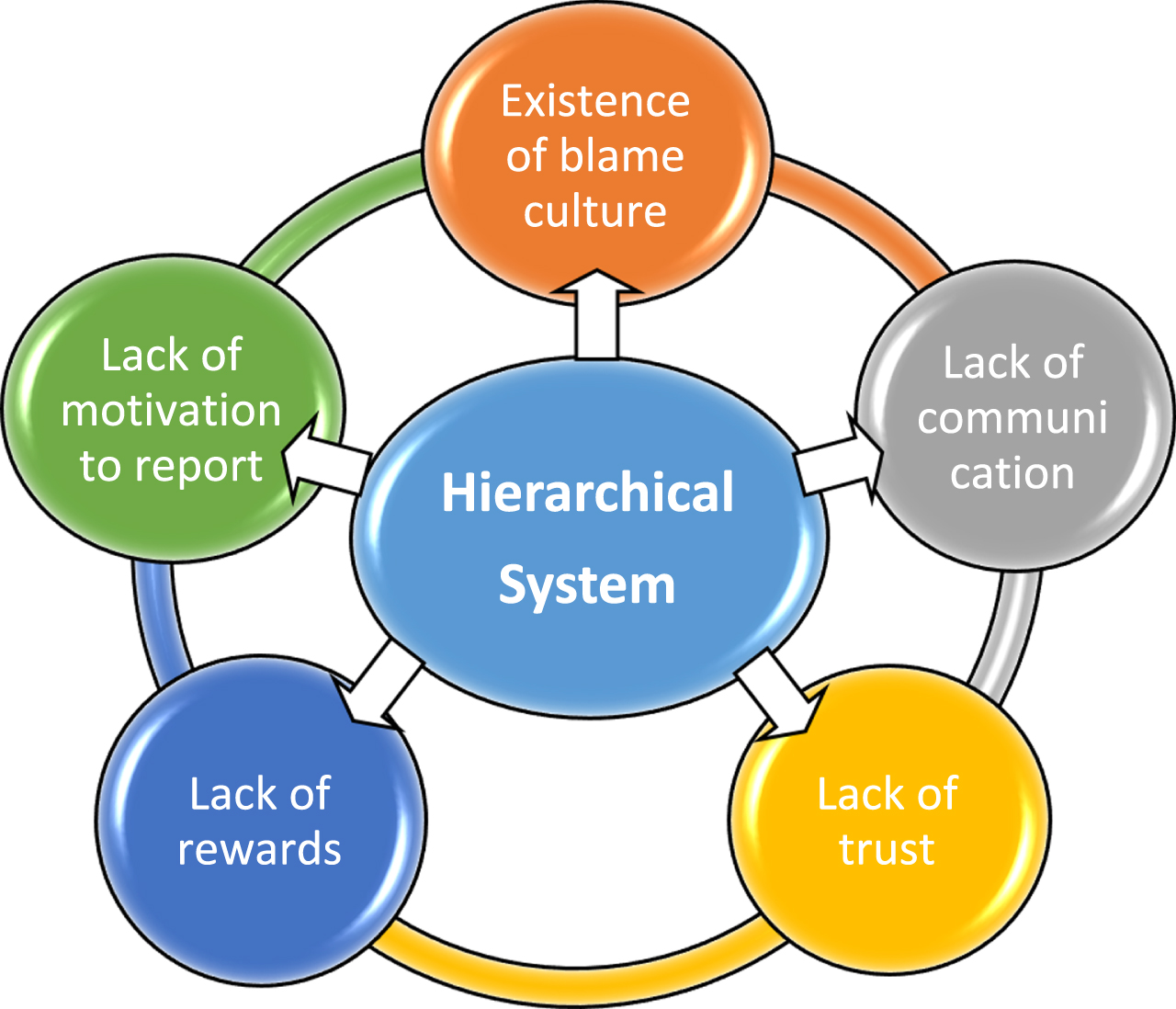
Main barriers faced by seafarers when reporting.
The hierarchical systems and procedures are developed by the shipping company, which approves and implements them on board the ship. If the hierarchical structure becomes strict and inflexible, it reduces opportunities to circulate information from ship to shore. Hence, poor communication between the ship and shore management might lower the motivation to report, especially from junior officers and ratings.
[Hendra] added, “E ven though DPAs give time to crews to speak up, people feel reluctant and uncomfortable because of the hierarchical system, and they cannot express their argument freely.” One of the DPAs also noticed that “T he crew’s anxiety and fear become a challenge for reporting” [Ikbal].
Participants reported that companies blame and punish the crew in cases of accidents involving losses for the company. In such cases, the companies may not only reprimand but also terminate seafarers’ employment contracts and blacklist them.
Furthermore, one interviewee describes a cascade of blame following certain near-miss reports “[. . . ] the companies will blame us, and sometimes senior officers blame us” [Farid].
Furthermore, according to DPAs, the main barriers that disrupt the implementation of a just culture are not limited to the strong hierarchical organization that makes crews fearful of reporting but also include the frequent change of crews, and the absence of anonymous reporting systems.
Figure 3 shows that there are three main barriers identified by the DPAs. Notably, the three DPAs conveyed a similar viewpoint, “Frequent changes in crew members” impact reporting because the company has difficulties familiarizing new crew members with company procedures.
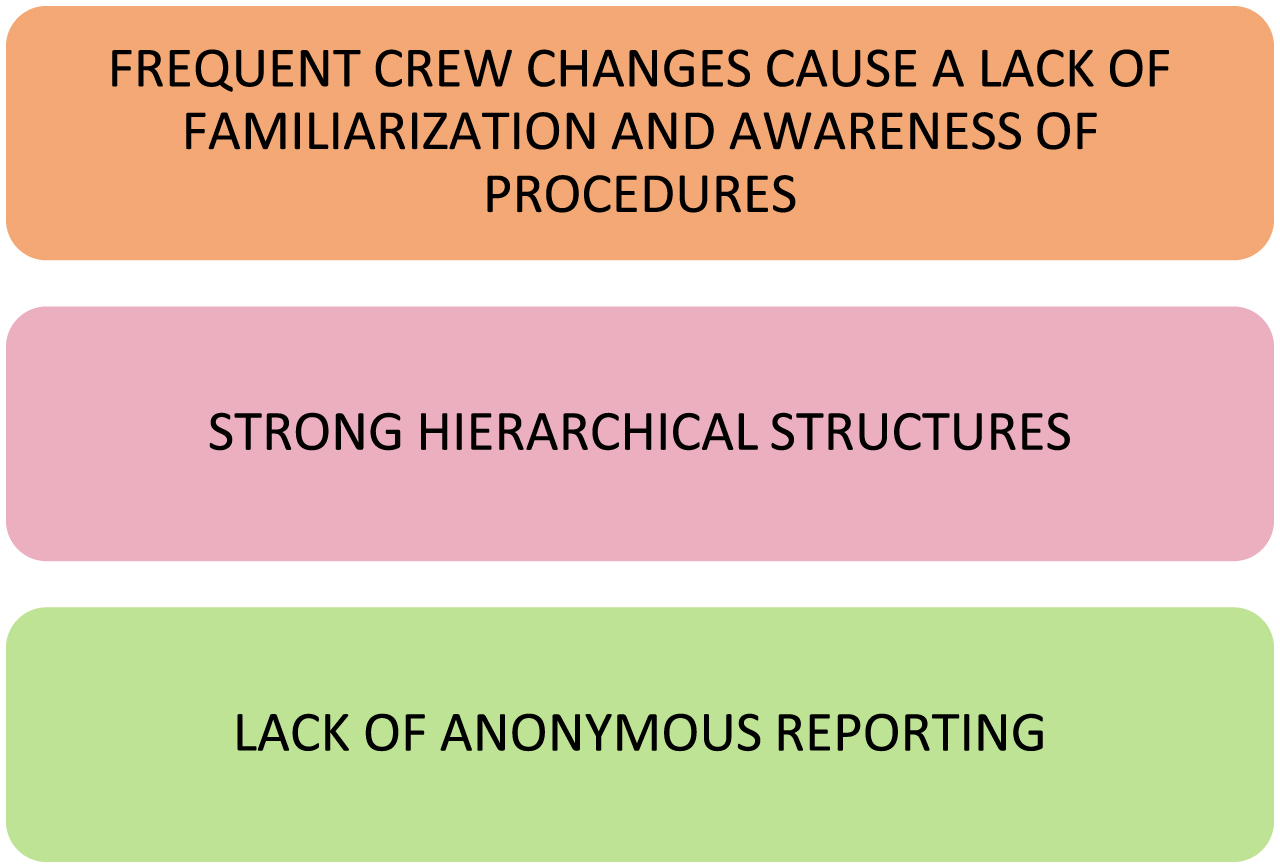
Main barriers faced by shipping companies related to a just culture implementation.
Finally, one DPA [Ikbal] highlighted that “To build a just culture, the ship management cannot rely on one side (onboard or shore) but there must be a synergy [onboard-onshore].”
As in any safety-critical sector, reporting near-misses and incidents is encouraged in shipping. The IMO guidance on near-miss reporting [34] highlights the importance of a just culture to feature “An atmosphere of responsible behaviour and trust whereby people are encouraged to provide essential safety-related information without fear of retribution.” Furthermore, the mandatory ISM Code requires shipping companies to establish a reporting system in order to promote a virtuous learning cycle in safety management via continuous improvement (Plan-do-check-act) [34, 35]. As ship owners are responsible for the development of procedures (ISM Code requirement), they have the power to encourage (or discourage) a just culture. Therefore, reporting occurrences should not be perceived as an extra workload or a threat by frontline operators. However, the study demonstrates that reporting does not seem so simple between sea and shore. The protection and anonymity of those reporting near-misses are not ensured, and insufficient resources are allocated to accident investigation and feedback on reported events [36]. Shipping companies and ships seem trapped in a blame culture and bureaucratic practices which hinder reporting [21, 37].
The study showed that although safety event reporting is mandatory and considered generally easy to use (the first pre-requisite explored for a just culture implementation), all participants agreed that organizational factors hamper reporting. Crew members seem to have no choice: they must report because it is imposed by the SMS and controlled by the company, but the quality of reporting under constraints is questionable. By developing policies and procedures to control every decision and activity, the company has a deep impact on the ship’s work system and trust. Besides, although the onboard hierarchical culture may be useful and justified, the study shows that inadequate management may create serious obstacles to a just culture. For example, junior officers and ratings, overseen by senior officers, cannot communicate their views directly. As expressed by most of the participants, by excluding junior officers during land-based management visits, DPAs damage trust and frustrate parts of the crew. This conclusion is in line with Bielić’s research [38], which highlights the negative impact of a shipping company’s organization (vertical organization) when the focus is solely on the senior officers for the realization of the company’s interests, rather than taking into consideration the perspectives and input of the entire crew.
The second explored pre-requisite for the implementation of just culture is the motivation to report [39], which requires good communication and feedback loops between ships and shore-based management. The motivation to report is determined by the organization’s will and actions to address each problem and respond to workers’ feedback [40]. In this respect, our study coincides with previous research that also suggests that the management does not always respond positively to feedback from the ship, which impacts the willingness of the crew to report future events [11, 41]. Further, in our study, there is no incentive of any sort nor evidence of improvement following reporting of near-miss/incidents on board ships. This is also affecting the motivation of the crew because rewards are a relevant psychosocial predictor of just culture in industrial settings [42, 43]. Consequently, in the absence of any incentive and potential for a personal threat (e.g., lack of action, blame), there is no motivation to report.
Concerning the third pre-requisite explored for a just culture, trust between workers and their management, this element is key in the successful adoption of effective reporting [44]. Low levels of trust affect the circulation of information including safety reporting. On the contrary, trust enables organizations to share information and learn from their own mistakes and also those of others [42]. The lack of trust in company management in the study influenced seafarers’ reporting, confirming the findings of Gausdal and Makarova [45]. Moreover, the study’s participants identified sanctions or threats as an important barrier to near-miss/incident reporting, in alignment with previous research that shows that the blame culture and sanctions are common in shipping [13, 46]. Firing employees who dare to talk results in the loss of good workers and damage trust within the organizations [47].
Distrust creates fear and blame [48], thus sharing safety-related information requires pre-conditions such as confidential reporting mechanisms [38, 49]. However, while the majority of DPAs supported, in principle, the idea of anonymous reporting for safety issues, they considered it difficult or impossible to implement (blaming “the onboard hierarchical structure”). This stance suggests the companies’ willingness to preserve the status quo. Is it because DPAs do not trust seafarers below certain ranks? Is it because DPAs are overwhelmed by work and need a sort of onboard filtering? Is it because DPAs are afraid of being blamed? Or is it a combination of those factors and others? Whatever justifications, the very possibility of identifying reporters will perpetuate the blame culture. Therefore, the question of how to build a just culture and learn from those experiencing the operation in such a context remains. It seems that certain shipping companies are unable to imagine seafarers as a resource for improvement; and this view is contrary to research on safety culture which systematically stresses the importance of involving frontline operators and taking a systems approach [11, 47].
The present study is relatively new in the maritime industry, and the number of international scientific publications and research works is close to non-existent. Previous attempts to progress guidelines for the development and implementation of an effective just culture in the international maritime industry were seen as premature [9, 10]. However, the current study could input new policy debates to develop the concept further and incorporate just culture into maritime national and international regulations. Although just culture in the shipping industry could be a step too far at this time [23], the practical issue that emerges from the paper’s findings is that implementing a just culture in the maritime industry would help increase reporting and enhance safety levels. A just culture cannot be bought as a program off the shelf [47], but our study indicates that maritime organizations can create a climate of trust, honesty, encouragement, involvement and of willingness to learn and respond to workers’ feedback. Trusting relationships between shipping companies and seafarers are of particular importance for honest reporting and would contribute positively to the industry’s safety records. Honest and healthy reporting is desirable, but cannot be forced to happen on its own. Therefore, the shipping industry requires dedicated efforts to overcome its structural inability or unwillingness to learn from past events and to improve its reporting/feedback mechanisms and, ultimately, the safety culture. Among these efforts, the findings can be used to design and develop training systems for managing responses to incidents and failures in a manner that will help create a just and trusting culture. Finally, the cultural and organizational barriers that prevent the maritime industry from adopting a just culture that facilitate reporting and enhance learning in daily operations call for further research.
Conclusions
The goal of this study was to explore three pre-requisites for just culture in a sample of Indonesian shipping companies. No sign of just culture has been found during this exploratory research. While near-miss reporting is mandatory, there is no structure in place to facilitate quality reporting for safety matters. On the contrary, findings show crew members fearing the consequences of reporting, hence limiting the use of their feedback to learn from operations and enhance safety performance.
Furthermore, there are no incentives for providing essential safety-related information, and the established blame culture threatens reporting of near-misses or incidents. DPAs confirmed that in the current hierarchical architecture, anonymous reporting could not be adopted and that each report must include the identity of the reporter.
Finally, the lack of or inappropriate communication between the ships and shore-based management constitutes a barrier to safety event reporting with a direct impact on trust and motivation to share feedback. To confirm the findings, further research on just culture requires insights from more seafarers and DPAs in Indonesia and worldwide, as well as from other relevant maritime stakeholders, including authorities at both national and international levels.
Ethical approval
The World Maritime University’s Research Ethics Committee (REC) approved the research, involving human participation, on 15 July 2020 (REC-20-36(M)).
Informed consent
Written informed consent was signed by all participants in the study.
Conflict of interest
The authors declare that they have no conflict of interest.
Reporting guidelines
The manuscript adhered to the EQUATOR relevant standards for conducting and reporting qualitative research (SRQR).
Footnotes
Acknowledgments
The authors would like to thank the participants in the study. They would also like to thank Prof. Anne Pazaver for her review, writing, and editing support. Ade Mardani Putra dedicates this publication to his beloved mother in heaven, Farida Ariani Binti Hi. Maliki Sarikam, who supported him with love and prayers until the end of her life. Putra also thanks the whole family and colleagues in Indonesia.
Funding
This research did not receive any specific grants from funding agencies in the public, commercial, or not-for-profit sectors.
In Europe, Just Culture in aviation is enshrined in law: “Just culture means a culture in which frontline, operators or others are not punished for actions, omissions or decisions taken by them that are commensurate with their experience and training, but where gross negligence, wilful violations and destructive acts are not tolerated” (Regulation No. EU 376/2017).
The six pre-requisites for a just culture include independence, feedback, acknowledgement, ease of reporting, motivation to report, and trust [31], all essential to successful reporting systems for safety concerns. This study focuses on the last three principles because these significantly affect the volume of safety data reporting and its quality. Reporting (especially near-misses and good practice) is essential for improving organizational safety performance and the most effective mechanism to achieve and measure a just culture [ ].
].
Although the sample size might be increased in future studies, the saturation principle indicated the study’s sample size was sufficient to gain valid insights into the research issues.