




Abstract
BACKGROUND:
Behavior-based safety (BBS) programs promote coworkers observing and correcting each other’s at-risk behaviors on site; the idea behind BBS programs is to create a cultural shift in a company where it is acceptable for coworkers to stop anyone, at any time, from working in an unsafe manner.
OBJECTIVE:
The main objective of this study is to examine the impacts of a BBS observation program in the construction industry.
METHODS:
The subject, an electrical contracting company, implemented the BBS program in January 2019. This study utilized multiple data sources: the company’s incident data, BBS program report data, and surveys, including the Safety Climate Assessment Tool for Small Contractors. A total of 3,891 at-risk behaviors from the BBS reports, including 600 comments, and 141 survey responses were analyzed.
RESULTS:
The most frequently reported at-risk behavior was the line of fire, and the at-risk behaviors were often observed when workers conducted tasks, such as running or pulling wires, installing devices, and installing lights. The overall perception of safety climate was high, and the respondents reported that the safety climate had improved since the adoption of the BBS program. Overall, implementing the BBS program benefited in cultivating the company’s collective safety climate.
CONCLUSION:
As a result of the BBS program, the company implemented better communication strategies for their safety meetings on the most frequently reported at-risk behaviors, replacing safety gears with higher quality ones, and redesigning online safety training to better reflect the identified tasks that were associated with more at-risk behaviors.
Introduction
The construction industry has high, disproportionate occupational injuries and deaths in the United States [1, 2]. The cases of fatal injuries in construction occupation surged from 924 (19.10%) in 2015 to 1,066 (19.99%) in 2019, recording the highest number of fatalities in the private construction industry since 2007 [3]. In 2019, the most common fatal injuries in construction were falls, slips, and trips (38.27%), followed by transportation incidents (23.64%), exposure to harmful substances or environments (15.85%), contact with objects and equipment (15.20%), violence and other injuries by persons and animals (5.44%), and fires and explosions (1.13%) [3]. The situation is similar to non-fatal injuries and illnesses; 195,600 cases of injuries and 2,600 illnesses were reported, which showed an incident rate of 3.0 per 100 full-time workers in the construction industry by the private sector in 2018 [4].
In the past decades, there have been many efforts to reduce fatal and non-fatal injuries and illnesses in the construction industry [5, 6], and various advanced technologies have been tested and introduced, such as automated hazard identification during construction planning using building information modeling (BIM) [7], hazards detection using site sensors [8], unmanned aerial vehicles (drones) for inspection and surveying [9], virtual reality simulators for equipment operator training and safety training [10], wearables for monitoring workers’ location and signs of danger [11], and mobile safety apps for location tracking and communication [12]. These technological advances can help with hazard detection, training, and safety monitoring. However, current safety monitoring practices in the construction industry remain manual, labor-intensive, and difficult to detect hazards in a timely manner on site as they still heavily rely on safety managers’ manual site observation [8, 13].
Behavior-based safety (BBS) programs promote coworkers observing each other’s (un)safe behaviors on site [14]. More specifically, BBS programs are strategically devised to engage the workforce in the implementation and utilization of their own safety initiatives; the crux of this approach is centered around the fundamental practice of workers observing their peers and providing feedback on safe and at-risk behaviors [14]. Thus, the idea behind BBS programs is to create a cultural shift in a company where it is acceptable for coworkers to stop anyone, at any time, from working in an unsafe manner. In the context of the cultural shift, BBS programs can be effectively implemented with a full benefit when used throughout organizations [15]. A strong safety program with an empowered workforce can benefit employees and employers [16]. This study aims to show the empirical evidence of a direct connection between the use of BBS observation programs and a reduction in accidents.
The main objectives of this study are to examine the impacts of a BBS observation program by (1) analyzing the subject company’s incident rate, (2) analyzing the reported unsafe behaviors from the BBS program, and (3) assessing safety climate using the Safety Climate Assessment Tool for Small Contractors (S-CATsc) [17] before and after implementing the BBS program. Based on the research objectives, specific research questions are as follows: Did the incident rate per full-time employee decrease after adopting the BBS program? What were the top three most frequently reported unsafe behaviors and tasks? Did employees who participated in the BBS program show a higher safety climate level than those who did not? Were there any changes in employees’ perceived safety climate before and after adopting the BBS program? If so, which safety climate factors among the eight changed most (and least)?
Literature review
Safety climate at construction sites
Safety climate captures the employee perception of safety and stems from a shared awareness among members within an organization [16, 18]. Many studies have found that a positive safety climate within the organization promotes safety behaviors at both individual and organizational levels and, eventually, enhances workers’ safety performance [2, 19–23]. For example, Choudhry et al. [19] collected 1,120 survey responses from 22 construction projects and found a positive relationship between the safety climate and perceived safety performance. Similarly, Lingard et al. [24] revealed the importance of first-level supervisors’ roles in preventing workgroup injury using regression analysis with 400 survey responses.
Safety climate is affected by different levels in the organization, including individual employees, coworkers, supervisors, and organization and management levels [25, 26]. For example, coworkers’ support and organizational-level safety climate affected group-level safety climate [1, 27], and workers shared a similar level of safety perception within a workgroup [1, 6, 28]. Additionally, when top management showed commitment to and prioritization of safety, workers showed improved safety performance [29, 30]. Also, coworkers’ safety commitment was found to be a mediator between top management’s commitment to safety and employees’ safety behaviors [1].
To measure the construction safety climate, CPWR [17] defined eight factors of safety climate: demonstrating management commitment; aligning and integrating safety as a value; ensuring accountability at all levels; improving supervisory leadership; empowering and involving employees; improving communication; training at all levels; and encouraging owner/client involvement. Considering these factors, the role of safety managers is to promote employees’ safety behaviors from an organizational approach in addition to the efforts in detecting potential hazards, monitoring workers’ safety behavior, and developing safety plans and training materials [19, 31]. However, safety managers cannot be concurrently present everywhere at construction sites, which often leads to failure to detect and prevent hazards before accidents happen. These temporal and physical difficulties of safety manager-based observation are much aggravated by the size and complexity of construction projects [32, 33]. Moreover, the safety climate within a company is not always homogeneous and can vary between different working teams [6]. Therefore, organizations should adopt different safety programs to enhance employees’ safety perception, practice, and climate.
Behavior-based safety programs
Providing safety programs at construction sites is one of the effective ways to enhance safety awareness [34]. The types of safety programs include behavior-based safety (BBS), people-based safety (PBS), and cultural intervention [34]. BBS programs have been applied to many fields, including construction sites, manufacturing plants, mining, and shipyards, and yielded positive safety outcomes [35–38]. Gravina et al. [37] define BBS as “based on the notion that all behavior is influenced by environmental variables, including both the physical environment and the social environment.” The root purposes of the BBS observation are 1) to create an atmosphere where people place their care and concern for others in front of their fear of speaking up [39], 2) to encourage safe behaviors rather than penalize unsafe behaviors [40], and 3) to ultimately change employees’ mindset toward their own safety behavior and potential risks of accidents and injuries [41]. Choudhry [30, 42] found that BBS discouraged risky behaviors that may produce incidents, increased safety performance levels among employees, and created employee ownership to adopt safe behaviors on construction sites. In the conventional BBS approach, facilitators who are either health, safety, and environment professionals or external consultants may be involved and provide feedback or make observations [43]. BBS peer observation can be useful in the construction industry due to the mobility of the workers, where safety managers cannot be present throughout the job sites at all times. Creating a culture of safe behavior must go beyond the construction industry staples of toolbox safety talks and governmental safety regulations and standards, which are necessary to convey safe working practices, but communication is often one-way. Using BBS reporting creates an opportunity for workers to actively affect their environment and participate in the ongoing safety process. A safety climate that promotes addressing concerns from both workers and management is crucial to improving the safety climate [27, 44]. If workers do not feel like the leading organization is concerned about their safety, they are less likely to report concerns.
BBS programs at construction sites can enhance workers’ safety by removing hazardous behaviors and ultimately building trust and safety culture within an organization [45]. BBS has been implemented in different industries, but the application of BBS in the construction industry, especially for small-to-medium-sized companies and subcontracting firms, is limitedly investigated in the literature. In this sense, providing empirical evidence of the benefits of BBS programs, such as reducing incidents and cultivating safety climate, is critical to the wide adoption of BBS programs in the construction industry. In addition, the program can be effective in retraining employees to implement new or revised procedures in order to perform their job safely.
Methods
This research uses multiple data sources: the company’s incident data, BBS observation program data, and surveys. The survey and observation data in this study is non-identifiable data. The following sections describe the details of each data source and the subject company’s background and implementation process.
Company background and implementation of the BBS program
A corporation comprising four distinct electrical contracting companies embarked on a BBS observation program in 2018. Two of the companies are based in the Midwest, and the other two are based in the South, where the two southern companies share a safety department. The safety department began officially tracking the participation of the BBS program in January 2019. This research project examines the data collected by the safety department for the first two years of the BBS program. The larger of the two companies (company A) has eleven branches plus a corporate level reporting, and the smaller company (company B) has four branches plus a corporate level reporting; this paper analyzes the data from company A, giving a total of eleven data sets to examine. The goal is for each employee to complete a BBS observation report for every 160 hours sold. ‘Hours sold’ refers to the total number of labor hours performed each month by the company. The formula to determine the number of BBS reports required by the branch each month is hours sold/160; this returns a target number compared to the total of observations made, and a monthly percentage is recorded for each branch.
The BBS reporting is accomplished by using a cloud-based software system that offers a browser-based and mobile application platform. The department uses this software system to host all corporate safety materials, resources, training schedules, and reporting tools. Each employee has access to the website and may choose to download the application to their mobile device. The application automatically notes the time, date, and physical location of the report. The observer is prompted to enter their names, supervisors’ names, and branch managers’ names. The identity of the observed employee is not recorded, and an employee must give permission to conduct the observation. The department recommends a time frame of shorter than 30 minutes to complete each observation.
Company incident data
The incident data included multiple indicators: hours between accidents, hours worked in the field, hours worked to support, temporary labor hours, total hours worked, the number of recordable incidents (based on OSHA), lost time accidents, lost workdays, restricted work say cased, and restricted workdays. Using those indicators, the following safety metrics were calculated: 1) incident rate (recordable accidents * 200,000 / total hours worked), 2) frequency rate (lost workday cases * 200,000 / total hours worked), and 3) severity rate (lost workdays * 200,000 / total hours worked). The accident cases were standardized by 200,000 hours, which is 100 workers x 40 hours x 50 weeks.
BBS report data
Further instructions call for the observer to begin with a positive comment and reinforce the safe behaviors observed and then discuss any unsafe behaviors observed and how to eliminate them, using open-ended questions and emphasizing that there are no consequences for the observation. This is in line with the research on behavior that emphasizes the idea of no punishment and the promotion of good behavior. The department identified eight states of being to report on, which are commonly reported in construction safety literature: 1) rushing/ frustration [46], 2) fatigue [47, 48], 3) complacency [47], 4) eyes/ mind not on the task [46], 5) line of fire, 6) personal protective equipment (PPE) [30], 7) loss of balance/traction/grip [44], and 8) proper tool use [47]. The use of PPE is a requirement on all job sites. Each of these behaviors is recorded along with the task description and any additional comments. The mobile BBS program application includes adding photographs if the observed employee remains anonymous. The data include the first two full calendar years and three months of BBS reporting (from January 2019 to March 2021). The analysis of this study included a total of 3,891 at-risk behavior reports with 659 descriptions in the comment section. After excluding 59 comments with non-identifiable comments (i.e., not mentioning the type of tasks), this study analyzed a total of 600 comments. Both 3,891 at-risk BBS reports and additional 600 comments were analyzed.
Survey
The survey includes four major parts: 1) S-CATsc, 2) items to assess workers’ perception of safety climate before and after implementing the BBS program, 3) items related to reporting and conducting the BBS program, and 4) items asking for organization information. The S-CATsc measures consist of eight categories: 1) demonstrating management commitment, 2) aligning and integrating safety as a value, 3) ensuring accountability at all levels, 4) improving supervisory leadership, 5) empowering and involving employees, 6) improving communication, 7) training at all levels, and 8) encouraging owner/ client involvement. Each category includes three to six items, and each measure provides the descriptions in five levels (1: inattentive, 2: reactive, 3: compliant, 4: proactive, and 5: exemplary). The researchers treated the five categories as a 5-point Likert scale with equal distance for data simplicity. All eight categories showed good or acceptable internal consistency, with Cronbach’s alpha between .78 and .90 (Table 1). The following eight questions evaluate the improvement of each category of safety climate after the company adopted the BBS program. The items use a 5-point Likert scale (1: not improved at all to 5: significantly improved). The last five questions evaluate the perception of the BBS program using a 5-point Likert Scale (1: strongly disagree to 5: strongly agree). An example is, “I believe the BBS observations are important.” Lastly, a question asks about their positions.
Safety climate measures (S-CATSC) (n = 141)
Safety climate measures (S-CATSC) (n = 141)
The survey was conducted online using Qualtrics from April 14th, 2021, to June 8th, 2021, and provided in English and Spanish. The survey was distributed through the company’s central email distribution system. Participants were informed of the intent of the survey and had the option to participate in a lucky draw to win a $100 gift card and small company goods. Regardless of their intention to participate in the lucky draw, every response remains anonymous with two separate survey and lucky draw links. A total of 151 responses were collected, but ten incomplete responses were excluded from the analysis.
Respondent backgrounds (n = 141)
Descriptive statistics: Company incident rate, accident types, and unsafe behaviors
The incident rate averaged 1.15 before adopting the BBS program between 2012 and 2018. After adopting the program, the rate decreased to 0.84 and 1.00 in 2019 and 2020, respectively. For severe accidents, reported lost workday cases and lost workdays were zero in 2019 and 2020 after adopting the BBS program, but zero lost workdays were also observed in 2013 and 2018 before adopting the BBS program (Table 3).
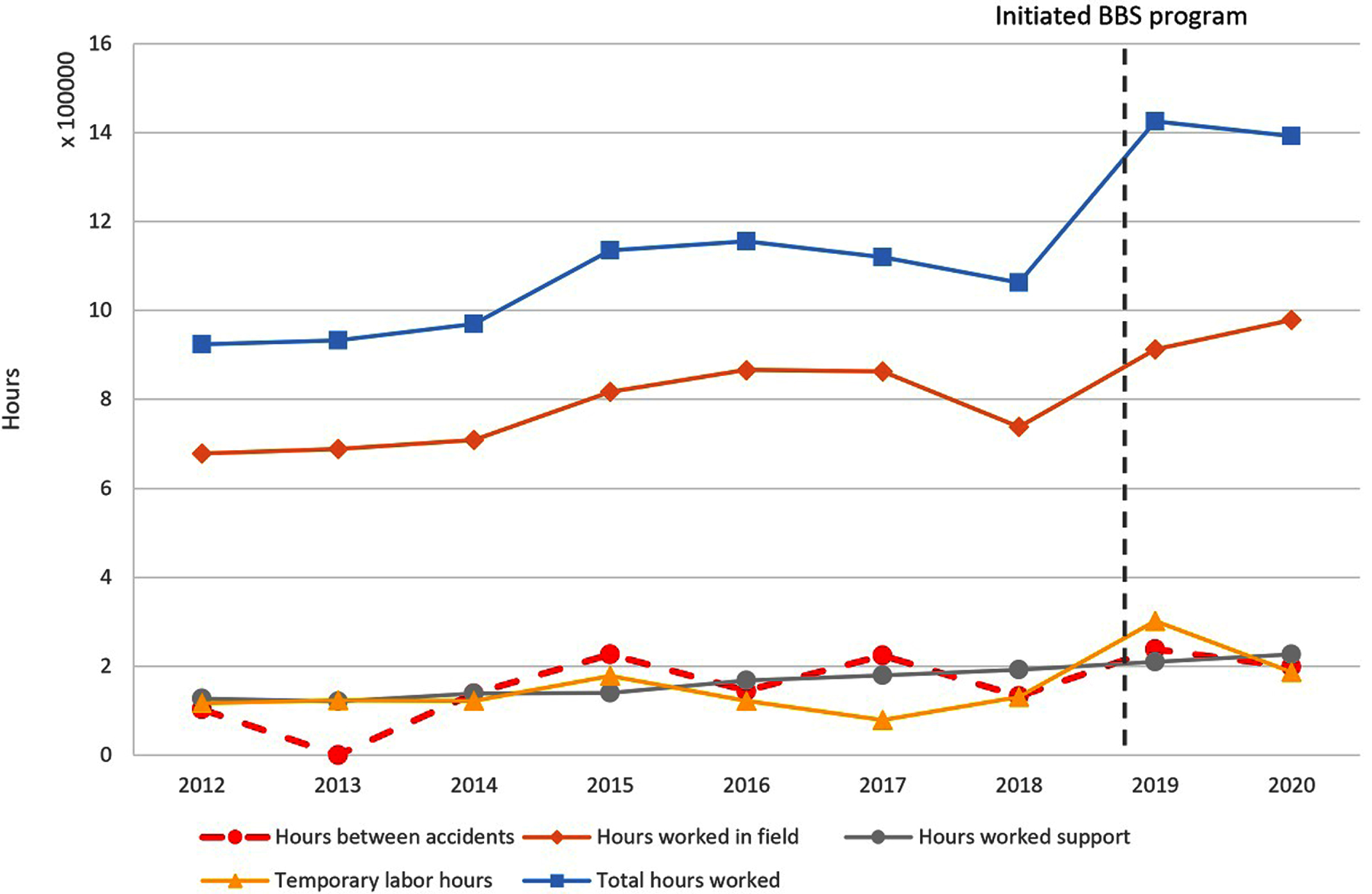
Working hours of the company between 2012 and 2020.
Incident rates between 2012 and 2020
For the accident type and numbers (Fig. 2), the three most frequent accident types were transportation, overexertion, and lacerations in 2018. In 2019, the most frequent accident was the same (transportation), but the second and third most frequent accident types changed. The second frequent accident type was contact with equipment/objects (24 to 29), and the third was overexertion (31 to 24). Lacerations decreased from 26 to 21.
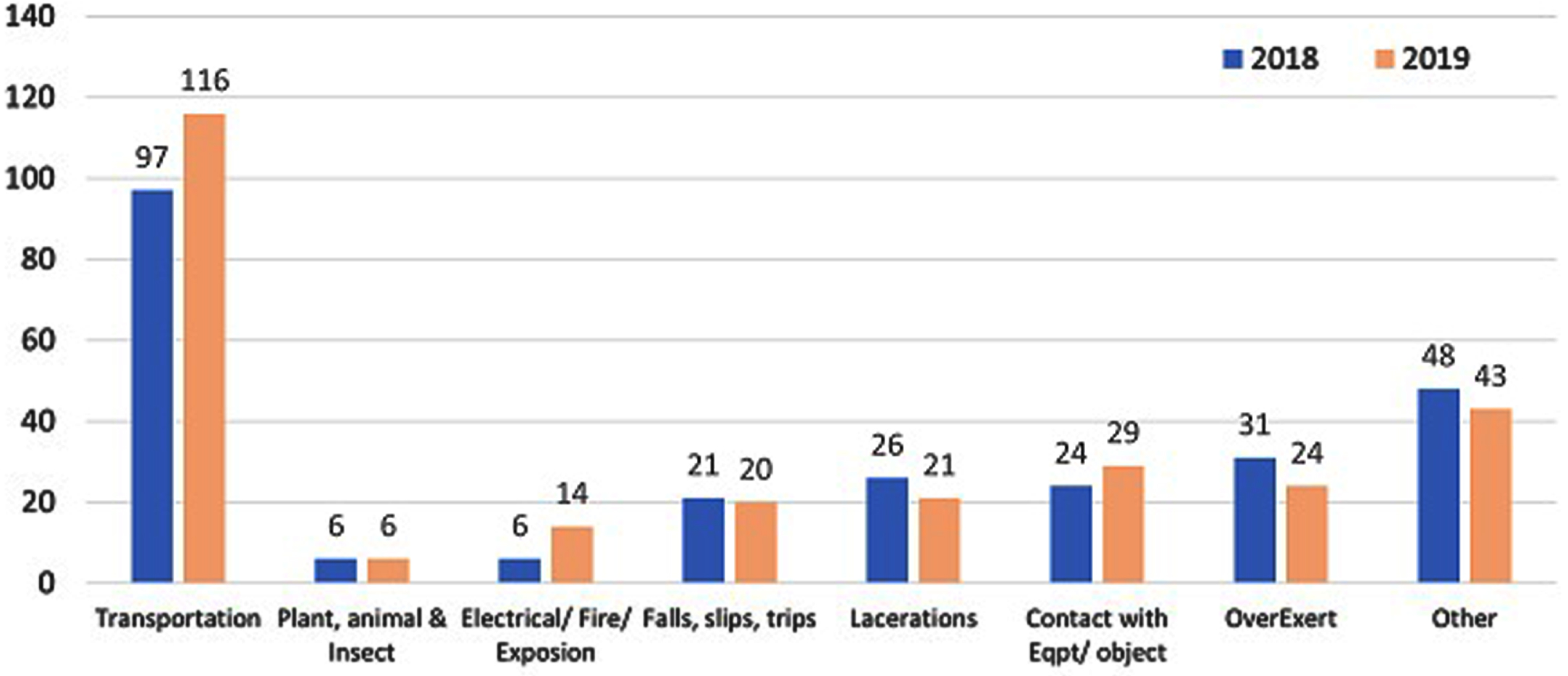
Accident numbers and types before (2018, total accidents = 259) and after (2019, total accidents = 273) adopting the BBS program.
The participants were asked to report the type of behavior and describe the tasks, if possible, via the BBS program. Table 4 shows the types of unsafe behaviors, their frequencies, and the types of tasks at hand. First, among eight unsafe behaviors, the line of fire (i.e., possible strike zone, pedestrian, material, or equipment) was the most frequently reported (20.12%), associated with 18 tasks in 92 comments. The line of fire was most frequently observed when workers were running or pulling wires. Second, the loss of balance/traction/grip (15.56%) was reported in 18 different tasks from 68 comments and was frequently observed when installing devices. Third, PPE-related unsafe behaviors (i.e., eye protection, gloves, sleeves, safety glasses, face shield, hardhat, harness, lockout/tagout) (14.88%) were found in 21 different tasks from 78 comments. Fourth, 14.16% of reports were about fatigue (tired or muscle fatigue over time, working out of the power zone). Fifth, rushing/frustration (12.31%) was observed in 24 tasks from 113 comments. Sixth, complacency (i.e., repetitive motion) was 11.80% of the reported unsafe behavior and was found in 23 tasks from 91 comments. Seventh, the eyes/ mind not on task accounted for 4.47% of the total unsafe behaviors in 10 tasks from 27 comments. The last behavior was proper tool use, which was observed in one type of task, running or pulling wires.
Unsafe behaviors reported via BBS program
Main tasks (Top 5) and their frequent risky behaviors (n, (%))
Note: Proper tool use was not in the table as it was not reported during the main tasks. Risky behavior (1) Line of fire; (2) Loss of balance/ traction/ grip; (3) PPE; (4) Fatigue; (5) Rushing/ frustration; (6) Complacency; and (7) Eyes/ mind not on task.
Among 61 tasks reported with risky behaviors, five main tasks were defined: 1) running or pulling wire, 2) installing devices, 3) installing lights, 4) running pipes, and 5) in the office. When workers were running or pulling wires, rushing/ frustration was frequently observed (15.95%). Fatigue was the most frequently reported risky behavior for installing devices or running pipes. Next, for installing lights, line of fire and rushing/ frustration were the most reported. Lastly, rushing/ frustration was the most reported unsafe behavior in the office.
After adopting the BBS program, the overall perception of safety climate was high, showing the range between proactive (4) and exemplary (5). The highest safety perception category was aligning and integrating safety as a value (4.68), followed by improving communication. The independent t-test showed no significant differences in eight criteria of the perceived safety climate between the BBS program participants and non-participants (Table 6). Although there was no statistical significance, BBS participants generally reported a higher level of empowering and involving employees, improving communication, and encouraging owner/ client involvement; whereas non-participants showed a higher perception of demonstrating management commitment, alignment and integrating safety as a value, ensuring accountability at all levels, improving supervisory leadership, and training at all levels.
Safety climate comparison between BBS participants and non-participants
Safety climate comparison between BBS participants and non-participants
After adopting the BBS program, more than 65% of the respondents reported that their perception of safety climate was moderately or significantly improved in all criteria (Table 7). The most improvement was found in aligning and integrating safety as a value, as about 75% of the respondents reported at least moderately improved, followed by ensuring accountability at all levels (74.13%).
Perception of safety climate and its improvement after adopting the BBS program (n = 141)
This study examined the BBS report, the perceived safety climate data, and incident data to find if the BBS program improved safety performance in a subject company. It was expected that BBS programs would positively impact reducing safety incident rates and enhancing safety climate in the subject company. Even though the single point of yearly incident data could not be compared statistically, the trend of incident rate slightly decreased in the subject company. Additionally, although the rate was not tested statistically, considering the increase in total hours worked and hours worked in the field, incident rates decreased after adopting the BBS program. Although this result complies with the previous studies, showing an increase in safety performance after adopting BBS programs [30, 37], it should be noted that the impact of the BBS program on incident rates is not conclusive because the subject company already had low incident rates in their records. Before adopting the BBS program, the incident rate was already lower than the first quartile of the incident rate (1.9) in the U.S. construction industry [49], so the decrease in the incident rate of the subject company was not significant. Also, there is a possibility that the BBS program contributed to reducing non-recordable incidents, which are minor cases but still can affect employee productivity and retention. In order to confirm the positive effect of the BBS program on safety performance (i.e., recordable and non-recordable incidents), further data collection with many companies is required.
The significance of this study is 1) to identify the most frequently reported risky behaviors, which might cause recordable as well as non-recordable incidents, and 2) to find the direct relationship between the implementation of the BBS program and employees’ safety climate. One challenge in safety management is to identify unsafe behaviors and condition accordingly [50], but this study was able to categorize the risky behaviors with the tasks. The participants reported eight types of risky behaviors via the BBS program. The most frequently reported risky behavior was the line of fire, followed by loss of balance/ traction/ grip, and PPE, and the risky behaviors were frequently observed during running or pulling wires, installing devices, installing lights, running pipes, and working in the office. It seems that these behaviors were mainly observed because of the nature of the work of the subject company. Importantly, this type of data is useful for the development of customized safety training for a specific company. For example, when running or pulling wires, workers should be cautious especially of rushing/ frustration, line of fire, complacency, and fatigue.
The company’s safety performance was also measured by the safety climate. After adopting the BBS program, the perceived safety climate was high, showing over 4.00 in all criteria. Additionally, more than 70% of respondents reported a moderate or significant improvement in the safety climate before and after adopting the BBS program. Among the criteria, aligning and integrating safety as a value showed the highest value. Initiating a safety program could influence the workers’ perception that the company shows their priority and commitment in safety [1, 50]. Notably, improving communication was the second-highest safety climate criterion. Communication within the company could increase when adopting a new safety program; furthermore, the BBS program could be a communication tool.
Interestingly, the level of perceived safety climate did not differ between participant and non-participant groups within the company. This result is possible because the BBS program and the safety climate (S-CATSC) measure had been adopted as a corporate-wide implementation. By initiating a corporate-wide safety climate, even the non-participants could be affected by the program. The safety program initiation shows the commitment of top management as well as co-workers, and it is one of the key factors to safety climate [1, 50]. The result of this study supports that partial employee participation in the BBS program can be effective, considering the overall safety perception of the company. Further examination of the application of the BBS program on an entire company can test the effectiveness of the BBS program, comparing the partial implementation.
In order to effectively adopt and use the BBS program, it is important to implement a further intervention. In the case of the subject company, they had three interventions based on the BBS results: 1) safety meetings, 2) replacing construction gear, and 3) updating safety training (Table 8). The BBS program enables the company to develop company-specific interventions based on the reports (i.e., risky behavior, tasks, and types of accidents). First, active communication is required between different positions as well as within the same position level. Communication plays an important role in encouraging employees to set safety goals and modify less desired behaviors. Communication should be throughout the entire organization and provoke thoughts from everyone concerning safer practices. Second, the reported data can be evidence of replacing or updating safety gear. When the accidents are related to the underperformance of gear, they can be replaced by one with better performance. Third, safety training can be focused on the results of the BBS reporting to correct risky behaviors and improve the safety quality [42, 51]. The key risky behaviors, main tasks, and accident types can be emphasized during the training of the subject company. Further interventions of the BBS program can be found to be more effective in enhancing safety on the site [52].
Intervention after adopting the BBS program
Intervention after adopting the BBS program
This study has several limitations. First, this study is a case study focusing on one company adopting the BBS program. This program needs to be applied to other construction companies to find generalized results. Second, this study retrospectively asked whether and how they perceived safety climate increased after adopting the BBS program compared to before, rather than measuring the safety climate before and after adopting the BBS program. Third, this recall survey had a possibility to reduce the reliability of the data due to the limitation of recall. Finally, although the frequently reported types of incidents (i.e., transportation, overexertion, lacerations, contact with equipment/objects) are related to at-risk behaviors reported in the BBS program (i.e., line of fire, loss of balance/traction/grip, PPE, fatigue, rushing/frustration, complacency (repetitive motion), and eyes/mind not on task) as well as types of tasks at hand (i.e., running or pulling wire, installing devices, installing lights, running pipes), this study is limited to claim the direct relationship between at-risk behaviors and the types of incidents.
This study demonstrated the importance of empowering and involving employees to improve safety behaviors and the overall safety climate and reduce incident rates. Implementing the BBS program, where a company’s leadership shows strong safety support and encourages coworkers to observe each other’s safety behaviors on-site, benefited in cultivating the company’s collective safety climate and culture. As a result of the BBS program, the subject company implemented three follow-up actions: 1) better communication strategies for their safety meetings on the most frequently reported at-risk behaviors, 2) replacing safety gear with higher quality ones, and 3) redesigning online safety training to better reflect the identified tasks that were associated with more at-risk behaviors.
The findings, as well as the subject company’s follow-up actions, illustrate the integration of top-down and bottom-up approaches. Although the BBS started from the organizational level leadership, the employees actively participated in the program and reported at-risk behaviors of coworkers. Through this iterative process of identifying commonly observed at-risk behaviors, the company’s safety team improved their safety programs by emphasizing at-risk behaviors in the company-wide safety training methods and communication and providing better equipment to prevent risk-inducing, compromised behaviors at job sites. This approach of continuous improvements based on workers’ observation will further strengthen employees’ own safety perception as well as safety climate toward their organizations, which will help not only to lower incidents but also retain and attract current and future employees.
To improve the results of this study, future research could consider several approaches. First, conducting further investigations on the other three companies within the same corporation is recommended, and tracking at-risk behaviors reported in the BBS program consistently. Second, using multilevel modeling analysis to account for the hierarchical nature of the data would be beneficial, as there was one corporation, four companies, branches under each company, division of work, and individual workers. Third, a longitudinal study could be conducted by following the BBS program data over several years after its implementation. Lastly, exploring interventions that empower workers to participate in the BBS program is crucial. Multilevel modeling can help identify the residual variance within data hierarchies at each level, as well as individual responses over time.
Footnotes
Ethical approval
The study was approved by the Tuskegee University Human Participant Review Committee (HPRC-IRB) (approval no. 082020 on September 7, 2020) prior to recruitment, consistent with the relevant section of 45 CFR 46 Code of Federal Regulation.
Informed consent
Informed consent was obtained from all participants. The manuscript does not contain any identifiable individual data in any form.
Conflict of interest
The authors declare that they have no conflict of interest.
Acknowledgments
Many thanks to Brandi Williams for recruitment and all study participants.
Funding
The authors declare that there was no funding for this research.