




Abstract
BACKGROUND:
In March 2020, with the scope to reduce the spread of COVID-19, most national governments around the world canceled in-person education and moved to online learning. Therefore, teachers and students had to adapt a new way of teaching. Most of Italian teachers never had such an experience before and encountered difficulties in effectively carrying out this process on their own. Difficulties that can naturally increase anxiety and stress, leading, in situations perceived as extreme, to burnout syndrome.
OBJECTIVES:
This paper endeavored to verify levels of job stress and burnout of Italian teachers caused by the COVID-19 pandemic using the validated Maslach Burnout Inventory-General. This study aimed to measure the association among the three main dimensions of burnout and the variables of teachers’ personal and working lives that changed due to COVID-19.
METHOD:
The aim of this paper was to verify burnout state and to measure the association among the three dimensions of burnout and the personal and working lives of Italian teachers using structural equation model analysis. The analysis was conducted in December 2021 and considered the situation in which the Italian teachers (from primary to middle and upper school) are working since March 2020.
RESULTS:
The results showed that teachers were emotionally exhausted; they did not feel able to fully fulfill their task towards the students. This involved a high absenteeism, a lower quality of work performance and the impossibility of making an objective evaluation of the students with an inevitable flattening of the class level. In contrast, the study shows that teachers who experienced few problems had relatively low levels of burnout.
CONCLUSION:
The findings brought out some proposals to reduce the risk of burnout and increase the individual well-being of schoolwork organization with positive effects on the lives of students: to strengthen social identity, to avoid a full-time online connection, to promote a psychological support service and to promote resilience training.
Introduction
The COVID-19 pandemic influenced education in various ways [24]. In March 2020, most national governments around the world canceled in-person education and moved to online learning with the aim to reduce the spread of COVID-19. The first consequence was teachers and students had to adapt to this new way of teaching [25, 33].
The online learning negatively affected the students, especially of primary and secondary schools, that have higher difficulties in adapting to the new learning environment than college students [3, 26, 75]. For example, children and adolescents can have more difficulties in creating and managing these strategies [43]. The transition from in-presence to online exacerbated existing educational inequalities among the students with the consequence that those from less advantaged backgrounds may risk falling behind during the online period, in fact students that are disadvantaged for socio-economic reasons are likely to have less access to technological means and students with special needs cannot find an adequate support. The transition from in-presence to online exacerbated existing educational inequalities among the students with the consequence that those from less advantaged backgrounds may risk falling behind during the online period. Furthermore, students’ isolation from their friends and teachers may cause greater inequality in the emotional well-being and motivation and may led to behavioral and psychological problems [18]. Another factor to consider is that with the closure of the schools, parents’ anxiety about learning and development of their children increases, and it becomes a demand for more attention from teachers and more time for their own children [35].
In this scenario, teachers had to cope more intense workloads, demands and expectations than when education is maintained in the classroom and with easily accessible communication technologies [8]. This implies that they did not just have to change their way of teaching by abandoning the frontal lesson in favor of new forms of online education [16], but also try to emotionally support the students inspiring them to study [56]. Many teachers never had such experience before or received sufficient training on how to deal with such a crisis and they were caught unprepared for this process. Furthermore, in many countries, teachers are expected to take the initiative and carry out this process on their own. Obviously, teachers that have limited skills in providing remote education or little experience dealing with digital tools, faced difficulties in effectively carrying out this process alone. Difficulties that can increase anxiety and stress, leading to burnout syndrome [23]. Teaching is a “helping profession” and therefore subject to emotional collapse. Hence, understanding burnout among teachers, as well as the factors related to it, takes on a fundamental importance [15, 29]. As a consequence, it is relevant to verify how COVID-19 pandemic is affecting teacher stress in order to measure job satisfaction and to find practical implications that improve quality of life for teachers and students too.
The current literature focuses mainly on analyzing how teacher social-emotional competence and professional development are associated with effective stress alleviation at work [59, 60]. Other studies investigated the impact of disciplinary problems of students on teachers’ job satisfaction [27]. Through a literature search, it emerges that the predominance of studies has essentially tended to focus on single aspects of this topic. This document offers an exhaustive framework on the various aspects related to the burnout, highlighting how these interact with each other.
The aims of this paper are: to verify levels of job stress and burnout of Italian teachers, measured using the validated Maslach Burnout Inventory-General [44]; to measure the association among the three main dimensions of burnout and the variables of teachers’ personal and working lives that changed due to covid-19. For this purpose, we submitted, in December 2020, a questionnaire to 1450 teachers and analyzed the data through structural equation model, a statistical technique capable to explore the complex and dynamic nature of interactions.
This paper is divided into further five sections. A focus on burnout is discussed in Section 2. Section 3 provides a description of methodology, questionnaire structure and procedure applied. Section 4 shows the results of applying the model to the data. Section 5 provides findings and discussion remarks. Some final remarks are made in Section 6.
The concept of burnout
In the 1930 s, the term burnout (literally, “burst”, “burned”, “exhausted”) was used, for the first time, in sports jargon and indicated the end of a sporting career after numerous victories [50].
From the 1970 s, thanks to Freudenberg, this term was used in the working field, particularly in the helping professions (occupations in the fields of psychology, psychiatry, counseling, medicine, nursing, social work, physical and occupational therapy, teaching, and education), that provide health and education services to individuals and groups. These categories of workers, in fact, are subject to emotional collapse caused by constant interaction with people who need help [58].
Burnout is a reaction to prolonged or chronic job stress [5] and is characterized by three main dimensions [44]: emotional exhaustion is a state of feeling emotionally worn-out and drained those results from excessive job, personal demands or continuous stress. People experiencing emotional exhaustion feel like they have no control of their life, feeling of being emotionally overextended and exhausted by one’s work. depersonalization that manifests as cynicism, coldness and hostility towards users. People experiencing depersonalization become more negative, impersonal or cold in one’s interactions with family, patients, colleagues and staff. reduced personal accomplishment due to a sense of inadequacy and incompetence at work. It represents the tendency to feel inadequate to perform one’s job, and to have generalized low professional self-esteem.
In 1998 Schaufeli et al. and in 2008 Maslach et al. highlighted that the three measurements of burnout do not necessarily evolve at the same time, and therefore, also the detection of one of the three could be important for the early recognition of burnout. In 1996 Lee et al. and in 2005 Taris et al. showed that the association among the three dimensions is a causal process that reflects the development of burnout.
Stress can be caused by different factors, intra- and extra-work. COVID-19 has created new and relevant stress variables that have been analyzed by a large amount of international research [17, 39, 52, 54, 61, 65, 68]. Hence, burnout has been fueled not only by the necessity to build and adapt to new teaching methods but also by anxiety, anxiety to communicate with parents, administrative and logistic support, personal beliefs about the situation, difficulties in using online platforms. Importance had also been given to attitude toward change, social and emotional intelligence, negatively correlated with burnout. Teacher’s personal situation is related to student’s learning and well-being and it is still fundamental with the return to face-to-face teaching. Many studies, this included, used the Maslach Burnout Inventory-General [44], since it is the most used and validated questionnaire, hence one of the most reliable [7, 39, 61]. To deepen possible behavioral outcomes of the teachers and other specific variables related to burnout dimension, we decide to create a specific questionnaire, that analyze five areas:
As suggested by Mojsa-Kaja (2015), Makhdoom (2019) and De Carlo (2019), these factors can be depauperated by an excessive amount of work. Excessive workload may create work-related stress and, in some individuals, may lead to emotional exhaustion, personal accomplishment and depersonalization (three burnout dimensions). Based on these considerations, we believe that five areas are related with the three burnout dimensions. The main hypothesis is that these five areas are not only affecting burnout, but are also affected by it, in a circle of mutual influence. Understanding if these other areas affect (and are affected by) burnout could be very useful in term of contrast and prevention of the syndrome. Moreover, measuring other dimension beyond burnout, could stimulate teachers’ awareness about what they could change actively to feel better.
Method
Methodology
Structural equation modeling (SEM) has gained an increased popularity in the last decades and it is used in many scientific sciences, like in the social sciences [57], psychology [55] and educational research [1].
One of the main objectives of the SEM is to investigate whether the hypotheses based on a theoretical model (referred to as the Conceptual Framework) reflect the observed data. In other words, the SEM model tries to understand if, given a theoretical model, it is possible to verify its reliability and accuracy on real data.
SEM is a measurement model for investigating relationships among manifest variables (directly measured data) and latent variables or theoretical constructs [6] and a structural path model, which relates the constructs to other constructs. In SEM, it is necessary a distinction among exogenous and endogenous variables. The first are commonly call independent variables or constructs, the second are dependent variables or constructs which are predicted by exogenous variables. The SEM model combines two tools within a single framework: confirmatory factor analysis and multivariate regression analysis.
The measurement model is essentially a confirmatory factor analysis (CFA) [28] and in matrix terms for both the exogenous and endogenous variables is:
where, x is a vector of independent measured variables, ξ is a vector of independent latent variables, Δ x is a matrix of exogenous factor loading of the x’s on the factors ξ, δ is a vector of measurement errors in x, y is a vector of observed variables, η is a vector of dependent or endogenous constructs, Δ y is a matrix of endogenous factor loading of the y’s on the factors η and ɛ is a vector of measurement errors in y.
The purpose of CFA is to build a model suitable for studying the relationships between the observed variables and the latent variables, i.e. those constructs are not observed, but derived from the combination of the observed variables.
The path model, which relates constructs to other constructs, in matrix terms is:
where, B is a matrix of coefficients of the η’s on η’s, Γ is a matrix of coefficients of the ξ’s on η’s and ζ is a vector of random disturbances [6].
The two widely used methods of SEM are: Covariance based Structural Equation Modeling (CB-SEM) and Partial Least Squares based Structural Equation Modeling (PLS-SEM). The first approach is based on covariance, and the second one is based on variance (partial least squares). Translated into sociological research, the distinction between CB-SEM and PLS-SEM is straightforward. If the research objective is theory testing and confirmation, then the appropriate method is CB-SEM. In contrast, if the research objective is prediction and theory development, then the appropriate method is PLS-SEM. Starting from these considerations, the CB-SEM analysis is an effective tool for relating the three dimensions of burnout and the variables of teachers’ personal and working lives that changed due to COVID-19.
Questionnaire
The questionnaire is consisted of 47 questions and divided into three sections.
The first section focuses on the various socio/demographics of a teacher which could help us to identify the following aspects: gender, age, residence, digital knowledge and didactic platform used for teaching.
The second section focuses on aspects that characterize teachers’ lives. It is divided into five areas, corresponding to the various aspects of teachers’ lives during pandemic period. For each area the questions derive from the study of the present literature. Participants used a 4-point Likert-type scale (1 = disagree, 2 = neutral, 3 = agree, 4 = strongly agree) to indicate the response to each item. Asterisked items are reverse scored, so that the opposite is true. To evaluate the internal consistency of each area, Cronbach’s alpha was computed considering a sample size of 50 teachers. Below the areas considered and the respective Cronbach’s alpha values: Deviant behaviors [38, 53, 69] (A1) were measured with the 4-item: “During digital teaching are you having an attitude of disinvestment in the training of students?”, “During digital education, were you able to detect signs of deviant behavior?”, “During the digital teaching managed to involve vulnerable students?” and “Did you leave your job during online education? *”. Cronbach’s alpha was α=0.89. Positive behaviors [19, 31] (A2) were measured with the 4-item: “During digital education, were you able to implement creative teaching methods?”, “Did you use alternative teaching aids for your lessons?”, “Did you attend digital education training courses at your own expense?” and “During digital education, did you use technological teaching tools (Socrative, Kahoot, Prezi, whiteboard)?”. Cronbach’s alpha was α=0.87. Teacher’s work organization and lifestyle [2, 36] (A3) were measured with the 3-item: “The hobbies you have now, are they the same ones you had before March 2020?”, “Do you take longer to prepare your lessons than in March 2020? *” and “Did digital teaching have a negative impact on your free time? *”. Cronbach’s alpha was α=0.81. Motivation of students [30, 46] was measured with the 4-item: “Do students feel motivated to attend online lessons?”, “Have you noticed if the level of motivation of more diligent students has decreased?”, “Have you noticed if the level of motivation of less students has increased?” and “Do students often leave online lessons?”. Cronbach’s alpha was α=0.82. Evaluation [14, 32] was measured with the 4-item: “Do you notice if the tasks performed by the students are similar to each other?”, “Did the students’ learning levels in the digital teaching period improve compared to those of the previous school year?”, “Do you think that digital teaching has compromised the effectiveness of learning? *” and “Do you think that an adequate assessment can be made even during digital teaching?”. Cronbach’s alpha was α=0.82.
The third section focuses on Maslach Burnout Inventory-General [44], a 22-item questionnaire, each a 6-point Likert-type scale (ranging from 1 – strongly disagree to 6 – strongly agree), which identifies three factors related to Burnout: emotional exhaustion, depersonalization, and personal accomplishment. The 9-item Emotional Exhaustion (EE) scale measures the sensation of being emotionally stressed and exhausted by one’s job. Higher scores imply a strong propensity for burnout. The 5-item Depersonalization (DE) scale insensitivity and impersonality towards individuals for whom a service is intended. Higher scores imply a strong propensity for burnout. The 8-item Personal Accomplishment (PA) scale measure the feeling of being competent and satisfied in one’s work. Lower scores imply a strong propensity for burnout. In our analysis we used the Italian validation of the Maslach Burnout Inventory.
The questionnaire was built, using the Google questionnaire platform, with reference to the indicate studies. After the construction there was the pretesting process. The questionnaire was tested with a group of 50 people who provided feedback on the complexity and how the questions were formulated. The pretest was also used to detect obvious defects. This phase did not highlight any critical issues. The questionnaire was diffused using direct contact with teachers located in the national territory and social platforms: Twitter, Facebook, WhatsApp, Instagram and LinkedIn. It was administered, in December 2021 and of 1474 participants, 1450 questionnaires returned complete (1333 females and 117 males 1 , domiciled in Italy 2 and average age of 47 years (σ = 10)). Participants in the study were teachers: 476 teachers in elementary school, 387 teachers in middle school, and 587 teachers in high school. In our analysis we didn’t take into consideration incomplete questionnaires (only 1.6% of the total) and this allowed to disregard the handling of missing data. The analysis was carried out on the full sample without considering the school grade in which teachers work. For the analysis we used a non-probability sampling technique because participants are self-chosen, and not selected on a random basis.
Results
The data distribution tables in the first section of questionnaire enabled us to obtain a general understanding of the background of respondents: 30% of teachers did not use or rarely used the PC before March 2020 (203 teachers in elementary school, 157 teachers in middle school, and 75 teachers in high school). As asserted by Badia, Menes and Sigales in 2013, this was a consequence of the fact that generally teacher had little training using ICT; 81% of the interviewees use the same platform for digital teaching: G-Suite; 52% of the sample declared that in the first period of the school year 2020/21 they did not participate in any training course on digital education promoted by the school in which they work (302 teachers in elementary school, 197 teachers in middle school, and 255 teachers in high school); 45% of teachers declared that the school did not provide adequate teaching tools (tablet, internet connection and education app) (307 teachers in elementary school, 211 teachers in middle school, and 135 teachers in high school).
The answers of the third section helped us to measure the levels of burnout syndrome assessing emotional exhaustion, personal accomplishment and depersonalization, according Maslach Burnout Inventory-General scale. In Table 1, the synthetic values obtained. The results showed that the teachers interviewed are subjected to a strong emotional exhaustion due to the situation they are experiencing in this period. Despite this, the data highlighted significantly low values for the factor’s personal accomplishment and depersonalization and this implies that teachers have a great ability to be resilient [74].
Burnout scores
Burnout scores
To investigate the relationship between the three burnout levels and aspects of a teacher’s private and working life we applied CB-SEM analysis. The total scores of three Burnout dimensions were viewed as observed variables.
In order to determine the correct structure of SEM analysis [28], we conducted both an exploratory and confirmatory factor analysis on the data distribution tables of second section of questionnaire using EFAtools package of the R programming environment, available at the link https://cran.r-project.org/web/packages/EFAtools/index.html and the lavaan package available at the link https://cran.r-project.org/web/packages/lavaan/index.html.
The exploratory factor analysis (EFA) allowed to identify the optimal number of latent variables (Allen, 1989). For this analysis we used the EFA function of the package EFAtools. The function was performed with varimax rotation using maximum likelihood estimation and by varying the number of factors to extract. The number of factors was evaluated by using chi-square test (χ2), comparative fit index (CFI≥0.95 is good; Bentler, 1990) and root mean square error of approximation (RMSEA≤0.08 recommended). The models (with one to five factors) considered were also compared using Akaike information criterion (AIC), Bayesian information criterion (BIC) and the index denoted as CAF (common part accounted for). Lower values indicate a better fit, and so the model with the lowest AIC, BIC and CAF is the best model. According to these criteria, the optimal number of factors to extract was five. In Table 2 were represented the factor loadings for the final EFA (method = ML, varimax rotation, χ2(86)=228.26, p < 0.001, CFI = 0.98, RMSEA = 0.03, AIC = 16.26, BIC = -368.76, CAF = 0.49).
Exploratory factor loadings
The finding highlights that the number of factors coincides with the number of sections reported in the second part of questionnaire. The variables with highest scores for each factor, represent the inserted questions in a specific section.
A confirmatory factor analysis (CFA) was conducted with CFA function of the package lavaan. In this analysis, no error covariances were freed; the first item in each factor was fixed at 1.00 and the other item within each factor were freed. The covariance of the five factors was fixed. The CFA also supported a five-factor model with an adequate fit (estimator = ML, χ2(142)=1105.16, p < 0.001, RMSEA = 0.03). Table 3 summarizes the selection of manifest variables and latent variables or constructs used in the formulation of the model proposed.
Latent constructs
Before obtaining the complete model was necessary to verify the level of collinearity among the constructs or latent variables. The collinearity test on CB-SEM was analyzed by determining the Variance Inflation Factors (VIF) [70]. Johnston and Jones stated that a VIF value greater than 5 has a problem with collinearity. In this study, the maximum VIF for the item is 2.807 and for the construct is 3.954 (workload). Thus, it can be concluded that the VIF value for items and variables is quite low, and the problem of multicollinearity does not exist. Finally, to examine the relationship of latent variables with three dimensions of burnout, we conducted a structural equation analysis using function SEM of package lavaan. This approach focuses the analysis on the structural level of the model that is the primary concern in addressing the research question. In Fig. 1 was displayed the proposed SEM model (estimator = ML,
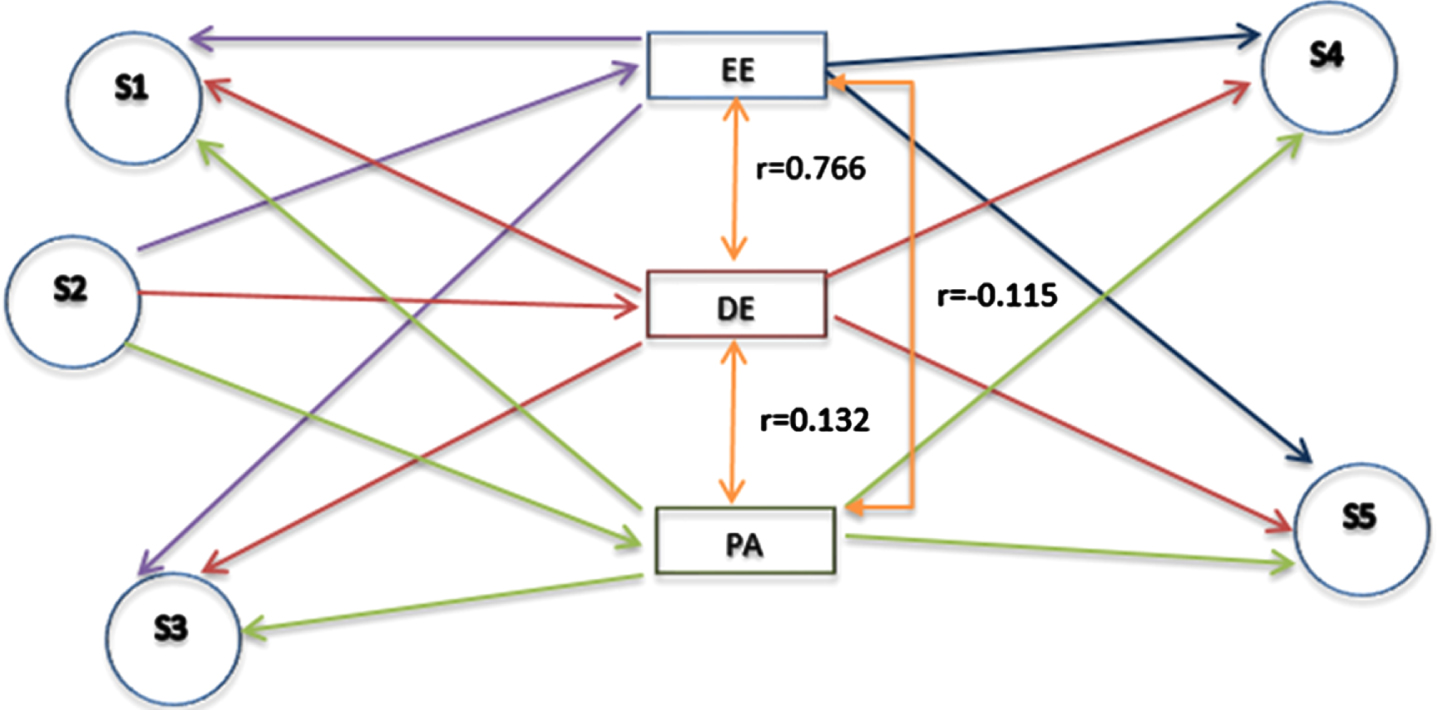
Expanded model of burnout: The impact deviant behaviors, positive behaviors, teacher’s work organization and lifestyle, motivation of students and evaluation.
The data, according to theory, highlighted an association between the three dimensions of burnout. Emotional exhaustion, personal accomplishment and depersonalization were significantly correlated (r) with S1 (r = 0.302, p < 0.001; r = 0.641, p < 0.001; r = 0.104, p < 0.001, respectively), S2 (r=-0.102, p < 0.001; r = -0.122, p < 0.001; r = -0.252, p < 0.001), S3 (r = 0.603, p < 0.001; r = 0.137, p < 0.001; r = 0.179, p < 0.001), S4 (r = 0.215, p < 0.001; r = 0.197, p < 0.001; r = 0.450, p < 0.001) and S5 (r = 0.412, p < 0.001; r = 0.414, p < 0.001; r = 0.255, p < 0.001).
Little & Co. (2002) showed that, when the research question concerns the relationship among constructs, is appropriate to verify the goodness of fit of a model with a reduced number of factors. Therefore, we examined the structural null model that leaves the factors uncorrelated and another attachment model in which we deleted the factor S2, characterized by relatively low correlation values. The results showed that the null model has a poor of fit (the model does not fit with the set of observations) (estimator = ML,
The results in Table 1 highlighted that 59% of the interviewees are subjected to a strong emotional exhaustion, feeling emotionally worn-out and drained. This is due to the stress from work or lives events. Despite this, though only 6% of teachers developed negative and sometimes callous attitudes toward students or colleagues, rather 99% believed to be realized professionally and therefore to be effective in helping students learn and in fulfilling other school responsibilities. According to Global Maslach Burnout Inventory-General scale, the 66% of teachers are at severe risk of burnout. The findings are coherent with the most recent literature [17, 39, 52, 54, 61, 68]. The dimension of positive behaviors has been found with a preventive and mediating role. This is coherent with other studies too [65]. This finding reflects a personal positive attitude but the same attitude could be inspired by school institutions, to help teachers feeling less helpless.
The SEM analysis showed that the three burnout dimensions were found to be differentially correlated to other variables reflecting aspects of work, ability to cope with stress or self-efficacy. The exhaustion component of burnout was more predictive of stress-related health outcomes than the other two components. Emotional intelligence and socio-emotional competencies, as well as the positive attitude toward changes and positive behaviors, can be seen as a personal feature [61]. Creativity and self-esteem can be also considered as protective factors [71–73]. However, since they are related to a better well-being and more effective students’ learning, they could be implemented by specific programs, following SEL projects [51].
As it was predictable reading previous literature [42], the SEM analysis highlighted those teachers, who manifest emotional exhaustion, perceive they are unable to give of themselves to students as perhaps they did earlier in their careers and are led to implement deviant behaviors: high absenteeism, retirement, and turnover rates and a lower quality of job performance. On the other hand, teachers that put into action positive behaviors such as following a course concerning the new platforms or preparing lessons or that are better suited to the needs of remote learning, have a low value of the variable related to emotional exhaustion [4, 5]. These findings confirm previous literature in relating teachers’ deviant behaviors to burnout dimensions [42, 49] but also the relations between them and positive behaviors [65]. The results, moreover, underline the importance of a balanced private life, that should not be depauperated by an excessive amount of work. The data showed many stressed teachers had to change their lifestyles by having no free time between planning of lessons and evaluation of students. This generates further stress which is perceived as the feeling of being emotionally overextended and drained by others going to increase emotional exhaustion.
Another important finding of our analysis is that the chronic work-related stress leads teachers to the inability to make an objective assessment. This will automatically lead to a poor attention of the teacher in the revision of test resulting in the levelling of the class and foment a teacher-student vicious cycle of frustration [12]. Hence, even if scholars do not all agree about what teacher effectiveness is, it seem undoubtable that burnout affects student evaluations of teaching, classroom observation, and student academic achievement. In fact, emotional exhaustion, personal accomplishment and depersonalization influence teacher’s motivation.
We believe that these correlations are circular and multidirectional, considering individuals as systems. So, it is likeable that, even if there is a large amount of literature that report relations between burnout dimensions and specific personal features of teachers, those influences are not unidirectional and that each aspect affects the others.
Conclusions, practical implications and limitations
In March 2020, most educational institutions around the world canceled in-person education and moved to remote learning. The transition from offline to online learning affected negatively the students exacerbating existing educational inequalities. In this scenario, teachers play a central role. They had to change their way of teaching by abandoning the frontal lesson in favor of new forms of online education and to try to emotionally support the students. However, many teachers, that never had such experience before or received sufficient training on how to deal with such a crisis, faced difficulties in effectively carrying out this process alone. Difficulties that increased anxiety and stress, leading to burnout syndrome.
In this paper, we measured, using Maslach Burnout Inventory-General, burnout levels among the teachers. The results highlighted that the teachers under test are subjected on one hand to a strong emotional exhaustion and on the other have a great ability to be resilient (low values for the factors personal accomplishment and depersonalization). This ability to adapt derives surely by previous experiences, the teachers are quotidianly stressed by classroom disruptions [65], by lack of student motivation and by problems with maintaining discipline [37]. The COVID-19 pandemic can be considered as another different situation or stimulus and, as asserted by Lazarus and Folk (1986), to be a condition that could lead to an increase in the perception of work stressors and that teachers have to face by implementing their own adaptive skills.
The SEM analysis allowed us to verify the relationship among the three burnout levels and aspects of a teacher’s private and working life. The results showed a correlation between the three burnout dimensions and the variables reflecting aspects of work, ability to cope with stress or self-efficacy. The statistical model highlighted that a strong emotional exhaustion, due to the situation the teachers are experiencing in this period, had a negative impact not only on their private and working life but also on the lives of students. The teachers, in this situation, perceive they are unable “to give themselves” to students. This involves high absenteeism, a lower quality of job performance and the inability to make an objective assessment of students with an inevitable flattening of the class level. In contrast, the study shows that teachers who experienced few problems had relatively low levels of burnout.
The findings brought out some proposals that could improve the quality of the work-life of a teacher improving burnout levels: to strengthen social identity. Affiliation with a group confers self-esteem resulting in a lower level of inadequacy and lower emotional exhaustion [9]. It could be considered to propose moments of sharing, supervision and intervision as happens for psychology professionals. In this way teachers could monitor themselves, vent their frustrations and share particularly difficult cases, at the same time this could foster group cohesion and trust in the school; to avoid continuous connection. Teachers must have the opportunity to take care of their passions and hobbies feeling less burdened by work. All this would be possible if educational institutions regulated the right to disconnect, a proposed human right regarding the ability of people to disconnect from work and primarily not to engage in work-related electronic communications such as e-mails or messages during non-work hours [64]; to promote the presence of a psychological support service within school institutions and with the possibility of receiving it online. Group interventions would afford include vicarious learning from others, knowing and being comforted by the fact that others share one’s difficulties and practicing in a safe environment constructive solution for interpersonal problems [21]; to promote resilience training, programs designed to reduce stress related to work and prevent absenteeism [11]. This could include the recruitment of new figures, both teachers and technicians, who can assist or replace teachers in the design of online content or during remote lessons. Moreover, there should be more technological support which can be given through a specific financial grant or through the provision of tools by the institution; propose refresher courses on new educational technologies. These should no longer be the prerogative of willing teachers, but should become part of everyone’s knowledge base. The pandemic has in fact made evident the unpreparedness of teachers not only for the use of specialized platforms, but also for the basic use of PCs and tablets [13, 16, 76]. This has contributed, although it is not the single cause, to fuel the teachers’ frustration and difficulty, hence the burnout.
These proposals would reduce the risk of burnout and increase the individual well-being of schoolwork organization with positive effects on the lives of students and their families too.
There are some limitations of this study. First, the study was cross-sectional, and the mediating model was insufficient to determine any causal relationship between schoolwork, burnout, resilience, and well-being. More experimental, prospective, and longitudinal approaches would be carried out to examine causality between these variables in the future. In addition, we have a limitation on sampling too. The data came from teachers that had volunteered to answer questions and no structured sampling framework was applied in the selection. Therefore, the results may not be fully generalizable. Future studies can expand the samples using a structured approach.
Footnotes
Ethical approval
Not applicable.
Informed consent
Consent was obtained from all participants in the first part of the questionnaire before the research commenced.
Conflict of interest
The authors declare that the research was conducted in the absence of any commercial or financial relationships that could be construed as a potential conflict of interest.
Acknowledgments
The authors thank all participants.
Funding
The authors have no funding to report.
The elevate percentage of female teacher reflects the real situation of Italian school as asserted by Eurostat report of 2022.
25% North, 27% Center, 35% South and 13% Isles.