




Abstract
BACKGROUND:
Over the years, the workplace landscape has significantly evolved, demanding an optimal psychological approach to establish an environment that values individual work and health. A firm’s culture inspires it to adopt business practices that enable its employees to live healthier lives.
OBJECTIVE:
The study aims to measure the mediating relationship of transparent communication between organizational culture and mental health in the Pakistani healthcare industry. The study also explores the relationship between organizational culture and mental health.
METHODS:
The study collected primary data via purposive sampling from the healthcare employees of Pakistan between March and May 2022. The study’s sample size consists of 509 respondents from the healthcare industry sector, and the research used Smart PLS software to measure the relationship through bootstrapping and algorithms.
RESULTS:
Organizational culture has a positive effect on the employee’s mental health. The study has found significant positive mediation of transparent communication and moderation of organizational trust between organizational culture and mental health.
CONCLUSION:
The COVID-19 pandemic has deteriorated workers’ mental health, causing considerable changes in the healthcare sector. Positive mental health at work is a critical factor that improves the working environment. As such, this study highlights the importance of mental health in the workplace setting. It extends the literature in the context of the healthcare industry, thus supporting employees’ well-being. The findings suggest a significant relationship between an organization’s culture and mental health. This study suggests the theoretical and practical implications for policymakers’ and researchers’ perspectives concerning employees and organizational culture.
Keywords
Introduction
Fast-growing globalization’s alterations of people’s lives is a constant feature of today’s world. However, besides the progressing modernity, workplace changes have caused employees to face numerous health challenges in every sphere of life [1]. Increasing competition and environmental complexity have elevated the need for novel business strategies to foster employees’ health [2]. As a result, many organizations need a healthier corporate culture to address their employees’ psychological issues to adapt to the changing business environment.
Organizational culture (OC) plays a vital role in managing workplace challenges. An organization’s culture refers to its shared beliefs, norms, consciousness, and faith [3], plus how it nurtures employee behavior, attitude, and well-being. It alludes to organizations’ processes, practices, and activities influencing employee performance [4, 5]. However, in recent years, the topic of an organization’s culture has received researchers’ attention in various contexts (e.g., management and psychology). OC is a significant component that enhances employees’ well-being. It develops a healthy working environment that ensures employees’ psychological wellness. The existing research states that workplace culture significantly fosters employee psychological well-being [6, 7], thus influencing their work performance. Indeed, in addressing increasing mental health (MH) issues in the workplace, corporate culture is conducive to workers’ welfare. As such, one study reveals that OC strives to harness the physical and psychological components of individuals’ health, thus raising the question of employees’ MH in various disciplines [8, 9].
Unsurprisingly, the healthcare industry is among the world’s fast-growing sectors [10]. However, besides being the fastest-emerging sector, research shows that the healthcare industry is still striving to improve its employees’ MH [11]. The healthcare industry demands constant hard work, thus heightening the perceived risk of MH problems for its workers. In particular, working in the healthcare industry sector can create worry and distress in individuals, thereby compelling organizations to embrace proactive policies for improving employees’ MH.
In the service industry (i.e., the healthcare industry), employees work to ensure the firm’s success. Drawing on this research, the concept of psychological well-being calls for supportive recovery in the healthcare industry context [12]. The literature has demonstrated that increasing psychological challenges have created numerous health issues for healthcare industry workers [13, 14]. Subsequently, a positive psychological approach needs to be adopted to frame mental well-being as a crucial aspect driving firms’ communication. In addition, the research shows that transparent communication (TC) plays a significant role in improving employees’ psychological health [15]. TC refers to disclosing meaningful information (i.e., reliable, credible, and truthful) across the organization network [16]. It follows the notion that organizations should convey information in a timely way to employees, thus strengthening their understanding of MH wellness. Indeed, the study indicates TC as an identifiable source of supporting individual MH [17, 18]. Transparent communication cultures foster workplace productivity by enhancing employees’ psychological well-being. It makes employees feel valued by the organization, thus improving their psychical and MH. Effective communication provides employees with feedback, thus reducing their mental stress. Indeed, this notion encourages employees to search for meaningful information that guides their attitude and behavior towards their wellness.
Consistently, transparency in the communication process makes employees understand the significance of organizational change [19]. Organizational transparency ensures the flow of information among employees while building their trust in the organization. Accordingly, the literature shows that TC builds strong organizational trust (OT) in individuals [20]. Trust is a broad term and to prove its existence, a deep examination of the firm’s environment is required. TC is vital in establishing OT, as it enhances employees’ confidence in the firm’s activities, practices, and procedures [21]. One study shows that an organization’s culture enhances its’ communication process, thereby boosting the organization’s trust among employees [22].
Employees have received considerable attention in the health-related field, but the management domain and organizational psychology still needs researchers’ attention [23]. The literature suggests that management in the healthcare sector should focus on improving employees’ MH. Hence, it has become essential for researchers to study the MH and well-being of healthcare industry employees to find ways to ensure they have a more productive and satisfying life.
Accordingly, this current study extends the understanding of employees’ MH in the healthcare service sector by bridging the existing research gap. The study intends to measure the mediating relationship of TC between OC and MH. The paper’s objective is to study the positive factors that influence workers’ psychological health in the healthcare industry. In the same vein, the current research examines the role of OC and TC in an individual’s MH. Lastly, it also explains the mediating effect of TC and the moderating effect of an organization’s trust nexus in the relationship between TC and MH.
A review of the literature suggests that more attention is needed toward the healthcare industry sector to identify a model of employee psychological well-being [24]. Perhaps, exploring this notion could assist to develop an ideological framework for healthcare industry research dedicated to understanding how organizations can foster employee and societal well-being. Accordingly, this study highlights how employee MH can be improved in the healthcare industry sector, which has been explored only in a limited way in the prior literature. This is the first time, to our knowledge, that a study has comprehensively incorporated the variables (e.g., organization culture, TC and organization trust) that improve employee psychological health.
Employee MH has been a prominent topic in the prior literature with regards to organizational research. Similarly, this paper motivates future researchers, academic experts, and policymakers to value the benefits of mindfulness and employee mental well-being, thus promoting psychological research. This study provides implications for global researchers, governments, and managers to facilitate employees’ health by developing an influential psychological model of well-being. This study also advances the need for documenting the impact of different factors to improve the mental well-being of the workforce.
Literature review
Positive MH plays an integral role in an organization’s success. In recent years, unexpected workplace changes have brought about numerous health-related issues, thus making it necessary for researchers to study employees’ MH. In particular, the last decade has greatly raised awareness of the concept of MH, substantially making employee well-being a prime concern of many organizations. Particular variables can assist employees to achieve good MH, leading to positive psychological outcomes. Hence, multi-level research is required into employee psychological health concerning these different factors.
Significantly, the following section examines the prior literature, which explores MH as the critical factor influencing employee life. Indeed, the literature review proposes an integrated framework that encourages a positive mental state as the crucial determinant of organization growth. In particular, this section explains the direct and indirect relationship of different variables with employees’ MH. The study variables include Organizational Culture (OC), Mental Health (MH), Transparent Communication (TC), and Organizational Trust (OT), which are explained in the next sections.
Organizational culture and mental health
In today’s competitive world, rapid workplace changes have become a norm, meaning ensuring employees’ well-being has become critical for business success. Employees spending the most time in the organization have called MH a vital construct that needs urgent investigation. MH is a growing subject that has gained researchers’ attention in terms of the workplace setting. One shows that MH influences employees’ well-being, competency, and performance [25]. Indeed, MH has become the prime concern of today’s organizations, with firms aiming to improve their employees’ MH. In some cases, company recognition of the benefits of mental wellness has encouraged them to develop a positive corporate culture, thus improving the firm’s performance.
An organization’s culture refers to the firm’s shared values and beliefs, which create a dynamic business environment differentiating one organization from another [26]. OC translates into different aspects, emphasizing the need to establish a profound firm culture that influences employees’ mental healthMH. A positive workplace culture values employees’ MH. One study shows that a psychologically healthy culture enhances employee job satisfaction and commitment [27]. A positive organizational environment modifies the social and psychological environment, thus making the culture conducive to promoting employee psychological wellness [28].
Furthermore, a positive corporate culture significantly fosters employees’ quality of life by lowering work fatigue. Indeed, creating a supportive OC enhances employees’ MH. Corporate culture sets the firm’s tone by identifying the benefits of developing a psychologically safe environment [29]. One study finds that a healthy corporate culture allows employees to save on the cost of healthcare [30]. Undoubtedly, this fundamental definition of OC has dramatically altered the need to understand this emerging phenomenon (i.e., MH). As a result, companies should find cost-effective ways of promoting mental well-being. To do so, managers should develop a favorable OC for supporting employee well-being.
Creating a workplace culture that values employees’ MH is not a costly endeavor. However, poor employee well-being can pose a considerable cost, leading to an emphasis on provision of MH services [31]. Workplace fatigue (i.e., physical and mental burdens) have drastically increased job dissatisfaction, work stress, and turnover [32]. A poor psychological environment elevates health problems in individuals, thus damaging their psychological health. One study shows that a negative corporate culture hampers employee work performance, thus making the organization bear the consequences such as low individual morale, stress, and burnout [33]. Undoubtedly, the debilitating effect of poor MH has severe consequences for employee productivity, performance, and absenteeism. As a result, management is experiencing difficulty gauging employees’ MH. One study shows that a lack of an effective OC is perceived to influence MH conditions by negatively affecting employee performance and well-being [34].
A poor OC causes employees to suffer psychologically. This low employee MH can lead to significant psychological issues. In recent years, the increasing mental cost has led some organizations to develop an OC that values a healthy working environment, substantially influencing their employees’ mental state. As a result, OC has become the strategic priority for most firms. One study shows that an effective OC promotes a healthy work-life balance, fostering employee mental well-being [35]. Consequently, in such a situation, organizations should develop a robust corporate culture to improve their workers’ health (e.g., physical and psychological).
OC establishes a positive working environment, thus promoting employee psychological well-being. A healthy organizational climate improves employees’ well-being, thereby improving the organization’s performance. The research shows that firm culture fosters customer satisfaction and an organization’s performance [36]. Hence, the literature reveals that a healthy work environment ensures employees’ well-being, presenting empirical evidence supporting the relationship between OC and MH. Based on the gathered data, we have developed the following hypothesis as follows:
H1: Organizational culture has a positive and significant impact on mental health
Organizational culture and transparent communication
Over the years, the rapidly evolving business environment has led employees to face considerable challenges, forcing organizations to adapt to the changing market conditions by developing a positive working atmosphere. Ideologies, customs, and principles are essential components of a firm’s culture. The way organizational members interact also contributes to a positive cultural environment. In particular, the workplace culture is a distinctive identity that enhances a firm’s image and reputation in the outside world.
Culture plays a significant role in moderating firms’ communication channels. In a positive OC, organizational transparency is reflected in the communication flow, thus allowing employees to perform their duties effectively. A robust OC establishes a positive identity, thus supporting a strong communication network. OC cements the employee-organization bond, thereby driving the employees’ desire for communication [37]. TC also enhances the workplace climate, in turn, with one study showing that workplace climate fosters a firm’s TC, thus causing employees to alter their work attitude and behavior [38].
An organization’s culture plays a dominant role in fostering its communication process [39], and effective communication is a reflection of positive OC. Thus, TC is an integral component of firms’ culture. In creating a transparency culture, leaders’ actions significantly influence employees’ activities, thereby fostering a workplace culture that establishes trust. A favorable workplace culture builds a strong relationship between individuals, promoting a healthy communication environment. In such cases, employees strive to develop a trustworthy relationship with the organization’s leaders. The corporate culture supports building workplace relationships. Therefore, researchers state that a firm’s positive culture establishes a leader-employee bond, and thus contributes to the maintenance of transparency across the communication network [40].
In a broad sense, OC produces TC. Transparent organizations widely share information with their employees, thereby making the workplace practices open to discussion. A positive organization’s culture requires employees to understand, interpret, and evaluate the information provided by managers. Accordingly, the literature suggests that organizations should identify the communication needs of employees and strive to provide them with truthful, relevant, and complete information [41]. Therefore, building a productive OC requires firms to engage their employees in the business process, thus making them an integral part of the business activity.
Openness is the core component of TC, and it encourages leaders to practice openness and accountability in sharing knowledge about the company’s status [42]. Transparency in information ensures the employees’ active participation. Accordingly, one study shows that a TC environment facilitates employees’ activities, thus leading to effective information management [43]. Therefore, organizations should practice TC by managing business activities through establishing a positive workplace culture. This may require management to provide employees with feedback related to their work tasks [44]. Indeed, corporate culture strategically enhances firms’ internal communication processes, substantially helping employees to improve their performance. Consequently, based on the prior literature findings, we suggest the following hypothesis:
H2: Organizational culture has a positive and significant impact on transparent communication
Transparent communication and mental health
In various disciplines, MH strategies in the workplace have been theorized as an effective way of ensuring organizations’ welfare in terms of improved outcomes (e.g., job satisfaction, performance). In recent years, digitization has led to changes in the mode of communication globally, giving rise to innovative technologies that have facilitated improved employee MH [45]. The digital innovation now driving the organizations’ processes has introduced another communication channel by which employees can improve their psychological well-being. Therefore, organizations should safeguard employees’ need for communication to influence the firm’s growth [46].
In particular, dealing with MH problems has become a considerable expense for global organizations. Yet mounting MH issues have elevated the need for effective communication programs and awareness of positive MH [47]. Providing information about psychological wellness enables employees to continue working. Hence, TC holds great significance in the lives of everyone within the organization (i.e., employees, leaders, and staff), by supporting their physical and psychological health (e.g., stress and emotional exhaustion) [48].
However, strengthening employee psychological well-being requires organizations to establish a TC culture. Organizational transparency encourages management to ensure employees’ mental well-being, thereby reducing workplace psychological challenges. TC enables employees to discuss workplace MH issues with their colleagues to improve their understanding of mental wellness [49]. Accordingly, one study indicates that firms’ TC motivates employees to share information about MH conditions with their subordinates (i.e., emotional state) [50]. Therefore, the literature suggests that firms should take necessary actions to encourage employees to communicate about these issues.
In particular, an organization’s TC encourages employees to speak up about their problems. It makes employees confident in their actions, thereby improving their psychological health. An organization’s transparency fundamentally motivates employees to get involved in the health and safety conversation. Organizational well-being initiatives assist workers to adopt prevention strategies, thus communicating for health support. The research shows that firms’ TC plays a crucial role in combating emerging health challenges through the self-management approach [17].
Undoubtedly, employees play an instrumental role in driving the firms’ operations. Management and employees together make the organization prosper. In particular, today, to improve performance, modern organizations have realized the benefit of enhancing employees’ MH [51]. In this age of knowledge, fulfilling employees’ needs has become the prime objective of such firms. Prioritizing employees’ health over organizational factors enables them to perform better, endorsing information sharing by the firm as a vital activity in fostering employees’ MH. In this way, TC helps reduce the negative effects of workplace issues on MH [15]. Therefore, having established the importance of MH conditions, organizations that embrace TC initiatives provide healthier lives for their employees [23]. Hence, based on the previous research, we propose the following hypothesis:
H3: Transparent communication has a positive and significant impact on mental health
The mediating role of transparent communication
An organization should serve as a safe place for workers, with OC playing a strategic role in fulfilling employees’ needs. The work environment and a firm’s culture influence its employees’ MH. The corporate culture supports the employee’s needs, thus promoting individuals’ well-being in the workplace. Significantly, TC has become a vital way of ensuring employee well-being. One study shows that open communication enables organizations to reduce workplace exhaustion, thus promoting individual welfare [48].
Digitalization now drives many firms’ communication process. The extending volume of data combined with innovation has led firms to establish transparency. One study suggests that management should ensure employee health through the control mechanism of information transparency [52]. In contrast, communication ambiguity leads to increases in health issues (i.e., distress and anxiety) [53]. In particular, concerning work-related issues, TC has helped organizations to solve work-life conflicts, thus enhancing employees’ welfare [15].
Organizational TC acts as a tool for enhancing employees’ working experience. It encourages the organization to value the employees’ psychological health. This open culture builds a favorable climate that permits employees to share knowledge about their psychological concerns. OC also influences the employee’s psychological status. From the organizational transparency perspective, a firm’s culture can equip its employees to fight health challenges, thus minimizing the increased workplace issues. One study demonstrates that a lack of consensus leads to employees facing MH issues such as anxiety [54], thus influencing their job performance.
Indeed, the power of OC lies in its communication process. A supportive organization culture enacts TC, thereby leading to a healthier outlook for workers [55]. An organization’s culture should foster a climate where employees freely communicate about their MH problems. A TC culture makes employee feel valued, thus embracing workplace transparency as the strategic means of sharing information [56]. Such information-sharing creates an effective organizational climate, thus inspiring employees to counter their MH condition with active involvement. Consequently, we suggest the following hypothesis:
H3a: Transparent communication mediates the relationship between organizational culture and mental health
The moderating role of organizational trust
Transparency is a fundamental tool that boosts trust in an organization. In the workplace, TC breeds trust, thus improving employees’ MH conditions. This communication openness improves information accountability, thereby raising employees’ confidence in the organization’s health practices. Indeed, the organizational wellness model promotes sharing information with employees regarding their MH. Given the role of organizational trust, one study states that workplace trust reduces employees’ stress, leading to them gaining psychological contentment [57]. Subsequently, trust is a prime element in promoting employees’ welfare.
In particular, #422E28TC builds trust in employees through the sharing of information. This openness of communication allows employees to convey their ideas, creating an interactive environment of trust [56]. One study shows that a high level of OT fosters employee engagement, thus leading to meaningful well-being [58]. Based on a review of the literature, it is apparent that the perception of transparency fosters employees’ trust [59] in firms’ health policies. Therefore, transparency is a strategic tool for strengthening employees’ trust and psychological health.
However, workplace changes have filled organizations with numerous increasing MH challenges. From the psychological perspective, OT lays the foundation of individuals’ belief in business activities. Trust is a fundamental tool advocating employee well-being. The results of one study support the communication process, stating that employee wellness positively relates to building OT (Lee, 2022). Perhaps, a positive corporate culture leads such organizations to establish an engaging atmosphere of the advanced communication network. Hence, prioritizing employees’ mental well-being has emphasized the need for an interactive work environment that drives employees’ psychological well-being. As a result, organizations have adopted novel communication strategies for improving employees’ psychological conditions [55].
In contrast, a lack of TC may decrease OT. Employees working in large organizations face high workplace distress due to the lack of OT. In explanting this notion, one study states that an organization’s TC is a strong indicator of employee stress, with OT playing a significant role in fostering this relationship [61]. In particular, the literature has examined firms’ communication processes at different levels, as raising employee productivity requires management to understand the role of psychological health regarding OT [58]. This need has gained researchers’ attention, thus leading to research that can assist organizations to improve individual MH. An organization’s trust is a measure that supports its sustainability and employee mental well-being. One study reports that a lack of OT makes employees experience significant MH challenges and thus require organizational support [62]. Hence, based on the literature, the following hypothesis was developed:
H4: Organizational trust moderates the relationship between transparent communication and mental health
Figure 1 shows the study’s conceptual framework. The study’s independent variable is OC, the dependent variable is MH, the mediating variable is TC, and the moderating variable is OT.
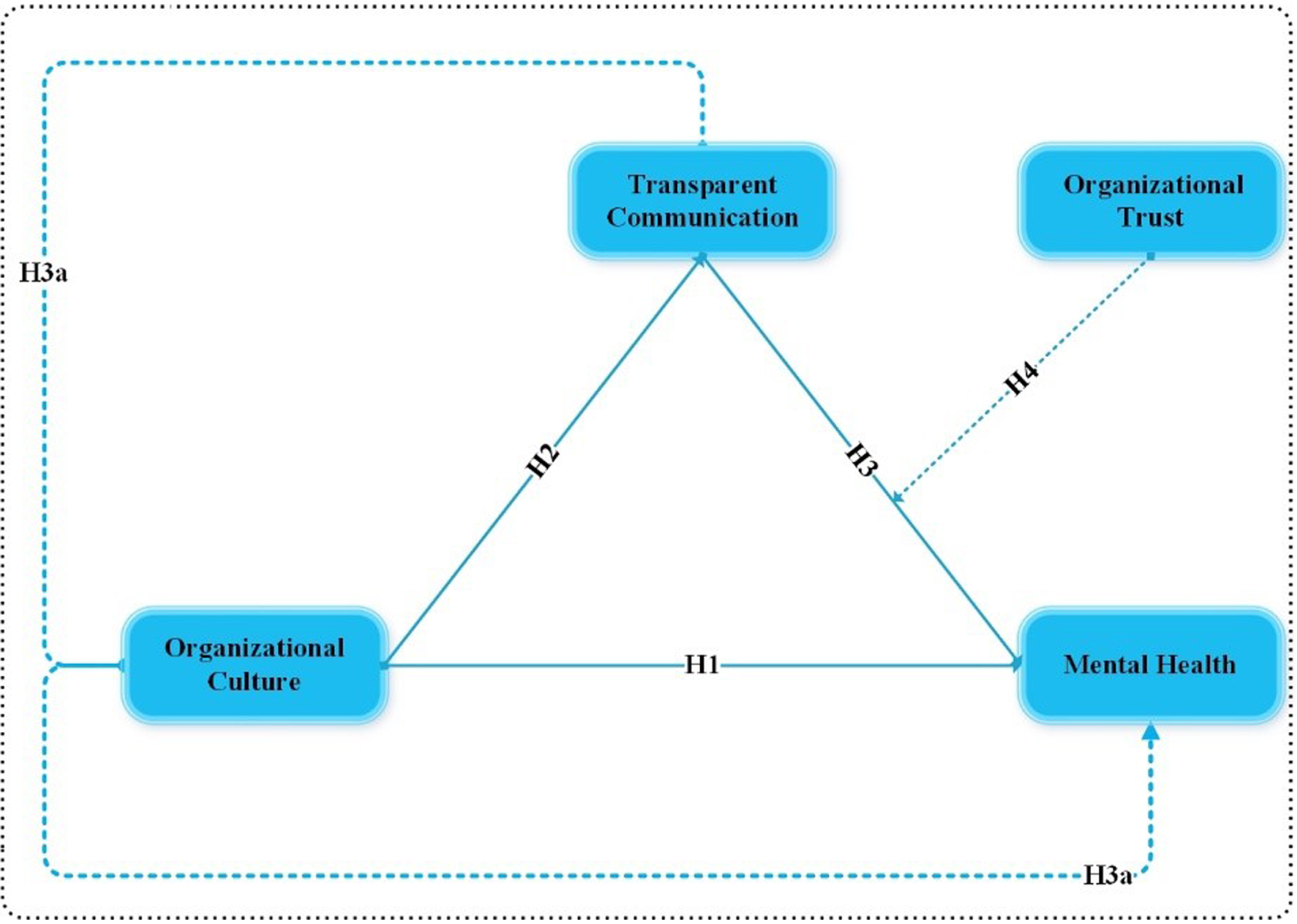
Conceptual framework.
Quantitative research using a self-reported questionnaire was used to collect data from the frontline healthcare employees in Punjab province, Pakistan. This study considered the healthcare centers affiliated with the Primary and Secondary Health Care Department of Punjab that also treated COVID-19 patients. We selected the Punjab province as a target location due to the high number of COVID-19 cases. Based on the purposive sampling method, only frontline employees such as doctors, nurses and paramedics were selected for the questionnaire’s distribution. The employee’s data was obtained from the healthcare centers administration. The questionnaires were distributed in two ways (physical visits to the healthcare center and a Google questionnaire link via WhatsApp). A cover letter explaining the research objectives and the confidentiality of the participant’s responses was attached to the survey.
This study used the previously tested variables items scale. The study questionnaire has three sections: study introduction, variable-related questions, and demographic-characteristics questions. A questionnaire survey was devised, and 600 questionnaires were disseminated among employees working in the healthcare sector between March and May 2022.
Of these, 509 valid questionnaires were received for data analysis. Some of the questionnaires were either improperly filled out or left unfinished. As a result, we did not consider any of these responses. The Statistical Package for the Social Sciences (SPSS) and Smart PLS software were used for data analysis and hypothesis testing. Structure equation modeling was used to measure the relationship between dependent, independent, and mediator. It is the most used method to measure the path coefficients.
The scale for the construct of OC consisted of 22 items and was adapted from Balcı et al. [63]. The TC scale comprised 18 items and was taken from Men [64]. The scale for OT had five items taken from Yue et al. [43]. The MH scale was taken from the study of Wu et al. [65], and it has five items (see Appendix-A). To assess the validity and reliability of the items, a pre-test was conducted to ensure any ambiguities in the questionnaires could be revised.
This research also applied the common method bias using Harman’s single-factor approach. The variance extracted by one single factor is 20.783% which is less than 50%, indicating no common method bias in this study [66]. Table 1 provides the demographic characteristics of the study respondents.
Demographic characteristics
Demographic characteristics
As shown in Table 2, the results of assessing the standardized factor loadings of the model’s items indicated that the initially standardized factor loadings of all 50 items were all above 0.6 as recommended by Abdullah et al. [67] and Hair et al. [68]. They ranged from 0.618 to 0.868.
Reliability & validity analysis
Reliability & validity analysis
Reliability was assessed using average variance extracted (AVE), construct reliability (CR), and Cronbach’s alpha (α). Table 2 shows that the AVE, which reflects the overall variance in the indicators accounted for by the latent construct, was above the cut-off 0.5 for all constructs [69]. The construct reliability value of OC was 0.963, TC 0.542, OT 0.535, and MH 0.549. Cronbach’s alpha value of OC was 0.964, TC 0.955, OT 0.853, and MH 0.589.
Table 3 represents a discriminant validity analysis of MH, OC, OT, and TC. All the values are within range as recommended by Kline [70]. Further, as shown in Table 3, discriminant validity analysis was conducted by adopting the Fornell & Larcker and HTMT method [71, 72].
Discriminant validity analysis (Fornell Larcker & HTMT)
Note: Values on the bold (italicized) represent the square root of the average variance extracted, while the off diagonals are correlations.
Table 4 shows variance influence factor analysis and Fig. 2 shows the graphical representation of assessment of measurement model.
Variance influence factor
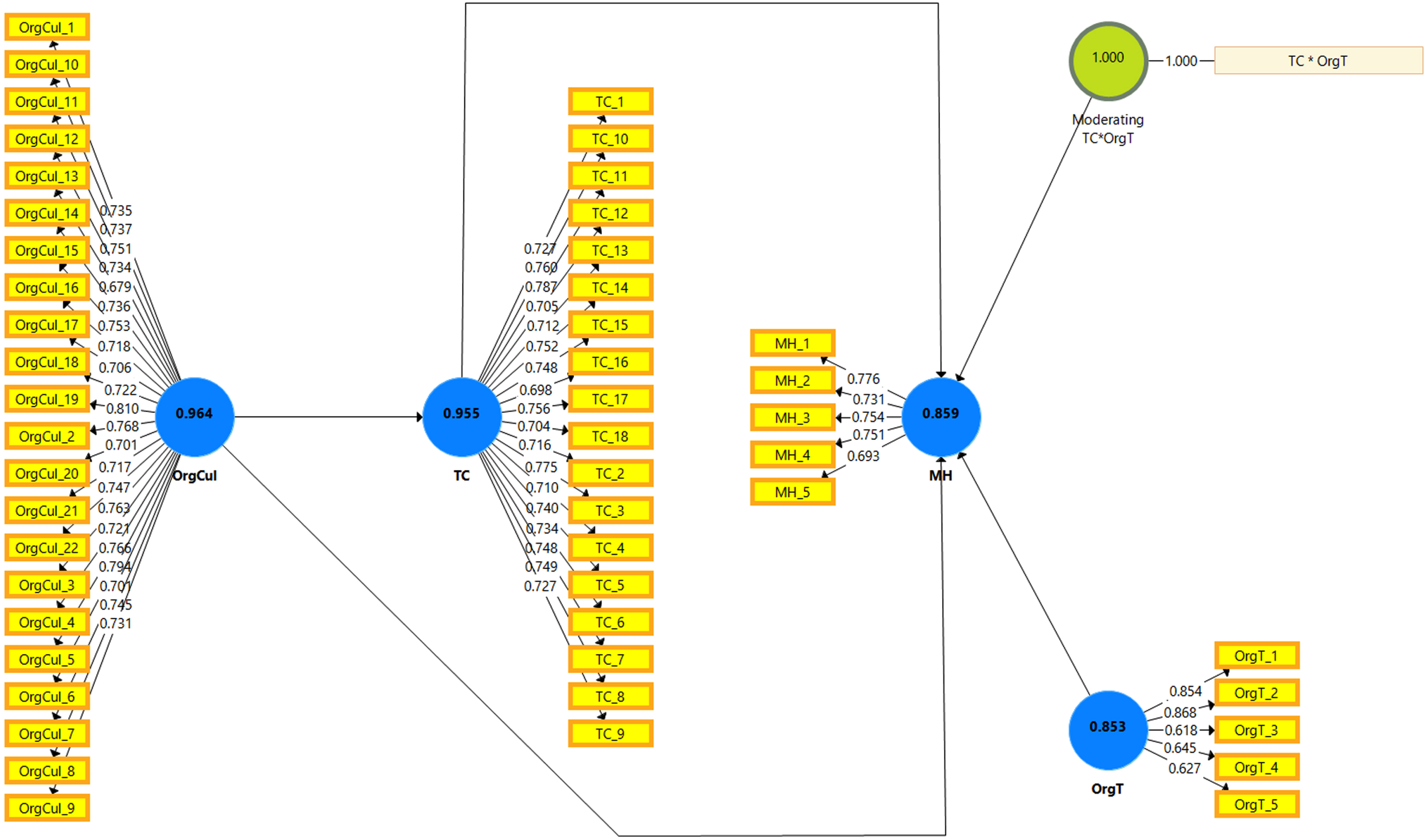
Assessment of measurement model.
Table 5 shows the direct relationship of H1-H3. There was a positive relationship between OC and MH (H1), and OC and TC (H2). The study also finds a positive relationship between TC and MH (H3). Thus, all the hypotheses were accepted at a p-value less than the standard level of 0.05.
Hypotheses testing direct effect
Indicates significant paths: ***p < 0.001.
The mediating effect of TC between OC and MH was significant at a p-value less than 0.05 (as shown in Table 6). The hypothesis H3(a) standard beta value was 0.347, the standard error value was 0.055, and the t-value was 6.332.
Hypotheses testing mediation effect
Indicates significant paths: ***p < 0.001.
Figure 3 shows the values of structural modeling. All the values are within range as recommended by the researchers.
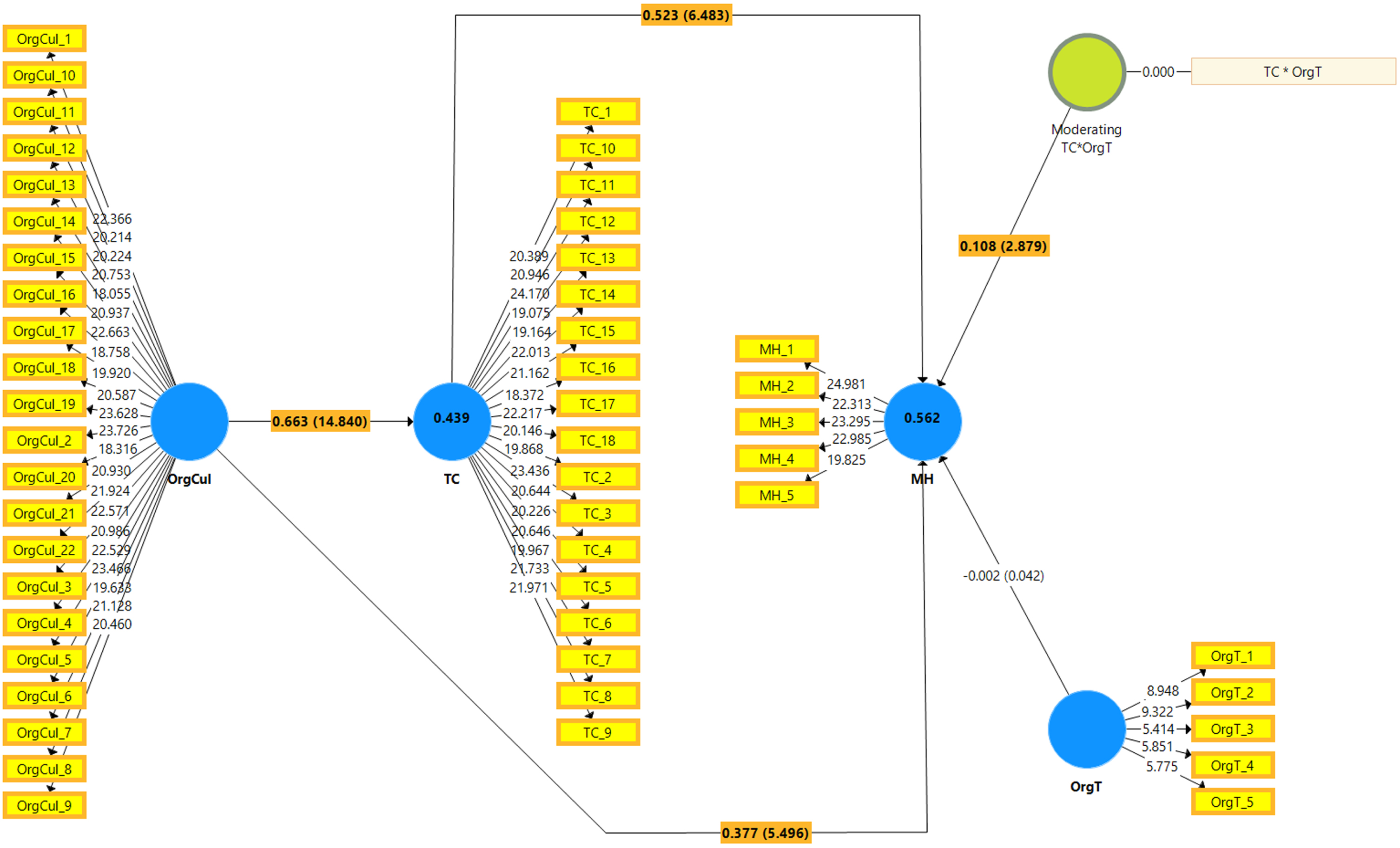
Structural modeling.
Hypothesis H4 states that OT moderates the relationship between TC and MH. The Beta value for H4 was 0.108, the Std. Error value was 0.038, and the T-value was 2.879. The results present the moderating effect of OT between TC and MH, as shown in Table 7.
Hypotheses testing interaction effect
*Indicates significant paths: **p < 0.01, ***p < 0.001.
Table 8 shows the quality criteria values (R2, Q2 and F2). MH R2 value was 0.562 and TC was 0.439. The value of R2Adj for MH was 0.559 and TC was 0.438. The Q2 value was 0.294 for MH and 0.228 for TC. All the R2, Q2, and F2 values were within range.
Quality criteria
Figure 4 shows the graphical representation of R2 & F2 values. All the values are within range.
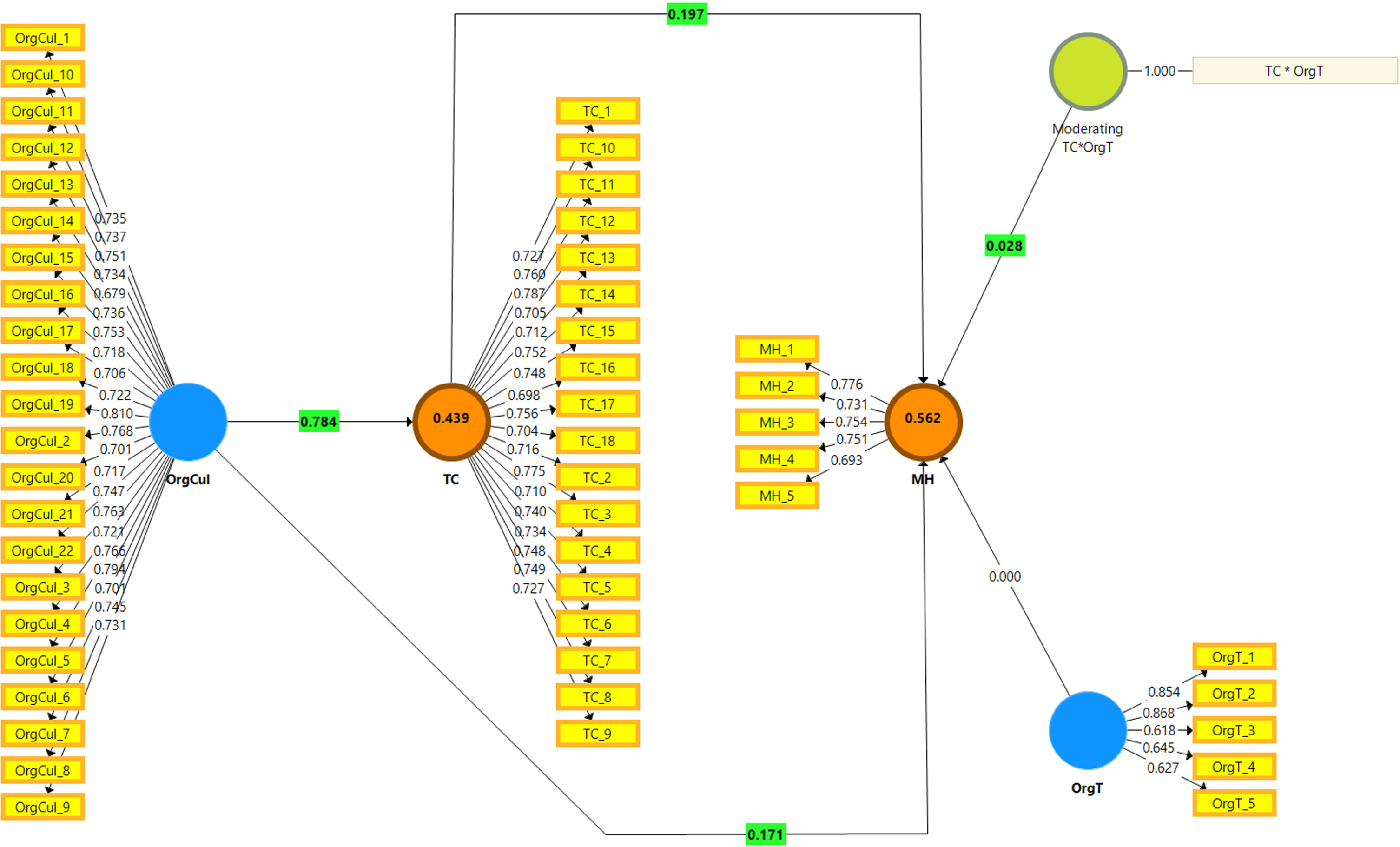
Graphical representation of R2 & F2.
Over the years, several factors have played an integral role in enhancing employees’ mental well-being. However, the way OC has helped boost the employees’ MH is unprecedented. An organization’s culture helps employees restore their MH due to the role of the firm’s TC. In recent years, increasing TC has improved the organizational climate, with benefits for employees’ psychological performance. Accordingly, this section demonstrates how different variables influence employees’ MH. In particular, it illustrates the study’s outcomes in light of previous reviews.
OC is the true determinant of employees’ MH. According to Lee and Jang [32], a negative OC can increase employees’ MH issues and fatigue. Similarly, Ricciardelli et al. [73] state that OC helps healthcare employees to fulfill their occupational calling by facilitating their overall mental well-being. Indeed, healthy corporate cultures assist employees to minimize the type of work pressure that causes intense psychological issues (e.g., depression, stress, and anxiety). In explaining this notion, one study states that healthy OC increases employees’ MH by significantly influencing their work behavior [74]. Our study outcomes support the prior literature, thus accepting H1.
Additionally, OC is an essential component in improving organization TC, which helps companies establish a profound culture of improved values and resources [75]. TC encourages employees to engage in the value addition process, thus meeting organizational objectives. In supporting this notion, Pathiranage et al. [76] state that the OC should model a firm’s communication system and transparency. Moreover, Shin [77] contends that an organization’s culture should advocate for transparency in its communication process and sustainably represent the organization’s goals. In alignment with this, our findings indicate a significant relationship between OC and TC, thus fundamentally accepting H2.
A TC culture is undoubtedly necessary for boosting employees mental condition. Creating psychological wellness requires an organization to adopt innovative communication tools for combatting workplace challenges. Poor organizational communication causes employees to face severe psychological issues (e.g., stress, depression). In times of crisis in particular, healthcare workers face increased MH issues brought about continuous changes and uncertainty, and thus demand that healthcare institutions establish a TC system. Dewey et al. [78] suggests that to manage uncontrollable situations (such as the COVID-19 pandemic), TC forms the foundation of employees’ positive MH. Similarly, Lake et al. [79] revealed that a TC system can help employees deal with mental issues. Furthermore, one study shows that firms’ TC networks ensure employees’ active participation, thereby immensely enhancing employees’ mental well-being [80]. Altogether, when it comes to workplace transparency, a positive OC encourages employees to build a healthy communication network, thereby reaffirming their well-being [81]. Hence, based on the analysis, our study results show a positive and significant mediating effect of TC, thereby accepting hypotheses H3 and H3(a).
Consequently, information TC has gained much attention from management as a means of improving employees’ mental well-being. Increasing concerns regarding this have led to organizations using their communication channels to spread awareness about psychological wellness. However, a high level of OT is needed to facilitates this type of communication Lee and Li [82] and have the intended effect on employees’ MH. Therefore, the study indicates that the increased need for TC has made teams adapt to the changing working environment, thus reporting higher OT and lower job stress [83]. The study results indicate that an organization’s trust is a critical tool that moderates the relationship between TC and employee MH. Overall, the current study’s hypotheses focus on the linear aspect of the psychological model, thereby indicating positive results. The study results show that the findings are significantly accepted and supported by the previous literature.
Conclusion
A workplace culture that stresses TC can reduce the negative effect of MH issues. Accordingly, the study results show a supportive relationship between TC and MH. Furthermore, the study findings identify that the unique association of OT with employees’ MH is significantly positive. Altogether, based on the study findings, all the hypotheses are proved and accepted.
In times of sudden changes, a positive OC associated with the employees’ mental condition is valued, with the issue of employees’ MH having gained prominence. In Pakistan’s healthcare sector, the emergence of the COVID-19 pandemic has brought considerable changes. As a result, to limit the impact of this crisis on healthcare workers, this study introduces multiple factors for improving employee MH. As prescribed by the study results, the paper suggests that healthcare organizations should reflect positive MH for their employees in their OC. Moreover, the results propose that effective communication techniques should be adopted to improve employees’ mental status. The findings indicate that institutions should facilitate employees’ mental well-being through new forums (e.g., teleworking and social connectivity). It advises that different platforms must be initiated for the persistent functioning of the organization and the enhancement of employees’ MH and professional fulfillment. Altogether, the study suggests establishing a positive workplace culture by promoting health initiatives. Hence, from the theoretical perspective, this study’s findings offer massive benefits, thus guiding all future researchers to pay attention to MH. From the applied perspective, the current study findings suggest adopting an OC that establishes an effective communication network (i.e., a transparent one) and thus foster employees’ well-being.
Study limitations
Despite numerous strengths, this research has a few limitations. Firstly, this study is confined to one geographical location only. It focuses on a single country (i.e., Pakistan), which makes it difficult to generalize the results and guide future researchers. Therefore, to expand the scope of the study, future researchers should cover other countries also. Secondly, this paper is restricted to the healthcare sector. As a result, further analysis should be conducted in different sectors. Hence, to overcome this limitation, future studies should include other industries and cultures to contextualize and further understand the study’s results.
Ethics statement
All participants gave their informed consent for inclusion before they participated in the study. All procedures were performed in accord with the ethical standards as laid down in the 1964 Declaration of Helsinki and its later amendments or comparable ethical standards. All procedures were approved by the ethical committee of the Department of Commerce and Business, Government College University Faisalabad, Layyah Campus (GCUFLC/2022/58).
Conflict of interest
The authors have no conflict of interest to declare.
Footnotes
Acknowledgments
Not applicable.
Funding
The authors acknowledge the financial support from the National Natural Science Foundation of China (Grant no. 71974102) and the Philosophy and Social Science Fund of Tianjin City, China (Grant no. TJYJ20-012).
