




Abstract
BACKGROUND:
Many organizations are undertaking efforts to reduce the stress of (oftentimes overworked) employees. Information Technology (IT) (e.g., smartphones) has the potential to be a key instrument for reducing stress. One design-relevant factor considered to reduce stress is the concept of autonomy. Unfortunately, little research exists using autonomy as a characteristic of technology design.
OBJECTIVE:
Against this background, this study aimed to investigate specific autonomy-related design options with the potential to prevent stress.
METHODS:
In a factorial survey, this experimental study tested three design options in an overwork scenario: 1) autonomy (no intervention by design), 2) nudge (“nudging” by design), and 3) enforcement (hard stop by design). 51 participants (mean age 38 years, 50% women, mean work experience 18 years) from the Netherlands, United Kingdom, United States of America, and Germany participated in the experiment for 330 seconds on average. To test our hypothesis, we used a two-step approach. First, a multiple linear regression was applied. Second, we carried out a one-way ANCOVA comparing the effects of our design options.
RESULTS:
Our results indicate that autonomy can be manipulated through technology design and is negatively correlated with stress. Additionally, the design options autonomy and nudge were associated with lower levels of perceived stress than was enforcement.
CONCLUSION:
The study proposes a careful use of IT and policies that limit the perceived autonomy of employees. Overall, this study offers a set of design recommendations arguing that organizations should implement technology that helps employees prevent overwork and maintain their autonomy.
Keywords
Introduction
The negative consequences of modern workplace design, including stress and work–life balance, are currently part of an employee’s daily work more than they have ever been [1]. One commonly referred example is overwork, which has a significant impact on stress [2, 3]. Working overtime is a common phenomenon: in 18 out of 29 European countries, the average actual working hours exceed the collectively agreed working hours [4]. In Japan, where employees regularly work too long, the term “kar
Information Technology (IT) has the potential to both reduce stress [8] and increase stress [9]. Through the ubiquity of technology in contemporary workplaces, new conflicts as well as new chances to reduce stress (e.g., by means of a better work-life balance) have emerged [10]. Therefore, it is crucial to identify technology characteristics that can be designed to enhance positive and buffer negative effects. Regarding overwork, the job demand control model [11–13] and the construct of autonomy [14, 15] have been proposed as promising ways to design technology. This also covers the freedom to decide when to stop work [16, 17]. However, organizations have already started to reduce the degree of autonomy by enforcing that individuals work only during business hours. For instance, Volkswagen implemented technology-supported policies that allow e-mail communication solely between 8 a.m. and 5 p.m. [18].
Although previous research has addressed the issue of overwork from a technology-design perspective (e.g., [16, 19–22]), research that focuses on how to design technology that maintains the individual’s autonomy to reduce stress is still missing. With the paper at hand, we want to address this important question. Specifically, we aim to develop and test different design options intended to prevent employees’ stress. Thus, our paper is guided by the following research questions (RQs): How can autonomy be integrated into technology design? How do specific design choices influence the perception of stress?
Theoretical background and hypothesis development
In a subsequent section, we introduce the theoretical background of the paper. This comprises an explanation of the transactional perspective on stress [23] and its relation to stress in the workplace. Afterward, the specific role of technology in the creation of stress is elaborated. By building upon the job demand control model and nudge theory, we propose hypotheses for the creation of design options that reduce technology-induced stress.
Transactional perspective on stress
Against the background of strain, which describes “the psychological and physiological responses made by individuals based on the fit between perceived stress and coping behaviors (e.g., rapid heart rate)” [24 : 3], stress has been conceptualized in different ways: as a stimulus, a response, or a condition that resides in the environment—to name only a few (an overview of the most relevant stress-related constructs used in this paper is given in Table 1). In our research, we have built up on the transactional perspective on stress (cf. Fig. 1) developed by Lazarus and Folkman [23].
Definitions of core constructs
Definitions of core constructs
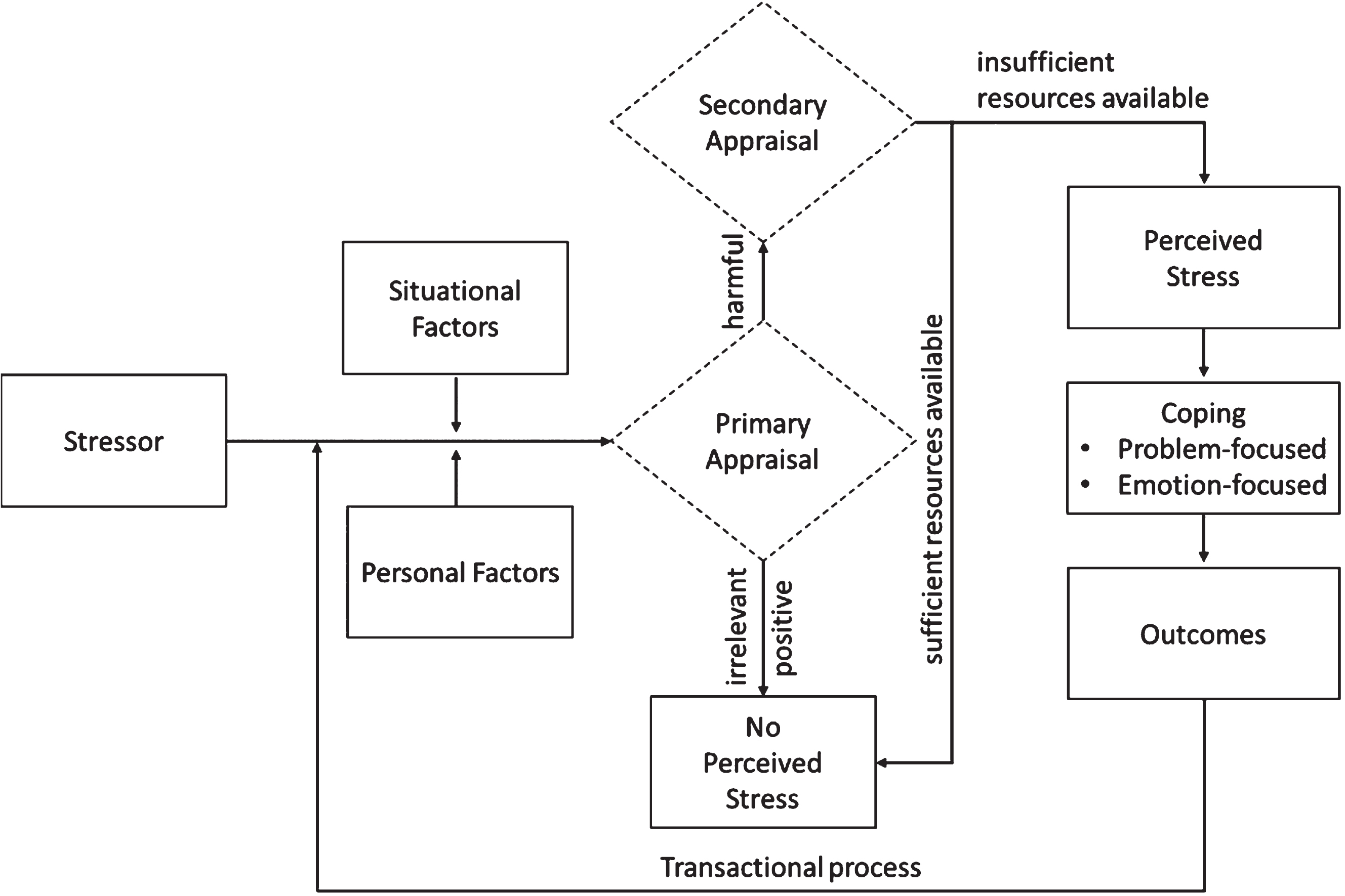
Transactional perspective on stress (adapted from [25]).
According to the transactional perspective on stress, perceived stress can be understood as a durable process involving individuals who deal with their environment. This is characterized by constant appraisal and reappraisal in response to stressors [24, 26]. Stressors are direct or indirect demands created by an individual’s internal or external environment, which upsets balance and, thus, affects wellbeing and requires action to restore balance [27]. When individuals are confronted with a stressor (e.g., a computer-generated message requesting that they stop working), they evaluate the relevance of the stressor in the phase of primary appraisal against the background of their individual characteristics (e.g., past experiences with the same situation) and situational characteristics (e.g., supervisor expectations).
In the first step, an individual evaluates whether a stressor is harmful. For example, a stressor could be considered harmful when a person is already working overtime but wants to finish his or her work. In that case (i.e., a harmful evaluation of a stressor), a secondary appraisal process follows where the individual has to assess if there are sufficient resources, including time, to change the situation. Should the result be negative, i.e., there are not enough resources available, the situation is perceived as stressful. In that case, coping mechanisms are applied to handle the situation. These coping mechanisms can be behavioral (e.g., problem-focused coping) or emotional (e.g., emotion-focused coping). As a consequence, individuals experience specific outcomes of this overall process, which can result in high blood pressure and strain. Finally, this process restarts with the evaluation (see arrow pointing back in Fig. 1).
Based on this line of argument, overwork as addressed in this study may result in strain because the resources to cope with the work at hand are not sufficient.
In the context of work, a balance between stressors from the environment and individual coping abilities is essential for the wellbeing of employees and employers’ productivity concerns [33]. As a result of misbalance, stress can lead to dissatisfaction with the job [34, 35], decreased commitment to the organization [33], decreased productivity [28, 36] or role conflict [26]. Factors that lead to perceived stress can be manifold and depend highly on situational and individual characteristics. Thus, if individuals can rely on resources that help them cope, negative effects from perceived stress can be diminished or buffered.
Research has highlighted the relevance of technology as an antecedent to stress [9]. This has been conceptualized as technology-induced stress, which can be described as a modern disease caused by an inability to cope with technologies in a healthy manner [37]. In terms of technology, technology-induced stress arises when IT requirements exceed the user’s situational level of competence. A central category of stressors is job characteristics, which was, for example, included in previous research to analyze technology-induced stress (for an overview see, for instance, [9]).
Technology-induced overwork can arise when technology offers the opportunity for employees to work after hours. With technology pervading not only work-life but also private life, employees are faced with the constant possibility of working anywhere at any time. This is especially facilitated if employees perceive high levels of after-hours availability expectations [38, 39]. Subsequently, employees who do not manage to set their boundaries between work and private life experience a lower level of psychological detachment from work—even in countries with high work environment legislation, such as Sweden [38]. Additionally, such decreased psychological detachment is related to higher levels of strain [40].
Reducing technology-induced stress with technology design
Technological characteristics have a significant impact on how individuals perceive (technology-induced) stress (e.g., [9]). Accordingly, technology can also be manipulated in a way to reduce negative consequences. Based on the literature, the concept of autonomy is highly relevant, since empirical evidence suggests that perceived autonomy affects technology-induced stress (e.g., [41–43]). Perceived autonomy is commonly understood as the “degree to which a worker has control over ‘how’ and ‘when’ work is done” [30 : 992]. This is surprising, as it is a resource for individuals’ coping abilities, a central component of one of the most influencing theories of work design—the job characteristics model [44]. Furthermore, it has already been used in other stress-related theories, including the job demand control model [45–47]. Regarding overwork, autonomy is most relevant, as it enables individuals to decide when and when not to stop working. Due to mobile technologies, the perceived autonomy of a large number of employees increases [48], which in turn further aggravates the issue of overwork.
Technology design allows the use of technological characteristics to support individual behavior. By aligning with design concepts, such as value-sensitive design (e.g., [49]) and design science theories (e.g., [50]), technology can be designed with characteristics and values to prevent an individual behavior (e.g., by manipulation with nudging to reduce stress) or to support a behavior (e.g., by limiting access to e-mails after 11 p.m.). Previous research shows that technology design supports the usability and innovativeness of technology for individuals [51–53].
Hypotheses on autonomy and stress in technology design
Mazmanian et al. [48] found that the use of mobile devices both increases and decreases the perceived autonomy of employees. The authors referred to this phenomenon as the autonomy paradox. The autonomy paradox describes the idea that mobile devices, such as laptops and smartphones, increase the perceived degree of autonomy, as they allow for work to be conducted in a much more flexible manner than in a stationary work environment. Consequently, one may argue that technology itself has a major influence on the individual’s perceived autonomy. Whereas previous literature on the use of mobile technologies indicates that technology can influence perceived autonomy, only a few studies dealt with perceived autonomy through technology design. Notable exceptions include the work by Marshall [54], which focuses on how autonomy can be designed from a design prospect perspective, Murray and Häubl [55], who analyze the effects of freedom of choice regarding different user interfaces, and Klesel et al. [56], who investigate the impact of freedom of choice with regard to mobile devices. As design research is still in an early stage regarding the inclusion of the concept of perceived autonomy, it is unclear whether perceived autonomy can be manipulated with technology design per se. Since the manipulation of freedom of choice toward a specific user interface is similar to perceived autonomy, there is reason to believe that technology design can also be manipulated with regard to perceived autonomy. Therefore, we propose the following hypothesis (H): Perceived autonomy can be manipulated through technology design.
According to well-known stress theories, including the job demand control model [45], perceived autonomy has a major influence on perceived stress. As perceived autonomy has rarely been included in design research thus far, it is uncertain whether there is also a negative relationship with perceived stress. Based on strong support from previous research on technology-induced stress (e.g., [9, 57]), we argue that a technological manipulation that leads to perceived autonomy has a negative influence on perceived stress. Consequently, we hypothesize that: Overall, perceived autonomy is negatively correlated with perceived stress.
Based on these two hypotheses, we propose our research model (cf. Fig. 2), which includes the relationship between technology design and perceived autonomy (H1) and the relationship between perceived autonomy and perceived stress (H2). Furthermore, our research model includes design options and their influence on perceived stress, which is described in the following section (H3 to H5).
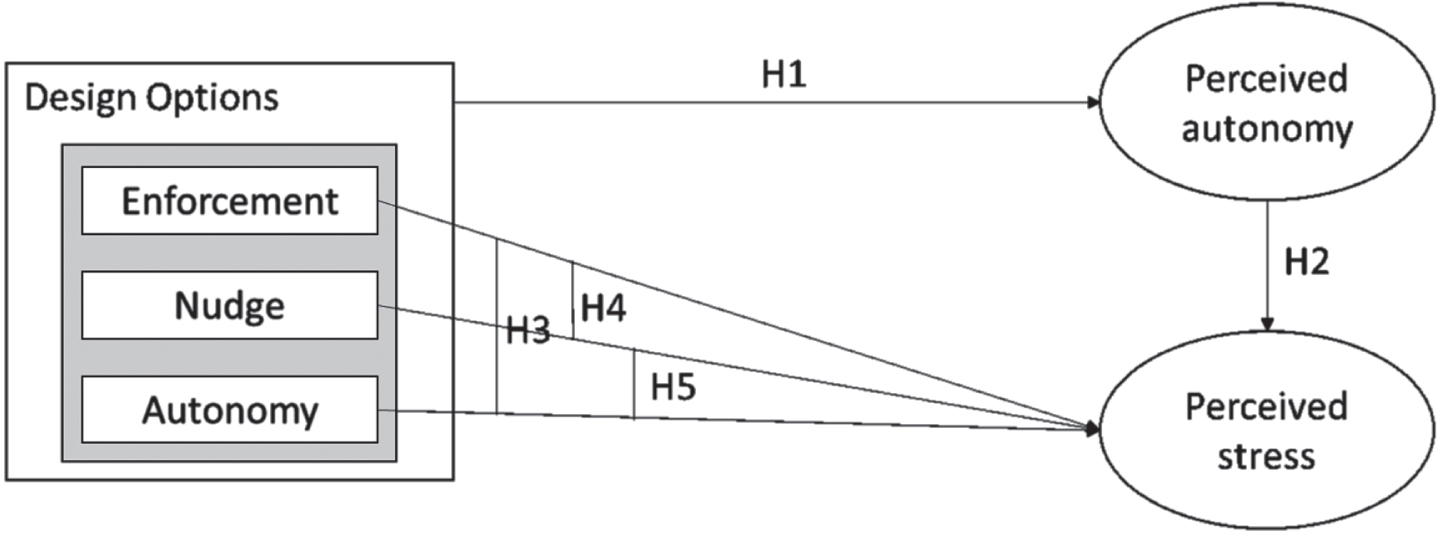
Research model.
In line with our previous expositions, we now propose our hypotheses with regard to three different technology design options.
Enforcement vs. autonomy
According to the job demand control model [45], the degree of autonomy influences employees’ perceived stress. The strain hypothesis of the job demand control model suggests that low control (i.e., enforcement) has a negative influence on employees’ health (strain hypothesis). The strain hypothesis of the job demand control model has received extensive support. For example, in a laboratory experiment, Häusser et al. [58, 59] manipulate job control through human-controlled or computer-controlled pacing and job demands through a number of requested tasks. Their experiment finds support for the strain hypothesis [58, 59]. Therefore, we propose the following hypothesis: Enforcement results in higher levels of perceived stress than does perceived autonomy.
Enforcement vs. nudge
Enforcement and autonomy are two sides of the same coin, as enforcement can be understood as an external determination (i.e., a lack of autonomy). On this continuum, forms of soft paternalism can be used as an intermediate form of enforcement and autonomy. A well-known theory, which can be considered a form of soft paternalism, is nudge theory [60]. Nudge theory suggests that individual behavior can be “nudged” by presenting a set of choices that is developed by a choice architect (in our case, this role is occupied by a team of researchers [61]). The individual’s behavior is guided by the creation of nudges and without enforcing a predefined direction, which follows the idea of soft paternalism. Nudges can be operationalized in various ways [62, 63], especially in the digital age [64]. A commonly known example of how to operationalize nudges is the use of default settings in software applications. Consequently, by predefining a default value toward an intended behavior, the individual’s behavior can be shaped.
As hypothesized in H3, enforcement results in a higher level of stress than does autonomy. As nudge theory maintains freedom of choice, we further argue that enforcement has a significantly negative effect on the perceived stress, in contrast to nudge. Hence, we propose the following hypothesis: Enforcement results in higher levels of perceived stress than does nudging.
Nudging vs. autonomy
Nudge theory is supposed to be a form of soft paternalism [60, 61] that allows individuals to make their own decisions. Based on that assumption, it can be assumed that there is no significant difference between nudging and autonomy. Therefore, we hypothesize the following: Autonomy and nudging result in a similar level of perceived stress.
Although all three design options have already been applied in previous research and practice (e.g., for enforcement, see [18]; for nudges, see [62], and for autonomy, see [55]), they have not been tested in a competing model, as proposed in our study.
Materials and method
Method selection
To address our RQ, we conducted an experimental study. Specifically, we used a factorial survey method that included experimental scenarios to aim for strong internal consistency [65, 66]. For this, we experimentally used textual elements that varied in each scenario. This method was applied successfully in similar research areas [67–69].
In our study, we used three treatments (i.e., design options enforcement, nudge, autonomy). Participants were randomly assigned to one of the three scenarios (enforcement vs. nudge vs. autonomy). Since parts of the initial sample of our experiment had to be excluded from the main analysis (see the following section with the characteristics of the participants), the cell occupations were not homogeneous (11 participants for the design option enforcement, 21 for the design option nudge, 19 for the design option autonomy). Since the statistical requirements were met, this inhomogeneity does not present an issue in our hypothesis [70]. To ensure the validity of the data, the participants had the opportunity to inform themselves in an open text field about potential problems and ambiguities when answering the questionnaire (the qualitative answers did not indicate any problems). Additionally, a pilot study was used with three respondents in every group to ensure that the context and the experimental setup were comprehensible.
Data collection and participants
We collected data from an online crowdsourcing platform (clickworker) that has already been used in many meaningful academic publications [71]. Since the platform has access to a wide variety of potential respondents, we had the chance to use different selection criteria to collect a representative sample for the purpose of the study (e.g., participants had to be knowledge workers with perennial work experience).
We analyzed our data using a two-step approach combining multiple linear regression with a one-way ANCOVA (Section 4). After collecting the data, we cleaned them, and the experiment was completed with 51 participants. To ensure the quality of the data, different eligibility checks were done. First, missing values were dropped. Subsequently, we removed values that undercut the minimum duration of the experiments, which was 270 seconds, or exceeded the maximum duration, which was 480 seconds. (The average duration was 330 seconds.) In a third step, we checked for a minimum retention time on different pages of the experiment. Finally, stated confirmability was applied to buffer against the unwanted effects of the online procedure [72]. Excluding unserviceable observations from our data collection, the final sample yielded 51 participants.
Our study included 25 females and 26 males. Participants had an average age of 38 years (M = 38.29, SD = 11.40). Our participants came from the Netherlands (47%), the United Kingdom (21%), the United States of America (21%), and Germany (11%). Eighty percent of the participants stated that they had studied at a college (more than 2 years) and could prove an average work experience of almost 18 years (M = 17.59, SD = 12.64). Most participants worked full-time (M = 38.45, SD = 12.71), and 59% were employees, followed by freelancers (18%) and managers (14%). The participants came from a wide area of work (e.g., manufacturing, IT-consulting, government), which meets the requirement of a sample comprising a variety of different types of knowledge work. Additionally, the participants stated that their yearly income average (after taxes) was approximately $38,000 (M = 37, 800, SD = 17, 45), which is approximately the average mean score ($36,000) of the yearly income in their countries of origin and, thus, can be considered a representative reflection. The demographics are summarized in Table 2.
Demographic characteristics
Demographic characteristics
The scenario-based experiment covered four phases. First, participants were informed about the general setting and goal of the study. To be transparent about the experimental procedure, we also ensured that we explained our procedure holistically at the beginning of the questionnaire. Second, the manipulation was carried out using different mockups, including different instructions and pictures of our design options (scenarios, cf. Table 3). Participants interacted from afar only via a computer. As our participants could not contact us during the experiment, we added an open text field to our questionnaire so that they could leave remarks. Third, the dependent variable and the control variables were measured. Finally, participants were asked demographic information.
Variation of textual elements
Variation of textual elements
Context. We chose e-mail management to contextualize the experiment, as this is a well-known situation relating to stress [73]. To that end, we provided the following information: “At the end of your workday after a long meeting, you are returning to your working place. The screen of your computer is locked by now. First, you are deactivating your screen lock. Now you can see the following picture (see next page) of your e-mail program.” On the following page, we presented the participants with a picture of their e-mail inboxes where new e-mails had arrived. To manipulate the level of perceived autonomy, we varied the instructions in the presented design options as described in the following.
Design options. Based on the theoretical assumptions presented earlier, we derived three distinct design options that are implemented by means of textual variations in a message box mockup (cf. Table 3, Fig. 3).
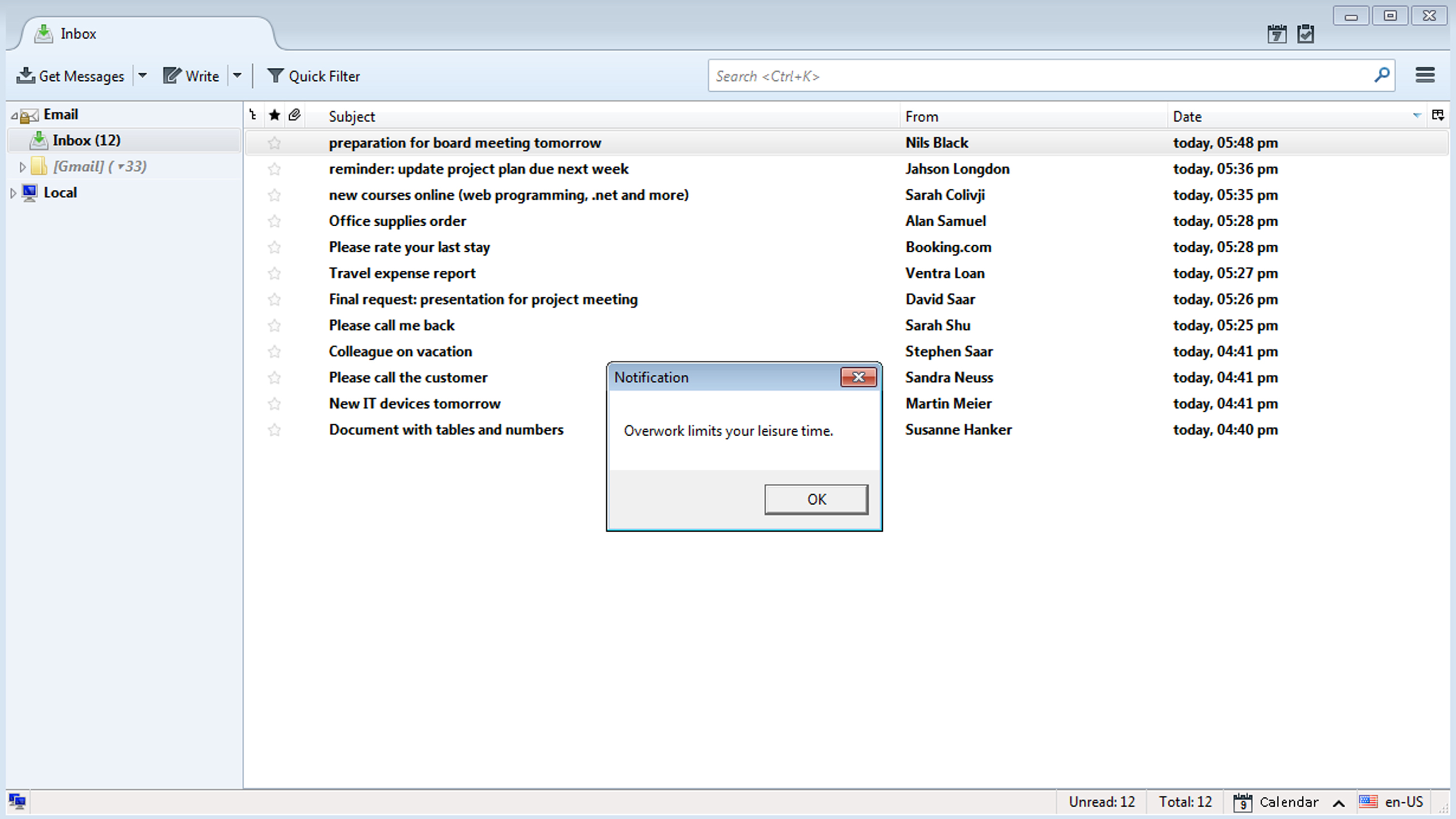
Mockup manipulation (nudge variation).
First, in the design option enforcement, the user was forced to stop working. Therefore, there was no autonomy to decide when and when not to continue working. Consequently, the text told the user that the working time was over, and the computer was locked until the following day. This scenario is close to existing approaches, e.g., terminating e-mail usage [18].
Second, in the design option nudge, the user was nudged to stop working. As mentioned earlier, there is a great variety of possibilities for implementing nudges [60, 62]. For the design of the nudge option, we carefully searched for existing theories that have been successfully used to influence behavior. To that end, we implemented a textual description guided by the endowment effect [74, 75], which is also part of prospect theory [76]. The endowment effect states that individuals value things more when they already own it. In our context, assuming that a large number of employees have to work contracted hours, we understand leisure time as something that is already owned by an employee. Hence, the design option brings forward the idea of losing leisure time to nudge the individuals to stop working.
Finally, in the design option autonomy, there was no intervention by technology. This alternative can be considered the current state of the art in a large number of organizations where no technological interventions exist to reduce overwork [77]. This scenario widely exists in the field of knowledge work [14, 48]. At the same time, this alternative is used as a control group.
Manipulation check/autonomy. To test our hypotheses and conduct a manipulation check, we used a single measurement item for the degree of perceived autonomy on a 7-point Likert scale, as used in previous studies [58, 59].
Stress. The dependent variable perceived stress was measured on a 7-point Likert scale with one item that asked the participants how stressed they felt when they finished working after the described situation. Using only one variable to measure perceived stress is a common practice regarding the validity of data and economy in research design [78].
Control variables. To control our models, we included the following single-measurement variables: knowledge work (“To determine if the given context of our investigation is relevant to you, please indicate how regularly you are using a computer/laptop for work?”), comprehensibility (“Could you put yourself in the described situation?”), overtime (“How likely is it that you have to work overtime?”) and one attention check (“How many new emails have you received in the described situation?”).
Sociodemographic variables. We measured sociodemographic variables, including gender, age, education, experience, working hours per week, and income per year [71].
Results
Manipulation check and hypothesis H1
To test the effectiveness of the manipulation and Hypothesis 1, we used a two-step approach.
First, we explored whether any of the sociodemographic variables (gender, age, education, experience, working hours per week, and income per year) affected the level of perceived autonomy, which had to be considered for the subsequent analysis. For this purpose, we carried out three different stepwise multiple linear regressions (one for each of the enforcement, nudge, and autonomy design options) to predict perceived autonomy. We tested the requirements to apply regression analysis. The data met the assumptions of independent errors (d = 2.02), and multicollinearity was not a concern (Tolerance = 1.00, VIF = 1.00). Only the regression weight of education (β = .54, t (17) = 2.67, p < .05) in the design option control/autonomy showed significant results. Regarding the remaining two design options (enforcement, nudge), none of the sociodemographic variables had a significant effect.
Second, a one-way ANCOVA with fixed effects was conducted to compare the effects of the three different design options (enforcement vs. nudge vs. autonomy) on the dependent variable perceived autonomy, which controls the confounding effect of education. To test the requirement of equality of variances, a nonsignificant Levene’s test indicated that the data met the assumptions of homogeneity of variances (p = .472). The results of the ANCOVA showed a significant effect of the design option factor on perceived autonomy, which controls education (F(2, 47) = 4.65, p = .014, η2 = .24). Scores of perceived autonomy were lower in the design option enforcement (M = 2.27, SD = 1.55) than in the design options nudge (M = 4.24, SD = 2.17) and autonomy (M = 5.00, SD = 2.08). Post hoc analysis using Tukey’s HSD to test differences among the three individual design options conformed to the descriptive picture and indicated that perceived autonomy was lower for participants in the design option enforcement than for participants in the design options nudge (p < .01) and autonomy (p < .01). However, the design options nudge and autonomy (p = .673) did not differ significantly. The results are summarized in Table 4.
Means and standard deviations of design options on perceived autonomy
Means and standard deviations of design options on perceived autonomy
In conclusion, the manipulation showed the intended effects, and we were able to support Hypothesis 1. Therefore, our results indicate that it is possible to manipulate perceived autonomy through different technology designs.
To test Hypothesis 2, we once again used an approach consisting of two steps.
First, to control for potential confounds, we investigated whether any of the sociodemographic variables (gender, age, education, experience, working hours per week, and income per year) had significant effects on perceived stress. Thus, we used a stepwise multiple linear regression to predict perceived stress on the sociodemographic variables. We tested the necessary requirements to apply regression analysis. The data met the assumptions of independent errors (d = 2.03), and multicollinearity was not a concern (Tolerance = .82, VIF = 1.22). None of the inserted predictors showed significant results. Therefore, we used the derived information and analyzed the relationship between perceived autonomy and perceived stress by means of simple correlation calculations. The results showed a medium-sized correlation (r (50) = - .33, p < .05), which supports the postulated negative relationship between perceived autonomy and perceived stress (Hypothesis 2).
To test Hypotheses 3 to 5, we used an approach consisting of two steps. First, we carried out three separate stepwise multiple linear regressions (one for each of the design options of enforcement, nudge, autonomy) to predict perceived stress on the sociodemographic variables (gender, age, education, experience, working hours per week, and income per year). Considering the requirements to carry out a regression analysis, we observed that the data met the assumptions of independent errors (d = 1.74 ; d = 1.21), and multicollinearity was not a concern (Tolerances = 1.00, VIFs = 1.00). The results of the regression analysis are summarized in Table 5.
Sociodemographic effects on perceived stress
Sociodemographic effects on perceived stress
The regression weights of experience (β = - .44, t (19) = -2.11, p = .048) in the design option nudge and working hours (β = - .51, t (17) = -2.46, p = .025) in the design option autonomy had significant effects, which could confound our results. We used the derived information in the subsequent analysis.
Second, a one-way ANCOVA with fixed effects was conducted to compare the effects of the three design options (enforcement vs. nudge vs. autonomy) on perceived stress as the dependent variable to control for the effects of experience and working hours from the prior step. An overview of the descriptive values of the different groups of design options is given in Table 6.
Means and standard deviations of design options on perceived stress
The ANCOVA showed a significant effect of the design option factor on perceived stress to control for experience and working hours (F (2, 46) = 4.09, p = .023, η2 = .14). Furthermore, regarding the requirements to carry out ANCOVA, a nonsignificant Levene’s test indicated that the data met the assumptions of homogeneity of variances (p = .370). The post hoc analysis by means of Tukey’s HSD test to determine the individual difference between the groups showed that perceived stress was significantly higher for participants in the design option enforcement than for participants in the design options autonomy (p = .007) and nudge (p = .049). The design options nudge and autonomy (p = .242) did not differ significantly.
In summary, the results indicate that enforcement leads to more perceived stress than do perceived autonomy (Hypothesis 3, p = .007) and nudge (Hypothesis 4, p = .049), as we predicted. In the case of Hypothesis 5 (nudge does not lead to more perceived stress than does perceived autonomy, p = .242), the nonsignificant result shows that we should not reject the null hypothesis, which is consistent with the deductive postulate. Thus, we can conclude that the results of the scenario-based experiment show gratifying and postulated effects (cf. Table 7).
Hypothesis testing
Discussion of the findings
Based on our findings, we can address our first RQ: How can autonomy be integrated into technology design? We build upon generic variations in a well-known context (i.e., e-mail management), and our findings support perceived autonomy being manipulated within technology design (F (2, 47) = 4.65, p = .014, ηp2 = .24); Hypothesis 1). Our discoveries also revealed an interesting finding, as education had a significant influence on the autonomy group option (β = .54, t (17) = 2.67, p = .016). This result indicates that in a situation where autonomy is granted, education has an influence on perceiving autonomy as such. Furthermore, it can be assumed that education is a relevant factor regarding the sensible use of autonomy. According to the OECD, the percentage of individuals with a bachelor’s degree or higher has increased in the last few years [79]. Therefore, perceived autonomy is increasingly recognized by individuals as their level of education has increased.
We now address our second RQ: How do specific design choices influence the perception of stress? Our study provides references that show that a higher degree of perceived autonomy is associated with smaller levels of perceived stress (r (50) = - .33, p = .018; Hypothesis 2). Regarding the specific design options, enforcement (M = 5.45) increases perceived stress in contrast to perceived autonomy (M = 3.42; Hypothesis 3) and nudge (M = 4.00; Hypothesis 4). Finally, nudge does not lead to higher levels of perceived stress than does perceived autonomy, which supports Hypothesis 3. Building upon these findings, we discuss contributions for technology design, theory development, and practical implications in the following.
Contribution to technology design
This paper is one of the first approaches to provide initial insights into how to design technology regarding autonomy. Our results indicate that autonomy is in fact relevant in technology design [16, 77], especially in a specific context (e.g., overwork) [89]. Thus, in contrast to the findings in previous studies (e.g., [16, 17]), when designing technology to motivate employees to reduce overtime, (technological) enforcement measures might be misleading, as they are related to a higher level of perceived stress. In this case, nudge elements can be used as a valuable alternative, as they decrease perceived stress on a similar level. It is noteworthy that autonomy is a central element of modern workplaces (referring to the job demand control model [14, 48]). Moreover, the various opportunities to nudge [62, 80] are well suited for the design of technology.
One reason to choose the context of e-mail management for our study is that it was previously used for related research [73]. Furthermore, e-mail management is comparable to other technology-supported work, such as managing booking entries or accomplishing tasks in enterprise systems. Therefore, we argue that using technology design to influence users’ perceived autonomy may be a promising way to prevent stress among employees in other contexts as well (e.g., [16]).
Contribution to theory development
Our research can inform future research from different viewpoints. First, our results contribute to theories on stress even though these theories emerged in the 1970s, before modern workplace technology was introduced. We argue that those theories are experiencing a renaissance rather than being buried, which is reflected in current studies [17, 89]. In relation to our study, there are also important references, including research on e-mails and interventions [23, 77]. Similarly, the job demand control model is still used to explain negative consequences, such as the work–life conflict that describes the struggle that employees may be subject to in their need to live up to different roles throughout their lives. In the case of a work–life conflict, the work role may interfere with different life roles, e.g., the role as a parent, as a spouse, as a friend, or as a caring child of one’s own parents [13, 82]). Therefore, the result of our study that enforcement increases perceived stress strengthens the stress hypothesis of the job demand control model [45]. Likewise, the result that the use of nudge or autonomy instead of enforcement reduces perceived stress provides support for the buffer hypothesis that perceived autonomy decreases perceived stress. These results are especially interesting because previous research could only show support for increasing stress measured by endocrinological indicators but not for increasing perceived stress [58]. One explanation for this difference might be that, in our case, the design of autonomy, nudge and enforcement was embedded more thoroughly into a context that individuals can relate to because being forced to restart a computer is a situation that computer users are faced with frequently (e.g., when the operating system enforces a reboot for an update). In contrast, Häusser et al. [58] change the degree of autonomy using pacing control in a repetitive task, which might have lower ecological validity.
Furthermore, our research has contributed to nudge theory [60, 61]. According to the literature, nudge can positively influence various behaviors, such as reducing smoking (e.g., [83]), promoting the motivation to vote [84], enhancing tax compliance [85], or increasing physical activity [86]. We addressed the call of previous research [87, 88] and started to investigate nudge theory as a valuable theory to shape behavior. We illustrate an instantiation of a nudge within technology design and show that nudging users to stop working provides a comparable level of perceived autonomy by letting them decide completely on their own when to stop working. This indicates that nudging is promising in designing technology in a way that reduces perceived stress. We operationalized autonomy in a generic manner through different textual variations. In line with previous research (e.g., [64, 77]), we encourage future research to further consider testing the effects of specific design elements (e.g., interfaces). Regarding our context, changes in the color or arrangements of widgets could be a fruitful approach. For example, when employees get to the end of their business day, the shutdown button could become highlighted by color and/or shape.
Implications for practice
Based on our practical-oriented context (i.e., e-mail management), we can derive further implications for organizations.
First, our research suggests that enforcement increases perceived stress. As perceived stress is negatively correlated with performance [17, 36], organizations are well advised to look for alternative approaches [89]. Therefore, existing endeavors, such as limiting e-mail access [18], should be questioned. Based on our findings, we encourage organizations to further use nudging techniques to address issues related to employees’ wellbeing, including perceived stress reduction. Examples for different nudging techniques are a reminder stating the performed working hours for the day or family pictures coming up on the screen. Other techniques to reduce stress are the introduction of communication rules and being transparent about communication after hours instead of limiting access to e-mails. In practice, this could be conducted by e-mail rules, such as “no e-mails after 11 p.m.”. For example, such rules and communication allow access to e-mails and remind employees of not answering right away if there is no explicit and important reason to do so.
Moreover, our research shows that technology is well suited to complement current undertakings, including organizational policies. Therefore, design research is increasingly important for psychological issues, including (perceived) stress. Consequently, design research can be used to shape the individual’s behavior to address negative consequences in organizations. Managers and software organizations can align with different design techniques offered on the market to shape employee behavior in organizations. During COVID-19, an example of this might be a reminder that shows up every 20 minutes on employees’ screens to ventilate their offices.
Conclusion
We have extended previous work on overwork, perceived stress, and design research using a scenario-based experiment. Our study shows that differences in the perceived level of autonomy can have different impacts on perceived stress. Since we used a fully randomized experiment, the findings can be traced back to the different design options. Specifically, we found that the autonomy and nudge design options were associated with significantly lower levels of perceived stress than was enforcement.
We therefore propose that organizations should be careful using technology and policies limiting the perceived autonomy of their employees. Furthermore, we showed one promising way to influence employee behavior using nudging without a perceived loss of degrees of freedom. Overall, implications from this study may have a significant impact in areas beyond e-mail usage as a context, namely, aspects in addition to functionality, which should not be neglected. More generally, we propose a set of design recommendations and argue that organizations should implement technology that gives employees the opportunity to prevent overwork and maintain their autonomy.
Limitations
As with every empirical study, this research has limitations that need to be acknowledged. First, the experimental procedure is designed for workstation computers from the perspective of an employee in a fictional setting. Thus, the results are limited to that specific domain. However, based on the generic approach, we argue that similar results can be obtained using different technologies, such as tablets. As we did not manipulate situational or personal factors regarding overwork, which are not technology-related, we cannot draw conclusions regarding how these variables relate to technological design options that vary in their degree of perceived autonomy. Personal factors, such as mindfulness or personal attitudes, might also be relevant for the primary and secondary appraisals. Similarly, situational factors, such as organizational culture (e.g., expectations of team members or the supervisor) or private life obligations (e.g., caring for children), are likely to influence the appraisal process of technological design options, especially regarding enforcement design. Therefore, future research could investigate the effect of supervisor and team member expectations as well as preferences and obligations regarding private life in relation to the design of autonomy in different technologies.
Second, although the results of our study support the main argument and show a highly significant manipulation, different effects of potential bias could have influenced the results, since we used a digital scenario-based experiment with less control than laboratory experiments.
Third, the subjective measurement of the dependent variable perceived stress should be interpreted prudently. In this regard, it would be interesting to compare the results of the setting with objective measurements of stress, such as the skin conductance response. Furthermore, using a work-related context and the handling of e-mails could have limited potential effect sizes. Using different contexts in the future is desirable.
Fourth, even though we conducted a G-power analysis to calculate our data sample, our N was rather small (N = 51) after cleaning the data. Although this might have increased the possibility of a Type I error, the findings of the paper can be understood as a valid reference that show that the design of technology at the workplace has an impact on perceived stress, since the chances of detecting meaningful impacts in small sample studies are impeded. Nonetheless, future studies should use larger samples to test differential impacts between different subsamples.
Finally, it should be noted that our manipulation was not based on the level of interfaces and had a rather explorative character, since nudging is still an unexplored theory in combination with design.
Outlook
In addition to addressing the aforementioned limitations, our research offers fruitful avenues for future research. Most importantly, we have provided promising insights into the conflict between perceived stress and the opportunities to buffer the phenomena by means of technology-based design. Thus, in future research, it might be promising to test other aspects of these models combined with the degree of perceived autonomy. Regarding the job characteristics model [29], skill variety as a context variable might be promising. Regarding the job demand control model [45], it would be interesting to identify the interaction effects that might result from including different levels of demand in an experimental design. Furthermore, future research could investigate how technology design relates to social and cultural factors (e.g., availability expectations) in the organization.
Footnotes
Ethical approval
Not applicable.
Informed consent
Not applicable.
Conflict of interest
The authors declare that they have no conflict of interest.
Funding
This publication has been partially funded by the Deutsche Forschungsgemeinschaft (DFG, German Research Foundation) – Project-ID 416228727 – SFB 1410, the German Ministry of Culture and Science of the Land of North Rhine-Westphalia (reference number: 005–1706-0006), and the research initiative “Instant Teaming between Humans and Production Systems” co-financed by tax funds of the Saxony State Ministry of Science and Art (SMWK3-7304/35/3-2021/4819) on the basis of the budget passed by the deputies of the Saxony state parliament.