




Abstract
BACKGROUND:
Among people with mental disabilities in Japan, 50.7% have left employment within a year despite the provision of employment support. Their subjective perceptions are likely relevant, as many causes for leaving employment are personal. However, thus far, employment continuity assessment has been based on objective indicators, while subjective evaluation remains underdeveloped.
OBJECTIVE:
We conducted a mixed-methods study to identify the subjective characteristics that impact the ability of persons with mental disabilities to continue working while receiving employment support.
METHODS:
In total, 41 participants with mental disabilities in continuous employment were included in the study, and data were collected using a demographic and employment status questionnaire and the Worker’s Role Interview. Further, to clarify the constructs related to subjective perceptions of work continuity, the step for coding and theorization (SCAT) method was utilized.
RESULTS:
The results revealed five overarching superordinate concepts and 12 subordinate concepts of subjective perceptions regarding maintaining the current work and the future for participants who continue to work. These perceptions may be related to the participants’ experience and the time course of work continuity. Subjective perceptions of difficulty levels were found to be the most and the least difficult for a reasonable accommodation without specific rules and awareness of the effects of work concepts, respectively.
CONCLUSION:
This research could facilitate the development of an employment support system based on people with mental disabilities’ subjective needs, thus contributing to their continued employment.
Introduction
In Japan, the 1960 Act to Facilitate the Employment of Persons with Disabilities and the Employment Rate Scheme for Disabled People were adopted to support employment for persons with disabilities [1]. In 2010, the number of people with physical, intellectual, and mental disabilities employed in the private sector was 271,795, 61,237, and 9,942, respectively; further, by 2020, their number had increased by 1.31-fold to 356,069, by 2.19-fold to 134,207, and by 8.85-fold to 88,016, respectively [2]. In Japan, persons with “intellectual disabilities,” as used in the law on employment support, include those aged 18 years or older who need special assistance due to intellectual disabilities that appear during their developmental stage and interfere with their daily lives such as Down’s syndrome. Furthermore, persons with “mental disabilities” include those aged 18 years or older who suffer from schizophrenia, acute addiction or dependence on psychoactive substances, psychopathology, or other mental illnesses [3]. The highest growth rate for employment of persons with disabilities in Japan was for those with mental disabilities, and the number of persons with such disabilities employed in establishments with five or more employees rose sharply from 40,000 in 2013 to 200,000 in 2018 [4]. Partly because of the labor shortage in Japan, their recruitment is being actively pursued, even by small- and medium-sized enterprises that are not obliged to employ them [5].
However, the turnover rate of individuals with mental disabilities within one year of employment is higher than that of those with physical or intellectual disabilities [6, 7], even if they disclose their disabilities and receive some employment support. The most common reasons people generally give for leaving employment are personal, such as dissatisfaction with the atmosphere, relationships, the workplace’s working conditions [8], and the gap between the job requirements and one’s ability [9].
Japan’s welfare service system for persons with disabilities, the “employment settlement support project,” was launched in 2018 to integrate continuous support regarding employment and daily life. However, an employment support system for people with mental disabilities has not been established thus far, even though there has been a rapid increase in the employment of those with disabilities. The decline in the quality of support due to insufficient knowledge and experience regarding persons with disabilities’ employment and workplace retention has long been considered a problem [10–12]. With respect to the state of employment continuity support for persons with mental disabilities, opportunity-based support is important and requires the skills of employment support specialists [13]. When problems arise in the continued employment of persons with disabilities, if the quality of the support specialists deteriorates, support organizations and those responsible for the employment of persons with disabilities in companies may be unable to accurately grasp their problems; further, the support necessary for continued employment, such as reasonable accommodation, may be unsuccessful.
In Japan, the Act to Facilitate the Employment of Persons with Disabilities stipulates the “employment rate system for persons with disabilities,” which obliges employers to employ persons with disabilities equal to or greater than the number of persons with disabilities obtained by multiplying the number of workers regularly employed by the employment rate of persons with disabilities. The legal employment rate of persons with disabilities in the private sector is 2.3% (as of 2022), and the range of private enterprises covered by the system includes employers with at least 43.5 permanent workers [14]. Compared with other countries, the legal employment rate of individuals with disabilities in France and Germany, which have similar compulsory employment systems as Japan, is 6% and 5%, respectively, which is higher than that of Japan [15]. In the United States and the United Kingdom, the employment of people with disabilities is progressing mainly due to the Employment Prohibition Act [15]; moreover, in the United States, 17.9% of all people with disabilities were expected to be working in 2020 [16], while in Japan this rate is 14.3%. Thus, employment for people with disabilities is numerically more advanced in several other countries than in Japan, where it is difficult for persons with mental disabilities to find and maintain employment [17, 18]. However, the benefits of employing people with disabilities include increased profitability (e.g., profits and cost-effectiveness, turnover and retention, reliability and punctuality, employee loyalty, and corporate image) and benefits for people with disabilities include improved quality of life and income as well as increased self-confidence [19]. Therefore, it is necessary to establish appropriate and effective support methods for the continued employment of people with mental disabilities.
The desired outcomes of employment support for people with disabilities are that they gain a place to work, generate income, perform professional roles, achieve social recognition, have co-workers and friends at work, enrich their personal lives, and improve their subjective quality of life [20]. Therefore, it is essential to provide employment support that also focuses on individual career development and the self-realization of people with disabilities [21]. For persons with mental disabilities, maintaining employment leads to enhanced outcomes in important areas, such as family relationships, overall health, self-esteem, and quality of life [22]. Therefore, employment support based on their perceptions is crucial. However, thus far, the evaluation of employment continuity has been based on objective indicators, such as the duration of employment; subjective evaluation remains undeveloped, and support reflecting subjective perceptions is insufficient. Understanding the subjective perceptions of these individuals may provide a benchmark for supporting subjective needs related to professional life and may lead to appropriate rational considerations in companies [23]. Hence, it is necessary to examine the subjective perceptions of persons with mental disabilities who continue to work.
In a previous study, the subjectivity of persons with mental disorders who worked for over a year was examined both qualitatively and quantitatively using a questionnaire based on the International Classification of Impairments, Disabilities and Health (ICF); the results confirmed that those who continued working had common subjectivities in physical, psychological, and environmental domains [24]. Although the influence of personal factors, such as values and life roles, was considered to affect employment, their perception of these factors was insufficient, indicating that an additional multifaceted perspective is required.
This study used a mixed-methods approach to identify the overall subjective characteristics that impact the ability of persons with mental disabilities who continue to work through employment support. Its significance is that by clarifying the subjective characteristics that influence the persistence of such individuals in employment, it will be possible to focus support based on their subjective needs and contribute to their continued employment.
Methods
Research design and participants
For this mixed-method research, we used a convergent design (Fig. 1), in which the quantitative and qualitative data collection and analysis were conducted separately, to integrate the results [25].
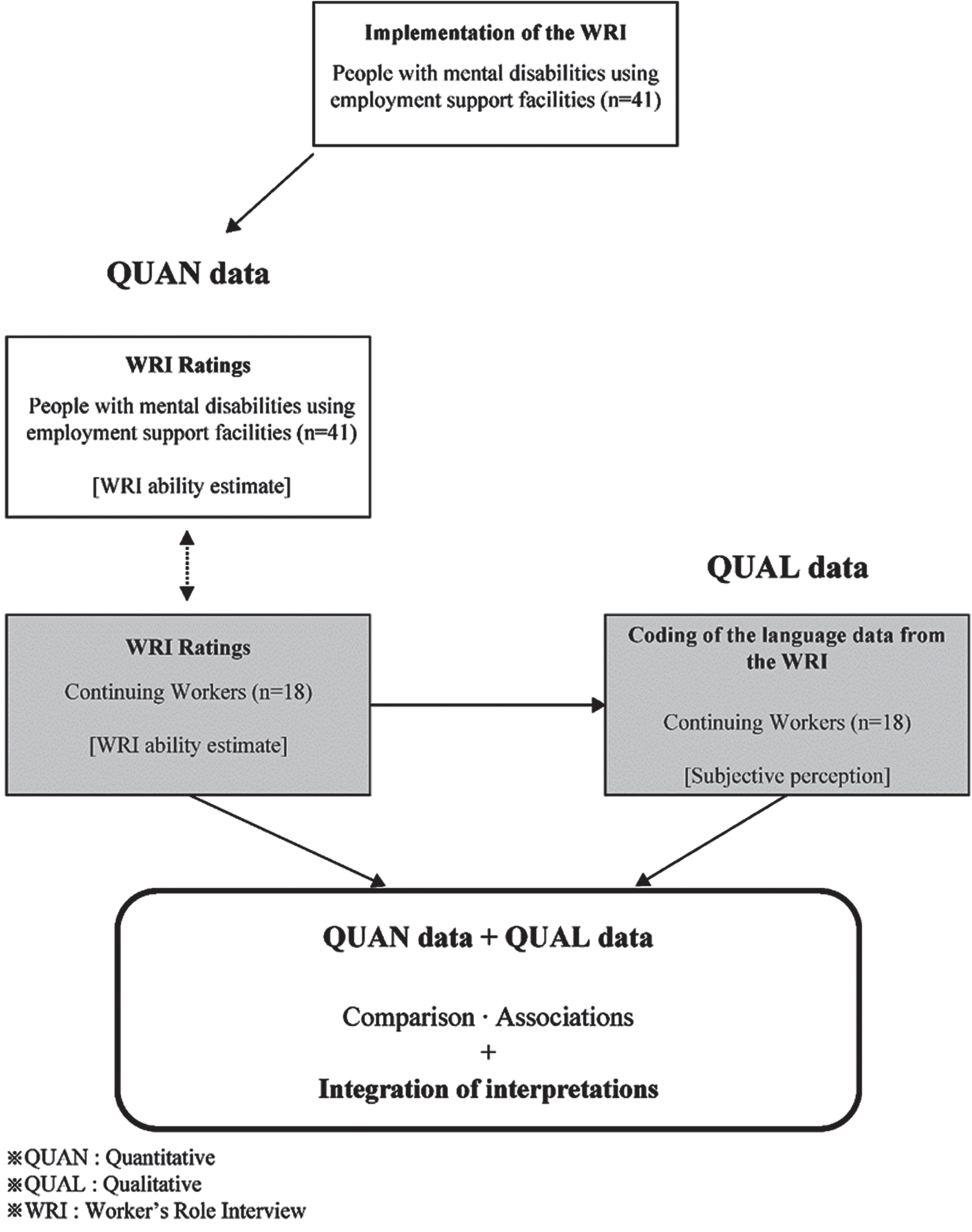
Complex convergent design diagram.
The inclusion criteria were as follows: (1) persons with mental disabilities (i.e., persons aged 18 years or older who suffer from schizophrenia, acute addiction or dependence on psychoactive substances, psychopathology, or other mental illnesses) who received employment support and (2) those who were in continuous employment, having worked for a company for at least one year. To ensure understanding of the interview content and the reliability of the self-reports, the exclusion criteria were as follows: (1) those who had been diagnosed with intellectual disabilities (i.e., persons aged 18 years or older who need special assistance because of intellectual disabilities that appear during the developmental stage and interfere with their daily lives such as Down’s syndrome) and (2) those whose mental symptoms had deteriorated at the time of the survey, as indicated by the attending physician.
The participants were recruited by (1) contacting work support facilities for persons with disabilities, (2) targeting those facilities that agreed to cooperate, and (3) displaying posters in the facilities inviting individuals to participate in the study. The participants who continued to work and prepared to work were named “continuers” and “preparers,” respectively.
The data were collected by occupational therapists working in an employment support facility for disabled people.
Participation in the research was voluntary; those who agreed to partake were provided with written and oral information about the study by an occupational therapist affiliated with the facility. The participants were informed that their non-participation or withdrawal from the research would not affect their use of the facility, or the services provided by the occupational therapist; those who provided their consent were considered the final participants.
In this study, the data were gathered using the following tools:
Demographic and employment status questionnaire
This included information such as sex, age, diagnosis, cohabiting families, and employment duration.
Worker’s Role Interview (WRI)
The WRI [26] is a semi-structured interview developed according to the Model of Human Occupation [27] that encompasses all ICF factors. This assessment method identifies the psychosocial factors that influence the ability to be employed by comprehensively capturing the participants’ subjective perceptions and assessing their ability to work. The factors that influence the prediction of returning to work and those regarding employment (ability to continue a job and be employed in general) can be assessed using 16 items divided into six domains. These domains are personal causal attributions (perceptions of one’s ability to work), values (what one considers important regarding work), interests (pleasure and enjoyment at and outside of work), roles (perceptions of the roles at and outside of work), habits (pre-work habits, current work practices, and lifestyle), and the environment (perceptions of the physical and human environment at work).
The WRI consists of five basic steps: (1) Preparing for the interview; (2) Conducting a semi-structured interview; (3) Conducting physical capacity assessments, functional assessments, and any additional screenings; (4) Scoring the responses using a 4-point rating scale based on the Model of Human Occupation (MOHO); (5) Using the WRI for discharge evaluation. However, steps 3 and 5 were not performed in this study.
A semi-structured interview was conducted with the participants in a private room for approximately one hour, using questions recommended by the WRI for clients with a chronic illness or disability. Subsequently, we classified the statements into 16 WRI items and rated each one on a Likert-type scale as follows: 4 points = strongly supportive, 3 points = supportive, 2 points = hinders, and 1 point = strongly hinders.
Data analysis procedure
The analysis was conducted in the following four steps:
Descriptive statistics on attributes
The means and standard deviations of the participants’ ages and their employment duration at the company they worked in were examined. Subsequently, the statistics of the WRI rating were the median, interquartile range, and total for all participants and for those who were still working.
Collection and analysis of the quantitative data
To confirm the item difficulty and ability estimates for the WRI domains the participants found difficult, the content spoken in the WRI was classified into 16 items. The ratings obtained were examined using the Rasch model, a mathematical model for converting the raw score that a person achieves on a questionnaire into a value on an interval scale [28]. Based on the participants’ responses to the items to be measured as the prime points of the evaluation criteria made in the ordinal scale, their ability and item difficulty estimates were expressed in the logit interval scale units, resulting in a unidimensional measurement [29]. The Rasch model uses the Infit Mean-Square (InMnSq) value and the standardized Z-score (Zstd) as statistics to determine data fit. As the WRI was a four-item rating scale, it was assumed that the fit between the participants’ ability estimate and item difficulty was problematic when it was outside the range of InMnSq >1.4 and Zstd >2.0 [29].
SPSS Base Edition 2020 (IBM, 2020) was used for the descriptive statistics of the data; further, FACETS 3.88.2 (Winsteps, 2020) was employed for the Rasch model analysis.
Collection and analysis of the qualitative data
To clarify the constructs related to the subjective perceptions of work continuity, the content (textual data) described by the continuers in the WRI was assessed using the step for coding and theorization (SCAT) method [30]. Since most of the text data were brief (one or two lines) and it was difficult to paraphrase them on the basis of the respondents’ context, we used the SCAT, which is considered effective for analyzing relatively small qualitative data. The SCAT is a technique of coding and theorizing that involves segmenting linguistic data, such as observations and interview transcripts, and attaching a code to each of the segments in the following four steps: (1) words to focus on in the data; (2) words outside the data to paraphrase; (3) words explaining the paraphrase; and (4) themes and constructs that emerge from the data. Based on previous studies, we adopted a SCAT variant [31, 32] that paraphrases and conceptualizes the intercepted data in a grouped manner.
Integrated interpretation of the qualitative and quantitative data
The qualitative and quantitative results of the constructs and the difficulty levels analyzed by the SCAT and the Rasch model, respectively, were integrated using a joint display. To ensure the collected data’s rigor, they were self-checked and re-examined over time to ensure their reliability. In addition, we obtained feedback from the co-authors and the respondents on whether the data were rooted in their interpretations, including the context of their responses, to ensure validity.
Ethical considerations
This study was conducted with the approval of Tokyo Metropolitan University Arakawa Campus Research and Safety Ethics Committee (approval number 14103). The research participants were fully informed in writing and orally that participation in the study was voluntary, and written voluntary consent from the research collaborators was obtained. The personal information of the participants was managed by connectable anonymization; further, the individual could not be identified, except by accessing the researcher’s computer. Moreover, personal information obtained from the interview that did not damage the data’s meaning when there was a possibility of identifying the individual, was deleted.
Results
Demographics of the participants and the WRI statistics
Overall, 41 subjects participated in the study. Their mean age was 38.1±9.57 years. The diagnoses were schizophrenia, depression and bipolar disorder, epileptic psychosis, social anxiety disorder, mood dysphoria, and autism spectrum disorder (ASD) Functional Level 1 in 23 (56%), 12 (29%), 2 (4%), 3 (7%), and 1 (2%) patients, respectively. Moreover, there were 18 continuing employees and 23 preparing for work. The mean duration of continuous employment at the current company was 3.9±2.57 years. Further, 29 (70%) had family members living with them, while 12 (30%) did not.
The overall median WRI statistic was 2.0 or 3.0, with a quartile range of 0.00–2.00. The median for the continuers was 3.0 or 4.0, with the quartiles ranging from 0.00 to 1.00. The total score was 47.0, and the quartiles ranged from 42.5 to 49.0. The total number of continuers was 47.0, and the quartiles ranged from 44.5 to 49.25 (Table 1).
WRI statistics
WRI statistics
※WRI: Worker’s Role Interview.
The overall WRI ability estimates of the InMnSq and Zstd were 0.83±0.34 and –0.48±1.03 logit, respectively; none had a problem with the fit. Additionally, of the 41 ability estimates, the 1st–20th included five preparers and 15 continuers, and the 21st–41st included 18 preparers and three continuers. In the top 20, 18 were in preparation and three in continuation. For those in the top 20 who were preparing for work and those in the bottom 21–41 who were continuing to work, we documented their living and working conditions in special notes (Table 2). The WRI item difficulty levels for all participants are shown inTable 3. The InMnSq and Zstd of the WRI item difficulty estimates for the continuers were 0.97±0.50 and –0.16±1.25 logit, respectively. The greatest item difficulty was 0.41 with logit for “16. Perception of co-workers” in the environmental domain. The lowest possible score was for “4. Commitment to work” in the value domain, with –0.91 logit. The InMnSq and Zstd values did not exhibit any fit (Table 4).
Ability estimates and standard errors, InMnsq values, Zstd values, and ability estimate ranks for all participants
Ability estimates and standard errors, InMnsq values, Zstd values, and ability estimate ranks for all participants
※n = 41. ※InMnSq: infit mean square. ※Zstd: standardised z-score. ※Cont: Continuers. ※Prep: Preparers.
Difficulty estimates and standard errors, InMnsq, Zstd, and item difficulty rankings for the WRI item for all participants
※n = 41. ※WRI: Worker’s Role Interview. ※InMnSq: infit mean square. ※Zstd: standardised z-score.
Difficulty estimates and standard errors, InMnsq, Zstd, and item difficulty rankings for the WRI item for the continuers
※n = 18. ※WRI: Worker’s Role Interview. ※InMnSq: infit mean square. ※Zstd: standardised z-score.
As a result of the SCAT coding, 12 group concepts of the subjective perceptions of the participants’ continuing to work were extracted and were further grouped into five superordinate concepts: consciousness in daily life, perception of reasonable accommodation, self-understanding and practice for job maintenance, future prospects based on the continuing work experience, and own perceptions of the benefits of working (Table 5). To indicate from which WRI item each concept was derived, the WRI question items are listed in the second column from the right inTable 5, and the WRI item difficulty in the first column from the right. The following is a storyline for each superordinate concept: In the text, {}, [],< >, and “” indicate the superordinate concept, the group concept, the paraphrase of the group, and the representative text data, respectively.
Self-perceptions of the people with mental disabilities in continuing employment
Self-perceptions of the people with mental disabilities in continuing employment
※SCAT: Step for cording and theorisation. ※WRI: Worker’s Role Interview.
Regarding daily life, for those who had family living with them, <understanding of the disability by family>, <consultation and advice to family>, and <support for daily life by family>were reported, indicating that they regarded these as [support from close people who supported employment]. However, some perceived that they had <no support from family>. Certain respondents were conscious of their non-work habits through [conscious leisure activities] such as <relaxation and rest through active leisure activities>and <work-conscious daily lifetime>, while others spent <purposeless leisure time>. They also had [a sense of their own role in life] as they were <contributing to the household with their income>. They were conscious of their daily lives.
Perception of reasonable accommodation
In the workplace, the participants felt that the company had provided them with a [pre-confirmed reasonable accommodation] that included <understanding of their illness>, <disability-friendly work instructions>, <cooperative attitude>, and <specific confirmation of necessary support>. Regarding a [reasonable accommodation without specific rules], there was a positive perception of <visible support from the co-workers>, and a negative perception of “no support from the co-workers.” These can be considered as the [perceptions of a reasonable accommodation] that they experience while continuing to work.
Self-understanding and practice for job maintenance
The participants who continued to work were able to “understand and come to terms with their disability and self-characteristics.” This was based on the <self-awareness of symptoms and understanding of coping strategies>, such as “I have delusions at work; however, I keep them at a distance,” and <understanding the effects of age and personal characteristics>. Accordingly, they had <disease management as their responsibility>, <efforts for stable attendance>, and <active communication>at work, and recognized these as [beliefs and practices for work continuity]. These were the perceptions of self-understanding and practice for job maintenance.
Future prospects based on the continuing work experience
As they continued to work, they had [the confidence to continue in their current jobs]. Nevertheless, they were aware that their <confidence in continuing to work was shaken>by anxiety about future changes in their interpersonal relationships and the working environment. In addition, there were perceptions of [the emergence of new work values] that consisted of <willingness to continue working in the future>and <goals at work>; these were their prospects based on continued work experience.
Own perceptions of the benefits of working
The participants who continued to work had prior experience attending psychiatric daycare or labor transition support facilities or had individual [awareness of the effect of work preparation adjustment]. This was composed of recognizing the <adjustment of regular life rhythm and sleep>and the <adjustment of low-load workload>, the experience of <stable attendance at facilities>, and <understanding of the environment suitable for oneself>based on these experiences. The [awareness of the effects of work] included <income to maintain one’s life>, <employment for independence and contact with society>, <adjustment of life habit through employment>, and <improvement of self-ability and skills>. Furthermore, they felt a sense of [enjoyment and accomplishment at work], comprising <conditions for enjoyment at work>and a <feeling of accomplishment at work>. This can be called one’s perception of the benefits of working, consisting of the connection between the previous and the present work experience.
Results of the integrated interpretation of the qualitative and quantitative data
The joint display (Fig. 2) shows the subjective perceptions and the difficulty levels of the participants who continued to work. The horizontal axis and the number in [] indicate the concept of subjective perception and its difficulty, respectively. The concepts generated from more than one WRI item were marked with the average WRI item difficulty levels; further, these were placed in order of difficulty on the vertical axis as the total difficulty level. This means that the higher the difficulty score, the more difficult it was for the subject to have that subjective perception, and the lower the difficulty score, the easier it was for the subject to have that subjective perception. The three concepts produced from the multiple WRI items were [conscious leisure activities], [beliefs and practices for continuing to work], and [confidence to continue the current job]. Those who continued to work perceived the items [reasonable accommodation without specific rules] and [awareness of the effects of work] as the most difficult and the easiest, respectively.
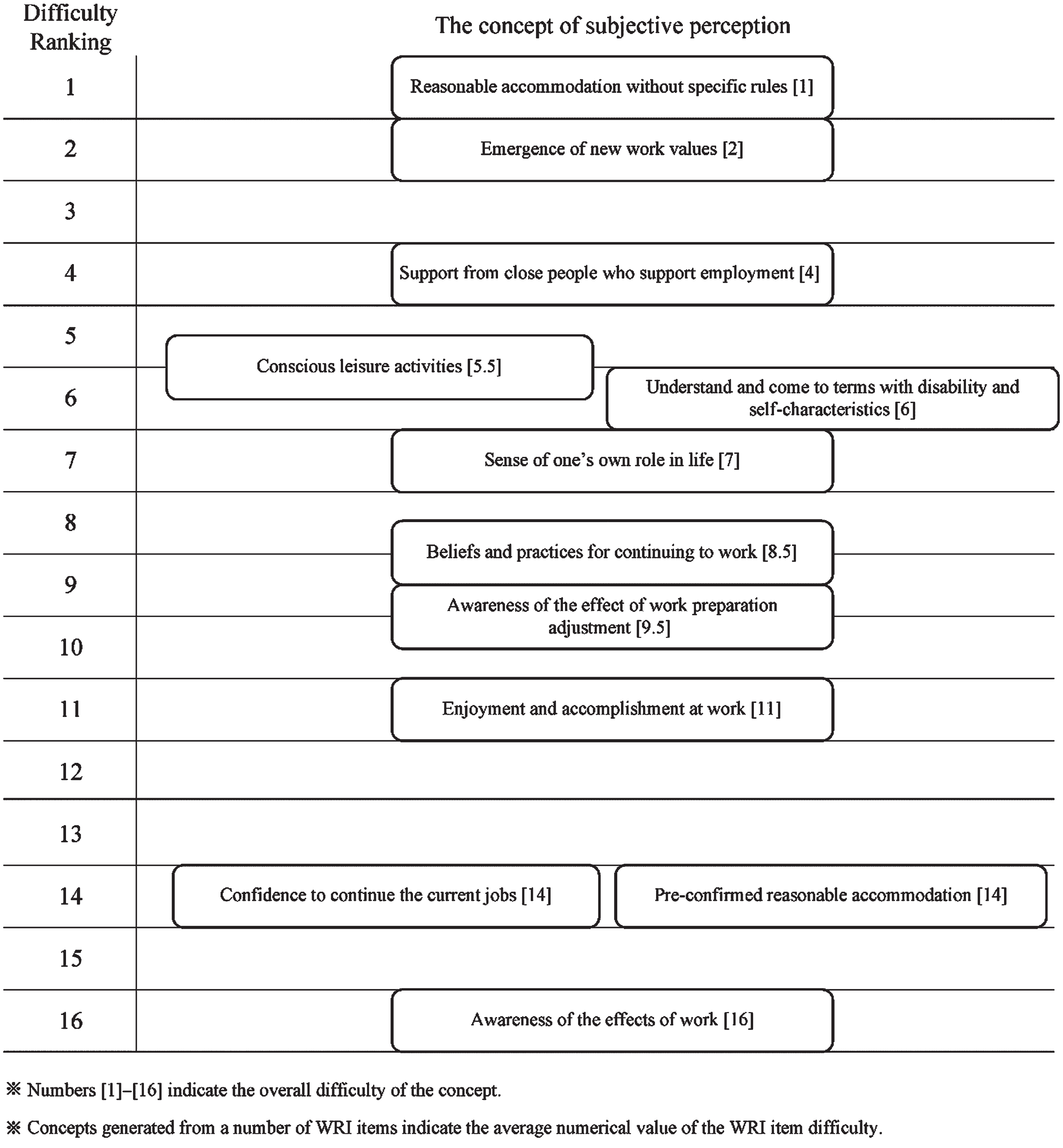
Joint display self-perception and difficulty of continue working among people with mental disabilities.
Relationship between the work-related abilities of people with mental disabilities and their employment status
According to the ability-estimated results, there tended to be more continuers and preparers in the top and the bottom 20, respectively. Regarding the characteristics of preparers in the top 20, many had a stable attendance at the employment training facilities, appropriate adaptation to work in the facilities, and good habits, such as planning to work soon. Therefore, habits may influence one’s ability to work. Previous studies [33] have also indicated that high attendance at training is a factor influencing the employment of people with mental disabilities using employment training facilities. These studies also indicated that good work habits impact finding [34], returning [35], and continuing to work [36]. These findings suggest that support for increasing habituation to continue working is important for the ability to work.
The concept of subjective perception and its difficulty in influencing the continuity of employment of people with mental disabilities
In the qualitative analysis, the WRI was employed as an interview guide; furthermore, the information obtained was used to identify the subjective perception characteristics of the people with mental disabilities who continued to work. In the analysis, the participants showed a link between their perceptions of their pre-work experience, current work, and the future; moreover, the quantitative analysis demonstrated that there was a degree of difficulty in having these subjective perceptions. A study of employees with mental disabilities and their employers found that those who remained at work could find a job that suited them better because of their work experiences [37]. Interestingly, we were able to draw on their experiences to show the process of maintaining their current jobs and the content of their specific subjective perceptions for the future.
In this research, the top concept of subjective perception based on experience was {own perception of the benefits of working}. They are aware of the benefits of working prior to commencing work; they may continue to recognize the effect of their work after they start working. Included in this concept is the notion of “awareness of the effects of work,” which is the most fundamental aspect of work, namely, what we work for. The WRI item from which this concept was extracted, “4. Commitment to work,” indicates the value and the personal standards of being employed; it was ranked 16th in difficulty and the easiest by the continuers (Table 4). Work remains meaningful and essential to those who experience work disability; further, most disabled people want to work [38]. It has been reported that the meaning of work held by individuals with mental disabilities is related to its continuation [37, 39]; however, we believe that those who continue to work may have a stronger sense of this meaning of work than they did before working. In addition, they may continue to experience and recognize new employment effects such as “enjoyment of work and a sense of accomplishment” through continued employment. The continuers’ difficulty level of the WRI item “6. Enjoys work,” from which this concept was extracted, was ranked 11th (Table 4), and perceived to be slightly easier than average. Its difficulty was ranked 6th among all the participants (Table 3). Specifically, this concept may be a new recognition of the effects of work generated by continuing to work; it is a characteristic of subjective recognition that is made more conscious by continuing to work.
{Self-understanding and practice of job maintenance} is the recognition of the process of maintaining the current job. The participants who continued to work had “beliefs and practices for continuing to work” and “Own obstacle and self-characteristic understanding and compromise.” They thought about how they could do their jobs efficiently and practiced specific behaviors, such as disease management based on past work experience, efforts to stabilize attendance and positive communication with others. Interpersonal relationships at work are a reason for individuals with mental disabilities to leave their jobs [6]; those who maintained their jobs reported that interaction with others at work was a factor related to job performance and satisfaction/happiness [40]. It is likely that the continuers perceive interpersonal skills as being important for maintaining employment as well as working consciously and continuously in their employment settings. We believe that this is a significant subjective perception that could lead to coping skills for maintaining work independently, even if the amount of support from the employment services decreases.
The same perception of the process of maintaining one’s current job includes the {perception of reasonable accommodation}. A rational consideration recognized by the participants was “reasonable accommodation without specific rules.” The WRI item from which this concept was extracted was “16. Perception of co-workers,” which was ranked first in difficulty (Table 4); it was the most problematic concept for the continuers. Interactions with co-workers can be the most challenging interpersonal relationships [7], which is also a reason for leaving a job. This is because, in the employment of people with disabilities, co-workers can be those who give instructions or who work on the same job, depending on the nature of the work; further, unlike the association between a boss and a subordinate, the framework of the relationship is often not formalized. In Japan, there is a culture of “reading the atmosphere” of the interpersonal environment around oneself, a behavior in which one judges the mood of the situation by oneself, studies the feelings of others without a verbal confirmation, and expects others to understand one’s feelings. Thus, in Japan, the relationship with co-workers involves not only a lack of framework but also the need to behave in a way that allows one to judge the mood of the situation [41]. This unique aspect of Japanese culture may lead to non-specific agreements, that is, to engage in work that is not directed and difficult. However, the concept of <realizing a reasonable accommodation>that was extracted from the WRI item “15. The continuers perceived boss/company” was considered easy and ranked 14th (Table 4). In general, a reasonable accommodation results from a pre-employment discussion between the employer and the employee. It has been reported that a successful implementation of reasonable accommodation can lead to longer working hours and periods [42] and reduces the risk of leaving work; moreover, high-quality support from supervisors and co-workers at work can increase the confidence and optimism of returning workers and help them feel valued [43, 44]. In addition, relationships with co-workers and supervisors are components of job satisfaction, emotional adjustment, and other factors that have a restraining effect on disability turnover [45]. Therefore, in addition to the perceptions of co-workers and superiors, it may be possible to examine the appropriate rational consideration sought by the participants by eliciting their subjective perceptions from a more specific perspective of how they receive a rational consideration.
In the process of maintaining their jobs, those who continued to work were {conscious of daily life}. Daily life impacts work absenteeism, tardiness, lack of concentration, and falling asleep at work [46]; however, it is unclear what kind of awareness in daily life is effective in maintaining employment. In this study, three concepts of awareness of life were extracted from the participants who continued to work: first, “support from close people who support employment”; second, “conscious leisure activities” that included active relaxation and not letting holiday fatigue carry over to work; and third, the perception of “one’s own role in life.” There is a notion of “occupational balance” [47] regarding how people spend their time at work and during holidays, based on the value of the work that is done each day. If the work balance is disturbed, work continuity will be affected [48]. This suggests that it is important to have a perspective on the degree to which work balance in one’s professional life is perceived as harmonious, how the participants spend their leisure time, and the sense of their role in life. Furthermore, the third concept was recognition of <the support of close people who support employment>, and the continuers’ difficulty level of the WRI item “14. Perception of family and peers,” from which this concept was extracted, was slightly high and ranked fourth (Table 4). We believe that this was partly due to some of them not having the support of their family or friends, even if they lived with them, and partly because they did not have the support of those who were physically close to them. However, it has been suggested that family support does not differ significantly between working and non-working people with mental disabilities [49]; moreover, the former tend to need less family support than the latter and consider building a relationship with their managers and co-workers at work more important [50].
Therefore, the perception of how appropriately they are supported at work may be more significant than family support for maintaining employment. In addition, by continuing to work, they gained the “confidence to continue in their current job,” which was included in the {Future prospects based on continuing work experience}. This concept was extracted from the WRI items “2. Expectation of success at work” and “10. Work habits.” Further, in a survey of mentally ill people on leave using the WRI, it was reported that “2. Expectation of success at work,” and “10. Work habits” were crucial items related to returning to work [51]. It has been highlighted that work habits influence the continuation of employment [34, 36]; however, people with mental disorders often leave work early. In addition, self-esteem may be enhanced by successful experiences at work [52]; we believe that work habits have been established to continue working and that stable attendance is a successful experience for people with mental disorders. This may provide them with the confidence to continue their current work. Therefore, the recognition of the habits that retain individuals at work and the recognition of the successes that reflect these habits may be an important aspect of continuity. By working with these perceptions, it is possible for “new work values” to emerge. This concept was extracted from the WRI item “5. Work-related goals” ranked second in difficulty for those who continued to work (Table 4); additionally, even those who continued to work found it challenging. It has been suggested that the factors that increase the value of work include past experiences of job loss and facing a disadvantage at work, together with doubts about future job prospects and ability [39]. This study’s participants practiced self-awareness of disability characteristics, communication, and coping skills in actual work situations. This gave them the confidence to continue their current job, thus building on the successes they had already experienced. While this confidence can be achieved with certainty in the current work environment, we believe that new work values can be attained only by those who can withstand uncertainty. This suggests that it is necessary to clarify the perceptions of the abilities currently acquired, as well as the approach to the tolerance of uncertainty, to support the continued employment of people with mental disorders.
Implication
This study identified the characteristics of comprehensive subjective perceptions of people with mental disabilities regarding their continued employment in companies. [Consciousness of daily life], [Perception of reasonable accommodation], [Self-understanding and practice for job maintenance], [Future prospects based on continuing work experience], and [Own perception of the benefits of working] were identified as superordinate subjective perceptions. These comprised those that had been held before employment and those that emerged gradually during continued employment and could serve as points of focus for support during continued employment. Thus, we believed that providing support for continued employment of the individuals with mental disorders might contribute to continued employment by making environmental adjustments based on their subjective perceptions while confirming these comprehensive subjective perceptions.
Limitations and future perspectives
Although the characteristics of the subjective perceptions obtained in this study can be developed to examine specific support for people with mental disabilities who stop working despite being supported by the employment support facilities, this research’s interpretation has the following limitations:
First, we were unable to show the tendency of the subjective perceptions of those study participants who were preparing for work; further, we could not compare them with those who continued to work. In the future, it is necessary to clarify the characteristics of the perceptions of those who are preparing for work and those who quit at an early stage; additionally, the perspectives necessary for the continuation of employment of people with mental disorders should be examined.
Second, although the participants’ recruitment was spread over several facilities in the Chugoku region, the Tokyo metropolitan area, and the Tohoku region of Japan, the data did not consider the labor market situation in each city, as more participants were recruited from large cities rather than from smaller local centers. In addition, we did not analyze the type of work (full- or part-time) of those who continued to work, which may have affected the interpretation of the results. In the future, it will be necessary to clarify the subjective perceptions of those who continue to work by assessing the labor market in the area where they live and their type of work.
The WRI used in this study is an assessment tool for people with disabilities who are going or returning to work. In this research, it was a suitable tool for those who were preparing for work; however, the interview content may have been unsuitable for those who continued to work. This may have affected the ratings and the results of the Rasch analysis. In the future, we would like to utilize a rating scale that applies to those who continue to work.
Conclusion
This study used a mixed-methods approach to identify the characteristics of the subjective perceptions that affect the employment of people with mental disabilities who continue to work. The results revealed five overarching superordinate concepts and 12 subordinate concepts of the subjective perceptions regarding maintaining the current work and the future for the participants who continue to work, drawing on their experiences and work preparation. The subjective perceptions may be related to the participants’ experience and the time course of continuing to work. In the future, it is expected that the participants’ subjective perceptions will be focused on in support of continued employment; further, the subjective needs for continued employment will be reflected.
Footnotes
Acknowledgments
The authors express their gratitude to all participants and therapists who participated in the study, and a special thanks goes to Hiroyuki Notoh and Masataka Shikata for their excellent advice.
Conflict of interest
The authors declare that they have no conflict of interest.
Funding
The authors report no funding.
Ethical approval
This study was conducted with the approval of the Tokyo Metropolitan University Arakawa Campus Research and Safety Ethics Committee (approval number 14103).
Informed consent
The research participants were fully informed in writing and orally that participation in the study was voluntary, and written voluntary consent from the research collaborators was obtained.