




Abstract
BACKGROUND:
The COVID-19 pandemic has led to widespread changes in the way people work. Some of these changes represent the same kinds of work modifications or adjustments that have often been requested as workplace accommodations, and which may improve labour market and employment outcomes for people with disabilities.
OBJECTIVE:
The aim of this scoping review was to examine the literature on workplace accommodations in the pandemic and their impacts and implications for people with disabilities.
METHODS:
Following a search of six international databases, articles were selected by two reviewers, and data were abstracted in accordance with scoping review methodology. A thematic analysis was used to report the relevant findings.
RESULTS:
Thirty-seven articles met the inclusion criteria, and three main themes were identified: positive impacts of pandemic-related workplace accommodations on people with disabilities (e.g., improved accessibility, reduced stigma around workplace accommodations, rapid implementation of workplace accommodations, opportunities for advocacy); negative impacts (e.g., worsened physical and mental health, new accommodation needs); and action needed and recommendations (e.g., revisit legislation and policy on accommodations, ensure representation of people with disabilities). Overall, our review identified a mixed assessment of the impacts of pandemic-related accommodations on people with disabilities. However, there was a broader consensus regarding the importance of learning from the experiences of the pandemic to improve workplace accommodation policies in the future.
CONCLUSIONS:
The pandemic may present opportunities for improving workplace accommodation policies, but our review also highlights the need for more research examining how workplace changes due to the COVID-19 pandemic have impacted people with disabilities.
Introduction
On March 11, 2020, the World Health Organization (WHO) declared coronavirus disease (COVID-19) as a global pandemic [1]. Since then, the pandemic has disrupted many aspects of society, including work life. Government policies designed to mitigate the spread of the virus have included lockdown orders and physical distancing measures, which have changed the way a typical workday looks for many individuals and organizations. There have been changes to existing workplaces—with spaces being reconfigured to adhere to physical distancing rules, and the establishment of new workplaces altogether—with many individuals switching to home or other remote forms of work [2, 3]. For many workers, their new workspaces were accompanied by the use of new equipment and digital technologies to facilitate remote work [4], and the traditional nine-to-five schedule in some sectors has been replaced by more variable (and in some cases flexible) work hours [5].
Notably, some of the changes to daily work routines that became commonplace during the COVID-19 pandemic represent the same types of workplace accommodations that were commonly requested by people with disabilities prior to the pandemic [6, 7]. A workplace accommodation refers to a change or modification to a job or workplace, which can be sought through either formal or informal channels, to enable qualified individuals to safely and effectively perform their job duties [8, 9]. A wide range of modifications fall under this umbrella term, but work from home arrangements, digital technologies, and flexible hours were among the most prevalent workplace accommodations sought by people with disabilities [10–13]. However, they have not always been successful; although the accommodation principle is a central component of antidiscrimination and equal opportunity laws in many countries [8], in practice, the process of seeking and receiving workplace accommodations can be complex and contested, and accommodation needs often go unmet [14, 15]. In Canada, for example, while employers have a legal duty to offer reasonable job accommodations for people with disabilities at all stages of the employment relationship to the point of undue hardship [16], national survey data from 2017 shows that only 59% of employees with disabilities who required accommodations had all of their needs met [14]. Other studies highlight that many people with disabilities do not disclose their condition to their employers, a prerequisite for receiving accommodations, with researchers identifying a range of individual, cultural and institutional barriers to disclosure [14, 17–20]. A systematic review on workplace disclosure among young people with disabilities, for example, found that such barriers included stigma, discrimination, and fear that disclosure would affect job performance [18].
There is growing research pointing to the importance of workplace accommodations for people with disabilities. For example, studies show that accommodations can improve labour force participation [21], inclusion and accessibility [14], productivity [13, 22], and extend working life [23] among people with disabilities. Workplace accommodations may help individuals with disabilities avoid or overcome workplace barriers; for example, work from home arrangements for people with physical disabilities to avoid inaccessible public transportation [24], or job coaches to create more supportive working environments for people with mental illness [25]. Moreover, workplace accommodations may be a factor in improving employment rates among people with disabilities [21, 26]. Employment is a well-known social determinant of health [27], and yet employment statistics point to persistent unemployment and underemployment rates among people with disabilities around the world [14, 28–30]. Further efforts are needed to understand how policies and practices surrounding workplace accommodations can be improved.
This review examines workplace accommodations in the context of the COVID-19 pandemic, and in doing so it fills an important gap in the current literature. Two rapid reviews and one scoping review have examined pandemic-related changes to the world of work [2–4]. The rapid reviews focused on the health effects of working from home [2, 3]. One review identified only poor effects (such as reduced physical activity, poor sleep quality, increased anxiety, depression and fatigue, and less job satisfaction) [2], while the other reported mixed findings (positive effects included increased safety and happiness) [3]. The scoping review compared flexible work arrangements before and during the pandemic, and identified mixed effects, including increased ‘technostress’ and increased productivity during the pandemic [4]. However, none of these reviews examined these changes in relation to workplace accommodations, or the implications for people with disabilities. In fact, two reviews stated that they explicitly excluded studies focusing on workers with disabilities, and the third made no mention of workers with disabilities [2, 3].
The purpose of this scoping review was to synthesize the literature on workplace accommodations during the pandemic, focusing on their impact and implications for people with disabilities. Given the significance of workplace accommodation for labour market and employment outcomes for people with disabilities, it is important to understand whether and how the practices and policies of workplace accommodation have changed during the pandemic, and to consider the impacts and implications for this population.
Methods
A scoping review was chosen because this type of review is best suited to addressing exploratory research questions on a novel topic or an emerging field [31]. The review followed the methodological guidance provided by Arksey and O’Malley [32], while also incorporating the updated guidance provided by the Joanna Briggs Institute [31]. We adopted the five-stage process outlined by Arksey and O’Malley and subsequently enhanced by Levac et al. [33]: (a) identifying the research question, (b) identifying relevant studies, (c) study selection, (d) charting the data, and (e) collating, summarizing and reporting the results [32]. We also used the Preferred Reporting Items for Systematic reviews and Meta-Analysis extension for Scoping Reviews (PRISMA-ScR) Checklist (see supplementary Table 1). This study did not require Institutional Review Board approval given that it is a review.
Identifying the research question
The following question guided our scoping review: What does the literature say about a) workplace accommodations during the COVID-19 pandemic, and b) their impacts and implications for people with disabilities?
Identifying the relevant studies
An electronic search for studies was conducted using a search strategy that was developed in consultation with a librarian with expertise in disability. The following databases were searched, covering December 2019 to December 2021: Medline, PsycINFO, Scopus, Applied Social Sciences Index and Abstracts, Sociological Abstracts and Google Scholar. The search strategy included a range of keywords to capture the different ways workplace accommodations are described in the literature, and to capture international variation in terminology (for example, in the UK the language used in legal and policy documents is workplace “adjustment”). The strategy also used medical subject headings and keywords related to disability (e.g., disabled, mental health disability) and COVID-19 (e.g., SARS-CoV-2, coronavirus). An example of a full search strategy can be found in supplementary Table 2. A manual search of reference lists of all included articles was also conducted.
Study selection
The following inclusion criteria were applied: (i) article published in a peer-reviewed journal explicitly addressing both (ii) workplace accommodations (i.e., changes to a job or workplace through formal or informal channels [8, 9]), adjustments, or modifications during the pandemic; and (iii) the impact or implications for people with disabilities. We used the broad definition of disability offered by the World Health Organization (WHO) in the International Classification on Functioning, Disability and Health, which refers to disability as “an umbrella term for impairments, activity limitations and participation restrictions” [34] (p. 79). Given the exploratory nature of this review, and because the focus on the COVID-19 pandemic makes this a particularly novel and timely topic, we wanted to capture as wide a range of findings, ideas and perspectives as possible. We decided that in addition to primary and secondary research articles, any type of peer-reviewed publication should be included, such as commentaries, editorials and opinion papers.
We excluded non-peer-reviewed work (e.g., theses and dissertations, grey literature, conference abstracts), books and book chapters, and systematic reviews. However, the reference lists of relevant systematic reviews were manually examined to ensure that no relevant studies had been missed in the database searches. We had no geographic or language restrictions during the search or title/abstract screening stage; however, only articles in English, French or Spanish were included for full-text screening. Studies were excluded if they addressed both workplace accommodations and people with disabilities, but none of the findings were in the context of the COVID-19 pandemic.
A total of 1991 titles were identified through the search. After removing duplicates (n = 48) (see Fig. 1), both authors independently reviewed the titles and abstracts (n = 1943) for inclusion using Covidence software. A total of 1783 studies were excluded at the title and abstract screening stage because they were irrelevant and did not meet our inclusion criteria, after which we were left with 160 full texts to review. A further 125 studies were excluded during full-text screening, leaving 35 studies meeting the inclusion criteria. Two additional articles were identified through follow-up internet searches, giving us a total of 37 studies in our review.
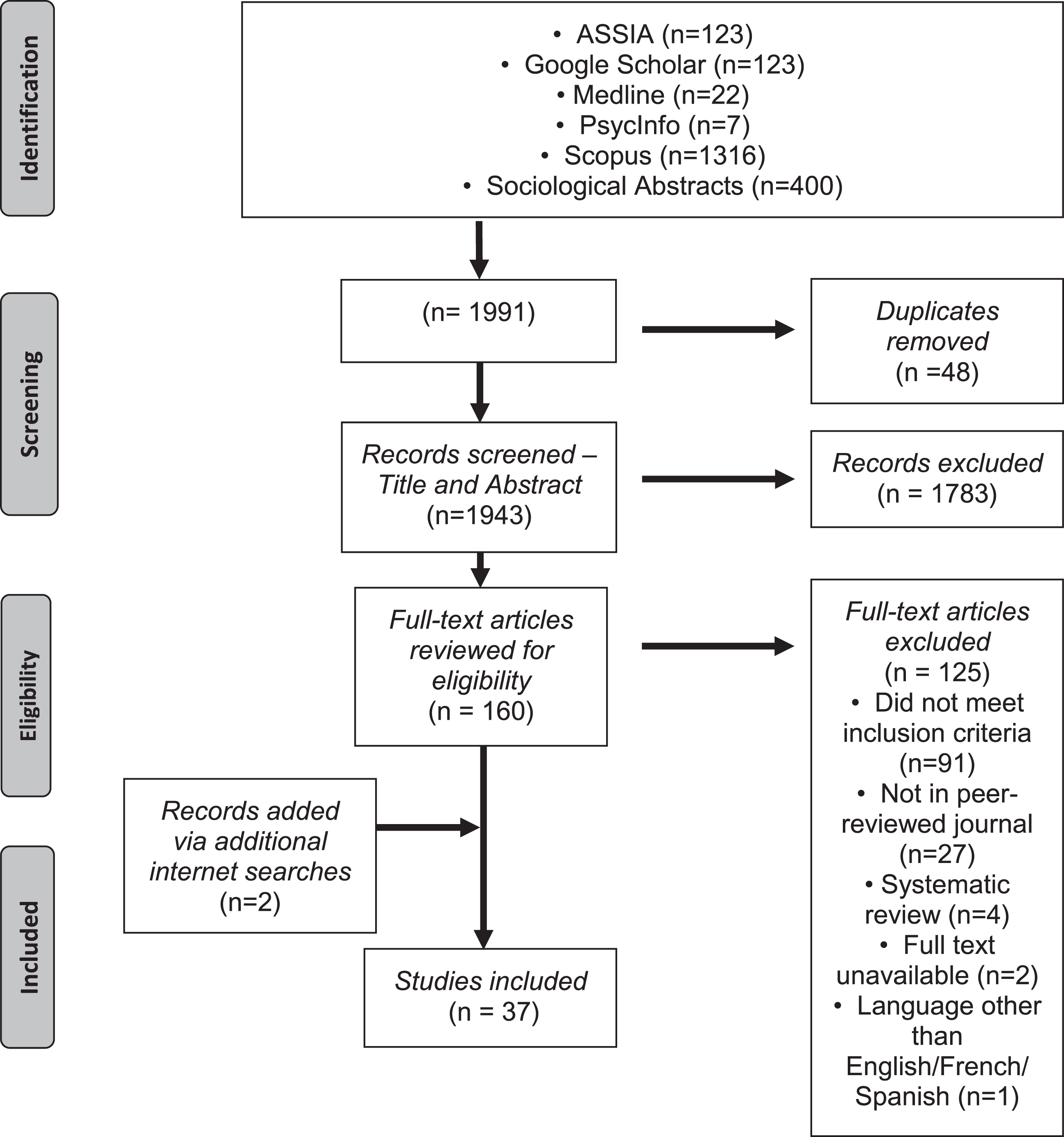
PRISMA flow chart (Adapted from Moher et al. 2009).
Relevant data were extracted from the articles using a data abstraction form. The following information was recorded: (a) author(s) and country of publication; (b) sample characteristics; (c) objective; (d) methodology and theoretical perspective; and (e) findings (see Table 1). The second author checked the form to ensure completeness and accuracy.
Overview of studies
Overview of studies
*Where the country of study differs from the country of the first author’s institutional affiliation, both are noted, respectively. †We only report on the findings and analysis related to our research question.
A basic descriptive analysis of the studies was performed, in accordance with Arksey and O’Malley’s [32] recommendation. Thematic analysis was then used, following the steps outlined by Braun and Clarke [35]: familiarization with the data (reading and re-reading the articles); generating codes (identifying and recording all relevant findings reported in the included articles and coding these findings); searching for themes (sorting all codes into common groups); reviewing themes (ensuring codes were properly assigned and grouped into themes that were relevant to the review question); defining and naming the themes; and writing the report.
Results
Study characteristics
Thirty-seven studies met the inclusion criteria. There were 13 articles from the US, eight from the UK, four from Canada, three from Australia, three with a global or multiple-country focus, and one paper each from Germany, Israel, Jamaica, Peru, Portugal, and Singapore. Eighteen studies reported sample characteristics, and thirteen of these included various types of disabilities (i.e., muscular dystrophy, Larsen Syndrome, low vision, and intellectual disabilities) or did not specify the disability type. The other five studies focused on a single disability or disability type, including spinal cord injury [36], neurological disabilities [37], autism [38], deaf and hard of hearing [39], and mobility disabilities [40]. The studies employed a range of methodologies and approaches. Twenty-six articles were qualitative, six were quantitative and five used mixed methods. Thirteen articles were based on secondary analysis, and 12 were primary research studies. The rest (n = 12) were perspective papers such as commentaries (n = 7), opinions (n = 2), editorials (n = 1), letters to the editor (n = 1), and organizational guidelines (n = 1).
Our review identified three main themes including: positive (or potentially positive) impacts of pandemic-related workplace accommodations on people with disabilities (i.e., improved accessibility, reduced stigma around workplace accommodations, rapid implementation of workplace accommodations, opportunities for advocacy); negative (or potentially negative) impacts (i.e., worsened physical and mental health, new accommodation needs); and the need for action on accommodation issues in light of the experiences of the pandemic (i.e., revisiting legislation and policy on accommodations and ensuring representation of people with disabilities).
Theme 1: Positive impacts
Twenty-eight studies (11 secondary analysis, 9 perspective and 8 primary research) identified positive or potential positive impacts of pandemic-related workplace accommodations on people with disabilities, which included improved accessibility, reduced stigma around workplace accommodations, rapid implementation of workplace accommodations, and opportunities for advocacy.
Improved accessibility
Eight studies (four primary research [36, 42], three perspectives [43–45], and one secondary analysis [46]) reported that the switch to working from home and other forms of virtual work improved accessibility for some workers with disabilities, such as spinal cord injury, Larsen Syndrome, anxiety disorders and autism. In Okyere et al.’s global survey of people with disabilities, the positive effects of working from home included increased control over work settings and a more supportive environment [41]. The survey included open-ended responses and one participant, a 40-year-old female with diabetes and anxiety, explained “My emotional well-being has increased because I am able to be home (my sanctuary), with my family and pets (unconditional love and support). I want to remain a remote worker!” [41], (p.29). The increased sense of control over working environment was reported in three other studies as well [38, 46]. Four studies highlighted how the transition to virtual workplaces had the effect of removing physical barriers associated with on-site work (such as congested workspaces that are difficult to maneuver with a wheelchair) [43, 46] and transportation-related barriers [40, 46] for people with mobility impairments. Interestingly, Adams et al.’s study of individuals with spinal cord injuries found that some individuals, who had already been working remotely prior to the pandemic but who had requested additional accommodations, finally had their requests granted once the pandemic began; however they did not specify the precise reason(s) for why these needs were now being met [36]. In another study, a professor with Larsen Syndrome explained that before the pandemic, he had (unsuccessfully) sought accessibility accommodations to teach remotely, because “being physically in the classroom was not always an option due to his conditions at that time” [42], (para.20). When the opportunity for remote work became a reality due to the pandemic, this represented the “first time he experienced supported employment” [42], (para.20).
Two studies reported more accessible work environments for workers who remained onsite during the pandemic [38, 47]. For example, Goldfarb et al. reported that some employees with autism found that because workplaces were emptier during the pandemic, the quieter environment was more conducive to working. One participant explained: “I control my physical environment’s sensory stimulation, there is no noise, not too much light ... it’s great, I don’t have to compromise if someone else listens to music” [38], (p. 10). Notably, this study reported an increased sense of control over work schedule and physical environment among both employees working remotely and those who worked on site during the pandemic. One study from the UK found that the reorganization of the physical workspace, such as leaving hallway doors open to allow air circulation to comply with sanitation and physical distancing requirements, made these spaces easier to navigate for some people with mobility issues [47].
Reduced stigma around workplace accommodations
Seven studies (three secondary analysis [46, 49], three perspectives [43, 50], and one primary research [38]) highlighted how the widespread nature of certain pandemic-related accommodations, such as the shift to remote work, the provision of adaptive technologies to facilitate home-working, and the option of more flexible hours lessened some of the stigma that these accommodations had been associated with prior to the pandemic [38, 48–50]. Holland [46], for example, observed that some workers with disabilities reported a positive experience of working from home during lockdown because their colleagues were also working remotely. As a result, they were no longer singled out and stigmatized for this accommodation. Similarly, Ahmed [43] explained how prior to the pandemic, academics with disabilities who were provided with adaptive technologies were accused of receiving favourable treatment, but this argument became obsolete when these same technologies became widely used during the pandemic for online teaching and conferences. An interesting finding reported in Goldfarb et al.’s study was that for employees with autism, working from home did not lead to a reduced feeling of social relatedness, which the authors suggest may be due in part to the fact that remote work was widespread, rather than unique to employees with disabilities [38]. It is worth noting that while these studies reported reduced stigma around accommodations, other studies in our review reported increased stigma (or potential stigma) for some people with disabilities as a result of new accommodation needs arising from the pandemic (discussed further below).
Rapid implementation of workplace accommodations
Twelve studies (five perspectives [45, 50–53], four secondary analysis [46, 55], and three primary research [38, 57]) focused on how rapidly workplace accommodations, especially work from home arrangements, were implemented at the onset of the pandemic. Four studies highlighted (drawing from either their own or secondary data) how certain jobs tended to see the swift transition to remote work, particularly management positions and other white-collar, knowledge-based jobs such as business and finance, education, information technology, and the sciences [38, 58]. Notably, all but one [38] of these studies observed that people with disabilities are underrepresented in these occupations. Finally, ten studies focused on the role of technology in facilitating this rapid shift to remote work [40, 60]. McNamara and Stanch, for example, observed that many businesses quickly turned to accessible technology tools such as Zoom in order to keep employees connected and maintain operations amidst the turmoil created by sudden and unexpected work from home orders due to the pandemic [45].
Opportunities for advocacy
Seventeen studies (10 secondary analysis [28, 60–62] and seven perspectives [43–45, 50–52]) discussed how workplace accommodations implemented during the pandemic created new conditions and opportunities for accommodations-related advocacy by and for people with disabilities. While the process for obtaining accommodations before the pandemic had often been a long and bureaucratic one [52, 63] these studies argued that the pandemic demonstrated that some accommodations can be quickly and easily granted. For example, in the pre-pandemic era working from home arrangements represented one of the most requested and most denied accommodations for workers with disabilities [45–47, 63]. Yet during the pandemic, “because everyone needed these changes, the historical ‘hard no’s’ quickly turned into ‘we could make that happen,’ a sentiment disabled people have been waiting to hear most of their lives” [50] (p. 2). As seven studies observed, disability advocates therefore now have the pandemic as a historical precedent to draw from, particularly when coming up against arguments about workplace accommodation being unfeasible [14, 62].
Four studies argued that the reliance on certain technologies to facilitate remote work provided real-world evidence of the benefits of the principle of universal design, wherein technology is designed to be usable by as many people as possible, with a diverse range of needs in mind [50, 60]. Sheppard-Jones et al. [59] observed that universal design may help reduce the need for individualized accommodation requests relating to technology, and the experiences of the pandemic may have provided an opportune environment for advocates to push for its implementation on a larger and more permanent scale.
One study explored how the issue of workplace accommodations in the pandemic was framed through a human rights discourse [64]. Some of the studies suggested that the experiences of the pandemic may affect the way that future courts rule on the issue of ‘reasonable accommodations’ when it comes to remote work [8, 62] or remote teaching [61]. Rodgers [62] suggests that the pandemic may have also created an opportune moment for advocating for a more collective-oriented approach to home-working accommodations, rather than the individual-based approach underpinning existing labour laws in the UK. Six papers argued that home-working or other remote working arrangements have become so ubiquitous since the pandemic began that they may represent a “new normal” moving forward [44, 55].
Theme 2: Negative impacts
Twenty studies (eight primary research [15, 65], six secondary analysis [28, 67], and six perspectives [44, 68–70]) reported negative or potential negative impacts of workplace accommodations during the pandemic, including worsened physical and mental health and new accommodation needs.
Worsened physical and mental health due to working from home
Thirteen studies in our review (seven primary research [15, 56], three secondary analysis [48, 67], and three perspectives [44, 47]) reported negative impacts for workers with disabilities, including worsened mental and/or physical health, resulting from work from home orders. Seven of these were primary research studies. The most reported negative mental health impact on workers with disabilities was increased isolation and/or loneliness, including for those with autism, mobility disabilities, anxiety, depression, and spinal cord injury [36, 40–42]. Increased isolation was also highlighted in four of the secondary analysis articles [45, 67] and two perspective papers [44, 47]. Another negative mental health impact was the increased feeling of sadness [41]. One paper discussed the negative impact that digital technologies such as Zoom can have on deaf and hearing-impaired workers, who may experience stress and fatigue from having to be hypervigilant to not miss anything during meetings; the paper also discussed how Zoom can be exclusionary towards workers with vision impairments [45]. Two primary research studies [36, 56] and one secondary analysis [48] reported on negative physical impacts of working from home during the pandemic. Adams et al., for example, found that workers with spinal cord injury who switched from on-site to remote work experienced worsened physical health early in the pandemic, due to the loss of daily physical activity (e.g., pushing a manual wheelchair) associated with travelling to, from, and within the workplace [36].
New accommodation needs
Seventeen studies described new (and sometimes unmet) accommodation needs for workers with disabilities that emerged during the pandemic [15, 65–70]. One study comparing the impact of COVID-19 on workers with and without disabilities found that in the early days of the pandemic, individuals with a disability were less willing to share their health needs with a supervisor; moreover, workers with both a mental and physical health disability reported more unmet accommodation needs than those with only one or no type of disability [15]. Several studies identified additional accommodation needs among workers who, due to their condition(s), were at an increased risk of serious illness if infected with COVID-19. Specifically, six studies noted that even when lockdowns or other policies requiring remote work came to an end, some workers with disabilities would need to continue to work from home as long as the pandemic was ongoing, due to their high-risk status [36, 69]. One study found that 17.7% of accommodation requests during the peak period of requests (in April 2020) were due to the fear of contracting COVID-19, although the authors did not specify what percentage of these were from individuals with disabilities [66]. Another new accommodation requirement resulting from the pandemic was the need for transparent masks among those who are deaf and hard of hearing; notably, Grote et al. [39] found that 87% of the deaf healthcare professionals in their study had not received these.
Four studies in our review discussed the potentially stigmatizing or other negative consequences of requesting extended remote work accommodations [36, 70]. For example, one study [36] found that some workers with spinal cord injury felt guilty about requesting ongoing remote work, especially if that meant their coworkers would need to take on additional on-site duties. A secondary analysis of labour and anti-discrimination law in Australia discussed the implications of businesses likely moving to a hybrid model of work with hoteling rather than permanent desks/offices post pandemic. In particular, this model could lead to the singling out and stigmatization of workers with disabilities who may need to request more permanent workspaces [67]. Staff with physical or mobility disabilities may, for example, require special equipment that cannot be transported back-and-forth between home and the workplace (or from one workspace to another); additionally, people with neurodiversity may struggle to cope with shared working spaces that are not adapted to accommodate their sensory sensitivities [67].
A common finding was that the pandemic-specific workplace changes created new accommodation needs for workers with disabilities. Twelve studies discussed additional accommodations that were required due to the transition to remote work [28, 70]. Five studies identified the types of additional accommodations needed, including adaptive technologies [40], ergonomic office furniture [56], adaptive office equipment [36, 41] and accessible communication devices [40, 42]. Three studies observed that for some workers with disabilities, these additional requirements were not met, which negatively impacted their work productivity [41, 65].
Theme 3: Action needed and recommendations
The third main theme, which we identified in twenty-three studies (eight primary research [15, 71], eight secondary analysis [28, 62], and seven perspectives [44, 68]) was regarding the need to take action on workplace accommodation issues. This theme was evident across all types of papers, regardless of whether they emphasized the positive or negative impacts of pandemic-related accommodations.
Revisit legislation and policy on accommodations
Twenty-two articles (eight primary research [15, 71], seven secondary analysis [28, 62], and seven perspectives [44, 68]) highlighted the need for revisiting current legislation and policies on workplace accommodations, due to the experiences of the pandemic. For example, six studies referred to the WHO’s recommendation that employers implement policies allowing for flexible work options for workers with disabilities because of their high-risk status in relation to coronavirus infection [40, 65]. Sixteen articles emphasized the importance of more permanent legislative and policy changes related to workplace accommodation [28, 68]. For example, Hoque and Bacon [28] caution that although the shift to working from home may have convinced many employers and employees (both with and without disabilities) of its benefits, legislation may be necessary to ensure this option remains available post-pandemic. They recommend that governments consider legislation such as Finland’s Working Hours Act 2020, which makes working from home a legal right for all employees. They also point to the UK’s Employment Bill 2019-2020, which contains a proposal for making flexible working a default for all jobs [28]. Holland [46] argues that new legislation making remote work permanently and universally available would reduce the barriers that people with disabilities face when requesting work from home as an individual accommodation. Some studies focused on the need to revise existing legislation that covers workplace accommodation, such as the Americans with Disabilities Act [50] and the UK Equality Act [39, 62].
Twelve studies included a specific focus on the role of employers in improving policies on workplace accommodations based on the experiences of the pandemic [15, 71]. Merone and Whitehead [53], for example, suggest that employers need to be more open to flexible working modalities, both in terms of hours and location, and Brown et al. urge employers to engage closely with their staff to “reimagine the workplace” in the post-pandemic world [47], [47] (p. 265).
Ensure representation of people with disabilities
Among the studies that highlighted the need for action to improve workplace accommodation policies in the post-pandemic world, a key sub-theme was the importance of the perspectives and experiences of workers with disabilities. Martel et al. [49] observed that current discussions have primarily been led by think tanks, business groups and consulting firms, and the authors caution against leaving out the perspectives of people with disabilities regarding how the ‘new normal’ workplace should look in the post-pandemic world. Saia et al. [50] remark that, “To remain consistent with the mantra nothing about us without us, the voices and experiences of disabled people should be prioritized.” This sentiment was echoed in five other articles in our review [47, 68]. Jesus et al., for example, argue that because people with disabilities have been disproportionately affected by the pandemic in terms of its negative health and economic consequences, this lends to the urgency of including them in discussions about formulating post-pandemic policies [58].
Discussion
This review explored workplace accommodations in the context of the COVID-19 pandemic, and their impacts and implications for people with disabilities. The pandemic has upended economies and labour markets around the world and led to significant changes to the world of work [2, 73]. Such changes included working from home, the adoption of digital technologies, and more flexible hours, all of which had been among the most commonly requested workplace accommodations by people with disabilities prior to the pandemic. As the findings of this review demonstrate, however, the impact of pandemic-related work arrangements on people with disabilities has been mixed. On the one hand, some studies reported positive impacts on workers with disabilities, including increased accessibility due to new (at home) or altered (on-site) working environments. Another positive impact that was reported was the reduction in stigma, or potential for reduced stigma, surrounding workplace accommodations now that modified work arrangements had become the norm in many sectors. On the other hand, our review found that for many workers with disabilities, the disruption in traditional work arrangements was not always (or entirely) a positive experience. Indeed, the fact that many of the included studies reported negative impacts of pandemic-related accommodations on people with disabilities must not be overlooked. It is consistent with other research that has found that the pandemic has negatively impacted people with disabilities, not just in terms of employment but also their health and overall well-being [74–76].
While the reporting on direct impacts of pandemic-related accommodations on people with disabilities was mixed, the message about their political and policy implications was more uniform across the reviewed studies. Overall, there was optimism that the experience of the pandemic has presented an opportunity for advocacy for people with disabilities with respect to workplace accommodations. Some of the studies argued that the swift implementation of accommodations like flexible location and hours at the onset of the pandemic serves as evidence of underlying ableist attitudes among employers and governments, who previously refused to provide these same accommodations on the basis of “undue hardship” [51, 52]. This argument is consistent with earlier studies that have suggested a link between ableism and the denial of workplace accommodations [77]. However, one of the long-term consequences of the pandemic may be that employers could have a harder time claiming ‘undue hardship’ [61, 62]. Furthermore, it may be that employers themselves will change their attitude about providing certain accommodations after having experienced that they are less costly, less time-consuming, and less detrimental to worker productivity than they perhaps previously thought.
While accommodations such as remote work became widespread in the pandemic, they were not universal. As some of the studies in our review pointed out, certain sectors did not see this broad shift to remote work or related modifications, and many people with disabilities worked in those jobs—particularly in the service and blue-collar sectors [55, 65]. These findings were consistent with pre-pandemic research showing that people with disabilities tend to be overrepresented in low-skilled occupations and underrepresented in high-skilled occupations [78, 79]. Therefore, while some observers have referred to the switch to remote work as a “mass movement” [53] or a “global experiment” [49], these statements need to be qualified.
One potential way to address the inequities in the availability of work from home options would be to implement more permanent legislation explicitly making the option a right for all workers, as a few of the studies in our review observed [28, 62]. Rumrill et al. suggest that permanently allowing pandemic-era remote work for all, regardless of disability status, would be one way to implement the universal design principle in employment legislation [37]. Such legislation could potentially eliminate the need for disclosure among workers with disabilities who require remote work, thus removing one of the common barriers to receiving workplace accommodation that has been identified in previous studies and reviews [18, 19]. As several studies in our review also observed, making these accommodations, such as working from home, universally available could potentially help improve employment opportunities for people with disabilities; jobs that were previously seen to be out of reach (e.g., due to inaccessible public transport systems) might now be viewed as attainable [38, 58]. However, this still leaves open the question of how to address jobs in which working from home is not feasible because of the nature of the role [55].
Our review also highlighted the importance of considering the lived experiences of people with disabilities [80]. The pandemic has sparked interest in reassessing how, where, and when we work, and as many studies in our review urged, people with disabilities must not be left out of these discussions. The experience of this pandemic has demonstrated that certain ways of working that were previously assumed by many to be impractical or unfeasible, may be practical and could become part of the “new normal”; since some people with disabilities have long been arguing for these reasonable accommodations, their perspectives and experiences would be valuable in informing employers and governments about how these changes can be implemented.
Limitations and future research
This scoping review has several limitations worth noting. First, it included studies from ten different countries, each of which had distinct pandemic policies and timelines and had different policies related to disability discrimination in employment. It is also important to note that the included studies varied in their degree of relevance and contributions to the findings. Additionally, this review excluded articles that did not explicitly address people with disabilities, and therefore we may have missed some findings regarding pandemic-related workplace changes that have relevance to people with disabilities, even if they were not part of the study population. It is notable that there have been three separate reviews on the impact of workplace changes in the pandemic on the general population, whereas the present review is the first to examine the impacts on people with disabilities. Given the limited amount of empirical data on the experiences and impact of pandemic-related workplace accommodations on people with disabilities, there is a clear need for further research in this area.
Importantly, the pandemic only affected certain aspects of work, and there are many kinds of workplace accommodations that were not implemented widely and were not affected by pandemic policies. While some of the studies in our review identified a possibility for new policies and approaches to workplace accommodations because of the pandemic, it is important to recognize that the practice of requesting and receiving accommodations may not have changed for many people with disabilities, especially those who require modifications or adjustments not related to flexible work arrangements. Future research should examine not only how pandemic-related accommodations take shape moving forward, but also whether these changes impact accommodation policies and court cases related to other types of work modifications and adjustments.
It is important to acknowledge that the COVID-19 pandemic is ongoing and that its full effects remain to be seen. The long-term physical and mental health impacts of working from home are not yet fully understood [81]. Notably, one recent longitudinal study based on pre-COVID data reported several benefits of virtual work over conventional office work, including less physical and mental stress and higher work performance [82]. On the other hand, it is also important to recognize that in some countries and jurisdictions, the easing of COVID-19 restrictions has also led to changes and even reversals of pandemic-related work policies, including the return to on-site work requirements in some cases. Future research should explore and compare the different practices that emerge over time, since it is likely that the evolving workplace will not look the same in all settings post-pandemic. Another particularly interesting phenomenon that would be worth following is the presence among the working population of ‘long COVID’, which may potentially become categorized as a disability [45, 70]. Efforts are already underway in some countries to draw attention to the need for workers experiencing long COVID to receive special accommodations, and future research could explore whether the new potential opportunities for advocacy identified in this review materialize and have any effects in this regard.
Finally, it is worth noting that the studies in our review had very little to say about the specific experiences of youth with disabilities. Other research on employment has found that young people with disabilities were disproportionately affected by the pandemic [74, 83]. Future research should explore how pandemic-related workplace changes affected youth and young adults, since few studies focused on this age group. More generally, additional empirical research is needed to understand how workplace changes during the pandemic have impacted people of all ages with disabilities, so that professionals in the field of rehabilitation can be better equipped to support those who have struggled with these changes and help those who have benefited make the most of their new working arrangements. Such information, coupled with advice and insight from people with lived experience with disability, will also be crucial for policy- and other decision-makers who seek to ensure that the “new normal” in the post-pandemic workplace is more equitable and inclusive for people with disabilities.
Conclusions
Several of the workplace changes that were implemented at the onset of the COVID-19 pandemic, including working from home, flexible hours and the use of digital technologies, were the same workplace accommodations that many people with disabilities had long requested, and often been denied. Our review found that when these changes were implemented during the pandemic, they had mixed results in terms of their impacts on people with disabilities. However, the amount of empirical research exploring the impact of these pandemic-related work changes on employees with disabilities is currently quite limited, and more research is needed in this area. The pandemic necessitated unprecedented experimentation with new ways and places of working, and there is an opportunity for clinicians, service providers and policy makers to learn what worked well and what did not work well for people with different disabilities, and to use these lessons to inform their practice in the “new normal” world of work.
Footnotes
Acknowledgments
We wish to acknowledge this land on which the University of Toronto operates. For thousands of years, it has been the traditional land of the Huron-Wendat, the Seneca, and the Mississaugas of the Credit. Today, this place is still home to many Indigenous people from across Turtle Island, and we are grateful to have the opportunity to work on this land.
Ethics approval
This study, as a literature review, is exempt from Institutional Review Board approval.
Informed Consent
Not applicable.
Conflict of interest
The authors declare that they have no conflict of interest.
Funding
This study was supported, in part, by the Canadian Institutes of Health Research-Social Sciences and Humanities Research Council (CIHR-SSHRC) Partnership Grant awarded to Sally Lindsay and the Kimel Family Opportunities Fund through the Holland Bloorview Kids Rehabilitation Hospital.
