




Abstract
BACKGROUND:
The COVID-19 pandemic caused an unprecedented health emergency across the world. Public health measures aimed at slowing the spread of the virus impose measures concerning physical distancing that citizens must observe. Thousands of workers quickly found themselves having to telework, with no preparation by their organizations. The literature reports the positive effects of teleworking on certain indicators of well-being, as well as best teleworking practices in a normal context. The urgent and unplanned nature of the switch to teleworking in a crisis may have changed the relationship between teleworking and well-being.
OBJECTIVE:
This study aimed to explore workers’ perspectives on teleworking in the context of the COVID-19 pandemic, regarding its effects on their well-being.
METHODS:
Following a descriptive interpretive research design, we collected qualitative data from 15 teleworkers via focus groups and individual interviews. Two researchers used a thematic analysis strategy to analyze the data.
RESULTS:
Data analysis led to identifying 16 factors that participants cited as influencing the well-being of teleworkers. These form eight categories: delays related to uncertainty, manager practices, organizational practices, social interactions, job characteristics, teleworking space, personal realities and personal practices. The results show the influence of interactions between work demands, control and social support on the well-being of workers.
CONCLUSION:
Because of its many advantages, organizations and their workers will increasingly engage in telework. The influences of telework on people’s well-being call for implementing concrete “best practices” that are applicable and that consider workers’ perspectives.
Introduction
On March 11, 2020, the World Health Organization declared the COVID-19 pandemic a global health emergency. To prevent the spread of the virus by ensuring physical distancing, telework quickly became a health measure that several companies around the world undertook. At the start of the pandemic, many individuals had to continue their professional activities from home, without their organizations preparing them. Workers had to adapt to new working methods or even accept new mandates [1]. In Canada, in June 2020, 39% of Canadian workers teleworked, compared to only 17% before the pandemic [2]. In the United States, 71% of people teleworked all or most of the time during the pandemic [3], while 43% of British workers did so [4].
The COVID-19 pandemic imposes its share of negative consequences on individuals and their well-being [5] due to continued exposure to stress, loss and change. In Canada, the proportion of people reporting good mental health in 2020 had decreased by 13% from the previous year [6], while a quarter of workers in the United States reported a decrease in their level of job satisfaction [3]. Other data suggest that Canadians living with significant financial repercussions from the pandemic have twice the rate of poor mental health and are at greater risk of developing uncertainties about their future employment [7]. However, the possibility of teleworking during the pandemic reduces the likelihood of experiencing a work stoppage or layoff, decreasing uncertainty regarding employment and income [8].
Teleworking is not a new way of delivering work, and the literature includes publications on the influence it can have on the well-being of individuals. Authors suggest various definitions of well-being at work, but many agree on the multidimensional aspect of well-being, including mental (e.g. cognition, affect), social (e.g. sense of belonging) and physical dimensions (e.g. lifestyle, physiological disorders) [9, 10]. Teleworking has particular benefits for individuals’ well-being, such as increased flexibility of working hours [1, 12] and a reduction in time constraints [11, 13]. Most studies also indicate that the increase of autonomy with teleworking is beneficial [1, 14]. Finally, the reduction of expense and stress of travelling are positive aspects of telework for well-being [11, 12]. On the other hand, teleworking can also harm well-being, in particular by causing hyperconnectivity—that is, the inability of people to disengage from tasks outside of working hours [11, 15]. Other authors reveal that teleworking involves less communication with colleagues and employers [16], which can cause isolation [1, 17] and a decrease in social support [13, 14]. In addition, teleworking can also cause conflicts between personal and professional life [18, 19], confusing life roles and harming well-being [11, 18]. Finally, the physical telework spaces may not be ergonomically sound, affecting the teleworkers’ physical well-being [12, 21].
In the context of a pandemic, the shift toward teleworking was largely involuntary and unplanned [22]. Indeed, this change in delivering work took place in a climate of crisis, uncertainty and stress [23, 24]. The anxiety engendered by this context of crisis would reduce the worker’s levels of productivity and life satisfaction [25]. This context may also have changed the relationship between teleworking and individuals’ well-being [26] when workers had no choice; not everyone has the same capacity to adapt well [1]. This capacity to adapt would also depend on the level of organizational preparation and previous experience of teleworking [27]. The confinement caused a greater alteration in well-being among teleworkers than among those who had the possibility of working face-to-face [28]. The conditions of carrying out telework represent one of the factors that most influences adaptation in the pandemic context [23]. The sudden change in working methods has also created the need for technological learning, [29], which significantly influences the adaptation to telework [23]. For most workers, alternating between teleworking and working at organizational locations was not an option [1]. For this reason, the pandemic has likely generated a feeling of social isolation that teleworkers can experience while being home most of the time [22, 30–34] as well as a decrease in organisational commitment [30]. Besides, Carillo et al. [23] indicate that professional isolation is the factor that most influences adaptation to telework in the context of a pandemic as well as being associated with job satisfaction [35]. As teleworking takes place every day, the sedentary lifestyle of workers is increasing, which can be detrimental to their well-being [24, 37]. On the other hand, with childcare services and schools closed for part of the pandemic, workers have had to combine teleworking and childcare [22]. This situation may have accentuated the deterioration of the balance between professional and personal life, adding to the issue of adaptation [1, 39]. In addition, teleworking in a pandemic situation could increase the number of working hours and the feeling of inability to disconnect, which is associated to professional stress [40, 41].
To promote adaptation in the context of teleworking during the pandemic and help in maintaining well-being, some authors raise favoured practices. First, they particularly encourage all forms of support from the organization [24, 42], the manager [24, 44] and colleagues [22, 42]. Facilitating networking among colleagues also needs to be promoted [24]. Some studies also recommend training for employees, such as cybersecurity training [45], ergonomic training [39] or training in managing the boundary between personal and professional life [24]. Given the rapid shift to a virtual working environment, good technical support is also desirable [24, 29]. On the organizational level, building a teleworking policy [11, 44] and establishing an action plan to oversee this mode of work delivery [22] are advisable. As teleworkers are at greater risk of a sedentary lifestyle, authors strongly encourage regular physical activity [46]. Spending all the time at home, the individual’s teleworking environment should be suitable and adequately equipped [39, 46]. In addition, using a specific and isolated place reduces distractions, which having the whole family at home can make more frequent [47, 48]. Moreover, avoiding working outside working hours can prevent work-family conflicts [49]. Finally, the literature recommends the teleworker create a routine to follow during workdays [38, 46]. Although these recommendations offer avenues for solutions to promote the well-being of workers in the context of teleworking during the pandemic, a lot come from literature reviews, experts or surveys, and rarely from a qualitative design. However, qualitative studies allow space for discussion, generative in-depth analyses of the perspective of the people mainly concerned, namely, the workers. Rather than analyzing the measurement of variables, qualitative analysis aims to understand and interpret practices and experiences through intellectual work to bring out the meaning of the elements mentioned [50]. Thus, documentation on workers’ perspectives on their experience of teleworking in the context of a pandemic is sparse.
The COVID-19 pandemic has transformed the way we work, in addition to influencing the well-being of individuals. Since health emergency measures made it impossible to work at the sites of organizations, many people had to turn to telework to continue their professional activities. This working method generates its share of benefits and challenges for workers and their well-being. Although authors document the influences of teleworking on people’s well-being [e.g., 51–53], the pandemic has changed the context in which it takes place. Thus, it is important to document how they have experienced the situation to date, to build the future situation. To ensure that teleworking practices arising from the pandemic experience respect workers’ rights and do not affect their well-being negatively, consulting them to understand their realities and needs is important. Documenting the perspectives of workers with the experience of teleworking during the pandemic is essential to fine-tuning existing recommendations and generating new ones. This increases the chances of adopting these practices and contributing to the well-being of workers. By acknowledging the lack of literature on the subject, this study aimed to contribute toward filling the gap by exploring workers’ perspectives on teleworking in the context of the COVID-19 pandemic, regarding the effects on their well-being. The pursuit of this objective will address the following research question: “What factors related to the experience of teleworking during the pandemic influence individuals’ well-being?”
Theoretical framework
The model by Karasek and Theorell [54] predicts that job strain is the result of interactions between the degree of job control, job demands and social support that individuals experience in the course of their work [54]. The literature recognizes that teleworking alters the levels of control, demand and support due to several factors (i.e. isolation, fewer time constraints, more flexible work schedules, hyperconnectivity, role conflicts) that make this model relevant for this study. Moreover, this model has already been used in the context of telework [55].
While professional demands refer to certain quantitative factors (e.g. amount of work, time constraints, complexity of the task, emotional demands), control at work comprises two elements: skill discretion and decision authority. Skill discretion corresponds to the opportunities a worker has to develop and use his or her skills, while decision authority refers to the leeway a worker has in the way he or she does the job [54]. To adapt this model to the reality of today’s workers, this study follows the examples of Duxbury and Halinski [55] and Kelly and Moen [56], who reconceptualize and reoperationalize demands and control to reflect workers’ contemporary realities. Therefore, the concept of control becomes redefined, to include control of one’s schedule, since this factor would favour workers’ well-being [56], while the concept of demand will include family demands, to be more holistic [55]. Social support is the set of social interactions in the workplace with colleagues and superiors [54].
Specifically, Karasek and Theorell [54] model first theorizes the strain hypothesis, according to which many demands and little control over them, as well as little social support, would lead to strain at work [57]. Consequently, the tension at work would lead to poor psychological and physiological well-being [57]. This model also coins the buffer hypothesis, which postulates that high levels of social support and control over work would mitigate the negative effects of very demanding work [57]. The last theory this model raises is that of active learning, which hypothesizes that with high levels of demand, social support and control of work, the demands act as a source of challenge and regeneration, rather than as a source of strain [57].
Methods
Design
This study followed an interpretive descriptive research design [58], consisting of describing phenomena from the perspectives of the individuals concerned, consistent with the objective of the study [58]. We also selected this qualitative design since, by documenting the perspectives of those affected and considering human subjectivity, it provides a detailed description of the phenomenon in its natural context [59–61].
Participants
Criteria for participating in the study included 1) being 18 years of age or over, 2) having teleworked during the COVID-19 pandemic, and 3) being able to speak and understand French. The researchers used a purposive sampling method and selected participants based on a maximum variation sampling strategy [62]. Recruiters ensured diversity in terms of gender, age and type of job, through advertisements in the research team members’ networks, on social media and by soliciting partner organizations, resulting in 15 participants being recruited between February 22nd and April 22nd of the year 2021. At that time, pandemic-related telework was in progress for about one year.
Procedure
Participants first had to complete a two-part web questionnaire consisting of a consent form and socio-demographic information (e.g. type of employment, type of dwelling, marital status). Second, the first three authors conducted focus groups to document the experiences of teleworking in a pandemic context and their effects on workers’ well-being. One of the authors led the conversation while the other two took notes. A pretested interview guide consisted of six themes: 1) Introduction (e.g. summarize in one sentence your teleworking experience since the start of the pandemic); 2) Teleworking conditions (e.g. what conditions have been helpful for your teleworking experience in recent months?); 3) Individual and organizational practices (e.g. what ways of working have helped you feel good at work?); 4) Good moves and facilitators (e.g. if you think back to your teleworking experience over the past few months, tell us what worked well and how it impacted your well-being); 5) Challenges and obstacles (e.g. think back to your teleworking experience over the past few months; tell us what went less well and how it impacted your well-being); 6) Improvements (e.g. if another pandemic arose, how could the teleworking experience improve to promote workers’ well-being?). According to Gallagher [58], the ideal number of participants in a focus group is 5 to 12 participants, allowing everyone to speak while having a wider variety of topics. The present study respected this recommendation. The first group included seven people, and five were in the second group. The average duration of the focus groups was of 108 minutes. Due to scheduling conflicts, three participants had individual videoconference interviews, lasting an average duration of 47 minutes. Regarding the number of groups required to reach content saturation, Guest and Namey [63] indicate that operating two or three focus groups will capture at least 80% of the topics. In doing so, the number of groups and participants was determined during the study, according to the achievement of saturation. According on literature on qualitative research, saturation may occur within the first twelve participants[63]. Thus, we collected data with 15 participants during two focus groups (n = 12) and three individual interviews (n = 3).
Analyses
Once transcribed recordings became verbatim transcripts, we used a thematic analysis strategy [50] to analyze the data, using the software QDA miner 6.0. This process of generating themes from the data that meet the research objective includes following five systematic steps that reflect an inductive posture [50]: 1) repeated reading of the data corpus to give an impression of immersion, 2) first coding of the elements of meaning identified, 3) attribution of meaningful labels to coded elements of meaning, 4) synthesis and assembly of codes in a structure with categories and/or themes and 5) moving back and forth between the data corpus and the general structure to ensure the interpretation of the selected elements.
Two analysts independently analyzed each interview. After each analysis, the two analysts met to discuss, compare and integrate their coding, to generate a common version that ensures inter-judge agreement and better validity [64]. Then, a third person reviewed the coding of each interview to give feedback. Between the analyses of the interviews, the researchers built a topic tree from the codes. Each interview was analyzed and coded from the topic tree the previous interview had produced. This procedure ensured the accuracy of the analyses since they were reworked and revised multiple times by different people until reaching a product representing the data as faithfully as possible.
Results
Description of participants
Of the 15 participants in this study, 10 (67%) were women. The individuals were between 25 and 62 years old (M = 41; SD = 11) at the time of their participation, and they were working between 32 and 45 hours per week. Participants held jobs in different sectors (e.g. sales manager, professor-researcher, environmental inspector), and 87% mostly teleworked. Of the 15 participants, 13 said they wanted to mostly telework in the future. Table 1 presents the descriptive characteristics of the sample.
Description of participants
Description of participants
Analysis of the data we collected revealed 16 factors related to the experience of teleworking in a pandemic context that would affect well-being. These factors gather into eight categories related to the individual, the organization or the interaction between these two, as exposed in Fig. 1. These factors illustrate aspects of teleworking in a pandemic context that the participants particularly mentioned as having an influence on workers’ well-being. Depending on the context and the period since the beginning of teleworking during the pandemic, the identified factors may have positively or negatively influenced workers’ well-being.
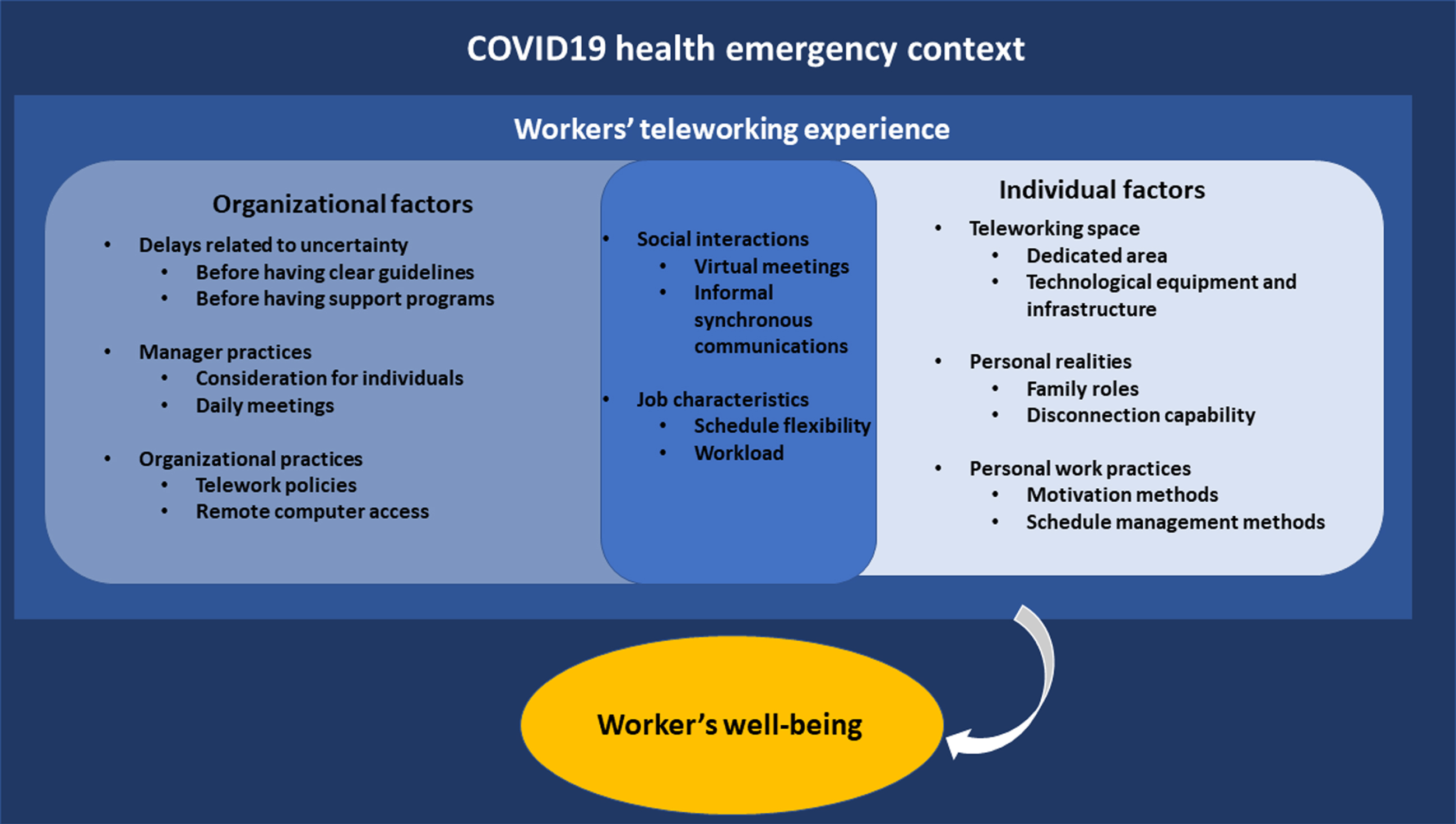
Factors influencing teleworkers’ well-being during the pandemic.
In the next paragraphs, we present the 8 categories (in bold subheadings) and 16 factors (in italics) arising from the experience of teleworking during the pandemic, relating to its effects on workers.
Due to the abrupt change in working methods and the lack of precedent for the pandemic, workers had to wait a certain period for their organization to be ready to face this new reality; there was a period of uncertainty. Participants mentioned that this delay related to uncertainty mainly had negative influences on their well-being because it led to a climate of insecurity that caused stress. The workers found themselves faced with the unknown, without reference points, and this was difficult for many. The first form of delay took hold before clear guidelines on how to operate in this new way of working came from the organization:
“At first, it wasn’t really clear, but I think it wasn’t clear to them [the managers] either. So, they can’t give us directions if they wait for directions [...]. We asked questions, then we didn’t really know what was coming. We didn’t know how long it was going to take and all that.” 1 [P06] 2
Several participants perceived this delay as “a loss of bearings” [P01]. The second form of delay occurred before having support programs, especially for access to office equipment. Thus, participants had “the impression of being left to themselves” [P07]. This delay may have caused workers stress, as one participant reported:
“Before things were clearer in terms of assistance programs [...], it took a good two months before we got organized [...]. That was a stressful part, unsettling.” [P03]
Manager practices
Despite the delays related to the uncertainty that prevailed at the beginning of the pandemic, most workers quickly felt the human qualities and attentive gestures of their managers, which lessened the negative effects on their well-being. Manager practices—namely, supervisor’s management behaviours—stand out as another category of factors that affected the well-being of teleworkers. Teleworkers have reported individual consideration practices as favouring their well-being. These practices refer particularly to managers showing concern for their employees’ well-being, as well as openness:
“[...] we have three partners, three managers, three ladies who manage the company, and they really have a real concern to make sure that it works well, to be transparent but also to see how things are going, how [they can] help so that [employees can] adapt as best possible.” [P05]
The daily videoconference meetings the manager organized to communicate with the employees represent another management practice favourable to the well-being the participants reported:
“Then, my boss also decided to do more daily sessions on how things are with the whole team. [...] see how it’s going, to have a little moment during the day to discuss our plans for the day and then how it’s going. [...] I really enjoyed these small daily periods like this.” [P04]
Participants also reported that these daily meetings influenced their well-being, making it possible to observe “where we are in our situation and what options are available to us.” [P05]
Organizational practices
Another category of factors that participants identified as influencing well-being relates to organizational practices—that is to say, the measures the organization, for whom individuals work, put in place. Our results suggest that practices were planned, but that the actual logistic had not been thoroughly worked out. The presence of a teleworking policy in the organization would positively promote the well-being of teleworkers:
“We already had a teleworking policy that was in effect [...], so there were already things in place. Everything was already ready, the infrastructure, everything was already ready. So, for that, it was good.” [P10]
Among organizational practices, the availability of remote computer access also reportedly positively influences well-being:
“On the other hand, luckily I had all my remote access with my computer to be able to work remotely [...]. We were overwhelmed by customers, I had to gather my troops, reassure them, encourage them to come and work. So, we had to be present for the team, without being there physically [.].” [P09]
Although the organizational practices to be followed were theoretically established, their actualization in the daily life of the workers was not without pitfalls, which had negative effects for the teleworkers. Indeed, some individuals initially did not have remote access, which they reported negatively impacted their well-being, implying that the organization was “really not organized.” [P11]
Social interactions
Participants reported changes in their social interactions relating to their experience of teleworking during the pandemic. Many mentioned experiencing a lack of social interaction that is harmful to well-being, but they found means to compensate. Indeed, since they worked remotely, exchanges between workers did not occur face to face, which changed communicating with others. Virtual meetings – as compared to face-to-face meetings - were a factor that participants frequently reported as negatively influencing their well-being:
“[...] the screen is okay, but seriously, both as a team and with the clients, to have the presence in real life [...] was the element that I missed the most, that I still miss the most and which has affected me the most [...] in the last few months.” [P05]
Even though the interactions had to be done virtually, which was difficult for many workers, individuals mentioned informal synchronous interactions with both colleagues and employers as having a positive influence on their well-being, acting as a compensation means, at least in part:
“My manager organizes, once every two weeks or so, a virtual lunch where there is no expectation to talk about work or anything. It’s just... we chat informally. So that, I would say, is something that helps me stay engaged, motivated [at my work].” [P08]
Job characteristics
Participants reported some characteristics of their job that had positive (i.e., schedule flexibility) of mitigate (i.e., workload) effects on their well-being. One of the characteristics of work that participants mentioned as greatly influencing the well-being of workers is schedule flexibility. Flexible working hours were seen as helpful for well-being, since workers were able to work at times that were optimal for them and better able to juggle personal and work roles:
“ [...] currently working from home I appreciate that, it’s really practical to be able to manage your schedule as you can, as you want. If there’s something going on with the kids, you’re available [...]” [P10]
Indeed, workers had the prospect of this factor giving them more freedom to perform other activities or to take breaks—for example, to exercise:
“[...] I would say that being able to work when I really want to is pleasant, because if ever in the afternoon I feel like going for an hour’s walk, coming back and working in the evening to recover that hour [...], it’s a freedom that I find really pleasant [...].” [P01]
In addition, this factor has become a source of motivation:
“[...] That was the part that I found the most interesting, I could really manage my schedule. I’m the type [of person] who wakes up very early, so I do a few hours in the morning [...] so the modifiable schedule was a way of motivating me [...].” [P02].
Workload is also a work characteristic that participants mentioned as an influence on their well-being. Some noticed an increase in their workload, especially at the start of the pandemic, which was seen as detrimental to well-being:
“[...] so, I don’t know if this is an impression or if it has really increased. Anyway, I have the impression that my task has increased [...]. The hour or the hour and a half in the car when you decompress, when you think of something else [...] I no longer have that decanting time [so I work instead].” [P05]
On the contrary, depending on the economic sector and on the readiness of organizations to move their operations to virtual mode, other participants rather felt a decrease in their workload, which allowed them to “breathe a little.” [P06]
Teleworking space
The telework space refers to the physical environment in which individuals work, also likely to influence their well-being. Participants shared that having a dedicated area was helpful, but the lack of ergonomics of their equipment negatively influenced their well-being. First, the possibility of dedicating an areato teleworking was an aspect that participants mentioned many times as favourable to their well-being:
“[...] I now have a desk, which isn’t really an office, but anyway I have a fixed space that’s dedicated to that, [to work], so it’s easier; then I think the environment is very favourable, very necessary, to have a good job.” [P13]
Reserving the area for teleworking also allowed some participants to have “a quiet corner” [P11] without disturbance. Then, they mentioned the availability and adaptation of equipment and technological infrastructure as promoting workers’ well-being:
“When the pandemic broke out, I realized that I had a computer that was up to date, that was hyper functional, that access was fine, and I was really happy to have this working tool that was really efficient, because if it hadn’t been the case, I think it would have been very, very laborious.” [P09]
Participants reported that the quality of the equipment and the workstation also influenced well-being, although some reported “back problems,” [P07] “fatigue” [P01] and “migraines” [P12] because of non-adapted equipment.
Personal realities
Personal realities influenced workers’ adaptation to telework, especially family roles and ability to disconnect. Among personal realities influencing teleworker well-being, participants mentioned family roles:
“What was difficult was the presence of the children. You work when they sleep, so you don’t sleep, you’re tired, it’s like a spinning wheel.” [P12].
Participants had to deal with “the adaptation of trying to share [the role of employee with] the role of parent,” [P01] which affected their well-being. The ability to disconnect outside of working hours was also a factor they reported as influencing their well-being:
“We take [up] bad habits. For lunch, we prepare a quick meal and then eat in front of our screen while working. So, it’s the separation [...]. When you are at the office, you have a cut[-off]. Going home, you’re no longer at work, whereas in teleworking, this cut-off [...] is less easy to make.” [P15]
Personal work practices
Finally, participants repeatedly mentioned personal practices—that is to say, the working methods that teleworkers borrowed or developed—as positively influencing their well-being, notably by increasing motivation and adequately manage schedule. One such work practice includes methods of motivation at work:
“I too tend to work when I feel more motivated, or I will do tasks for which I feel motivated today. [...] Me, what re-engages me I would say in my work, it is the Zoom [meetings]. [...] So, when I have [lack of] motivation, I try to call small Zooms [with colleagues]. In any case, it helps me” [P03].
Another such practice aims to use methods to manage one’s work schedule:
“Starting early, [because] in the afternoon, I may be less brain active, I am less ‘on.’ [...] I will take the opportunity to do household chores and then all that, which will allow me to have time with the children also in the evening.” [P13]
People choose the times of the day when they work, according to their needs, which promotes their well-being.
Discussion and recommendations
This study aimed to explore workers’ perspectives on teleworking in the context of the COVID-19 pandemic, regarding effects on their well-being. Analysis of data we collected from 15 teleworkers revealed 16 factors relating to telework in the pandemic context, which we grouped into eight categories. The factors we identified were those workers found as influencing their well-being, either positively or negatively. The results of this study contribute to the advancement of knowledge on theoretical and practical standpoints. From a theoretical standpoint, this study helps to increase knowledge of demand-control-support interactions in the contemporary situation of teleworking during the pandemic. This study also highlights the important influence of the individual, organizational and social dimensions of the environment on workers’ well-being. On a practical level, this study makes it possible to generate avenues for concrete recommendations that organizations and workers may put in place to optimize well-being in the context of teleworking. Since these recommendations come from the reality of workers, they complement those that come from expert opinions or literature reviews.
The influence of demands, control and support on workers’ well-being
Consistent with the results of the telework study by Duxbury and Halinski [55], the high-level demands in our results mainly concern the interaction of work with the family domain. Workers perceived these demands as negative influences on their well-being. Indeed, they mentioned the difficulty of disconnecting causing longer working days, as well as increased family responsibilities as unfavourable for their well-being. Indeed, the situation experienced during the pandemic with schools or daycares closed, home schooling, and mandatory teleworking for several members of a household was unprecedented and strained people’s coping skills, adding to their demands. While research prior to the pandemic period suggested that teleworking may increase people’s ability to balance work and family roles by the flexibility it provides [65–67], this did not appear to be the case during the particular context of the pandemic. However, our findings agree with the study of Kelly and Moen [56] that increased work control—that is, the possibility to manage schedule that teleworking offers—appeared to have a particularly positive influence on workers’ well-being, and may have compensated – at least partly – the negative effects of the high-level demands. This form of autonomy has allowed workers to develop methods or strategies for adapting the work to their needs, giving themselves leeway to carry out the work while preserving their well-being. In addition, the virtual nature of meetings with colleagues and superiors caused a lack of social interaction that they saw as very harmful to their well-being. Nonetheless, daily informal synchronous meetings that partially filled this gap appeared to be a contributing factor in their well-being. This is consistent with the influence of social support on well-being in Karasek and Theorell model [54]. Nearly all of the participants wish to continue teleworking in the future, so we may assume that this is a working modality that they value and perceive favourably. Thus, combining increased work control with some social support appears to mitigate the adverse welfare effects of high-level demands, even in the particular context of the COVID-19 pandemic. Our results thus suggest that the use of the Karasek and Theorell model [54] is relevant for studying worker’s well-being despite the context. Indeed, the concepts of the model apply well in the context of teleworking during the pandemic, even with a work reality that has not been studied much so far (e.g., virtual social contacts, isolation at home with family, abrupt changes in work tasks).
Well-being of teleworkers: an important influence of the environment
The results of this study support the important influence of the environment on the well-being of teleworkers. Indeed, 16 factors, including individual, organizational and social environmental factors during the pandemic, highlight teleworking’s influence on well-being.
First, on an individual level, the physical work environment seems to be a factor that influences the well-being of teleworkers. Dedicating an area to teleworking is desirable, allowing the worker to isolate from the disturbances of the household and perform tasks by concentrating and, thus, feeling good. Toniolo-Barrios and Pitt [68] corroborate this result, reporting the difficulty of working when there are distractions in the house that can interfere with concentration. Having access to a teleworking room can also decrease the occurrence of work-life interference associated with physical and mental health issues [69]. The results of this study also highlight other factors of the individual worker’s environment, including the quality of equipment and technological infrastructure, that workers report as influencing their well-being. Some participants also mentioned having experienced physical occupational injuries, such as back pain, due to their work equipment. Scientific literature supports this point; numerous studies suggest that workers tend to settle on unsuitable workstations, resulting in non-neutral postures associated with increased risk of musculoskeletal injuries [20, 70]. Many participants in this study reported that installing suitable and ergonomic office equipment markedly improved their well-being while working in greater comfort and better situated. Some studies, including Lopez-Leon and Forero’s [46], also support the need for suitable ergonomic equipment for teleworking.
At the organizational level, a few environmental factors seem particularly influential, such as the daily meetings the organization sets up. These frequent meetings better informed teleworkers about the evolution of the pandemic situation and its impacts on the organization. The uncertain context of the pandemic and the abrupt change in working patterns make having this kind of information particularly important. In the same sense, authors report that daily teleworking meetings were very useful in facilitating work monitoring, clarifying and coordinating the roles and responsibilities of workers and ensuring better group cohesion [71]. Also, in relation to the organizational environment, workers reported that the support the organization offered (e.g. technological support) was difficult to obtain at the start of the pandemic, apparently influencing their well-being negatively. In fact, some did not have immediate access to support and felt left on their own during this stressful time. This study underlines the importance of formalizing the procedures and access to equipment in order to better frame the functioning of telework in a pandemic and thus avoid the stress linked to the climate of uncertainty. To improve these environmental factors linked with the organization, pre-established teleworking policies (including a structured plan for implementing these policies) can prove useful, since they allow teleworkers to have a clear and supportive structure from the start, in addition to getting help quickly. Moreover, certain studies concerning teleworking include this recommendation [23, 43].
Finally, on the social level, the results of this study show that teleworkers felt the need for social interactions that the technological environment did not fully satisfy. Although it was possible to communicate with their colleagues virtually, many participants reported experiencing a glaring lack of face-to-face social interactions that negatively influenced their well-being. Numerous studies also report this telework challenge, such as that of Greer and Payne [18]. Indeed, telework transformed communications by making workers feel more formal and distant, possibly reducing their sense of belonging and causing social isolation [72, 73]. However, informal synchronous meetings that workers or employers organized helped to improve their well-being, providing workers with support. According to Tremblay and Demers [22], these communications are essential for maintaining team cohesion and corporate culture.
These results are consistent with theoretical models in occupational health that recognize the link between the environment and well-being [e.g. 74–77]. They also agree with the model according to which labour resources at the individual, group, leader and organization levels influence the well-being of the worker, the IGLO model [78].
Recommendations from the experience of teleworkers
The results of this study recommend best practices relating to teleworking to reduce its negative influences on workers’ well-being. Table 2 summarizes these practices that come from the experience of teleworkers. First, organizations should establish clear teleworking policies to avoid uncertainty among workers and include a structured plan for implementing these policies. These policies would also help in framing work demands, so the workload and hours of work are optimal. Then, for those for whom it is a possibility, we recommend that workers organize their home to dedicate a room to teleworking, with ergonomic equipment. Finally, the last recommendation supports the need to ensure several forms of support from the organization, employer and colleagues. To support teleworkers, organizations can equip them with ergonomic office equipment and appropriate technological infrastructure, while employers can schedule daily meetings to ensure follow-up and communication with their employees. Colleagues can work together to help each other and provide another form of social support, through informal synchronous meetings or exchanges. The best practices that emerge from this study come from teleworkers’ experience, increasing their likelihood of implementation. Consistent with our results, the recommendations mainly concern the environment, whether they relate to the organization (e.g. policies), individual (e.g. teleworking space) or even colleagues (e.g. support)..
Best practices to promote well-being, according to the perceptions of teleworkers
Best practices to promote well-being, according to the perceptions of teleworkers
These recommendations complement those already available in the scientific literature, making it possible to generate a knowledge base to guide future teleworking practices. However, it is important to consider that the challenges of adapting to telework may vary among individuals. Thus, employers need to be aware of the challenges and needs of individuals and take an individualized approach to supporting each of their workers when it is possible. Researchers highlighted this idea of the importance for employers to be sensitive to the specific characteristics of their employees [79], to consider the different realities [80] and unique needs of workers [81]. Research conducted during the pandemic demonstrated that a one-size-fits-all approach would not be optimal to promote the well-being of workers; an equitable approach that considers individual realities and needs would be preferred [82, 83]. A concrete means to implement such an approach would be to involve teleworkers in decisions [67] and to encourage their initiatives [83] towards the application of these recommendations, which may enhance their control over the situation and favor their well-being as suggested by the model of Karasek and Theorell.
The main strength of this study is its analysis of workers’ perspectives; most studies on the subject comprise literature reviews or expert opinions. Using focus groups gave workers the chance to discuss and exchange views on various topics that helped them better understand their experience of teleworking during the pandemic. Another strength of this study is the qualitative design. The pandemic is a unique situation that includes features that may not be detectable in a quantitative design. The constitution of the sample appears to be a limitation of this study; the jobs of more than half of the participants are in the private sector; very few are in the community and parapublic sector, where the reality may not be the same. Also, the cross-sectional nature of this study made it difficult to capture the evolution and adaptation during the 12 months of teleworking experienced by the participants. Indeed, they reported different factors that may have changed over time. However, it was difficult to assess the chronological evolution of these factors in the focus group. This information should be considered when interpreting and using the results of this study. Finally, interpreting the data requires noting that this study engaged only French-speaking Canadians, calling for use of judgment since the results may not necessarily transfer intact to another population.
Conclusion
This study aimed to explore workers’ perspectives on teleworking in the context of the COVID-19 pandemic, regarding its effects on their well-being. The results highlighted 16 factors that specifically influence workers’ well-being. Consistent with the theoretical model, the levels of demands, control and social support are among those influences. In particular, the importance of considering the environment, in its individual, organizational and social aspects, emerged to promote the well-being of teleworkers. This study enables recommending best teleworking practices to workers and their organizations, to improve their well-being. For the future, more than half of the participants in this study wish to continue primarily teleworking, supporting the importance of investigating this mode of work delivery to better understand its effects. Further studies could advance knowledge of telework, which will inevitably become an increasing part of tomorrow’s reality. Future research could use a quantitative design to examine the relationships between the different factors and well-being.
Footnotes
Acknowledgments
The authors thank all individuals who participated in this study.
Ethical approval
Ethical certification was obtained from the Research Ethics Committee of the Integrated University Health and Social Services Center of the Capitale-Nationale (CIUSSS-CN), number 2021-2239.
Informed consent
All procedures performed in studies involving human participants were per the ethical standards of the institutional and/or national research committee and with the 1964 Helsinki declaration and its later amendments or comparable ethical standards. Informed consent was obtained from all individual participants included in the study.
Conflict of interest
None of the authors have any conflict of interest to declare.
Funding
This work was supported by a research grant from the Social Sciences and Humanities Research Council (1008-2020-1002).
Data availability
The datasets generated during and/or analysed during the current study are available from the corresponding author on reasonable request.
Verbatim extracts from the participants’ interviews exemplify the factors. The extracts are a free translation from the original French transcripts.
Numbers (1 to 15) in the brackets refer to the participant’s number.