




Abstract
BACKGROUND:
Stress is common among police personnel leading to several negative consequences.
OBJECTIVE:
We performed a systematic literature review to identify risk factors for stress among police officers.
METHODS:
We searched PubMed and Scopus electronic databases through to July 2018 and we conducted this review according to the Preferred Reporting Items for Systematic Reviews and Meta-Analyses (PRISMA) statement. The Newcastle-Ottawa scale was used for studies quality assessment.
RESULTS:
After selection, 29 cross-sectional studies met the inclusion criteria and included in the review. The average quality of studies was low since no study was rated as having low risk of bias, three studies (10.3%) as moderate risk and 26 studies (89.7%) were rated as having high risk of bias. Stress risk factors were summarized in the following categories: demographic characteristics; job characteristics; lifestyle factors; negative coping strategies and negative personality traits.
CONCLUSIONS:
Identification of stress risk factors is the first step to create and adopt the appropriate interventions to decrease stress among police personnel. The early identification of police officers at higher risk and the appropriate screening for mental health disorders is crucial to prevent disease and promote quality of life.
Introduction
Stress is a dynamic process resulting from external pressure on most occasions [1]. A broad and multilevel concept such as stress requires the incorporation of knowledge from several sciences (from neuroscience and biology to psychology and sociology) in order to be explained [2]. There is a continuous de-bate regarding the most appropriate way to define and conceptualize stress without yet a universal accepted definition of term. The most important feature of stress is the adaptation of an individual to environmental conditions that change over time [2]. Thus, the individual, the environment and time and their interaction are the core concepts of stress [3, 4].
Differences in the personality and the experiences of individuals could lead to different responses in either positive or negative stressors [5]. Positive stress is produced after the appropriate response to every day stressors. In contrast, failure of an individual to response adequately to stress can produce negative stress. Positive stress makes an individual feels ex-cited in situations like starting a new job, getting married, and having a child. An individual experiences negative stress when she/he is unable to cope with situations like the death of a family member, the divorce, the loss of a job, and a chronic illness. Feeling stressed can be a normal and beneficial situation motivating individuals to focus on work and be productive, while too much stress can be painful and even catastrophic, resulting on depression and other health problems. Thus, positive stress can be useful and motivating, while negative stress can be devastating and detrimental.
Adverse working conditions such as long working hours, shift work, extreme physical workload, noise, time pressure, limited rewards (salary, opportunities and esteem) and occupational hazards can result in work-related stress that increases the risk of diseases (type 2 diabetes, cardiovascular diseases, musculoskeletal complaints and periodontal disea-ses) [6–8]. Moreover, work-related stress is associated with decreased productivity and increased absenteeism and medical and health care cost due to the increased number of patients with mental health disorders [9, 10]. Work-related stress occurs when the demands from the work environment exceed the workers’ abilities and resources to deal with this demands resulting on discordance in the expectations between the workers and the organizations [11, 12]. Certainly, work is only one aspect of life that can produce negative stress since there are many others stressful life events (e.g. school life, family issues, love and marriage, having children, social activities, health and financial issues) that can give rise to the experience of negative stress [13, 14]. Although there is an interaction between the life stressors and the job-related stressors, it is not always obvious, making the understanding of stress more complicated [11, 12]. Stress tends to be multidimensional in nature, reflecting psychological and physical responses to environmental stressors [15], and should be recognized and treated early since otherwise it can produce a state of anxiety that if maintained can result on mental disease [16].
Police work is a high stress and challenging occupation, and police officers constitute a high-risk group for mental health morbidities such as post-traumatic stress disorder, anxiety disorders, depression, suicidal thoughts and behaviors [17–19]. Police officers experience significant job-related stressors and exposures such as violence, work injuries, job pressure and demand, lack of support, physical threats in operational field, long working hours, burnout and fatigue. These job-related stressors and exposures increase risk of poor mental health [20–23], and negative consequences such as increased risk of metabolic syndrome, hypertension, obesity and dyslipidaemia, smoking, alcohol and drug abuse, poor sleep quality, decreased quality of life and job satisfaction [24, 29–35]. In particular, job-related stressors and exposures increase stress, anxiety and irritability among police officers resulting on reduced productivity, absenteeism and worse quality of life [24–28]. Police officers contribute to the safety of society and there is a need to protect and improve their mental and physical health. In that case, identification of sources of stress through valid research is extremely important since then it is given the chance to create and adapt the appropriate interventions and strategies in order to decrease modifiable sources of stress and so on stress.
To the best of our knowledge, no systematic literature review exists addressing the risk factors for stress among police officers. Therefore, we performed a systematic literature review to find out stress risk factors among police officers. As mentioned earlier, stress is a broad and multilevel concept that is used with different meanings in the literature. Thus, we decided to focus on studies that measure life stress and job-related stress in order to be as comprehensive as possible. Moreover, within the context of this review, stress will only be considered as a negative psychological state.
Material and methods
Search strategy
We conducted this review according to the Prefe-rred Reporting Items for Systematic Reviews and Meta-Analyses (PRISMA) statement (36). We sea-rched PubMed (from 1946) and Scopus (from 1966) electronic databases through to July 2018, to identify relevant studies. We used PICO approach [37, 38] to identify the appropriate search terms and we used the following algorithm in all fields: ((“police officer*” OR police OR “police force” OR “police service*”) AND (“risk factor*” OR factor* OR determinant* OR stressor*) AND (stress OR “occupational stress” OR distress OR “work stress” OR “work-related stress” OR “job stress”)). We used a great number of search terms and the wild card term “*” to improve the sensitivity of the search strategy. Two independent reviewers (DF and TK) evaluated the articles, while disagreements were discussed and resolved by consensus with a third reviewer (PG). The references of selected articles were searched to identify further appropriate studies. Our review was not prospectively registered.
Inclusion and exclusion criteria
There were no limits regarding participant characteristics, publication status or publication date. We included original studies that met the following inclusion criteria: (1) life stress or job-related stress was the outcome variable independently the way that was measured, (2) stress was assessed separately from anxiety, depression or other psychological symptoms, (3) any stress risk factors were the independent variables (e.g. demographic and job characteristics, lifestyle risk factors etc.), (4) studies published in peer-reviewed journals, (5) studies were published in English, (6) studies with quantitative data, (7) we searched on PubMed from 1946 and Scopus from 1966 through to July 2018, and (8) study populations included police officers. We excluded studies that did not meet these inclusion criteria and studies with posttraumatic stress disorder as the outcome variable.
Data extraction
We extracted the following information from each paper: first author’s name; year of publication; country of study; study design; year of data collection; number of participants; risk factors measure (including questionnaire); outcome measure (including questionnaire); level of analysis (univariate or mult-ivariate); and measures of effect and precision (e.g. coefficient beta, correlation coefficient, p-values, 95%confidence interval). Meta-analysis was considered but rejected due to high heterogeneity of studies on risk factors and stress measurement, level of analysis, measures of effect and precision and quality (risk of bias).
Risk of bias assessment
Two authors (PG and DF) performed independently an assessment of bias in the included studies using the Newcastle-Ottawa quality assessment scale adapted for cross-sectional studies since all studies in our review were cross-sectional [39, 40]. The Newcastle-Ottawa scale has the following three components assessing bias in the studies: selection; comparability; outcome assessment. Each study was assigned stars for items within each component for a maximum of ten stars, i.e. five stars for selection, two stars for comparability and three stars for outcome assessment. We chose to quantify the risk of bias by summing up the stars that each study was assigned in order to get a summary of bias even though there is not specific cut-off points for the Newcastle-Ottawa scale in case of cross-sectional studies. Accordingly, we decided to rate studies as high risk of bias if they received seven stars or less, moderate risk of bias if they received eight or nine stars and low risk of bias if they received ten stars, that corresponded to the highest methodological quality.
Results
Study selection
The search on PubMed and Scopus returned 568 and 19,791 records respectively. After removal of duplicates, 19,904 records remained and 19,635 were excluded at first screening (title/abstract), leaving 269 full-text articles assessed for eligibility. No additional records identified through other sources. Finally, 29 studies met the inclusion criteria and included in the systematic review. The flowchart of systematic literature review was constructed according to the PRISMA statement (36) and is presented in Fig. 1.
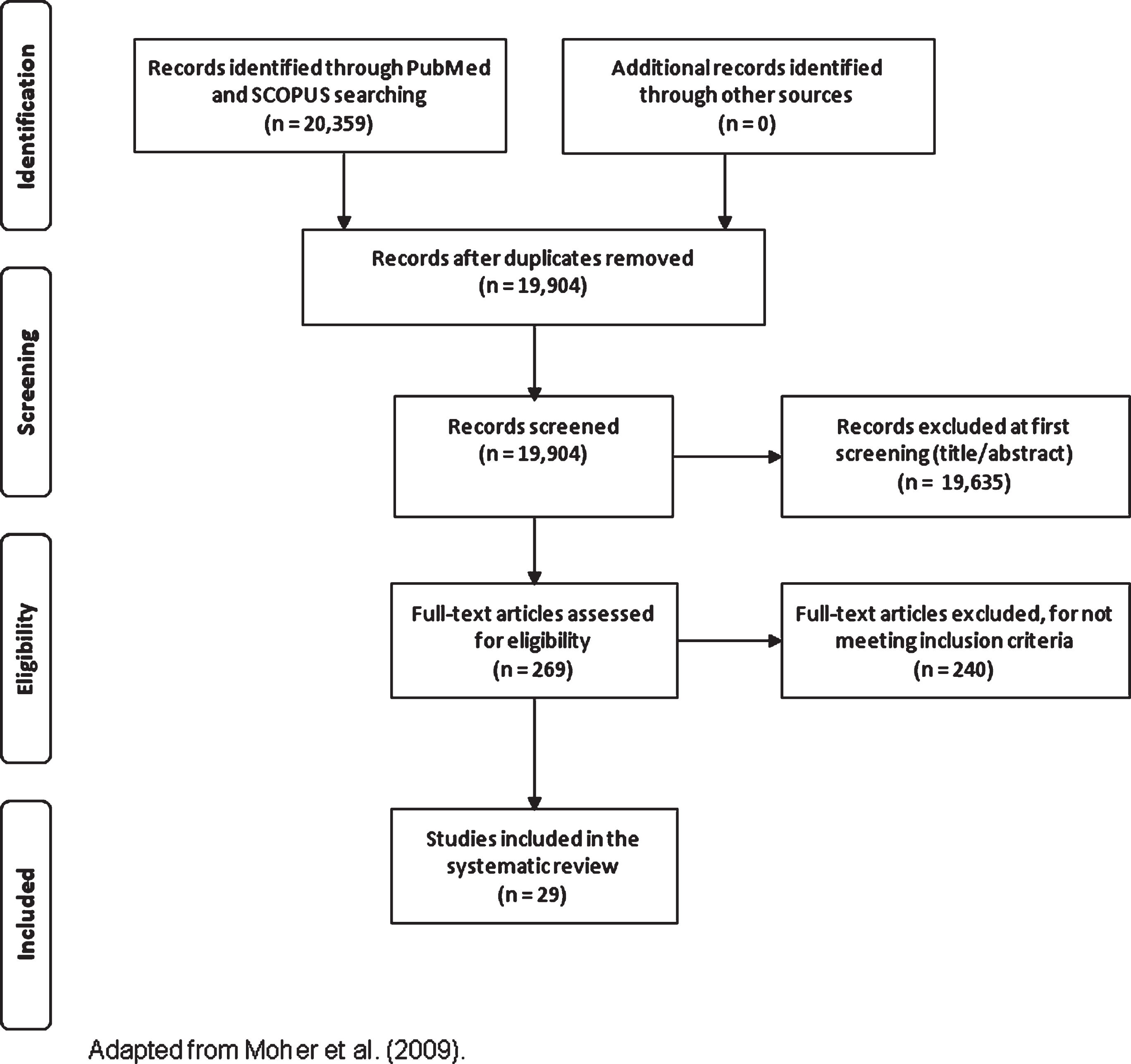
Adapted from Moher et al. (2009).
A summary of studies included in the review is presented in the Appendix. All studies were cross-sectional, the number of participants ranged from 102 to 3272, and the percentage of males ranged from 58%to 100%. Studies were published between 1985 and 2018 and were conducted in USA (11 studies), United Kingdom (3 studies), India (3 studies), Italy (2 studies), South Korea, Malaysia, Norway, Lithuania, Jamaica, France, China, Canada, Spain, and Switzerland.
Multivariate analysis to eliminate confounders was used in 20 studies [21, 41–57], while uni-variate analysis without taking confounders into consideration was used in nine studies [22, 58–65]. Different confounders were eliminated in each study and summarization of them in the review would be meaningless.
Risk of bias assessment
Detailed ratings for items within each component of the Newcastle-Ottawa scale are presented in Table 1. Mean quality score was 5.45, and ranged from 3 to 8 on the 10-point Newcastle-Ottawa Scale indicating low quality in general. In particular, using the Newcastle-Ottawa Scale, no study was rated as having low risk of bias, three studies (10.3%) as moderate risk, and 26 studies (89.7%) were rated as having high risk of bias. Sample size justification and comparability between respondents and non-respondents characteristics were the most frequent bias since only two [31, 58] and four studies [43, 66] respectively addressed these issues. Another common bias was the incomplete description of the statistical test since only eight studies [21, 53] described and presented appropriately the measures of effect, including confidence intervals and the probability level (p value). Nine studies [22, 58–65] did not eliminate confounders, while five studies [21, 60–62] did not describe the sampling strategy. Risk factors and outcome were ascertained by means of self-reported questionnaires in all studies.
Risk of bias assessment in studies included in the systematic review
Risk of bias assessment in studies included in the systematic review
Adapted from (39) and (40). aArrangement in publication year order.
Job-related stress was the outcome in 14 studies [23, 66], life stress was the outcome in 13 studies [21, 64] while both job-related stress and life stress were the outcome in two studies [49, 52]. Stress measurement was performed with a visual analogue scale in one study [52], with a dicho-tomous (yes/no) question about stress in another study [62] and with validated questionnaires in the other 27 studies. The most frequent questionnaires were the “General Health Questionnaire, GHQ” (three studies), the “Perceived Stress Scale, PSS” (two studies), the “Effort/Reward Imbalance” questionnaire (two studies), the “Brief Symptom Inventory, BSI” (two studies) and the “Spielberger Police Stress Survey” (two studies).
Risk factors
Due to high number and variability of stress risk factors, we decided to summarize them in the following categories to simplify the understanding of the review: demographic characteristics; job cha-racteristics; lifestyle factors; coping strategies; personality traits. Measures of effect (coefficient b, correlation coefficient and odds ratio) and measures of precision (p-value and 95%confidence interval) are presented separately for each study in the Appendix to avoid repetition.
Demographic characteristics
Increased age was associated with stress [23], while married police officers experienced more stress versus singles/divorced [61]. Males and police officers who worked in districts with > 50,000 inhabitants experienced more stress [23].
Job characteristics
Conflicting results were found regarding police rank, since two studies found that lower police rank increased stress [58, 64] and three studies found that higher police rank increased stress [23, 41]. Moreover, increased years of experience increased [52] or decreased [65] stress.
Negative work-related conditions increase stress such as work-role overload [42], increased working hours [61], shift work [46, 62], decreased job satisfaction [50, 63] and on-duty injuries [45]. Other work stressors include work-family conflict [43, 54], negative working environment [41, 67], patrol assignment [43], burnout [65], bureaucracy [55], and self-estimation that salary is inappropriate regarding duties [31].
Four studies [50, 62] found that operational and organizational work factors increase stress. In particular, exposure to critical incidents (e.g. violence, crowd control, dealing with rape victims, using force, negative public opinion and hoax calls) increased stress [50, 62]. Additionally, demands of work impinging on home, lack of support from senior officers, dealing with someone who is drunk, subject to a complaints investigator, being at risk of hepatitis or AIDS, not enough control over work, and urgent requests preventing planned work are stress risk factors [51]. Finally, poor cooperation, workplace discrimination and lack of organizational fairness are operational and organizational work factors that increase stress [50].
Lifestyle factors
Decreased physical exercise [22, 65], lack of hobbies [52, 65] and smoking [22] were considered to be stressors.
Coping strategies
Eleven studies [21, 65] found that negative and maladaptive coping strategies, such as self-distraction, denial, self-blame, lack of humour, lack of planning, lack of control and avoidance, increased stress.
Personality traits
Several negative personality traits such as neuroti-cism, psychoticism, introversion, and decreased res-iliency were associated with stress [43, 66]. Neuroticism involves anxiety, worrying, mood disorders, and negative feelings [68], psychoticism invo-lves inappropriate emotional expression [69], while resiliency refers to positive personality traits, e.g. situation control and work commitment [70].
Discussion
To the best of our knowledge, this systematic literature review is the first that has been conducted to identify risk factors for stress among police officers. We have found evidence for the link between stress and a variety of demographic characteristics, job characteristics, lifestyle factors, coping strategies and personality traits. However, this evidence appears to be weak due to high risk of bias in the studies included in the review.
Regarding demographics, we found that increased age was associated with stress while married, and males experience more stress. Increased age is associ-ated with tiredness and exposure to life and job-rel-ated stressors, while low marital quality and marital dissatisfaction can be a source of chronic stress resulting on decreased well-being [71], psychiatric disorders [72], and major depressive episodes [73].
We found that police officers who worked in large cities experienced more stress. Work in large cities may increase stress among police officers due to their frequent exposure in critical and extremely stressor incidents including among others murders, suicides, robberies, on-duty injuries, violence, crowd control, and dealing with rape victims [23]. These stressful work situations may predispose police officers to post-traumatic stress disorder since they often arrive first at the scene of suicides, murders, sexual abu-ses and traffic accidents. The risk for developing post-traumatic stress disorder is increased among professionals who are exposed to traumatic events, such as firefighters, emergency medical personnel and military veterans [74–76], and also among police officers especially for those dealing with seriously injured persons [77, 78]. Thus, appropriate interventions and management are required in order to raise the self-awareness of police officers regarding mental disorders and especially post-traumatic stress disorder. In addition to this, police officers in big cities may work under more difficult work-related conditions such as increased working hours, work-role overload and negative working environment. These difficult work-related conditions lead on decreased job satisfaction, work-family conflicts, burnout and decreased sleeping hours and leisure time.
Regarding job characteristics, we found that negative work-related conditions increase stress as well as operational and organizational work stressors. A negative work environment affects both mental and physical health resulting on stress-related disorders even on depression [79, 80]. Police officer rank is a controversial issue without clear evidence about the way that is related with stress. Rank is usually associated with office work since higher rank officers tend to work in the office, while lower ranked officers who will spend more time away from the station on patrol. Out of office work is usually accompanied with exposure in critical and extremely stressor incidents increasing the risk for mental disorders such as stress, anxiety, depression and post-traumatic stress disorder as mentioned earlier [51, 78]. Office work is related with duties that increase stress such as more responsibilities, decision-making processes, and bureaucracy [41, 81]. Higher ranking police officers take on more responsibility since they have to make important decisions usually under pressure. The more the police officers participate in decision-making processes, the more the stress and the strain they may experience.
With regards to lifestyle factors, decreased physical exercise and lack of hobbies considered to be stressors. Literature confirms this finding since physical exercise and especially aerobic exercise decreases stress, anxiety and depression, and protects a person from psychiatric disorders [82–87]. Physical exercise decreases stress by improving the function of metabolism, nervous and cardiovascular system [88–90], and strengthening self-confidence and self-control [91–93]. Physical exercise seems to be a promising cost-effective adjunctive treatment option for mood disorders since it could be easily disseminated and applied with minimal side effects [82]. Additionally, exercise improves both mental and physical health because of its broad-reaching effects. In particular, exercise is as effective as psychotherapy in the management of anxiety in patients with mood disorders and almost as effective as pharmacotherapy [82, 95]. Personal training based on clinical and demographic characteristics of individuals could maximize exercise efficacy.
A number of studies in this review confirm that negative and maladaptive coping strategies increase stress. Coping strategies are cognitive and behavioral actions used to confront stressor events, and their choice depends mainly on personal experiences and attitudes [3, 57]. Positive coping strategies such as those focus on problem (e.g. planning, immediate response and support from others) help people to find their mental balance and adapt better in stressor events resulting on better stress management [57, 96]. On the contrary, negative and maladaptive coping strategies (e.g. self-distraction, denial, self-blame, lack of planning and lack of control) increase stress and affect negatively mental and physical health [53, 97]. Identification of stress risk factors is the first step to create and adopt the appropriate interventions, such as health promotion programs and counseling services, in order to decrease stress. In particular, health promotion programs should be targeted on the implementation of coping strategies and the improvement of lifestyle factors among police officers.
We found that negative personality traits and especially neuroticism and psychotism increase stress among police officers, a finding that is confirmed from systematic reviews in other populations [98, 99]. In these reviews, negative personality traits and neuroticism are associated with stress, depression and drugs abuse (REFS). Neuroticism involves anxiety, worrying, mood disorders, and negative feelings, with neurotic individuals experience more distress, symptoms, and pain [68]. Psychoticism involves inappropriate emotional expression, taking risks, and disregard for common sense resulting usually on antisocial behavior [69]. Police officers with neurotic and psychotic personality traits are more vulnerable to experience stress when deal with the challenging tasks of police job [60]. Similar, introversion is more likely to be seen in neurotic people [100], while there is a positive correlation between stress and neurotic and psychotic traits and a negative correlation between stress and extroversion [101]. Resilient individuals possess positive personality traits such as situation control, work commitment and challenge that increase self-confidence and growth and decrease stress [70].
Our review has several limitations. Firstly, all studies included in the review were cross-sectional. It is well-known that temporality of relationship between risk factors and outcome in cross-sectional studies creates uncertainty unless the risk factor is something fixed, such as gender. Cross-sectional studies cannot prove causality but help to generate more vigorous research hypotheses that should be tested with more valid studies such as cohort or randomized studies. Moreover, low quality of studies included in the review results on weak evidence for the link between risk factors and stress. Such a bias is inherent in reviews with studies with high risk of bias and could be decreased only by designing and conducting more reliable and valid studies. Although the great number of studies that have been conducted in the field, there is a need for more well-designed and rigorous studies with less bias than previous studies. Even though evidence from this review appears to be weak due to high risk of bias in existing studies, the existence of stress factors among police officers is a reality. Moreover, the different ways that studies have used to measure both risk factors and stress may have affected the review findings and require a careful interpretation. For example, the definition of “stress” is challenging and its objective measurement is quite difficult even impossible due to individual perceptions and different self-reported questionnaires that used in studies.
Conclusion
There is a need for health surveillance and a continuous assessment of mental health of police personnel to promote health and maintain well-being. The early identification of police officers at higher risk and the appropriate screening for mental health disorders such as depression, anxiety disorders, post-traumatic stress disorder, suicides thoughts and behaviors is crucial to prevent disease and promote quality of life.
Conflict of interest
None to report.
Footnotes

Appendix
Summary of studies examining risk factors for stress among police officers NM: non mentioned; OR: Odds Ratio; CI: Confidence Interval. aArrangement in publication year order. b Demographic characteristics: gender, age, marital status, children, educational level. Job characteristics: years of experience, rank, working hours, shift work, job satisfaction, workload, salary, work environment, support from colleagues/superiors, operational and organizational factors. Lifestyle factors: sleep duration, physical activity, smoking, alcohol, work-family conflict, health state. Demographic characteristics, job characteristics and lifestyle factors were self-reported in all studies. c Univariate analysis does not eliminate confounders, while multivariate analysis eliminates confounders, decreasing so the systematic bias.
Reference
Country
Study design
Year of data collection
Number of police officers (percentage of males, mean age)
Risk factors (questionnaire)
Outcome (questionnaire)
Level of analysis
Main results
Tsai et al. (2018)
USA
Cross-sectional
1995
594 (86.7%, 36.1 years)
Demographic characteristics; job characteristics
Job stress (a latent construct consisting of overall stress, job stress and burnout)
Multivariate (Structural equation modeling)
Higher police rank (coefficient b = 0.14, p < 0.05) and negative working environment (coefficient b = 0.74, p < 0.05) were associated with stress
Duxbury &Halinski (2017)
Canada
Cross-sectional
2011–2012
1469 (79.6%, 40.9 years)
Job characteristics
Life stress (10 items measure) (102)
Multivariate (Structural equation modeling)
Work-role overload was associated with stress (coefficient b = 0.316, p < 0.001 for males and coefficient b = 0.225, p < 0.001 for females)
West et al. (2017)
USA
Cross-sectional
2004–2009
422 (74%, 43 years)
On-duty injury (payroll work history data)
Life stress (Perceived Stress Scale, PSS)
Multivariate linear regression
Increased on-duty injury count was associated with stress (p = .025)
Griffin &Sun (2017)
USA
Cross-sectional
2011
138 (87%, NM)
Demographic characteristics; job characteristics; lifestyle factors
Life stress (Perceived Stress Scale, PSS)
Multivariate linear regression
Patrol assignment (coefficient b = –0.17, p < 0.05), work-family conflict (coefficient b = 0.32, p < 0.001) and decreased resiliency (coefficient b = –0.26, p < 0.05) were associated with stress
Lambert et al. (2017)
India
Cross-sectional
2016
827 (88%, 36.5 years)
Work-family conflict (18 items measure) (103)
Job stress (6 items measure) (104)
Multivariate linear regression
Work-family conflict (coefficient b = 0.25, p < 0.001 for strain-based scale; coefficient b = 0.07, p < 0.05 for behavior-based scale; coefficient b = 0.17, p < 0.01 for family-based scale) was associated with stress
Nelson et al. (2016)
Jamaica
Cross-sectional
2016
134 (63%, 32 years)
Demographic characteristics; job characteristics; coping strategies (NA)
Life stress (items from the Well-being Process Questionnaire, WPQ)
Multivariate linear regression
Negative work environment (coefficient b = 0.23, p < 0.001) and coping strategy focus on emotion (coefficient b = 0.43, p < 0.001) were associated with stress
Luceño-Moreno et al. (2016)
Spain
Cross-sectional
2016
565 (87.4%, 39.7 years)
Demographic characteristics; job characteristics
Job stress (DECORE)
Univariate
Lower police rank was associated with stress (p < 0.01)
Maran et al. (2015)
Italy
Cross-sectional
2015
617 (58%, NM)
Demographic characteristics; job characteristics; coping strategies (Brief Cope)
Job stress (Operational Police Stress Questionnaire, PSQ-Op; Organizational Police Stress Questionnaire, PSQ-Org)
Multivariate linear regression
Self-distraction (p < 0.01), denial (p < 0.05), self-blame (p < 0.01), lack of humour (p < 0.01) and lack of planning (p < 0.05) were associated with stress
Seoketal. (2015)
South Korea
Cross-sectional
2013
353 (100%, NM)
Demographic characteristics; job characteristics; life style factors
Life stress (Psychosocial Well-being Index Short form, PWI-SF)
Univariate
Smoking, decreased physical exercise and chronic disease were associated with stress (p < 0.05 in all cases)
Lu et al. (2015)
China
Cross-sectional
2014
2226 (84.6%, NM)
Job satisfaction (Minnesota Satisfaction Questionnaire, MSQ)
Job stress (Siegrist’s effort-reward-imbalance, ERI)
Univariate
Decreased job satisfaction was associated with stress (Pearson’s correlation coefficient = –0.2, p < 0.01)
Ma et al. (2015)
USA
Cross-sectional
2004–2009
365 (72.6%, 41.2 years)
Shift work (database of payroll records)
Job stress (Spielberger Police Stress Survey)
Multivariate linear regression
Shift work was associated with stress (p < 0.05)
Masilamanietal. (2013)
Malaysia
Cross-sectional
2011
579 (87.4%, 35.2 years)
Demographic characteristics; job characteristics
Life stress (Depression, Anxiety and Stress Scale, DASS)
Multivariate logistic regression
Higher police rank (OR = 10.68; 95%CI = 3.51 to 32.53) and self-estimation that salary is inappropriate regarding duties (OR = 2.73; 95%CI = 1.43 to 5.22) were associated with stress
Kaur et al. (2013)
India
Cross-sectional
2013
150 (90%, 42 years)
Demographic characteristics; job characteristics; coping strategies (Coping Checklist-1 (CCL-1); personality traits (Eysenck’s Personality Questionnaire, EPQ)
Life stress (General Health Questionnaire, GHQ)
Univariate
Neuroticism (p < 0.001), psychotism (p < 0.001), extroversion (p = 0.023), negative distraction (p < 0.001) and denial/blame (p < 0.001) were associated with stress
Garbarino et al. (2013)
Italy
Cross-sectional
2009
289 (99.3%, 35.4 years)
Personality traits (Big Five Questionnaire, BFQ)
Job stress (Demand/Control/Support, DCS; Effort/Reward Imbalance, ERI)
Multivariate linear regression
Neuroticism (coefficient b = 0.12, p < 0.05) and high agreeableness (coefficient b = –0.16, p < 0.001) were associated with stress
Selokaretal. (2011)
India
Cross-sectional
2009
102 (95.1%, 36 years)
Demographic characteristics; job characteristics
Job stress (The Professional Life Stress test)
Univariate
Increased working hours was associated with stress (p < 0.001) and married experienced more stress (p < 0.001)
Gerber et al. (2010)
Switzerland
Cross-sectional
2008
460 (74.8%, 40.7 years)
Shift work
Life and job stress (Trier Inventory for the Assessment of Chronic Stress, TICS)
Multivariate analysis of covariance
Shift work was associated with stress (p < 0.001)
Žukauskasetal. (2009)
Lithuania
Cross-sectional
2003
314 (66.9%, NM)
Operational and organizational job factors
Job stress (a yes/no question about stress)
Univariate
Violence against colleagues (p < 0.05), hoax calls (p < 0.001), crowd control (p < 0.001), dealing with rape victims (p < 0.05), using force (p < 0.001), negative public opinion (p < 0.05), shift work (p < 0.01) and high work demands (p < 0.05) were associated with stress
Gershonetal. (2009)
USA
Cross-sectional
1999–2000
1072 (85.7%, 36 years)
Job characteristics; coping strategies (Coping Scale and Police Coping Scale)
Job stress (Police Stress Scale)
Multivariate logistic regression
Negative coping strategy (OR = 2.70, 95%CI = 2.03 to 3.60), avoidance coping strategy (OR = 2.68, 95%CI = 1.94 to 3.70), critical incidents exposure (OR = 1.62, 95%CI = 1.21 to 2.15), poor cooperation (OR = 1.47, 95%CI = 1.11 to 1.97), workplace discrimination (OR = 1.64, 95%CI = 1.21 to 2.21), lack of organizational fairness (OR = 1.92, 95%CI = 1.42 to 2.59) and job dissatisfaction (OR = 1.93, 95%CI = 1.44 to 2.60) were associated with stress
Berg et al. (2005)
Norway
Cross-sectional
2000
3272 (82.1%, NM)
Demographic characteristics; job characteristics; coping strategies (Coping Strategies Scale of the Pressure Management Indicator)
Job stress (The Job Stress Survey, JSS)
Multivariate linear regression
Increased age (p < 0.05), higher police rank (p < 0.05), male gender (p < 0.05), police officers who worked in districts with > 50,000 inhabitants (p < 0.05), neuroticism (p < 0.05), lack of control (p < 0.01) and reality weakness (p < 0.01) were associated with stress
Collins &Gibbs (2003)
United Kingdom
Cross-sectional
2003
873 (80%, NM)
Operational and organizational job factors
Life stress (General Health Questionnaire, GHQ)
Multivariate logistic regression
Demands of work impinging on home (p < 0.00001), lack of support from senior officers (p = 0.00006), dealing with someone who is drunk (p = 0.0009), subject to a complaints investigator (p = 0.003), being at risk of hepatitis or AIDS (p = 0.005), not enough control over work (p = 0.005) and urgent requests preventing planned work (p = 0.02) were associated with stress
Deschamps et al. (2003)
France
Cross-sectional
1999–2000
617 (84%, 39.9 years)
Demographic characteristics; job characteristics; lifestyle factors
Life and job stress (visual analogue scale)
Multivariate logistic regression
Increased years of experience (OR = 5.72, 95%CI = 2.52 to 12.98, p < 0.0001), lack of hobbies (OR = 1.93, 95%CI = 1.31 to 2.85, p = .001) and lack of sports (OR = 1.53, 95%CI = 1.04 to 2.26, p = .03) were associated with stress
Gershonetal. (2002)
USA
Cross-sectional
2002
105 (98.1%, 53.5 years)
Job characteristics; coping strategies [questionnaire adapted from scales developed by (105, 106)]
Job stress (11 items adapted from the National Institutes for Occupational Safety and Health work stress scale)
Multivariate logistic regression
Exposure to critical incidents (OR = 3.71, 95%CI = 1.26 to 10.9) and maladaptive coping behaviors (OR = 5.35, 95%CI = 1.75 to 16.35) were associated with stress
He et al. (2002)
USA
Cross-sectional
1999–2000
1100 (85.7%, NM)
Lifestyle factors; coping strategies (e.g. talk to family/friends about the problem, planning, stay away from everyone, smash or break things)
Life stress (a modified version of the Brief Symptom Inventory, BSI)
Multivariate linear regression
Negative work environment (coefficient b = 0.157, p < 0.05 for males), work-family conflict (coefficient b = 0.227, p < 0.05 for males and coefficient b = 0.174, p < 0.05 for females) and negative coping strategies (coefficient b = 0.238, p < 0.05 for males and coefficient b = 0.345, p < 0.05 for females) were associated with stress
Zhao et al. (2002)
USA
Cross-sectional
1996
345 (100%, NM)
Job characteristics
Life stress (Brief Symptom Inventory, BSI)
Multivariate linear regression
Bureaucracy (coefficient b = 0.15, p < 0.05) and decreased feedback (coefficient b = –0.20, p < 0.05) were associated with stress
Patterson (2001)
USA
Cross-sectional
2001
233 (89%, 37 years)
Coping strategies (Ways of Coping Questionnaire, WAYS); life stressors (13 items measure) (107)
Life stress (15 items measure) (107)
Multivariate linear regression
Life stressors (coefficient b = 0.51, p < 0.001) and negative (emotion-focused) coping strategies (coefficient b = 0.18, p < 0.05) were associated with stress
Brownetal. (1996)
United Kingdom
Cross-sectional
1992
810 (97%, 47.1 years)
Job satisfaction (22 items, e.g. being valued, salary); coping strategies (28 items, e.g. planning, dealing with problems immediately)
Job stress (Occupational Stress Indicator, OSI)
Univariate
External locus of control (Pearson’s correlation coefficient = 0.21, p < 0.001) and lack of positive coping strategies (Pearson’s correlation coefficient = 0.1, p < 0.05) were associated with stress
Violanti (1992)
USA
Cross-sectional
1992
180 (90%, 23.1 years)
Coping strategies (Ways of Coping Check List, WCCL); life stressors (Social Readjustment Scale)
Life stress (Center for Epidemiological Studies Depression Scale, CES-D)
Multivariate linear regression
Escape/avoidance (coefficient b = 0.33, p < 0.05) and self-control coping coefficient b = 0.32, p < 0.05) were associated with stress
Brown &Campbell (1990)
United Kingdom
Cross-sectional
1989
954 (80%, 36.4 years)
Demographic characteristics; job characteristics; lifestyle factors
Life stress (General Health Questionnaire, GHQ)
Univariate
Lower police rank was associated with stress (p < 0.001)
White et al. (1985)
USA
Cross-sectional
1980
232 (93.5%, 35.8 years)
Demographic characteristics; job characteristics; burnout (Maslach Burnout Inventory, MBI); coping strategies measurement (108)
Job stress (modified Spielberger Police Stress Survey)
Univariate
Decreased years of experience (p < 0.01), burnout (p < 0.05), decreased physical activity (p < 0.05), decreased hours of hobbies (p < 0.05) and negative coping strategy (p < 0.05) were associated with stress