




Abstract
BACKGROUND:
Millions of employees were laid off during the COVID-19 pandemic. The hospitality industry has been gravely hit by this crisis.
OBJECTIVE:
Drawing from the theory of conservation of resources (COR), our study aims to examine possible factors that influence turnover intention among hotel employees.
METHODS:
The hypotheses were tested on 141 hotel employees from Klang Valley, Malaysia. Data were collected by means of questionnaires, purposive sampling was employed, and PLS-SEM was used in performing the data analyses.
RESULTS:
Job insecurity and psychological distress were found to be the potent antecedent of turnover intention. In contrast, the role of perceived supervisor support did not significantly moderate the effects of both job insecurity and psychological distress on the quitting intention.
CONCLUSION:
Re-looking at existing policies and leadership styles may be fruitful in ensuring the sustainability path of an organization. This is pivotal in growing back the entire hospitality industry that has gravely affected by COVID-19.
Introduction
The COVID-19 outbreak, which began in 2020, has a significant impact on the economies of numerous countries, including Malaysia [1]. In order to stop the COVID-19 spread, the government has implemented Movement Control Order (MCO), which is a complete lockdown to ensure that people stay at home and avoid direct contact with one another [2], making it more difficult for enterprises such as hotels to operate. Tourism, hotel, and travel businesses, which became highly vulnerable to the current pandemic situation, have already seen a dramatic decrease in demand [3, 4]. The enforcement of MCO restricts anyone from travelling or entering any business location. This complete lockdown has made hotels unable to reach its potential to provide their products and services to their customers. As a result, hotel business suffered significant losses in sales because of social distancing and a sharp drop in the tourist count [5]. It has been reported in the news that the hospitality industry is losing nearly RM300 million for every half month as it is closed for business during the pandemic as well as the ongoing travel restrictions [6]. Their inability to overcome the new challenges that they are encountering has forced them to shut down their business activities temporarily or permanently.
Due to the poor financial condition of hotels, employees have been forced to retire early, take unpaid vacation, have their welfare benefits reduced, and even change their shifts or positions [7, 8]. Individuals’ skills, knowledge, and expertise that yield a set of job outcomes, are referred to as “human capital” [9]. Human capital is identified as crucial personal resources for the employees of the hotel in offering quality services to hotel clients [10]. This means it can provide a significant impact on the efficacy and efficiency of hotel operations. However, since the COVID-19 outbreak, this has impacted the way the hotel management treats their personnel. The hotels had to implement several cost-cutting measures to survive, which includes reducing the salaries of workers (44.6%), carrying out workforce retrenchment (14.06%), cutting down the benefits of employees (34.69%) and providing other job assignments to workers (73.75%) [7]. A survey carried out recently by the Malaysian Association of Hotels (MAH) showed that in Malaysia, vast hospitality employees about 63.13% were placed on unpaid leave. As a result, current employees’ morale has been affected, and resulted in the tendency of high job turnover. According to the Malaysian Department of Statistics, the labour force has decreased from 15.79 million in quarter 1 to 15.68 million in quarter 2. Recent news has reported that the unemployment rate has increased in June 2021 due to the restrictions that are more stringent in the effort to prevent the spread of COVID-19 [7].
This research attempts to provide several contributions to the hospitality field. Firstly, the present research examines the job insecurity and the psychological distress which act as crucial antecedents on turnover intention. Secondly, despite numerous moderating variables having been researched by hospitality researchers [11], there is still a lack in the empirical investigations of the potential of the research context’s moderating role. As such, this study employed the perceived supervisory support as a moderator in the causal relationships between psychological distress, job insecurity, and turnover intention.
Theoretical background
Conservation of resources (COR) theory development
Conservation of resources (COR) theory outlines how environments can influence human’s behavior [12]. Resources are anything used by individuals to achieve daily demands [13]. COR theory recommends that employees who are challenged by means of mental health complaints are able to leave work with the possibility of major nonattendance, reduced job performance as well as work engagement. Further, the COR theory suggests that individuals have the motivation in creating, maintaining, and increasing their valued resources stock in coping with stress [13]. Hobfoll [12] defines resources such as organizational resources, for example, job autonomy or managerial positions.
The individual tends to lose resources in a stressful environment [14]. Therefore, people focus on the preservation of existing resources (conserves) and obtaining new ones (acquisition), that include emotional, physical or cognitive that is used by the employees to achieve job objectives [13, 15]. This theory also emphasized that employees would lose their sense of belonging when resources deplete which may lead to their resources (emotional) exhausted [13]. In this connection, the present study suggests well-motivated superiors appear less susceptible to the loss of resources and may reduce the potential emotional exhaustion.
Turnover intention
One of the largest challenges an organization faces is the turnover among employees, which leaves a lasting impact. This has become a serious problem, especially in the human resource management field [16]. Employee turnover intention has long been examined by researchers, who have developed many definitions of turnover intention.
Turnover intention is defined as the intention of a worker as in changing their organizations or works voluntarily [17]. Akgunduz and Erylimaz [11] on the other hand, defined turnover intention as the thoughts or awareness of employees’ awareness in leaving the job. Turnover intention is also known as a crucial antecedent of the real time turnover, which leads to substantial costs incurred towards organizations [18]. Researchers in the past have studied the potential antecedents of turnover intention to minimize the profound impact it has on an organization’s costs and performances.
Investigating the antecedents of turnover intention is vital as this signal the ability of leaders’ or supervisors to execute strategies as well as policies in a holistic way into the business practices to retain skilled workers while maintaining the business sustainability. Jerez-Jerez [8] connects occupational framework and employee turnover intention in restaurants in London, UK. Park and Min [19] analyzed the damaging consequences of job demands, job stress on burnout as well as daily turnover intention of hospitality workers in the industry of hospitality. Okae [20] studied the relationship between turnover intention in employees and their job satisfaction, employee engagement, employee motivation, employee compensation, and the environment of work in the hospitality industry. Considerable studies have found the relationship between job satisfaction, the commitment of the organization, and employees’ intention to leave the organization [21]. Cho et al. [22], investigated the practices of human resource management and turnover rates for non-managerial workers, in which respondents were drawn from lodging and restaurant companies in the United States.
In the pool of literature in the hospitality industry, although a significant number of antecedents were identified, the relationships between the antecedents and the turnover intention differ significantly in magnitude and even the effects’ direction. Hence, this research suggests a model of research that offers a theoretical explanation for the moderating role of perceived supervisory support in the relationships of job insecurity, psychological distress and turnover intention.
Job insecurity and turnover intention
The fear an employee has in losing their job or fear towards unemployment is the definition of job insecurity [23]. Job security is among the most crucial, and powerful characteristics of a job that decides job satisfaction [24]. Various studies have shown that job security is not only determined on how likely a person is to lose a job, but also how likely an employee is to find another [25]. Factors determining job security include offering a good job condition, on-time salary payment, treating all employees equally, and providing enough time for social simulation [26].
Job insecurity would affect an employee’s ability to deliver their best performance when providing services to customers [27]. It could influence the turnover intention of employees [28]. Lai and Wong [29], conducted follow-up interviews with three hotel general managers in Macau to validate the result of their study and they have discovered that several employees were searching for employment when management encouraged them to take unpaid leave and reduced their working hours or days. A study conducted on employees that are working in five-star hotels in Seoul has revealed that employee perceptions toward job insecurity impact employee engagement and turnover intent greatly [30]. Another study by Koo, Curtis and Ryan [27] has reported that perceived job insecurity significantly reduces emotional commitment and therefore reduces the psychological, physical, and employees’ mental energy, thereby inducing decreased engagement. Therefore, the following hypothesis is suggested:
H1: Job insecurity is positively related to turnover intention.
Psychological distress and turnover intention
Employees’ psychological distress could result in impaired wellbeing like fatigue, sleep problems, chronic tension, and manifest diseases [31]. Psychological distress indicators could be grouped under emotional, physical, behavioural, and cognitive symptoms [32]. According to previous studies, over 450 million people suffer from psychological distress at any given moment, including stress, depression, as well as anxiety disorders, which led to many types of impairment and illness over the world [33]. The numbers are certainly higher now. Therefore, psychological distress issues must be treated seriously.
In an organizational context, psychological distress among employees might lead to quitting. By quitting they might retain the emotional and psychological distress under control [34]. Negative emotions change which is related to jobs associated with job distress. To balance emotional as well as psychological resources, employees withdraw and disengage from work [35].
The relationships between COVID-19 as well as issues regarding mental health were conducted in several studies [36–41]. Thus, this research could be the pioneer empirical study that verifies the significant negative impacts of psychological distress during the COVID-19 pandemic on turnover intention among hotel employees in Malaysia. This could enhance our knowledge of the impact of COVID-19 pandemic towards mental health issues as well.
Prior empirical evidence using the theory of COR has shown employees who are fearing the pandemic largely refuse to stay [42]. Relatedly, only a handful of studies have been developed in developing countries in the context of the hospitality industry, hence this study proposes psychological distress could serve as a key component to increase turnover intention. Therefore, the following hypothesis is posited:
H2: Psychological distress is positively related to turnover intention.
Moderating role of perceived supervisor support (PSS)
The construct of PSS is defined as “employee assessments of whether or not their managers care about them and value their work” [43]. Zhou [44] defined supervisor support as one of the most imperative drivers of business success as supervisors gave helpful feedback to their employees on their behaviour that allows the employees the room for learning, developing, as well as improving their general job performance.
The antecedents of PSS in prior studies tested on transformational leadership [45] in which samples are drawn from hotels in Taiwan. Park and Jang [46] linked greater employee satisfaction as the antecedent to PSS. Numerous research studies have identified the positive link between PSS as well as employee outcomes and provided suggestions for upcoming research to focus on the PSS’s antecedents and consequences [46]. Relatedly, findings in Gordon [47] indicated that PSS may be a factor that is more important to influence employees’ psychological contract and work engagement. As their samples, the authors chose those in managerial positions in the hotel industry in the United States. Again, Perrot et al. [48], also noted that staff with greater PSS displayed higher performance.
Apart from examining the antecedents of PSS and its impact on organizational performances, prior studies have taken steps forward to analyse its role as a mediator and moderator. Accordingly, Caniëls [49] found that no moderation effect was found on the support of supervisor towards the relationship between problem identification and the generation of idea. PSS was also employed as a mediator in the research Chen and Wu [45] in between transformational leadership and performance, and also retention at hotels.
Despite the past outcomes that confirm PSS is encouraging organization performance, in the COVID-19 era, the issue of turnover intention is greatly grounded in employees. Notably, changes during the pandemic such as downsizing, being laid-off, last in first out practice, outsourcing, restructuring, and hiring of non-permanent employees have resulted in general stress and trauma that no doubt has contributed to the widespread burnout and eventually quitting the job. Hence, there is a need for enhanced relationships within the organization, like support by the managers to harmonize the situation. However, less focus has been denoted in developing countries particularly in Malaysia in the context of PSS and turnover intention of employees. Thus, we argue that PSS is highly likely to improve job embeddedness and may result in reduced turnover. By basing on the arguments above, we present the H3 and H4 hypotheses as follows:
H3: Perceived supervisor support moderates the relationship between job insecurity and turnover intention.
H4: Perceived supervisor support moderates the relationship between psychological distress and turnover intention.
The research model is outlined in Fig. 1 and the methodology carried out to study these hypotheses is elaborated in the following section.
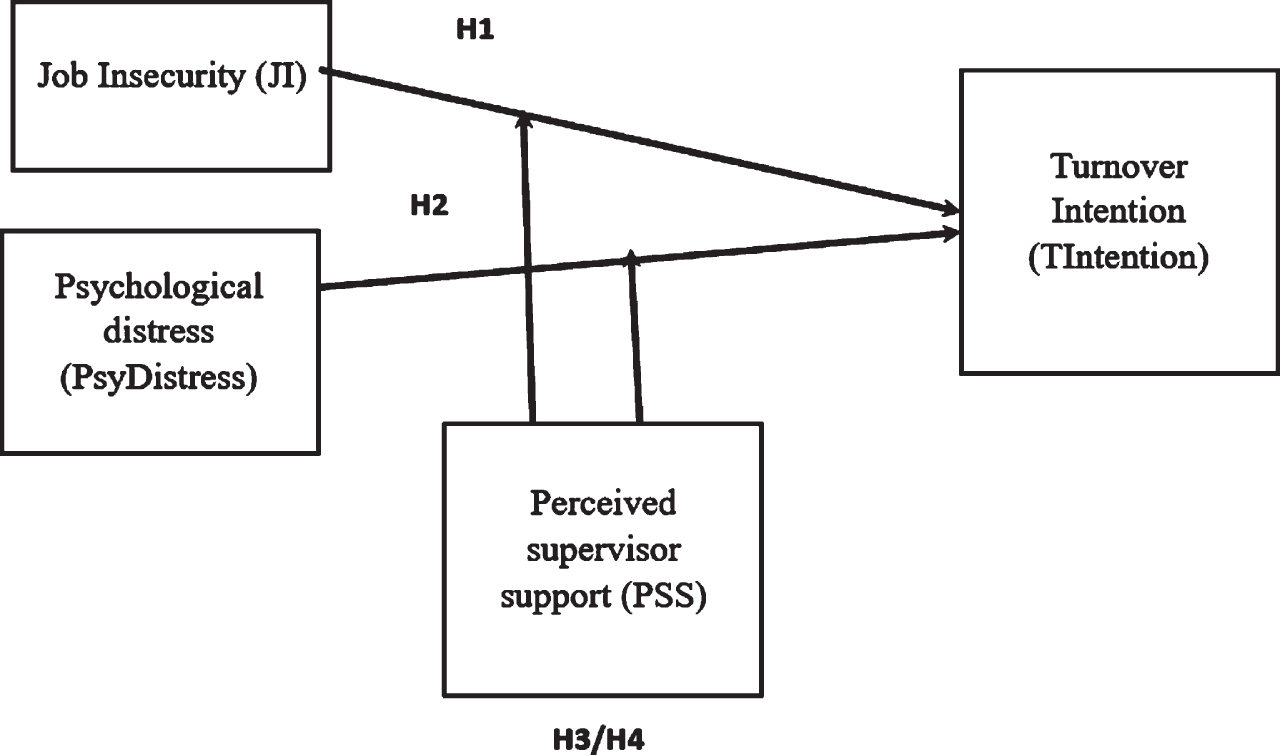
Research model.
Research design and sample size
The participants of this study were hotel employees during the COVID-19 pandemic. A questionnaire-based survey was designed and later distributed among the hotel employees. We measure employee job insecurity, psychological distress, employee turnover intention, and perceived supervisor support. In ensuring that respondents could provide valid responses, a purposive sampling method was used to select the respondents. Each questionnaire was attached with a letter explaining the investigation for the purpose of academic and that the information gathered would be treated as confidential. According to the G*Power, the minimum sample size would be 85. Hence, we have usable sample respondents of 141 to proceed with data analysis.
Measures
A total of 141 questionnaires were collected during the 9-months period from December 2020 to August 2021. All the scales were adapted from previous research. In this research, job insecurity was quantified with the scale that was introduced by Witte [23], and the items for psychological distress was quantified by Kessler Psychological Distress Scale [50, 51] in which the items related to nervousness or restlessness occurred during the COVID-19 pandemic. Perceived supervisory support adapted from Chen and Wu [45] and turnover intention was computed using the scale designed by Anasori et al. [52].
Results
The data was analyzed using the Partial Least Squares Structural Equation Modeling (PLS-SEM) approach, that has three advantages coinciding with the goals as well as this research’s characteristics: PLS is suggested for models which emphasize theory development [53] it has a permanent ability to calculate a cause-and-effect relationship model [54]; and it requires the lowest demand towards the measurement scales like the sample size as well as conditions for normality [55]. This made it a specifically appropriate technique for this research. In this research, SmartPLS 3.3.3 software was employed in estimating the suggested model (see Fig. 1).
Respondent demographics
Most respondents were male (62%), with most working experience between 3 to 6 years and about 45% of them with a college degree (see Table 1). Data collection was conducted among hotel employees at Klang Valley, Malaysia. Klang Valley is among the cities in Peninsular Malaysia, which is a melting pot of cultures, where the economy thrives and the residents have different income and academic level, purchasing power, ethnicity, and religion [56]. According to these traits, this population is a sample that is desired and represents the best proxy in examining turnover intention during this COVID-19 outbreak in Malaysia.
Demographic profile (n = 141)
Demographic profile (n = 141)
Factor loadings, average variance extracted (AVE) and composite reliability (CR) are employed in assessing convergent validity [57]. The suggested value of 0.5 was exceeded by all the item loadings, the construct CR values are larger than 0.7 and the AVE values exceeded the 0.5 threshold value [57] (see Table 2). Hence, convergent validity is well established in the dataset.
Assessment of measurement model on loading, CR and AVE
Assessment of measurement model on loading, CR and AVE
Discriminant validity is analyzed using Heterotrait and Monotrait (HTMT) correction ratio techniques toward the datasets [58]. The threshold value of HTMT.85 is not violated by the discriminant values [59], showing the construct items have no multi-collinearity issue (see Table 3).
Assessment of discriminant validity using HTMT
Assessment of discriminant validity using HTMT
Apart from respondent demographic, the variables of job insecurity, perceived supervisor support, psychological distress and turnover intention were adapted from relevant past studies. These variables were measured using a 5-point Likert scale to measure the outcome variable. The distribution of responses is analyzed, where the absolute skewness and/or kurtosis values of larger than –1 and +1 show highly non-normal data [54] (see Table 4). Dataset were found to fall within the acceptable range of kurtosis.
Descriptive statistics
Before initiating the structural model assessment, it is crucial to ensure that no collinearity issues are present in the structural model. The collinearity test outcomes. The offending value of 3.3 is higher than the VIF value for each construct [60] indicating that there is no problem with collinearity in this research (see Table 5). The structural model specifies the causal relationships between constructs in the model (path coefficients and the coefficient of determination, R2 value).
VIF value
VIF value
The bootstrapping method is used to estimate the significance of the path coefficient as suggested by Hair Jr et al. [61]. The path assessment results for every hypothesized relationship in the model can be seen in Table 6. The proposed direct relationships are all significant [Job Insecurity (JI) ⟶ Turnover Intention (TIntention), β = 0.377, t = 4.131]; [Psychological Distress (Psy Distress) ⟶ TIntention, β = 0.19, t = 2.067]. Although perceived supervisor support (PSS) was not hypothesised towards turnover intention, the relationship still is significant at 95 percent confidence interval [PSS ⟶ TIntention, β = -0.198, t = 2.442]. In summary, the result indicates that JI, Psy Distress and PSS have positive impacts on the TIntention among hotel employees in Klang Valley. Hence, H1 and H2 hypotheses are subsequently supported.
Assessment of structural model using bootstrapping
Notwithstanding significant relationships, it is imperative to look at the coefficient of determination (R2) assessment, the effect size (f2) of the paths and the predictive relevance (Q2) (see Table 7). Firstly, the value for coefficient of determination (R2) is 0.312. This shows that the exogenous variables in this study, namely job insecurity, psychological distress and perceived supervisor support possesses adequate capacity (31.2 percent) to explain turnover intention. Secondly, every exogenous variable (JI, f2 = 0.142; Psy Distress, f2 = 0.036; PSS, f2 = 0.057) reflects effect size of small to medium on the endogenous variable and lastly, predictive relevance (Q2) of the path model using the blindfolding procedure is also exhibited (Table 7). This is important because PLS-SEM emphasizes exploration and prediction results rather than theory testing. Q2 values greater than 0 indicate acceptable predictive quality for each model. Overall, the Q2 of 0.216 for intention, which is larger than 0 suggesting that all exogenous variables possess predictive ability over the endogenous.
Assessment of coefficient of determination (R2), the effect size (f2), and predictive relevance (Q2)
The moderating effect of perceived supervisor support (PSS) on the relationship between job insecurity and turnover intention (β = -0.033, t-value=0.238), and psychological distress and turnover intention (β = 0.292, t-value=0.991) can be seen in Table 8. This shows the relationship between job insecurity, psychological distress on turnover intention is not moderated by perceived supervisor support (PSS). Dawson’s (2013) plot as depicted (see Fig. 2) shows that the relationship postulated has no effect when PSS is high. Therefore, H3 and H4 are rejected.
The relationship between job insecurity (JI) and psychological distress (Psy Distress) moderated by perceived supervisor support (PSS)
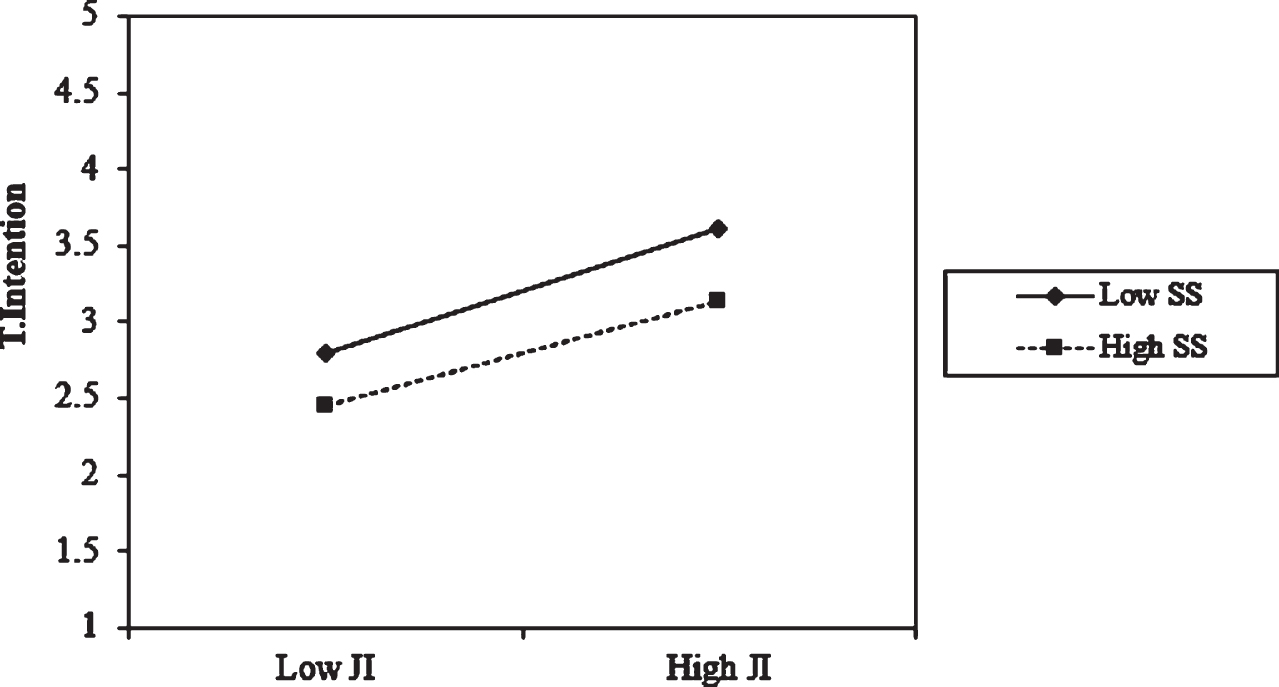
No moderating effect of SS on the relationship between job insecurity and turnover intention.
The objective of the present study was to test a conceptual model that investigates perceived supervisor support (PSS) as a moderator in the causal relationship between job insecurity (JI), and psychological distress (Psy Distress) on employees’ turnover intention (TIntention) during the COVID-19 outbreak.
As expected, the result found job insecurity and psychological distress are potent antecedents of turnover intention. Respondents of this study demonstrated that inadequate planning and preparedness by organizations during the pandemic failed to ensure job security which has led employee effort and commitment levels to drop. Thus, job insecurity has led to an increase of undesired attitudes and behaviours such as leaving the organization. Similar findings were found in work of Staufenbiel and König [62] and Stiglbauer et al. [63], who found that job insecurity enhanced employees’ turnover intentions. Another plausible explanation for this result would be, most Malaysian hotels had no choice but to take up cost-cutting measures to keep on the survival path. A survey involved 320 hotels nationwide have revealed the cost-cutting includes employees’ salary cut (44.6%), reducing employees workforce (14.06%), cutting down the benefits of employees (34.69%) as well as assigning other works to the employees (73.75%) [6]. These circumstances have triggered job insecurity and increased turnover intention, thus H1 is supported.
Similarly, our second hypothesis (H2) shows a positive relationship between psychological distress and turnover intention. In this construct we measure psychological distress from various facets comprising mental health, including generalized anxiety disorder and depression, as suggested by Bentley et al. [64]. Results proved that poor mental wellbeing led to intention to quit due to fear of COVID-19. Our result is consistent with prior studies by Brunetto et al. [65] and Tsuno, et al. [66]. The COVID-19 pandemic has surely changed routine life, resulting in unanticipated changes which led to extreme psychological responses as well as mental health crisis. Psychological distress would have increased due to economic uncertainty, grief, self-isolation, lockdown, survivor guilt, loss of family and friends to illness and other factors that arise due to this pandemic. This can cause psychological impact that makes employees feel trapped, resulting in a lack of attention at the workplace that breeds higher levels of turnover.
Contrary to our anticipations, the outcomes from our sample did not support the moderating role of perceived supervisor support in the relationship between job insecurity and psychological distress to turnover intention. Perhaps, employees are not appearing to be thriving with the support of supervisors as maybe the supervisors or superior management have encountered some deficiencies in exercising proper strategies which include preparedness, response, as well as recovery phases during COVID-19. In this regard, lack of employees’ trust towards supervisors does not aid in fostering any motivation among respondents to continue serving the employer, as such major sources of distress and job insecurity remain highly influenced by turnover intention. In summary, perceived supervisor support as the moderator does not strengthen the effect of psychological distress and job insecurity on turnover intention.
Theoretical implications
The present research fills the scarce literature that investigates the effect of job insecurity and psychological distress on turnover intention in the industry of hospitality. Further, it unravels the role of perceived supervisor support as a moderator to examine employees’ quitting intentions. Thus, this study employs the theory of COR. To date, researchers’ research and meta-analyses have found COR theory to be a major explanatory model to understand the stress process at work. Hence, our study further validates job insecurity, and psychological distress to be the most viable theoretical perspectives which influence one to be unable to sustain, acquire, and protect their available resources (quality of life, family life, health, and well-being). In this relation, drawing from theory of COR, scholars can consider job insecurity, and psychological distress as important factors when developing models for organization sustainability in terms of improving turnover intent. This paper also fills the gap by following the scholarly interests in the impacts of COVID-19 on the tourism industry [67, 68].
Managerial implications
From the managerial standpoint, the outcomes from the current research provide a major implication for those top managers wanting to generate a competitive advantage during the pandemic. In these challenging times, there is no question that small or large businesses, they took a certain amount of economic beating. Top management should realize this and start to tap on the fundamentals of their businesses. In other words, they should start investigating the ground and reinvent the organizational structure, with one goal being is to empower the supervisors as they are the closest people with frontliners and employees. Top management should be ready to provide enormous flexibility in supervisors’ roles so that employees will remain connected and have new possibilities for them to escape the dilemma of anxiety and scepticism. This can help in retaining the employees with positive attitudes and eventually result in economic savings.
Limitations and future directions
The research has some limitations despite these findings. Firstly, the data were only collected in Klang Valley Malaysia within hotel employees. We call future researchers to generalize the sample to other industries as well. Secondly, we would recommend future studies to explore other potential antecedents to link with turnover intention for example job burnout. Furthermore, our result suggests that no moderating effect of perceived supervisor support in the relationship between job insecurity and physiological distress hence, other constructs like organizational culture and organizational commitment can be further explored as moderators to reduce the employees’ turnover intent at times of pandemic.
Conclusion
Re-looking at existing policies and leadership styles may be fruitful in ensuring the sustainability path of organization. This is pivotal in growing back the entire hospitality industry that has gravely affected by COVID-19. This paper has managed to bridge the gap between top management and its subordinates as well as provide empirical evidence on human resource literature.
Ethics approval
The study was approved by the Universiti Tunku Abdul Rahman (U/SERC/128/2022).
Funding
None to report.
Conflict of interest
The authors have no competing interests.
Footnotes
Acknowledgments
The authors have no acknowledgments.
Author contributions
Conceptualization and data collection: JSA; Research framework recommendation and writing: LM and NR; Writing-original draft preparation: WLL; Writing-review and editing: FHA. All authors have read and agreed to the published version of the manuscript.