




Abstract
BACKGROUND:
This paper focuses on the concept of career construction based on the theory of conservation of resources to understand the overall effect of career capital on career success from both a subjective and objective manner through the mediating effect of perceived employability.
OBJECTIVE:
This study attempts to explain how different integrated aspects of career capital, including human, social, and psychological (antecedents), influence both subjective career success and objective career success (outcome) through the mediating effect of perceived employability (mediator).
METHODS:
Time-lagged data of 331 employees from the telehealth medical billing service companies based in Pakistan were analyzed through a structural equation modeling technique using SmartPLS software.
RESULTS:
The main results confirmed that career capital positively affects perceived employability and career success while perceived employability positively mediates the relationship between career capital and career success.
CONCLUSION:
This research responded to prior calls by explaining the positive mediating role of perceived employability (as a mediator) in explaining the positive influence of career capital on career success using different various dimensions of career capital and career success. This research included the contextual issues by testing the model in the telehealth sector of Pakistan. The findings suggested that context or occupation matters in the relationship between career capital and career success.
Introduction
Job security and lifetime employment are no longer the norms in the contemporary world of work as the working professionals continually evaluate their circumstances. They have adequate awareness of the job market and work prospects when developing their careers [1, 2]. Employability has become one of the most significant outcomes in contemporary careers [3] and a key research topic in career, work, and occupations literature [4]. Individuals can develop and sustain employability early in their careers by analyzing existing and potential labor market prospects [5, 6]. An individual’s perception of employability is crucial for job seekers because it relates to job opportunities available in the labor market [7, 8]. Thus, scholars have asserted the need to examine the antecedents, mediators, moderators, and outcomes of perceived employability [9]. Even though the importance of individuals in the volatile job sector remains significant, an imminent academic focus is needed to unwrap various aspects of perceived employability [10, 11].
Career success is another critical factor for modern workers and organizations. Subjectively and objectively, employees who find their careers to be successful are more dedicated to their jobs and their companies than those who evaluate their careers as unsuccessful [12]. Individuals require career services and specific resources related to career capital (an umbrella term) to excel in their professions. Many experts believe career resources can be developed through training and development and other methods [13]. Career capital components, including human capital (what you know), social capital (who you know), and psychological capital (who you are), are closely connected to career success. Despite that, less is known about the impact of career capital components on career success [9].
From a COVID-19 perspective, present-day occupations are characterized by more regular movements across corporate and occupational borders due to rising labor market volatility [11]. For individuals who want to optimize career success, the need to preserve employability has become crucial [10]. The prolonged COVID-19, coupled with other factors, has significantly added to employees’ and job seekers’ stress, making navigating the labor market more arduous [14]. With the growing joblessness and underemployment in developed and less developed countries, career capital requires more academic and corporate attention [15].
In Pakistan, slow economic growth and rising unemployment in the COVID-19 era have become significant concerns for public and private sector organizations and individuals [16]. The crowded labor market has created an access barrier for highly educated and skilled people to enter the labor market [10]. With COVID-19 causing a job shock worldwide, employability can play a crucial role in effectively handling career shocks [10]. Such job market problems drive many young people towards floundering developments, i.e., stunted job growth and employability issues [10, 11]. Therefore, this study makes an initial attempt to explain how different integrated aspects (i.e., human, social, and psychological) of career capital (antecedents) influence both subjective and objective career success through the mediating effect of perceived employability, as called for in earlier studies [9].
Theoretical background and hypotheses development
The career construction theory conceptualizes job creation as an action-oriented mechanism in which individuals create a profession and design their lives and careers [12]. This theory suggests that individuals consciously use career resources to satisfy the demands of complex working environments and navigate contextual rewards and restrictions [17]. The same theory further adds that career success comes through employability and the context in which career capital builds boundaries that frame how employers help employees construct their careers [9]. Thus, it is necessary to acquire career resources, considering the need for individuals to aggressively develop their careers while adapting effectively to the opportunities and challenges generated by the environment [11]. Career capital is recognized as a valuable career asset for career success [12]. Job opportunities, in particular, help young professionals manage the contemporary world of work more successfully and enable them to grow and sustain their employability. Drawing from the conservation of resources theory, many scholars validate that employability is an instrumental resource that can help individuals handle difficulties and take advantage of opportunities discovered when routing the labor market, thereby theoretically contributing to increased career success [18]. Presti and Pluviano’s model also suggests that employability could be a potential mediator linking different factors and career success. These researchers have asserted that individuals who perceive high employability achieve success by taking advantage of the resources within their reach [9]. Figure 1 shows a research framework of the current study.
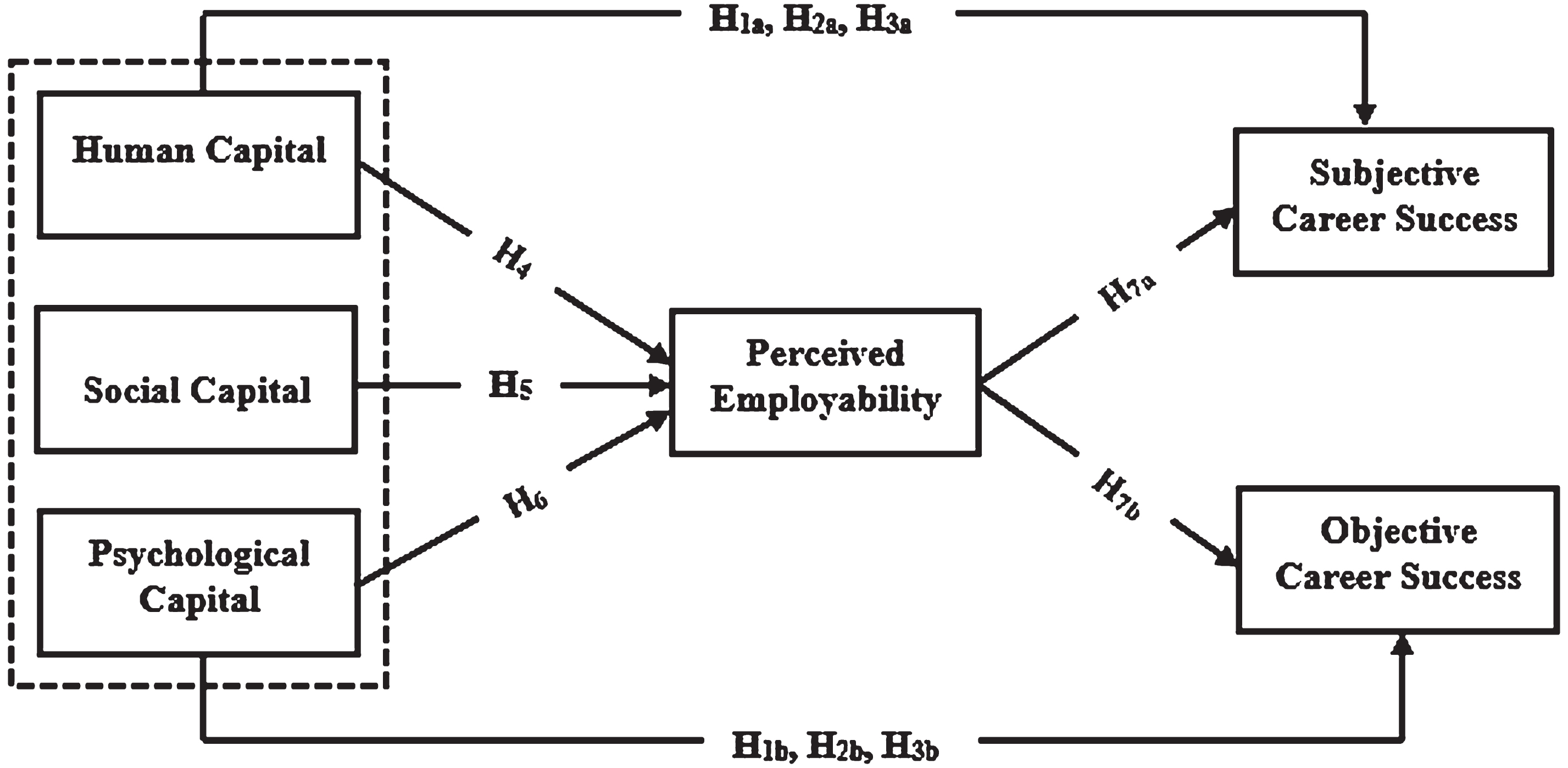
Research framework.
A high degree of human capital offers among workers generates high opportunities [19]. Apart from a recent Chinese study that confirmed the association between human capital and career success [20], prior studies indicated that career success experiences a 39 % variance due to human capital [21, 22]. Human capital is based on individual training, education, and job experiences that lead individuals toward entire successful careers. An empirical study on the impact of human capital on career success verified a positive link among the constructs [9, 23]. Employees with high levels of human capital are likely to be satisfied in their professions. Building on the notion of the career construction theory, this study proposes that human capital has a significant impact on career success. Hence, it is hypothesized that:
The relationship between social capital and career success
In temporary labor markets, career success provides access to meaningful information and decreases search costs. It significantly contributes to career development by supporting employees, obtaining new jobs, opening new ways of collaborative work, and building ties with others who offer emotional and social support [24]. Past studies corroborate the profound effects of social capital on subjective and objective career success [9, 25]. Previous findings indicate that corporate mobility and promotions are connected to the network [26]. Professional relationships are also the primary means of finding work prospects and can guide employment and personal development [27]. Similarly, extant works support that a high degree of social capital delivers various advantages for organizations, one of them is less turnover rate, which shows greater job satisfaction in the workers [28]. Managers are advised to locate employment across informal networks rather than conventional job search methods [29]. Thus, in line with the above concept, the following hypothesis is proposed:
The relationship between psychological capital and career success
Karatepe and Karadas found that workers scoring high on psychological capital are happy with their employment, professions, and lives, i.e., perception of subjective career success is high. Psychological capital is connected to job mobility and objective career progress [30]. Career self-efficacy is correlated with effective job search and re-employment [31]. Resilience can facilitate career success because it involves coping with complexity, confusion, and change to recognize and appreciate work opportunities [32]. Employees develop their career paths to steer in the direction of their occupational targets using various resources to stay firm. In other words, based on tenets of the career construction theory and conservation of resources theory, it is predicted that the psychological capital predicts subjective and objective career success.
The relationship between human capital and perceived employability
Previous case studies on Italian workers in the hospitality industry have confirmed a significant link between human capital and perceived employability [33]. Occupational experience is considered a core attribute that allows workers to cope with continuing technical progress and internationalization. Modern workers need occupational experience to remain appealing in a knowledge-driven economy that demands deep-level skills [34]. Per the career construction theory, workers with high levels of occupational experience are likely to view themselves as more employable. Hence, it is hypothesized as follows:
The relationship between social capital and perceived employability
A beneficial impact of increasing social social capital on perceived employability was noticed by Akkermans and Tims [4]. Likewise, Ng and Feldman found that career success is connected to social support and social integration [35]. Akkermans et al. [13] explained that social networks provide a wider span of career opportunities, improving perceived employability and providing and occupational edge [36]. As the theory of career construction reformulation suggests, the social capital analysis of the workers results in affective reaction strengthens perceived employability, determining behavioral response and career satisfaction. Based on the above discussion, the following hypotheses are proposed:
The relationship between psychological capital and perceived employability
In his Graduate Capital Model, Tomlinson proposed that psychological capital enhances the capacity of an individual to cope with challenging problems and fix issues. A strong and statistically relevant association between psychological capital and the perceived employability of college students was found by Donald et al. [37]. Individuals who display a high degree of psychological capital due to their perseverance and effort improve their chance of achievement in gaining more employability skills [38]. Psychological capital plays an important part in the development of employability skills portrayed by university students [39]. Redrafting the career construction theory provides instructions on the development of psychological capital, enriching the perceived employability. Based on the above argument, it is postulated that:
The relationship between perceived employability and career success
An strong correlation between perceived employability and career success was noticed by Peeters et al. [40]. Awino and Kipsang observed a favorable relationship among employability and the career success in knowledge workers in Finland [41]. Another study in the banking sector of Pakistan indicated that employees with some employability skills were competitive. This finings provided evidence for the link between employability and career success [42]. In another study, the undergraduate students demonstrated high capacity of employability in their near future [34]. As per the conservation of resources theory, the bond between perceived employability and career success induces a sense of satisfaction among individuals. Thus, the current study hypothesizes the following:
The mediating role of perceived employability
A study suggests that people with high qualifications, experience, and ability criteria are more analytical, which implicitly leads to subjective career measures [43]. Onyishi et al. recognized a lack of longitudinal evidence relating human capital and career to employabilityand found that these factors to be interelated [44]. According to Baluku et al. by taking better advantage of the resources within their reach, employees with high human capital achieve success. This view ressonates with the conservation of resources theory [45]. In addition, Peeters et al. offered ample evidence for the hypothesis that career capital and career success are positively related [40]. Therefore, the following mediation hypotheses are conjectured based on the above empirical data and theoretical arguments:
Past research found that social networks are sensitive to the changes in the business world and respond proactively [46]. Social capital conceptually underpins the construct of employability [47]. Employability is the sub-dimension of adaptability that originates through socially fit gigs [48]. Based on a comprehensive meta-analysis of 107 reports, Safavi and Bouzari concluded that perceived employability is complemented by social capital, ending in subjective career achievement joys [49]. Overall, these findings indicate that the correlation between social capital and career success is well known in the literature, although its connection with perceived employability is still sparse and fragmented [50]. Using the tenets of the career construction theory, the current research study claims that social capital leads to improving the employability of individuals because it gives them more energy to make the most of opportunities for themselves and their society, thereby becoming more employable and contributing indirectly to their success:
There is academic support for the positive contribution of perceived employability in the nexus between career satisfaction and psychological capital [45]. Mao and Shen concluded that psychological capital frills motivate individuals to work hard with hope and resilience, leading to subjective and objective success in their career paths [51]. Pakistani workers in food and beverage industry reported that they were happy and positive about their careers [3]. Ching et al. noticed a positive psychological state of employees working in insurance companies. The researcher found them more employable [52]. In another study, positive sychological capital was observed among hotel workers. Employees showed positive capacity and probability for success based on motivated effort and perseverance [49]. Other studies indicate that perceived employability positively mediates the relationship between organization-based self-esteem and career success [42]. Perceived employability is boosted bypsychological capital, whichupliftscareer success. Based on such arguments, it is proposed that:
Participants and procedures
Data were collected through a survey questionnaire from seven US medical billing companies in two cities of Pakistan with a total population of 2,720, including MTBC (Medical Transcription and Billing Companies) having 1800 employees, PMTAC Private Limited having 250 employees, Primatac having 40 employees, Bellmedex containing 350 employees, Pro Medical Billing Solutions Pvt. Ltd. possessing 150 employees, Millennium Medical Billing-MMBC having 50 employees, Skyline Technologies having 80 employees). The managers of these companies were approached and permission was granted only for online data collection due to COVID-19. Self-completion questionnaires were disseminated through various social apps (e.g., Whatsapp, emails, messengers, and Facebook pages) among more than 500 employees comprising senior and junior staff members of clerical, operational, managerial, and administrative levels. A three-wave data collection procedure was done. Each survey from the same respondents was conducted with a time gap of thirty days (one month). Overall, 395 submissions were obtained in Time 1 survey, but seven questionnaires were excluded due to incomplete and improper responses. The remaining 388 questionnaires were selected for Time 2. After getting 371 responses, the authors omitted 17 questionnaires because of missing information. Three hundred fifty-four questionnaires were distributed in Time 3 survey, out of which 343 answers were obtained, after excluding 12 incomplete questionnaires. A total of 331 responses were kept aside for final data analysis, yielding a response rate of 83.8%.
All possible measures were followed to safeguard compliance with international and internal ethical standards. All measures in this research work engaging human participants were fulfilled in strict accordance with the Nuremberg Code and Belmont Report, the 1964 Helsinki statement, and its later revisions or similar ethical principles. A form of consent was taken from all individuals who contributed to this work.
Measures
The participants shared their opinions through a five-point Likert scale (“strongly disagree” to “strongly agree”). This study applied five-items scale established by Eby et al. to measure human capital. [53] The scale item example is as follows:“I have a versatile range of work-related skills”. The four items scale of Eby et al. was applied to measure social capital [53], adopted by Järlström et al. in latter studies. The sample statement of scale included the following: “I am well connected within the organization”. Through a scale of 12 items scale, the current study measured respondents’ psychological capital. The scale was established by Luthans et al. [54]. The current study adopted Rothwell and Arnold scale to measure perceived employability [55]. The scale contained nine items and the sample item is “I believe I could easily obtain a comparable job with another employer.” Greenhaus et al. [56] scale was incorporated to measure the subjective career success. The sample items constituded “I am satisfied with the success I have achieved in my career.” This study measured respondents’ objective career success through two aspects: promotion and salary. For promotion, participants expressed their views regarding the total promotion they had received during their professional careers. Next, the participants reported the range of their monthly salary, comprising direct commissions and bonuses.
Results
Construct reliability and convergent validity
The model measurement was done with the help of reliability and validity (convergent and discriminant). PLS algorithms were run to calculate the outer loadings for all constructs. All loadings were considered good, as they were greater than the accepted threshold, i.e., 0.7. The average variance extracted (AVE) was used to measure convergent validity. Its value should be greater than 0.5 [57], as shown in Table 1.
Reliability and convergent validity statistics
Reliability and convergent validity statistics
Note. HC = HC; SC = SC; PC = PC; PE = PE; SCS = subjective CS; OCS = objective CS; IE = internal employability; EE = external employability; OPT = optimism; RES = resilience; HOP = hope; SE = self-efficacy.
Perceived employability and psychological capital were measured as second-order constructs. The redundancy analysis was used to analyze the reliability and validity of higher-order constructs. All dimensions of a construct should have significant weight on their respective variable. Table 2 shows the results.
Weight & significance of dimensions
Note. IE = internal employability, EE = external employability, OPT = optimism, RES = resilience, HOP = hope, SE = self-efficacy.
Heterotrait-Monotrait (HTMT) ratio of correlation was used to measure discriminant validity. Henseler et al. [58] described this method as a more accurate measure of validity than the traditional ones. Its value should be less than 0.9, as shown in Table 3.
Hetrotrait-Monotrait (HTMT)
Note. HC = HC; SC = SC; PC = PC; PE = PE; SCS = subjective CS; OCS = objective CS; IE = internal employability; EE = external employability; OPT = optimism; RES = resilience; HOP = hope; SE = self-efficacy.
The present study evaluated the structural model to investigate the link between career capital and career success through the mediating effect of perceived employability. Table 4 shows regression fallouts for testing the hypotheses. The assessment is generally suggested for changes in R2 values [59]. R2 value indicated 75.8% of subjective career success while all indicators predicted 43.4% of objective career success. The outcomes showed that there was a significant positive relationship between human capital and subjective career success (β= 0.583, t = 12.907, p < 0.05); social capital and subjective career success (β= 0.193, t = 3.443, p < 0.05); psychological capital and subjective career success (β= 0.164, t = 3.596, p < 0.05). The findings showed that employees exhibiting high career capital that uplifts their moral, emotional, social, and psychological needs, are satisfied subjectively. Thus, it was concluded that H1a, H2a, H3a were accepted. More so, the results supported a significant positive relationship between human capital and objective career success (β= 0.266, t = 3.883, p < 0.05); social capital and objective career success (β= 0.268, t = 2.936, p < 0.05); psychological capital and objective career success (β= 0.078, t = 1.177, p < 0.05), therby affirming H1b, H2b, H3b. These findings corroborated prior beliefs that employees with higher pay, perks, and positions are motivated and satisfied, objectively. As per the current result, perceived employability was found enriched by human capital, supporting H4 with a significantand positive association (β= 0.102, t = 3.296, p < 0.05). Employees with a high sense of social capital reported favorable perceived employability perception, thus H5 was supported (β= 0.605, t = 17.678, p < 0.05). The current analysis revealed that psychological capital, representing emotional and moral stability in occupation, had a significant ans positive effect on perceived employability. Thus, H6 was approved (β= 0.287, t = 6.270, p < 0.05) (see Figs. 2 and 3 for details).
Summary of results
Summary of results
Note. HC (HC), SC (SC), PC (PC), PE (PE), SCS (subjective CS), OCS (objective CS).
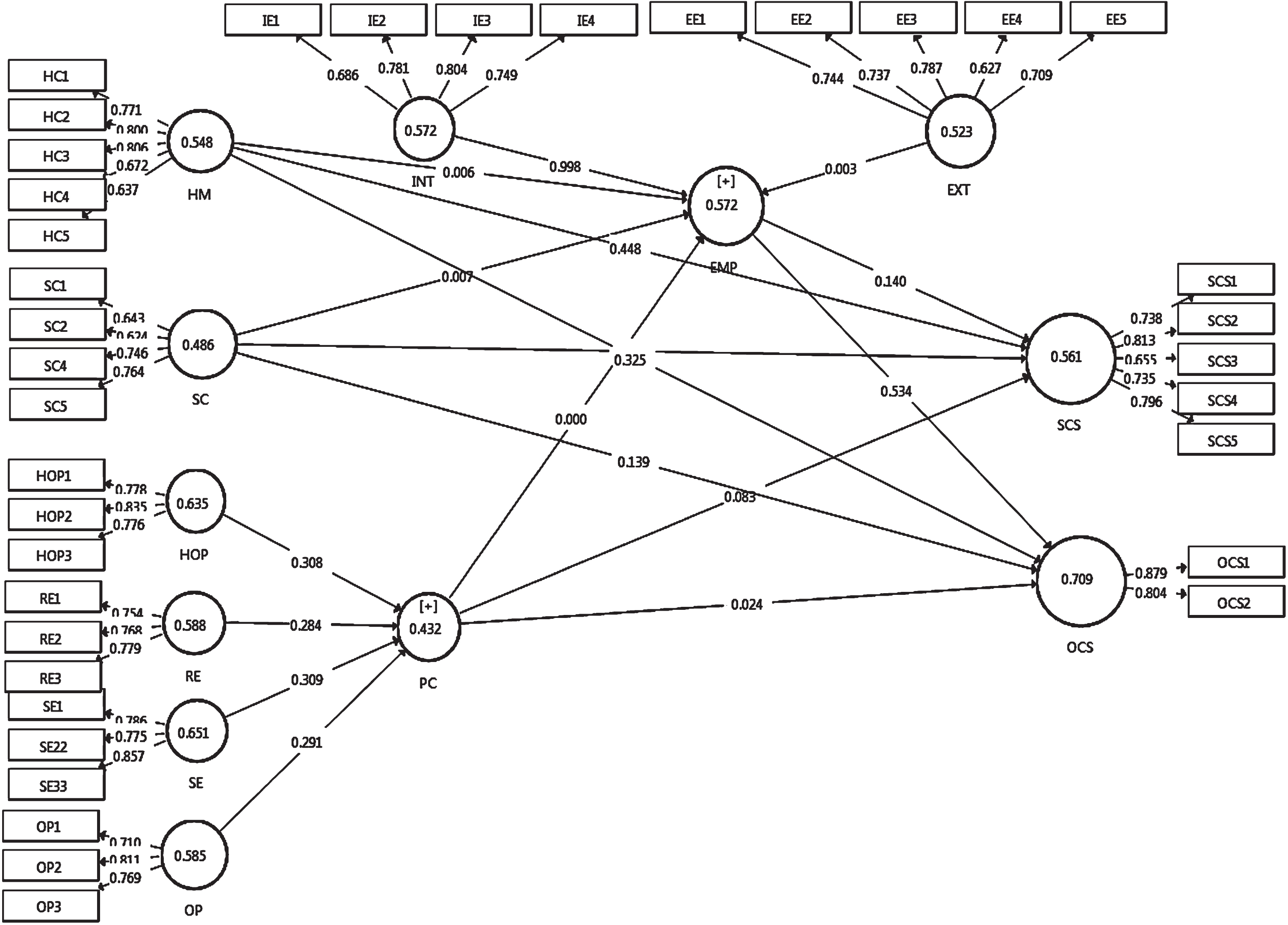
Outer loadings.
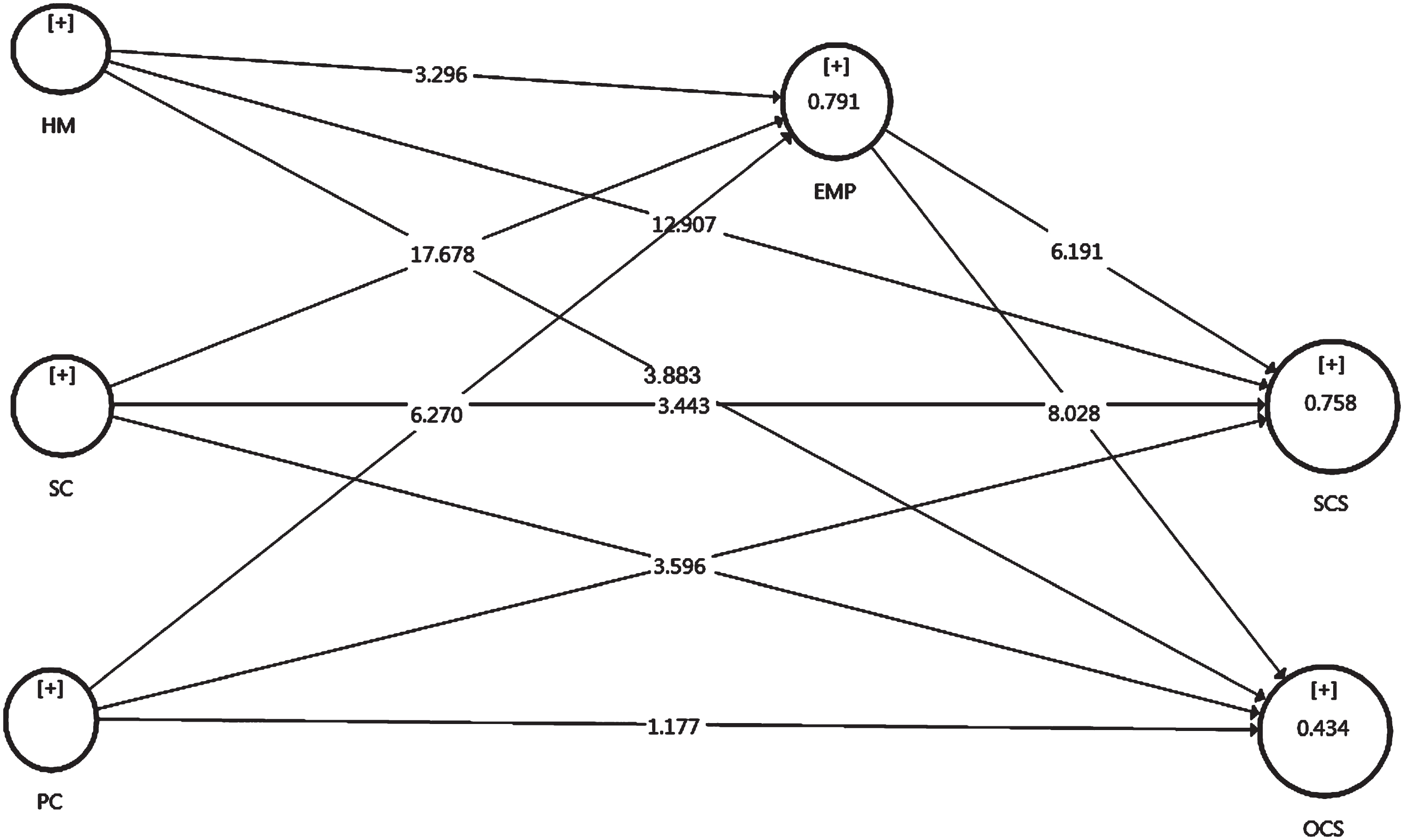
Results of the structured model.
Furthermore, the results demonstrated that perceived employability favorably contributes to subjective (β= 0.384, t = 6.191, p < 0.05) and objective (β= 0.733, t = 8.028, p < 0.05) career success of employees, thereby corroborating H7a and H7b. For the effects of mediation, the present analysis by bootstrapping technique showed that perceived employability partially mediated the relationship between human capital (β= 0.039, t = 2.985), social capital (β= 0.232, t = 5.586), psychological capital (β= 0.110, t = 4.561) and subjective career success (significant at and p < 0.05), validating H8a, H9a, H10a. The indirect path means that perceived employability is boosted by career capital, ending in subjective career success. In addition, perceived employability played a partial mediation role between human capital (β= 0.075, t = 2.979), social capital (β= 0.444, t = 6.767), psychological capital (β= 0.210, t = 4.560) and objective career success (significant at p < 0.05), confirming H8b, H9b, H10b. In essence, the current nalaysis revealed that employees endowed with hierarchical positions and substantial rewards enjoy success. Effect sizes (f2) were analyzed based on Gefen et al.’s approach, in which the effect sizes determine the impact of exogenous latent constructs on endogenous variables [60]. The current study noted that most values with larger effect size, i.e., f2 values larger than 0.35 deonoted larger effect sizes, 0.15 medium effect sizes, and 0.02 small effect sizes. The summary of all results is depicted in Table 4.
Further analysis of predictive relevance was used to measure the predictive performance of the model. As a statistical requirement for acceptance, the path model must be in a condition to sufficiently predict measuring indicators of each endogenous variable [58]. Predictive validity was evaluated with cross-validation with holdout samples following Shmueli et al. [61], whereas cross-validated prediction errors and summaries statistics were obtained using root mean squared error (RMSE) and mean absolute error (MAE). The corresponding Q2 from the PLS Predict analysis indicated that all values were more significant than zero, suggesting sufficient relative performance. RMSE, MAE, and MAPE were lower than the corresponding value in LM, as shown in Table 5, demonstrating that model has well out of sample predictive power.
Indicator prediction summary
Indicator prediction summary
SCS (subjective CS), OCS (objective CS.
This study was initiated with several objectives. First, following prior calls [9], the study tested and established that careers success (both subjective and objective) can be achieved through human capital.. because the results confirmed that human capital, based on individual theoretical and practical education, and training, is a fundamental resource for a successful career. Second, the current study assessed the role of social capital in the career success of individuals. Results of this study supported the early studies highlighting that social capital is an important antecedent of individual career success [62]. Social capital allows individuals to pursue better opportunity for their career with the support of a developmental network and career mentors. Third, in line with a previous study, this study investigated the contributions of psychological capital in shaping individuals’ career success [63].
Wittekind et al. noted that most research scholars agree that the constructs associated with human capital has a significant, positive role in determining individual perceived employability [64]. These authors argued that job-related skill advancement and qualification significantly supportperceived employability. As the fourth study objective, his longitudinal study verified the above-noted claims by empirically establishing that human capital is significantly linked to perceived employability. Fifth, the present study explored the significance and pertinence of networks in medical billing among employees. In line with prior studies on individual employment, the current study results established that perceived employability of individuals increases through networking [65]. Employees, espousing superior networking skills, are more likely to pursue better career opportunities [66]. Sixth, this investigation empirically linked psychological capital to perceived employability. The current model adds to the few works offering empirical proofs for the significant positive link of psychological capital construct withperceived employability [67]. That said, some studies have linked psychological capital to job search attitude and behavior [68]. For example, some papers suggest the hope attribute of psychological capital (including the quality to work and develop towards accomplishing goals) increases perceived employability [69]. Seventh, this study examined [and found support for] the connection between perceived employability and career success (subjective and objective), consistent with earlier claims [40, 42].
Beyond the direct relationships examined herein, this research also checked the effect of career capital (human, social and psychological capital) on career success in the presence of perceived employability, in response to earlier calls [70]. As hypothesized, perceived employability significantly mediated the linkages between human capital and career success, which offered empirical support to prior theoretical concepts concerning the explanatory role of perceived employability in the human capital-career success nexus [9]. Moreover, this study examined the positive effect of social capital on individual career success in the presence of perceived employability. The result showed that social capital was positively associated with individual career success through the mediating effect of perceived employability. Finally, the current study investigated the mediating role of perceived employability in the association between psychological capital and career success. As predicated, the outcomes confirmed the mediating effect of perceived employability in the relationship linkages between psychological capita and career success. To the best of our knowledge, no empirical research has empirically linked career capital (human, social and psychological capital) to career success through perceived employability.
Conclusion
Theoretical implications
The paper enriches the career management literature by extending the career construction theory.The paper offers alternate paths and mechanisms (direct and indirect role of perceived employability) through which the human, social, and psychological capital influence the subjective and objective career success of employees, particulary in an under-reserached context, i.e., medical billing companies. Moreover, the study applies the conservation of resources theory to relate employability skills to potential career resources, thereby extending previous research and shedding light on why and what aspect of career capital increase employee career success. The conceptual and empirical model, built on various career management theories, contributes to complex models in the current career literature as it comprehensively integrates and explains the systematic flow between three aspects of individual capital (human, social and psychological), two types of career success (subjective and objective), and perceived employability. Furthermore, the findings drawn from the longitudinal study design and data of employees in the telehealth sector offers can be generalized to other healthcare in Pakistan sectors.
Practical implications
The outcomes of this study provide some practical suggestions for managers (team leaders), organizational researchers, and practitioners on how to diagnose and prevent factors that disrupt employees smooth sailing towards their anticipated career paths and blur their chances of success. Employers benefit from workers who can engage in their careers, yet they should be mindful of the individual factors that determine career satisfaction of employees. Management should empower supervisors to take steps indispensable for raising employees’ well-being. Organizations may include instructions to help workers show constructive attitudes, such as proactive behaviors and intervention in job crafting. Employees could be inspired and encouraged in this manner to maximize subjective and objective success sequentially. For HR professionals who might consider dedicated programs, the current comprehensive model provides a useful HR matrix for HR, enabling them to develop targeted programs to foster career capital qualities, enhance perceived emplaybility, and uplift the hope of career success among workers.
Limitation and future research
This study lays out several limitations that should be noted for future research. Firstly, the targeted sample was collected from a specific geographical area (i.e., seven medical billing companies) of Pakistan,. Secondly, the time-lagged nature of the study and use of convenience sampling may hinder chances of extending the generalizability of findings. The reason behind this limitation was time and recourses constraints... Fourth, only perceived employability was taken as a mediator between career capital forms and career success.. Fifth, the current study tested mediation only.
To address the first limitation future research should consider collecting data from other regions considering some other organizations and sectors. Cross-lagged, three-wave longitudinal or experimental study could be used to collect data for future research to address the second limation of this study. Thirdly, future scholars might go for qualitative or a mixed method research study for detailed and extensive exploration of the current mediation model. For fourth limation, future studies can consider other explanatory factors, including intrinsic motivation, psychological empowerment, or commitment, as mediator construct. Finally, Future studies should consider using a moderated-mediation model to analyze the subjective and objective measures using career shocks, organizational career management practices, or family employability support, as moderators in the current model [9, 13].
Ethical approval
The study was approved after a comprehensive review by the Ethics Committee of the International Islamic University, Pakistan.
Informed consent
Following ethical standards, written consent was taken from all participant after the provision of a clear and thorough study explanation.
Conflict of interest
No conflict of interest related to this manuscript has been reported.
