




Abstract
BACKGROUND:
Work-system participation and factors are associated with occupational vocal health for vocally reliant workers, such as sports coaches. However, there is limited use of systems approaches and worker collaboration to address occupational voice.
OBJECTIVE:
The current research aimed to cooperatively consider coaches’ vocally reliant systems participation, including addressing vocal ergonomic factors that can create barriers for occupational vocal health and voice use.
METHODS:
Collaborative action inquiries explored vocal ergonomics with coaches (n = 24) from nine professional basketball teams. Across three basketball seasons, coaches and a subject matter expert identified what influenced coaches’ voices and trialed approaches to optimize vocally reliant coaching participation. Nine action inquiry methods were used, including search conferences, ergonomic approaches to enhance systems participation, and focus groups. Multi-level analyses were also undertaken.
RESULTS:
Participants cooperatively generated, implemented, and evaluated different strategies. A cumulative total of 57 strategies were explored within teams (team mean = 6.33, SD = 3, range = 4–14). Cross-case analysis identified 25 different strategy types. Overall, participants appraised 31.58% (18/57) strategies as supportive (i.e., enhanced facilitators for voice), 61.40% (35/57) strategies as somewhat supportive (i.e., some enhanced facilitators and some ongoing barriers), and 7.02% (4/57) strategies as unsupportive (i.e., pervasive ongoing barriers not mitigated by strategies). Further, factors across coaches’ work-systems continued to influence coaches’ voices in dynamic and complex ways.
CONCLUSIONS:
Collaboration with coaches enriched vocal ergonomic approaches by providing novel, context-anchored insights. Collaboration should form ‘part’ of broader mechanisms to support coaches’ voice use and vocal health at work.
Introduction
Workers across occupations increasingly rely on voice as an essential occupational tool for undertaking work-related activities and broader job participation [1–5]. Examples of these occupational voice users (OVUs) include educators [6, 7], performing artists [8, 9], call center workers [4, 10], health care workers [11, 12], community faith leaders [13, 14], and sports coaches [15–19].
However, many OVUs experience diminished vocal health associated with their vocally reliant work engagement and broader work-related factors [3, 20–23]. Common occupational vocal health hazards experienced by OVUs include loud and prolonged voice use, inadequate instrumental support (e.g., amplification), insufficient recovery opportunities, voice use during intense emotions, high stress, loud and noisy environments, poor air quality, and challenging organizational climates [3, 20–26].
Vocal OHS
Voice is advocated as a key occupational health and safety (OHS) issue for all OVUs given their occupational vocal reliance, recognized hazards, and broader implications of occupational vocal health [3, 20–22]. OHS aims to protect workers’ health, safety, and wellbeing [27, 28]. This is done by addressing risks and hazards, and promoting safe work practices [27, 28]. OHS also facilitates workers’ participation in health and safety measures (i.e., consultation and participation) [27, 28].
Suggested avenues for specifically considering OHS for voice (i.e., vocal OHS) include policy [22], stakeholder education and training [22, 29], OHS risk management [3, 22], consideration of systems thinking approaches [13], and vocal ergonomics [3, 21].
Systems thinking
A ‘system’ is an integrated entity with components that function in relation to each other and their context(s) [30–32]. People can be considered ‘system users’ (i.e., actors) when they engage in systems for activity (i.e., work) and broader life participation [33–35]. Systems thinking identifies and analyses systems holistically, elementally, and contextually [30, 36–41]. Approaches to systems thinking also interrogate and potentially transform system functioning, such as people’s system(s) participation [30]. 1 1
Systems thinking facilitates human factors and ergonomics (HFE) to optimize peoples’ experiences of systems participation [32, 42–44]. HFE aims to enhance peoples’ health, safety, and wellbeing [32, 43]. Systems thinking also enables HFE assessment and enhancement of performance at user and broader system levels [32, 43]. Further, systems thinking approaches allows deep considerations of system-based accessibility and usability [32, 42–44]. HFE is often engaged to analyze and optimize work-systems [35].
Work-systems are the multifaceted contexts where people undertake activity and broader participation [34, 46]. Contexts where employment-based work is undertaken are a common type of work-system [35, 46]. These work-systems typically comprise of people, task and job design factors, tools and technology, physical environment(s), psychosocial factors, and broader organizational factors [35, 46]. Further, system users (i.e., workers) uniquely experience the dynamic interactions between technical and socio-organizational systemic attributes [33, 45]. Participatory ergonomics is a type of HFE that specifically engages this local experience and knowledge to optimize work-systems [47–51].
Participatory ergonomics
Participatory ergonomics enhances systems by expressly integrating system users in collaborative system analyze (i.e., knowledge inquiry) and (re)design approaches (i.e., actions) [47–51]. Users are recognized as local knowledge experts [47, 48]. Further, users’ knowledge is considered valuable for optimizing system within participatory ergonomics [47, 48]. Collaborative inquiry and action between users and other knowledge stakeholders (e.g., HFE experts) can optimize users’ experiences of performance, health, accessibility, and usability [47–51].
Participatory ergonomics research does not appear to typically consider voice, which mirrors the routine lack of voice within general HFE practice and research [52]. However, vocal ergonomics is an emerging global field that typically integrates HFE into broader occupational vocal health management [3, 20].
Vocal ergonomics
Vocal ergonomics 2 is a specialized field that aims to incorporate HFE principles with voice science to enhance people’s vocally reliant system(s) participation [3, 35]. Published vocal ergonomics research often aims to facilitate OVUs vocal wellbeing and safe voice use by considering vocal ergonomic factors (see Table 1). Vocal ergonomic factors are systemic attributes (i.e., work-system factors) that influence vocally reliant system(s) participation [3, 35]. Vocal ergonomic factors function as facilitators, barriers, or complex and dynamic systemic moderators [3, 53].
Examples of vocal ergonomic factors explored within extant literature
Examples of vocal ergonomic factors explored within extant literature
Existing literature reports various approaches to considering vocal ergonomic factors, including environmental sound measurements [20], laboratory simulation [70], and appraising instrumental support (e.g., amplification) [20, 25]. However, it does not appear commonplace for vocally reliant workers to ‘actively participate’ in vocal ergonomics and vocal OHS initiatives. Further, vocal ergonomics research typically does not appear to interrogate systems thinking approaches [13], despite Vilkman’s early urging that vocal OHS and vocal ergonomics be considered systematically [21].
Sports coaches are a vocally reliant occupational group [15–19] who undertake their work in the sociotechnical ‘supra-system’ of sport [39, 71–74]. Indeed, sport is a dynamic phenomenon that contributes to economic and social capital at local, national, and global levels [75–77]. Sports coaches hold special status in facilitating sporting participation [77–79], with top-level coaches often holding public prominence and experiencing associated ongoing performance critique [18].
Coaches’ voices facilitate sporting participation for themselves and their athletes [15–19, 80–82]. Coaches’ voice use patterns (e.g., volume, pitch, and tone) influence athletes’ performance success, particularly in top-levels of sport [16, 81]. Coaches also rely on their voices during broader team engagement [16, 19], to speak directly with staff [16, 19], when engaging with the media [17, 19], and to talk remotely to key stakeholders [17].
Coaching participation is also associated with experiences of diminished vocal health [15–19]. Occupational vocal health hazards for top-level coaches include prolonged voice use during performance critical times, psycho-emotional factors, lack of adequate recovery breaks, voice use in environments with loud acoustic noise, poor air quality, and sport-related participation demands (e.g., tournaments beachside location during gameplay) [15–19, 67].
However, current identified hazards for coaches’ voices draw almost exclusively from football-type sports with male coaches [16]. Optimization of vocally reliant coaching participation via considering vocal ergonomic factors and systems approaches is also limited [16]. A recent pilot by the current authors (published in WORK) used participatory ergonomics to identify and address vocal ergonomic factors with coaches in floorball (aka salibandy, innebandy, unihockey) [16]. This pilot found that collaboration with coaches facilitated novel insights into vocal ergonomic factors and system (re)design.
Most research on coaches’ occupational vocal health also appears to be undertaken over short timeframes [15–18]. This is despite coaching often occurring during prolonged competition seasons [39, 82–84]. Further, the high flux and evolving nature of sport across competition seasons influences coaching participation [39, 82–84]. Sporting seasonal progression is also linked to coaches’ experiences of health conditions such as stress and burnout [71, 84]. It is likely that coaches’ experiences of voice are similarly variable as seasons progress. However, this seems yet to be explored in existing research. Increased use of longitudinal research to explore vocally reliant coaching would provide opportunities to investigate changes in coaches’ voice use and occupational vocal health experiences over time. Longitudinal research with coaches may also facilitate in-depth exploration of collaborative systems (re)design across seasonal coaching.
Materials and methods
Research aims
This research is part of a broader investigation into vocal ergonomic considerations with top-level domestic basketball coaches. The research explored how coaches’ vocally reliant systems can be cooperatively investigated and adapted to benefit coaches’ voices. Research aims included: Examining coaches’ experiences of vocally reliant coaching participation; Identifying vocal ergonomic factors (i.e., aspects of coaches’ work-systems that influence coaches’ voices); Cooperatively designing vocal ergonomic approaches within coaching contexts, including developing, implementing, and evaluating actions; and Generating new conceptual knowledge claims.
The current article focuses on findings associated with aim 3.
Methodology
This research was guided by the Participatory Inquiry Paradigm [85] and the complementary methodological approaches of dialectical multicase study [31, 86], co-operative action inquiry [85–89], and systems thinking [13, 90–92].
Collectively, these research orientations ascribe to the existence and value of contextually anchored knowledge [31, 93]. They also provide opportunities for systems thinking approaches focused on experiences of systems participation [31, 90]. Two specific systems thinking approaches particularly facilitated deep investigation and exploring enhancement of vocally reliant coaching. These specific systems thinking approaches were the sociotechnical systems approach [13, 91] and the International Classification of Functioning, Disability and Health (ICF) [13, 92].
These systems thinking approaches supported collaborative exploration of coaches’ system participation, including factors that influenced voice use and vocal health [13, 92]. Coaches were framed as assets within their work-systems and for optimizing their vocal wellbeing [13, 34]. As such, their active participation and local knowledge insights held value for investigating and optimizing systems [33, 48]. Health was also positioned as broader than illness and relationally associated with broader systemic attributes including social, physical, and technical attributes of coaching [13, 92].
Research context and participants
Basketball was selected as the focus sport within the current research. This was based on coaches’ high vocal reliance across coaching and anecdotally recognized vocal health hazards. Industry scoping and basketball’s lack of vocal health research representation also informed selection.
Coaches from nine professional basketball teams (n coaches = 24, n teams = 9) undertook action inquires with a vocal ergonomics subject matter expert (SME; noted later). All coaches in all teams actively participated as local experts (i.e., their vocally reliant coaching knowledge held status) [47, 89]. This sample size supported in-depth, longitudinal, and participatory research in all nine teams.
Coaches’ average age was 42.67 years (SD = 7.41), and average prior coaching experience was 18.15 years (SD = 8.27). Coaching roles in all teams included a head coach, and one or more assistant coaches. Regular weekly team activities included indoor team training, indoor located games, and travel obligations (e.g., airplanes, cars). Table 2 details coaching demographics and team characteristics.
Coach demographics and team characteristics
Coach demographics and team characteristics
Note. n = number. aAll coaches not in fulltime paid coaching employment reported participating in additional paid employment roles.
The lead researcher (i.e., 1st author of this paper) was the SME, and is a practicing ergonomist and speech pathologist outside of this research. The SME has no (sub)elite basketball coaching experience. The SME facilitated all action inquiries with coaches, broader coach liaison, and analyses [16]. In this paper, the term ‘coaches’ refers specifically to these workers. The term ‘participants’ indicates coaches and the SME collectively, as the SME was an active participant in meaning-making, decision-making, and considered actions within this research [16]. All coach and team names within this research and the current article are pseudonyms.
Action inquiry collaboratively propels systems change [90]. Local experts explore system experiences with other key stakeholders by undertaking cooperative meaning making and decision making [85]. Together, they generate considered actions and contextually-anchored knowledge (i.e., inquiry) [88, 89]. In an HFE context, participatory ergonomics is a form of action inquiry. Participatory ergonomics uses action and inquiry to iteratively investigate systems and generate (re)design approaches [47–51].
In the current study, coaches and the SME actively participated in action inquires within each team. Action inquiries were informed by participants’ in-context (local) knowing, reflective practice insights, and broader scientific knowledge [94]. The average length of action inquiries across the nine teams was 23 weeks (SD = 8.16). Total aggregate infield participation by the SME was 207 weeks. Each team’s action inquiry spanned four stages, with each stage including various approaches (see Fig. 1 and Supplementary Table 1). All research processes adhered to approvals from the sport’s national governing body and SME’s university ethics committee.
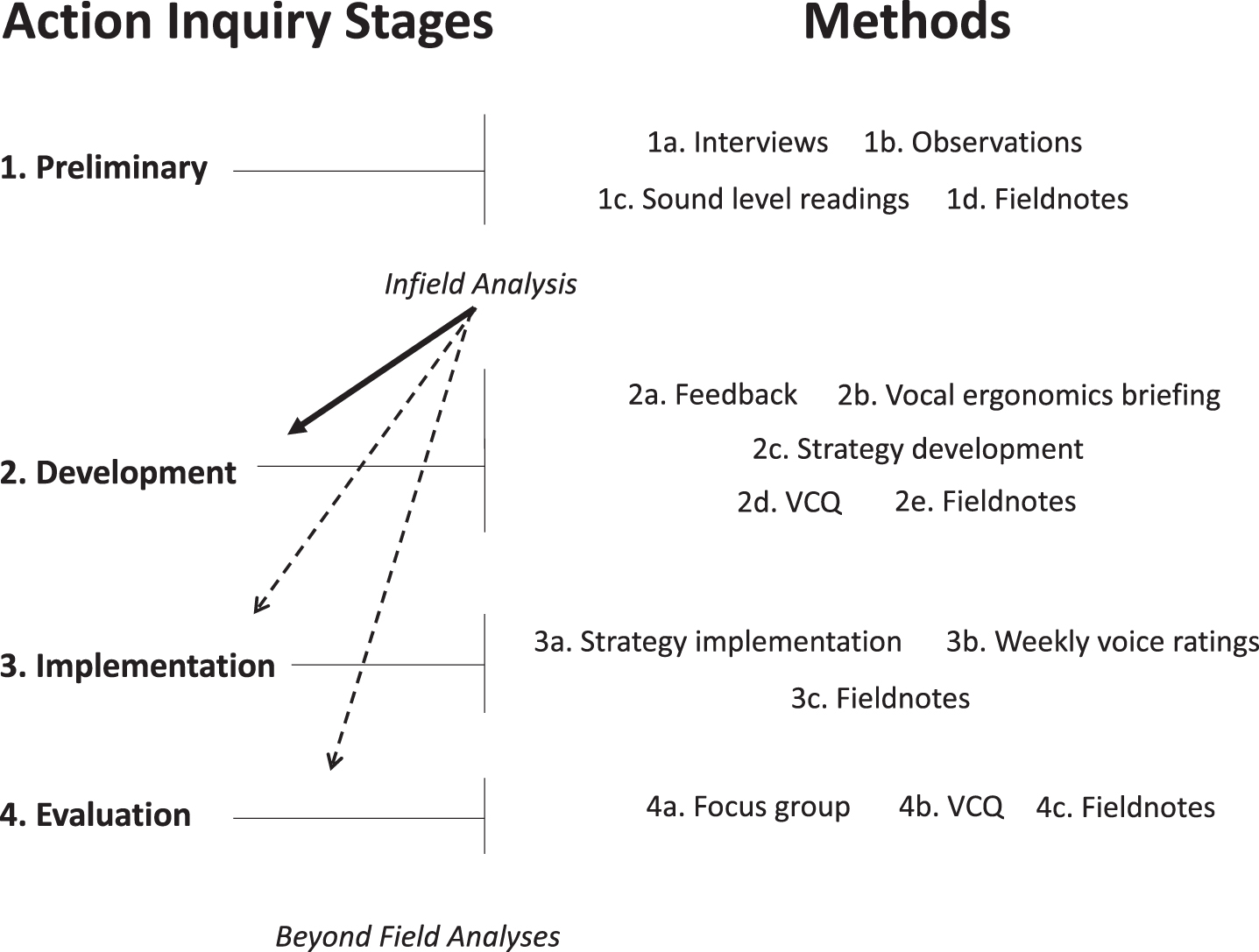
Stages of cooperative action inquiry. Solid, thick line indicates where infield analysis directly facilitated transition from the preliminary stage to development stage. Broken dash lines indicate where infield analysis informed meaning and decision making within and between stages. VCQ = Voice Capabilities Questionnaire [15, 95].
The SME undertook multi-level analyses across this research. In-depth case analysis and cross-case analyses informed claims to knowledge regarding the overarching research focus [31]. Case-level analyses was undertaken via: Infield inquiry - open coding [96], categorical aggregation [97], direct interpretation [97]; Deep case analysis - reflexive thematic analysis [93, 98], descriptive statistics [99]; Preliminary case reports based on case findings [31], which were shared with coaches as part of the member reflection process [100].
Cross-case analytical interpretation engaged Stake’s ‘merging case findings’ protocol [31] and cross-case descriptive statistics [99]. Cross-case analyses supported identification and development of cross-case topics and key factors. Cross-case topics integrate congruent and differing experiences regarding a common concept within and across teams [31]. Pertinent to the current article, identified differences in experiences of strategy implementation reported by coaches within the same team were coded and considered during subsequent development of themes and topics [31].
As forms of contextually anchored research, action inquiry and dialectical multicase study reject the positivist assertions that knowledge generation is neutral, free from influence, and removed from prior theory [31, 101]. Rather, research is influenced by how a researcher conceptualizes knowledge, and allocates privileges about what is known and who does the knowing [31, 101–104].
The current research followed reflexivity and broader research quality recommendations from published literature to interrogate researcher assumptions, decision making, and outcomes of their conduct on the research [85, 105–108]. Reflexivity approaches also aimed to facilitate empowered, reflective, and epistemic participation for all participants [85, 108]. Reflexivity approaches used in the current research included SME reflexive journaling [107], SME participation analysis [16], member reflections [100], and critical friends [88, 101].
Results
Participants collaboratively developed, implemented, and evaluated vocal ergonomic approaches during the action inquiries within each team. Vocal ergonomic approaches are also known as voice support strategies (abbreviated ‘strategies’ hereafter). Strategies aimed to benefit vocally reliant coaching participation by considering coaches’ voice use, vocal health, and broader work-system factors.
A cumulative total of 57 strategies were explored across all nine teams, with teams averaging 6.33 strategies each (SD = 3, range 4–14). During cross-case analyses, highly similar strategies were identified and compared. For example, all approaches to systematic hydration were grouped together and analysed. Twenty-five different strategy types were identified during this collation process (see Supplementary Table 2). The following sections detail participants appraisal of vocal ergonomic approaches. Coaches’ reporting of vocal health across the associated action inquiry span when strategies were implemented is also supplied.
Evaluating vocal ergonomic approaches
At the end of each team’s action inquiry, participants undertook an evaluation focus group to appraise each strategy explored within that team. Evaluation discussions investigated strategies’ usability, coaches’ voice use experiences, and coaches’ vocal health. Strategy appraisal also considered coaches’ experienced facilitators and barriers to voice while trialing strategies.
Overall, coaches in all teams (9/9) reported that participation in action inquiries enhanced their awareness of voice. Coaches also noted that participation provided them with additional considered actions coaches could use to support their voice for coaching. Coaches in 7/9 teams also highlighted that the process provided new insights into the nature of their work-systems regarding voice. Further, coaches in all teams (9/9) reported experiencing enhanced facilitators during vocally reliant coaching that they associated with strategy implementation. However, coaches in all teams (9/9) also reported continued experiences of barriers to their voice use and vocal health associated with their broader work-systems. These barriers were not mitigated by the implementation of strategies.
Based on thematic analysis of evaluation discussions and subsequent analytical inquiry (see Section 2.4: Action Inquiries), each strategy was categorized as supportive, somewhat supportive, or unsupportive. Key context influences experienced by coaches during strategy implementation were also classified as facilitators or ongoing barriers and were linked to vocal ergonomics factors. Supplementary Table 2 maps all collated strategies with vocal ergonomic factors, strategy appraisal, and key context influences. Supplementary Table 3 also provides summary descriptive statistics regarding teams’ use and evaluation of vocal ergonomic approaches.
Supportive strategies
‘Supportive strategies’ were classified as vocal ergonomic approaches where coaches reported predominantly experiencing benefits from strategy implementation. Benefits included the enhanced presence of facilitators for coaches’ voice use and vocal health. Cumulatively, coaches reported finding that 31.58% of strategies were supportive (i.e., 18/57 individual strategies used across teams). When vocal ergonomic approaches were collated into strategy types, 12 strategy types were appraised as supportive by at least one team.
Changing use of training locations was a strategy that coaches reported to be supportive for voice. Two teams used this strategy. One team delayed the start time of their training sessions, and the other team changed their training location entirely. Both methods allowed teams to be sole occupants of training locations. Coaches reported that changing when and where their teams trained avoided challenging acoustic environments. In previous training locations, coaches had experienced reduced speech intelligibility, additional vocal task demands, distracted athletes, and increased reactive use of potentially unsafe voice use patterns. Bronson and Mia discussed the influence of changing training locations, stating: Bronson: In terms of training, the gym that we are in now is pretty good for sound. Good for us talking. Mia: Yeah, the acoustics there are much better than at [redacted prior training location name]. Bronson: So, Mia doesn’t have to raise her voice to be clearly heard in the gym now, (Mia – yeah) and neither do I. It’s pretty good. Feels pretty good on the voice.
(Ravens’ evaluation focus group)
Somewhat supportive strategies
‘Somewhat supportive strategies’ were classified as vocal ergonomic approaches where coaches reported concurrently experiencing benefits (e.g., enhanced facilitators) alongside noticeable ongoing barriers. Cumulatively, coaches reported finding that 61.40% of strategies were somewhat supportive (i.e., 35/57 individual strategies used across teams). When vocal ergonomic approaches were collated into strategy types, 20 of the 25 strategy types were appraised as somewhat supportive by at least one team.
Vocal rest was a strategy that coaches typically reported as being somewhat supportive. Coaches in four teams introduced vocal rest using various protocols. Coaches’ vocal rest methods included light voice use days following games, batching non-speaking tasks after player-based coaching, and delegating vocally reliant tasks to others. Coaches conceptualized vocal rest after demanding voice use as analogous with athletes’ resting after play. Coaches also reported that vocal rest supported their recovery from vocally demanding coaching activities, particularly when experiencing voice symptoms.
However, coaches in 3/4 teams identified ongoing systemic barriers that affected their desired undertaking of vocal rest. Coaches shared that vocal rest was disrupted by their prioritization of team performance outcomes, attending meetings, participating in game competition, media commitments, and beyond coaching responsibilities including family engagement and non-coaching work.
Grant, a head coach, also reported that desired player outcomes typical prompted his vocal rest during team activities, rather than his attempts to support his vocal health. Grant described this, stating:
Not talking in gameplay or huddles, and that – that isn’t to give my voice a rest. I’m trying to, I am trying to think of stuff I do do – if my voice is struggling. More I’ll not use my voice to change basketball, more team strategy, wanting to let them figure something out. Yeah, not because (pause), but if I’m struggling, I just keep screaming and eventually really struggle. But the me not talking isn’t for me – it’s for them (the players)
(Grant, Lions’ evaluation focus group).
Unsupportive strategies
‘Unsupportive strategies’ were classified as vocal ergonomic approaches where coaches reported predominantly experiencing pervasive ongoing barriers that were not mitigated by strategy implementation. Cumulatively, coaches reported finding that 7.02% of strategies were unsupportive (i.e., 4/57 individual strategies used across teams). When vocal ergonomic approaches were collated into strategy types, four of the 25 strategy types were appraised as unsupportive by one team each.
Coaches across teams reported experiencing ongoing barriers to voice despite trialing vocal warmups, task modification when a coach was unwell, voice amplification, and ensuring players’ attention. Coaches recognized a mismatch between strategy processes, tools, and user needs during vocally reliant activities. For example, coaches reported that amplification at training did not prepare athletes for how they would hear coaches’ voices in games. Similarly, coaches avoided using vocally reliant voice warmups as they found them too conspicuous to be undertaken around other people.
Prioritization of player performance needs and undertaking broader coaching responsibilities also persistently interrupted engaging strategies. For example, one head coach reported continuing with demanding voice use for coaching and meetings when unwell despite having planned to delegate vocal tasks to others. Persistent environmental noise was also an ongoing barrier for coaches’ voices that was not adequately addressed by unsupportive strategies. Further, unsupportive strategies sometimes generated additional barriers, such as amplification creating intermittent sound distortion and sound competition when multiple coaches were amplified at the same time.
Vocal health rating
As part of their action inquiry involvement, coaches used the Voice Capabilities Questionnaire (VCQ) to rate their experiences of voice symptoms and problems [15, 95]. Coaches used the VCQ for three reflection spans: overall coaching career prior to action inquiries, current season before strategies, and current season after strategies. Overall, coaches reported reduced experiences of poor vocal health that aligned with the span of strategy implementation.
Coaches’ VCQ reports indicated how frequently they experienced 16 specific voice symptoms that are commonly experienced by coaches and other OVUs such as teachers [15, 95]. Overall, coaches typically experienced voice symptoms most frequently across their coaching careers (i.e., prior to action inquiries). Overall, coaches typically experienced voice symptoms least frequently after strategy implementation. Table 3 details summary descriptive statistics for voice symptom reports across teams.
Voice symptom and problems for three reflection spans
Voice symptom and problems for three reflection spans
Note. SD = Standard deviation. Coaches used the Voice Capabilities Questionnaire (VCQ) to report experiences of 16 voice symptom frequencies, and presence and severity of voice problems [15, 95]. Average reports the overall mean of team-level means (i.e., average of coaches’ ratings from each team) for symptoms or problems. Frequency ratings for each voice symptom used a Likert-type scale of whole numbers 1–5 (1 = never, 5 = always). Possible severity ratings used a Likert-type scale of whole numbers 1–5 (1 = slight, 5 = severe).
VCQ reports also detailed coaches perceived presence and severity of voice problems. In total, 15 coaches reported a voice problem at one or more reflection points (team mean = 1.67, SD = 0.87). These 15 coaches equate to 63% of the coaches who explored strategies during action inquiries. The number of coaches with reported voice problems for each timespan were: across coaching career = 13 coaches (54% of coaches); before strategies = 8 coaches (33% of coaches); and after strategies = 5 coaches (21% of coaches). Possible severity ratings of voice problems ranged from 1 (slight) to 5 (severe). Coaches’ average mean severity ratings for each reflection point were: across coaching career = 2.69 (SD = 0.53); before strategies = 2.00 (SD = 0.84); and after strategies = 1.60 (SD = 0.55). Table 3 also summarizes VCQ findings for voice problems across teams.
Participants in the current research explored the development, implementation, and evaluation of vocal ergonomic approaches (aka strategies) within the contexts of coaches’ work-systems. Coaches’ vocally reliant systems participation was often enhanced by strategy implementation. However, coaches also continued to experience various work-system factors as barriers to their voice use and vocal health. The following sections discuss strategies relative to vocal ergonomic factors. 4 Published literature also elucidates this discussion.
Personal factors and vocal ergonomic approaches
Personal vocal ergonomic factors were coaches’ individual attributes, personal experience, own behaviors, and life circumstances that influenced vocally reliant coaching participation. Published literature asserts that various personal factors affect voice use and vocal health for OVUs. Such personal factors include:
One of the most prominent personal factors for OVUs vocally reliant systems participation appears to be their vocal health [3, 67]. Across published studies, top-level sports report experiencing diminished vocal health at least sometimes while coaching [16–19, 67]. Other OVUs also report poor vocal health associated with their essential voce use for work task undertakings, including call center workers and schoolteachers [10, 109]. Further, across OVU occupational groups, diminished vocal health appears linked to broader work-systems, including task demands and vocal hazards [3, 67].
These findings suggest that personal behaviors and skills are not exclusively responsible for workers’ occupational vocal health [13, 58]. However, recommendations to support OVUs vocal health are often linked to personal health-related behaviors and knowledge [8, 110]. Coaches in the current study identified that their awareness of voice was supported by strategy engagement. Extant literature also reports that vocally reliant workers benefit from vocal awareness, which facilitates safe voice use, help-seeking, and recovery behaviors for some workers [13, 111]. However, coaches in the current study also reported that despite increased awareness of voice, prioritization of athletes’ needs and other systemic factors often usurped coaches own vocal health management behaviors. These findings support the assertion that exclusively relying on coaches’ personal behaviors is insufficient to mitigate the effects of work-systems on coaches’ voices.
Vocally reliant activity factors and vocal ergonomic approaches
Vocally reliant activity factors were characteristics of activities and tasks associated with coaches’ voices. Undertaking vocally reliant activities is also a definitional characteristic of OVUs [20]. Coaches’ voice use and vocal health are linked to the nature of their vocally reliant activities [15–17, 19]. Coaches in the current study explored how vocal ergonomic approaches could optimize voice as a tool for coaching and vocal task demands. Particularly, vocally reliant activity factors were often associated with coaches’ potentially unsafe voice use patterns.
Potentially unsafe voice use patterns can contribute to vocal (over)loading and possible phonotrauma [3]. Potentially unsafe voice use patterns are a recognized hazard for various OVU groups, including teachers [62, 112], fitness instructors [25], and clergy [13]. Potentially unsafe voice use patterns include repeated yelling and prolonged voice use without adequate rest opportunities [3, 61–63]. Excessive vocal loading can also occur in the context of broader systemic factors such as noise, stress, additional muscular loading, and distances between communication partners [3, 61–63].
Strategies considering vocally reliant activity factors supported coaches’ vocal load coping during tasks, attempted to reduce vocal loading contributors, mitigating effects of vocal loads, and support coaches’ recovery. An example of a mitigation strategy for vocal loads used in the current research is vocal warmups. Vocal warmups are typically undertaken as a structured sequence of exercises that are designed to prepare the voice for demanding vocal activity [113–115]. General body warmup such as aerobic exercise may also support voice use by supporting warmup of voice related sub-systems [116, 117].
Vocal warmups likely support voice users to gain vocal ease, decrease vocal effort, improve voice production, attain desire vocal quality, enhance vocal wellbeing, and avoid vocal overload and vocal fatigue [113–115]. Benefits of vocal warmup exercises may also be associated with voice users’ facilitated movement through the warmup phase of vocal loading [115]. However, extant literature also questions the physiological and acoustic effects of vocal warmup exercises for OVUs [114, 115]. Further, coaches in the current study recognized that how vocal warmups requiring them to use their voices was not feasible to undertake within their work context, given potential disruptions to other key coaching tasks. These findings may have implications for the generic recommendation of using vocal warmups that is often provided to OVUs.
Physical environmental factors and vocal ergonomic approaches
Physical environmental vocal ergonomic factors were attributes of physical spaces that influenced vocally reliant coaching participation. Notably, acoustic environments influence OVUs vocally reliant systems participation by influencing speech intelligibility [3, 118]. Challenging room acoustics create barriers to vocally reliant activities and broader systems participation by reducing speech intelligibility, increasing vocal workloads, and diminishing listeners’ ease of receiving spoken information [3, 35]. Acoustic environmental attributes that influence speech intelligibility for OVUs include room acoustics, background noise, reverberation, and activity noise [3, 118].
Coaching environments often have high levels of activity noise and background noise [15–17, 66]. Participants in the current study noted that loud, noisy, and reverberant environments decreased coaches’ speech intelligibility and contributed to coaches’ vocal demands.
Coaches in two teams attempted to use voice amplification as a strategy to overcome demanding acoustic environments at training. Coaches in these teams posited that voice amplification would support them being heard by players and reduce their need to engage in excessively loud voice during training sessions. Amplification is recommended as standard practice for OVUs likely to experience heavy vocal demands, noisy environments, and large (aka long) speaking distances [3, 69].
However, participants in the current study identified various barriers associated with amplification use, such as intermittent sound distortion, general public on adjacent courts hearing coaches’ talk, and additional sound competition. Coaches also reported that amplification at training did not mirror coaches’ voice use at games, which was unamplified. Given training was preparatory for game situations, coaches suggested that this difference was not in service of their players. Rezende and colleagues [109] suggest that amplification is only an appropriate vocal OHS approach if it meets the work needs of OVUs. As such, amplification should not be used alone or as a generic safety strategy for voice use in noise [109]. The current research also suggests that worker consultation is necessary to appraise appropriateness of amplification use.
Team-based factors and vocal ergonomic approaches
Teams are groups of people who work together or undertake aligned activities to achieve shared goals [42, 119]. Work teams are social infrastructure that exist within broader organizational environments [120–122]. Coaches within the current research all belonged to basketball teams. Basketball teams consisted of coaches, athletes, and sometimes auxiliary staff (e.g., team managers, physiotherapists, and strength and conditioning experts). Team-based vocal ergonomic factors were attributes of basketball teams that influenced vocally reliant coaching participation.
Work-team dynamics influence vocally reliant systems participation for OVUs, including workers’ voice use and vocal health [12, 24]. Participants in the current study engaged vocal ergonomic approaches that considered team characteristics [13, 91]. Coaches reported that strategies where role-related task responsibilities were discussed clarified how coaches’ voice use could support others’ needs and desired team outcomes. Coaches also suggested that these strategies enhanced coaches’ experiences of vocal workload due to voice related role content clarity. Role definition also affects schoolteachers’ voice use and vocal health, with role ambiguity associated with teachers increased vocal workloads and poor vocal health [24].
Coaches also reported ongoing barriers during strategy implementation associated with team-based factors. In the current study, coaches often engaged potentially unsafe voice use patterns associated with dynamic player needs, varied player skills, and turbulent team climates. These findings align with broader published reports that coaches’ vocal communication, including voice use patterns, changed reactively in response to athletes’ needs [16, 123–125].
The influence of communication partners’ behaviors is not typically considered within occupational vocal health research [16]. However, The Stakeholder Model recommends considering the experiences of various stakeholders within communication interactions, including those of voice users and listeners [126]. The Stakeholder Model appears to have potential future applications to explore stakeholder experiences of employment-based activity and participation regarding voice. Further, assertions within The Stakeholder Model appear complementary to social dynamics within the sociotechnical systems and ICF approaches [13, 91].
Club-based factors and vocal ergonomic approaches
Workplace organizations are the overarching social infrastructure that facilitate workers’ employment-based activity and participation [120–122]. Basketball clubs were the specific work organizations for coaches in the current study. Club-based vocal ergonomic factors were club-related systemic attributes that influenced vocally reliant coaching participation. Workplace factors influence other OVUs voices, including teachers, performing artists, and faith leaders [3, 65]. Such factors include job design, workplace culture, and organizational expectations [3, 67].
Workplace factors were not typically addressed within vocal ergonomic approaches during the current research, which reflects the higher-order nature of these factors. Future research may overcome this limitation by integrating management and club-board members into action inquiries. Unfortunately, integration of these stakeholder groups was beyond the scope of the current study.
Resource access for player-based coaching activities was one club-based factors considered within strategies in the current research. Specifically, coaches leveraged their already experienced supportive resource access to specifically enhance their vocally reliant coaching participation. Resource access influences work-related health, including experiences of workload [127], and health behaviors such as presenteeism [128]. The vocal ergonomic approach ‘changing training location engagement’ directly utilized access to club resources to optimize vocally reliant coaching participation. The approach changed training locations and altering timing of training to avoid overlap with a public basketball competition. Coaches recognized that this strategy reduced their vocal demands, environmental noise, public presence on adjacent courts, and player distractions. However, given that not all teams have supportive resource access, it is unlikely that all teams would be able to change when and where they held training to avoid demanding acoustic environments.
Sport-related factors and vocal ergonomic approaches
In the current study, each team engaged in sport-related organizational environments as part of their competition participation. Coaches also participated in broader industry level engagement, such as basketball leagues and the national sporting body. Sport-related vocal ergonomic factors were broader attributes of sporting contexts that influenced vocally reliant coaching participation.
Sport-level factors typically continued to function as ongoing barriers despite vocal ergonomic approaches. This again aligns with higher-order factors typically being beyond the control of local system users [129]. However, coaches in the current study did implement approaches that supported recovery from the effects of sport-related factors, such as using vocal rest.
Periods of vocal rest (i.e., light voice use or non-voice use) support recovery from the biomechanical loading effects associated with demanding voice use [7, 62]. Vocal rest within (i.e., brief voice use breaks of 3 or more minutes) [7] and between [7, 62] vocally reliant activities facilities vocal loading recovery. It should be noted that coaches’ implementation of planned vocal rest following games was sometimes mitigated by coaching demands, organizational demands, and life commitments. These findings suggest that while vocal rest benefited coaches, it was not always a realistic strategy for vocal health recovery within their work and broader life demands.
Findings from the current study suggest that sport-related vocal ergonomic factors likely require industry-level support if they are to be meaningfully addressed. Future exploration of a top-down sport (supra)system analysis of vocal ergonomics would highly benefit forward planning of vocal ergonomic approaches.
Limitations and strengths
The current research was a qualitative-dominant mixed methods investigation. The research was undertaken between an SME and 24 coaches from nine Australian top-level basketball teams. The sample size, single sport focus, single country focus, and emphasis on top-level coaches facilitated in-depth findings with high particularization [31, 86]. While in-depth particularization can cultivate rich insights into phenomena [31, 105], generalizability limitations should be considered [105]. Specifically, statistical-probability generalizability and direct applicability to workers in other contexts are likely limited in the current research [105].
However, this research provides opportunities for other forms of generalizability. Dialectical multicase study findings are anchored in case evidence, integrate cross-case analytical interpretation, and generate cross-case assertions [31]. This supports possibilities for resonance with other lived contexts and extant conceptual knowing [105]. Thus, the current research invites opportunities for naturalistic generalizability [31, 105], transferability [100, 130], and analytical generalizability [90, 130].
Participatory ergonomics as an approach can also be criticized given its eclectic nature and situatedness, which limits uniformity and makes comparisons between studies more challenging [48, 129]. Participatory ergonomics is also typically applied to workplace systems, such as in the current research [48, 129]. Many workplaces are complex, open systems [39, 131], consisting of dynamic factors that are not always meaningfully addressed within ‘interventions’ [39, 131]. As found in the current research, top-down work-system factors are challenging to address when vocal ergonomic approaches are user centric [129]. It was unfortunately beyond the scope of the current research to integrate active participation of broader key stakeholders, such as club board members, sponsors, and industry leaders. Broader stakeholder engagement may have allowed top-down factors to be more directly addressed.
The current research could further be criticized regarding the nature of bias and researchers’ impact on research contexts (see Sections 2.3 and 2.4). Specifically, the lead researcher’s active involvement with coaches in shared meaning making and decision-making created opportunities to affect the behaviors and meaning making of others. However, the current research engaged multiple ongoing reflexivity and research quality mechanisms for continuous interrogation of assumptions and influence being made during the research process (see Section 2.5) [85, 105–108]. SMEs active engagement also provides opportunities to enrich collaborative meaning making and decision making within participatory ergonomics [48, 49]. As such, SME active involvement and input is encouraged – but requires ongoing reflexivity and research quality considerations.
The current study also holds strength in its engagement of data richness, innovation, and contextually anchored considerations of vocal health. In-depth analysis of case situations provided rich, novel, and situated findings [31, 132]. Cross-case analytical interpretation supported generation of novel assertions regarding vocal ergonomic approaches and vocal ergonomic factors for coaches [31]. To the current authors knowledge, this dialectical multicase study is the first to engage longitudinal action inquiries for vocal ergonomics. It also appears to be only the second study to consider participatory vocal ergonomics with sports coaches (the first being the pilot to this study) [16]. Further, this work provides a longitudinal example of how collaborative engagement can consider vocal ergonomics approaches within the contexts of coaches’ work-systems.
Conclusions
Sports coaches experience vocal ergonomic factors across their work-systems. Coaches also hold valuable insights as system users and local experts regarding their vocally reliant coaching participation. Cooperative engagement with coaches in the current research provided novel opportunities to integrate coaches’ knowledge into exploration of system optimization. Longitudinal engagement with coaches appeared particularly supportive for codesign, implementation, and appraisal of vocal ergonomic approaches. Future shared engagement with workers to consider work-system optimization appears particularly timely, given the current rapidly evolving nature of vocally reliant work such as health-based mask wearing and increased telepresence.
These findings support the assertion that worker-level approaches should form ‘one’ part of broader vocal OHS management. Relying only on workers to take responsibility for their vocal OHS is inadequate to address factors situated across their work-systems. Coaches’ ongoing optimization of vocal ergonomic factors would benefit from supportive alliance between workers, vocal health experts (e.g., speech pathologists), HFE professions, management, and industry. Further, findings from this study reemphasizes that vocal OHS management should be systemic, flexible, responsive to context needs, and utilize existing best practice for OHS and HFE [21].
Footnotes
Acknowledgments
The authors would like to thank Basketball Australia (BA) for endorsing this research. Appreciation is also given to the International Ergonomics Association (IEA). IEA provided opportunity to present research findings associated with this research at IEA2021 through spoken presentation and an extended abstract entitled Presenteeism and Voice: Ergonomic Factors for Sports Coaches. Care has been taken to ensure that publication consent agreement for the extended abstract is not breeched. Authorship of all works remains the same. Additional thanks are given to the reviewers of this article. Their extremely helpful suggestions and considerations have been greatly appreciated by the authors.
Ethics approval
The study was approved by the La Trobe University Human Research Ethics Committee (FHEC13/223).
Informed consent
Informed consent was gained from all participants prior to their active participation in the current research.
Conflict of interest
The authors declare no conflict of interest.
Funding
Not applicable.
Disclaimer
The content of this article extends on the presentation and extended abstract presented at IEA2021 discussing how coaches’ engagement in presenteeism was associated with their vocally reliant systems participation. The IEA2021 presentation was entitled “Presenteeism and Voice: Ergonomic Factors for Sports Coaches”. Care has been taken to ensure that publication consent agreement for the extended abstract is not breeched in the current article. Authorship of all works remains the same.
Various researchers provided further detailed discussion regarding different systems thinking approaches [13,  ].
].
Extant literature interchangeably uses the terms ‘vocal ergonomics’ [55, 70] and ‘voice ergonomics’ [20, 58]. Sala and Rantala suggest using ‘voice ergonomics’ to indicate that the field is not restricted to singers (aka vocalists) [20]. However, the term ‘voice’ is often used in broader OHS and participatory research to denote opportunities for people’s input, decision making, and broader influence [144, ]. Further, ‘vocal’ is a common adjective modifier to describe human voice. The current authors use the term ‘vocal ergonomics’ given the above considerations.
Within dialectical multicase study, ‘case topics’ identify the key features of each case [31]. Case topics are the main analytical and organisational groupings developed during case analysis [97]. Case topics also support the researcher’s development of case-level assertions (i.e., abstract conceptual claims to knowledge that are anchored in case findings) [31, 97]. Case topics are evidenced by case data, such as quotes and observation notes [, 31,97]. In the current research, case topics integrated identified themes and statistics identified in the previous level of case analysis.
Further details on the conceptual construction of overarching categories, associated topics, and specific vocal ergonomic factors prominent across teams will be presented in a future article by the same authors. However, asserted concepts are informed by case evidence, extant theory, and existing research. As such, it is pertinent to consider these concepts when discussing vocal ergonomic approaches.