




Abstract
BACKGROUND:
The COVID-19 pandemic affected the work environment worldwide and forced companies to adopt work from home (WFH) suddenly.
OBJECTIVE:
This study aims to identify factors that influence productivity in the WFH modality, considering the Brazilian scenario in the COVID-19 context.
METHODS:
The approach used was a Delphi method with 19 specialists in the subject. Three rounds were conducted; in the third round, specialists indicated how the factor influences productivity through a scale. For the data collected in this last round, data was analysed via Grey Relational Analysis technique.
RESULTS:
The results indicated that 17 factors could influence productivity in the WFH modality in the analysed context. Comparatively, the five factors with more capacity to influence productivity are 1) Availability of adequate equipment and peripherals to develop the work activities; 2) leadership support; 3) The adequate place to develop work activities; 4) Internet and electricity supply stability; and 5) Clarity from the collaborator regarding their role in the company, responsibilities and activities to be developed. The frequency analysis indicated that factors affect at least moderately productivity in WFH modality.
CONCLUSIONS:
This article contributes to increasing knowledge associated with the WFH modality in the context of the COVID-19 pandemic. The information present here can be used by academics and managers, even in a post-pandemic scenario, to debate productivity in remote work modalities.
Introduction
The COVID-19 pandemic provided abrupt changes in people’s lives, transforming personal and professional aspects [1–5]. Regarding professional aspects, companies were forced to adjust their organisational practices [6–10]. Many organisations were forced to implement alternative workspaces to satisfy the social distancing requirements [1, 12]. For administrative areas, to maintain their operations and avoid greater dissemination of the virus, companies opted to abruptly adopt the work from home (WFH) modality [6, 13–21]. Few organisations had already developed initiatives related to WFH before the COVID-19 pandemic. These companies had the opportunity to apply the work modality in a planned and strategic form [18]. However, there was no time for planned actions and pilot testing, not even time to reflect [22]. The mentioned context needs to be included in future classes about companies administration to debate with students and future professionals the importance of human factors and ergonomic in the organization of the activities [23].
WFH is a work modality when activities are performed at home, distant from the company’s traditional workplace; the collaborators are located in different geographic locations [24–26]. The evolution of this kind of work modality is due to information technology and telecommunication, which allow people to work remotely [2, 27–33]. Nowadays, communication software such as MSTeams, ZOOM, Google Meet, among others, allow collaborators of a company to have videoconference calls, conversations and organise meetings with high productivity and efficiency [22, 35].
Analysing the evidence-based literature makes it possible to see positive and negative points regarding WFH. Focusing on positive aspects, several authors highlight that using this modality, it is possible to improve workers’ satisfaction and productivity [22, 36–40]. More specifically, it is possible to increase well-being and reduce fatigue associated with commuting, a less stressful work environment, a better balance between work and family life [36, 38], and autonomy [39, 40]. For the companies, it is expected a significant cost reduction and productivity gains. Lastly, the public sectors expect a reduction in the social costs in commuting, environmental pollution and urban congestion [22, 40].
Despite the benefits mentioned, the evidence-based literature also highlights some disadvantages. One of the most significant challenges is delimiting the boundaries between professional and personal life [4, 21]; in other words, coping with family commitments and work has become one of the most critical challenges for remote workers [36]. Work invades life domains because the worker has access to technology all the time [21, 41]; at the same time, family members demand more time, attention and care, since they are at home the whole day [15]. It is essential to highlight that some workers spend more time performing activities at home than office time [42], evidencing productivity loss. In addition, social isolation, consequent psychological challenges, lack of management and technical support, and other possible aspects need to be considered [28].
According to some authors, the adequacy of workspace to develop the activities also needs to be considered when productivity is analysed [43, 44]. The comfort of the environment, temperature and air renewal, the illumination conditions, noise levels control, the ergonomic conditions of the furniture, and technological infrastructure are essential elements to consider [43, 46]. Of course, these aspects influence administrative and human relations and have consequences in psychological conditions [43]. Toniolo-Barrios and Pitt [4], mentioned that during the first months of the COVID-19 pandemic, workers were forced to improvise their furniture in office desks rapidly where a living room, bedroom, and kitchen became shared places (few people had dedicated offices in their houses). In addition, family members needed to share IT equipment and accessories [6] and the cost of the internet and energy supply increased when compared before the pandemic [6, 47].
In summary, while the WFH can provide some advantages, especially in the COVID-19 pandemic there were a series of challenges that people had to face associated with managing work and children care, household chores and general family demands, among other activities [4, 6]. All aspects influence the collaborator’s productivity [6, 20] and need to be better analysed, evidencing a research gap.
Before the enforced adoption of WFH in the COVID-19 pandemic, some author such as Choudhury et al. [48] already debated how remote work influence productivity. However, the evidence-based literature before the pandemic regarding WFH generally focused on more planned company projects, with elements and variables more controlled; in this sense, productivity could be analysed in a more pragmatic form. Productivity in WFH in the COVID-19 pandemic context is more complex and volatile and it needs to consider that most companies did not have time to plan the transition to this modality. In this scenario, it is essential to identify the factors that influence productivity in a specific moment not planned as the COVID-19 pandemic, evidencing a research gap to be explored. Considering this context and aiming to contribute to the knowledge base, this study’s main purpose is to identify factors that influence productivity in WFH, considering the Brazilian scenario in pandemic context. A Delphi approach with specialists familiarised with the subject was used.
In addition to this expanded introduction that presented the theoretical background about WFH advantages and disadvantages, this article presents additional three sections. Section two is dedicated to presents methodological procedures, allowing readers to understand all aspects carried out to reach results. Section three presents the results, associated debates and limitations of the study. Section four presents the conclusion and final considerations.
Methodological procedures
Cooper and Schindler [49] mentioned that it is essential to develop well-defined stages to reach reliable results in a study. In this sense, five stages were defined to carry out this research, as presented in Fig. 1.
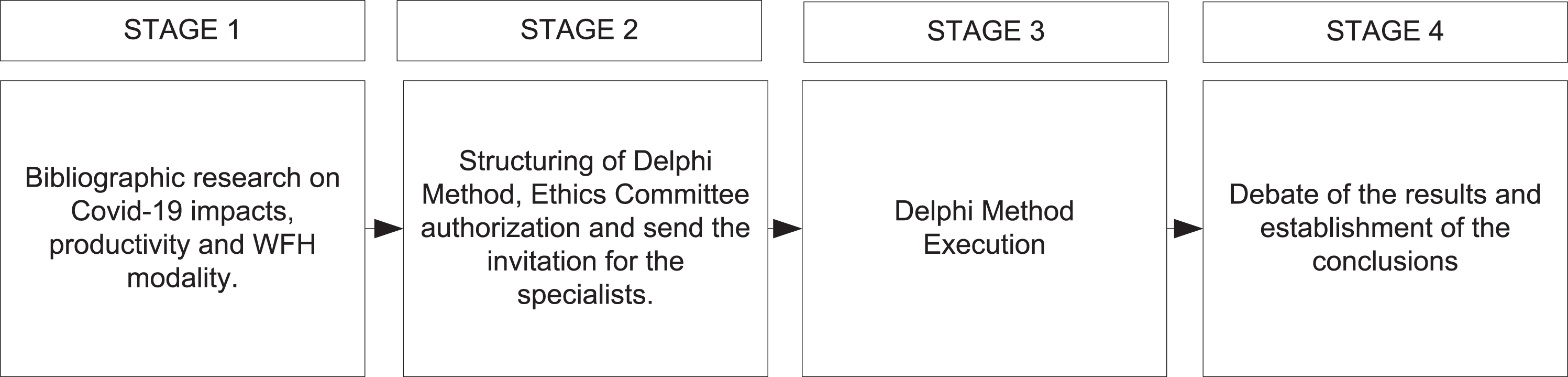
Stages of the research.
A bibliographic research characterised the first stage to understand better the COVID-19 impacts on companies, WFH modality aspects and productivity influences. For this purpose, articles were searched on scientific basis using the following terms and their combinations: “productivity”, “telework", “work from home”; “remote work” and “COVID-19". Synonyms also were used. The following international scientific database was consulted “Emerald Insight”; “Science Direct”, “Scopus”, “Web of Science”, “Springer” and “Taylor and Francis”. It is essential to mention that with this search, it was possible to note that productivity in the WFH modality in the context of COVID-19 is a research gap to be explored.
In the initial second stage, Delphi method procedures were defined. Delphi is a method to generate ideas or contributions regarding a specific theme through a collective communication process [50, 51]. The process is composed of rounds. Generally, in the first round, specialists present their opinion about a theme; after this round, a moderator synthesize the main ideas and present a panel to all participants anonymously; based on information presented in this panel, participants can maintain, complete or change their opinion; the rounds continue up to a consensus or no more change is required by the participants [50–55]. Specifically, in this research, we conducted rounds up to no more changes were required by participants in their opinion. With a list of factors that can affect productivity, and using the scale presented in Table 1, participants finally indicated how each factor affects productivity in the WFH modality. It is essential to mention that two scores in each level were planned to allow a fine adjustment in the participants’ responses if they desire.
The scale used by specialists to indicate the influence of each factor on productivity
All procedures planned and described above was approved by an Ethics Committee, as recommended by Brazilian Law for research with people involvement. As will be better described in section four, 25 specialists manifested their opinion; however, only 19 specialists continued up the last round. The literature argues that some participants dropouts are common during Delphi method rounds [50, 56]. To facilitate data management, the Google Forms platform was used to collect and store the data. The 19 specialists’ group was composed of 14 managers or senior directors and 5 PhD academics who have experience in remote management during the pandemic or study on the theme.
For data analysis, three techniques were used. For the rounds in the Delphi process in which specialists debated the factor influencing the productivity in WFH modality, the technique used was content analysis according to Elo and Kyngäs [57] guidelines. According to these authors, it is necessary to select the unity of analysis in the preparation phase and verify if the data make sense. Elo and Kyngäs [57] explain that a unit of analysis can be a word or a phrase. In our study, the unity of analysis is the factors that influence the productivity in WFH. In the second phase, researchers need to choose an approach (inductive or deductive) [57] and we opted to conduct our analysis considering the inductive approach. In this kind of approach, researchers begin to analyse information without pre-defined categories; the categories are consequences of the analysis and appear with the evolution of analysis. The inductive approach included the following steps: open coding, coding sheets, grouping, categorisation and abstraction. With this information, a model of conceptual map can be defined, if this was the purpose of the researchers [57].
For the last round of Delphi, data was collected via a scale, and then, we have quantitative data. We decided to analyse this kind of data via frequency analysis and Grey Relational Analysis (GRA), according to Kuo et al. [58]. This technique allows to order variables comparatively; in our case, it will be possible to order comparatively factors that affect productivity in the WFH modality.
According to Kuo et al. [58], the first step to calculate Grey Relational Analysis is to structure a matrix with data considering scores given by the specialists, in our case, scores to each factor that affect productivity in WFH modality. In the sequence, it is necessary to normalize the scores on a scale from 0 to 1. For this, we decide to use Equation 1 [58] (note: we do not have criteria; we have respondents; then normalize criteria is both possible and results need to be considered according to it)
The next step consists of calculating the difference of each element of the matrix normalised to the reference sequence, using Equation 2. Following the recommendation of [58], we chose as reference sequence the X0j=1
With value of Δ
ij
calculated, it is possible to calculate Grey Relational Coefficient (ɛ) via Equation 3. In this study, we decided to use as distinctive coefficient (ρ) the value 0,5. The values of Δmax and Δmin are calculated considering all values of Δ
ij
, calculated via Equation 2.
Finally, the Grey Relational Grade (R) is calculated using equation 4. In this study, we adopted the same weights for all respondents; then, the value corresponds to the average values obtained from the Grey Relational Coefficient (ɛ).
With values of R, the factors that affect productivity were ranked and outcomes analysed.
In this section, it is analysed the main results obtained and they are debated considering the statements presented in the literature. After two rounds, the Delphi method made it possible to obtain 17 factors that affect productivity in the WFH modality, in the participants’ opinion. (See these 17 factors in Table 2).
The factor that impacts productivity in WFH modality
The factor that impacts productivity in WFH modality
As mentioned in the methodological procedures section, in round three, participants evaluated the factors considering the scale presented in Table 1. An interesting information to be cited is that for all factors analysed, at least 58% of the respondents measured scores equal or greater than 5, indicating that the factor in question affects at least moderately productivity in WFH modality. Scores measured by respondents were normalized, using equation 1, and are presented in Table 3.
Score attributed by the respondents normalised to each identified factor
In the sequence, the differences for each value of Table 3 from the reference sequence were calculated and the results are presented in Table 4.
Differences for each value of Table 3 from the reference sequence
Using Equation 3 and values of Table 4, Grey Relational Coefficients (ɛ) and Grey Relational Grade (R) were calculated, as shown in Table 5.
Grey Relational Coefficients (ɛ) and Grey Relational Grade (R)
The Grey Relational Grade values (R) were used to comparatively order the factors that affect productivity, as presented in Table 6.
Ranking of the factors that impact productivity in WFH modality
Comparatively, the factor with more significant impact on the productivity of WFH modality was the availability of adequate equipment and peripherals to develop the work activities (F5). With the abrupt change to the WFH modality, not all workers had time and resources to set of equipment at home; once the technology becomes the only communication channel among teams, the availability of adequate equipment and peripherals to develop work activities passed to influence the productivity strongly. In addition, it is essential to remember that with all family members at home, IT equipment (laptops, tablets, printers), internet connection, desks to work and study needed to be shared, as highlighted by [6].
In the sequence, we have leadership support (F17). Leadership behaviour-oriented and committed relationships and team development are critical factors in overcoming the virtual environment’s challenges in troubled times. The WFH modality reduced the frequency of interactions among workers and their managers [36, 59] and, as a consequence, it may impact job satisfaction and productivity. Based on these concerns, organisational support is fundamental to remote workers’ satisfaction and wellbeing as pointed out [28]. Especially in WFH in COVID-19 pandemic, isolation and stress affected workers; the managers’ support was essential; they needed to show leadership behaviour and trust in the worker’s autonomy [27] simultaneously. Hinojosa et al. [60] also highlight the role of the pandemic in changing the relationships between leaders and workers.
The adequate place to develop work activities (F4) is the third factor that comparatively affects productivity in the WFH modality. This item included aspects associated with environment comfort such as space, temperature, air renewal, illumination level, noise level, furniture ergonomically designed, etc. There is a strong relationship between the workplace and workers’ health and efficacy [61]. An inadequate workplace negatively influences efficacy, while a well-organised workplace can be a vital resource for increasing productivity [62]. Sometimes, the space inside the house is limited, the desk and chair may not have the necessary adjustments to provide an ergonomically adequate work environment, especially in the long term. These aspects cause several symptoms related to health and may lead to problems in productivity.
To Sarsak [61], this poses the challenge of setting up a home workspace to be as ergonomically correct and safe as possible. To Grant et al. [41], having a peaceful private space to work without interruptions is seen as a great advantage. WFH usually affects concentration due to environmental distractions, such as doorbells, noisy pets and disruptive children [4].
As well as the availability of adequate equipment and peripherals, Internet and electricity supply stability (F6) also impact productivity and comparatively was ranked in the fourth position. The use of IT technology tools was widely intensified during the pandemic due to remote work; new challenges emerged, such as slow internet connection, electrical power failures, cyber-attacks and problems with the private virtual network [6, 47]. Generally, a slow internet connection is responsible for virtual meetings interruptions and compromises productivity [18].
The fifth position was evidenced by the factor “Clarity from the collaborator regarding their role in the company, responsibilities and activities to be developed (F10). The greater this clarity, the more autonomous the collaborator will be, and therefore, the greater the probability of being more productive [63]. In a virtual work environment, the workers have many tasks, including professional and personal shores, then [27] a clarity in professional activities will enable better performance and desired results [45].
Some limitations can be attributed to this study. The first is that, despite the participants’ great experience, the respondents’ answers reflected the moment of the COVID-19 pandemic in which the study was conducted. The pandemic has been characterized as a new situation for everyone and new studies emerge every month; further research may complement the information presented here. The second limitation is that the participants did not focus on a particular professional or business activity. If they did, some factors could stand out over others.
As mentioned before, the productivity analysis in the COVID-19 pandemic context is more difficult because companies did not have time to plan the transition to the remote work modality and variables and elements were less controlled compared with similar projects developed by other companies before the COVID-19 pandemic. This study investigated the main factors affecting WFH modality productivity during the COVID-19 pandemic, considering the Brazilian scenario. The findings presented here are essential to understand the mentioned period and be used in future research.
The methodology approach used the Delphi method; in the first and second rounds, factors were debated and in the third round, specialists assessed the mentioned factors using scale. Through an analysis of frequencies of scores, it was possible to note that all aspects in a general way affect at least moderately the productivity in the WFH modality. When analysed comparatively, through GRA analysis, five factors stand out: 1) Availability of adequate equipment and peripherals to develop the work activities; 2) Leadership support; 3) The adequate place to develop work activities; 4) Internet and electricity supply stability; 5) Clarity from the collaborator regarding their role in the company, responsibilities and activities to be developed. For the theory, this paper presents consolidated information that can be used in future studies. For the practice, managers can use the information to reflect on the aspect of productivity of their teams.
As propositions for future studies, we recommend that factors highlighted here to be studied by other researchers individually to understand their consequences on productivity better. We also encourage studies in specific sectors or certain professional activities.
Footnotes
Acknowledgments
This work was supported by the Conselho Nacional de Desenvolvimento Científico e Tecnológico (CNPq) under Grant 304145/2021-1.
Conflict of interest
None to report.