




Abstract
BACKGROUND:
A variety of scholars deal with change agents’ role within change processes and highlight their relevance as role models in an organisation, but there are shortcomings. First, research on the impact of change processes has traditionally focused on the impact on employees’ (change recipients’) wellbeing but only limited attention has been paid to the impact on change agents’ own well-being, resilience, and health. Second, studies that reflect on female CAs’ well-being are missed.
OBJECTIVE:
This study aims to enhance our knowledge on the role of women as change agents in analysing their perceived self-efficacy during change and their job satisfaction as job-related dimension of wellbeing.
METHODS:
We applied a mixed-method design, conducting two studies based on data from 71 specialists – change agents – working in the transport or mobility departments of seven local authorities participating in the H2020 CIVITAS SUITS project, from six different countries, Greece, Spain, Italy, Romania, United Kingdom, and Lithuania.
RESULTS:
The first quantitative survey shows that female change agents may have to perceive higher levels of self-efficacy during organisational change to perceive similar levels of job satisfaction as men. The second qualitative study (focus groups) provides more in-depth explanations of these results. This allows us to derive managerial implications to prevent decreases in women’s well-being and strengthen their resilience and health during change.
CONCLUSION:
This mixed-method study highlights the role of women as change agents, driving organisational change within male-dominated transport departments of local authorities. Our results show that female change agents need extra support in managing change processes within male-dominated contexts as the transport and mobility field to avoid a decrease in their perceived job satisfaction, their well-being and herewith, their physical and mental health.
Keywords
Introduction
Change agents (CAs) are without any doubt key for the implementation of organisational changes [1, 2]. Therefore, a variety of scholars deal with CAs’ role within change processes and highlight their relevance as role models in an organisation [1, 8]. However, two shortcomings within the field stand out. First, research on the impact of change processes has traditionally focused on the impact on employees’ (change recipients’) wellbeing [5] but only limited attention has been paid to the impact on CAs’ own well-being, resilience and health when driving the organisational change (for an exception see [2]). Second, studies that reflect on female CAs’ well-being are missed. This is surprising as the number of women in leading management positions is steadily growing [6] and statements such as from the United Nations Secretary-General are very prominent, who singled out women’s leadership for their unique ability as “drivers of solutions [3]” when they are empowered.
Therefore, this study aims to enhance our knowledge on the role of women as CAs in analysing their perceived self-efficacy during change and their job satisfaction as job-related dimension of wellbeing [4], by applying a mixed-method design within the transport and mobility sector1\footnote []1Just to mention, data provided by the Statistics National institute [INE] Spain based on the national economic activity code [CNAE] shows for example that 5,2% of people are employed in the transport sector and that 19,35% of these are female. This gender gap as remained similar over the past 10 years, and was in fact widening in 2019 with 829.200 male employees in the sector against and 198.900 female employees., a very male-dominated context.
The role of the CA may be described as ‘an individual or group, who carries out the task of instigating and managing change in an organization’ [2, 8]. One of the key factors that has been proven as a positive predictor for performance, i.e., successful organisational change, is self-efficacy [9, 12] the “individual’s belief in his or her own ability to organize and implement action to produce the desired achievements and results [7]”. In our study, we focus on CAs who were internal appointees and whose job it was to help the transport departments of local authorities (LAs) to meet the challenges of delivering transport services that are fit for purpose (i.e., sustainable, inclusive, accessible, efficient, effective and affordable) [10]. The study took place as part of the four year, H2020 CIVITAS SUITS (Supporting Urban Integrated Transport Systems project), the goal of which was to increase the ability of European, small to medium LAs, to implement sustainable transport measures. The project addressed the comprehensive organisational changes needed within the transport departments to enable them to work with new processes, partners, regulations, modes of transport and innovative technologies (see www.suits-project.eu). Data were gathered during intensive cooperation with the LAs of six European cities (Turin and Rome in Italy, Transport for West Midlands (UK), Valencia (Spain), Kalamaria (Greece) and Alba Iulia in Romania) and their wider stakeholders.
With this study, we aim to contribute to the existing knowledge by analysing the role of female CAs within a male-dominated context, focussing on perceived self-efficacy and job satisfaction as job related dimension of wellbeing, during change. Based on our findings, we are able to derive clear managerial implications to prevent decreases in women’s well-being and strengthen their resilience and health during change.
Theoretical background
Self-efficacy is one of the key variables of Bandura’s Social Cognitive Theory and defined as “an individual’s belief in his or her own ability to organize and implement action to produce the desired achievements and results” [7, 13, 19]. Former studies have provided strong evidence that self-efficacy is a positive predictor of performance outcomes [9, 12, 67]. Self-efficacy theory (SET) emphasizes the relevance of an individual and the individual’s perceptions of his/her personal capabilities as key determinants of successful outcomes. i.e., successfully implemented organisational change [13]. Accordingly, two key factors of behaviour are of interest: perceived self-efficacy and outcome expectancies, such as job satisfaction. Therefore, SET explicitly focuses on how individuals and communities can be empowered with a sense of agency that will facilitate goal attainment. This is decisive as SET does not assume that individuals who are currently successful are inherently better than those who are not. Instead, SET suggests that individuals who are struggling in achieving their performance targets may not have been provided with opportunities to obtain the mastery necessary to develop self-efficacy. Thus, following the idea of SET, we belief that it is the responsibility of the organisation/top management to provide everyone, regardless of their gender, with sufficient opportunities to engage in mastery experiences, receive positive social persuasion, and witness positively reinforcing models that will engender a strong sense of self-efficacy. As such, employees who doubt their ability to respond to the demands of organizational change are likely to focus on their feelings of incompetence, which will be accompanied by feelings of psychological distress, and a failure to deal with the situation [8, 19, 20, 21, 67]. In contrast, employees who have high levels of self-efficacy are unlikely to be distressed by feelings of inadequacy and, for this reason, are expected to persist in their efforts to manage the organizational change process [21]. As already mentioned, job satisfaction, is one of the key variables to measure outcome expectancies in line with SET. Job satisfaction is defined as the degree to which an individual has positive and negative feelings about a job, other employees and the work environment [22]. In the present study, we explore the job satisfaction of CAs during change.
Hypotheses
Self-efficacy and job satisfaction during organisational change
In line with the idea of SET, research has shown that self-efficacy is consistently and positively associated with job satisfaction [27, 28]. According to Nielson and colleagues [2], we argue that CAs may perceive an increase in job satisfaction due to three reasons. Firstly, they are likely to benefit from additional information about what the change involves and thus better understand how they may use the change and their specific role to improve their job and that of their colleagues [23]. Secondly, taking on a particular role in supporting the implementation of organisational change may make CAs feel part of an ‘in-group’ who fulfil an important role in the organisation, in our work CAs became knowledgeable about new sustainable transport measures and how to modernize their LA by engaging in training with other CAs [24]. Thirdly, being trained in change management, running workshops and networking with other LAs will develop CAs’ work related, transferable skills and enrich their jobs, which can increase job satisfaction. In SUITS, we designed regular workshops for all CAs to share and celebrate their successes and provide support in overcoming obstacles [18].
While we do not question this positive link between perceived self-efficacy and job satisfaction, in the context of organisational change (i.e., new work practices or technologies), levels of job satisfaction may erode and directly damage the physical and mental health of employees [25, 26, 67]. The reasons behind this decrease in job satisfaction may include the increased workload required of CAs, as organisations struggle to meet tight deadlines and targets [26], new expectations towards their work or/and changing relationships with their co-workers whilst in the process of change. However, we argue that CAs perceiving self-efficacy may deal more effectively with difficulties, persisting in the face of failures [29] and are more likely to be satisfied with their jobs. They may have more confidence to solve conflicts with colleagues whose roles, responsibilities and tasks are changing; to overcome frustrations when changes are not perceived as beneficial; to remain calm, and in a good mood, and to stay motivated during the organisational change process, thereby deriving job satisfaction from their work [29]. In other words, individuals who are confident in their abilities and competence to perform a job will experience job satisfaction. Thus, we assume in line with recent research that perceived self-efficacy is positively related to job satisfaction for CAs during change.
Hypotheses 1. Perceived self-efficacy is positively related to job satisfaction for CAs.
The role of gender
Although there is a cultural shift away from traditional gender-role stereotypes [30, 31], some beliefs about females’ ability to perform certain tasks (especially those related to STEM subjects (Science, Technology, Engineering and Mathematics) at the heart of a lot of transport planning jobs) are resistant to change [32]. Perceived self-efficacy is subject to socialization processes: expectations (or parents, teachers, work colleagues) with respect to women’s and men’s skills and behaviours influence self-efficacy [36]. In male-dominated working contexts, such as transport, women, in our study - female CAs - are likely to perceive lower status, fewer opportunities, and lower job satisfaction [33, 35, 68]. Research shows the negative effects on women’s self-evaluations (and evaluations by others) when women engage in tasks and behaviours typically associated with men and work in male-dominated contexts [33]. Additionally, women form a minority group of employees in transport. This effects their behaviour as well [34, 68]. Female CAs may have to work harder to convince colleagues and senior management of their ideas. They could become further undermined and isolated if their efforts require colleagues to take on extra work and training [39]. Buy in and trust from across the department and senior management are key [40] but it is also easier to scapegoat a member of a minority group if things do not go to plan or cause dissatisfaction.
Furthermore, we focus in this study on CAs managing organisational change, which means CAs have to cope with an extraordinary situation of an organisation that is characterized by specific uncertainty and perceived vulnerability. Research has shown that women are more risk averse [37, 38] and that the more they avoid taking risks the greater the risk is perceived [37]. This has many implications for CAs, as they are risking their career’s, reputation and the respect of their colleagues in leading a change process. In addition, LA transport departments are usually equipped with very high financial budgets regarding their future mobility planning [15] which may increase the perceived risk of a failure. Finally, consequences of mismanagement or failures affect not just the LA itself but also citizens for many years [41, 42]. Thus, the risk of managing such changes in this field may be perceived even higher than in other organisations and sectors. Research suggests that women may lack confidence in their ability to successfully complete such non-traditional tasks [32]. This is supported by research that shows that negative beliefs about one’s abilities may result in reduced willingness to take risks, reduced desire to be visible, and negative self-presentation, which reduces job satisfaction [29]. More recent empirical evidence suggest also that women report lower workplace confidence for male-dominated contexts such as the transport sector due to a perceived misalignment between their qualities and those of the workplace [43, 68]. This lack of confidence may have far reaching consequences because women who fear that they lack the ability to perform their role as CA may avoid those change related tasks such as fostering direct dialogue or conflict [6] or turn down prestigious assignments (to the detriment of their career), which will in turn lower their level of job satisfaction.
Putting together the arguments above, it seems likely that female CAs in the transport sector will believe less in their capabilities to master the demands imposed on them during organizational change when compared to male CAs. Consequently, we propose
Hypotheses 2. The relationship between perceived self-efficacy and job satisfaction is moderated by gender.
Method and analysis
Sample and procedures
In recent years, the need to improve and modernise transport services has become a key topic for LAs [15]. Societies’ requirements towards a sustainable and liveable future have become a decisive challenge for future mobility planning [15] with many citizens increasingly supporting sustainable options, with resource efficient modes of travelling, wider accessibility, and inclusivity. New mobility paradigms [16], new market entrants (such as uber) and technology (such as e-vehicles, autonomous vehicles, and collection of real time mobility data) requires LAs to modernise their ways of working. For example, the need to use and share big data, or to understand the impact of new mobility providers, requires new organizational structures and processes to be introduced into the LAs [40]; more diversity in decision making bodies requires working with new partners and citizens; understanding transport as an integral part of a smart city requires interdepartmental working and knowledge sharing. This threatens public sector employees in a number of substantive ways. New roles and responsibilities may make former routines obsolete and require increased flexibility and motivation [17], trigger stress and dissatisfaction in this case in mobility and transport departments [13, 16] in which employees may be set in their ways of working and have a lack of understanding of technology and new concepts. CAs are needed to help such departments transform into ones which can be more resilient and forward thinking.
Data for this study were gathered during the H2020 CIVITAS SUITS project from 71 participants, who worked as CAs for 4 years in the transport or mobility departments of the seven LAs participating in the SUITS Project. The CAs were identified by the head of the LAs department of transport or mobility together with the research team since CAs have to be equipped with particular skills, such as a clear understanding of the change relevance and the whole change processes within their roles [8]. They require ‘softer management skills’ such as strong interpersonal skills, including the ability to build and maintain relationships, communicate effectively, demonstrate empathy, and provide constructive criticism, support, and respect their colleagues, get access to senior management, and know how to support the movement of the organisation – in this case towards more sustainable thinking and use of technology [44]. The CAs in SUITS were in particular responsible to implement innovative, sustainable transport measures within the LAs; such as innovative transport schemes, innovative procurement, urban freight measures, safety and security measures. In all, 50 of participants were male and 21 were female and the average age was 38.9 years [standard deviation [SD] = 11.406].
The complexity of behavioural change in LAs requires an intense, immersive, and long engagement with them, enabling the team to build up trust and buy in and a true understanding of context and culture of the LAs. Thus, our approach used a two-fold engagement strategy. First, an online forum, which was developed for knowledge exchange between the LAs, regular use of social media and teleconferencing ensured all LAs were engaged and developed trust in each other as they embark on their change processes. Secondly, a series of five workshops [18] within LAs, with partners and between partners occurred across the lifetime of the project (2016–2021) to support change implementation. Previous experience has shown that face to face meetings are essential for capacity building exercises, knowledge transfer and development of trust between the partners. The first “Kick-off Workshop” included CAs and LA representatives from all cities to get to known each other and to build trust and mutual understanding. The second workshop “Developing a Change Champion” included mainly local CAs, identified as local champions of change with a remit of: building and retaining trust as a means of reducing resistance to change and ensuring a successful implementation of behavioural change. The workshop focused on how to promote safe learning cultures to enhance ideation, and the role of emotions in managing change and supporting how sense is made of experiences. The third workshop “Local Transport Programmes”, held in each city, included the local CAs, other staff and user groups involved in the new transport measures. The main goal of this workshop was to establish local action learning sets and cross-LA communities of practice learning sets. Workshop 3 brought together members and users from these different learning sets to meet face to face to facilitate the exchange of ideas and of support. These participants had an important role in sustain change by offering fresh new insights from other contexts to enable challenges faced by one LA to be overcome more effectively. Workshop 4 “Review, Refresh, and Reset” involved those from the second workshop reviewing their plans and the progress. It was a workshop designed to provide space in the change process to include reflection and review of progress, of mistakes and learning, and to focus on where to refresh and to reset different activities and parts of the transport measure plans that are not working as intended. The last workshop, another Swap Shop, focused on modelling a cycle of learning with emphasis on learning from others’ insights and adopting what worked, through insight not only into what to do but into why this bit is important in the transfer.
Additionally, we conducted a survey and seven focus groups in 2018, 2019, and 2020 to explore the role of gender in self-efficacy and job satisfaction and to understand the challenges faced by the CAs. To answer our research aim, we firstly conducted the survey to analyse whether gender tendencies towards differences between the perception of self-efficacy and job satisfaction exist. Secondly, we run seven focus groups to create in-depth knowledge regarding the reasons for the potential differences related to self-efficacy between female and male CAs. Prior to the online survey and the focus groups, participants received an information sheet and a consent form explaining the purpose of the research, the voluntary nature of their participation, and how their data would be anonymized.
In the first part of this study, participants were asked to respond to the online questionnaire distributed with the support of the transport departments in the LAs. In a first step, mailings were sent to all CAs asking them to participate in our study. Each mailing included a short summary of the proposed research and a link to the appropriate questionnaire. Two reminders were sent after one and three weeks. To rule out non-response bias, we compared early [the first 25% ] and late [the last 25% ] responders on a number of demographic variables, such as age and work experience. A multivariate analysis of variance identified no significant differences [Wilks’ Λ = .10, F = .10, p = .98], indicating that non-response bias should not be a serious concern for our study [33]. To minimize the threat of common method variance, we implemented several procedural remedies. We included reverse-coded items, assured our respondents of their anonymity, and provided them with detailed instructions on how to fill out the survey [45].
In the second part of the study, all participants were asked to join one focus group. The CAs were allocated into groups of male and female participants based on their common characteristics relative to the issue being discussed around self-efficacy, gender, and job satisfaction. The aim of these focus groups was to identify the reasons for the different levels of perception that had been identified in the survey and to create more in-depth knowledge to be able to derive managerial implications. The participants spent 1 1/2 to 2 hours discussing how self-efficacy may trigger perceived job satisfaction during change with a focus on gender aspects. The focus groups were led by a moderator who used the internal dynamics of the group to understand why people feel the way they did about gender issues and their perceptions towards self-efficacy and job satisfaction during their work driving the organisational change. As a kick-off the participants were asked (a) how they felt while managing change, (b) which obstacles they had faced and (c) which positive experiences they made.
The data from the survey was analyzed with SPSS, the focus groups were transcribed and analyzed using Template Analysis, which allows for identification and comparison of different phenomena [46]. This has been shown to be of value in studying stigmatized groups [47]. In line with our aim to analyse the role of women as CAs in a male-dominated context, the analysis focused on indications of stereotypical perceptions regarding self-efficacy and job satisfaction. Focus group coding was undertaken by one of the authors, with four of the transcripts double-coded by the other co-authors to ensure consistency. Areas of disagreement were discussed, with differences resolved to produce final themes, and first- and second-order codes. Final themes have been for example: perceived job satisfaction, sources of self-efficacy, self-evaluation of coping with tasks, perception of colleagues’ evaluation.
Measures
Self-efficacy was assessed according to Fugate’s scale [48, 49] on change related self-efficacy based on the conceptual understanding of self-efficacy by key scholars in the field [19]. The scale comprises five items such as “Whatever is changing around here, I am sure I can handle it” or “I get nervous that I may not be able to do all that is demanded of me by this change”. The scale that has been adopted several times [50, 51]. Cronbach’s alpha was .78.
Job satisfaction was assessed by a two-item scale that includes “overall, I am satisfied with my job” [62] and “I am satisfied with the way that I conduct my job” [52]. Although the first item has been acknowledged as single item for measuring job satisfaction [62, 63], we added a second item to our measurement model that mirrors the change situation of the participants. This item was important to understand whether the CAs are satisfied with the way they are able to fulfil their specific job in managing the change. Cronbach’s alpha was .82.
Gender was asked by answering the question whether the participant is ‘male’ or ‘female’, similar to other scholars in work research [53]. One extra field was left open to allow the participants to provide “no answer” when they did not feel adequately addressed.
Control variables. Participants were asked to complete the following demographic questions. On the individual level, we controlled for employees’ team tenure, department tenure and organisation tenure and age. Tenure and age were reported in years and included in our analyses as these variables have been found to correlate with job satisfaction [54, 55]. We also included two variables – employee’s department and role- to ensure that only CAs from the transport or mobility departments were included in the study. Finally, we controlled for participants’ hierarchical job level to understand whether this may have an influence on how women perceive themselves regarding their performance during organizational change [56]. The hierarchical job level was measured as 1 = top management, 2 = senior management, 3 = middle management, 4 = junior management, 5 = non-management.
Results
T-tests comparisons of change self-efficacy and job satisfaction scores by gender
T-tests comparisons of change self-efficacy and job satisfaction scores by gender
Regression for self-efficacy predicting job satisfaction
D.V = Job satisfaction; R2 = 0.278.
In the following, we present results from the survey before those from the focus groups.
Further, we ensured that our data showed differences between male and female participants. An exploration of the differences in self-efficacy and job satisfaction scores between male and female were performed using an independent-samples t-test. There was a significant difference in the scores of job satisfaction between male and female [t;70 = 1.723, p = .023], with males indicating a higher level of job satisfaction [M = 5.902, SD = .800] than females [M = 5.350, SD = 1.113]. Contrastingly there were no significant differences between male [M = 5.235, SD = .798] and female [M = 4.870, SD = .706] in self-efficacy [t;70 = 2.022, p = .094].
Afterwards, we conducted a linear regression analysis, using SPSS, to analyse whether job satisfaction and self-efficacy were positively related with each other. Results of the linear regression indicated self-efficacy was a significant predictor of job satisfaction [t[70] = 5.148, p < 0.01, R2 = .278]. This is consistent with hypothesis 1 according to which self-efficacy is positively related to job satisfaction.
In a following step, we performed a moderation hypothesis. The moderation effect of the relationship between self-efficacy and job satisfaction was conducted using the PROCESS mediation macro in SPSS [58]. The moderation model showed to be significant [R2 = .356, F = 12.321, P < .01] with the significant interaction between self-efficacy and gender [b = .583, SE = .255, 95% CI[.025,.075], t = 2.289, p < .05] revealing that the relationship between self-efficacy and job satisfaction was moderated by gender. These results support hypothesis 2 which states that gender moderates the relationship between self-efficacy and job satisfaction. Table 3 summarizes the key results.
Regression model with job satisfaction as a dependent variable and gender as a moderator
R2 = .356; F = 12.321; P < .01. Note: LLCI = lower limit interval of confidence; ULCI = upper limit confidence interval.
Following the discovery of this significant moderation, we further explore the nature of the interaction and thus, conduct a slope analysis [69]. From the slope analysis, it is possible to conclude that for high levels of self-efficacy women tend to feel more satisfied than men. Contrarily for low and moderate levels of self-efficacy men tend to be more satisfied. This suggests that job satisfaction in women seems to be more dependent on high levels of self-efficacy than in men. However, for both genders higher levels of self-efficacy result in higher levels of job satisfaction [see Fig. 1].
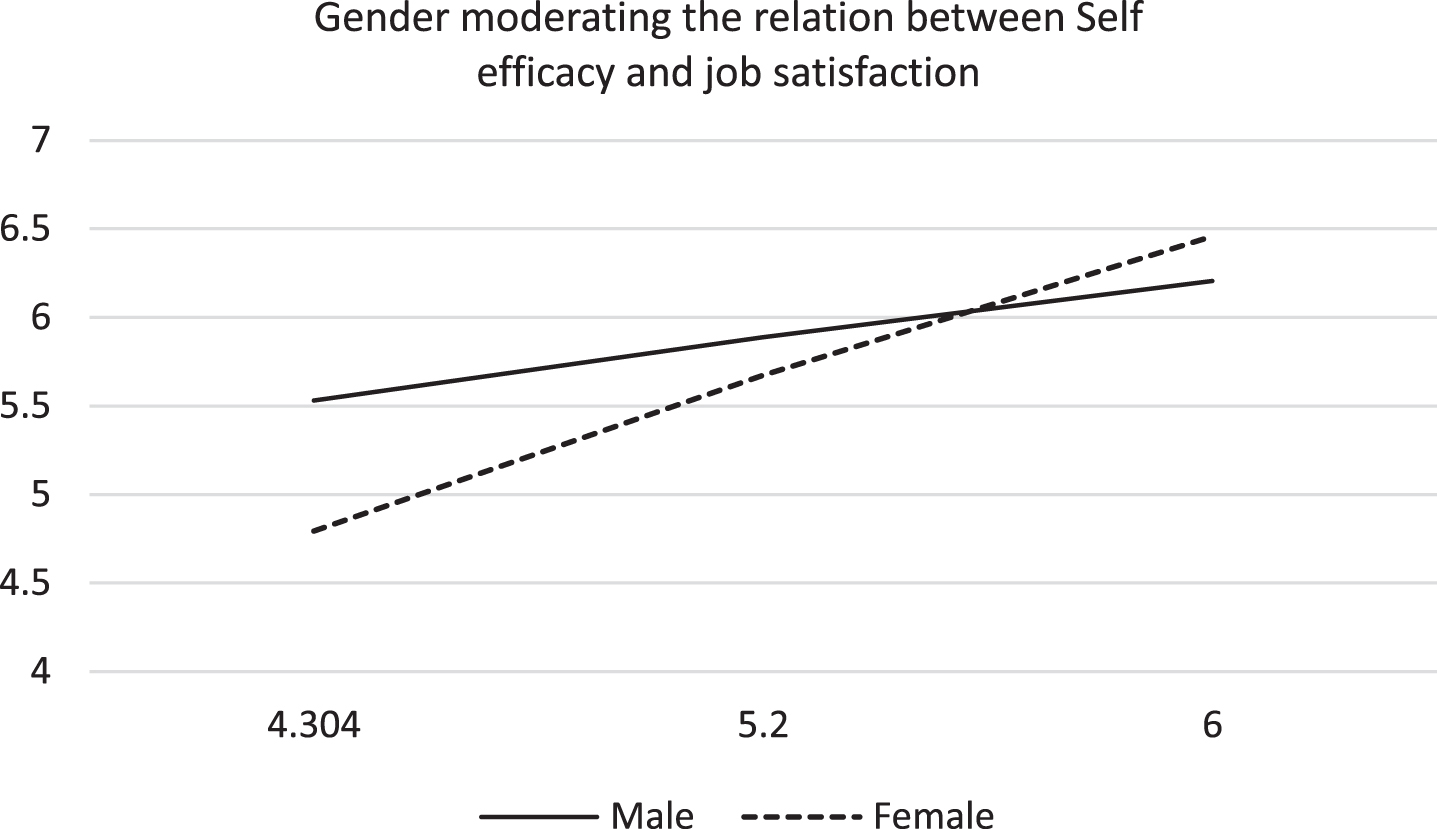
Slope analysis.
In the following section we will highlight the key findings from the focus groups regarding potential reasons for the tendencies in gender differences we found.
“It is good to know that you are part of the change and that you have specific skills that are needed” [P2; focus group 4; male].
“Others may not understand why particular decisions are made as they are – but hey, I understood this and that made me less vulnerable” [P3; focus group 3; female].
Further, the results also showed that gender differences in self-efficacy perception are very present.
“You know, I bring an argument in our discussion – nobody is listening – the same argument will be made a couple of minutes later by a male colleague – and everybody is listening. How does this come?” [P1; focus group 5; female].
“I am still the only women most of the times when we meet in the leadership team – and I know that I have to be prepared as twice as good as men to get my arguments in the middle of interest” [P5; focus group 2; female].
The reasons why female CAs perceive themselves as less successful seem to be attributed on the one hand to behaviours typically associated with men and not with women being a CA. For example:
“I am not the aggressive game changer, I am looking to talk to people and to listen to them – however, that seems not the behaviour our top management is expecting” [P3; focus group 5; female].
“Often times I hear, that I have to be more forceful and strong, yeah.. maybe I am not such a good change agent as men” [P4; focus group 3; female].
On the other hand, a lack of confidence could be spotted when female CAs raised their concerns regarding their role as CA within their LAs.
“I am not so familiar with the role of a change agent, I am the first women anyway in that position within our organization and thus, I first had to demonstrate that I have the skills to cope with the challenges during change before I was accepted” [P2; focus group 7; female].
“Oh gosh at the early beginning, when I heard that I should become the change agent, I thought I do not have any of the skills that are needed to drive a change, I took several seminars and asked for support by my line-manager. He was surprised that I asked for such support, as before nobody did – typical men in my eyes” [P2; focus group 7; female].
“I am still struggling to demonstrate how good I am– to be honest I am sure that my less aggressive behaviour has been the reason for the fact that colleagues who are younger climbed up the career latter quicker than I” [P1; focus group 5; female].
Finally, we identified some indicators that suggest that ‘lower opportunities for women’ exist to be promoted.
“To be honest, women are so rare in our field, and most positions are with men, typically white men, and they really want other men on these jobs [...] [P2; focus group 7; male].
The study contributes to the existing knowledge on work by analysing the role of female CAs within a male-dominated context, focussing on perceived self-efficacy and job satisfaction, as job related dimension of wellbeing, during change. By applying a mixed-method design, conducting a quantitative and a qualitative study, based on data from 71 CAs working in the transport or mobility departments of seven local authorities participating in the H2020 CIVITAS SUITS project, from six different countries, this study sheds light on two existing shortcomings in the literature. Firstly, this study pays attention to the impact on CAs’ own well-being, resilience, and health when driving an organisational change and secondly, this study reflects on female CAs’ well-being in a male-dominated sector which has been highlighted as decisive key for women’s ability as “drivers of solutions” by the United Nations [3].
Addressing our first contribution, we will focus on CAs perceived self-efficacy during change in general. While scholars in the field traditionally highlighted the relevance of perceived self-efficacy for employees’ well-being, resilience, and health during organisational changes [20, 25, 29, 67], this study demonstrates that also CAs’ own well-being is driven by their perceived self-efficacy when managing change. Our statistical results of study one demonstrate that CAs perceived self-efficacy influences their job satisfaction positively. While scholars regularly find that job satisfaction may erode during change and directly damage the physical and mental health of employees [25, 26, 67], our results underline the positive effect of self-efficacy to avoid decreases in job satisfaction and as such to increase employees’ resilience and maintain their physical and mental health. This is compelling as SUITS’ CAs were required to work beyond their contracted hours as they were seconded into their roles as CAs for the duration of the project and did this on top of their existing work, and further, had to ensure that they get support of senior management colleagues and junior members of staff – all of whom may feel insecure and unwilling/unable to work to adapt.
Furthermore, our results of the second study (interviews) support the positive effect of perceived self-efficacy on job satisfaction as they provide additional empirical evidence for Nielson and colleagues’ [2] arguments why CAs perceived self-efficacy influences their job satisfaction positively during change. Firstly, our CAs all stated that they were equipped with additional information related to the ongoing change processes within the LAs and thus, understood how they may use the change and their specific role to improve their job and that of their colleagues [23]. In particularly, information about the recent stage of the change, the future vision, little steps, and small successes were key for their own well-being [17, 18]. Secondly, SUITS’ CAs perceived themselves as part of the ‘in-group’ who fulfilled an important role in the LA in managing the change and therefore, perceived self-efficacy that fostered job satisfaction [18, 24]. Thirdly, due to the training that SUITS CAs received in change management, their participation in regular workshops, designed for all CAs to share and celebrate their successes and provide support in overcoming obstacles, our CAs developed work related, transferable skills and enriched their jobs, which increased their perceived self-efficacy and as such their job satisfaction. These workshops supported CAs in particularly to develop confidence in solving conflicts with colleagues whose roles, responsibilities and tasks had been changing; in overcoming frustrations when changes were not perceived as beneficial; in remaining calm, and in a good mood, and in staying motivated during the organisational change process, thereby deriving more job satisfaction from their work.
Our second contribution of this study is related to gender as our study shows that female CAs definitively need greater support from the top management when managing change in an organisation (i.e., LA) within male-dominated sectors. While our quantitative findings showed that female CAs levels of perceived self-efficacy seem to have been higher to achieve similar levels of job satisfaction as their male colleagues (see slope analysis), several arguments drawn on the qualitative data underpin this finding.
Firstly, our interviews showed that the transport and mobility sector is indeed a very male-dominated context [32]. Therefore, female CAs were challenged by perceiving lower status, fewer opportunities, and trust into their abilities to manage organisational change [33, 35, 68]. In particularly “low levels of acceptance” perceived by a male-dominated top management and junior staff gave SUITS female CAs a hard time when trying to get support from the wider organisation. Female CAs explained that they had to convince their colleagues with more compelling arguments as their male colleagues in similar roles. They also mentioned that they had to work harder to be respected by their top management and to get honoured for managing change. They further became undermined and isolated, especially when their efforts required colleagues taking on extra work and training [17, 39]. Furthermore, they had the feeling that even little failures without any serious consequences, were expected by their male colleagues and even strengthened their stereotype thinking. Consequently, such colleagues gave SUITS’ CAs an even harder time to successfully managing the change.
Secondly, all female CAs mentioned in the interviews that they were facing scepticism regarding their abilities in managing such an organisational change which lowered their positive self-image which in turn reduced their job satisfaction [29, 68]. This lowered self-efficacy lead some of SUITS’ female CAs to avoid specific activities that could have driven the organisational change successfully such as conflict escalation or face-to-face discussions with the male-dominated top management [2].
Moreover, our study supports research which showed that women are more risk averse than men [37, 38] and that they try to avoid taking risks the more, the greater the risk is perceived [37]. Our female CAs highlighted in the interviews that they perceived very high levels of vulnerability as they were risking their career’s, their reputation, and the respect of their colleagues in leading such a change process within an LA. They agreed on the fact that they were a little afraid of being responsible for the relatively high financial budget that they received and that they were conscious regarding potential consequences of a mismanagement that would affect citizens for many years [41, 42].
Fourthly, we found that particularly the micro-political processes in the LAs (i.e., informal meetings and networks) had a fundamental impact on SUITS’ female CAs’ work and careers. LAs are political arenas in which employees are even more in constant competition for limited resources, power and influence as in other organisations. This context requires a certain level of political skill, passion, and thick skins in order to achieve the desired success [61]. Based on our interview results, we recognized female tendencies to follow regulations and to follow processes and to ignore the importance of internal political processes for their own work and success. This finding is not new [59, 60] but it underpins the relevance of organisational support for female CAs to ensure their well-being and health when performing the role as CA. To address this, SUITS developed a supportive community of practice in which female CAs could share their experiences with project researchers/consultants and their counterparts in other LAs.
Managerial implications
Our results show that female CAs need extra support in managing change processes within male-dominated contexts as the transport and mobility field to avoid a decrease in their perceived job satisfaction, their well-being and herewith, their physical and mental health. Furthermore, we were able to develop some recommendations about how the top management could support female CAs to cope with the extra challenges when managing change within a male-dominated context. Firstly, it is important for female CAs that the top management ensures that they get the full, and public support of senior management, with regular check-up meetings to discuss upcoming challenges. Secondly, female CAs benefit a lot from other female CAs experiences to perform their tasks.
Thus, we want to encourage the top management of changing organisations to look for mentoring opportunities or female networks in which women can exchange knowledge and best practise examples of how to cope with particular situations (e.g., as developed on the Horizon project ‘Transport Innovation Gender Observatory – TInnGO’ project [https://www.tinngo.eu/]. Thirdly, we want to encourage the top management of a changing organisation to break down deeply anchored assumptions and gender stereotypes within their organisation and become aware of unconscious prejudices about gender. In general, we recommend that organisations create a culture of equality and diversity within their workforce.
Finally, we want to highlight the huge influence of acknowledgment regarding the role of female CAs for their well-being, resilience, and health. All interview partners agreed that this is the key for their motivation to successfully manage change. Such acknowledgement can be easily shown by an organisation in celebrating small success-steps along the way to change.
Limitations
The sample was relatively small and limited to LAs in the project, which were very diverse. The LAs had, to a certain extent already acknowledged the need for organisational change, so the job of the CA might have been easier. Access to staff in transport departments was limited owing to their pressure of work. This was made more difficult in 2021, the last year the project when we had hoped to see higher levels of organisational change. There was organisational change, but this was in response to the COVID pandemic. LAs which followed our change process were in a better position to react to the demands of lockdown and the need to redesign transport services during this time.
Secondly, the results of our quantitative study are based on a cross-sectional sample. Thus, we cannot show any procedural change regarding the behaviour or perceived self-efficacy between women and men during the organizational change. However, we additionally conducted a series of focus groups to elaborate more in detail what the reasons are for the different levels of perceived self-efficacy and job satisfaction and conducted statistical tests to reduce the likelihood of a common method bias. Nevertheless, future studies should try to observe potential changing attitudes and behaviours to enrich our knowledge on the relationships between self-efficacy related to change and perceived job satisfaction.
Thirdly, as most focus group researchers, we used the group as the unit of analysis [64]. By doing so, we coded the data and presented emergent themes. Although these themes can yield important and interesting information, analyzing and interpreting only the text has limitations as no information is provided about the degree of consensus and dissent, resulting in dissenters effectively being censored or marginalized and preventing the delineation of the voice of negative cases or outliers that can increase the richness of the data [65]. Future studies could take the individual or the group in focus of their analysis instead of the unit of analysis [66].
Finally, we want to raise awareness that our results may be affected by the COVID pandemic which started during the lifetime of SUITS. Organizational learning regarding implementation requires ongoing reflection and continuous re-adjusting in the light of emerging evidence [69]. Thus, we tried to ensure robust evaluation and revision of our results in the light of the pandemic, e.g. making our CAs aware of potential influences due to the pandemic such as the fact that Covid was driving the change. However, our local authorities have proved to be not only resilient, but highly adaptable when the context demanded it, accepting and applying different sources of knowledge to inform change. Therefore, in our case Covid was rather accelerating the ongoing changes instead of hindering them.
Conclusion
This mixed-method study highlights the role of women as change agents, driving organisational change within male-dominated transport departments of LAs by focussing on perceived self-efficacy and job satisfaction, as job related dimension of wellbeing. Herewith, this study sheds light on two existing shortcomings in the literature. Firstly, this study pays attention to the impact on CAs’ own well-being, resilience, and health when driving an organisational change and secondly, this study reflects on female CAs’ well-being in a male-dominated sector which has been highlighted as decisive key for women’s ability as “drivers of solutions” by the United Nations. Firstly, our quantitative findings indicate that female CAs indeed need to perceive higher levels of self-efficacy during change to perceive the same levels of job satisfaction as male CAs. Secondly, based on qualitative data, we are able to spot potential explanations for the identified gender-related differences regarding perceived self-efficacy of CAs. These results allow us to derive managerial implications to prevent decreases in women’s well-being and strengthen their resilience and health during change.
Footnotes
Ethical approval
All studies included in this paper comply with UK ethical practice and are GDPR compliant.
Informed consent
The consent was obtained from all participants in the first part of the questionnaire and the focus groups before the research commenced.
Conflict of interest
The authors declare that they have no conflict of interest.
Acknowledgments
The authors wish to thank all project partners of SUITS and TinnGO for their generous assistance in participant recruitment and survey distribution for these studies. Further, they thank all participants in the studies.
Funding
The data for this research were collected during the SUITS project, which was funded by the European Union (Grant agreement ID: 690650, Programme H2020-EU.3.4. – Societal challenges – Smart, Green and Integrated Transport, Topic MG-5.4-2015 – Strengthening the knowledge and capacities of Las) and the TinnGO project, which received funding from the European Union’s Horizon 2020 Research and Innovation programme (Grant agreement No. 824349).