




Abstract
BACKGROUND:
Because of wrong sitting position, children have back-pain and related musculoskeletal pain (MPD). Due to inappropriate designed class furniture by not taking into account the children’s anthropometric measurements have negative effect on children musculoskeletal systems. The impact of the COVID-19 pandemic crisis has changed the furniture industry’s production trends.
OBJECTIVE:
This study aimed to develop a new fuzzy based design of ergonomic-oriented classroom furniture for primary school students considering the measured anthropometric dimensions of students’ safety, health, well-being, i.e. ergonomic criteria, socio-psychological aspect and post-COVID policies.
METHODS:
In the study 2049 number of primary school students are assessed considering COVID-19 pandemic policies and their static anthropometric dimensions were measured between 7-10-year-old (between 1st-4th grade students) and descriptive statistics of children among their ages and genders are calculated; mean, standard deviation, percentiles. The data collected from the students were analyzed quantitatively by using Significance Analysis: Mann-Whitney U test statistic, t-test, Regression Analysis and one-way ANOVA. In the study interviews with experts are performed and fuzzy mathematical model (by using fuzzy-AHP, fuzzy-TOPSIS and fuzzy-VIKOR) is developed to calculate Turkey’s three schools’ furniture.
RESULTS:
Results showed statistically significant differences between two genders. And it is observed that the seating bench height is too high for primary school students and lower than the height of the classroom’s blackboard from the floor. Fuzzy Multi Criteria Decision Making Method’s (FMCDM) results show that primary school students’ ergonomic classroom furniture should be mainly designed by considering “COVID-19 Criteria”, “Ergonomic Criteria” and “Socio-Psychological Aspect”. Students’ existing seating benches and tables are changed by considering post-COVID policies/protocols, Ergonomic Criteria and Socio-Psychological Aspect. And a new seating bench/chair and table’s dimensions is proposed in the study.
CONCLUSIONS:
Children study at school for long periods and their activities involve long periods of time on their desks in schools. As per the results of the study, it can be concluded that school management must consider the genders, ages of students and take into account the post-COVID policies/protocols while procuring the classroom furniture. The COVID-19 pandemic is the single largest event to have affected children globally in their access to school in recent times; estimates suggest that over 85%of the world’s total enrolled learners, 1.5 billion children and youths, have been affected. The coronavirus pandemic also creates dramatic changes for the school furniture.
Introduction
Furniture designs change over time taking into account ergonomics and anthropometric data. By the mid-19th century, the industrial revolution and the impact of mass production enabled the production of chairs and tables in various forms [1]. The chairs were depicted with a low seat as seen on Egyptian Pharaohs’ stools [2]. Ergonomics and anthropometry have been used to combine adjustability to accommodate a wider range of people, to develop new forms of furniture that include task/office tables/chairs [3].
Although adjustability was the primary criteria in furniture designs, the adjustable furniture has beed used in 1960s. In the early 1990s, many furniture manufacturers start to mass furniture production based on measured anthropometric data [4].
The design of school furniture is not focused by manufacturers until recent years. School furniture’s design should be based on anthropometry and ergonomic criteria. But they are not focused on the statistics and anthropometric data/measurements, i.e. gender, nationality, body structure, age, physical activity, nutrition.
The impact of the COVID-19 pandemic crisis has changed the furniture industry’s production trends and increased the importance of digitalization. Social distancing has become the new normal after the COVID-19 pandemic, therefore consumers’ and school management spending on school furniture is expected to increase.
Many researchers make investigations on prolonged sitting and the design of chair, desk and their combinations in work place and computer workstation [5–9]. Few researchers have been investigated and proposed ergonomic-oriented classrooms’ furniture designs [10–12], this study investigates school furniture and recommend school furniture design guideline considering the measured anthropometric dimensions of students and post-COVID policies/protocols.
Aim of the study
The main goal of the study is to recommend the ergonomics oriented system based on Student Health framework for school managers. The new ergonomic school furniture design protects students’ health, and well-being in post-COVID period. To design a post-COVID ergonomic classroom furniture, first step is to examine the existing school furniture dimensions [13, 14] if they are well-matched to students’ anthropometric measurements.
The results obtained from the investigation (in fall semester of 2019-2020) show that in pre-COVID period children attended classes regularly, i.e. five times a week, and were seated more than five hours in a day. In contrast, in the post-COVID period, children attended classes irregularly, i.e. maximum two times a week, and were seated more than five hours a day when they attended their classes.
Previous studies about school furniture
In the literature there are few studies about school furniture designs. Many studies showed that children were seated long periods in classrooms [9, 15–17] and this causes bone and muscle pain. Sitting for a long time in wrong position causes illness, such as low back pain [18]. Students’ back pain and neck pain problems have been frequently seen among students [19]. Numerous researches investigated prolonged sitting on the chairs/furniture [8, 21].
All over the world due to unsuitable school furniture designs; children are under the severe risk of musculoskeletal injuries in schools, i.e. postural stresses and strains due to prolonged sitting [22, 23]. Continuous sitting position has disadvantages, and potential long-term consequences.
The correct determination of the classroom furniture dimensions is only valid if anthropometric measurements of the students are taken correctly [24]. And it is related with the correct/proper sitting postion [25–27]. Saarni et al. [2] investigated the children sitting postures positions which affect their spine while working on computer workstation. They proposed new ergonomic classroom furniture to reduce musculoskeletal disorders and pain that students experienced. In the literature there is not any ergonomic classroom furniture study considering post-COVID policies and protocols.
Material and methods
Governments and non-governmental organizations provide resources to create safer and supportive environments to organizations [28]. Due to the COVID-19 pandemic, many countries closed their schools, around 1.6 billion students continue their education via distance-learning system.
While developing post-COVID classroom furniture, it is necessary to get the students’ anthropometric measurements considering their gender, nationality, body structure, age, physical activity, nutrition. In the study three primary schools in Turkey were investigated, and the details of them are presented in Table 1.
Investigated student numbers in Turkey
Investigated student numbers in Turkey
While measuring the students’ anthropometric measurements, standard anthropometric measurements were used and measured by using ISO and EN-standards, i.e. ISO 5970-1979 and EN1729. The following anthropometric dimensions of primary school students (weight; sitting height; eye, elbow, shoulder, elbow, knee height, arm length; elbow-elbow distance; shoulder. . . ) which are necessary to design the chair, desk, table and seating benches, i.e. school furniture, were taken/measured as per related ISO and EN standards.
Students’ weight and height measurements in examined three Turkish primary schools are presented in Table 2 and Table 3. Students’ seating benches width measurements in examined three Turkish primary schools are presented in Table 4.
Students’ weight measurements (kg)
Students’ height measurements (cm)
Students’ seating bench width measurements (cm)
In the study; an integrated Fuzzy-AHP Fuzzy-TOPSIS and Fuzzy-VIKOR approaches are used to assess/evaluate Turkey’s primary students’ ergonomic classroom furniture. In literature Fuzzy Multi Criteria Decision Making Methods (FMCDM) are used in different fields by many researchers and Fuzzy-AHP, Fuzzy-TOPSIS and Fuzzy-VIKOR are also used in many sectors/researches [29–36]. In this study Turkey’s primary school students’ ergonomic classroom furniture design considering post-COVID policies and protocols is performed under fuzzy logic.
Fuzzy-AHP method
Since the standard AHP method does not include the possibility of situations with ambiguity in the estimation, it is possible to upgrade this method with fuzzy approach, i.e. Fuzzy-AHP method. The Fuzzy-AHP method suggests their application directly in criteria pairs comparison matrix. Triangular fuzzy numbers are used in most cases/problems by many researchers in literature because of this reason in the study triangular fuzzy numbers method is used in Fuzzy-AHP method. A triangular fuzzy number that is defined in R set can be described as Triangular fuzzy number.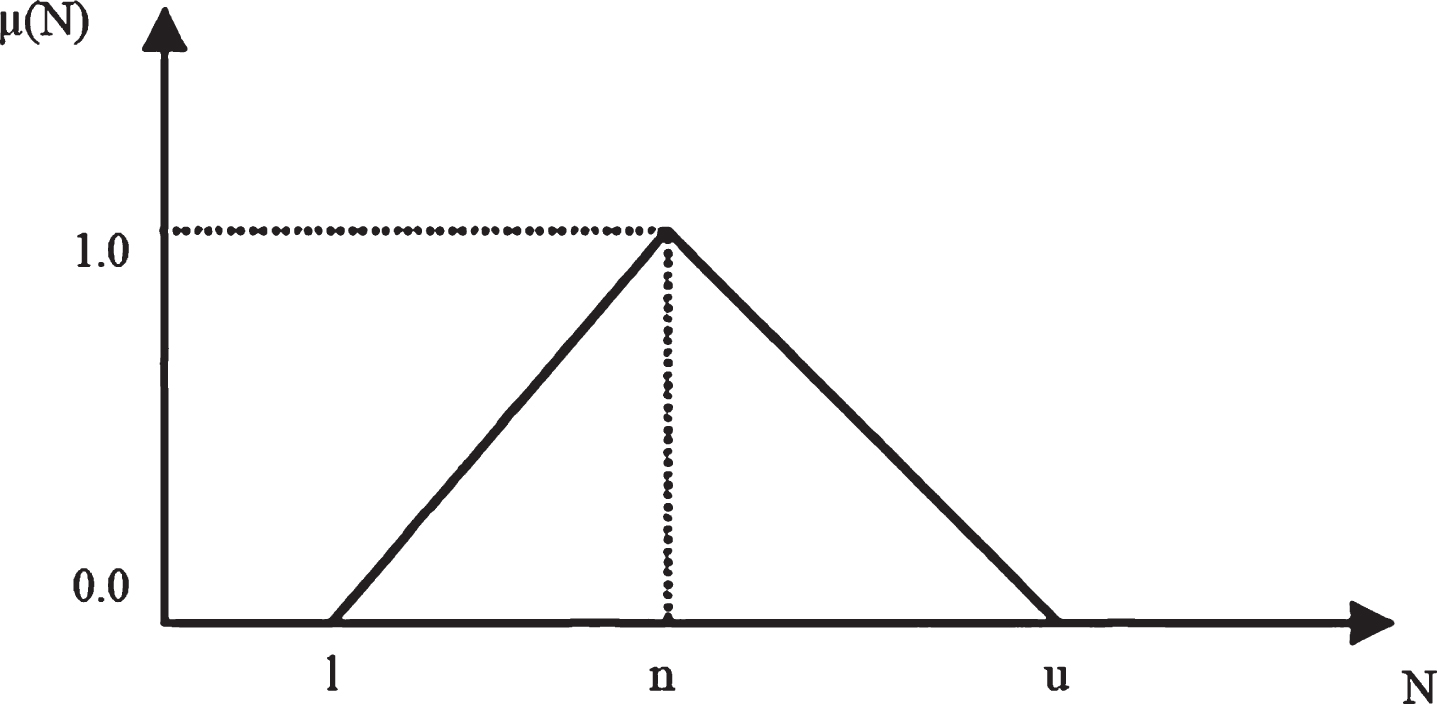
In the study the performance of each scenario to each criterion is introduced as a fuzzy number. And in the study the ratings of qualitative criteria are considered as linguistic variables. These linguistic variables can be expressed in positive triangular fuzzy numbers as described in Table 5 [29, 30].
Linguistic variables for the alternatives
After forming a matrix of fuzzy criteria comparison it should be defined vector of criteria weights W. For that purpose, the following equations/steps were used in the study.
Let X = {x1, x2,..., xm } be an object set, and G = {g1,g2,...,gn} be a goal set. N extent analysis values for each object can be obtained as
In order to obtain the expression
And it is required to calculate the inverse vector above by using Expression (5);
It can be represented in the following manner by Expression (7):
Where d is the ordinate of the highest intersection point D between μN1 and μN2.
To compare μN1 and μN2, values of both, V(N2≥N1) and V(N1≥N2) are needed.
Assume that Expression (10) is;
The fuzzy-TOPSIS calculation most important step is given in Expression (13) [38], i.e. Creating the Decision Matrix; aggregated ratings are calculated by using Equation (13) [29, 30]:
The basic steps of proposed fuzzy TOPSIS method can be described as follows [29–31]:
Then, the aggregated fuzzy importance weight for each criterion is normalized as follows:
Then, the aggregated fuzzy importance weight for each criterion is normalized as follows:
where vj1=
Then the normalized aggregated fuzzy importance weight matrix is constructed as
Then, normalized decision matrix is obtained as:
Where
Here
for i = 1, 2, . . . , m and j = 1, 2, . . . , n
The fuzzy closeness represents the distances to the fuzzy positive ideal solution and the fuzzy negative ideal solution simultaneously.
The VIKOR method is one of the FMCDM. It was developed by Serafim Opricovic [39] to solve decision problems with conflicting and non-commensurable criteria, assuming that compromise is acceptable for conflict resolution. VIKOR ranks alternatives and determines the compromise solution closest to the ideal solution. The international recognition of the VIKOR method was due to contribution of Serafim Opricovic and Gwo-Hshiung Tzeng [40].
In this study Fuzzy-VIKOR method is used to solve problem in a triangular hesitant fuzzy environment. The triangular fuzzy numbers are used to handle imprecise numerical quantities. Fuzzy-VIKOR is based on the aggregating fuzzy merit that represents distance of an alternative to the ideal solution [32]. The related steps are as follows [32]:
Step-1: Determine the positive triangular ideal solution (PTIS) and the negative triangular ideal solution (NTIS).
Step-2: The aggregated fuzzy ratings of alternatives with respect to criterion are calculated by using below Sj and Rj below equations:
Step-3: Normalization. Compute the values
Step-4: Rank the alternatives by sorting the values of S, R and Q in decreasing order which results in three ranking lists.
Step-5: Propose as a compromise solution the alternative A’ which is ranked the best by the measure Q(minimum) if the following two conditions are satisfied:
CC1: Acceptable advantage:
Q (A”) –Q(A’)≥DQ (33)
where A” is the alternative with second position in the ranking list by Q; DQ = 1/(m-1) DQ = 1 / (m-1) (if m≤5 ise DQ = 0.25); where m is the number of alternatives.
CC2: Acceptable stability in decision: Alternative A” must also be the best ranked by S or/and R. This compromise solution is stable within a decision making process, which could be “voting by majority rule” (when v > 0.5 is needed) or by “consensus” v ≈ 0.5 or with ”veto” (v < 0.5). Here v is the weight of the decision making strategy “the majority criteria” or (“maximum group utility”). If one of the two conditions is not satisfied, then a set ofcompromise solutions is proposed, which consists of: Alternatives A” and A’ if only condition CC2 is not satisfied, or Alternatives A’, A”. . . Am if condition CC1 is not satisfied, Am is determined by the relation Q(Am) - Q(A’)≤DQ for maximum m (the positions of these alternatives are “in closeness”).
In the study Fuzzy-AHP, Fuzzy-TOPSIS and Fuzzy-VIKOR procedures and related calculations have been coded/solved by using MATLAB program.
Turkey’s primary school students’ ergonomic classroom furniture, i.e. measuring scale, consists of 6 dimensions-main criteria and 18 evaluation factors-sub-criteria are evaluated/assessed by each expert/DM. In the process of prioritization of criteria, subcriteria and alternatives, the DMs used in the selection process was consulted. A questionnaire was developed following the methodology proposed for the below methods, which was answered by 29 experts/DMs. The comparison matrix and pairwise comparison matrices for subcriteria and alternatives are calculated. Subsequently, the normalized pairwise comparison matrix of criteria was obtained. The priority vector and the CR for the criteria were obtained. In the study 6 main criteria and related sub-criteria are presented below:
Average seating bench width in one of the primary schools (cm)
Average seating bench width in one of the primary schools (cm)
Sitting width averages of all students in one of the Turkish primary schools
Seat height averages
Knee height averages of all students in one of the Turkish primary schools
The average height of the classroom’s blackboards/whiteboards from the floor
Eye height (sitting) averages of all students in one of the Turkish primary schools
One-sample test: Sitting width - T test chart
Knee height - T test chart
Eye height (sitting) - T test chart
Pollution, Air Pollution Status of School, Exhaled Air Pollution, Hazardous Waste.
Fuzzy mutual criteria comparison
After acquiring the fuzzy comparison matrices, importance weights of school furniture design’s dimensions; evaluation criteria is calculated by the FAHP method [29]. According to the calculated criteria weights for schools’ furniture weights; the most important evaluation dimension/main-criteria is “COVID-19 Criteria” with 0.216 importance weight, the second important evaluation dimension is “Ergonomic Criteria” with 0.207 importance weight and the third important evaluation dimension is “Socio-Psychological Aspect” with 0.173 importance weight.
Ranking the alternatives by using Fuzzy-TOPSIS and Fuzzy-VIKOR methods: To evaluate the school furniture, Fuzzy-TOPSIS and Fuzzy-VIKOR approaches are conducted with the collected data of DM’s surveys/interviews. Primarily, the linguistic variables of the alternatives are created. By the help of criteria weights, Fuzzy-TOPSIS and Fuzzy-VIKOR method’s steps are performed/completed and three schools’ furniture are ranked. Primarily, the linguistic variables of the alternatives are created thusly in Table 16.
Linguistic variables of the alternatives in Fuzzy TOPSIS method
Then Fuzzy-TOPSIS method is used for the ranking of three schools’ furniture according to the relative distance values of alternatives (CCi). The values of indicators are set into triangular fuzzy numbers. Utilizing the method of triangular fuzzy numbers, the fuzzy numbers of financial ratios are obtained [29–31]. After applying the steps in Fuzzy-TOPSIS method, i.e. defined steps in above Section, schools’ performance scores are ranked. The ranking of the alternatives is as follows: School-B (first ranked), School-A (second ranked), School-C (third ranked). The reason of it is in School-B’s furniture design; COVID-19 criteria, ergonomic criteria and socio-psychological aspect criteria are considered/satisfied.
In Fuzzy-VIKOR method, by ranking the preference order by the help of DMs/experts and by compromise solution; School-B’s furniture design is the best alternative. From the comparison table we find that the values of Q1 increases as the value of weight v increases, the values of Q3 decreases as the value of weight v increases while values of Q1 remains unaltered. The ranking of the alternatives is not affected by the change of weights.
The COVID-19 pandemic has changed the educational system, related landscape, and learning-environments of students, i.e. schools, have to evolve to meet new challenges considering post-COVID policies and protocols stated by WHO-World Health Organization, CDC-Centers for Disease Control and Prevention, and recommendations during the COVID-19 pandemic [41–43]. In the post-COVID period, changes in physical spacing are required to allow physical distance between students. This can be achieved by using unused areas/spaces in classrooms and adding new elements to existing furniture, i.e. transparent shields, and the necessary areas/spaces to prevent the transmission of diseases, or purchase a new furniture that satisfy post-COVID policies, i.e. transparent shields. . . etc.
Post-COVID strategies in schools include; redesigning larger unused spaces such as corridors, libraries and gyms, limiting classroom capacities, adding physical barriers between students, changing the configuration of desks in classrooms and their spacing should be arranged considering physical distancing (social distancing) guidelines, i.e. approx. 2 meters (6 feet).
When school educational system returns, the following improvements in schools should be made to keep every child safe in post-COVID period in schools: School’s HVAC (Heating, Ventilating and Air Conditioning) air conditioning systems will be changed by higher filtering rate HVAC that have MERV 13 or MERV 17 filters. School management should take precautions/measures on indoor air to reduce the spread of the COVID-19 pandemic, i.e. dilute the indoor air inside the school. Humidification systems similar to health systems in schools should be used in schools. Approx. 60 cm high, transparent table top-mounted screens on three sides of each classroom’s tables/desks to provide shielding is added in post-pandemic period while maintaining site lines to classmates, teacher and content. A moveable screen provides a transparent shield between the teacher and students. It can be moved, if desired, to provide shielding while using the whiteboard. Landmarks, signs, colored tape marks on school’s floor should be placed 2 meters apart to arrange/show physical distancing (social distancing).
Conclusion
Governments are setting comprehensive rules to prevent the spread of the COVID-19 pandemic. Due to the COVID-19 pandemic, standards are changing while adhering to healthcare standards covering COVID policies/protocols/precautions, the revised standards provide a healthy starting point for protecting students from the COVID-19 pandemic. Educational institutions should follow the above-mentioned revised standards and related recommendations to reduce the risk of COVID-19 transmission.
School furniture, i.e. an environmental factor, plays an important role in educational system since it affects the learning capacity of students, wheres it is often neglected. As people begin to develop posture patterns at an early age, the need for ergonomically designed furniture is a must to develop correct posture patterns and physical well-being in the future. School management provide an opportunity to improve student learning and participation capacities by purchasing suitable classroom furniture. While doing so, post-COVID policies and protocols stated in Section “Post-COVID Policies related to Schools” should be considered.
Due to improper designs of school furniture; children are under the severe risk of musculoskeletal injuries in schools. Examination of the existing school’s furniture with the statistics/anthropometric measurements of children show that existing classroom desks and seating benches in the primary school are inappropriate furniture for the students.
In the study, fuzzy mathematical model (by using fuzzy-AHP/fuzzy-TOPSIS/fuzzy-VIKOR) is developed to calculate schools’ furniture. Turkey’s primary school students’ ergonomic classroom furniture, i.e. measuring scale, consists of 6 dimensions-main criteria; Technical Criteria, Ergonomic Criteria, COVID-19 Criteria, Socio-Psychological Aspect, Environmental Criteria, Existing Furniture Condition Criteria, and 18 evaluation factors-sub-criteria. In the process of prioritization of criteria, subcriteria and alternatives, the DMs used in the selection process was consulted. A questionnaire was developed following the methodology proposed for the below methods, which was answered by 29 experts/DMs.
In the study, firstly, each DM practiced pair-wise comparisons of Turkey’s primary school students’ ergonomic classroom furniture dimensions and evaluation factors are calculated by using fuzzy-AHP. Using the survey data acquired from these experts, integrated pair-wise comparison matrices are formed by combining all expert opinions. Thus, the pair-wise comparison values are converted to triangular fuzzy-numbers and fuzzy pair-wise comparison matrices are created. After acquiring the fuzzy comparison matrices, importance weights of school furniture’s dimensions; evaluation criteria is calculated by the FAHP method [29–32]. According to the calculated criteria weights for school furniture’s weights; the most important evaluation dimension/main-criteria is “COVID-19 Criteria” with 0.216 importance weight, the second important evaluation dimension is “Ergonomic Criteria” with 0.207 importance weight and the third important evaluation dimension is “Socio-Psychological Aspect” with 0.173 importance weight.
In the study Fuzzy-TOPSIS and Fuzzy-VIKOR method is used for the ranking of three schools’ furniture according to the relative distance values of alternatives. After applying the steps in Fuzzy-TOPSIS and Fuzzy-VIKOR method, i.e. defined steps in above Section, three schools’ furniture performance scores are ranked. In Fuzzy-TOPSIS the ranking of the alternatives is as follows: School-B (first ranked), School-A (second ranked), School-C (third ranked). In Fuzzy-VIKOR method, by ranking the preference order and by compromise solution School-B’s furniture design is the best alternative. The reason of the selection of School-B is; COVID-19 criteria, ergonomic criteria and socio-psychological aspect criteria are considered/satisfied in School-B’s furniture design/selection.
FMCDM’s results show that primary school students’ ergonomic classroom furniture should be mainly designed by considering “COVID-19 Criteria”, “Ergonomic Criteria” and “Socio-Psychological Aspect”. Students’ existing seating benches and tables are changed by consideing post-COVID policies/protocols, Ergonomic Criteria and Socio-Psychological Aspect. If a new seating bench/chair and chair will be purchased by management than the chair dimensions proposed in Table 17 should be purchased or arranged accordingly.
Proposed class room furniture dimensions for primary school students considering post-COVID policies/protocols (in cm)
The hesitant fuzzy environment when applied is very helpful in decision making situations when DM/experts might consider multiple priorities or judgments. All FMCDM methods estimate criteria weights by the help of DM so human judgment can be avoided by assigning weights to different attributes. In the study Fuzzy-AHP, Fuzzy-TOPSIS and Fuzzy-VIKOR approaches are conducted with the collected data of DM’s surveys/interviews. Fuzzy-TOPSIS and Fuzzy-VIKOR methods result in same preference of selecting a school’s furniture design based on Quality evaluation. Whereas fuzzy-VIKOR method stands out to be the best due to its computational easiness in the study.
With small changes to the density, geometry and division of the physical space in classrooms, the necessary physical distancing can be achieved in post-COVID period. This can be reached by rearranging the existing school furniture and adding a few new elements to classrooms’ desks and tables and spaces. Bigger changes can be achieved by introducing more modular furniture and video technologies that maximize flexibility over time and can address the needs of multiple learning modes while maintaining distancing recommendations.
In the post-COVID period, physical distancing can be allowed by making changes in the physical spacing in schools. It can be made by adding few new items to existing furniture to prevent disease transmission, i.e. transparent shields, and using unused areas in school and classrooms, or purchase a new furniture that satisfy post-COVID policies which are explained/listed in above Section.
By applying the recommended new post-COVID ergonomics-oriented classroom furniture dimensions, comfort level of students satisfying post-COVID policies and protocols will increase and the new post-COVID design will reduce the musculoskeletal disorders, related pain and aches.
Footnotes
Acknowledgments
Special thanks to the schools’ management for their help and support while investigating the school’s furniture and measuring anthropometric dimensions of students.
Conflict of interest
None to report.