




Abstract
BACKGROUND:
Dentistry is one of the highest risk occupations that face COVID-19, especially in countries that are severely affected by the pandemic, such as Indonesia.
OBJECTIVE:
The purpose of the study was to determine factors influencing job satisfaction among dentists during the new normal of COVID-19 pandemic in Indonesia by utilizing the Structural Equation Modeling (SEM) approach.
METHODS:
A total of 310 Indonesian dentists voluntary completed an online questionnaire, which contained 58 questions. Several latent variables such as perceived severity of COVID-19, staff cooperation and management commitment, personal protective equipment, job stress, working hours, income, and overall job satisfaction were analyzed simultaneously.
RESULTS:
SEM revealed perceived severity of COVID-19 had significant effects on job stress (β:0.394, p = 0.025) and the utilization of personal protective equipment (β:0.757, p = 0.001). Subsequently, job stress (β:–0.286, p = 0.001), working hours (β:0.278, p = 0.018), income (β:0.273, p = 0.003), personal protective equipment (β:0.145, p = 0.038), and staff cooperation & management commitment (β:0.091, p = 0.002) were found to have significant effects on overall job satisfaction. In addition, management & staff cooperation was found to have a significant association with job stress reduction (β:–0.319, p = 0.003) which subsequently led to higher satisfaction.
CONCLUSIONS:
The current study is one of the first that analyzed job satisfaction among dentists in Indonesia during the global COVID-19 pandemic. The integrated latent variables can be applied and extended to evaluate job satisfaction among dentists during the COVID-19 pandemic in other countries. Finally, this study contributed as a theoretical foundation for policymakers to enhance the job satisfaction of dentists during the COVID-19 pandemic.
Introduction
Indonesia is one of the countries that was severely hit by the COVID-19 pandemic. As of June 14, 2021, the COVID-19 pandemic has affected 1,919,547 people, including 53,116 deaths despite 29,869,630 vaccine doses have been administered [1–4]. Ironically, Indonesia was reported as the country with the highest number of death cases of medical workers in Asia with a total of 317 medical doctors, 33 dentists, and 235 nurses have reported deaths as of February 15, 2021 while the number of active cases is continuously growing [5]. The type of transmission in Indonesia is categorized as community transmission, which is a larger outbreak of local transmission [6].
Due to the possible transmission route of exposure to disease and the time interval close contact during activities, dentists are placed to be the highest risk profession who face coronavirus disease 2019 (COVID-19) [7–11]. As of September 22, 2020, a total of 115 dentists were infected in Indonesia. On August 3, 2020, World Health Organization (WHO) released the interim guidance of consideration for the provision of essential oral health services in the context of COVID-19 based on scientific findings. WHO advised to delay oral health care related to non-emergency cases such as check-ups, dental cleanings, and preventive care until COVID-19 transmission was reduced [12]. This situation is a challenge for dentists to perform daily practices.
Along with facing a pandemic situation like this, undergoing dental practice is influenced by the level of job satisfaction of dentists during a pandemic. Some studies showed that the dentist’s job satisfaction or quality life can impact job performance in daily practices [13, 14]. Interestingly, Ayers et al. [15] mentioned that there was a significant difference in the level of job satisfaction of male and female dentists. However, despite the availability of many studies related to job satisfaction among dentists [14–29], a very limited study focuses on job satisfaction during the COVID-19 pandemic. Quadri et al. [30] only investigated the awareness of COVID-19 among dentists in Saudi Arabia. Similarly, Nibali et al. also only investigated the perceived impact of COVID-19 on the periodontal practice in United Kingdom [31]. Several factors during the COVID-19 pandemic such as perceived severity of COVID-19 [32–36], the availability of personal protective equipment (PPE) [37–40], stress [41], and mental health [41, 42] related to COVID-19 may influence job satisfaction among dentist. So, further research is required particularly for enhancing job satisfaction among dentists during the COVID-19 pandemic.
In dental research or dental ergonomics that utilized questionnaires, most studies only applied either ANOVA [31] or regression analysis [28]. These methods require at least three or even more constructs including the mediating variable to test the relationships among constructs [43]. Furthermore, the causal relationships were mainly underexplored. An advanced statistical approach is required to derive the causal relationships between the multivariable and it can be achieved by utilizing structural equation modeling.
Structural equation modeling (SEM) is an advan-ced statistical method that combined between multiple linear regression and factor analysis simultaneously [43]. In dental research, this method has been utilized by Fenlon and Sherriff [44] to determine factors affecting patients’ satisfaction with new complete dentures. In addition, Yamaga et al. [45] also utilized this method for investigating the relationship between oral condition, denture quality, chewing ability, satisfaction with dentures, and oral health-related quality of life (OHRQoL) in complete denture wearers. In public health research, this method also has been performed to evaluate the extended IMB model for exploring the factors influencing health behaviors during COVID-19 [46]. Thus, this method can also be applied in determining factors affecting job satisfaction during the COVID-19 pandemic.
The purpose of this study was to determine factors influencing job satisfaction among dentists during new normal of COVID-19 pandemic in Indonesia by utilizing Structural Equation Modeling (SEM) approach. Several latent variables such as perceived severity of COVID-19, staff cooperation & management commitment, personal protective equipment, job stress [47, 48], working hours, income, and overall job satisfaction were analyzed simultaneously (Fig. 1). The current study is one of the first studies that analyzed job satisfaction among dentists during the global COVID-19 pandemic. The integrated latent variables can be applied and extended to evaluate job satisfaction among dentists during the COVID-19 pandemic in other countries. Finally, this study contributed as a theoretical foundation for policymakers and industry to enhance job satisfaction of dentist during the COVID-19 pandemic.
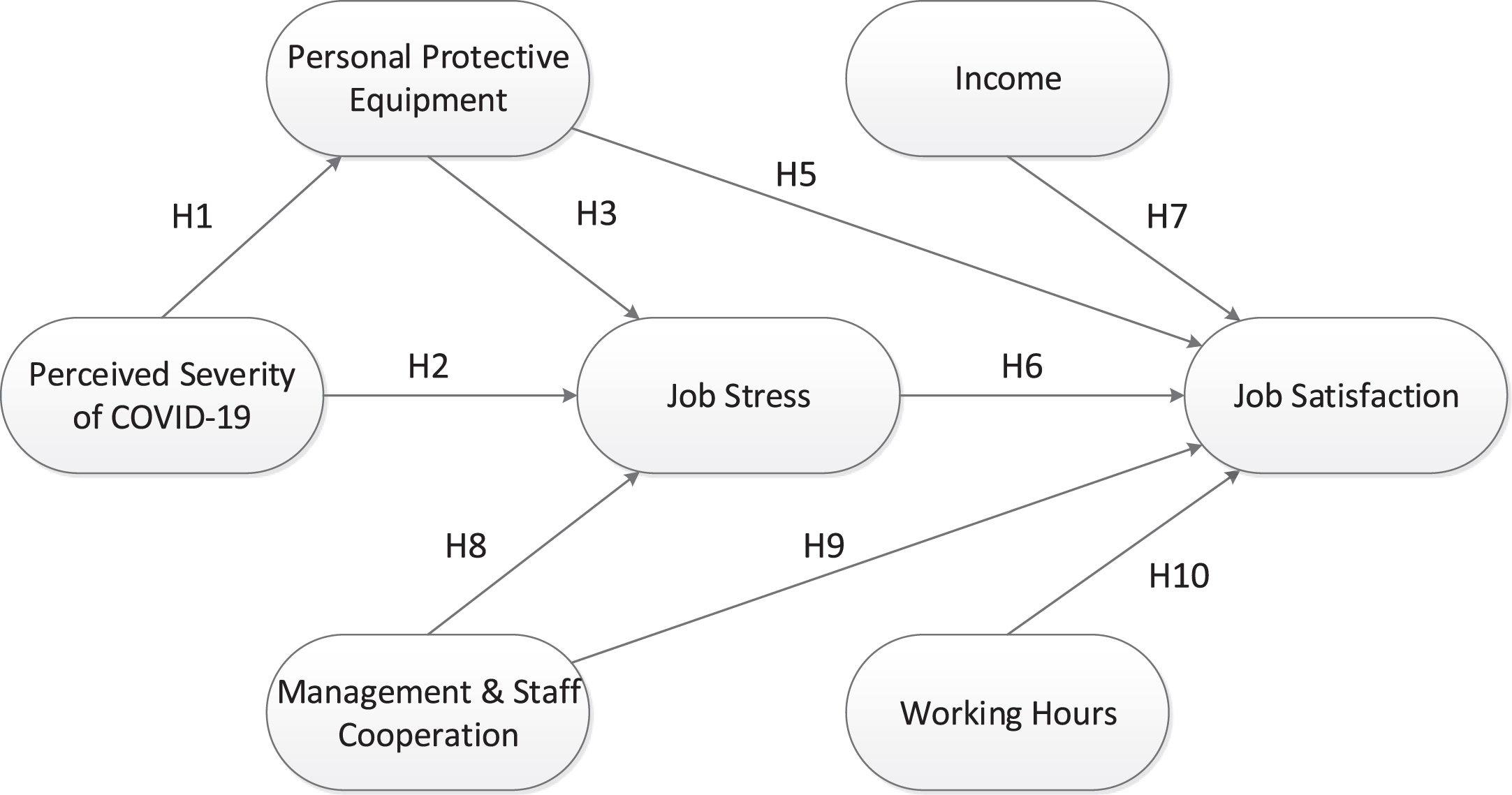
The proposed model construct in the current study.
Study participants
A total of 310 dentists between 23 to 54 years old (mean: 27.57, standard deviation: 4.54) voluntary participated in the current study (Table 1). They were registered in the Indonesian Medical Council and practiced before and/or during the COVID-19 pandemic. Among 310 dentists, a total of 242 (78.1%) were reported still working during the COVID-19 pandemic.
Socio-demographic characteristics (n = 310)
Socio-demographic characteristics (n = 310)
Since the study was conducted during the new normal of the COVID-19 pandemic, an online questionnaire was distributed from August 10, 2020 to October 1, 2020 using convenience sampling method. It was distributed from one dentist to another dentist. Although this study was not required ethical approval, the data were collected anonymous, the confidentiality of the data was guaranteed, and the informed consent was obtained before the subject filled the questionnaire.
A self-administered questionnaire was developed for this study. It was developed to determine factors influencing job satisfaction among Indonesian dentists during new normal of the COVID-19 pandemic in Indonesia (Table 2). The questionnaire consisted of 9 sections: (1) informed consents, (2) general characteristics of respondents (gender, age, years of practices, and practice during the COVID-19 pandemic or not), (3) perceived severity of COVID-19, (4) job stress, (5) personal protective equipment, (6) management of health services & staff cooperation, (7) income, (8) working hours, and (9) overall dentist job satisfaction. All latent were measured by a 5-point Likert scale.
The constructs and measurement items
The constructs and measurement items
SEM was computed by utilizing AMOS 24 with the Maximum Likelihood estimation approach. The Maximum Likelihood estimation approach was selected since it can derive the parameter estimates in a model by utilizing all information in the sets of equations simultaneously [49]. This approach is more advanced than the hierarchical regression since all the hypotheses construct can be analyzed simultaneously. The hypotheses construct had 7 latent variables including 4 exogenous latent variables (perceived severity of COVID-19, management & staff cooperation, income, and working hours) and 3 endogenous latent variables (personal protective equipment, job stress, and job satisfaction).
Following some previous studies that utilized SEM approach [44, 51], 7 indexes were selected to access the model fit: (1) chi-square to degrees of freedom (CMIN/DF), (2) Goodness of Fit Index (GFI), (3) Adjusted Goodness of Fit Index (AGFI), (4) Root Mean Square Error of Approximation (RMSEA), (5) Incremental Fit Index (IFI), (6) Tucker Lewis Index (TLI), (7) Comparative Fit Index (CFI). A value lower than 2.00 for CMIN/DFis widely known as the minimum cut-off for a good model fit [43]. In addition, a value of higher than 0.80 is also a good cut-off for model fit for GFI and AGFI [52]. Similarly, a value of greater than 0.90 for IFI, CFI, TLI was also considered as a good fit [43]. Finally, a value of lower than 0.07 was considered as a good fit for RMSEA [53, 54].
Results
Figure 2 demonstrates the preliminary model of the current study. Based on this figure, there were two insignificant paths: PPE ⟶ job stress (β:0.05, p = 0.743), management & staff cooperation ⟶ job satisfaction (β:0.02, p = 0.882). A final model was derived by eliminating these two paths. In addition, as suggested by Hair [43], the factor loading of each indicator should be higher than 0.5 to make sure the quality of the indicators. Based on Table 3, 17 out of 58 indicators were eliminated since the factor loadings were lower than 0.5, including PS3, PS4, PS5, MS1, MS3, PPE5, PPE6, PPE7, S7, WH4, WH5, WH6, WH7, I6, I7, OS1, and OS2. In addition, following some of our previous studies that utilized SEM approach [34], some modification indices were also applied to enhance the model fit.
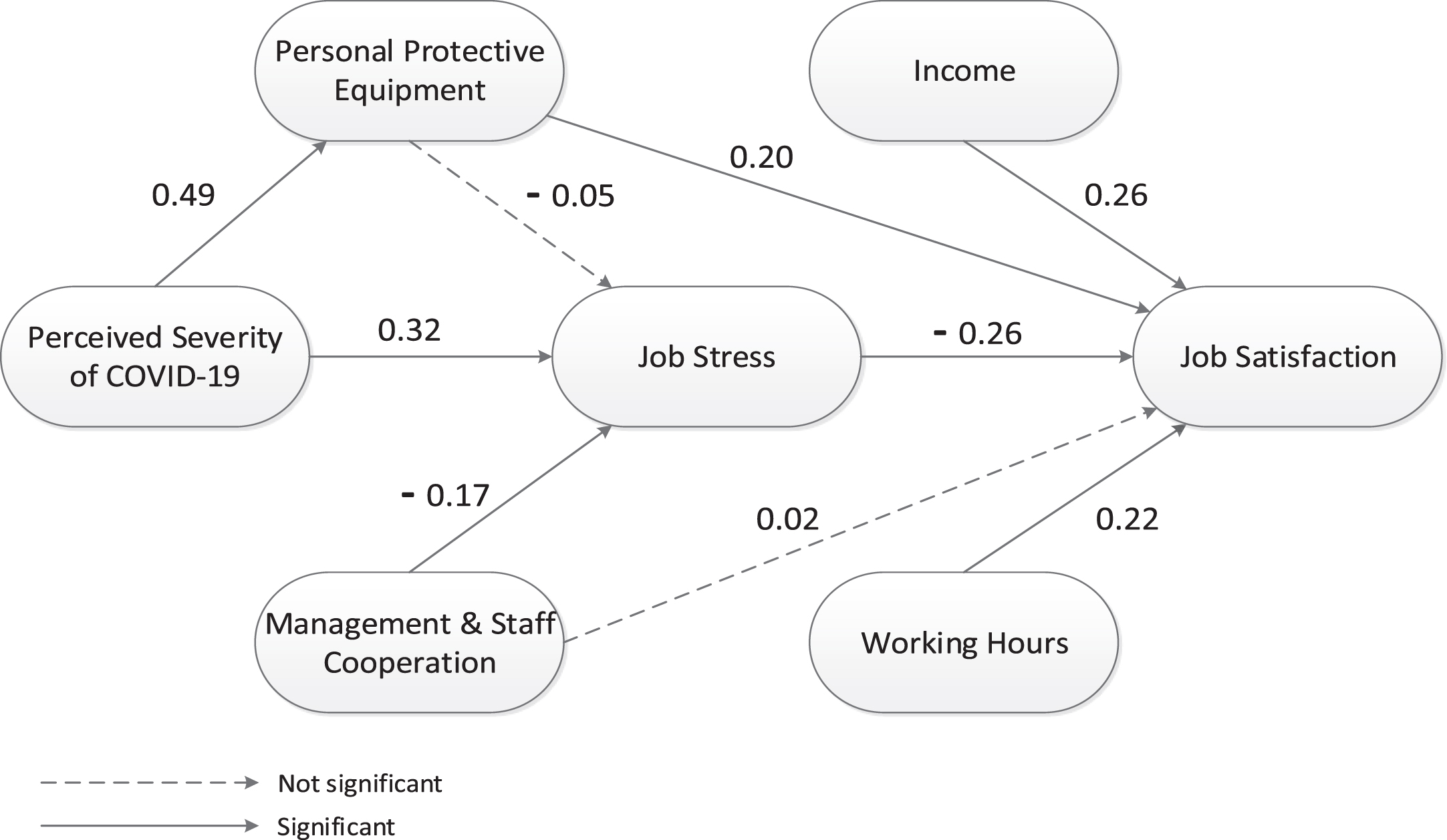
The preliminary model.
Descriptive statistic results
Figure 3 demonstrates the final SEM of factors influencing job satisfaction among dentist during new normal of COVID-19 pandemic. In addition, Tables 4 5 represent the model fit and the direct, indirect, total effects respectively. Based on Table 4, CMID/DF value was 1.739, which was lower than the suggested cut-off of 2.00. The GFI and AGFI values were 0.843 and 0.816 respectively which were higher than the suggested cut-off of 0.8. Similarly, The IFI, TLI, and CFI values were higher than 0.9, indicating that the model is a good representation of the data. Finally, the RMSEA value was also lower than the suggested cut-off of 0.07.
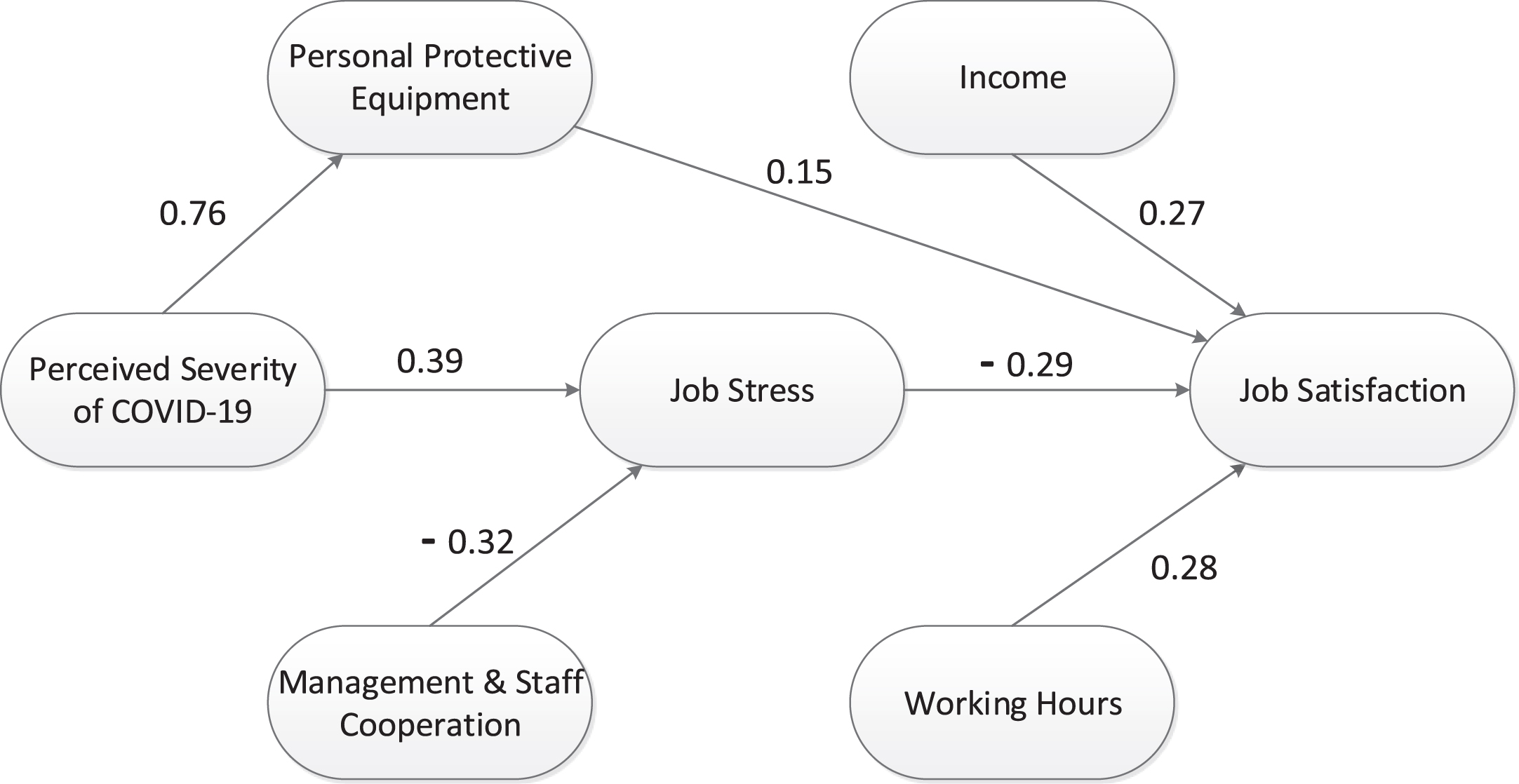
The final SEM of factors influencing job satisfaction among dentist during new normal of COVID-19 pandemic.
Model fit
Direct, Indirect, and Total Effects
According to SEM results, the perceived severity of COVID-19 among dentists had a significant effect on PPE (β:0.757, p = 0.001) and job stress (β:0.394, p = 0.025). A study conducted by Wahed et al. [35] found that risk perceptions of COVID-19 were high due to the fear of transmitting the disease not only to them but also to their family. New guideline of COVID-19 prevention was announced to dentists, especially PPE procedure, due to high possibility transmission in dental practices [12]. This guideline also forced dentists to perform additional cleaning as stated by Houghton et al. [37]. Moreover, as supported by Tysiac-Mista et al. [38], this study suggests the coordination of health services related to the COVID-19 pandemic regarding the availability of PPE should be done when dentists performed their daily practices.
Regarding job stress, our study was in line with Martina et al. [48] that showed dentists considered their job as a high risk to them and their families. Thus, most dentists were scared to return the daily practices. Performing daily practices was a source of anxiety among dentists during large-scale social restriction of the COVID-19 pandemic [48]. Grover et al. [42] explained in their study that research should be focused on the impact of the COVID-19 pandemic among health workers’ mental health. Furthermore, mental health professionals should emphasize that mental health goes hand in hand with physical health in this situation [42].
PPE is a widely discussed issue since this COVID-19 pandemic has begun. The current study showed that PPE in the COVID-19 pandemic had an insignificant effect on job stress. However, Houghton et al. [37] mentioned that a lack of PPE, uncomfortable to use PPE, and feeling isolated and frightened by patients might become a serious concern for dentists. Tysiac-Mista et al. [38] also showed that a lack of PPE led to an overwhelming feeling of fear and anxiety among dental professionals. Moreover, using PPE tends to feel extreme exhaustion as explained by Turkoglu et al. [40].
The current study showed that job stress, working hours, income, and PPE were the main factors influence job satisfaction among dentists during new normal of the COVID-19 pandemic. Based on the SEM results, working hours (β:0.278, p = 0.018), income (β:0.273, p = 0.003), and PPE (β:0.145, p = 0.038) had significant positive effects on job satisfaction whereas job stress had a significant negative effect on job satisfaction (β:–0.286, p = 0.001). It could be interpreted that adjusting the working hours, income, PPE, and controlling the possible factors that affect stress during this COVID-19 pandemic should be done by the stakeholder for improvement of job satisfaction among dentists.
Interestingly, this study showed that income found to be one of the most significant factors in job satisfaction. This result was similar to several studies [19, 29] that showed income as a significant determinant of job satisfaction. According to Sasso et al. [28], dentists working in a large group setting are more satisfied with income and benefit than the dentist in solo practice. Benefit packages received by the dentists in a large group setting may impact their job satisfaction level [18].
SEM indicated that working hours significantly affect job satisfaction among dentists during new normal of the COVID-19 pandemic. This finding was supported by K. Goetz et al. [23] that working hours are one of the significant factors that affect overall job satisfaction among dentists. In line with this study, Luzzi and Spencer [14] also stated the flexible working hours of dentists may improve their job satisfaction. Slightly different from the existing study explained before, Al-Buainain et al. [24] found that the possibility to take an opportunity for part-time work besides daily practices affects the least job satisfaction among dentists.
PPE is the job satisfaction factor that has been found by the current study among Indonesian dentists during new normal of the COVID-19 pandemic. As explained by Zhang et al. [41], the importance of physical protection led to access to PPE become job satisfaction factors among health workers in Iran during the COVID-19 pandemic. Our study had completed the previous studies [54–58] by providing an overview of job satisfaction among Indonesian dentists that were affected by the PPE factor.
Regarding the job stress, this study showed a significant negative effect on job satisfaction. This result was similar to a study conducted by Roth et al. [29] and Cui et al. [22]. Moreover, Purine et al. [26] and Ab-Murat et al. [59] explained that dentists experience different kind of mental health impairments such as nervousness, physical burnout [58], anxiety, depression, sleeplessness, lack of self-esteem, and loneliness in their daily practices [26, 59]. This finding showed that stress and other mental health impairments threaten the mental health of dentists in their daily practices that may affect their job satisfaction. We suggest that preventive measures should be taken to reduce stress-causing factors for dentists during the COVID-19 pandemic.
Finally, regarding the management and staff cooperation of the health services factor, our study found this factor had a low significant indirect effect on job satisfaction (β:0.091, p = 0.002). Meanwhile, this factor had a significant negative direct effect to job stress (β:–0.319, p = 0.003). Although this finding differs from Roth et al. [29] and Sasso et al. [28], it could be interpreted that the stakeholder should pay attention to the management and staff cooperation of health services, so that it improves job satisfaction among dentist by reducing the job stress factor among dentists during new normal of COVID-19 pandemic [60].
Despite the high novelty and substantial contribution of the study, we would like to acknowledge several limitations about the current study’s findings. First, our study assumed that the dentists were under homogenous institutions, in fact, dentists can work either in the hospital, clinic, or even in a small public health center. Future research to examine the effect of the institutions to the overall satisfaction would be a good research topic. Second, the respondents were not under the same province or city. Different provinces or cities could lead to a different level of perceived severity of COVID-19. In Indonesia, several provinces are under the green zone which means that the local transmission is less severe. Last but not the least, the current study selected six main factors as the main contributing factors to job satisfaction. In fact, there are several more factors that can influence the job satisfaction among dentists such as relationships with patients, the government supports, and even the existence of health insurance [61, 62]. Future research that incorporates these latent variables in the SEM would be a very promising research topic.
Conclusion
COVID-19 is a global crisis in 2020 [61]. In Indonesia, a total of 117 dentists were infected by COVID-19 as of September 29, 2020. Ironically, 33 dentists were passed away due to COVID-19 as of February 15, 2021 [5] and the numbers could be higher since Indonesia is one of the countries that seriously hit by COVID-19 pandemic.
The purpose of the study was to determine factors influencing job satisfaction among Dentist during new normal of COVID-19 pandemic in Indonesia by utilizing Structural Equation Modeling (SEM) approach. Several latent variables such as perceived severity of COVID-19, staff cooperation & management commitment, personal protective equipment, stress, working hours, income, and overall satisfaction were analyzed simultaneously. A total of 310 dentists from Indonesia were voluntary filled an online questionnaire, which contained 58 questions. SEM indicated that perceived severity of COVID-19 had significant effects on job stress (β:0.394, p = 0.025) and personal protective equipment (β:0.757, p = 0.001). Subsequently, working hours (β:0.278, p = 0.018), income (β:0.273, p = 0.003), and PPE (β:0.145, p = 0.038) had significant positive effects on job satisfaction whereas job stress had a significant negative effect on job satisfaction (β:–0.286, p = 0.001). In addition, management & staff cooperation was found to have a significant association with job stress reduction (β:–0.319, p = 0.003) which subsequently led to higher satisfaction. Interestingly, working hours and income were found to have the highest effect on overall satisfaction indicating that the policymakers should concern more on these two factors in order to enhance the job satisfaction among dentists in Indonesia.
The current study is one of the first studies that analyzed the job satisfaction among dentist during the global COVID-19 pandemic in Indonesia. The integrated latent variables can be applied and extended to evaluate the job satisfaction among dentists during the COVID-19 pandemic in other countries. Finally, this study contributed as a theoretical foundation for policymakers to enhance the job satisfaction of dentists during the COVID-19 pandemic.
Footnotes
Acknowledgments
The second author, Titis Maulanti DDS, would like to thank Indonesia Endowment Fund for Education (LPDP) for supporting the study. In addition, the authors would like to thank all dentists in Indonesia who voluntary participated in this study.
Conflict of interest
The authors declare that they have no known competing financial interests or personal relationships that could have appeared to influence the work reported in this paper.