




Abstract
BACKGROUND:
Worldwide ageing and thus, workforce ageing, is a concern for both developed and developing nations.
OBJECTIVE:
The aim of the current research was to determine, through a systematic literature review, the effects of age in three dimensions that are often used to define or assess productivity at work.
METHODS:
PICO framework was used to generate search strategies, inclusion criteria and terms. Scopus and PubMed databases were used. Peer-reviewed journal papers written in English and published (or in press) between January 2014 and December 2018 were included.
RESULTS:
After filtering through inclusion criteria, 74 papers were included in the review. Considering productivity, 41%of the findings showed no differences between younger and older workers, 31%report better productivity of younger workers and 28%reported that older workers had better productivity than younger workers. Performance was better in older workers (58%), presenteeism generally showed no significant differences between age groups (61%). Absenteeism was the only outcome where younger workers outperformed older workers (43%).
CONCLUSION:
Overall, there was no difference in productivity between older and younger workers. Older workers performed better than younger workers, but had more absenteeism, while presenteeism showed no differences. As ageing has come to workplaces, holistic approaches addressing total health are suggested to overcome the worldwide workforce ageing phenomenon.
Introduction
Humanity is living an unprecedented situation. We are living longer than ever before [1, 2]. It is estimated that by 2050 the world’s population aged 60 years and older is expected to be about two billion, and today, 125 million people are aged 80 years or older [3]. By 2050, there will be almost this many (120 million) living in China alone, and 434 million people in this age group worldwide. By 2050, 80%of all older people will live in low- and middle-income countries [3].
Aging has been defined as the persistent decline in the age-specific fitness components of an organism due to internal physiological deterioration and as a complex biological process in which changes at mol-ecular, cellular, and organ levels result in a progress-ive, inevitable, and inescapable decrease in the body’s ability to respond appropriately to internal and/or ex-ternal stressors [4]. It is undeniable that ageing is associated with more chronic illness and other concomitant conditions, such as hearing loss, cataracts and refractive errors, back and neck pain, osteoarthritis, chronic obstructive pulmonary disease, diabetes, depression, and dementia [3]. It is often assumed that ageing presents biological and social changes in individuals, resulting from the impact of the accumulation of a wide variety of molecular and cellular damage over time which leads to a gradual decrease in physical and mental capacity, a growing risk of disease, and ultimately, death. However, these changes are neither linear nor consistent, and they are only loosely associated with a person’s age in years [1, 3], otherwise why while some 70 year-olds enjoy extremely good health and functioning, other 70 year-olds are frail and require significant help from others? While frailty is generally regarded as a problem of old age, the symptoms by which the phenotype is identified can also occur in younger people [5].
Age has been linked with decrements in some cap-acities, both physical and cognitive [4]. However, ageing alone is not necessarily associated with illness or lower performance, since there is a wide variation of ageing effects on people‘s capabilities related to how closely they are associated with other factors such as regular physical activity and everyday pract-ice of a particular skill. For example, physical str-ength can be associated with a lack of use, and it is not uncommon to find industrial working populations to show a conditioned pattern as a result of years of physical work, thus strength and work capacity can be maintained as they grow old [6, 7]. The definition of which age can be considered as “old” regarding work varies. For example, according to the Centers for Disease Control and Prevention (CDC), the age of 40 years is used as a starting point for the “older worker” [4] while the World Health Organization (WHO) states that it should be 45 years of age [8].
There are several definitions of productivity. For instance, the Organization for Economic Co-ope-ration and Development (OECD) defines it as a ratio of a volume measure of output to a volume measure of input use [9]. The International Labour Office (ILO) defines productivity as how efficiently resources are used; where it can be measured in terms of all factors of production combined (total factor productivity) or in terms of labour productivity, which is defined as output or value added divided by the amount of labour used to generate that output [10]. According to this latter definition, labour productivity increases when value added rises through the better use of all factors of production, either through efficiency or effectiveness or both [11]. Efficiency is determined by the amount of all types of resources that are necessary to obtain certain results and effectiveness by comparing what can produced with what was actually produced (i.e. planned versus actual outputs). Consequently, effectiveness is not related to the amount of resources that need to be committed to achieve that output. Productivity can be determined by looking at the obtained production (effectiveness) versus the invested effort for reaching the result (efficiency) i.e., if we can reach more with less effort, the level of productivity increases. Therefore, productivity can be defined as the sum of efficiency and effectiveness [11]. Some authors define productivity in terms of absenteeism and presenteeism [12, 13]. This is also correct, since not attending at work and getting paid (absenteeism) and showing up to work sick and producing less (presenteeism) can be converted to either direct or indirect cost, thus affecting productivity. In the current review, productivity will be considered in terms of three main components: performance (qu-antity or quality of work performed), absenteeism (not showing at work) and presenteeism (showing up sick).
Productivity deficiencies and age stereotypes are common towards older workers. The overall percep-tion is that older workers are weaker, have less ada-ptability, are less technologically savvy and show overall less performance than their younger counterparts. This can translate into discriminatory policies, thus affecting perceptions at an individual, company and state’s point of view, contributing to the creation of artificial barriers to older workers. [14–21]. A mixture of stereotypes and facts related to the decline associated with ageing are present in the literature and in the general populations thinking, which could prevent a sustainable working and overall quality of life for older workers (current and future). Therefore, the aim of this paper was to find, through a systematic literature review, the level of productivity of older workers when compared against their younger counterparts.
Methods
To achieve the outlined goals, the systematic literature review (SLR) methodology [22] was used in this study. This methodology, besides being replicable and scientifically transparent, is also very useful to generate a basic framework for an in-depth analysis of the existing literature [22]. However, prior to the SLR, and as suggested by Denyer and Tranfield [23], a scoping study (exploratory review) of the field was produced. This was helpful to elucidate the existing basis of the topic, to identify if the proposed SLR fits the current body of knowledge, to define the key concepts and to define the research question to be addressed. Also, this SLR followed the five-step approach defined by Denyer and Tranfield [23]: Step 1: question formulation Step 2: locating studies Step 3: study selection and evaluation Step 4: analysis and synthesis Step 5: reporting and using the results
Step 1: Question formulation
The first step (Step 1) of this SLR consisted of def-ining the research question for the study. The PICO (Population, Intervention, Control, Outcomes) fram-ework was used to generate this question since, according to Sacket et al. [24] and Thabane et al. [25], dividing a research question into four categories allows for a better understanding and identification of relevant information. Hence, the research question formulated for this SLR was: In workers’ population (P), how does the age group (I) younger (<45 years old) or older (>45 years old) (C) influence the work productivity (O)?
Step 2: Locating studies
Step 2 comprised the selection of the bibliographic databases and the definition of the search strings to be used, which were aligned with the research question. Scopus and PubMed databases were selected as they cover a wide range of research areas with the most relevant peer-reviewed journals [26]. The sea-rch strategy considered 3 categories that were com-bined using a Boolean AND operator: (Work terms) AND (Ageing Terms) AND (Productivity terms). The terms within each category were combined using the Boolean OR operator (Table 1).
Search terms
Search terms
Then, in Step 3, the inclusion and exclusion criteria were defined to select the most relevant studies to include in the review. The following key inclusion criteria were defined prior to the search: The search string was applied for Title, Abstract and Keywords in Scopus and Title and Abstract in PubMed; Original articles written in English and published (or in press) in peer-reviewed journals between January 2014 and December 2018.
References and abstracts were loaded into Mendeley and then transferred to Rayyan software, which was used, by three of the authors, for the screening of title and abstracts to identify relevant papers to retrieve for full text analysis. This process was performed independently by two of the authors applying the exclusion criteria at level 1a (Table 2) adapted from Kennedy et al., [27]. If the authors did not know how to answer a question, they were instructed to move forward to Level 1b (Table 2). Disagreements between authors were referred to a third author, and a decision was then made regarding its inclusion. Finally, full texts were independently reviewed for inclusion by the three authors applying the exclusion criteria defined at level 1b (Table 2).
Screening questions and the response that led to exclusion
Screening questions and the response that led to exclusion
RCT: random control trial, NRCT: Non-randomized controlled trial.
Step 4 consisted of analysing each paper in detail, extracting, and storing the information, to identify key issues. Primary studies meeting the inclusion criteria, which were reported in included reviews, were identified and the corresponding data extracted using a standardized data extraction form. The Quality Assessment Tools known as “QualSyst tools” was selected as it allows appraising quality and assessing potential for bias over a wide variety of research designs from experimental to observational [28]. Furthermore, this tool has one version for quantitative studies and another one for qualitative studies. The former version was the one used in this review. The quantitative version corresponds to a checklist of 14 questions, giving the possibility of answering “yes”, “no”, “partial” or “not applicable”. The corresponding score are 2 points for “yes” 1 point for “partial”, and 0 points for “no”. The total score is the average score computed with all (applied) answers.
The QualSyst was used by three of the authors to evaluate the internal and external validity of the studies considered in the review. The QualSyst tool was originally created as a threshold that allows a study to be included in a review through a cut-off point (0.55 to 0.75) [28]. In this review the QualSyst cut-off score of 0.55 was chosen in order to capture 75%of the articles initially deemed as relevant for the review as well as to ensure inclusion of several descriptive articles which contained valuable data [29].
Step 5: Reporting and using the results
The current paper can be considered as a formal presentation of the results obtained, comprising Step 5. The results were grouped (Tables 4 10) according to the productivity variables considered namely: performance, presenteeism and absenteeism. In this paper productivity considered the three variables me-ntioned before. Furthermore, the results were categorized according to the sample population considered in the reviewers’ papers: workers with no baseline sickness nor health condition and workers with a declared baseline sickness or health condition.
Summary of the results
Summary of the results
BS: baseline sickness, HC: health condition. For this study productivity is performance + presenteeism + absenteeism.
Performance findings with no specific baseline sickness
*Author with multiple findings and present in more than one table.
Presenteeism findings with no specific baseline sickness
*Author with multiple findings and present in more than one table.
Absenteeism findings with no specific baseline sickness
*Author with multiple findings and present in more than one table.
Performance findings with specific baseline sickness or condition
*Author with multiple findings and present in more than one table.
Presenteeism findings with specific baseline sickness or condition
*Author with multiple findings and present in more than one table.
Absenteeism findings with specific baseline sickness or condition
Overall results
Figure 1 shows the results of the search strategy. The search on the databases resulted in an initial number of 9,048 papers (SCOPUS: 7,723 and PubMed: 1,325), which was then reduced to 8,063 after the removal of duplicates entries. After screening the title, abstract and keywords of each article, 126 papers were identified as being potentially relevant. After reviewing the corresponding full-texts, 85 papers were selected based on the inclusion criteria. Finally, after applying the QualSyst, nine papers were removed due to their methodological quality and thus 74 papers were included in the final review.
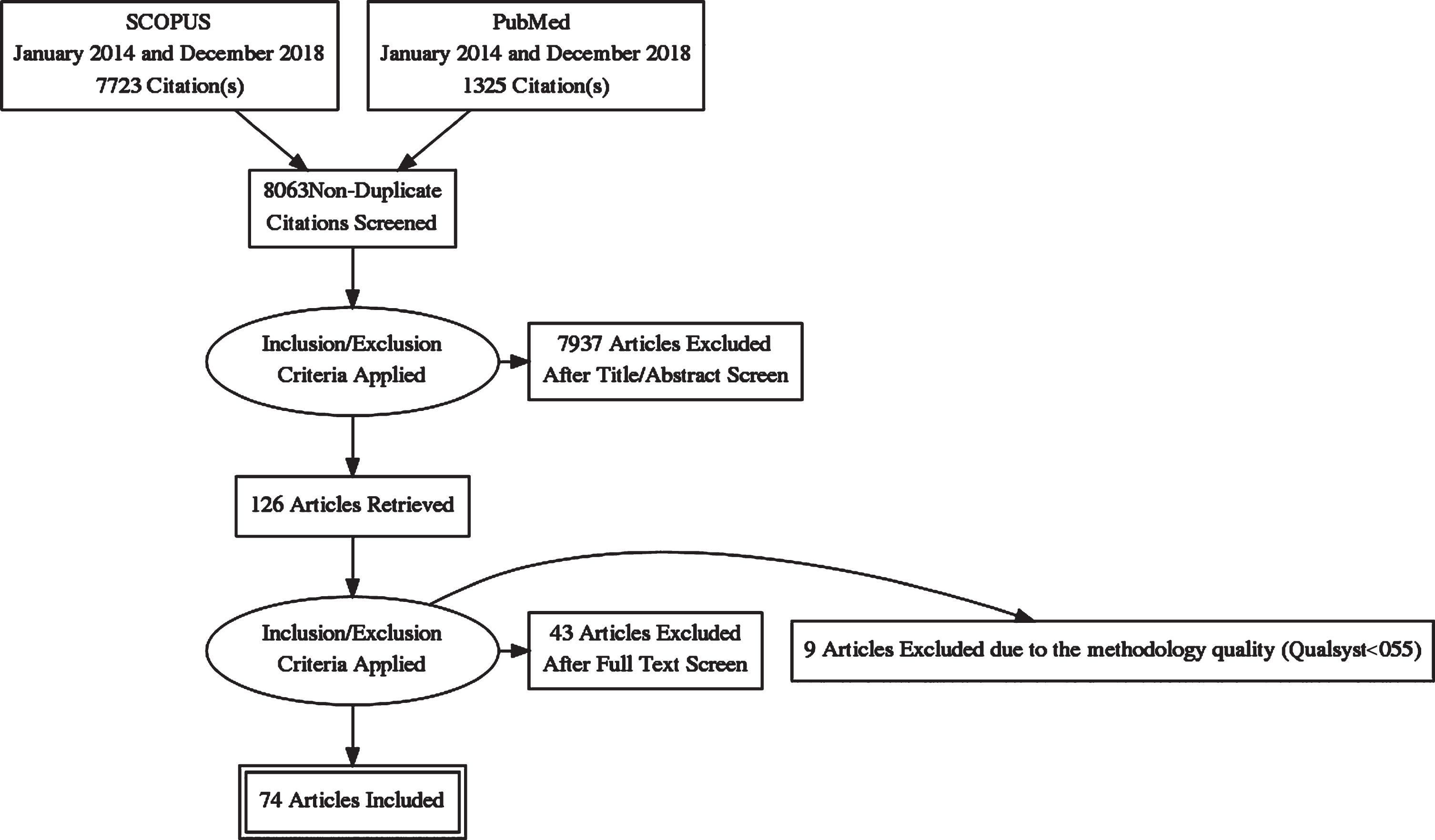
PRISMA flow diagram of included studies.
Even though 74 papers were included, some of them considered more than one outcome, therefore in order to calculate %and frequencies, if one study considered more than one outcome, it was counted as a new one to the overall quantity within a particular outcome. Therefore, 88 findings were retrieved, of which 19 were related to performance, 18 were related to presenteeism and 51 were related to absenteeism. Some papers considered populations with specific diseases or baseline sickness and other considered the outcomes without mentioning any particular disease. All of them were included but analyzed separately, since absenteeism and presenteeism inherently imply that people has become ill to the point of showing sick at work or not showing at all, independently of the causes. In the case of studies that considered workers with baseline sickness or health condition, only those studies were age comparisons were made (i.e.: younger workers (under 45 years old) versus older workers (above 45 years old with the same disease or health condition).
For example, Gangan and Yang [30] considered absenteeism in workers suffering from depression or the case of Ackerman et al. [31] that analyzed outcome variables patients with knee osteoarthritis. Others, however, only mentioned the outcome without specifying any particular disease, such as Ang and Madsen [32] and Chiesa et al. [20].
The obtained findings used longitudinal (20) and cross-sectional (67) research approaches. Studies included in the current review considered many countries part of 5 continents. Table 3 summarizes the continents and main countries of the selected studies. Note from Table 3, that some papers used data or studied outcomes in more than one country, thus the quantity does not match the actual number of studies.
Continent and countries of studies analyzed
Before presenting the results, it is important to mention the column with results presented in Tables 4 10. The findings were classified as (+) when older workers performed better in a particular outcome than their younger counterparts, (–) when older workers performed worse than younger workers and (+/–) when there was no difference between older and younger workers. Out of the total 88 findings included for analysis, 63 did not report any particular disease or health condition. From those 63 findings, 12 findings came from seven studies that had more than one outcome. 25 findings came from studies that did report a particular disease or health condition related to one of the outcome variables, where 9 findings came from four studies reported more than one outcome. A summary of the described findings can be seen in Tables 4 10.
As can be seen in Table 4, the majority of the studies analyzed regarding performance, considering both studies focused on a particular illness or in general, show that older workers are more productive than younger workers. In 58%(11 out of 19) studies showed that older workers had higher productivity than younger ones. Following this trend, it was found that in 26%(5 out of 19) there were not significant differences between ages. Finally, 16%(3 out of 19) of the papers showed that younger workers were more productive than older ones.
Presenteeism
Observing Table 4, regarding presenteeism, 61%(11 out of 18) of the studies did not find significant differences between ages. Followed by 28%(5 out of 18) that found older workers had less presenteeism that younger workers and 11%(2 out of 18) where younger workers had less presenteeism.
Absenteeism
Also from Table 4, when considering absenteeism, 43%(22 out of 51) of the studies found that older workers had higher absenteeism than their younger counterparts, 39%(20 out of 51) showed that there were no differences between older and younger workers and 18%(9 out of 50) reported that older workers had lower absenteeism than younger ones.
Productivity
Finally, productivity results from Table 4 show that in 41%of the findings there was no significant difference between older and younger workers, followed by 31%where younger workers had better indicators than older workers and 28%where older workers had better results than their younger counterparts.
Workers with no baseline disease nor health condition
As can be seen in Table 4, 63 out of 88 findings used one of the outcomes under study without mentioning a baseline sickness nor health condition.
Performance
A total of 17 findings conveyed performance, where 11 (65%) found that older workers outper-formed their younger counterparts (+), three (18%) found younger workers performed better and three (18%) found no difference between older and younger workers (+/–).
Presenteeism
As can be seen in Table 6, 11 findings used presenteeism, where in Table 4, (36%) older workers presented less presenteeism than young workers (+); five (46%) found that there were no differences between young and older workers (+/–); and two (18%) showed that young workers had less presenteeism (–).
Absenteeism
From Table 7, it can be observed that 35 findings evaluated absenteeism, where in seven (20%) older workers had lower absenteeism (+); 12 (34%) showed no differences between young and older workers (+/–) and in 16 (46%) studies young workers presented less absenteeism (–).
Workers with a declared baseline sickness or health condition
As mentioned before, there were 25 findings that focused on performance outcomes in workers’ populations with a baseline sickness or health condition, such as diabetes, depression, TMERT, arthritis, chronic pain, osteoarthritis, cardiovascular diseases, among others. It is important to highlight that four studies presented more than one dependent variable (Performance, Absenteeism and Presentism).
Performance
Only two findings included (Table 8) did not find significant differences between older and younger workers’ performance (+/–). In these particular cases, they focused on workers with chronic health conditions, like respiratory conditions, mental illness and cardiovascular diseases, among others [89] and in teachers with voice disorders [86].
Presenteeism
Observing Table 9, it can be noticed that seven findings evaluated presenteeism. In one, where all workers had knee osteoarthritis, young workers were found to report more presenteeism than older workers (+). On the other hand, in the remaining six, no differences were found between young and old workers (+/).
Discussion
The aim of this of this article was to find, through a systematic literature review, what is the level of productivity of older workers when compared against their younger counterparts. Reviewing the 74 papers selected according to the pre-defined criteria and ext-racting the 88 findings, it is possible to note that 41%showed no significant differences between you-nger and older workers in productivity; 31%of the reviewed findings report better productivity of younger workers compared to the oldest and 28%reported that older workers had better productivity than younger workers. Overall, there is evidence indicating that older workers have no difference in productive than younger workers. However, it is important to mention that these results are different from the findings presented by other research, that found negative impact of age in productivity, especially those that used the company (or overall) pro-ductivity associated with age [101–104]. Changes in workforce age structure may have an impact on production system performance or productivity; however, despite several reviews of aging and work productivity that have been conducted previously, the link between age and productivity is still unclear due to the lack of empirical evidence, and by the fact that productivity effects of aging are still difficult to be estimated [105].
In this section, the primary review findings are discussed separately according to each variable: performance, presentism and absenteeism. The authors realized that the diverse nature of the studies and the variables used in the reviewed studies were quite different, mainly due to the populations studied, age cut-off points to define older workers used and mostly the definitions used to define productivity.
Performance
Regarding performance, it was found that older workers had generally higher levels than younger workers. A possible explanation could be the inverted U-shaped model of performance related to age. Basically this theory states that performance is low in the beginning of an individual‘s work life, then starting to increase as the person gains experience and confidence, for then reaching a plateau, and finally slowly decreasing until retirement age [106]. The inverted U- shaped model has been reported by other authors, with different peak ages, but all of them find that a person's performance, even though it is might be lower than their peak, is higher than were they were young beginners [107–109]. Study design is also related with the inverted U-shaped performance model. For example, there may be differences in re-sults depending upon whether data were collected cross-sectionally or longitudinally. For example, the effect of intraindividual aging on performance obs-erved in longitudinal studies may be smaller in magnitude than the effect of broad age group differences observed in cross-sectional studies at any one point in time [110]. Thus, examining the potential moderating effects of sample and data collection characteristics is not only important for research methodology purposes but for theoretical and practical reasons too. It allows to identify the conditions under which age is likely to have positive, zero, or negative associations with various components of job performance [110]. In the current review, only 2 papers used a longitudinal design, where 1 found older workers had higher performance [33] and 1 found no difference [86]. Meanwhile, 17 studies used a cross-sectional design, where 10 found that older workers outper-formed younger workers, 5 found no differences and 2 that showed younger workers outperformed older ones. Since there were only 2 studies that analyzed performances with a longitudinal design, it is difficult to say if design had an effect in the results.
It might be possible that physically demanding jobs (strength, vision, endurance, etc.) could act as a confounding factor, making older workers to perform in a poorer manner compared to younger ones, especially considering the fact that by varying levels, decline experienced by ageing in those areas [6]. It is worth mentioning however, that this is not a rule and should be taken with caution, since people that have higher levels of healthy life expectancy through being active, both socially and physically at work and at their personal life’s, usually experience no significant problems impacting their performance with increasing age [3, 15]. From a physical performance standpoint, an older worker’s experience may allow him or her to compensate for excessive physical de-mands [111], therefore type of work is also relevant to performance. For example, in the current review, some studies used nationwide registers [32, 36] of workers while others used specific sectors [44, 84]. The latter ones allow to discuss the implications of work characteristics. The majority of the studies where older workers showed better performance were associated with services, such as financial services, healthcare, public service and community work, food service and academics [20, 44]. Just two studies of the ones that mention a particular sector or occupation showed poorer results in older workers in financial services and healthcare [35, 42]. Even though older workers can experience a decrease in some capabilities, other attributes such as wisdom and emotional maturity improve with age [111]. This emotional improvement has been reported in professional orchestra musicians, were older ones reported less anxiety while performing [87], possibly explaining why in the current review most of the papers that reported better performance in older workers were in the sector related with service. Contrary to what could be expected, two studies that found better performance in the older groups, were conducted in jobs more physically demanding, such as operators/ harvesters and manufacturing [43, 45]. In general, capability declines can affect workers but not necessarily their performance. For instance, after passing the performance maximum for men and woman in the age of 20 to 30 years, inevitably a continuous decreasing in muscle strength occurs, however, in industry this is less of a concern nowadays with the diminishing role of physical work than in a time when it was the human body’s physical strength that was of the highest importance [6]. Ageing is not always linked to physical under performance, since firstly people that have higher levels of healthy life expectancy through being active, both socially and physically at work and at their personal life’s, usually experience no significant problems impacting their performance with increasing age [3, 15]. From a physical performance standpoint, an older worker’s experience may allow him or her to compensate for excessive physical demands [111]. Most of the evidence used to argue under performance in older workers that found reduction in physical capabilities used maximal capacities, and not the submaximal ones commonly used in industry, thus the ecological validity of these findings can be certainly questioned [7]. The same applies to cognitive capabilities, where although changes in cognition have been shown to occur across the lifespan, research has also indicated that such changes in laboratory tests (often times novel tasks) do not parallel changes in work performance. For instance, many jobs in which older workers are employed rely heavily on accumulated knowledge that relates to crystallized intelligence [111]. Research has shown that older adults perform well at tasks at which they are expert or in environments in which they are familiar [112].
These findings provide evidence that, for instance, a worker may not have enough experience to perform certain jobs when younger, but may have too slow of a reaction time or not enough physical strength to perform other tasks when older, therefore, the ideal work situation is one that matches the demands of the job to the abilities of the employee in order to facilitate optimal worker performance without the employee experiencing any health problems [111]. This review provides evidence that performance is not affected necessarily by age, probably due to compensatory strategies [111]. “Aging is a very dynamic process. You can be too old for a job at 30, and too young for a job at 45. It’s a continuous process” [113].
None of the reviewed studies considered the subjective age which was consider an important performance factor, since feeling younger than chr-onological age has been related to increased health, vitality, and productivity [114, 115]. Additionally, there were several confounding factors that studies due to methodological and economic constrains cannot address entirely. For example, some studies used and controlled several variables such as income level or job position and age but were conducted in one company or sector [20, 35], whilst other used quite large and representative samples and accounted for a very good sampling strategy but used and controlled fewer variables [32, 39].
Presenteeism and absenteeism
Presenteeism was found to mainly have no significant difference between ages (61%). However, 28%of the studies that considered this outcome found that older workers had less presenteeism than their younger counterparts, while 11%found the opposite. Again, in all of the reviewed studies, presenteeism was self-reported which may have produced biased findings in the older worker groups.
Absenteeism analyzed in the publications, showed that 43%of them reported that older workers had higher levels absenteeism, followed by 39%that sho-wed no differences and 18%that showed that younger workers had more absenteeism. This is probably to the fact that ageing is often associated with higher rates of chronic illness, therefore it was not a surprise and it was already reported in previous works [3]. When comparing findings that focused in studies with no declared condition and those that studied younger and older workers with a particular disease (i.e. arthritis), it was found that 50%of the findings showed no significant differences in those with a particular disease versus 34%in those with no declared illness. In fact, when performing the same analysis, the findings with no declared illness shows that in 46% of them younger workers had less absenteeism compared to 38% in the group with a declared condition. Thus, it could be implied that when sick, age might not be as important as the sickness in itself. This was the case for example, in a study comparing young versus older workers with knee or hip osteoarthritis [31]. Therefore, one could assume that absenteeism rates in older workers could be due to diminished physical capabilities mediated by age related illness, being illness the key point and not age. This indicates that a particular sickness is generally responsible for absenteeism and not merely age. Further studies or reviews could focus in this particular topic in order to elucidated more clearly patterns mediating age, sickness and absenteeism. Other research has found that older workers usually have less accidents but need longer to recover from injuries, thus suggesting that possibly the long time to recover of an older worker can also affect absenteeism [111, 116]. Therefore, overall “safer” jobs and health focus approaches could be used to increase or prevent productivity loses. According to WHO, maintaining healthy beha-viors throughout life, particularly eating a balanced diet, engaging in regular physical activity, and refra-ining from tobacco use, contribute to reducing the risk of non-communicable diseases and improving physical and mental capacity [3]. People have private and working lives, both interdependent from one another, where evidence supports that risk factors in the workplace can contribute to common health problems previously considered unrelated to work and vice versa, there focusing in strategies that address health in general are more effective [117]. This topic will be further discussed in the following section.
Theoretical and practical implications
Ageing of the workforce is here to stay and probably will increase. In the US, according to the U.S. Bureau of Labor Statistics (BLS), nearly 40 %of people ages 55 and older were working or actively looking for work in 2014. That labour participation rate, is expected to increase faster for the oldest segments of the population, especially for those with ages between 65 and 74 and 75 and older through 2024, where in contrast, participation rates for most other age groups in the labour force are not proje-cted to change much over the 2014-24 decade [118]. Europe has experienced similar changes in its workforce, where in 2016 the employment rate for older workers aged 55–64 in the EU stood at 55.3%, com-pared with 66.6%for those aged 15–64 as a whole, where the increase has been largest among older women [2]. However, and despite a substantial gro-wth in the employment rates of older workers over the past decade in many EU countries, the European Commission’s Joint Employment Report 2017 highlights the potential to increase these rates further [2]. Ageing is not happening exclusively in the developed world, it is estimated that by 2050, one in five people in poor nations will be over 60 years old [119].
Age alone is not the only factor associated with productivity, where it is usually mediated with several other ones, such as type of work, work environment and individual characteristics [120]. Also, the relationship between age and work is not simple; factors including the physical nature of the job and worker’s health and fitness interact with age to either increase or decrease the potential effect of age [121]. In that regard, the high rate older people at the workplaces and the coexistence of a multigenerational workforce like never before can present issues at the time to set practical recommendations in organizations [122]. Adding up to the equation are radical changes in work arrangements, due to the fast pace and demanding economic and technological environments. All of them present significant challenges for occupational health and safety, where a lack of holistic long-term interventions addressing the needs of younger and older workers are not commonly found nor known by organization [4, 122].
As mentioned previously in the introduction section, healthy life expectancy is key, where a longer stay in good health improves average labour productivity during working age. WHO defines healthy life expectancy as the average number of years that a person can expect to live in full health [123]. Over the last century, healthy life expectancy increased about one-to-one with life expectancy, meaning that future generations are not only expect to live longer but also to live a longer part of their life in full health [15]. Therefore companies and governments that encourage practices, incentives and policies that aim to improve Total Worker Health (TWH), should be imitated, since it has been suggested that implementing policies and practices addressing TWH has helped maintaining a healthy private/work life [117, 122]. TWH, concept used by NIOSH in the early 2000, stands for “policies, programs, and practices that integrate protection from work-related safety and health hazards with promotion of injury and illness prevention efforts to advance worker well-being” [117]. It involves considering all aspects of work in a coordinated manner, where TWH is concerned with the entire working life of individuals, integrating occupational safety, work health protection programs together with general health promotion may be more effective for safeguarding worker safety, health, and well-being than either of these programmatic activities on their own [117, 122]. TWH differs from traditional wellness programs in that it includes all aspects that might contribute to illness in a systemic integrated manner, and not focusing only in isolated one-dimensional interventions [122]. Since absenteeism is more prevalent in older people, TWH could provide a more effective framework for future research and interventions, thus aligning more with healthy life expectancy and considering the individual as a nontrivial being. Supportive environments enable people to do what is important to them, despite losses in capacity [3, 123–125]. Strategies may be needed to identify workers at particular risk of health-related job loss, when older, and to assist them—for example, through interventions to promote their fitness in middle and later life [5]. As mentioned previously TWH can help providing this support framework, through identifying potential difficulties for current and future older workers in order to reduce or eliminating them. This interventions, should focus on several fronts, like nonphysical space, such as changes in work organization such as flexible schedules, part-time work, programmed retirement or job rotation [6].
Additionally, the physical space, like the workstation and overall physical environment can be modi-fied to reduce unnecessary demands, implementing aids related to manual handling, electric tools, lighter equipment, temperature, interfaces and adjustable work stations [6, 126]. Transgenerational Design/ Age-differentiated work design, or designing for all generations, is the best way to address workplace ergonomics, i.e. interventions that are all inclusive and promulgate that better design means better design for everyone, not just older workers [6, 111].
Finally, it is important to considerer that older and younger workers have differences, especially in what motivates them and keeps them engaged at their jobs sustaining high levels of performance. For example, Bal and De Lange [127] found that flexibility is valued differently and make older workers perform better. In particular, they found that flexibility, like working from home and a flexible schedule, are more preferred by older workers and additionally increasing their performance, in order to accommodate caring for self or others, while younger workers report feeling more engaged with their job, but not increasing their performance. Other studies found that the concept of individualized career customization, i.e. to offer different incentives according to preference and individual‘s stage of life, is useful for maintaining performance and reducing absenteeism within older workers. Younger workers prefer more career development incentives while older ones prefer more flexibility [33, 60]. Finally, organizations can retain their older workers longer if they provide sufficient support, the work offered is satisfying, and part-time work is available [128].
Limitation of this review
A probable limitation of this review includes the search process itself, which researchers using this information should be aware of when interpreting the results presented in this paper. This SLR was based on journal papers found in only two specific bibliographic databases (Scopus and PubMed). Despite knowing that these databases cover a very wide range of different areas, searching in different databases, such as Google Scholar or MEDLINE, or checking the references of the articles included could also have provided relevant information that might have been relevant to this review.
One major limitation is related to the information of the analyzed studies. Productivity was often heterogeneously defined. For example, some author take the ILO definition used in the current research, while others define it in terms of presenteeism and/or absenteeism (Gordois et al. 2016; Grossmeir 2015). This presents a challenge for research since it is not wrong or right to use one or another, since in the end, absence and presenteeism can be translated to monetary burden, thus being closely related to performance. Another shortcoming of the literature review was the fact that the most used performance indicator was self-reported by the participants. Obviously this could present bias, therefore this measure could be complemented by performance information from supervisors [129] or company information [130], thus providing a potentially more unbiased source of information. Finally, future research should include work arrangements in the analysis, for example working hours and pays schemes. Work arrangements, such as performance-based salary and long hours, have been shown to impact both health [131] and productivity [132]. Thus, these work arrangements and other ones such as contract type should also be introduced since they can provide a broader view of the issues that can compromise health and productivity, especially in jobs with high physical and/or mental demands such as healthcare [132].
Conclusion
The current review found that older workers do not lose performance when compared against younger ones, in fact they performed better. Presenteeism showed no differences between age groups. The only outcome where older workers showed more adverse results was regarding absenteeism. Possible explanations could be related to the fast pace ageing of the world’s population and its workforce, together with a mixture of complex physiological, socio demographic, economic and technical changes.
New holistic frameworks, such as Total Worker Health (TWH) have linked common chronic diseases that are usually associated with ageing to be in part attributed to adverse work conditions. In fact, it can be considered a vicious cycle since in terms of productivity it also affects it. Holistic interventions focusing on TWH can provide a more accurate framework that can be used to address physical/cognitive decline of and ageing workforce and particularly of more frailty prone individuals, thus maintaining overall health and sustaining both healthy life expectancy and productivity throughout an individual’s life cycle.
Conflict of interest
None to report.
Footnotes
Acknowledgments
This work was supported by the Mutual de Seguridad C.Ch.C en el marco del fondo “Proyectos de Investigación e Innovación SUSESO”. “Trabajo fue seleccionado en la Convocatoria de Proyectos de Investigación e Innovación de Prevención de Accidentes y Enfermedades Profesionales “2017” de la Superintendencia de Seguridad Social (Chile), y fue financiado por “Mutual de la C.Ch.C” con recursos del Seguro Social de la Ley N° 16.744 de Accidentes del Trabajo y Enfermedades Profesionales”.