




Abstract
BACKGROUND:
Cross-national comparisons of students’ school quality of life (QoL) can support our understanding of factors that may affect students’ health and well-being at school.
OBJECTIVE:
To compare Canadian and Israeli students’ perception of their school QoL.
METHODS:
The Quality of Life at School Questionnaire (QoLS) was administered to 1231 students in 4th to 6th grades from Canada (n = 629) and Israel (n = 602), measuring: Physical Environment, Positive Attitudes, Student-Teacher Relationship, and Psychosocial.
RESULTS:
The Canadian students scored significantly higher than the Israeli students on all domains. The two-way ANOVA did not show a statistically significant interaction between country and gender nor age. However, within each country, girls and 4th grade students reported higher overall QoLS.
CONCLUSIONS:
This study lends support for the universal aspects of perceived QoL at school. This information may serve clinicians and educators in setting goals and developing programs to enhance students’ school QOL.
Introduction
Policy makers frequently use quality of life (QoL) to measure and compare the outcomes of health, social and educational services within or between jurisdictions [1, 2] and to guide policy [3]. For children, school is the context in which they spend a large part of their day and that will, ideally, guide and support them to achieve their individual needs and goals for a prosperous and healthy life [4]. Assessment of children’s QoL in school can provide stakeholders with important information regarding the positive and negative impact of development and implementation of educational policies on the well-being of children in school. Although several studies have compared school QoL in different countries [5], research has mostly focused on adolescents and on the psychosocial aspects of QoL. Few studies examined school QoL in students in elementary schools, and none were found to assess the physical environment or the student-teacher relationship, both of which are important aspects of school QoL [2, 6].
School quality of life
Subjective QoL is defined as individuals’ perception of their position in life, in the context of the culture and value systems in which they live, and in relation to their goals, expectations and standards [7]. It reflects the degree of satisfaction or happiness experienced by a person in various domains of life [8]. With respect to the school context, although subjective definitions of QoL vary, most include dimensions such as (a) students’ satisfaction with school [9], (b) promotion of academic achievement and/or sense of responsibility [10, 11], (c) teacher-student relationship [12–14], (d) commitment to school work [9], (e) social relationships and climate [13, 15], and (f) the physical environment of the school and classroom [2].
The literature in this area suggests that school QoL is strongly associated with positive health and academic outcomes as well as overall QoL. For example, positive school environment, supportive peers and good academic achievement promote health and overall QoL [16, 17]. School QoL also positively affects children’s development, ability to learn, as well as their achievement and engagement at school [18–20]. Conversely, among children with lower well-being, 51% did not look forward to going to school, as compared to 19% among those with average to high well-being [21].
Factors that affect school QoL
Age and gender are two factors that have frequently been found to influence students’ perception of their QoL in general, and specifically school QoL. Several researchers have reported that students’ perception of their school QoL or satisfaction at school decreases as they grow older [2, 22]. The findings regarding the role of gender are conflicting. Several researchers found no effect of gender on school QoL [2, 23], while others reported that girls’ perception of their school QoL was better than that of boys [5, 25]. Therefore, age and gender appear to be important factors that need to be considered in studies of school QoL.
Cross-national school QoL comparisons
There is a theoretical debate whether QoL is uni-versal in nature or specific to culture, disease, or disability. The universal approach assumes that assessing the core life domains is relevant for different groups regardless of their cultural or disability because of the basic similarities and human experience. This notion has been supported by studies of individuals with mild to moderate intellectual disability [26, 27] and by several measures of health-related QoL developed by the World Health Organization [28]. The second approach assumes that differences in the perceptions of QoL may also arise due to cultural diversity [29] or policies that may affect school life. This raises the question whether school QoL measures can accurately capture the experience and the emic perspective of the students.
Studies that used general and universal measures of school QoL have found differences in children’s overall subjective well-being and experiences across countries, but data on this topic is limited. An analysis of the International Survey of Children’s Well-Being (ISCWeB) showed that children’s assessments of their satisfaction with school life vary from country to country, ranging from highly positive in Algeria and Ethiopia to low in Germany and Estonia [30]. The objective of this study was to compare students’ perception of their school QoL in two countries, Canada and Israel, taking into account age and gender differences. While these two countries are considered “Western countries”, they also vary in many aspects such as geography, size, and culture. Results of this study may expand our knowledge about shared and different aspects of school QoL in different countries.
Methods
Participants
This study is a comparison of two independent population-based cross-sectional samples consisting of 1231 students in 4th to 6th grades (between the ages of 9 and 12 years) from Canada (n = 629) and Israel (n = 602). Data for the Canadian sample was obtained from students attending 18 schools located in the southwestern rural region of Nova Scotia as part of an evaluation of a health promoting schools program in a regional school board [31]. Data for the Israeli sample was obtained from students attending five general education schools in different cities in Israel. Students were excluded if they were receiving special education services. The students in both samples came from predominantly low to middle class families.
Procedure
Ethics approval for the Canadian study was ob-tained from the Health Research Ethics Boards at Dalhousie University and additional permission was granted from the school board, and for the Israeli sample from the Israeli Ministry of Education. In both samples, parental written consent and students’ oral assent were obtained for all children who participated in the study. In both countries, trained research assistants administered the QoLS. After explaining the study objectives to the students, the research assistants asked the students to fill out the QoLS. They explained that there were no “right or wrong” questions and that the purpose is to learn how the students felt.
Measures
Quality of Life at School Questionnaire (QoLS)
The QoLS is a self-report questionnaire that was developed to assess elementary and middle school students’ perception of their QoL at school due to the scarcity of assessments available to assess school QoL [2, 32]. The questionnaire was based on the World Health Organization’s biopsychosocial model of functioning [33], as well as on the theoretical definitions that view school QoL as students’ feeling of well-being and satisfaction at school. It considers their positive and negative experiences in school context, their relationship with teachers, and their perception of the physical environment. The QoLS’ original language is Hebrew, and the instrument was translated to English, Arabic, and French [6, 34].
The QoLS includes 36 items, 35 of which are divided into four domains: (a) Physical environment of the school and classroom (9 items; e.g., “I have enough light in my class” or “The chairs and tables are comfortable for me”); (b) Positive attitudes toward school (9 items; e.g., “I feel safe at school” and “I am satisfied with my grades”); (c) Student-teacher relationship (6 items; e.g., “I like my teacher” or “my teachers help me succeed”); and (d) Psychosocial aspects (11 items; e.g., “I have friends in school” or “ I have trouble sleeping at nights because of things that happen to me in school”). In addition, there is one general item (“In general, I feel my life at school is good”). Each item is scored on a 4-point Likert-type scale, from 1 –‘never true’ –representing the answer that least describes the reality of the student to 4 –‘always true’ –representing the answer that most describes the reality of the student. A mean score ranging from 1 to 4 is computed for each of the domains as well as for the total QoLS score.
The QoLS was found to have sound internal consistency (Cronbach’s α) in each of the four domains: Physical Environment 0.79; Positive Attitudes 0.85; Student-Teacher Relationship 0.85; Psychosocial 0.83. In addition, the QoLS had good convergent validity as demonstrated by the correlations among the domains and the total score (r = 0.40–0.86). The QoLS was translated into English by its developers using the translation-back-translation and adjustment method [35]. For the Canadian study, the instrument was also culturally and linguistically adapted to the Canadian context (e.g., “whiteboard” instead of “blackboard,” or “walk/bike/ride to school” instead of “way to school”). Similar to the original version, the internal consistency for the four domains in the Canadian version was medium-high (α=0.75–0.87). Convergent validity was moderate to high (r = 0.44–0.86) [6].
Analyses
Analyses were carried out using Stata/SE 13 (Stata Corp., College Station, TX, US). Sample characteristics and QoLS scores were summarized for each country overall and by age and gender. We compared the students’ QoLS total and domain scores between the two countries using t-test with Bonferroni correction (where significance set at p < 0.012); Cohen’s d was calculated for each difference. After ascertaining homogeneity of variances, two-way ANOVAs were used to examine the interaction of country and gender effects in the total QoLS scores. Finally, 2 (countries) X 3 (grade levels) ANOVA was conducted to examine the interaction of these factors.
Results
Gender and grade level distribution of the two study groups are described in Table 1. There was a significant difference in the distribution of gender and age between the groups. The means and standard deviation of the QoLS scores by country, overall and by domains, are presented in Table 2. Comparison between the two study groups indicated that the Canadian students scored statistically significantly higher in all four domains, with the highest effect size in the Psychosocial domain and moderate effect size in the Physical Environment domain. In both countries, domain scores were highest for Teacher-Student Relationship domain and lower for Psychosocial. Examination of individual items of the QoLS showed that the students in Canada perceived almost all aspects of school QoL as significantly better than the students in Israel. However, there were items for which students in both countries felt similar, including e.g., perceived safety, academic success, interest in school subjects, understanding from teachers, and having friends.
Gender and grade level of the participants by country
Gender and grade level of the participants by country
Comparison of QoLS overall and domain scores between countries
A two-way ANOVA did not show a statistically significant interaction between country and gender (F(1,1227) = 0.12, p = 0.73) or between country and grade level (F(1, 1225) = 0.85, p = 0.43). As can be seen in Table 3, for both genders and grade levels, the Canadian students perceived their school QoL as significantly higher with moderate effect sizes relative to Israeli students. Within-country comparisons showed that girls in both countries scored higher than boys in the Positive Attitudes domain; significantly higher QoLS scores in girls compared to boys were also seen for total QoLS among Israeli students and for Physical Environment among Canadian students (Figure 1). Significant grade-level differences were found for the Teacher-Student Relationship and Physical Environment domains among Canadian students with 4th graders having a higher rating compared to students in other grades (Figure 2). There were no statistically significant differences across grades in Israeli students.
Comparison of QoLS overall scores between countries by gender and age
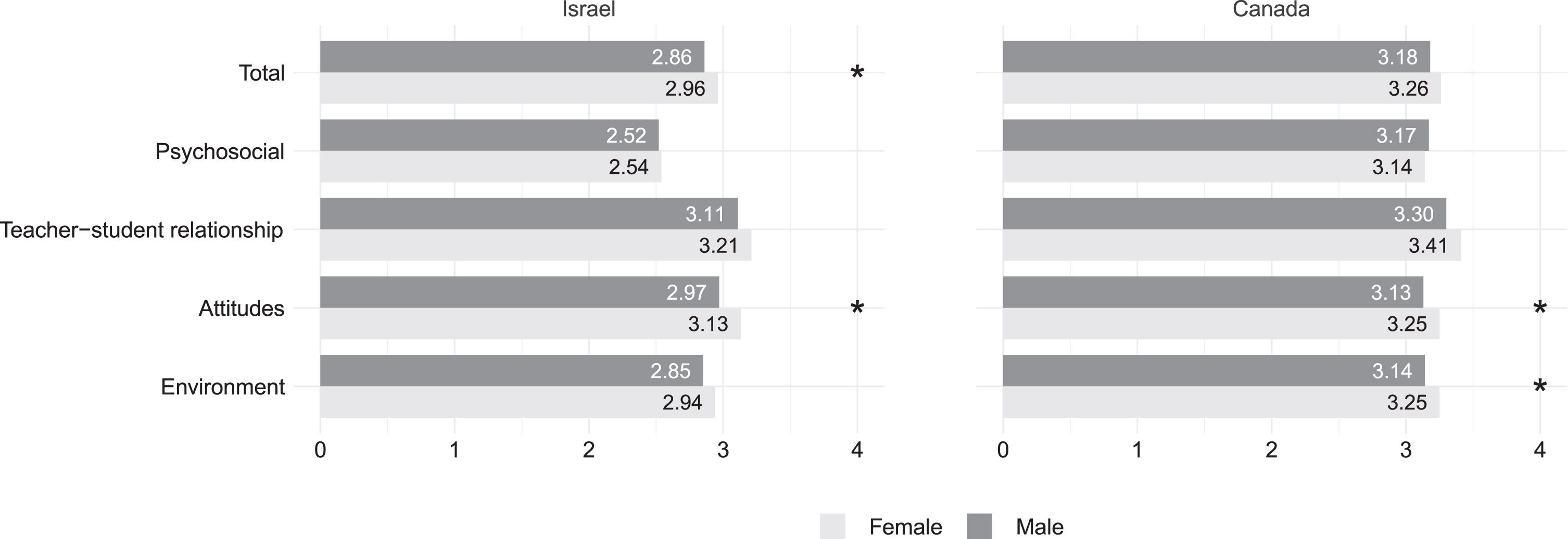
Gender differences in QoLS among Israeli and Canadian students.
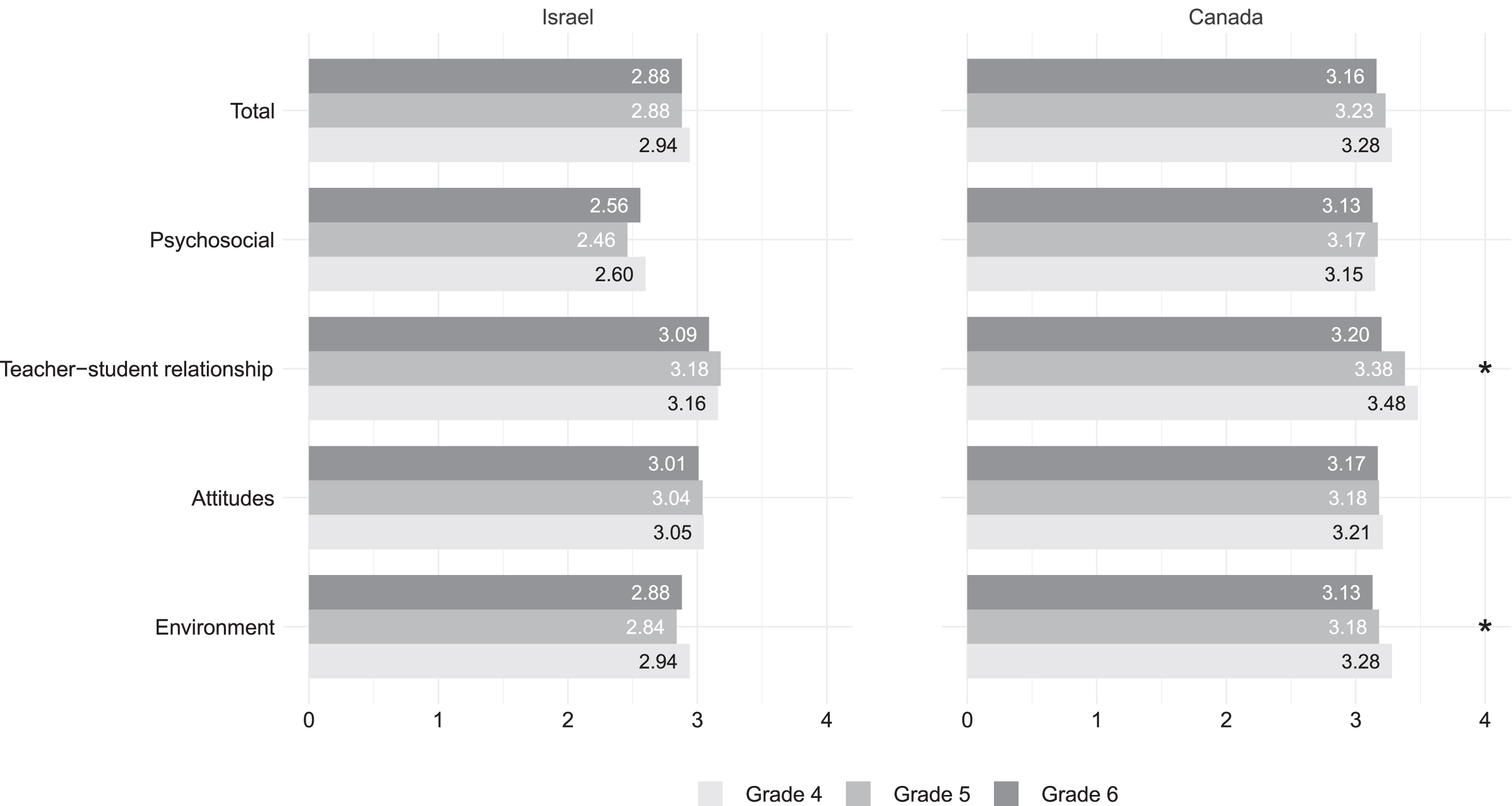
Grade differences in QoLS among Israeli and Canadian students.
School QoL is an important educational and health-related outcome. Yet, knowledge of students’ perception of their QoL at school, including the effect of the schools’ physical environment, students’ relation with teachers and psychosocial aspects is limited. Moreover, only few studies have compared the QoL of elementary school-age students between different countries. This study compared the school QoL of 4th- to 6th-grade students in a province in Canada and in Israel, taking into account gender and grade-level effects.
In examining gender differences across countries, we did not find a significant country-gender interaction. Our results showed that girls in both countries perceived their overall school QoL, and positive attitudes toward school, as higher than boys. These findings are congruent with results of Mok and Flynn [25] who examined factors contributing to the school QoL of 8265 secondary school students (using path analysis) and identified gender as an important factor contributing to school QoL. Similar results were also reported in various international studies of children’s well-being indicating that girls were more satisfied with school than boys [24, 36].
Second, we analyzed grade differences across countries and did not find a significant country-grade interaction. Our findings of a lack of a country-grade interaction suggest that neither gender nor grade-level explain the differences between the countries. Examination of the various domains revealed different patterns within countries. Only in the Canadian sample significant differences emerged in the Physical environment and Student-Teacher Relationship domains, where 4th graders reported higher satisfaction. In most studies elementary school children were compared to adolescents, and it was found that the younger children perceive their QoL as higher [2, 38]. In our study, this trend was noted even within a small age range. In a recent publication using data from the Health Behaviour in School-aged Children (HBSC) study, 11-year-olds in 42 countries were more likely to enjoy going to school than 13- and 15-year old children [36]. It is not quite clear why as children grow older they are less satisfied with their general well-being [39] or perceive their school QoL as lower [31]. One explanation for this phenomenon was suggested by Eriksson, Welander and Granlund [40] who found that with age children seem to lose interest in classroom activities.
Differences between countries
Overall, our results showed that the students in Canada perceived their school QoL as better than their peers in Israel. This was noted in the overall school QoL score as well as in the different domains. These results highlight the variability in students’ perception of school QoL across different countries, as shown in previous studies. For example, a study among the European Union countries as part of the HBSC cross-national survey [18, 41] showed that children in the Netherlands and Austria perceived their well-being at school as the highest, as compared to students in Finland and Estonia. In a later HBSC study [36] 11-year-old students in Canada and Israel were rated in the lower third in their satisfaction from school and from their peers at class, as compared to students from various European countries.
Similarly, the ISCWeB 2013–14 [30] showed that among 10- and 12-year-old students from 15 countries on different continents, 84% of students from Ethiopia agreed that they like school as compared to 21% of German students. In this survey, Israel ranked in in the lower third for satisfaction from school (Canada did not participate); however, taking into account the overall experience in school, Israeli students ranked in the middle. In a consecutive analysis of 8-year-old students from 16 countries who participated in the ISCWeB 2013–15, students from Israel ranked low for satisfaction from school [39]. These results are in line with the results of the current study, where the Israeli students expressed less satisfaction from school compared to Canadian students.
It is difficult to establish why students in different countries vary in their perception of school QoL. To better understand our results, we explored the differences between the Canadian and Israeli students in the various domains, the total score, and specific items. We noted that the differences between the two countries were especially large in the Physical Environment and Psychosocial domains, where the Canadian students perceived their QoLS as better. Theoretical models relating to individuals’ health and well-being, such as the biopsychosocial model [33], have established that the physical environment may enhance or impede individuals’ participation in daily life activities [42]. Thus, the school physical environment may play an important role in facilitating students’ academic performance, social participation, health and overall well-being [43, 44]. Despite the role of the physical environment in health and well-being, it is rarely addressed in school QoL questionnaires and general well-being surveys. It important to note that the Canadian sample was part of a study looking at health promoting schools, so it might be that these schools had a more supportive environment as a result of the attention toward creating a health promoting school ethos.
The physical environment of school is often re-searched in relation to adverse effects of ergonomics’ variables on students’ health, such as the classroom furniture, temperature, light, etc. [48, 49]. These variables are included in the QoLS; however, it was interesting to note that in our study differences between groups were seen in items such as appearance and cleanliness of the classroom and school, or having a fun place to play at school. These findings may imply that students’ school QoL may be affected not only by the comfort aspects of the school environment such as furniture or lighting, but also by the aesthetics and the playground where social interaction occurs [45, 46].
Concerning the psychosocial domain of the QoLS, which includes items relating to peers and the effect of school on emotional well-being (e.g., loneliness, frustration), our results indicated that Israeli students felt more distressed at school (desire to change school, feeling lonely or having trouble sleeping at night due to issues at school). These findings are similar to a recent study of 1081 12-year-old students in Israel, which also showed that social exclusion (feeling lonely) was negatively associated with children’s subjective well-being [47].
With respect to both countries, our results showed that students perceived their relationship with their teachers as highest and their psychosocial well-being as lowest. In both countries the lowest ranked items were ‘frustration at school’, and ‘discomfort or pain during the school day’. On the other hand, the students were fond of their teachers and felt supported, have friends and feel safe at school. These results warrant further research into specific reasons for the low psychosocial domain and its effect on the overall well-being at school and in general. Layard and Hagell developed a concept they termed ‘schools-for-wellbeing’ and claim that schools should be concerned with the well-being of children as they are with their academic performance [45]. Results from the Psychosocial domain, which was rated lowest in both countries and especially in Israel, can lend some support for this view.
The present study has some limitations. The QoLS was examined in students from two countries with a Western-oriented culture. Given the variability of QoL within countries demonstrated in previous studies, larger scale studies are needed to corroborate levels of QoL at school and to clarify the role of gender and age differences, as neither sample is a nationally representative sample. In this study, we did not collect nor examine factors that affect school QoL, such as educational system, size of the school, or the number of students per class. Finally, the students’ personal factors, which may affect the school QoL was limited to gender and age. Thus future studies should expand the data collection to these variables as well.
Conclusion
School is one of the main contexts in which children participate, and thus plays a significant role in the child’s overall QoL. Quality of life should be assessed specifically in the context of school and not just as part of general assessment of QoL, as it was found to positively affect children’s development, ability to learn, achievement at school, and health. Our research and literature search points to several major implications: In various international surveys of children’s well-being, the measurement of well-being lacks the multidimensional aspects of QoL at school. Thus, receiving incomplete information pertaining to the different patterns within and between countries or cultures. It appears that there are universal aspects of school QoL, that is, aspects that are important to students’ well-being at school regardless of culture. It is important to measure and relate to the physical environment at school in its broader aspect, that is, not only the physical layout of the classroom and school or the furniture, but also to other factors such as the classrooms’ and schools’ appearance and aesthetics and play areas. When measuring or planning for intervention to improve students’ well-being, there is a need to relate to gender and age different needs. A theoretical based questionnaire, such as the QoLS, can provide useful information on students’ school related QoL profile for teachers, principals and policy makers. It can serves as a basis for planning appropriate goals and programs to improve students well-being at school.
Conflict of interest
The authors declare that they have no conflict of interest.
Ethical approval
Ethics approval for the Canadian study was obtained from the Health Research Ethics Boards at Dalhousie University and additional permission was granted from the school board. Ethics approval for the Israeli study was obtained from the Israeli Ministry of Education.
Informed consent
Informed consent was obtained from all individual participants included in the study.