




Abstract
BACKGROUND:
Prolonged sitting has been shown to induce transient low back pain (LBP). Height adjustable office desks now present the opportunity to replace sitting with standing in the workplace. Since standing has also been associated with LBP, this may not be an advisable alternative.
OBJECTIVE:
To determine if objectively measured prolonged exposures to desk work while standing, compared to sitting, results in lower perceived LBP in healthy adults.
METHODS:
A systematic search of several databases was conducted. Two independent reviewers screened titles/abstracts and conducted a quality assessment. The results of three studies were pooled using an inverse variance random-effects meta-analysis. Heterogeneity was tested using the Chi-squared test and I2 statistic.
RESULTS:
Objectively measured prolonged standing postures during desk work did not induce significantly less perceived LBP compared to seated postures (standardized mean difference 0.60, 95% CI –0.68 to 1.87, p = 0.36.) There was significant heterogeneity, I2 = 90%).
CONCLUSIONS:
It appears that replacing seated desk work postures with standing for prolonged periods of time would not be recommended. Larger studies, including a wider age range and health history, conducted in the field with objective measures is recommended to obtain more generalizable data on which to base ergonomic standards for work postures.
Introduction
Globally, low back pain (LBP) is the leading cause of years lost to disability [1]; is responsible for billions of health care dollars annually [2, 3]; and is not easily resolved, with a significant number of cases progressing to chronicity [4, 5]. In vivo basic science research has demonstrated that prolonged sitting can induce transient perceived back pain in young, healthy populations [6–10]. Considering 40% of the workforce in developed countries [11] are seated for more than two thirds of the workday [12–14] solutions for those who develop pain in sitting are important. To this end, the introduction of height adjustable office desks to workplaces has provided an option to replace seated postures with standing. However, prolonged standing has also been shown to be associated with LBP [15] and may not be a helpful alternative.
To date, there has been a number of epidemio-logical studies that have looked at the association of either standing or sitting postures with LBP [16–20]. However, there has been no systematic evaluation of the literature that directly compared seated and standing desk work postures in terms of immediate LBP development. Further, the studies that have examined the association of either sitting or standing postures with back pain have relied on self-report exposure time or have assumed posture duration based on an occupation title. There is evidence from the literature to suggest that these methods of time determination far underestimate actual durations [21]. The objective measure of sitting and standing time, either by direct observation, timed laboratory trial or wearable sensor would provide a more robust dose/response picture of exposure to postures with back pain. Therefore, the purpose of this study is to conduct a systematic review and meta-analysis to determine whether objectively measured prolonged standing results in less perceived low back pain compared to prolonged sitting.
Research question
Does objectively measured (by laboratory controlled time trial, direct observation or wearable sensor) exposures of prolonged (≥one hour) desk work while standing result in lower perceived back pain (upper or lower back determined by pain scale rating) compared to sitting in adults (>18 years of age) with no history of low back pain?
Methods
Identification of studies
A systematic review of the literature was conducted, with the support of a health services librarian (MS), in accordance with the Preferred Reporting Items for Systematic Reviews and Meta-Analyses (PRISMA) guidelines [22]. The electronic databases PubMed (MEDLINE), EMBASE, SPORTDiscus and CINAHL were searched on October 20, 2017 and updated on November 14, 2017 and September 2, 2018. No language restrictions were used and all articles published from database inception to the search date were included. Both observational studies (cross-sectional, cohort, case control) and randomized control trials were sought. The search strategy included all possible versions and combinations of the terms “back pain”, “discomfort”, “upper back”, “lower back”, “objective measure”, “sensor”, “laboratory”, “sitting”, “standing”, “motion analysis” and “video” in either the title or abstract. The specific search strategies for each database are included in the appendix. The reference lists of included articles were also screened to locate additional papers missed by the initial search. We considered sitting and standing in any context (i.e. occupational space, laboratory, leisure time etc.) in any country so long as the criteria of “objectively measured time” was met and the outcome of perceived back pain could be directly related to the exposure.
Title and abstract screen
Exact duplicates of article were identified and removed using RefWorks by the health sciences librarian (MS). Two authors (DD and RG) reviewed the titles and abstracts of the remaining articles and compiled a list of papers that appeared to fit the inclusion criteria. If there was any question of acceptability at this point, the full paper was accessed in order to confirm study details. Reasons for exclusion were documented. The reviewers met to discuss their findings. Discrepancies were resolved through discussion and with consultation of a third reviewer (MG) to reach a final decision when necessary.
Two independent reviewers (DD and RG) extracted data for each for the included studies using a standardized form including the following information: study setting, population demographics and baseline characteristics, details of intervention and control conditions, methodology, recruitment rates and study dropout numbers, outcome measures (including units and variance).
Assessment of quality
Following data extraction for each paper, two independent reviewers (DD and RG) completed a quality assessment of all included articles. Specifically, a critical appraisal checklist from the Joanna Briggs Institute was used to assess these quasi-experimental studies [23]. The reviewers met to discuss their findings. Discrepancies were resolved through discussion and with consultation of a third reviewer (MG) to reach a final decision.
Quantitative analysis
Perceived pain data (continuous data) from in-cluded studies were then pooled using an inverse variance random-effects meta-analysis calculating the 95% confidence intervals and two-sided p-values accordingly. Heterogeneity was tested using the Chi-squared test and I2 statistic and we considered 0.25, 0.5 and 0.75 as low, moderate and high levels of heterogeneity respectively for the I2. To visually assess publication bias, a funnel plot was generated. Review Manager 5.3 was used to calculate the analysis and generate the resulting tables and figures an online version of R was used to calculate the Fail-Safe N and Kendall’s tau for the funnel plot.
Results
The search was performed on October 20, 2017 and re-run on November 14, 2017 and September 2, 2018. Figure 1 presents the PRISMA flowchart for this process. A total of 208 articles were found from all databases and 93 were identified and removed as exact duplicates. One new article was identified through a search of reference lists. Of these 116 articles, four [24–27] were identified as satisfying the inclusion with no exclusions and a full text review was completed to extract data (Table 1) and perform the quality assessment (Table 2). All studies were laboratory-controlled cross-sectional experiments that used each participant as an internal control in order to examine outome variables between three work posture conditions for one or more hours: standing, sitting and either sit/stand protocol or a perching-type sit/stand chair. For the purpose of this analysis, only the sitting and standing conditions were used. All studies had measures of perceived back pain discomfort that could be directly related to the posture exposure. Sample sizes of all studies were small, ranging from 12 to 24 participants and only one, Karakolis et al., balanced the population with respect to gender. While all studies included young, healthy individuals, only Karakolis et al. presented detailed exclusion criteria.
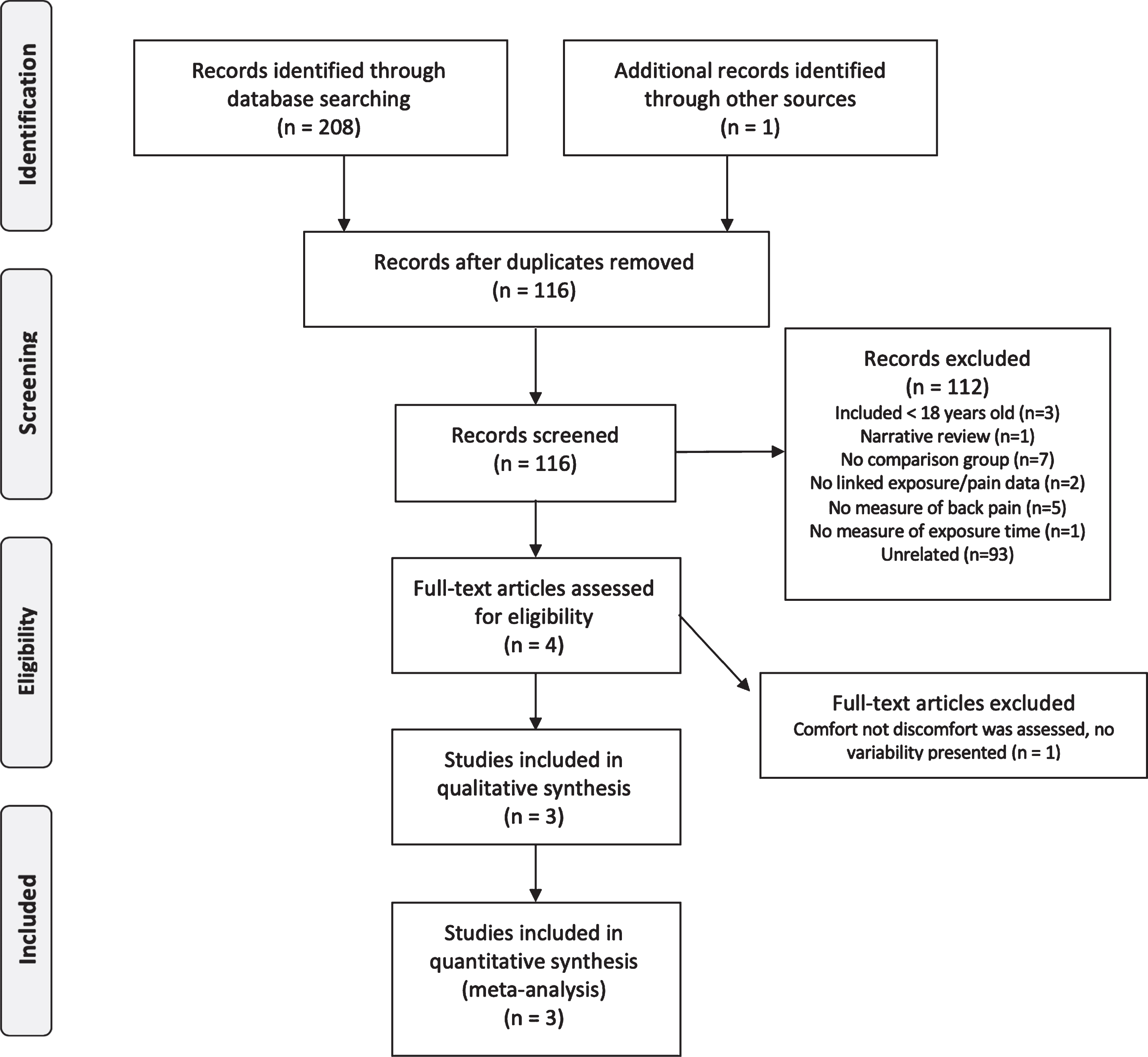
PRISMA flow diagram for search results and selection of included articles for qualitative and quantitative analysis.
Details of each study included for qualitative analysis
The checklist for quasi-experimental studies (non-randomized experimental studies) from the Joanna Briggs Institute was used to assess quality for the four articles identified as satisfying the inclusion/exclusion criteria of this study. Final results, following review and consultation by two independent researchers, are presented. Based on these findings one study, Chester et al. 2002, was excluded with justification provided
All included studies were found to have acceptable quality. At this stage Chester et al., 2002, was excluded from the qualitative and quantitative analyses. This decision was made based on the fact that perceived ratings of comfort were used instead of discomfort and the assumption could not be made that inverting comfort values would approximate discomfort. Further, no standard deviations or p-values for the mean results were provided which direcly limits inclusion into the quantitative analysis.
With the exception of the study by Le and Marras, which found higher rates of perceived pain in the prolonged standing condition, the majority of included studies [25–27] found little difference in pain ratings between postures.
Quantitative synthesis
Data from the three included studies [25–27], in-cluding a total 56 participants, were pooled for the outcome measure of perceived low back pain using standardized mean differences (Fig. 2). Prolonged standing postures during the completion of a standar-dized work task in a laboratory controlled environment did not induce significantly less perceived low back pain compared to seated postures (standardized mean difference 0.60, 95% CI –0.68 to 1.87, p = 0.36). There was significant heterogeneity observed in this analysis. Specifically, I2 was 90% which indicates a large amount of heterogeneity not attributable to random error.
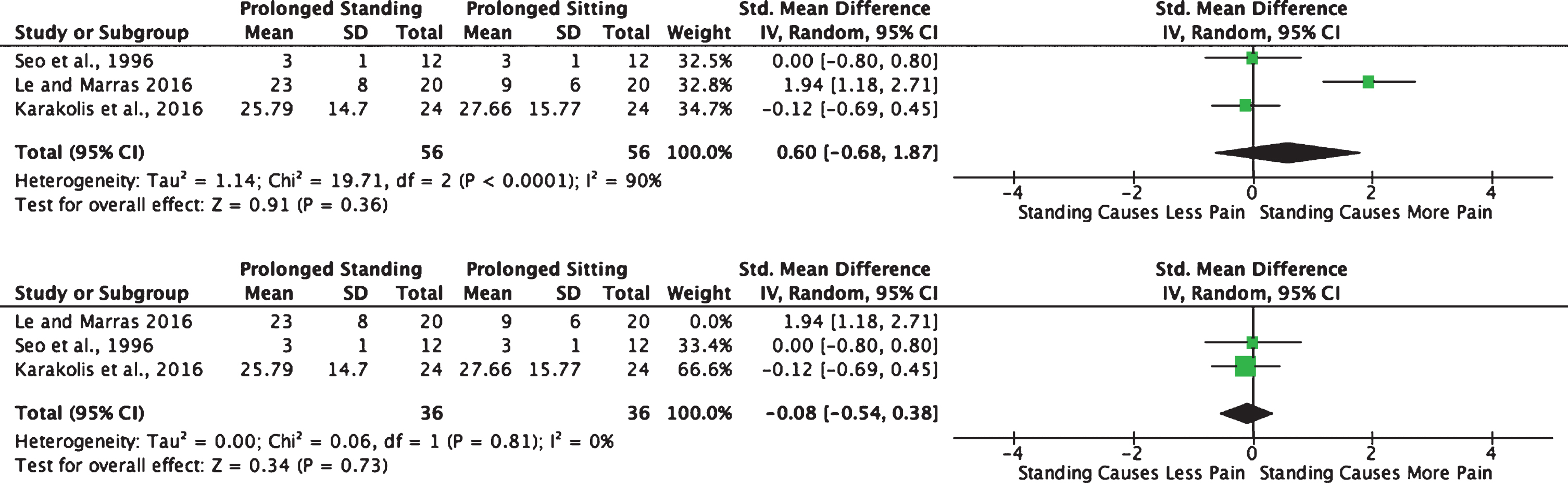
Top: Forest plot and measures of heterogeneity for perceived ratings of low back discomfort in laboratory-controlled and objectively measured conditions of prolonged standing versus prolonged sitting desk work postures in healthy adults for all three incldued studies. Bottom: Forest plot and measures of heterogeneity for perceived ratings of low back discomfort in laboratory-controlled and objectively measured conditions of prolonged standing versus prolonged sitting desk work postures in healthy adults with data for Le and Marras (2016) removed.
A visual analysis of the Forrest Plot (Fig. 2) highlighted Le and Marras (2016) as potentially driving this heterogeneity, perhaps due to the presence of a backrest in the seated condition compared to no back-rest in the remaining two studies. Considering this, there was a question of whether this methodologi-cal difference impacted the results. Therefore, a secondary analysis was done removing the Le and Marras study. Doing this removed the heterogeneity previously seen (I2 = 0%), however, did not change the overall result. No statistical difference was found between prolonged standing and sitting in terms of the outcome perceived ratings of low back pain (p = 0.73).
The potential for publication bias was assessed visually to be low using a funnel plot (Fig. 3). The plot is symetrical and covers a fair range of standardized mean differences. Further, a rank correlation test, Kendall’s tau, was found to be low (tau = 0.3333, p = 1.0000). The Fail-Safe N calculation using the Rosenthal Approach found that 8 studies would be needed to change the result from insignificant to significant.
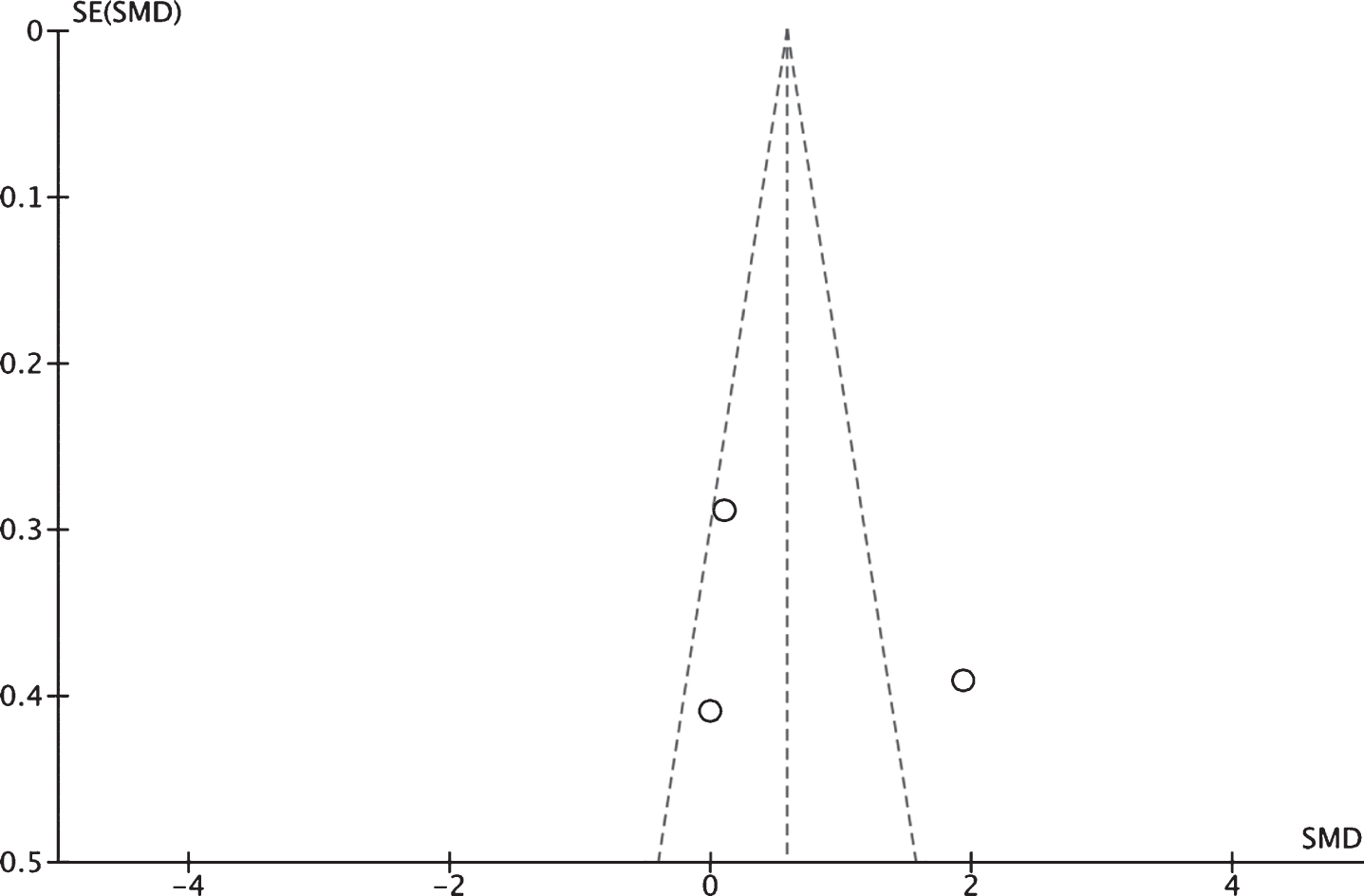
To visually assess for publication bias, a funnel plot of the three studies included in the quantatitve analysis has been prepared. Since the plot is balanced (Kendell’s Tau = 0.3333, p = 1.0000), it appears that the risk of publication bias in this case is small. The Fail-Safe N was calculated to be 8 using the Rosenthal approach.
The results of this study suggest that prolonged standing for desk work does not translate into lower rates of perceived low back pain compared to sitting. Both postures induce low back pain that appear to be directly linked to the exposure. Furthermore, it appears that the perceived pain induced in all studies is large enough to be clinically meaningful: having a change of more than two points on a discrete scale and more than 2 cm or 20 mm on a 10 cm or 100 mm visual analog scale. Therefore, this suggests that neither posture would be recommended for prolonged periods of deskwork. To be prudent, however, the results of this study should be interpreted with caution, given the cross-sectional study design, small number of included studies, and small sample size of the included studies.
The result that prolonged standing for desk work is no better than sitting in terms of perceived back pain supports opinons that have been expressed in the literature, namely that both standing and sitting, statically sustained for prolonged periods of time can lead to pain [28]. To date, no meta-analyses of perceived low back pain in res-ponse to sitting and/or standing have been conduc-ted. However, previous systematic reviews, have reached conflicting conclusions about the relationship between posture and pain during desk work. A number of reports have concluded there is a relationship between sitting [18, 30] and low back pain as well as standing [15, 31] and low back pain while others have found conflicting results for these postures [16, 32]. The relationship with back pain is indeed complex, with many confounding variables such as health history, previous back injury, psychological, social, economic and occupational factors playing a role. While this work highlights that prolonged standing may not be a suitable replacement for prolonged sitting at work, more studies, using higher level designs, are needed to generate high quality evidence upon which to base occupational standards and recommendations.
The heterogeneity in the main analysis was high (I2 = 90%). While the included studies were very similar in terms of experimental setting, health status, age range and objective measures there were some key differences that could have contributed to this finding. For instance, Karakolis et al. found significant differences in perceived discomfort ratings between men and women: with men perceiving higher rates of back pain in standing and women perceiving higher rates in sitting. Since most articles included in this analysis contained datasets with unbalanced genders and did not present data separately for males and females, there is the possibility that these differences contributed to the observed heterogeneity. However, considering the heterogeneity dropped to 0% with the removal of the Le and Marras study, it is reasonable to conclude that the factor driving the large heterogenity was the presence of a backrest. The sensi-tivity of the results to the presence/absence of a backrest during sitting was tested during the analysis by removing the study by Le and Marras and re-analy-zing the data. While the result was unaffected in this case, it can be argued that this factor needs to be better addressed with more research before drawing a firm conclusion; especially since logically the ability to recline back and unload body stress on a support would result in lower amounts of perceived back pain.
This study was strengthened by using data from studies in which the exposure was objectively measured. This is particularly important as recent evidence suggests that self-recall for posture exposure, beyond TV viewing, is poor [33]. However, this study was limited by a several factors. First, there were a small number of (small) cross-sectional studies that fit the inclusion criteria (total participant sample = 56) and, while a within-control design was used, there were no true control groups in the design of any of these studies. Secondly, the data extracted from two papers (Le and Marras 2016 and Seo et al. 1996) were estimated from graphs, as tabulated data were not provided. Further, since only Karakolis et al. presented data separately by gender, a subgroup analysis could not be performed in this meta-analysis. Future work should take care to study and present data for males and females since Karakolis et al. found a significant interaction for gender and posture and these underlying differences can contribute to heterogeneity and may warrant gender-specific recommendations for guidelines.
Conclusion
Replacing sitting with standing for deskwork would not be recommended based on the results of this study; indeed both postures appear to be a problem. However, this interpretation must be accepted with caution due to the study type, number and size or the studies included in this analysis. To best answer this question, larger studies, with objective measures conducted preferably in a field setting and including a wider age range and sub-grouped by gender and health history should be performed to generate high quality evidence upon which to base ergonomic guidelines.
Conflict of interest
The authors have no conflicts of interest or funding to declare for this project.