




Abstract
BACKGROUND:
Multiple sclerosis (MS) is an intrusive disease that significantly affects labor force participation.
OBJECTIVE:
This study examined the extent to which factors at the personal, health and function, and environmental/career maintenance levels contribute to the predictability power for quality of life among employed people with MS.
METHOD:
Participants consisted of 523 members of nine National Multiple Sclerosis Society chapters representing 21 states and Washington, DC. These individuals were employed at the time of the survey, and they were primarily middle age (average age of 48 years) and Caucasian (74%).
RESULTS:
The final hierarchical multiple regression model explained 54 percent of the variability in participants’ quality of life scores, although none of the hypothesized personal/demographic predictors were significant. Participants who perceived better overall health and lower levels of stress, who experienced less severe cognitive and mobility-related MS symptoms, and who expressed stronger job-person matches and higher levels of job satisfaction reported higher quality of life scores than did other participants.
CONCLUSIONS:
The findings underscore the complexity involved in predicting perceived quality of life among employed people with MS. Implications of these findings for future research and clinical practice are discussed.
Introduction
The purpose of this article is to present findings from an empirical investigation of the correlates of quality of life (QOL) among a national sample of employed people with multiple sclerosis (MS). With its onset in early to middle adulthood, multiple symptoms affecting a wide range of functional domains, unpredictable and often progressive disease process, and deleterious impact on labor force participation [1–3], MS is well known to medical and social science researchers for intruding upon quality of life (QOL) and other important indices of well-being [4].
What is MS?
MS is a chronic, immune-mediated disease of the central nervous system [5]. The disease is characterized by episodic and recurrent periods of inflammation that result in the destruction of central nervous system myelin and subsequent damage to the underlying central nervous system axons [6, 7]. The lipid-based myelin sheath surrounds the central nervous system axons and facilitates efficient conduction of electrical impulses from the brain to the rest of the body via the spinal cord [2]. When damage to the myelin occurs, electrical impulses are not conveyed effectively, impeding the transmission of information and disrupting virtually every physical, sensory, mental, and emotional process [8, 9].
Personal and demographic characteristics of people with MS
MS affects as many as 3 million people worldwide [2, 5]. The prevalence of MS in the US is estimated at 900,000 [5]. Some 10,000 new cases of MS are diagnosed each year in the US [1]. Initial symptoms are most often evident during early adulthood, typically between the ages of 20 and 50 [1, 8]. MS is about three times more common in women than men [5, 10].
MS occurs in most ethnic groups, including African Americans, Asians, and Hispanics/Latinos [11], but it has historically been thought to occur most frequently among Caucasians in Western Europe and North America [9]. That said, recent US research suggests that the risk of developing MS may be higher in African American women than in Caucasian American men or women [12]. Geography has also been linked to the risk of developing MS, with higher MS prevalence rates being reported in temperate regions of the globe and in the northern half of the United States [13].
The etiology of MS includes both genetic and environmental factors [14]. Genetic factors appear to have a significant role in the development of MS [13], but research suggests that environmental factors may trigger the autoimmune response in genetically susceptible individuals [14, 15]. Suspected environmental triggers for the initial symptoms of MS include viruses and bacteria such as measles, human herpes virus-6, and Epstein-Barr virus. There is also growing evidence that ultraviolet light exposure, vitamin D levels, and cigarette smoking may be associated with the risk of developing MS [13, 16].
Impact of MS on health, function, and employment
The typical course of MS is one of unpredictable cycles of relapses and remissions, with progressive deterioration of health over time [15]. The physiological symptoms of MS are many and varied, including fatigue (which is reported by approximately 90% of people with MS) [2], mobility problems, spasticity, numbness and tingling in the extremities, tremor, diminished strength and coordination, chronic pain, hypersensitivity to heat, visual impairments, bowel and bladder dysfunction, and sexual dysfunction. The type and severity of MS symptoms are determined mostly by the location and size of the lesions that occur in the central nervous system [2].
In addition to its physiological and sensory effects, MS can impact cognitive functioning, emotional energy, and mood states. Current estimates of the prevalence of cognitive impairment among people with MS range from 43% to 70% [1]. Along with fatigue, cognitive impairment is a leading reason for loss of employment [17, 93]. Cognitive impairment is most frequently observed in information processing speed and efficiency, episodic memory or long-term memory retrieval, complex attention, executive functioning, and visual perceptual skills [1, 17]. Overall intelligence, simple attention, and verbal skills are usually not affected by MS [18]. Depression and anxiety are the most frequently reported mental health problems among adults with MS [1].
There is no cure for MS, but considerable progress is being made in understanding its causes and disease processes. The development of new treatments has also rapidly increased in recent years. Current treatments are aimed at modifying the disease course, managing relapses, and alleviating ongoing symptoms. As of this writing, disease-modifying therapies form the basis of treatment for most types of the disease.
MS can interrupt health and function in virtually every aspect of life. At least 55% of Americans with MS require some form of assistance with walking, more than 50% require the help of another person to perform personal care activities, and over 60% require assistance with routine or instrumental activities [19–21]. Nearly half of people with MS require some form of home care assistance and approximately 25% will require long-term care during the course of their illness [21]. In a recent national survey of over 5,000 Americans with MS, almost one-in-five (17.4%) indicated that they were limited in their homes because their residence did not meet their accessibility needs [19]. The symptoms of MS frequently lead to physical inactivity and a sedentary lifestyle, and people with MS have consistently been found to be less physically active than persons without MS [22–24].
The relationship between health and employment has also begun to receive increased research attention. Employment provides a means by which individuals survive, derive power, connect socially with others, and attain self-determination and well-being [25–27]. In contrast, being disconnected from the labor market, or not engaging in productive activity, is often associated with negative physical and psychological health-related outcomes [28, 29]. High unemployment and underemployment rates disproportionately impact individuals with disabilities and chronic health conditions [30]. These contribute to increased social isolation, higher risk for decreased levels of physical and psychological health, and decreased engagement with the broader society [29, 31].
Being disconnected from the labor market is a prominent problem for people with MS. With its onset in early to middle adulthood, MS usually affects people with established employment histories who were working at the time of diagnosis [32]. However, the majority of Americans with MS are unemployed five years after diagnosis [33], and the global labor force participation rate of people with MS has languished at 40 percent for decades [15, 91].
As a consequence of the complexity of the factors involved in the decisions that people with MS make about employment, effective approaches to vocational rehabilitation remain elusive [32, 35]. Vocational rehabilitation researchers have identified the episodic and unpredictable nature of the disease, the wide range of physiological and neurological symptoms, and a lack of understanding of the disease on the part of employers as partial explanations for the significant attrition from the work force that coincides with diagnoses of MS [36]. However, the interactions among personal characteristics, health and function, and work environmental factors in determining one’s prospects for continued employment following an MS diagnosis are not well understood.
Impact of MS on quality of life
People with MS have consistently been found to experience lower QOL levels than the general population [37–39]. This difference is particularly pronounced in health-related QOL domains, reflecting the significant QOL impact of MS-related symptoms such as fatigue, cognitive impairments, depression, chronic pain, and bladder and sexual dysfunction [39, 40]. In addition to the symptoms of MS, other features of MS that have been proposed to account for the relatively lower QOL include the compound nature of the effects of MS across diverse areas of functioning (neurological, neuropsychiatric, physical, social, etc.); the fact that MS is typically diagnosed in young adults and thus disrupts multiple developing career, family, and social roles and identities; the ongoing stress associated with the unpredictable course of MS and concurrent difficulty in maintaining a sense of control; the lack of a cure; and the frequently disruptive and cost-prohibitive nature of disease-modifying MS treatments [37, 41–43].
As noted, loss of or premature exit from employment is a common outcome for adults with MS, which in itself has significant implications for QOL. Employment status has consistently been identified as an important determinant of QOL [4, 44]. Moreover, for working-age adults with MS, employment is often cited among the most important QOL contributors. Furthermore, the impact of MS on employment is frequently identified as one of the factors having the most significant negative impact on QOL [45–47].
Health and function in MS are inherently and reciprocally linked with employment. Specifically, employed people with MS are more likely to report better physical functioning, better cognitive functioning, lower rates of depression and loneliness, and better health-related quality of life than those who are not employed [e.g., 48–50]. Furthermore, QOL is generally found to be higher in those who are working [51]. Alternately, premature discontinuation of employment can have significant negative effects in terms of financial stability, community access and participation, physical and psychological health, and QOL [4]. Although the relationships among health and function, employment, and QOL have been clearly established, the complex nature and important elements of these relationships remain unclear, hence the present study.
Theoretical framework of the present study
For employed people with MS, it is theorized that overall perceptions of QOL are shaped by personal or demographic factors, health and function factors, and environmental factors related to career maintenance. Personal factors that have been linked to QOL in previous research include gender, age, racial/ethnic status, marital status, and educational attainment [34, 53]. In some studies, health and function factors appear to be the primary predictors of important psychosocial outcomes such as QOL, with those individuals who experience the most intrusive physical, cognitive, and emotional symptoms of MS reporting the lowest levels of QOL [54, 92]. Typical health and function factors in the literature include duration of illness, perceived stress, course of illness, self-reported symptom severity, number of symptoms, amount of fatigue, and extent of cognitive and mobility impairment [52, 55–57]. Less is known about work environmental factors related to career maintenance and their impact on QOL for employed people with MS. It is theorized that constructs such as perceived job-person match, perceived job satisfaction, overall satisfaction with the employment situation facing people with MS, expectations regarding continued employment, and the use of workplace accommodations are positively associated with QOL for employed people with MS.
The Illinois Work and Well-Being Model (IW2M) provides a useful framework for organizing the determinants of QOL that were examined in this investigation. Research in the area of MS has attempted to develop an increased understanding of the factors associated with the challenges experienced by individuals with MS related to career development and employment. Over the past several years, the IW2M has received attention as a framework for conceptualizing factors related to the career development and employment of individuals with chronic health conditions such as MS. The IW2M was informed by the International Classification of Functioning (ICF) Model as well as theory based research regarding employment of individuals with chronic health conditions. The model is comprised of three major interactive domains (Contextual, Career/Employment Development, and Participation) that have bidirectional relationships to inform outcomes and potential interventions. Each domain consists of factors that allow for the full operationalization of individual, environmental, career/employment, participation, and potential interventions that interact at both the within- and across-domain levels and influence individual behavior, functioning, and broader societal participation. This model provides a structured framework to conceptualize factors that impact the career development for adults with MS and has the potential to guide career development and employment research within the population with MS (see Fig. 1; [58–60]).
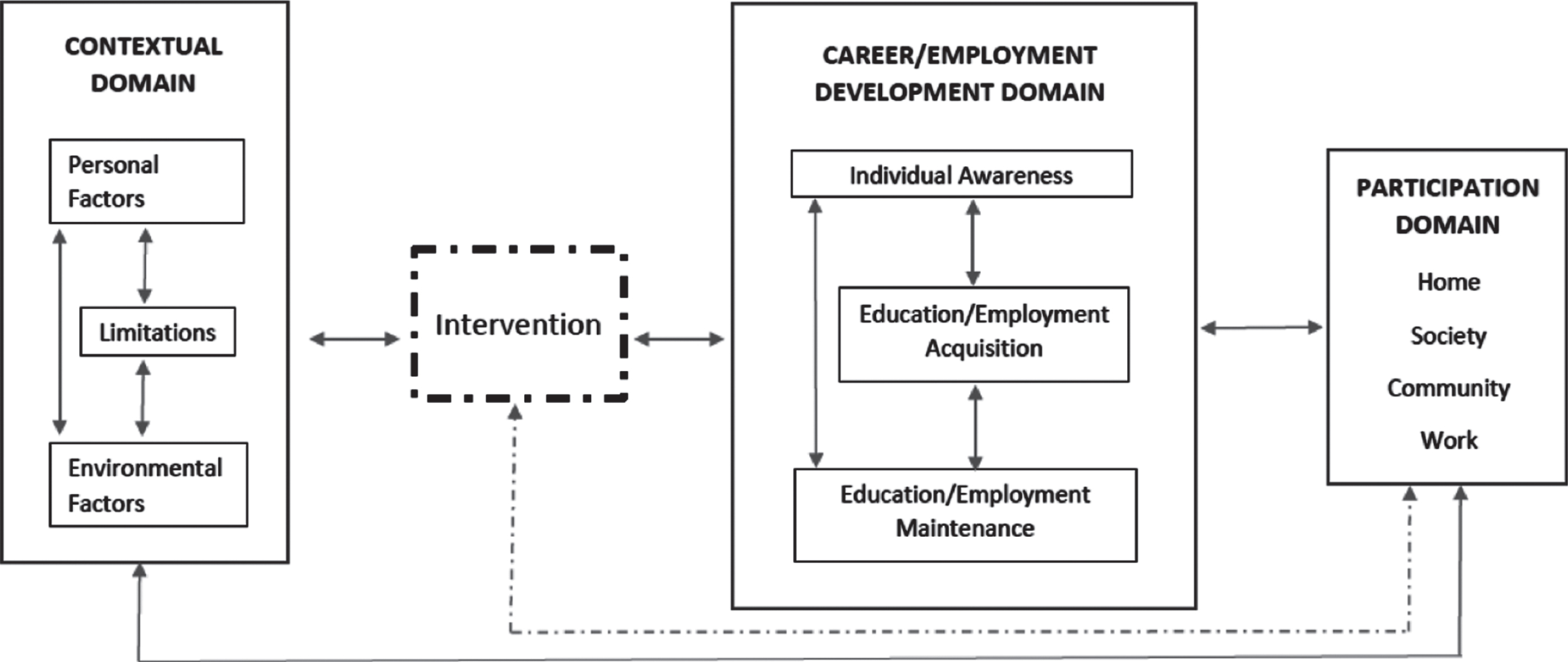
The Illinois Career Development Framework.
The research question that guided this study is: “To what extent do factors at the personal, health and function, and career maintenance levels contribute to the predictability power for QOL among employed people with MS?”
Hypotheses for the study were as follows: Personal, health and function, and career maintenance variables all influence perceived QOL. Career maintenance factors help explain the variance in perceived QOL even after the variance of personal and health and function factors have been controlled in the analysis.
Method
The researchers applied an ex post facto, multiple correlational design to answer the research question and test the hypotheses. A hierarchical multiple regression analysis was used as the primary statistical procedure.
Participants
The sample in this study was extracted from data collected in a national survey of the employment concerns of Americans with MS from nine National Multiple Sclerosis Society (NMSS) chapters, representing 21 states and Washington, DC in the US [61]. Participants were 523 people with MS who were employed at the time of the survey and provided complete information on the variables contained in the present analysis.
The sample included 432 women (83%) and 91 men (17%). Fifty-nine percent (59%) of respondents described their communities as suburban, whereas 20% lived in urban areas and 21% resided in rural settings. With an average age of 48 (SD = 10.31), participants in the sample were well educated (99% were high school graduates, 60% were college graduates). Most of the participants were Caucasians (79%); 9% were African Americans; 11% were Hispanics/Latinos; and 1% were Asians, Pacific Islanders, Native Americans, or Alaskan Natives.
Most participants (n = 381, 73%) were employed full-time at the time of the survey, and 142 participants (27%) were employed part-time. One hundred thirty-five participants (27%) indicated that they had requested on-the-job accommodations from their employers, and 232 (44%) reported using accommodations at work.
Illness-related symptoms reported by the participants suggested a variety of severe to non-severe MS conditions, as well as a wide range of physiological, sensory, and psychological effects. In descending order of frequency, the most commonly reported symptoms were fatigue (indicated by 73% of respondents), tingling (50%), balance/coordination problems (49%), numbness (45%), cognitive impairment (43%), diminished physical capacity (41%), bowel or bladder dysfunction (37%), gait/mobility impairment (36%), pain (32%), spasticity (31%), sleep disturbance (28%), anxiety (23%), vision problems (21%), depression (21%), and sexual dysfunction (16%). The mean number of reported MS symptoms was 6 (SD = 3.36).
Measures
The instrument used in this study was a 98-item questionnaire that included fixed and open response sets. The personal/demographic, health and function-related, and career maintenance-related items were developed by the research team based on a literature review and on input from several expert consultants and one working group of 13 adults with MS in the Ohio Buckeye NMSS Chapter [61]. Variables that were considered in the present analysis were measured and coded as described in the following paragraphs. Reliability and validity information is provided where available.
Independent variables: Personal characteristics
Four demographic variables were considered in this study to represent participants’ personal backgrounds. These included gender (dichotomous; 0 =female, 1 = male), racial/ethnic status (dichotomous; 0 = Caucasian, 1 = non-Caucasian), edu-cational attainment (dichotomous; 0 = elementary/secondary/some post-secondary education, 1 =college graduate or higher), and age (continuous; number of years old at the time of the survey).
Independent variables: Health and function
Seven variables representing participants’ health and functional status were extracted for the analyses in this study. Self-reported general health status was measured on a 5-point scale ranging from 1 (bad) to 5 (excellent). Cognitive impairment was assessed by asking respondents to rate their current cognitive abilities on a 6-point scale, ranging from normal cognition where there is no limitation on activity or lifestyle to total cognitive disability where every day memory problems or confusion prevent doing many daily activities. Perceived symptom severity was measured on a 5-point scale ranging from no current symptoms to multiple severe symptoms significantly limiting daily functioning. Another estimate of severity of MS using the Patient-Determined Disease Steps [PDDS; 62] measured gait/mobility impairment on a 9-point scale ranging from normal (1) to bedridden (9). The respondent’s illness duration was self-reported and operationalized as the number of years since diagnosis. Participants’ disease course was measured dichotomously, as either relapsing-remitting MS or a progressive or other course.
In addition, participants’ stress levels were measured using the Perceived Stress Scale [63], an 11-item instrument that asks respondents to report how frequently during the previous month they had encountered or dealt with stressful life events. The items were rated on a 5-point Likert scale (i.e., “1 = never”, “2 = rarely”, “3 = occasionally”, “4 = often”, “5 = always”). Higher scores on positively stated items indicate effective coping for a particular type of stressful event (e.g., “How often have you felt that things were going your way?”). The scoring metric for negatively stated items (e.g., “How often have you felt that you were unable to control the important things in life?”) was reversed so that higher scores indicate effective coping and lower stress levels. The item scores were summed, and the possible range for the scale was 11–55, with higher scores indicating lower levels of perceived stress. The Cronbach Alpha coefficient for the Perceived Stress Scale within the present sample was 0.90.
Independent variables: Career maintenance factors
Five variables were used to represent different aspects of respondents’ work environments that influence their ongoing career maintenance prospects. Use of workplace accommodations was coded dichotomously based on whether respondents were using or not using on-the-job accommodations at the time of the survey. Perceived job/person match was measured on a 5-point scale ranging from 1 for complete mismatch to 5 for perfect match. Participants’ perceived job satisfaction was assessed on a 5-point scale ranging from 1 (very dissatisfied) to 5 (very satisfied). The survey questionnaire also included a list of 38 overall employment concerns items. In responding to those items, participants indicated whether they were satisfied or dissatisfied that the concern was being addressed in their work situations. Concerns items addressed such issues as access to information on disability benefits programs, discrimination in hiring and retention practices of employers, employment protections under major legislation, the quality of rehabilitation and employment services, access to assistive technology, and support for returning to work and planning for the future. A sum score (range 0 to 38) was created to represent the number of employment concerns with which participants were dissatisfied, with higher values indicating greater levels of employment concern.
Participants also responded to a 3-item scale assessing their employment expectations in the next two to five years (i.e., giving up work entirely due to MS; reducing workload due to MS; changing to a less demanding type of work due to MS). The items were measured on a 5-point Likert scale ranging from very likely (1) to very unlikely (5). Based on these items, three steps were taken to create the 3-level categorical variable in this study. First, the variable, giving up work entirely due to MS, was recoded into a dichotomous variable in which 0 represents the original categories of uncertain, unlikely, and very unlikely and 1 represents the original categories of likely and very likely. Next, the other two variables, reducing workload due to MS and changing to a less demanding type of work due to MS, were combined and recoded into a dichotomous variable in which 0 indicated participants who were unlikely to reduce their job duties or hours and 1 indicated those who were likely to reduce their job duties or hours. Finally, the two dichotomous variables were combined and recoded into a categorical variable that contains three types of participant employment expectations. Category 1 includes participants who expect to remain employed over the next 2 to 5 years (i.e., those who would neither give up work entirely nor reduce work demands in their job in the future); Category 2 includes participants who expect to reduce their job duties or hours in the next 2 to 5 years; and Category 3 includes participants who expect to exit employment over the next 2 to 5 years (i.e., giving up work entirely). The categorical variable was represented by two dummy variables in the analysis with Category 1 functioning as the reference group.
Dependent variable: Quality of life
The criterion variable, QOL, was measured using the Quality of Life Scale [64]. Respondents rated their levels of satisfaction with their involvement in seven major life areas (i.e., social life, family life, hobbies and recreational experiences, educational and intellectual development, activities of daily living, romantic experiences, expectations and hopes for the future) using a seven-point Likert scale ranging from 1 (totally unsatisfying) to 7 (completely satisfying). The possible range for the total QOL scale is 7–49, with higher scores indicating higher levels of perceived QOL. Within the present sample, the scale had high internal consistency (Cronbach Alpha = 0.90).
Procedure
A detailed report of the procedures that were used to develop the questionnaire and conduct the survey from which the present study sample was drawn, including IRB approval and adherence to ethical conventions regarding primary and secondary data analyses, can be Rumrill et al. [61]. Among the 1,932 respondents to the national survey, 523 employed individuals provided complete information on the measures used in this investigation and comprised the present study sample.
Statistical analysis
A three-block hierarchical regression model was used to measure the incremental variance accounted for by each set of predictors over and above what was explained by predictors entered at earlier steps in the model. The continuous variable, QOL, served as the criterion. The three sets of independent variables were entered into the model sequentially as follows: (a) personal characteristic variables: gender, racial/ethnic status (white vs. non-white), educational attainment, and age; (b) health and function variables: overall health rating, cognitive impairment, perceived symptom severity, Patient Determined Disease Steps (PDDS) score, illness duration, stress coping level, and disease course; and (c) career maintenance: use of workplace accommodations, perceived job/person match, job satisfaction, employment concerns, and future employment expectations. The analysis was conducted using the statistical computer package SPSS 24 [65], and the alpha significance level for the hypothesis tests was set at 0.05.
Results
Regression assumptions such as normality of errors, homogeneity of error variance, and linearity between the independent and dependent variables were tested using diagnostic techniques. Influential observations and collinearity issues were also screened and examined. Other than five outlier/influential cases that were identified in this process, no severe departures from the regression assumptions were found. As a result, the hierarchical regression model was fitted to the sample data twice, one with all the cases and the other with the outlier/influential cases removed. The comparison between the two sets of results indicated that the two analyses rendered almost identical results except that the model with the outlier/influential cases removed had slightly better model fitting indices. Therefore, the results of the model with five cases removed are reported here in this study.
Table 1 exhibits the descriptive statistics related to the categorical independent variables, whereas Table 2 displays descriptive statistics related to the continuous independent and dependent variables. Table 3 displays the results of the hierarchical regression analysis, providing the values of change in R2 (ΔR2) at each step, unstandardized regression coefficients (B), standard errors associated with the unstandardized regression coefficients, and standardized coefficients (β) for the independent variables at each step when they were newly entered into the model and subsequently entered into the final model.
Descriptive statistics of participants for categorical independent variables (N = 523)
Descriptive statistics of participants for categorical independent variables (N = 523)
Descriptive statistics of participants for continuous variables (N = 523)
Hierarchical regression analysis for quality of life of employed adults with multiple sclerosis (N = 518; 5 outlier/influential cases removed)
Note. *p <0.05; **p <0.01; ***p <0.001.
The four personal/demographic predictors were entered into the regression model in the first step. As a block, they accounted for a small but significant amount of variance in QOL (R2 = 0.05, F (4,513) = 6.26, p < 0.001). Race and educational attainment contributed significantly to the explanatory power for QOL. Specifically, QOL decreased significantly for non-Caucasian employed participants with MS when compared to their Caucasian peers (β= –0.14, t = –3.13, p < 0.01); QOL increased significantly for employed participants with MS who had a college or higher degree when compared to their peers who did not graduate from college (β= 0.14, t = 3.29, p < 0.01).
In the second step, the addition of health and function variables yielded a large and significant increase in the variance explained in QOL (R2 = 0.51, ΔR2 = 0.46, ΔF (7,506) = 68.12, p < 0.001). Participants’ QOL scores increased significantly when their health status (β= 0.26, t = 6.04, p < 0.001) and illness duration (β=0.09, t = 2.27, p < 0.05) increased; however, their QOL scores decreased significantly when cognitive impairment (β= –0.14, t = –3.77, p < 0.001), mobility impairment as measured by PDDS (β= –0.17, t = –3.59, p < 0.001), and stress level (β= –0.35, t = –9.53, p < 0.001) increased. In the third step, the environmental/career maintenance variables also accounted for a significant amount of variance in QOL in concert with what had been explained by the first two blocks of predictor variables in the model, although the third block contributed only three percent to the explanatory power of the prediction model (R2 = 0.54, ΔR2 = 0.03, ΔF (6,500) = 5.83, p < 0.001). QOL scores increased significantly when participants’ perceived job/person match (β= 0.09, t = 2.55, p < 0.05) and self-reported job satisfaction (β= 0.12, t = 3.16, p < 0.01) increased.
In the final model, all variables except race, educational attainment, and illness duration that were identified as significant contributors to the variance in QOL in the previous two steps remained as significant contributors: health status (β= 0.24, t = 5.86, p < 0.001), cognitive impairment (β= –0.12, t = –3.36, p < 0.01), PDDS/mobility impairment (β= –0.18, t = –3.81, p < 0.001), stress (β= –0.30, t = –8.17, p < 0.001), perceived job/person match (β= 0.09, t = 2.55, p < 0.05), and self-reported job satisfaction (β= 0.12, t = 3.16, p < 0.01). The final model accounted for 54% of the variance in QOL, which is a large effect size according to Cohen’s guidelines [66].
Findings from this investigation affirm the utility of multi-factorial models for explaining social and behavioral outcomes, in this case, perceived QOL [64]. QOL was operationally defined in this study as personal satisfaction with seven life areas. Specifically, adults with MS perceived their levels of QOL as being significantly related to independent variables pertaining to health, mobility, cognitive functioning, perceived stress, job match, and job satisfaction. This relationship between health, function, and career maintenance constructs and social participation outcomes is consistent with IW2M postulates and hypotheses based on the World Health Organization Model [67] and other multi-factorial theories such as Social Cognitive Career Theory [68–70] and the Conservation of Resources Theory [71].
As noted in previous discussions of the IW2M, the importance of the results of this study lie in their relevance to questions such as “why and how” do health, cognition, stress, mobility, job match, and job satisfaction relate to broader constructs of social participation and well-being. In addition, results of this study also suggest the broad array of therapeutic interventions needed to enhance QOL for people with MS. Consistent with the IW2M theoretical propositions, rehabilitation professionals could monitor the effects of each intervention on all of the QOL predictors to better understand overall treatment impact. In that regard, it is important to bear in mind that health and function predictors explained 51 percent of the variability in participants’ QOL scores, with career maintenance predictors adding only three percent to the explanatory model.
Supported in multiple investigations pertaining to life outcomes of adults with MS (e.g., [55], this study indicated that a biopsychosocial model [67, 72] consisting of health, functioning, and career maintenance variables (especially those related to health and functioning) provides important insights into differential levels of QOL. In a biopsychosocial model, the impact of disability is viewed both as a function of health conditions and contextual factors. Consequently, the discussion to follow addresses the “why and how” specific constructs in each of the IW2M categories (i.e., personal, health and function, and career maintenance characteristics) did or did not relate to perceived QOL and the medical and psychosocial services required to enhance QOL, which is considered an overarching goal of rehabilitation services [72, 73]. Implications for future rehabilitation practice and research are suggested.
Personal/Demographic factors
In this investigation, personal/demographic characteristics included gender, racial/ethnic status, age, and educational background. Results of the hierarchical regression analysis indicated that these variables dropped out of the model with the addition of the health and function and career maintenance variables. This finding does not suggest that these demographic factors are unimportant in understanding the life outcomes of adults with MS because ample evidence exists to suggest just the opposite, particularly when identifying demographics predictive of being employed or not. Age, gender, racial/ethnic background, and educational attainment have all been shown to be related to whether an adult with MS is employed or unemployed [34, 76]. However, because this study was based on survey results with only employed adults with MS, one would not expect vast differences in the group in terms of these demographics. Because study participants were employed, one would expect them to possess attributes consistent with those related to finding and maintaining employment. For this reason, differences at the health and function and career maintenance levels (especially health and function) rather than demographics were more likely to be retained when entered in the model.
Health and function factors
The utility of the IW2M for explaining QOL among employed adults with MS is far more apparent in terms of the health and function factors (i.e., better overall health, fewer mobility and cognitive limitations, and lower stress levels). Collectively, these constructs predicted the predominant amount of variance (51% of the 54% total) in QOL as would be expected based on findings from many studies which demonstrate how these variables affect life outcomes such as employment (e.g., Simmons et al. [55]. According to the IW2M and empirical findings in other studies, the components of this disease and disability model have significant implications for the needs of people with MS and the services required to meet those needs. Other research clearly supports the primacy of this disability and disease model in that MS symptoms (cognitive difficulties, mobility limitations, and fatigue) and longer durations of the illness are associated with unemployment [52]. Comments regarding the importance of each of the health and function factors follow.
Better overall health
The National Multiple Sclerosis Society (NMSS) website [77] provides a comprehensive overview of health maintenance strategies that will enable individuals with MS to achieve a healthy lifestyle. Areas discussed in the online publication include health maintenance, diet, exercise/physical activity, mood, and use of complementary therapeutic therapies. The health maintenance section, for example, discusses primary and MS-specific care needs and the interventions needed to promote health and decrease the probability of co-morbid conditions such as heart disease, cancer, stroke, and diabetes. By following the guidelines in this material, adults with MS could prevent or at least lessen further deterioration in their conditions, thereby resulting in higher levels of QOL.
One should not overlook the contribution of living conditions to maintenance of good health and QOL for adults with MS. Uehara explained that the probability of experiencing inadequate housing is a function of characteristics of the housing market and housing needs and resources of the individual [78]. Adequate finances, accessible and affordable shelter, water, electricity, heating/cooling, food, childcare, transportation, and availability and portability of health insurance [79] are necessary but not sufficient to improve the quality of life for adults with MS and their families. Home assessment and case management services can address these critical conditions given the fact that most housing in the United States is inaccessible due to steps at each entrance and narrow halls and doorways [73, 80].
Fewer cognitive and mobility limitations
As indicated in previous QOL research [81], measures of disease present only a partial picture of overall health status. Objective as well as subjective effects of the disease such as actual and perceived extent of cognitive and mobility limitations are important predictors of well-being as indicated by the results of this and other investigations [54, 82–85]. Because it attacks the central nervous system, MS has a high probability of negatively affecting cognition, ambulation, coordination, strength, and stamina (i.e., fatigue), any one of which can have negative effects on performance of essential job functions, motivation to continue employment, and QOL [33]. Important interventions for these MS effects include physical and occupational therapy; home modification; cognitive rehabilitation; workplace accessibility; and job accommodation, particularly job restructuring, flexible work hours, work at home, and ergonomic solutions to address hand and ambulation demands [33, 34]. Early intervention is particularly important for employed adults with MS who exhibit significant cognitive and mobility symptoms with the potential to result in job loss [56]. Unfortunately, research suggests that methods of cognitive rehabilitation have limited success [56, 86], although promising new approaches exist such as the use of iPad “apps” to buttress cognitive skills such as organizing, scheduling, and remembering [87].
Lower stress levels
The impact of high levels of stress can have both physical and psychological effects that negatively influence quality of life and, in the case of employment, “feeling too stressed by the effort to work” was a common reason adults with MS gave for leaving employment [55]. Therefore, assisting adults with MS in managing these symptoms is particularly important even in cases where one might not expect high levels of stress. For example, Smith and Arnett reported that adults with MS who were employed had higher stress levels than adults with MS who had either cut back on their employment or who were currently unemployed [56]. Reduction of stress can occur via many techniques such as peer support groups, stress management training, patient and family education regarding MS, information on disclosure and employment rights, and reduction of workplace barriers and discrimination [9, 88].
Career maintenance factors
Two career domain factors related to career maintenance as conceptualized by the IW2M remained in the model –job match and job satisfaction –even with the more substantial impact of health, functioning, and stress considerations on perceived QOL. Considered logically and in terms of expectations from the Minnesota Theory of Work Adjustment [89], one would propose that job match is an important determinate of job satisfaction. “Satisfactoriness” indicates that the employee can perform job tasks at an acceptable level in the eyes of the employer, which would obviously encourage the employer to retain and advance the employee. Being satisfied in a job that one cannot perform adequately seems a contradiction in terms. As a result, Simmons et al. (p. 934) called for early intervention to address worksite barriers “before they undermine job satisfaction and become a disincentive to stay employed” [55]. A broad range of interventions pertains to “satisfactoriness” and satisfaction of an employee with MS including job accommodation, accessibility modifications, and employer education regarding MS and Americans with Disability Act provisions, and prevention and remediation of on-the-job discrimination [34, 90–94]. Of course, the pre-eminence of health and function factors as observed in this study remains an important caveat in any career maintenance intervention for people with MS; above all else, employed people with MS wishing to preserve positive perceptions of QOL should be encouraged to establish and maintain effective symptom management and health promotion practices.
Limitations
The authors acknowledge several limitations that should be kept in mind when interpreting the results of this investigation. These include the complete reliance on self-report data (which renders responses prone to recall errors), the low response rate (26%) in the original survey from which this study’s data were drawn (which limits the external validity or generalizability of the present findings), and possible bidirectionality in the relationship between QOL and several of the predictors (e.g., perceived stress, overall health rating, expectations regarding continued employment, job-person match). It is also true that this sample drawn from the membership organization National Multiple Sclerosis Society (NMSS) may not be entirely representative of the broader population of Americans with MS. Finally, readers should note that findings from this study may not generalize to people with MS in countries outside of the United States.
Conclusion
Results of this study suggested that employed people with MS who perceived better overall health and less stress, who experienced lower levels of cognitive and mobility impairments, and who perceived their jobs as more satisfying and as closer in correspondence to their personal traits were more likely to report higher QOL than were other participants. The final model, which accounted for 54 percent of the variability in participants’ QOL scores, did not retain any of the personal/demographic predictors that were hypothesized to be related to QOL, and the career maintenance predictors added only three percent to the explanatory power of the model.
The powerful overall effects that were observed in this study provide convincing evidence of the particular potency of perceived overall health and symptom severity (especially cognitive, stress-related, and mobility-related symptoms) in understanding the mechanisms that underlie QOL perceptions for people with MS. Findings of this study also suggest the need for tailored psychosocial, medical, and vocational interventions to help employed people with MS manage their symptoms, maintain overall health, and maintain their careers as long as they wish to do so.
Conflict of interest
The authors report no declarations of interest
Footnotes
Acknowledgments
This research was funded through a Health Care Delivery and Policy Research grant from the National Multiple Sclerosis Society, New York, NY. The authors wish to thank the National Multiple Sclerosis Society, its participating chapters, and the study participants for their support and assistance with this research.