




Abstract
BACKGROUND:
Occupational incidents and accidents are still commonplace in the contemporary workplace, despite increased understandings of safety.
OBJECTIVE:
This article aims to yield new insights into safety-related thinking, decisions and behaviours through the application of an institutional logics perspective.
METHOD:
Semi-structured interviews with twenty-two managers in a railroad construction and maintenance organisation were conducted, in which a variety of topics related to occupational safety and management were discussed.
RESULTS:
The results illustrate that an institutional logics perspective provides useful insights into the different logics of the market, profession, and corporation in the occupational safety context. Furthermore, the results demonstrate contradictory viewpoints, so-called complexity, between these three logics and subsequent management approaches.
CONCLUSIONS:
We demonstrate that viewing occupational safety through the lens of institutional logics leads to a better understanding of safety and reveals various rationales for safety attitudes and behaviours that otherwise may have been dismissed as irrational. Understanding and possessing the discourse of logics can help managers and safety professionals with analysis and prevention of accidents.
Introduction
Occupational accidents are still commonplace in contemporary workplaces, despite increased understanding of safety, human psychology, and human-technology interaction [1–3]. Researchers and practitioners not only struggle to understand, reduce and prevent occupational accidents but also seemingly view such events as a result of irrational behaviours and decisions [4]. However, dismissing behaviour as irrational is ‘simply an admission that the behaviour is inexplicable in terms of the concepts to hand’ [4, p148], which subsequently makes it difficult to develop policies and interventions to counter (unsafe) behaviour. In the present study, we propose that the perspective of institutional logics [5–7] can be used to uncover, illustrate, and explain dynamics that are overlooked by traditional methods of studying occupational safety. We have three aims with this introduction of logics in the safety context. First, to reveal the different logics at play when safety is discussed. The multiplicity of logics and their settlement in organisations enables us to better understand why occupational safety often fails. Second, to explain how employees apply different logics and thereby differ in terms of their approach to occupational safety, which can be traced by seeing how they explicitly articulate their logic. Third, to increase current understandings of the various logics in order to help find solutions that minimise the amount of conflict within organisations, which depends on the manners in which the multiple logics are treated in a given situation.
Theoretical framework
Behaviours and decisions at a given moment are based on the knowledge, perspective and understanding people have of the situation at that time, something that is called ‘local rationality’ [8]. Viewing occupational safety issues through the lens of different institutional logics provides a pragmatic avenue for identifying such local rationalities and analysing the complexities associated with them, as there are distinct logics present in organisational contexts that each provide their own coherent rationale for safety [9].
Institutional logics are ‘the socially constructed, historical patterns of material practices, assumptions, values, beliefs, and rules by which individuals produce and reproduce their material subsistence, organize time and space, and provide meaning to their social reality’ [10, p804]. Greenwood et al. [6, p318] summarise the content of this pattern by describing how institutional logics ‘provide guidelines on how to interpret and function in social situations’. Such institutional logics define what is considered valuable within a cultural system [5, p232] and what is considered the most rational choice to make. Combined, these cultural systems, or institutional orders, ‘compose the key cornerstone institutions of society’ [7, p53]. Logics are the more subtle and abstract underlying mechanisms that guide institutional orders and social meaning [11]. A logic ultimately comes down to the root metaphors that people use to view reality [5]. This creates a coherent logic as people define rationality from a certain perspective. The use of an institutional logics approach thus allows for the explanation of behaviour beyond the assumption that people think alike about the consequences of working unsafely. Depending on the specific dominant logic, people will differ in their assessment of what is (in)appropriate, (ir)rational, and (un)safe in the safety context.
The most widely accepted set of ideal types of institutional logics, which we therefore also apply in the present study, was proposed by Thornton et al. [7]. This set comprises seven institutional orders: the market, the profession, the corporation, the state, the family, the community, and the religion. Each of these orders has its own distinct logic that provide guidelines for the interpretation and functioning in social situations [6, p318]. This set of logics has proved effective in a variety of studies [cf. 12–14]. The institutional logic forms the basic unit, and field logics, organisation logics, and individual logics emerge from there and are ‘nested within these societal-level logics’ [15, p366]. We will summarise each of the orders and their application to the safety context (see Table 1).
An overview of key references, the defining characteristics of the seven interinstitutional orders, and their application to safety
An overview of key references, the defining characteristics of the seven interinstitutional orders, and their application to safety
Within organisations stakeholders rarely consider the same set of values, beliefs, rules and behaviours as rational. As organisations strive for stability and external support they incorporate a variety of incompatible structural elements [16, p356] often leading to the presence of multiple logics [6, 15]. Such multiplicity of logics can lead to confusion and tension [17], because the participants in the interaction do not share the same set of values, definition of rationality and reality. A typical example of such a clash between logics can be found in the field of healthcare, in which the logics of the market and the profession collide [18, p199].
Whereas early work about logic multiplicity framed the relationship between conflicting logics in terms of dominance [18], later research associated logic multiplicity with increased durability, sustainability, and innovativeness [15]. Additionally, research found that multiple conflicting logics can coexist for long periods of time or remain unresolved [18], and identified organisations that could not achieve their goals with one singular logic [11]. In order to account for these conflicting outcomes of logic multiplicity research, Besharov and Smith [15] developed a framework that allows for the categorisation of organisations along two (continues) axes: the degree of logic compatibility (i.e., the extent to which logics provide (in)compatible prescriptions for action) and the degree of logic centrality (i.e., the extent to which one or multiple logics are core to organisational functioning). On the outer edges of these axes, Besharov and Smith [15, p371-373] identify four ideal types of organisations incorporating multiple logics: (1) contested organisations, (2) estranged organisations, (3) aligned organisations, and (4) dominant organisations. With their framework, Besharov and Smith [15] focus on the implications of logic multiplicity for internal conflict, as it is a central concern in previous research about logic multiplicity.
Applying logics to occupational safety
We propose that an institutional logics perspective provides new methods to uncover, illustrate, and explain the rationale(s) underlying safety-related thinking, decisions and behaviours and that awareness, acknowledgement, and understanding of these different rationales can further improve workplace safety and are much needed to do so.
Institutional logics ‘provide guidelines on how to interpret and function in social situations’ [6, p318], defining what is considered valuable within a cultural system [5] and what is viewed as the rational choice. As such, occupational safety should not be viewed as a distinct logic, although logics on different levels (e.g., institutional, field and organisational) can be used to explore and explain occupational safety (related) issues [cf. 20–24]. As different logics presume different ideas about safety, and uncovering those different ideas provide insights into what makes safety so difficult to address, their identification and interpretation can help create safer workplaces. Viewing existing research through an institutional logics lens reveals that others have already implicitly illustrated the presence of the state [25, p1001], religious [25, p1001], market [4, p146], and corporate [26, p416] logic in the occupational safety context, as well as implicit illustrations of opposing logics [25, p1002]. An overview of the defining characteristics for rationality and an application to occupational safety of the institutional orders can be found in Table 1. To explore and illustrate the applicability of logics to the safety context, we analysed data from an organisation in which safety issues arose due to different logics.
Method
The data reported in this manuscript were collected as part of a larger project regarding the role of occupational safety in managers’ work. In the current analyses and report, the focus is exclusively on data concerning institutional logics and logic multiplicity in the occupational safety context.
Participants
Face to face interviews were conducted with supervisors employed at an organisation where occupational safety plays a prominent role in the planning and execution of work (railroad construction and maintenance). Supervisors were explicitly targeted, as they are seen as ‘the primary carriers of the contending conceptions of control’ [9, p102], are likely to have the power ‘to determine organizational responses to multiple institutional logics’ [6, p344], and play an increasingly important role in the delegation of job tasks, management of subordinate performance, and balancing competing production, quality, and safety demands [37].
Making use of a stratified sampling technique (N = 30) managers were approached to take part in the study. An employee satisfaction survey conducted earlier within the organisation inventoried employees’ willingness to participate in safety-related follow-up research. From those employees willing to participate in additional research, a selection was made by the HR manager that mirrored the managerial structure of the organisation. Potential participants were first approached via e-mail, of which 22 participated in the study (response rate of 73%). All participants were male and at least 40 years old (M = 51.7, SD = 5.3). Participants’ tenure with the current company ranged from 3 to 37 years (M = 18.8, SD = 9.1), and their overall tenure in the railroad construction and maintenance industry ranged from 3 to 38 years (M = 24.1, SD = 9.4).
Instrument
Qualitative methods are widely used and have much potential for studying institutional logics [38]. Data were therefore collected via interviews held in offices located at or nearby work locations, and all interviews were recorded with a digital voice recorder with consent. The semi-structured interviews covered themes related to participants’ work (e.g., ‘Can you tell me about the day-to-day activities in your work?’ and ‘How many people do you supervise?’), the role of safety in their work (e.g., ‘How does safety play a role in your work?’) and potential conflicting demands between safety and other organisational demands (e.g., ‘Do you ever experience tensions between safety and other organisational demands?’ and ‘Does it ever happen that other demands get prioritised over occupational safety?’). The interviews lasted between 40 and 96 minutes, with an average duration of 62 minutes.
Data analysis
The recordings were transcribed verbatim and subsequently coded using the ATLAS.ti software package (version 7.5). We used a deductive multi-step content-analytic procedure to analyse the data.
First, the first author read the transcripts and marked meaningful units of analyses consisting of single or multiple sentences. Second, this author took the lead in proposing a categorisation of the units of analyses into the institutional orders. Here, a single unit of analysis could reflect a singular logic or be reflective of logic multiplicity. Third, the proposed categorisation was discussed in iterative rounds with the entire research team, linked to the theory, and modified until agreement about the interpretation of each of the different units of analyses was reached. Three logics were found to be most prominently present: the logics of the market (26 quotes by 11 interviewees), the profession (34 quotes by 16 interviewees), and the corporation (28 quotes by 12 interviewees). Additionally, six quotes that reflected the state logic and one quote that reflected the community logic were found. There were no quotes that reflected the logics of the family or religion, which is in line with earlier findings from Johansen and Waldorf [11] that the state, market, profession, and corporation orders are mainstream organisational-capitalist orders.
As we searched for strong patterns of institutional logics in the data, the decision was made to exclude statements referring to the community and state logics. For the community logic, this was done because there was only one reference present in the data (i.e., ‘And, that is why I say [ ... ] you go out with the four of you, and all four of you have to feel responsible. Because then you can get the job done. And, they also have to help each other because otherwise things are not going well.’ –M10). For the state logic, this was done because there were only six references present in the data. Additionally, in discussing this categorisation, it proved difficult to interpret the references to the state logic unequivocally due to uncertainty about the origins of certain rules and regulations (i.e., state or corporation). For example, one interviewee stated that ‘officially’, he was not allowed to walk from the level crossing to the workplace without the presence of a ‘safety man’. From this quote, it is not clear whether ‘officially’ refers to corporate policy or to state rules. Finally, in the proposed categorisation, ten units of analyses from five interviewees that reflected logic multiplicity, wherein the logics of the state, market, profession, and corporation were present, were found. Five quotes that reflected logic multiplicity but included a (possible) reference to the state logic were excluded from further analyses, leaving five quotes that the authors agreed reflected logic multiplicity.
Results
The analysis identified three logics in the data: the logics of the market, the profession, and the corporation. First, the emergence of each of these logics will be illustrated and explained (4.1). Second, the presence of logic multiplicity and conflicting logics will be analysed and presented (4.2).
Institutional logics
The results illustrated that interviewees justified their safety-related behaviours using various logics. Interviewees’ justifications of safety-related behaviours were not only rooted in different institutional orders but also accounted for using arguments that could be linked to the repertoire of elemental categories within these orders [see 7].
Logic of the market
Interviewees’ rationalisations of safety-related behaviours and decisions reflected the logic of the market. For example, interviewees referred to the system (the NEN Safety Culture ladder) put in place by the public contracting authority [see 39] to promote occupational safety through offering economic advantages. Within this system, organisations can obtain a fictitious discount within public bids if their safety performance meets certain standards. The higher the safety standards, the higher the fictitious discount, thus increasing the chance of winning the bid. Employees use that financial stimulus as a motivation to work safely:
‘That discount by [the public contracting authority], it increases our chances, it increases our continuity; loosely translated, it means that I can keep my job. They will not all think like that but ... , so that drive is pretty inherent. People have started to think very commercially, to put it bluntly: “we have to do it safely because then we get a discount”’ –M20, Higher-level manager
This example exemplifies the logic of the market: safety performance is considered an asset for gaining market share, as better safety performance leads to increased consumer preference. The market logic was also reflected through the focus on increased efficiency profit, as rail contractors face heavy competition and are willing to accept the same work for much less than before:
‘For example, the contract [area], we accepted that contract for 60% of the budget we used to get. So, all offerings are brought on the market for about half of their value. And, that really leads to a competition between contractors, which is not good. Because, as foreman, you are responsible for both safety and production. And, that is a balance that you have to keep.’ –M10, Foreman
The foreman expresses his worries regarding the negative effects that the competition between contractors has on the balance between safety and production. Albeit implicit, he is worried that the focus on increasing profitability will lead to a focus on production which in turn will result in less safety.
Logic of the profession
Inherent to a profession are certain standards, and interviewees described the influence of such standards in their work when it comes to occupational safety. Interviewees stated that they make their own decisions in work and that they use their professional expertise to prioritise safety over conflicting organisational demands:
‘Well, you know for yourself that you can perform the work safely. I myself know what I do, and I do it safely. Look, if it really cannot be done, then you will say: “scr*w you”’ –M24, Group leader
Interviewees also expressed that they prioritised work over following standard working procedures that are put in place to ensure the safety of employees. Here, quality of craft and personal reputation are associated with ‘getting the work done’:
‘People want to get started with their work. That is it. It is only a waste of time when you are waiting there. [...] But, you know, I would walk to the workplace too. Even if I had more time. Because you can always have a setback you know? And, then, you need that time; you just really need that time’ –M31, Group leader
These quotes are reflective of the manner in which professionals use their expert knowledge and ability to make skilled and independent judgements about what is safe and what is not.
Logic of the corporation
The institutional logic of the corporation is centred around the organisation’s structure with its hierarchical levels. The influence of managers’ hierarchical power on safety-related decisions and occupational safety was visible in the data. Managers used their hierarchical power to unburden their subordinates. One of the interviewees described a situation in which his department reached its maximum capacity in terms of occupancy of machinery:
‘Well, then I called the director of projects on Friday afternoon and the manager of another one of our branches and I told them: Guys, we have reached our maximum capacity and we are all out. If we have to choose which one of you to cancel this weekend due to sickness of a driver or for some other reason, let’s agree that I will call you. My men know that they can call me, and if the moment comes that we have to make decisions, then we can call with the three of us, and we decide on what to do.’ –M16, Higher-level manager
When managers take the responsibility they are entrusted with, they help their employees make safe choices. Employees do not have to deal with higher managers that they do not know and might be more willing to choose safety over the fear of negative consequences. However, managers also used their hierarchical power to determine the content and planning of work by requesting actions from their employees that conflicted with safety but could be beneficial for the market position of the firm:
‘I notice sometimes that I ask my employees, what I call “immoral questions”. For example, safety is very important, but can’t we cancel that safety appointment and focus on our enterprise resource planning?’ –M20, Higher-level manager
Although they were aware of the pressure that can follow from their managerial position:
‘So, I have to be careful myself, with what I say and the way I say it. Because, if those boys think that they have to do this, have to do that, that things should be completed, then you put a certain pressure on them.’ –M4, Foreman
As demonstrated above, examples of rationalisations rooted in the institutional orders of the market, profession, and corporation were apparent in the data. Table 2 provides more examples of such rationalisations.
Safety rationale per institutional logic
Safety rationale per institutional logic
The previous section already demonstrated that multiple logics are core to occupational safety. In addition to these examples, which each reflect a single logic, examples that reflected complexity that arose when incompatible prescriptions from multiple institutional logics were encountered also emerged in the data. Examples of complexity between the institutional orders of the market, profession, and corporation were present (see Fig. 1). Within each quote, the part referring to a particular logic is underlined. Words or sentences referring to the market logic are underlined with a  , those referring to the profession logic are underlined with a
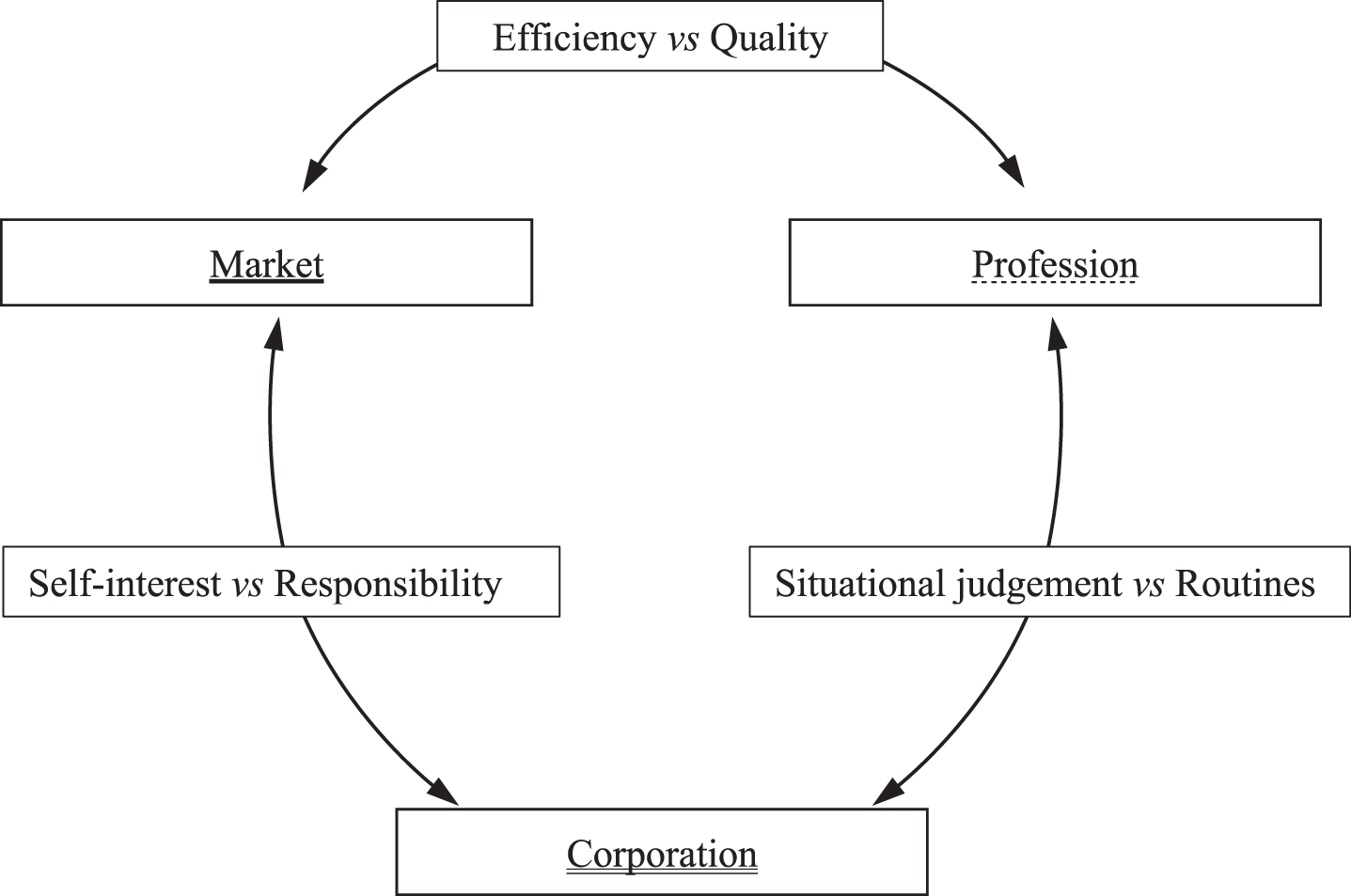
The institutional orders of the market, profession and corporation and the complexities arising from incompatible prescriptions between them.
When the orders of the
‘This year, we have cancelled our bids three times. [Researcher: Yes, but I assume there are just so many times you can cancel your bids on work?] [...] Even if we have to do it a hundred times, that does not matter.
In the above quote, the professional is not willing to make concessions to working safely. Based on his knowledge, he judges that working when electricity is running is unsafe, despite the apparent wish of the client. The interviewee in this example solves the complexity arising from the collision of the logic of the market and the logic of the profession by stating that the client (market) has to learn that the professional will not make concessions to working safely. He implicitly stresses the legitimacy of his choice based on his expert knowledge about work safety.
Logic of the market versus logic of the corporation
When the
‘A few years ago, we sometimes thought
The interviewee describes that initially, he was more motivated by increasing efficiency, but when confronted with the self-interest of the client reasoning from the same market logic, he turned to the corporation logic and took responsibility for his subordinates. This example illustrates that the interviewee tried to solve the complexity initially by leaving things implicit, reckoning that the client would take responsibility. However, when the safety question was made more explicit, complexity arose, and in this instance, the parties involved were forced to settle the responsibility question. As the client refused to pick up the glove, the interviewee was almost forced to do so.
Logic of the profession versus logic of the corporation
When the order of the profession collides with the order of the corporation, actors are confronted with the managerial hierarchy and the organisational culture (corporation logic) on one hand and personal expertise and reputation (profession logic) on the other:
The interviewee describes that –following from the logic of the profession –there is a certain willingness to get the work done, which is also expected from them. However, getting the work done requires professionals to use their expert knowledge to make a translation from the general applicable rules and routines of the corporation to an approach that fits with the specific situation. In the process of doing so, they are likely to deviate from and violate those corporate routines, and inherently the corporation logic. Making this translation is accepted –and perhaps even expected by managers –but only as long as things go well. When things go wrong, managers will use their hierarchical power to protect themselves, hiding behind corporate routines that should have been followed.
Discussion
The aim of this study was to increase our understanding of what drives safety-related decisions and behaviours. We proposed that the discourse of institutional logics could be used as a lens to uncover, illustrate, and explain rationales for safety-related behaviours and decisions that are otherwise left uncovered or dismissed as irrational [cf. 4, 25, 26].
This study makes several contributions to the field of occupational safety. First, it demonstrates that an institutional logics perspective can be effectively applied to empirical data and used to uncover and identify the easily overlooked differences between the rationales that people employ to justify their views about occupational safety. By applying the institutional logics perspective to the descriptions of safety issues by managers, we were able to uncover the logics of the market, profession, and corporation. Within this study, the market logic was reflected in the use of safety performance as a means to increase consumer preference and the effects of market competitiveness on safety. The professional logic led managers to prioritise staying safe over getting the work done, whereas others prioritised the timely completion of work over standard operating procedures that should keep them free from harm. The logic of the corporation was reflected in the means in which managers made use of their hierarchical power to determine the content and planning of work. These examples demonstrate that an institutional logics perspective can be used to identify different rationalities underlying behaviours and decisions and how those different logics lead to differences in approaches towards safety.
Second, in addition to illustrations of individual institutional logics in the data, examples of logic multiplicity between the logics of the market, profession and corporation emerged. Here, people use the same words but speak different languages. Complexity between the logics of the market and the profession arose due to the incompatibility of the market logic’s self-interested focus on increasing (efficiency) profits, whereas the professional wanted to adhere to high-quality work standards. In this situation, the manager resolved the conflict by stating the client had to learn from the professional’s personal expertise regarding how to keep the work safe. The complexity between the logics of the market and the corporation occurred as result of the market logic’s self-interested focus on increasing (efficiency) profits, whereas managers have to uphold their hierarchical status and responsibilities. Initially, the solution to complexity was sought in leaving the responsibility for occupational safety implicit. However, when the client made this issue explicit and refused to take responsibility, the manager was forced to do so. The complexity between the logics of profession and the corporation arose as a result of rules and routines that are prescribed by the corporation that were incompatible with the work that was expected to be done. The group lead tried to solve the complexity by using his expert knowledge to translate the general rules and routines to fit with the specific situation.
The new concepts (i.e., the various logics and their associated elemental categories) introduced by the institutional logics framework provide both researchers and practitioners with a discourse that allows them to study and analyse occupational safety in new manners. These concepts not only allow for providing meaning to seemingly irrational behaviours [4], but also provides a means to break down the complex structure of behaviours rooted in various rationales into manageable pieces [cf. 22–24]. Additionally, these concepts complement the local rationality principle that Dekker [8] introduced to explain human error and further it by illustrating that similar people in similar situations can reach different conclusions based on the prevailing institutional logic [22].
Third, the framework designed Besharov and Smith [15] proved to be a useful tool to indicate the degree of conflict within the organisation. As multiple logics were core to the safety-related decisions and behaviours (i.e., a high degree of logic centrality) and provided contradictory prescriptions for action (i.e., a low degree of logic compatibility), the organisation in this study can be categorised as a contested organisation. In line with the results, this implies that members of the organisation ‘hold competing expectations about appropriate organisational goals and lacking a clear guideline as to which goals should prevail’ and that the organisation encounters extensive conflict [15, p371]. The contradictory prescriptions for action and the resulting competition between organisational goals jeopardises occupational safety. If safety is not beyond a doubt the number one organisational goal, employees cannot be expected to maintain workplace safety at all times. The ability to predict the degree of conflict within an organisation and to understand how this conflict originates provides managers with opportunities to minimise such conflict and its impact on performance and stability [15, 40].
In sum, the demonstrated usability of the institutional logics perspective in studying and analysing occupational safety provides both researchers and practitioners with new means to explore and address human and organisational safety issues.
The demonstrated usability of an institutional logics perspective for occupational safety also has implications for practice. First, managers should be aware that people can have different underlying rationales for their safety-related thinking, decisions and behaviours. Second, in addition to this awareness, the ability to identify the different logics at play allows managers and safety professionals to minimise the impact of speed on accuracy in times of haste and crisis. Third, through awareness and identification of the different logics, managers and safety professionals can help in exploring misunderstandings in conversations between different actors, in addition to uncovering the nature of these misunderstandings through articulating the various logics. Fourth, the discourse of logics can be used in the analysis of occupational safety incidents. As Dekker [8] notes, no one comes to work to do a bad job, and what they do and decide makes sense to them in that specific situation. In the case of a safety incident, the institutional logics perspective can shed light on the motivations and rationales that drove employee decisions and behaviours instead of dismissing the accident solely as caused by human failure. Finally, the discourse of logics provides (safety) managers with the ability to recognise, articulate, and discuss the different rationales for occupational safety that are easily overlooked by traditional management approaches. In doing so, it not only contributes to the understanding of employee functioning in terms of occupational safety but also provides managers with opportunities to engage with employees by articulating the divergent rationales they apply and to use the discourse of logics by adapting their arguments in such a manner that they are in line with the dominant logic of their conversation partners, thus increasing their intelligibility and persuasiveness.
Although we are convinced that the findings presented in this study contribute to the current knowledge and understanding of safety-related decisions and behaviours, there are some limitations that must be addressed. First, the group of managers participating in this study was limited in size, especially considering the limited number of managers that made implicit references to institutional logics. Future research should therefore further explore the presence of (conflicting) institutional logics concerning occupational safety with larger research samples and in organisations operating in other sectors. Second, although the state logic seemed to emerge from the data, it proved difficult to unequivocally interpret these units of analyses. The wordings used by interviewees did not clearly allow for a definite answer regarding the origins of the referenced rules (i.e., state or corporation), which led us to adopt a rather conservative approach and exclude all related quotes. Future research should therefore explore whether references to the state logic can be interpreted more clearly.
Conclusion
The current study demonstrated that the institutional logics perspective is a valuable lens that provides new methods to uncover, study, and explain the different rationales underlying occupational safety. It allowed us to uncover the logics of the market, profession and corporation in occupational safety-related thinking, decisions and behaviours of managers. Such insights into and understanding of the various rationales underlying safety can help in the prevention and analysis of accidents, ultimately leading to safer workplaces.
Conflict of interest
None to report.
Footnotes
Acknowledgments
This research was approved by the ethical committee of the Faculty of Behavioural, Management and Social sciences of the University of Twente (reference number: BCE16359). This research did not receive any specific grant from funding agencies in the public, commercial, or not-for-profit sectors.