




Abstract
This paper is a brief personal journal of our relentless pursuit of Web Intelligence (WI). How it all started? What have achieved? Where are we heading? Our search for the ultimate meaning of the Web enables us to see and appreciate the power of the Web for building a better human society through collaboration, co-learning, and co-creation. The Web is a powerful idea, a scientific and technological innovation, and a social creation. Web Intelligence explores the connectivity, diversity, and plasticity of the Web, as well as the global brain supported by the Web. The goal of research on Web Intelligence is to build a better connected world of everything, by people, and for a new intelligent human society.
Introduction
Popper [7] once said, “All things living are in search of a better world.” “The search for truth, particularly in the natural sciences, no doubt counts among the best and greatest things that life has created in the course of its long search for a better world.” As a matter of fact, our more than two decades journey of research on Web Intelligence (WI) is a search of a better connected world based on the idea and platform of the Web. In this fascinating journey, we have grown along with the exciting development and evolution of the Web. It not only enriches our academy lives, but also enlightens our personal everyday life. The Web changes the ways that we see, know, and change the world for the better.
We started by introducing Web Intelligence with a direct reference to the Internet-based World-Wide-Web (WWW), which suggests that Web Intelligence is about Artificial Intelligence (AI) on the WWW platform [15,16,18,21]. Gradually, we recognized that the notion of the Web is a much more powerful and richer idea. At a high conceptual level, a Web is a huge number of entities or things connected together. The WWW platform is only one of the most successful realizations of a Web. With this new understanding, we now view the Web as an abstract idea of a set of connected things, in which many important structures and properties emerge from the interconnections and interactions of the entities. The Web may be implemented and realized either biologically and physically, leading to human natural intelligence, machine artificial intelligence, and human–machine co-intelligence [10]. For example, the brain is a web of connected neurons, a human society is a web of connected people, a software system is a web of connected programs, and a scientific field of study is a web of connected ideas, notions, and concepts. Although these are perhaps over-simplifications of the reality, they do capture the most essential basics and serve as a rough first approximation for further elaboration and articulation.
Web Intelligence may be viewed in multiple ways by embracing various types of web, leading to, for example, connected intelligence, network intelligence, distributed intelligence, web-based emergent intelligence, crowd intelligence, social intelligence, global intelligence, human–machine co-intelligence, and many more. We envision a grander future research agenda of Web Intelligence for building a better connected world of everything, by people, and for a new intelligent human society.
How it all started: In search of the Wisdom Web
With the introduction of the concept of World-Wide-Web (WWW) by Tim Berners-Lee1
The introduction of the concept of Web Intelligence (WI) was mainly the result of the interplay of the set of powerful ideas that underlying our individual research fields. Together with Professor Setsuo Ohsuga, we coined the term “Web Intelligence” (WI) and published a two-page position paper [18] at the 24th IEEE Computer Society International Computer Software and Applications Conference (COMPSAC 2000) (see Fig. 1). In the paper, we gave a one-sentence definition of Web Intelligence: WI exploits AI and advanced information technology on the Web and Internet. The basis of WI is AI and IT. The “I” happens to be shared by both “AI” and “IT”, although with different meanings in them, and “W” defines the platform on which WI research is carried out. The goal of WI is the joint goals of AI and IT on the new platform of the Web. That is, WI applies AI and IT for the design and implementation of Intelligent Web Information Systems (IWIS). An IWIS should be able to perform functions normally associated with human intelligence, such as reasoning, learning, and self improvement. Web Human–Media Engineering, Web Information Management, Web Information Retrieval, Web Agents, Web Mining and Farming, Web Information System Environment and Foundations, Web-Based Applications.
It can be seen that our initial conceptualization of Web Intelligence had a strong emphasis on Web-based intelligent systems and applications.
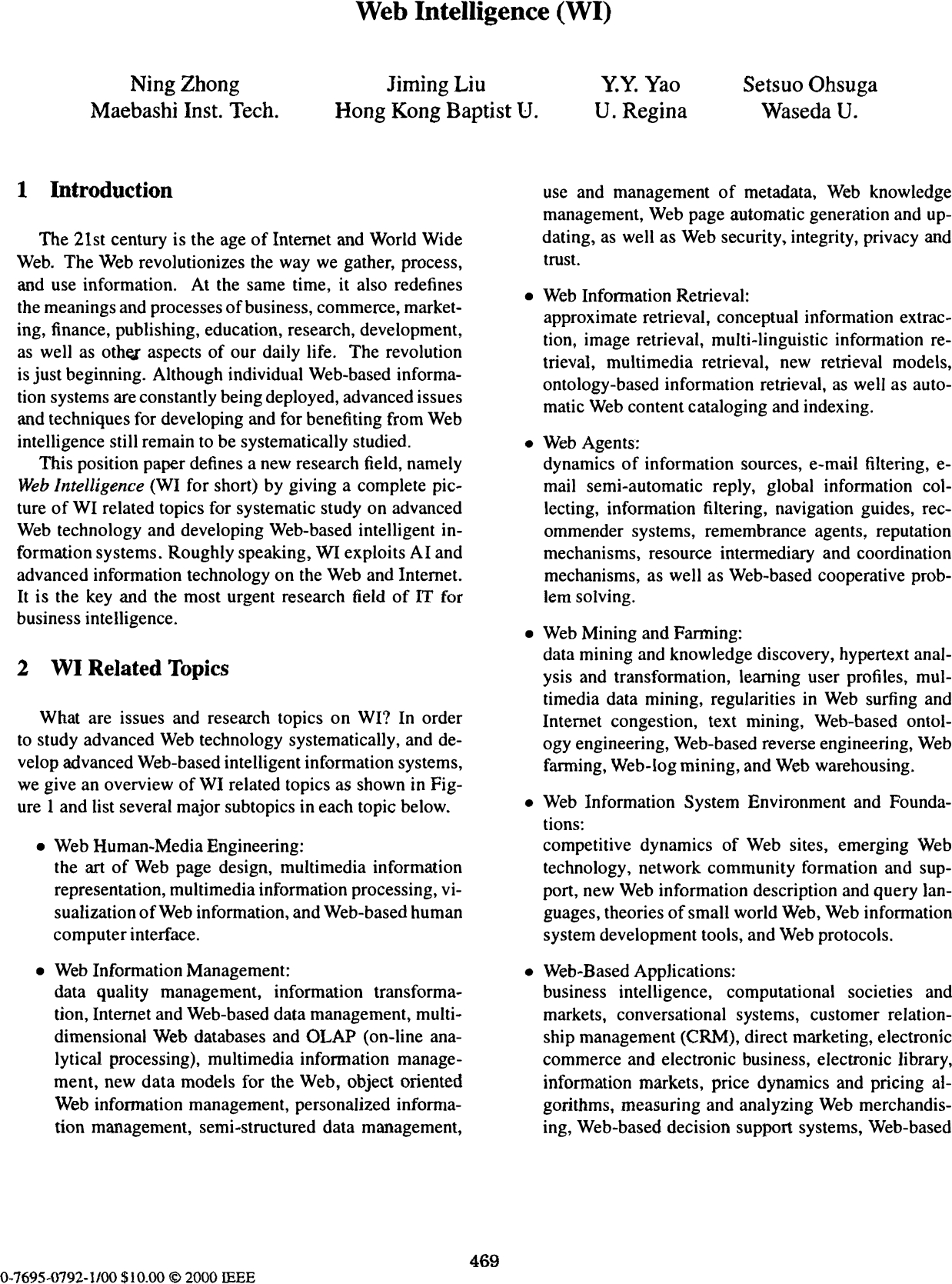
First paper on WI.
Our further research motivated us to dig deeper into the notion of Web Intelligence. To realize the full value of the Web, we must move beyond intelligence and enter the realm of wisdom. As a result, in 2002 we edited a special issue in IEEE Computer for promoting Web Intelligence research as a “search of Wisdom Web” [15]. In the editorial, we predicted that “Web intelligence will produce the new tools and infrastructure components necessary to create a Web that serves its users wisely.” Furthermore, “The next-generation Web will go beyond improved information search and knowledge queries and will help people achieve better ways of living, working, playing, and learning.” A four-level conceptual framework was suggested:
Internet-level communication, infrastructure, and security protocols, Interface-level multimedia presentation standards, Knowledge-level information processing and management tools, and Application-level ubiquitous computing and social intelligence environments.
Accordingly, “The intelligent Web seeks to provide resources that encourage sustainable knowledge creation and scientific and social evolution.”
In 2003, Jiming [3] delivered a keynote speech at the International Joint Conference on Artificial Intelligence to articulate fundamental questions of the Wisdom Web: The major challenge of the Web research and development in the next decade will be Wl-centric, focusing on how we can intelligently make the best use of the widely available Web connectivity. The new WI technologies to be developed will be precisely determined by human needs in a post-industrial era; namely:
information empowerment; knowledge sharing; virtual social clustering; service enrichment; practical wisdom development.
The next paradigm shift in WI will be towards the notion of wisdom. Developing the Wisdom Web will become a tangible goal for WI research. The new generation WI will enable humans to gain wisdom of living, working, playing, in addition to information search and knowledge queries.
In 2003, Ning [12] delivered a keynote speech at the International Conference on Active Media Technology by looking at the business and service aspects of Web Intelligence. He suggested two ways to study Web Intelligence: Study the Semantics in the Web. One of the fundamental issues of WI is to study the semantics in the Web, called the semantic Web, that is, modeling semantics of Web information. Study the Web as Social Networks. We can view the Web as a directed network in which each node is a static Web page to another. Thus, the Web can be studied as a graph that connects a set of people (or organizations or other social entities) connected by a set of social relationships, such as friendship, co-working or information exchange with common interests.
In 2005, Yiyu [8] delivered another keynote speech at the International Conference on Active Media Technology by discussing the scopes, goals, challenges, and future development of WI. Four perspectives on the Web were discussed:
the computer science perspectives: infrastructure and intelligent systems, the information science and knowledge management perspectives: data, information, knowledge, wisdom hierarchy, the social intelligence perspectives: connectivity, social network intelligence, application perspectives: electronic commerce. Web Intelligence as a new field of science, technology and engineering, design philosophy and principles of the Web, the laws of the Web, the Web revolution: one link at a time, the more things change, the more they stay the same.
Particularly, for the future development of Web Intelligence, we may consider the following issues and topics:
The constant evolution of the Web, under the principles of Web connectivity, diversity, and plasticity, makes the research of Web Intelligence to be a fascinating exploration in many new territories.
An important result of our research on Web Intelligence is a new understanding that the Web is an idea, a metaphor, and a conception of a set of interconnected things. There are many types of web, depending on the types of things. This requires a multi-view and multiple disciplinary study of Web Intelligence in various contexts. Furthermore, it offers opportunities to combine Web Intelligence with other fields. For example, two of the many initiatives are Web Intelligence meeting brain informatics [13,19] and Web Intelligence meeting immunology [5,6]. The former takes the metaphor of the brain as a huge number of connected neurons. The latter takes the simple view that human immune system is a web of cells, namely, “human immune system is a typical example of a highly sensitive, adaptive and self-regulated complex system involving numerous interactions among a vast number of cells that belong to different types” [6].
In 2005, Ning [13] gave a keynote speech at the Atlantic Web Intelligence Conference, in which he introduced the concept of “Brain Informatics.” To quote from Ning, Brain Informatics (BI) is a new interdisciplinary field to study human information processing mechanism systematically from both macro and micro points of view by cooperatively using experimental brain/cognitive technology and WI centric advanced information technology. In particular, it attempts to understand human intelligence in depth, towards a holistic view at a long-term, global field of vision, to understand the principle, models and mechanisms of human multi-perception, language, memory, reasoning and inference, learning, problem-solving, discovery and creativity.
The cover page of the proceedings of BI 2006 (see Fig. 2) depicts a picture that brain informatics (BI) explores the connections of cognitive science, neuroscience, and WI centric IT. Today, brain informatics weaves together three powerful ideas in a probe of human natural intelligence, while simultaneously extending new meanings towards the future of artificial intelligence in the connected world [1]. That is, brain informatics is brain science in the Web Intelligence centric Information Technology age. Brain informatics studies the human brain from the viewpoint of informatics (i.e., human brain is an information processing system) and uses informatics (i.e., WI centric information technology) to support brain science research. In particular, a representative direction by meeting WI with brain informatics is the investigation of thinking and reasoning, focusing on clarifying intelligent information processing mechanisms via the large scale brain cognition encoding and decoding studies, and then severing as the development of future intelligent computing and agent to realize the embodied AI. With this idea, we include this paper in the current issue as a practical explanation and interpretation, through exploring the WI-related techniques and methods to create thinking space for and from the systematic brain informatics investigation [2].
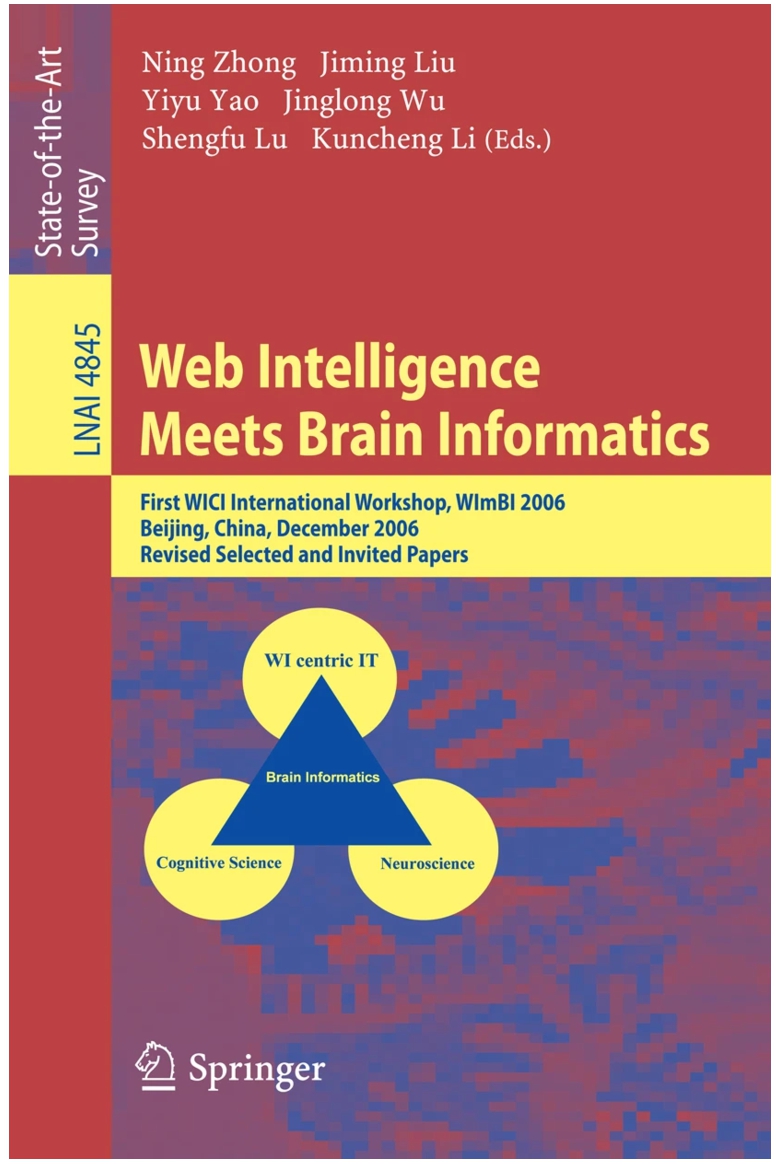
Cover page of the proceedings of WI meet BI in 2005.
Peter Drucker is commonly accredited to the saying: “The best way to predict the future is to create it.” Regarding where we are heading in Web Intelligence research, the same can be said. Although we do not have a crystal ball to tell us exactly what will be happening, we are confident that research in Web Intelligence, based on a broader understanding of the Web, will profoundly change the ways that we see, know, and change the world. With the achievements of Web Intelligence, under the theme of “Artificial Intelligence in the Connected World”,2
We welcome you join us in this journey of search. As laid out in the website of the Web Intelligence Consortium,3
Track 1: Web of People
Cognitive Modeling and Computing
Conversational Search and Dialog Systems
Crowdsourcing and Social Computing
Human Centric Computing and Services
Human Creativity and Decision-making Support
Human-level Collective Intelligence
Human–machine Co-intelligence in the Connected World
Information Diffusion Modeling and Analysis
Opinion Mining and Sentiment Analysis
Recommendation Systems
Situation and Personality Awareness
Social Media and Social Networks
User and Behavioural Modelling
Wisdom Services
Track 2: Web of Data
Artificial Intelligence Generated Content (AIGC)
Big Data Analytics and Deep Learning
Big Data and Human Brain Complex Systems
Cognitive Models and Computational Models
Data Driven Services and Applications
Data Integration and Data Provenance
Data-Knowledge-Wisdom Hierarchy
Data Science and Machine Learning
Few-shot Learning and Transfer Learning
Graph Isomorphism and Graph Theory
Information Search and Retrieval
Knowledge Graph and Semantic Networks
Linked Data Management and Analytics
Multimodal Data Fusion
Pre-trained Language Models and Applications
Representation Learning
Track 3: Web of Things
Distributed Systems and Devices
Dynamics of Networks
Industrial Multi-domain Web
Intelligent Ubiquitous Web of Things
IoT Data Analytics
Location and Time Awareness
Open Autonomous Systems
Sensor Networks
Streaming Data Analysis
Web Infrastructures and Devices Mobile Web
Wisdom Web of Things
Track 4: Web of Trust
Blockchain Analytics and Technologies
De-Platforming and No-platforming
Decentralization of Internet
Fake Content and Fraud Detection
Hidden Web Analytics
Monetization Services and Applications
Trust Models for Agents
Ubiquitous Computing
Web Cryptography
Web Safety and Openness
Web-scale Security, Integrity, Privacy and Trust
Track 5: Web of Agents
Agent Networks and Multi-Agent Systems
Autonomy Remembrance Agents
Autonomy-oriented Computing
Behaviour Modelling and Individual-based Modelling
Chatbot and Intelligent Agent
Computational Social Science
Deep Reinforcement Learning
Distributed Problem-Solving and Reasoning
Edge Computing and Cloud Computing
Local–global Behavioural Interactions
Mechanism Design
Network Autonomy Remembrance Agents
Self-adaptive and Self-organizing Evolutionary Systems
Social-cyber-physical Systems
Symbols-Meaning-Value Space
Track 6: Emerging Web in Industry, Society, Health and Smart Living, and the Web of Everything
AIGC in Industry, Finance, Culture, Tourism, Education and Healthcare
Data Brain, City Brain and Global Brain
Data-driven Service Industry
Data-driven Innovative Service-oriented Society
Digital Ecosystems and Digital Epidemiology
Digital Transformation and Digital Twin
Explainability and Interpretability
Fairness, Accountability, and Transparency
Generative AI and the Web of Everything
Human–machine Symbiosis in a Connected World
Web3, Metaverse and Smart Living
Wellbeing and Healthcare in the 5G Era
The quotation of Ralph Waldo Emerson, “It’s not the destination, it’s the journey,” perhaps better summarizes our journey in search and research of Web Intelligence. The three of us form a simplest social network, or more precisely, an essential of component (i.e., a triad) of social networks. The dynamics of this simple Web of three helped us to see personally the potential power of threes for collaboration, co-intelligence, and co-creation, which is discussed in a recent paper [9]. We have in fact created something that is beyond our individual abilities. Along the way, we have also observed the working of two other triads. The triad of the World-Wide-Web, Artificial Intelligence, and Information Technology had led to the introduction of Web Intelligence; the triad of WI centric IT, cognitive science, and neuroscience had led to brain informatics. It might be worthwhile to explore other triadic structures for Web Intelligence research.
We hope that our story may inspire further collaborations of researchers by making full uses of the Web. We envision a better connected world and a more intelligent human society that can be built based on research and exploration of Web Intelligence. The Web is an idea; it is more about the connection, diversity, and plasticity of a connected world. We need Web Intelligence and Wisdom Web to see, to know, and to change the world wisely. With the advance of Web Intelligence, we may have the intelligence and wisdom to ensure a better connected world.