




Abstract
BACKGROUND:
Maintaining gait stability is an important factor for preventing falls of normal adults. Thus, it is necessary to conduct research on gait variables in normal adults.
OBJECTIVE:
In this study, we conducted research on the effect of rhythmic exercise using proprioceptive neuromuscular facilitation (PNF) patterns on gait variables in normal adults.
METHODS:
Thirty-two subjects were divided into two groups, the training and control groups, with 16 subjects in each group. We measured various gait variables step time difference (STD), step length difference (SLD), single support difference (SSD), stance phase difference (STPD) and swing phase difference (SWPD) for the pre-test and post-test in each group.
RESULTS:
As a result of paired t-tests on various gait variables (STD, SLD, SSD, STPD, SWPD) of the training and control group, the training group showed significance in SLD, STPD and STD and the control group had no significance in all items.
CONCLUSIONS:
In this study, which verified the effect of rhythmic exercise using the PNF patterns on the gait variables of normal adults, there was statistical significance in SLD, STPD, and STD showing that dynamic exercise using the PNF pattern is helpful in improving the walking ability of normal adults.
Introduction
In daily activities, gait is a movement that moves the body while minimizing energy consumption. It requires balance ability, coordination, kinesthetic sense, proprioception, and integrated muscle action [1]. Maintaining gait stability is an important aspect in preventing falls. Injuries due to falls may limit an individual’s functional movement and mobility and also lead to restrictions in various social activities. This can lead to the development of depression and other conditions and can reduce a patient’s quality of life [2]. Walking is a pattern movement based on balance and is a form of behavior that moves the body from one place to another. It is the most basic way for humans to lead a life, and is used to evaluate the quality of life, including daily life movements and functional activities. It is the most basic element. Gait is divided into a gait cycle of a stepping phase and a rocking phase, and in the progression from the stepping phase to the heel, sole, and toe, the body weight is transferred from the heel, causing the foot to naturally prostrate, absorbing the impact force with the ground [3]. Additionally, gait is influenced by several factors such as strength, muscle mass, and muscle-tendon unit construction [4, 5]. Changes in lower extremity muscles may reduce the range of joint motion required for walking, ultimately affecting walking performance [6, 7, 8]. In particular, hip flexion contractures result from immobility or low levels of regular physical activity, resulting in decreased hip range of motion, increased pelvic tilt, and decreased contralateral stride length [9]. When the human body is inactive, its physical condition gradually deteriorates [10], and this conditioning as a result, in addition to bone loss [11], it causes loss of muscle mass [12], deficits in postural control [13, 14], and decreased motor and functional mobility [15, 16, 17].
Among therapeutic exercise interventions, Proprioceptive Neuromuscular Facilitation (PNF) is a therapeutic intervention method that promotes exercise activity in weak or damaged body parts by applying resistance to strong body parts, and is similar to other exercise interventions. Compared to this method, it not only encourages the subject’s active participation in exercise, but also facilitates coordination training of the trunk, limbs, leg joints, and shoulder joints [18]. Normal adult walking is characterized by efficient anti-phase coordination between the pelvic girdle and the scapular girdle [19]. Proprioceptive neuromuscular stimulation applied through cross-training improves function and increases muscle activity, flexibility, and balance by stimulating proprioceptors within muscles and tendons. It mainly increases muscle strength, flexibility, and coordination in response to stimulation of the muscular nervous system, thereby improving motor function. It is effective in maximizing the motor function’s response [20, 21]. When a single pattern is used, responses using such radiation can appear in various directions and ranges depending on the therapist and posture, and when multiple patterns are applied simultaneously, greater force is exerted, increasing muscle strength. It has a greater impact on safety and can increase the diversity and efficiency of treatment by using various intervention methods [18].
When walking, the greater the difference in step length and step time between the two feet, the more unstable the gait. A study has reported improvements in strength, endurance, and walking speed through the performance of lower extremity exercise. It also emphasizes that lower extremity exercise improves the functional stability of the body and the functioning of the muscles in the waist area, thereby resulting in improved balance and walking ability [22].
Rhythmic exercise using PNF patterns is a type of stabilization exercise that involves rhythmic diagonal movements of the upper and lower extremities while maintaining a stable posture. It is also an effective exercise for the development of the multifidus, transversus abdominis, and transversus abdominis muscles, which contribute to lumbar stabilization, as well as upper and lower extremity strength [23]. In addition, PNF patterns exercise has been found to have a positive effect on the posture of normal adults [24] and revealed statistical significance in balance [25]. Walking requires balance, coordination, kinesthetic sense, proprioception, muscle integration, posture, and trunk stability. The effects of PNF patterns exercise on abdominal muscle thickness – which is involved in posture, balance, and trunk stability – have been studied, but there have been no studies on walking, which can be considered the culmination of all these components. In this study, we sought to verify the effect of rhythmic exercise using the PNF patterns on gait variables in normal adults.
Materials and methods
Subjects
This study included thirty-two healthy adults as participants, who were lived in south KOREA. The selection criteria were that the subjects were healthy, normal adults. The exclusion criteria were the presence of any arthritis disorders prior to participating in the experiment, being overweight, consumption of alcohol before the experiment, spinal pain such as back pain, structural abnormalities in the spine, on any medication, or herniated intervertebral disc patient.
The participants were randomly divided into a training group (TG; M
Examination methods
The rhythmic exercise using the PNF patterns was performed by alternating the dynamic exercise using the PNF D1 pattern on the left and right sides, with the subjects performing abdominal drawing-in before performing the exercise for trunk stabilization.
When exercising, the left foot supports the body weight and the right lower extremity performs hip flexion, external rotation, adduction, knee flexion, and ankle dorsi flexion. The left upper extremity performs shoulder adduction, flexion, external rotation, and elbow flexion, and the right upper extremity performs shoulder extension and internal rotation, abduction, and elbow extension. Use the PNF pattern when doing the exercise in the opposite posture while keeping your right foot fixed. One thing to keep in mind is that your torso should not shake during exercise, and your feet touching the floor diagonally should always touch the same point (Fig. 1) [26].
Rhythmic exercise using the PNF (proprioceptive neuromuscular facilitation) patterns.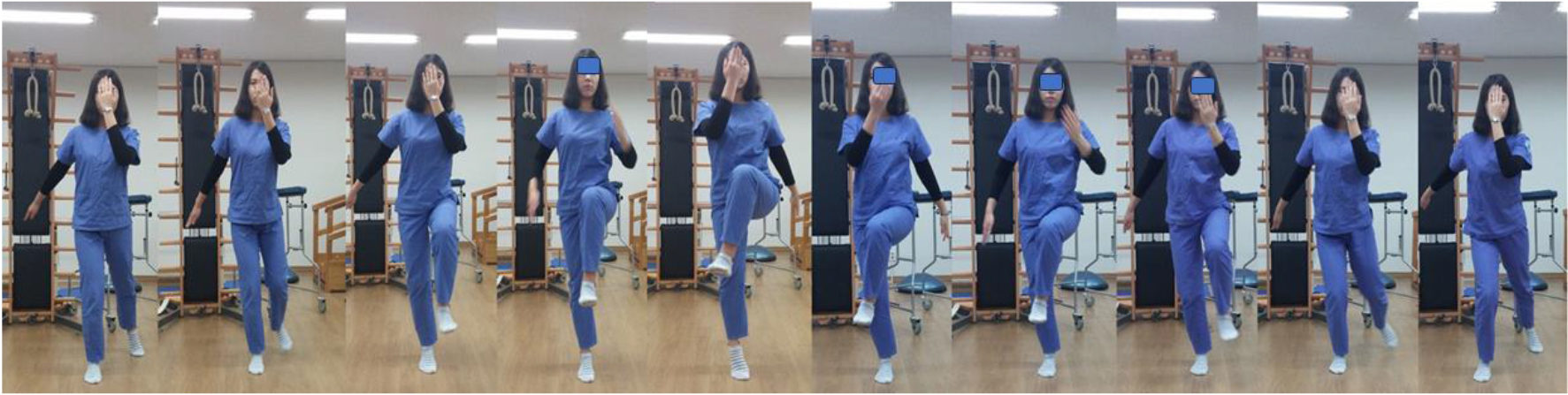
A total of 6 weeks of PNF pattern exercise was performed in the experimental group, with 5 minutes of warm-up exercise, 5 minutes of cool-down exercise, and 20 minutes of main exercise, 3 times a week. CG was measured twice only after daily activities without special exercise, and the exercise was conducted in a flat, spacious, and safe exercise therapy room.
The OptoGait (MICROGAIT, Italy) used for gait analysis is a gait analysis device that operates as an optical sensing system with 96 LEDs.
OptoGait’s transmitter and receiver bars are installed on both sides of the treadmill, and when the subject walks on the treadmill, the gait is analyzed by infrared rays to calculate step time difference (STD), step length difference (SLD), single support difference (SSD), stance phase difference (STPD) and swing phase difference (SWPD). It also calculates the time spent touching the ground and floating in the air while walking, running, and jumping through 1,000 transmissions per second to accurately calculate the data and analyze the gait through dedicated software. At the time of measurement, the experiment participants wore comfortable sportswear and the measurement location was a flat, spacious and safe exercise therapy room.
Statistical analyses
Using SPSS 21.0 KO (SPSS, Chicago, IL, USA), changes in the subject’s SLD, STPD, SWPD, SSD, and STD were compared for each group’s pre-test and post-test using a paired
Results
The comparison results of pre-intervention and post-intervention data for the TG and CG revealed that the TG had statistically significant differences in SLD, STPD, and STD (
Comparison of SLD, STPD, SWPD, SSD and STD between Pre- and post-intervention in each group (mean
SD) (unit: SLD-cm STPD, SWPD, SSD, STD-%) (
32)
Comparison of SLD, STPD, SWPD, SSD and STD between Pre- and post-intervention in each group (mean
* p< 0.05, SLD; step length difference, STPD; stance phase difference, SWPD; swing phase difference, SSD; single support difference, STD; step time difference.
Comparison of SLD, STPD, SWPD, SSD and STD between Training group and Control group (mean
* p< 0.05, SLD; step length difference, STPD; stance phase difference, SWPD; swing phase difference, SSD; single support difference, STD; step time difference.
Walking is affected by the corticospinal tract, which is activated when performing tasks that require adaptation [27]. While performing tasks that require accurate control, the motor-evoked potential of the leg muscles increases, which helps to improve walking ability [28]. Human walking puts pressure on the spine, pelvis, and lower extremities due to gravity, which can affect posture misalignment, gait, and balance. The pelvis plays an important role in human movement because it supports the spine and acts as a center of connection between the upper and lower extremities [29]. The spine and pelvic must be in the correct posture so that it can adjust the upper and lower body during movement to improve the performance of daily living activities and walking ability [30].
In a previous study, Wang [31] reported that rehabilitation therapy for patients with hemiplegia of short and long duration increased walking speed after 12 sessions for hemiplegia of short duration. Genthon et al. [32] measured changes in the center of pressure while maintaining similar postures in normal subjects and hemiplegia patients and reported poorer balance control in hemiplegic lower extremities in hemiplegia patients. Garland et al. [33] reported that rehabilitation therapy helps improve standing balance and functional mobility in hemiplegia patients. De Haart [34] reported that rehabilitation therapy helps improve standing balance in post-acute stroke patients.
Cristopoliski et al. [35] investigated whether a stretching program that increases the range of motion of the lower extremities in elderly people improves walking. Twenty healthy elderly women were divided into two groups. The experimental group performed stretching exercises 12 times over four weeks, while the control group did not exercise. As a result of evaluation before and after the experiment, the experimental group’s stride length increased, walking speed increased, and double support time decreased. Additionally, it was reported that the anterior and lateral tilt and rotation of the pelvis were greater in the experimental group, and that stretching can be used as an effective means to improve range of motion and affect walking performance. Seo and Kim [36] classified 30 chronic stroke patients into an experimental group and a control group. For 4 weeks, the experimental group received 30 minutes of general exercise therapy and then 30 minutes of inclined walking training using the PNF lower limb pattern. The control group received general exercise therapy for 30 minutes and then walked training on level ground for 30 minutes. The Berg balance scale test, time-out and movement test, and functional reach test were performed, and statistical significance was reported in the experimental group. Ritzmann et al. [37] performed a high-load jump exercise similar to gait training in 23 men using high-intensity interval training, repeating 4 jumps 10 times, and reported increased gait variability and improvement in gait rhythmicity as a result. Lim [38] randomly assigned 22 stroke patients to an experimental group (
Cho and Gong [24] conducted a study on 32 normal adults. They divided the subjects into two groups training and control. The training group received rhythmic exercise using the PNF patterns three times a week for six weeks. As a result, the training group showed statistically significant improvements in pelvic position, pelvic rotation, trunk inclination and scapular position. Gong [23] conducted a study on 32 normal adults. He divided the subjects into experimental and control groups. The experimental group performed dynamic exercise using the PNF patterns for 6 weeks, and the experimental group showed an increase in the thickness of the deep abdominal muscles that contribute to trunk stabilization. In addition, Gong [25] also reported that balance ability improved in the training group after six weeks of PNF patterns exercise.
As a result of this experiment, TG showed statistically significant differences in SLD, STPD, and STD, and CG showed no statistically significant differences in all variables. The PNF patterns exercise is believed to have a positive effect on gait variables by improving abdominal deep muscle activation, posture, and balance through the continuous diagonal and spiral movements of the pelvis, lower extremities, scapula, and upper extremities while maintaining body stability through abdominal draw-in. Although the existing PNF patterns exercise mainly targeted patients with hemiplegia and quadriplegia, it is disappointing that this study targeted normal adults. In the future, additional research is needed to expand the research area to include neurological patients. However, we wanted to find out how effective dynamic exercise using the PNF pattern is for the gait of normal adults. Thus, rhythmic exercise using PNF patterns with abdominal draw-in conducted in this study is recommended as an effective exercise method for improving walking ability in people with poor core stability, posture, and balance.
Conclusions
In this study, as a result of verifying the effect of rhythmic exercise using the PNF patterns on the gait variables of normal adults, there was statistical significance in SLD, STPD and STD, which suggests that rhythmic exercise using the PNF patterns helps improve the walking ability of normal adults.
Footnotes
Acknowledgments
This research was supported by Korea Nazarene University Research Grants in 2024.
Conflict of interest
None to report.