




Abstract
BACKGROUND:
The stratum corneum (SC) is the outermost layer of human skin and deemed as barrier against chemical exposure and water loss. Moisturizers have beneficial effects in treating dry skin, especially the SC. Confocal Raman spectroscopy (CRS) was used to evaluate the efficacy of moisturizers on skin hydration and penetration, with such agents posing inherent characteristics of being noninvasive, nondestructive, timesaving, and cost effective. Bionics vernix caseosa (BVC) cream mimics the composition of vernix caseosa (VC), which could protect the newborn skin.
METHODS:
This research applied CRS to evaluate the penetration depth and water content variation during the intervention with two moisturizers, BVC cream and Vaseline. Volunteers received the 2 h application of BVC cream and Vaseline on the forearms. The evaluations on 0 h, 2 h, 4 h and 6 h were performed clinical assessment. Experimental data was processed by least square method and analysis of variance (ANOVA).
RESULTS:
The penetration depth of Vaseline was deeper than that of Bionics vernix caseosa cream. Specifically, BVC cream penetrated 18
Introduction
The skin is the largest organ of human being and accomplishes multiple defensive functions, such as protection against exogenous chemical and physical factors. The stratum corneum (SC) is the top layer of the epidermis, with the function of a barrier against the penetration of exogenous substances and the loss of water [1, 2, 3, 4, 5]. Skin barrier in proper condition is necessary to regulate evaporative water loss while maintaining the level of hydration essential for the enzyme reactions that facilitate stratum corneum desquamation and maturation [6]. Skin moisturization is important for flexibility and other aspects of a healthy appearance [7]. If the SC’s water content (10–20%) decreases, the protective layer of the skin starts to become dry. In this case, cosmetic products are usually applied to healthy promotion, moisturized skin and overcome signs of dryness [8].
Moisturizers prevent evaporative water loss to the environment by placing an oily substance on the skin surface where water cannot penetrate, thus replenishing the SC moisture by water moving from the lower viable epidermal and dermal layers [9]. Vaseline, an oil-soluble ingredient in cosmetic formulas, has been proposed as the best treatment for dryness, among its various occlusive properties. However, Vaseline is a thick and waxy material that makes it difficult to handle and inconvenient for general use, especially over large areas of the body [10].
Vernix caseosa (VC) is a white and creamy substance, which naturally occurring biofilm covering the skin of the fetus during the last trimester of pregnancy. VC coating on the new born baby skin, facilitates extrauterine adaptation of the skin in the first postnatal week if not washed away after birth and protects the neonatal skin [11]. VC consists of water (81%), lipids (9%), and proteins (10%) [12], which can be deemed as a baby’s natural skin cream with multiple functions such as skin miniaturization, protection against bacterial infection, pH adjustment and epidermal barrier repair [13, 14, 15]. As a result of bionic technology, Bionics vernix caseosa (BVC) cream could be used for a better improvement of the moisturizing process.
Confocal Raman spectroscopy (CRS) is used as noninvasive method to determine depth profiles of water concentration of skin seems to be a highly sensitive technique to monitor changes of molecular [16, 17, 18, 19, 20]. Currently, commonly used instruments are capacitance or conductance principles designed to evaluate the barrier function of stratum corneum, including trans epidermal water loss (TEWL) and hydration. Because highly hydrated skin is high conductivity and low capacitance, use oil products will hinder the flow of ions in the skin [21]. Therefore, it is more accurate to evaluate the influence of oily substances on skin moisture content with CRS. Caspers et al. [22] proposed a method to calculate the concentration profile of water mass, based on the ration of integrated region from 3350 cm
Materials and methods
Six healthy volunteers, 3 females and 3 males, aged between 23 to 25 years were recruited. The volunteers were informed not to shower or bathe at least 4 h and not to use any skin care products on the forearms for at least 72 h prior to the experiments. After 20 mins acclimation time, 2 skin areas (each of 2
Moisturizer lotion
Vaseline (TeFuWang, China).
BVC cream lotions include refined jojoba oil 10
Confocal Raman spectroscopy
Samples were placed in a constant temperature and humidity chamber under the microscope interfaced to a CRS (Horiba Jobin Yvon, Villeneuved’Ascq, France). The sample video image of was used for accurate positioning of the laser spot on the sample. A 660 nm pumped Nd:YLF laser was utilized. The collected light was filtered through a notch filter and dispersed with an 8 cm
Data analysis
BVC cream and Vaseline penetration measurements
Penetration was determined by using the classical least squares method, first obtaining the spectra of the samples and skin as well as the spectra after using the product, according to the following formula:
where the coefficients for the skin and sample are
BVC cream and Vaseline influence skin moisture content measurements
According to Caspers et al. [22], the skin water content as a function of depth was detected by the ratio of the protein keratin integrated peak areas (between 2910 and 2965 cm
Statistical analysis
The ANOVA test was used for measurement of time changes among the subjects at 0 h, 2 h, 4 h, 6 h. The
For each time, the average results if the measurements on all volunteers’ stratum corneum were presented as mean
Results
BVC cream and Vaseline penetration measurements
(a) BVC Cream and (b) Vaseline penetration measurements.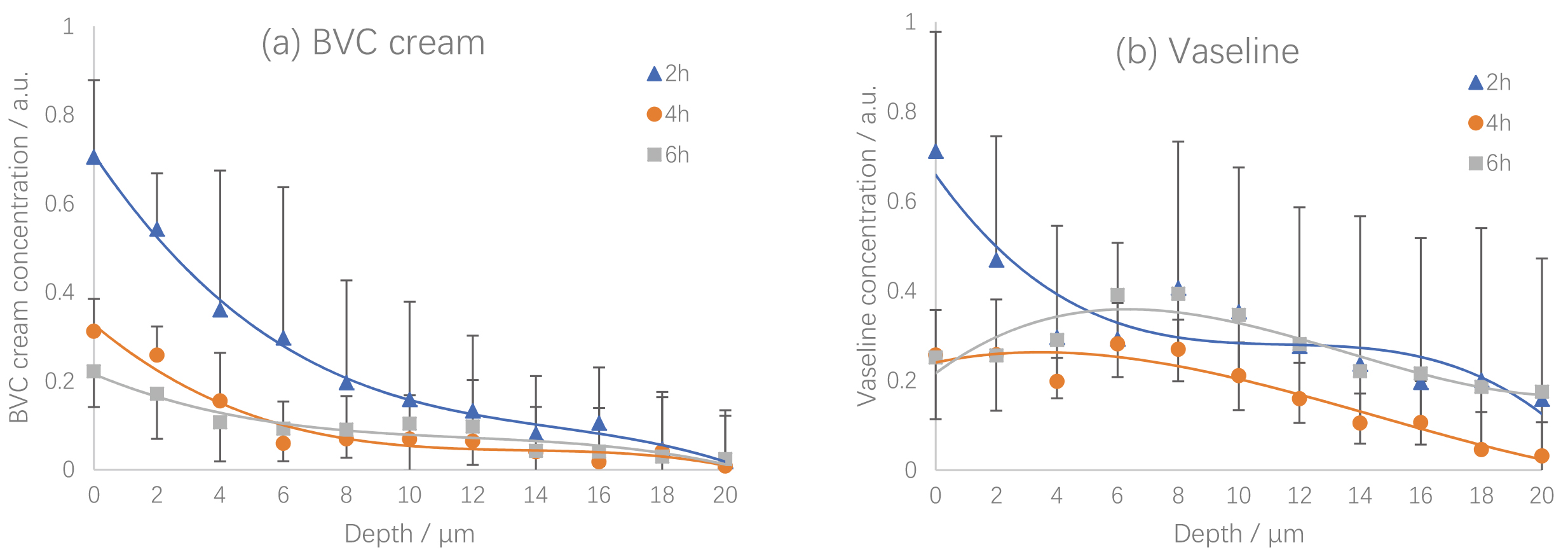
The results of skin retention of volunteers using BVC cream and Vaseline are shown in Fig. 1. The x-coordinate is the skin depth, and the y-coordinate is the retention of the samples. When the percutaneous absorption at a certain depth is greater than zero, it indicates that the sample penetrates to that depth.
As shown in Fig. 1a, the penetration depth of the BVC cream is approximately 18
(a) BVC cream and (b) Vaseline influence skin moisture content measurements.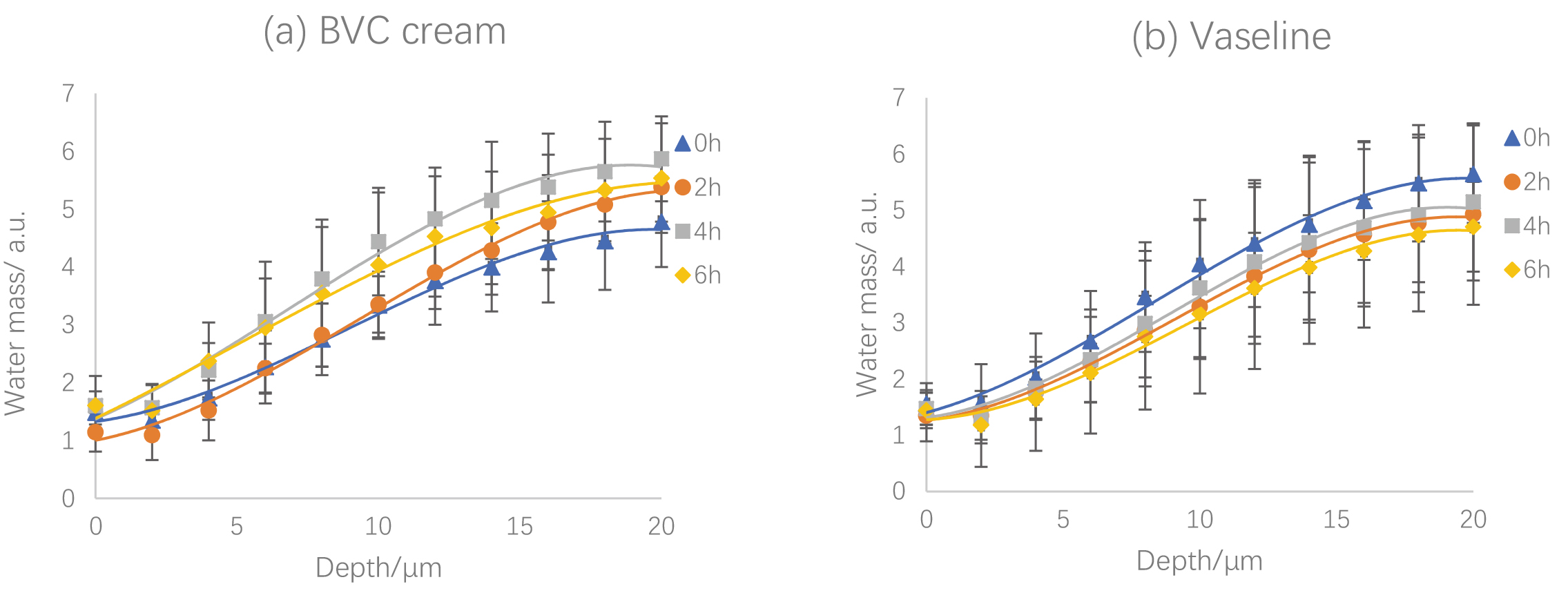
The influence of the samples on the skin moisture content is shown in Fig. 2. The x-coordinate is the depth of the skin, and the y-coordinate is the ratio of the water peak (3100–3620 cm
In Fig. 2a, the skin water content showed an upward trend after applying BVC cream for 2 or 4 h, but there was no significant difference (
In Fig. 2b, the water content of the skin decreased after applying Vaseline at 2 and 4 h, but there was no significant difference at any depth (
Comparison of the skin penetration depth
The maximum depth of collection was 20
Based on the above results, BVC cream and Vaseline mostly remain in the SC. The stratum corneum (SC) plays an important role in the skin barrier protection. However, when we use external intervention for skin care, we need to consider the target position of the active ingredients. Lipids of stratum corneum are with an important role in the regulation of the various compounds absorption from the surface of the skin [27].
BVC cream is a semipermeable film that allows the passage of water vapor [28]. Vaseline is an impermeable film that allows low water vapor transport, indicating that BVC cream is almost fully occlusive compared with BVC cream [28, 29, 30]. Georgios et al. [31] investigated Vaseline and found a significantly higher penetration depth. s Additionally, as for the high occlusion ability, Vaseline gives rise to an increase of water in the SC and causes a swelling effect. The stratum corneum swells to several times its normal thickness and exhibits increased cell membrane permeability when exposed to liquid water or high humidity. Occluded environments or Prolonged high humidity also contribute to poor skin conditions, e.g. diaper dermatitis [32]. Damaged stratum corneum treated with semipermeable films recovers more quickly than damaged stratum corneum treated under complete occlusion or no occlusion, as reported after tape stripping and in premature infants [33, 34, 35, 36].
The moisturizing properties of Vaseline
The water content of Vaseline showed a significant difference by comparison of the results at 6 h with those at 2 and 4 h. Vaseline is a ready-made occlusive emollient [37]. It forms a film on the skin surface, fills the gap between a large number of exfoliating keratinocytes under dry skin conditions, smooths the rough surface of the cuticle, and increases the skin’s moisturizing ability [37]. After applying moisturizers such as glycerin, Vaseline is applied to the skin, which can significantly reduce TEWL [38, 39]. Based on the experimental design and equipment requirements, Vaseline was wiped for 2 h. As described in Section 4.1, Vaseline has the function of SC swelling and skin barrier disruption, leading to a significant decrease in water content after 6 h. Additionally, TEWL as a cell signal can induce the repair of the SC barrier and the synthesis of intracellular lipids. If TEWL is completely blocked, the repair of the SC barrier will be impeded. When the Vaseline is removed, the water content will return to the pretreatment level. However, other research also shows that Vaseline can penetrate SC to help repair the skin barrier, starting with the production of intercellular lipids, such as sphingolipids, free sterols, and free fatty acids [40].
The moisturizing properties of BVC cream
BVC cream is composed of 9 types of lipids, and some of its components form an oil film like that of Vaseline. Although each of the lipid species is important for stratum corneum homeostasis, ceramides are of particular importance because of their large weight contribution and structural characteristics. Ali et al. [41] used Raman spectroscopy to and the organization of three synthetic ceramides (CER) and detect the evolution of the conformation differing from each other by their polar heads in nature (sphingosine, phytosphingosine and a hydroxyl sphingosine), namely CER 2, III and 5. CER III and 5 illustrated a ordered organization and more compact and stronger polar interactions at intermediate relative humidity values, while CER 2 illustrated opposite tendencies and results to those observed with CER III and 5 [41]. BVC cream adds Ceramide III, and its polar head may bind hydroxy of water molecule. This may be responsible for increasing the skin water content. If the environmental humidity changes, BVC cream supplies the skin with ceramides. It has been illustrated that when free fatty acids, cholesterol, or ceramides are applied alone, they aggravate the barrier rather than improve. In contrast, a mixture of the three key lipids in appropriate molar ratios leads to normal barrier repair [42]. Thus, the present conclusion supports the scientific mixture of lipids in BVC cream lotions.
Compare the moisturizing properties of BVC cream and Vaseline, we find the two different kind of mechanism. BVC cream reconstituted skin lipids, which include CER and unsaturated fatty acid. These materials can combine with hydroxyl group of water to increase water content and repair skin protection. While, Vaseline only contain saturated fatty acid that over the skin to prevent water loss.
Our subject remaining to be explored is how to use CRS to compare skin penetration and the moisturizing effect of different moisture lotions. We used only healthy subjects to minimize confounding variables. Future research is suggested include testing subjects with damaged skin. The results of the present experiments indicate that BVC cream can be used in cosmetics for infant skin and sensitive skin, as well as an external reagent for fragile skin with thin cuticles.
Above all, Vaseline can penetrate deeper into the skin, meaning that it can be used as a substrate for medical purposes or for deeper targeted sites. In infant skin and sensitive skin, the SC is thin. Therefore, in the process of creating moisturizing products, skin physiological characteristics should be considered in the design principles.
Conclusion
The penetration depth of BVC cream is approximately 18
Footnotes
Conflict of interest
The authors have no potential conflicts of interest to disclose.