




Abstract
BACKGROUND:
Fully implantable hearing devices (FIHDs) can be affected by generated biomechanical noise such as mastication noise.
OBJECTIVE:
To reduce the mastication noise using a piezo-electric sensor, the mastication noise is measured with the piezo-electric sensor, and noise reduction is practiced by the energy difference.
METHODS:
For the experiment on mastication noise, a skull model was designed using artificial skull model and a piezo-electric sensor that can measure the vibration signals better than other sensors. A 1 kHz pure-tone sound through a standard speaker was applied to the model while the lower jawbone of the model was moved in a masticatory fashion.
RESULTS:
The correlation coefficients and signal-to-noise ratio (SNR) before and after application of the proposed method were compared. It was found that the signal-to-noise ratio and correlation coefficients increased by 4.48 dB and 0.45, respectively.
CONCLUSION:
The mastication noise is measured by piezo-electric sensor as the mastication noise that occurred during vibration. In addition, the noise was reduced by using the proposed method in conjunction with MATLAB. In order to confirm the performance of the proposed method, the correlation coefficients and signal-to-noise ratio before and after signal processing were calculated. In the future, an implantable microphone for real-time processing will be developed.
Introduction
Recently, the number of patients with hearing loss has been increasing owing to the increasing average life expectancy of humans and rapid industrialization. Therefore, hearing assistance devices have been developed utilizing advances in medical techniques. In particular, fully implantable hearing devices(FIHDs) are attracting increasing attention, because they overcome acoustic feedback and cosmetic problems [1, 2, 3, 4, 5, 6, 7]. The devices are implanted under the skin of the temporal bone [8, 9, 10]. The microphone of the devices, however, can be adversely affected when patients are eating meals. Moreover, the acoustic signals collected by the microphone are attenuated through scattering and absorption by the skin and other tissues [11]. The signals can be distorted, although the vibrations caused by patient mastication are relatively small. Jenkins et al. [12] studied the skin vibration of the temporal bone, which is the anatomical vibration generated by mastication. However, they did not consider the anatomical vibration effect for an implanted microphone. Woo et al. [13] studied anatomical mastication with dual-channel microphones and an adaptive filter. However, the adaptive filter is not suitable for hearing devices owing to its excessive computation, and the microphones cannot be affected by the acoustic sounds. In addition, the methods used can cause biocompatibility issues between the implant and the hearing aid. Normally, the temporal bone is carved when FIHDs are implanted in patients. The mastication noises of the vibration characteristic are caused by the bumping together of the upper and lower jawbones. Piezo-electric sensor is suitable for the measurement of the vibrations generated by mastication owing to the piezo-electric sensor’s characteristic.
In this paper, reduction methods of mastication noise are proposed that utilizes the piezo-electric sensor. Mastication noise is caused by the vibration of the upper and lower jawbones. The conventional methods of acquiring mastication noise are not suitable for measuring the noise at FIHDs. The noise can be better measured by a piezo-electric sensor than by conventional methods. The proposed method does not require much computation for real-time processing. To confirm the improved efficiency of the proposed method, the results obtained with the proposed method are compared using correlation coefficients and signal-to-noise ratio.
Method
Experimental model and proposed algorithm
Figure 1 shows the experimental model. To acquire the mastication noise at the FIHDs, the microphone and piezo-electric sensor are used with the skull model.
Experimental model for mastication noise and experimental schematic.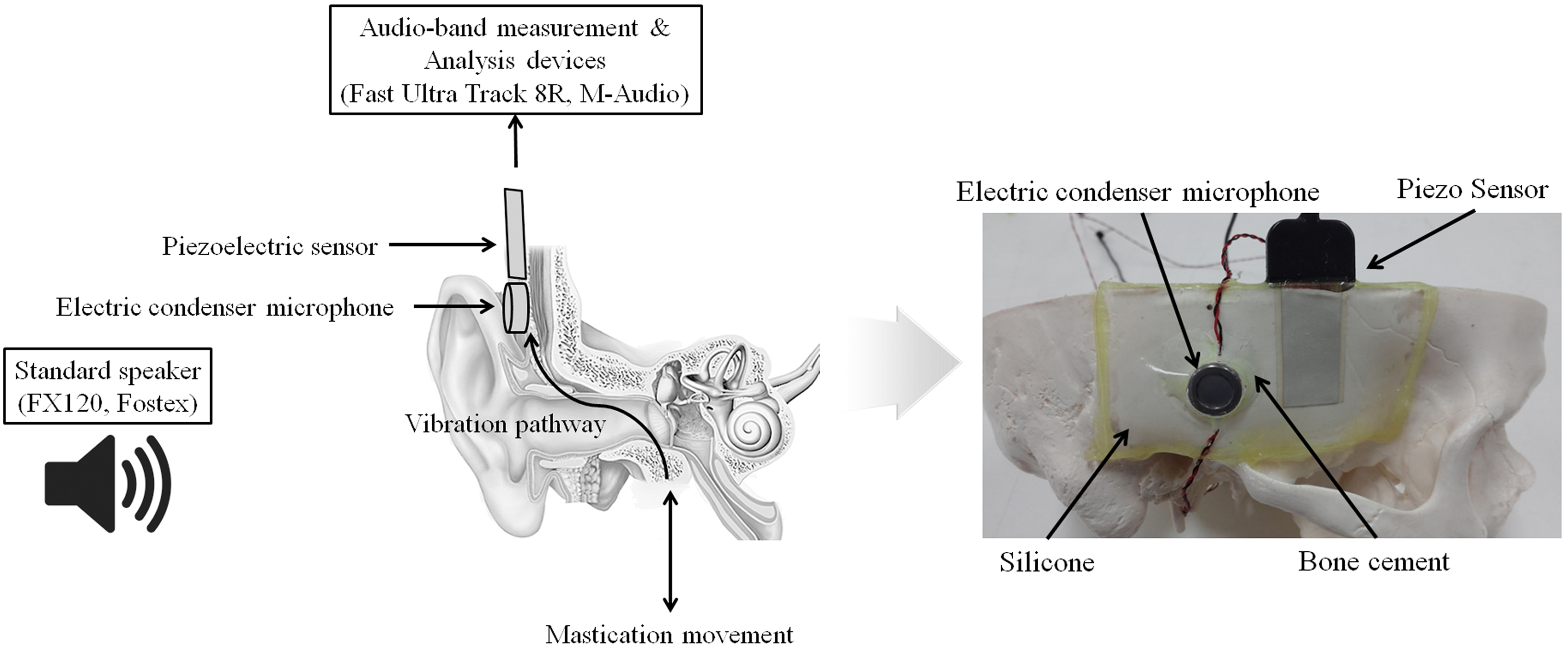
The implantable microphone was fabricated with an electric condenser microphone (ECM). The piezo-electric sensor constituted of a rectangular element, plastic housing, and a coaxial cable. The sensors were laminated with epoxy or cyanoacrylate due to fix at around the temple according to Fig. 1. The microphone was fixed with bone cement to reduce outside noise. The piezo-electric sensor was located beside the microphone for the measurement of equal mastication noise. In addition, the microphone and sensor were covered with 6 mm of silicone owing to imitate the implanted hearing aid on skull model.
The experiment was conducted in a chamber with background noise of approximately 30 dB SPL. The masticatory movement was generated using the lower jawbone of the skull model. The model was exposed to 1 kHz pure-tone sounds of approximately 85 dB SPL through standard speakers (FX120, Fostex). An audio-band measurement and analysis device (Fast Ultra Track 8R, M-Audio) was used to measure each output signal of the microphone and piezo-electric sensor.
The masticatory noises were generated by moving the lower jawbone, and the signals were simultaneously acquired with 1 kHz sounds using a standard speaker. Figure 2 shows the measured signals.
Acquired signals with (a) 1 kHz pure-tone at ECM, (b) 1 kHz pure- tone and mastication noise at ECM, and (c) mastication noise at piezo-electric sensor.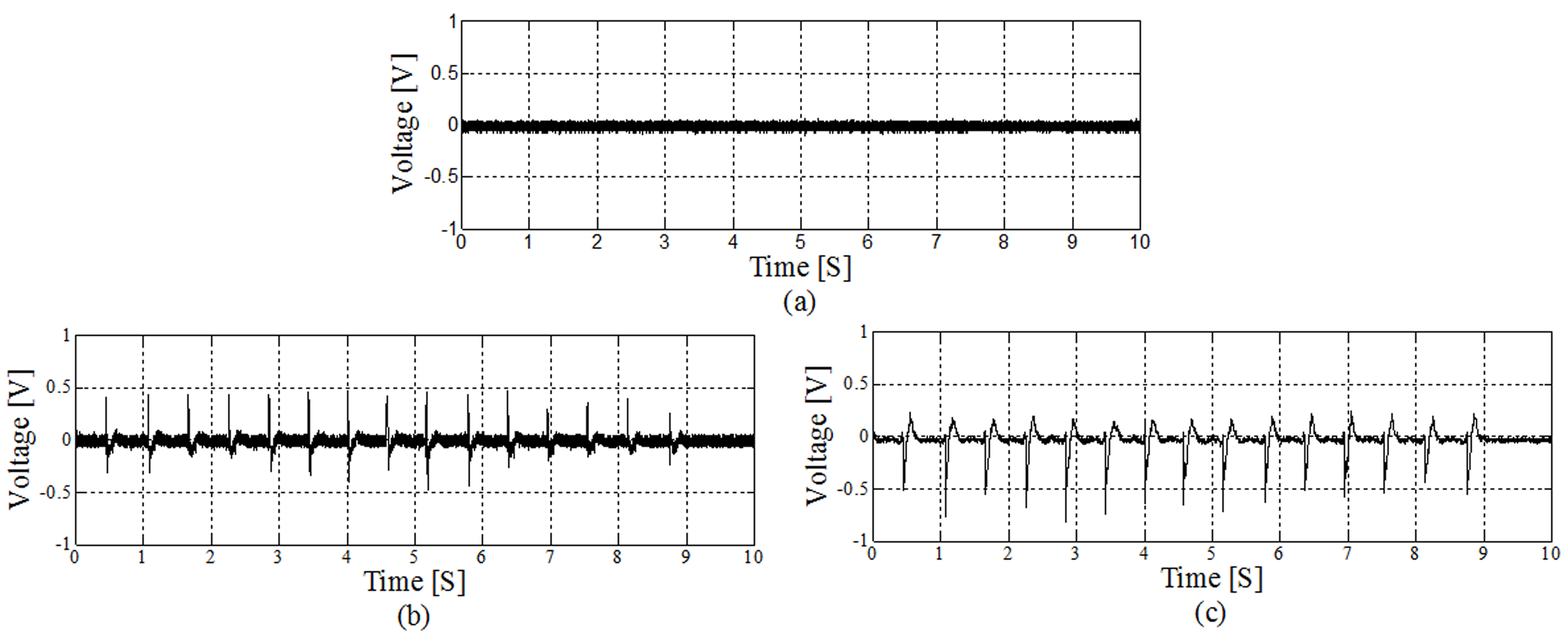
Figure 2(a) presents the appearance of the pure-tone signal. Figure 2(b) shows the simultaneously acquired mastication noise and pure-tone signal. Finally, Fig. 2(c) displays the signals of mastication noise only. The mastication noise mechanism is the vibration of the upper and lower jawbones. The piezo-electric sensor can therefore measure the mastication signal better than the conventional microphone, and hence, it is used in the proposed method.
The ECM under the silicone simultaneously measured both the pure-tone signal and the mastication noise. The noise exhibits greater variation than the pure-tone signals in Fig. 22(c). To reduce the noise, the proposed method employed the following steps. First, the noise ranges were detected by using the standard deviation in the following equation:
where ND(
The mastication noise was then removed using the proposed method with the acquired pure-tone and mastication signals. Equation (2) shows the proposed method, which uses a nonlinear gain control function:
where NFS(
The processed data are shown in Fig. 2. Figure 3(b) shows the noise ranges extracted with the piezo-electric sensor’s signal using Eq. (1). In accordance with Eq. (1), the noise components were detected efficiently, as shown in Fig. 1(b). Figure 3(c) shows the simultaneously measured mastication and pure-tone signals.
Correlation coefficients and SNR before and after application of proposed method
Correlation coefficients and SNR before and after application of proposed method
Results of experiment and proposed method: (a) 1 kHz pure- tone at ECM, (b) result with Eq. (1), (c) 1 kHz pure-tone and mastication noise at ECM, and (d) result with proposed method.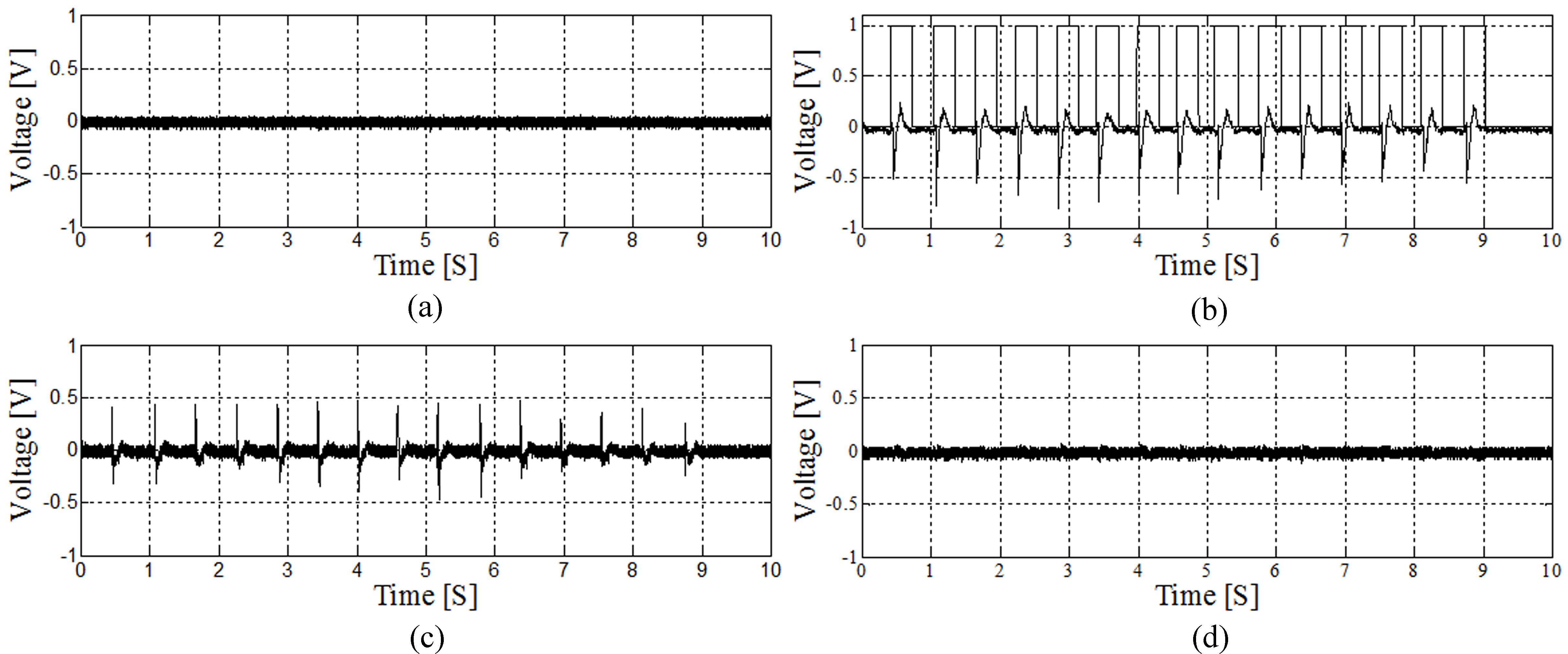
Results of experiment and proposed method.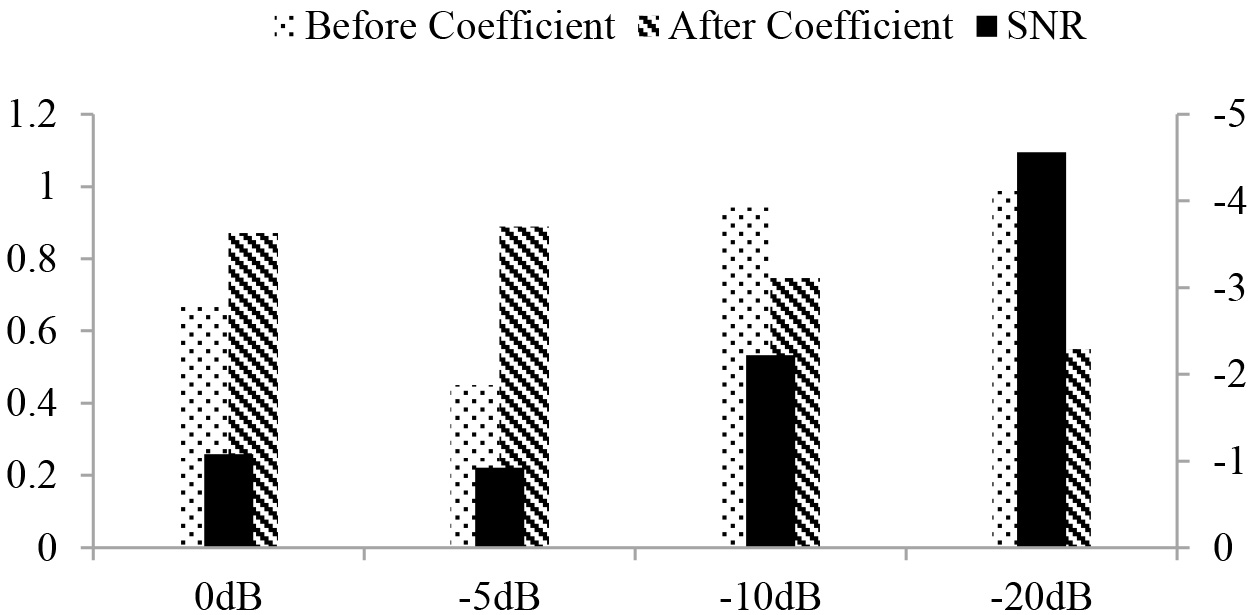
Table 1 shows the correlation coefficients before and after the proposed method was applied. Type A is the dataset of Fig 3(a) and (c), and Type B is the dataset of Fig 3(a) and (d). Table 1 shows that the correlation coefficients improved by 0.45 after application of the proposed method. Table 1 shows the SNR before and after application of the proposed method. It is seen that the SNR increases by 4.48 dB after application of the proposed method. Figure 4 shows that the proposed method’s SNR and coefficient are better than those of the conventional method in various SNR environments. However, at
This paper proposed a noise reduction method that employs a piezo-electric sensor to reduce mastication noise. The conventional methods did not consider the biomechanical problems associated with mastication movement. Jenkins et al. [12] and Woo et al. [13] studied mastication noise at FIHDs with a microphone. However, because mastication noise is generated as vibrations from the jawbone, the microphone is not suitable because of problems related to biocompatibility. The piezo-electric sensor has the appropriate characteristic to acquire the noise. In this paper, we proposed a method to measure the noise with an implanted microphone and piezo-electric sensor in the model. The noise was reduced by using the proposed method in conjunction with MATLAB. To confirm the performance of the proposed method, the correlation coefficients and SNRs before and after signal processing were calculated. It was found that the SNRs and correlation coefficients increased by 4.48 dB and 0.45, respectively. In the future, an implantable microphone for real-time processing will be developed.
Conflict of interest
None to report.
Footnotes
Acknowledgments
This study was supported by the National Research Foundation of Korea (NRF) grant funded by the Korea government (MSIP) (No. 2016R1A2A1A05005413, 2015R1A2A2A03006113).