




Abstract
In many industries, multiple parties collaborate on a larger project. At the same time, each of those stakeholders participates in multiple independent projects simultaneously. A double patchwork can thus be identified, with a many-to-many relationship between actors and collaborative projects. One key example is the construction industry, where every project is unique, involving specialists for many subdomains, ranging from the architectural design over technical installations to geospatial information, governmental regulation and sometimes even historical research. A digital representation of this process and its outcomes requires semantic interoperability between these subdomains, which however often work with heterogeneous and unstructured data. In this paper we propose to address this double patchwork via a decentralized ecosystem for multi-stakeholder, multi-industry collaborations dealing with heterogeneous information snippets. At its core, this ecosystem, called ConSolid, builds upon the Solid specifications for Web decentralization, but extends these both on a (meta)data pattern level and on microservice level. To increase the robustness of data allocation and filtering, we identify the need to go beyond Solid’s current LDP-inspired interfaces to a Solid Pod and introduce the concept of metadata-generated ‘virtual views’, to be generated using an access-controlled SPARQL interface to a Pod. A recursive, scalable way to discover multi-vault aggregations is proposed, along with data patterns for connecting and aligning heterogeneous (RDF and non-RDF) resources across vaults in a mediatype-agnostic fashion. We demonstrate the use and benefits of the ecosystem using minimal running examples, concluding with the setup of an example use case from the Architecture, Engineering, Construction and Operations (AECO) industry.
Introduction
A double patchwork of stakeholders and projects
Interdisciplinary collaborations often require intensive information exchange between domain experts with various backgrounds. In many cases, a ‘real-world’ product will be involved, which will interact with its environment for its entire life cycle. When these interactions are to be captured digitally, e.g., to make predictions or invoke active interactions with physical surroundings, the concept of ‘digital twins’ comes into sight – a core aspect of Industry 4.0 [36]. The example industry used in this paper is the Architecture, Engineering, Construction and Operations (AECO) industry, worldwide one of the most decentralized industries [6]. In the AECO industry, people from many professions interact with the asset in all of its life cycle phases, ranging from direct stakeholders such as architects and engineers, commissioners, contractors, workers, facility managers, and inhabitants to indirect partners such as governmental agencies and product manufacturers. Because most stakeholders will be involved in multiple projects at the same time, we can generally speak of a ‘double patchwork’, a many-to-many relation between stakeholders and collaborative projects.
Since every activity in the process requires input from different disciplines, and every discipline has its own workflows and data formats, it is impossible to determine a ‘complete’ data model for describing a product’s digital twin at the start of the project. As a matter of fact, every model is by definition incomplete, as many purposes require different combinations of interdisciplinary and contextual datasets. A modular approach allows gradually building the project model whenever input from a new discipline is required. In this collaborative context, Semantic Web and Linked Data technologies are often identified as apt technologies to achieve interdisciplinary data mapping, logical inferencing and query-based discovery of federated data [2,32].
At the same time, expressing knowledge using these technologies often increases its complexity and processing time, and sometimes adds little value to the overall data. This applies for example to non-structured or semi-structured datasets, such as imagery, point clouds, geometry and, sensor data streams [48], where the increase in complexity does not need to a significant increase in value. This need for heterogeneous solutions is acknowledged by both academia and industry, but efficient solutions for dynamic management of such resources are currently lacking.
The fact that the number of disciplines involved is dynamic and depending on the use case also implies that it is very impractical to try to centralize all this information in a single Common Data Environment (CDE) [21]. Present-day CDEs are mostly not created with data federation at their core, nor do they use domain-agnostic standards to express knowledge about the asset. This impedes a more mature data integration and reuse practice for the AECO industry and adjacent disciplines aiming to incorporate building data in their workflow – which does not only result in information losses during data handover phases, but also in the creation of parallel, unlinked and unsynchronized duplicates of information. For example, when contextual data is copied into the CDE, or when not all stakeholders during the life cycle of an asset use the same CDE. In turn, this weakens the asset’s intended Single Source of Truth (SSoT) [50] because the risk for ambiguities and inconsistencies increases. Moreover, uploading everything to a centralized, commercial cloud hub may cause issues regarding intellectual property rights (IPR) and data sovereignty (‘how do I remain in control of my data and how can it be used legally’) [17]. This holds for both project-specific and external, contextual data (e.g. geospatial, governmental and historical data). When the digital asset model is meant to be used during the operational phase, other information streams will need to be integrated as well, such as user preferences and room reservations. Similar to Open Data [28] practices, added value will rise from combining different datasets (or collections of datasets) in order to answer a particular question. In many scenarios, building data will not even be the core input, but only provide contextual information for other activities. Defining a ‘project’ as a question-specific collection of datasets supports the above-mentioned claim that it is inherently incomplete, or, in other words, that it can always be further extended. This naturally aligns with the Open World Assumption (OWA) [10] on which the Semantic Web [3] relies. In this light, the aim to centralize ‘all’ project data on a single platform is simply impossible. Phrasing this differently in context of present-day infrastructures, a ‘central CDE’ can thus be considered ‘federated’ from the moment it refers to external contextual information.
To the authors’ knowledge, currently there are no federated CDEs based on domain-agnostic open standards. However, the technologies to support such infrastructure are available. In such an environment, Linked Data technologies allow stakeholders to freely choose where their project contributions will be hosted, and control in a fine-grained way who may access certain project information (e.g., other stakeholders, the public, product manufacturers, etc.) [47].
This may be a self-hosted data environment. Upcoming open Web specifications such as WebID-OIDC [37] allow the creation of a decentral, potentially self-hosted Web identity – in other words, a username for the entire Web, to be used to prove access rights to specific data on the Web. This is one of the core enabling technologies for the specifications of the Solid project [42], where WebIDs are used to control access to resources on a personal data vault. In Solid, such vaults are called ‘Pods’. In the case of multi-stakeholder, multi-resource collaborative projects, this means that a company can authenticate in a standardized way to the vaults of other project participants to access their (filtered) project contributions. Also, online services (i.e., those which have been granted access) can combine private project information from various stakeholders with open datasets on the Web and present end-users with powerful ways to interact with this data – without mediation of a central, project-external cloud provider or the need for its permissions to use their API. Up to this point, the main focus of Solid has been on single-vault environments. However, multi-vault environments require a different approach in many cases. In this paper, we propose an architecture for such multi-vault environments. Our proposal will be based on the Solid ecosystem, although several additional boundary conditions will be applied, regarding URL stability, metadata management and sub-document, cross-Pod references of heterogeneous resources.
Research questions
The above considerations indicate the need for a federated, multi-purpose, cross-domain ecosystem for heterogeneous digital twin projects. The ecosystem should be domain-agnostic at its core, but extendable to address the needs of and interoperability between specific industry domains. Hence, we can formulate the main research question of this paper as follows:
The ecosystem described in this research question needs to meet the following constraints:
In devising our approach to answer this research question, we will start from the following hypotheses:
In the following sections we will investigate the current challenges for such layered ecosystem to work. Although we will take the use case of the AECO industry to identify the requirements of the ecosystem, we aim for a solution that is generally applicable. We will describe and address every sub-challenge in a domain-agnostic fashion, although the examples will be related to the AECO industry.
Relationship to earlier work
This paper is the continuation of previous research on enabling technologies for a federated CDE. It was proposed in [47] to use the Solid infrastructure as a means to create a federated Common Data Environment, and to map the specific ‘decentral’ nature of the AECO industry to the available technologies offered by the Solid specifications. This research was extended in [51], which describes a methodology for pattern-based access control to AECO datasets. In contrast with username- or group-based approaches, this experimental approach allows to specify the properties someone should have to access data (e.g., ‘the architect of the project as approved by the project owner’), based on the SHApes Constraint Language (SHACL)1
SHACL:
In the next section (Section 2), background technologies and related work will be discussed. In Section 3, we will motivate the extensions we need to make to the current Solid infrastructure in order to achieve the goals of the envisaged ecosystem, regarding metadata patterns, interfaces and microservices. Section 4 then builds upon those extensions to propose aggregation structures for single- and multi-vault configurations, and Section 5 devises the patterns for asynchronous sub-document linking. A minimal proof-of-concept from the AECO industry is then described in Section 6. We evaluate the ecosystem against the original objectives in Section 7. Furthermore, the ecosystem will be evaluated against the FAIR principles (Findable, Accessible, Interoperable and Reusable) [52] for scientific data management and stewardship, as a measurement for its general applicability. Although FAIR data management is usually related to open datasets, we note significant overlaps with access-restricted multi-disciplinary environments as required by the AECO industry, and, more generally, to the built environment, due to the cross-domain usage of project-specific and contextual datasets. The paper concludes with a discussion and overview of future work (Section 8). In the remainder of the paper, the ecosystem will be called ConSolid. Definitions related to the data patterns used in the ecosystem are published as the ConSolid vocabulary.2
ConSolid namespace:
ConSolid proof-of-concept:
This section will cover key technologies for data aggregation and containerization, as well as the fundamentals of the Solid ecosystem. Finally, we review some related initiatives for Web decentralization.
Containerization of federated, heterogeneous datasets
In a digital construction project, many resources may actually refer to one and the same object. A window may be semantically described in graphs produced by different stakeholders in the project, and be visualized in multiple images, point clouds and geometries (2D and 3D). The overall set of resources representing a digital building model is often denoted as a ‘multi-model’ [13] or, according to ISO 19650, an ‘information model’, i.e. a set of structured and unstructured information containers [21]. An ‘information container’ is then a ‘named persistent set of information, retrievable from within a file, system or application storage hierarchy’ [21]. For the remainder of the text, we will use the term ‘multi-model’. The term ‘federated multi-model’ is related to project data residing on multiple servers, connected in a larger catalog using Linked Data technologies. A multi-model can be organized in (nested) containers or catalogs, which, together with metadata descriptions, aid in discovering the right datasets for the right task. Two approaches are hereby considered relevant in context of this paper: the Linked Data Platform (LDP),4
LDP:
DCAT:
The Linked Data Platform specification (LDP) presents guidelines for storing of and interaction with heterogeneous Web resources, and presents a basis for a read-write Web of data using HTTP. Based on the type of container, membership of resources and containers can be either predefined (
The Data Catalog Vocabulary (DCAT) is an RDF vocabulary designed to facilitate interoperability between data catalogs published on the Web [1]. DCAT defines a domain-agnostic way of aggregating federated datasets in a
CDC:
Over the last years, the concept of ‘data sovereignty’ of actors in the digital economy has known growing interest [18]. Data sovereignty is closely related to data security and protection. It allows to self-determine how, when and at what price others may use [your data] across the value chain [20]. One of the core ideas is that the owner of the data remains in control [43]. Hence, organizations cannot use your data for whichever purpose that suits their interests. The majority of web services still rely on centralized data storage, which means that it is still up to the service providers to comply to existing regulations for data protection (such as the EU’s General Data Protection Regulation (GDPR) [7]). Numerous recent initiatives therefore focus on decentralized or federated data storage, where the owner of the data ultimately gets to decide on which server their data resides and who is allowed to interact with the data. In the below paragraphs, we will briefly discuss some of these projects.
The Solid ecosystem
When datasets are not openly accessible on the web, but only available to selected agents, an authentication mechanism needs to be in place. For example, Web-based construction projects typically consist of restricted project-specific data and open contextual datasets. Most common implementations rely on authentication mechanisms that are added to the middleware and/or backend of a web service implementation. These authentication mechanisms shield and secure the databases (SQL, NoSQL, triple stores, etc.) from random access, while only allowing authenticated users through, for example, tokens (2-way handshake). Different is the Solid project for Web decentralization [42], which adds a decentralized authentication layer on top of a heterogeneous resource server, with an LDP-inspired protocol with containers and documents as the primary interface. The authentication layer is based upon the concept of a WebID; a URL that uniquely identifies an agent on the Web. Consequently, this WebID can be used as a decentral ‘username’. Most commonly, a WebID dereferences to a self-descriptive, public RDF document (the ‘card’), which enriches the WebID with basic information about the represented agent (Listing 1).

Example solid “card” (Turtle syntax). The WebID is a specific resource in the card that can be semantically enriched with RDF. Prefixes are included in the Appendix
Building upon this WebID concept, the WebID-OIDC protocol, which is developed in the context of Solid, combines the decentral flexibility of the WebID with the well-established standard OpenID Connect7
OIDC:
Access control rules in Solid are expressed in ‘Access Control Lists’ (‘.acl’), which relate specific
ACP:

Example ACL document, regulating access to a specific container and its resources
The general use of Solid as an enabler of decentralized digital ecosystems is described in [43], from a techno-economic perspective. Arguments to extend Solid Pods beyond documents and containers, and consider it a ‘hybrid knowledge graph’ exposed via multiple interfaces are given in [9]. Furthermore, in earlier work (Section 1.3), we have identified the Solid specifications as a suitable basis for the needs of a digital AECO industry. This has multiple reasons:
It allows a stakeholder-centric approach to manage collaborative projects in a federated way.
It supports storage and linking of heterogeneous datasets.
It supports the ‘Single source of Information’ (SSoI) principle by design, as CDE services do not locally duplicate information, but services can discover the right data for their use case and create cross-server references.
A comparison between the original goals of Solid and an interpretation for the AECO industry is given in Fig. 1. The Solid specifications and their implementation in the Community Solid Server9
Community Solid Server:

In the remainder of the paper, we will use the term ‘Solid Pods’ when referring to the Solid specific interpretation of data vaults. When speaking about the concept in general, the term ‘data vault’ will be used.
The International Data Spaces (IDS)10
IDS:
GAIA-X:
The Interplanetary File System (IPFS)12
IPFS:
Query-based resource discovery
As mentioned in Section 2.2.1, a data vault can be seen as a resource server with a decentralized authentication layer on top. The authentication layer communicates with the IDP of the visiting agent and checks if they are allowed to interact with resources on the vault. The spine of a Solid Pod is the Solid Protocol, based on the LDP specification, which defines patterns for reading and writing RDF data in containers. The result resembles a classic folder-based file system. Every resource is retrievable via a URL by concatenating the Pod root with the respective containment branches separated by slashes – much like a Web-based file system indeed.
While this container-based interface can essentially be seen as just one of the many possible APIs on top of the Pod [9], its current application hard-wires ‘implicit’ (i.e. non RDF-based) semantics in the URLs of resources and imposes a tree-like folder structure. In this folder structure, every URL contains the URLs of their parent directories up until the root of the Pod. This is a design choice embedded in the Solid specifications, which enables quick inference of a resource’s parent containers (a feature called ‘slash semantics’) and its governing access control rules. However, at the same time it also imposes a quite rigid structuring of resources, because it implies that there is only one possible (direct) parent folder, and resource URLs inherit the (often arbitrary) tags of all their (recursive) parent folders. This while these parent directories may change over time, thereby invalidating the resource URL.
We consider the following example, related to the stages of publication (Work-in-progress, Shared, Published, Archived) as defined in ISO 19650 [21], the authoritative standard in the AECO industry which defines the basic concepts for information management in a Common Data Environment. Moving a resource from the folder ‘/work-in-progress’ to ‘/shared’ will change its URL on the Pod from ‘https://jeroen.werbrouck.me/pod/work-in-progress/file1’ to ‘https://jeroen.werbrouck.me/pod/shared/file1’, thereby breaking any reference pointing to the original URL. Moreover, in a multi-purpose collaboration platform, the containment of a resource in this specific parent container might only be relevant in a specific situation but totally illogical in others: maybe someone would like to aggregate their resources in a different container structure when addressing a different use case. Hence, it makes sense to strip these implicit containment semantics from the URL as much as possible, so the URL can be reduced to a string of the form ‘root + GUID’. Note that this ‘form’ still follows the Solid Protocol specification, as it allows to interact with resources via HTTP – there are just no slash semantics beyond the root of the Pod, which remains essentially a (very large)

A flat list of resources in a data vault. Containment triples and metadata are mentioned using RDF instead of slash semantics, allowing resources to be grouped flexibly.
The ‘meaning’ that allows semantic containerization and filtering on higher-level (domain-specific) layers must now come from an explicit metadata record that ‘enriches’ the heterogeneous resource using RDF ontologies, instead of from the parent container. Note that the form of a metadata record as a specific type of document is still very much under discussion in the Solid ecosystem. However, explicit metadata records can be handled exactly the same as other resources on a vault: it is a regular RDF resource which happens to advertise itself as being metadata of another resource, hence allowing query-based discovery of this other resource.
One advantage of storing semantically rich metadata on a resource in a metadata record, is that this record can be updated without changing the resource (or its URL) itself: for example, the URL of the resource remains the same, but changing a metadata tag from ‘work-in-progress’ to ‘shared’ allows the original URL of the resource to remain intact, while a use-case specific ‘virtual’ folder structure can be created using a query-based discovery pattern [46]. In other words, query-based resource discovery allows to get rid of implicit semantics in a URL, as resource discovery does not depend anymore on URL destructuring.
File-based resources on the Web are inherently heterogeneous. In industries such as the AECO industry, a myriad of file formats is used for different use cases: although RDF-based knowledge description is becoming more popular, non-RDF datasets (e.g. imagery, point clouds and geometry) will continue to play a big role in many situations. However, using RDF on a metadata level can offer a lot of benefits without changing the nature of the resources themselves – RDF then acts as the ‘semantic glue’, flexibly connecting heterogeneous, federated resources on the Web in a ‘hybrid’ knowledge graph. Because the approach discussed in Section 3.1 eliminated implicit URL-based semantics, every project resource needs at least one RDF-based metadata record to allow query-based discovery of the resource, and inclusion in query-based views on a data vault. This is particularly of value to non-RDF resources, since e.g. binary resources cannot be directly queried with SPARQL – but a metadata record allows registration of queryable semantic descriptions. We identify the need for a queryable, access-controlled union of all metadata records on a data vault, to be able to construct these virtual views, which are essentially just filters on vault data. Optionally, this union includes RDF-based project resources as well. The infrastructure for such union of resources on a Pod will be described in Section 3.3.
As a vocabulary to structure this metadata network, we will opt for the DCAT vocabulary (Section 2.1), contrasting with Solid’s default usage of LDP containers. This is because the DCAT vocabulary allows to:
address ‘containerization’ and expressive metadata descriptions with a single, integrated vocabulary;
semantically decouple metadata records and actual resources, which allows RDF-based discovery of heterogeneous datasets and semantic indication of a distribution’s versions and content-type;
let metadata records semantically indicate versions of distributions, which is currently not an option in Solid;
avoid conflicts with Solid’s default usage of containers.
Furthermore, DCAT is the preferred metadata vocabulary for data points compliant to the FAIR principles [27]. Listing 3 gives an example of an RDF-based metadata record in the ecosystem, aggregated in a larger catalog, using DCAT.

Catalog and metadata record of a resource, using the DCAT vocabulary. Both the catalog and the dataset are accessible as an HTTP resource and as a named graph in the SPARQL satellite. An example vocabulary is used to denote the publication statuses
The example of changing a resource’s publication status (ISO 19650) while maintaining its URL (Section 3.1) now boils down to the insertion of a SPARQL INSERT/DELETE query to this resource. The query mentioned in Listing 4 will allow the resource to be included in a new virtual container for shared resources, and excluded from the one for resources tagged ‘work in progress’ (Listing 5).

SPARQL INSERT/DELETE query for updating the ISO 19650 publication status of a resource in the ecosystem. The definitions for publication statuses are placeholders

SPARQL query to filter project datasets that are ‘shared’ and return their distributions as virtual containers, to be used by LDP-compatible tooling
The union of metadata records is to be used as the primary way to query a vault, but it also allows other (higher-level) interfaces to be established. They can be used as a generic way to present a (set of) resource(s) on the vault via industry-specific APIs. In the AECO industry, many subdisciplines are involved, all having specific internal information representation standards and agreements, but eventually they need to access the same data. Reading and discovering data could then happen via dedicated APIs on top of the vault or of the entire federated project. Such APIs create virtual views on the knowledge graph of the project (similar to the one in Listing 5), filtering relevant information for a particular domain or use case. Since many industry standards are not RDF-based, the APIs also serve a mapping purpose: graph-based knowledge can be re-organized to fit particular industry standards, as is described in [46]. For example, Listing 5 can be part of an API-based, domain-specific interface that organizes the project conforming to the ISO 19650 specification and its defined stages of publication. Other examples, such as a mapping to the Information Container for Linked Document Delivery (ICDD) (ISO 21597) [19] or the BIM Collaboration Format (BCF) API13
BCF-API:
We consider a (private) SPARQL endpoint an apt interface to query the union of knowledge graphs on a data vault. Such interface to the Pod Union is already implemented by the Enterprise Solid Server (ESS, Inrupt).14
ESS:
As indicated in Section 2.2.1, access control on a Solid Pod currently works on the level of (RDF and non-RDF) documents, by means of ACL resources that mention which actors are granted which access rights to which resources. In an exclusively LDP-based environment, the applying ACL document is found by searching for the ‘closest’ ACL resource: a feature allowed by the slash semantics feature. This means that either the ACL is linked directly to the resource to be found (as ‘{URL-of the-resource}.acl’) or a stepwise approach is taken to find a general ACL document in one of the parent containers (the closest one is the one that counts). In this framework, the hierarchical LDP folder structure will be omitted in favour of a flattened list of resources (Section 3.1). ACL inheritance is no option here, as a resource can be ‘contained’ in multiple (virtual) parent containers, which may impose conflicting ACL rules to their child resources or subcontainers. To maintain compatibility with the Solid specifications it is necessary that either (1) a single ACL resource governs all effective resources on the Pod, or (2) that every effective resource has its own ACL resource. The first option is immediately ruled out, as this would contradict the goal of having a fine-grained access control mechanism. Therefore, the second option is chosen. Although hierarchy-based ACL structures have the advantage of access control inheritance, having an individual ACL graph per document has the advantage of direct mapping. When not only metadata and project resources are mirrored to a SPARQL endpoint, but also their ACL resources, the union of these ACL graphs can be easily checked to construct the set of resources a visitor is allowed to interact with: a combination of explicit authorizations and the authorizations granted to the public (mostly
Multiple options are now possible to include only the resulting set of allowed resources – which option to choose will depend on the purpose of the query. The first and most general option is the creation of a permissioned union graph through the injection of the allowed resources via a‘FROM <{resource}>’ statement. A second option is querying the vault through injection of the allowed resources via a ‘FROM NAMED <{resource}>’ – this is similar to the first option, but triple patterns will need to be enclosed by a graph variable: if the enclosed triple patterns are not present in the same named graph, the result set will be empty. An example query modification comparing both options is given in Listing 7. More information on the differences between ‘FROM’ and ‘FROM NAMED’ in SPARQL queries can be found in [23].
The first option is the most flexible one to query the Pod as a whole, but, as we will demonstrate in Section 3.4, it is also the most expensive one regarding query execution time – especially in fragmented data vaults containing large amounts of resources. Execution time for the second option lies much closer to the original query time and may, for example, be used to query metadata patterns which are known to occur within the same graph. This maps well with the purpose of the SPARQL endpoint in the ConSolid ecosystem, where it will be primarily used for query-based discovery of relevant project datasets. Following this discovery, targeted queries can be executed on smaller union graphs of project-specific (i.e. non-metadata) resources, making the queries based on ‘FROM’ queries more feasible.
Considering that a typical SPARQL endpoint does not implement such access control and query adaptation functionality, currently all requests to the SPARQL endpoint need to pass via a proxy service which has been granted full read permission, acting on behalf of the Pod owner. This service determines the WebID of the visitor, checks for which resources they have access rights, and injects these in the query, which is then executed. Optional arguments can be passed to instruct which of the query options (FROM or FROM NAMED) should be used. In the remainder of this text, we will consider the proxy service and database service as one, calling it a ‘satellite’. The SPARQL satellite should be easily discoverable, which can be done by registering the triple pattern in Listing 8 in the WebID of the owner of the Pod.
The above-described approach can be considered a hybrid solution between the current document-oriented focus of a Solid Pod, set by the Solid specifications, and the Pod as a ‘hybrid knowledge graph’ as envisioned in [9], which considers documents and their corresponding ACL resources as just one view on the data in a Pod. At the moment of writing, the latter is hypothetical, as there are no implementations yet of this approach.
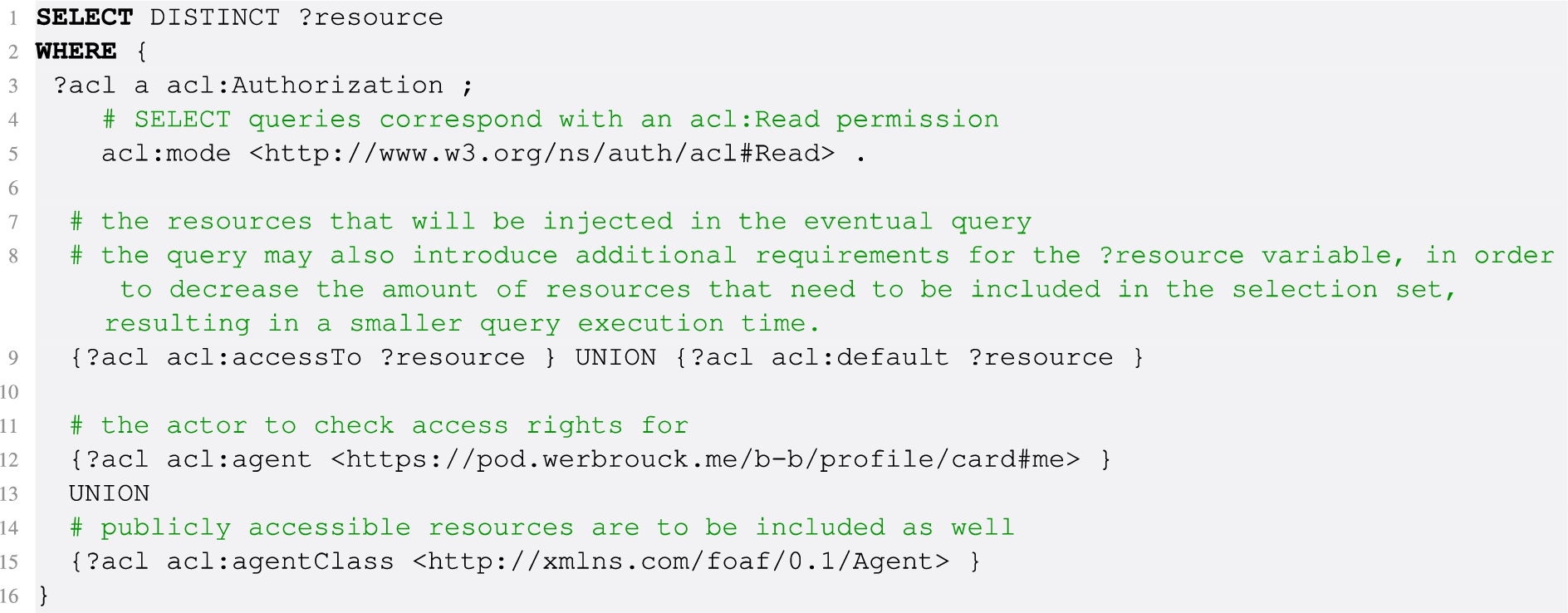
SPARQL query to retrieve the resources a given agent is able to query. Public resources should be included as well. This query assumes that every resource on the Pod has its own ACL. In the scenario explained in Section 3.1, in which all resources are present in a flattened LDP folder, this is the case. Richer descriptions of the ?resource variable are possible, to yield a smaller but more detailed result set

The SPARQL satellite dynamically updates any query to only include those named graphs to which the visitor has read access

Triple pattern to find the SPARQL satellite to a Pod, via the WebID of the Pod’s owner
As a prototypical implementation of the SPARQL satellite, we modified the Community Solid Server codebase to forward any RDF-based information to a SPARQL store, next to offering HTTP access to all resources via a root LDP container in the Pod.15
Solid Community Server + SPARQL store:
Apache Jena Fuseki:
SPARQL satellite prototype:
Performance optimization of this setup is out of the scope of this paper. However, it is important to get at least a notion of the order of magnitude of query execution time with the above-mentioned method for access control verification. As a quick verification of this setup, a Pod was populated with 10 718 851 triples, spread over 1288 graphs, including ACL resources and metadata descriptions (see Section 4). For each of these resources, the owner was given full access rights, resulting in 644 permitted resources (as every resource has an ACL attached). Two other accounts were created and were assigned read permissions to a random subset of resources on the main Pod, respectively resulting in 242 and 208 permitted resources. Execution of the original (metadata) query in Listing 7 yields the results listed in Table 1, using a machine for which the specifications are listed in Table 2. For each modification, Table 1 includes the query execution time directly on the SPARQL endpoint, the execution time from the perspective of the client (i.e. including the creation of the set of allowed resources (Listing 6)). It is technically possible to create a bypass for the Pod owner, which would allow to query the full union graph without restrictions (cf. the Enterprise Solid Server by Inrupt). The equivalent is execution of the original query on the default graph (column ‘Default’ in Table 1).
Query execution time for the query in Listing 4
*Query execution time directly on the SPARQL endpoint.
**Total query execution time for “client > satellite > SPARQL store (ACL) > satellite > SPARQL store (query) > satellite > client”
In this minimal example, we observe that the execution time of ‘FROM NAMED </resource/>’ queries directly on the SPARQL endpoint lies generally in the same order of magnitude as executing the query without access control on the default graph. In the case of the queries injected with ‘FROM </resource/>’, query execution time increases significantly, demonstrating its limited applicability, notwithstanding its potential for generating a ‘permitted union graph’. As mentioned before, one of the main purposes of the SPARQL endpoint is discovery of relevant datasets on the Pod, i.e. metadata queries where the triple patterns will indeed reside in a single named metadata graph. Therefore, within the boundaries of the ConSolid ecosystem, we can in most cases rely on the first case. The results of this discovery can then be used in a targeted follow-up query on project data. As execution time will decrease with smaller amount of allowed graphs, application of ‘FROM </resource/>’ will still have its use cases. Note that reduction of the set of queried resources can already be integrated in the access control query (Listing 6), which can be refined with more precise queries on which graphs to include, i.e. by imposing additional metadata queries on the ‘?resource’ variable (e.g., regarding publication status, publication date or even the ontologies that are used). Lastly, from the perspective of the client, performance would increase when all functionality would be included directly in the SPARQL endpoint, allowing to reduce the amount of requests from 6 (client > satellite > SPARQL store (ACL) > satellite > SPARQL store > satellite > client) to 2 (client > SPARQL store > client).
We can generally conclude that the permissioned SPARQL satellite is feasible for query-based discovery of project datasets, using modified queries (‘FROM NAMED <{resource}>’). Execution time for querying the entire project Pod as a permitted union graph (‘FROM’), however, may only be acceptable for some use cases. However, when the list of targeted resources is limited, it is still a possibility.
Specifications of the machine hosting the satellite implementation and the Fuseki SPARQL store
In Section 3, we set the basic infrastructure for a Solid Pod to allow Pod-wide queries and the application of virtual views. Using the DCAT standard, metadata records and the resources they represent were linked semantically as
We define a ‘Dataset Aggregator’ as a collection of pointers to relevant datasets on the Web. This collection may be automatically generated, based on specific parameters or queries (i.e. it may take the form of a virtual view [46]), or manually curated. Dataset Aggregators will form the core to maintain federated multi-models in a scalable way in the ConSolid ecosystem.
The initial level of aggregation occurs when an actor bundles resources on a single data vault, for example, when grouping all resources on the vault that belong to the same project. As shown in Listing 9, this boils down to creating a

An aggregation which is only one level away from aggregating
All stakeholders can thus create their own local aggregator for a collaborative project, independently from the others, forming the main ‘access point’ on the vault to find project data. Aggregating local datasets, this can perfectly be called a multi-model of its own, but by referencing the catalogs of other stakeholders (on their vaults) (using
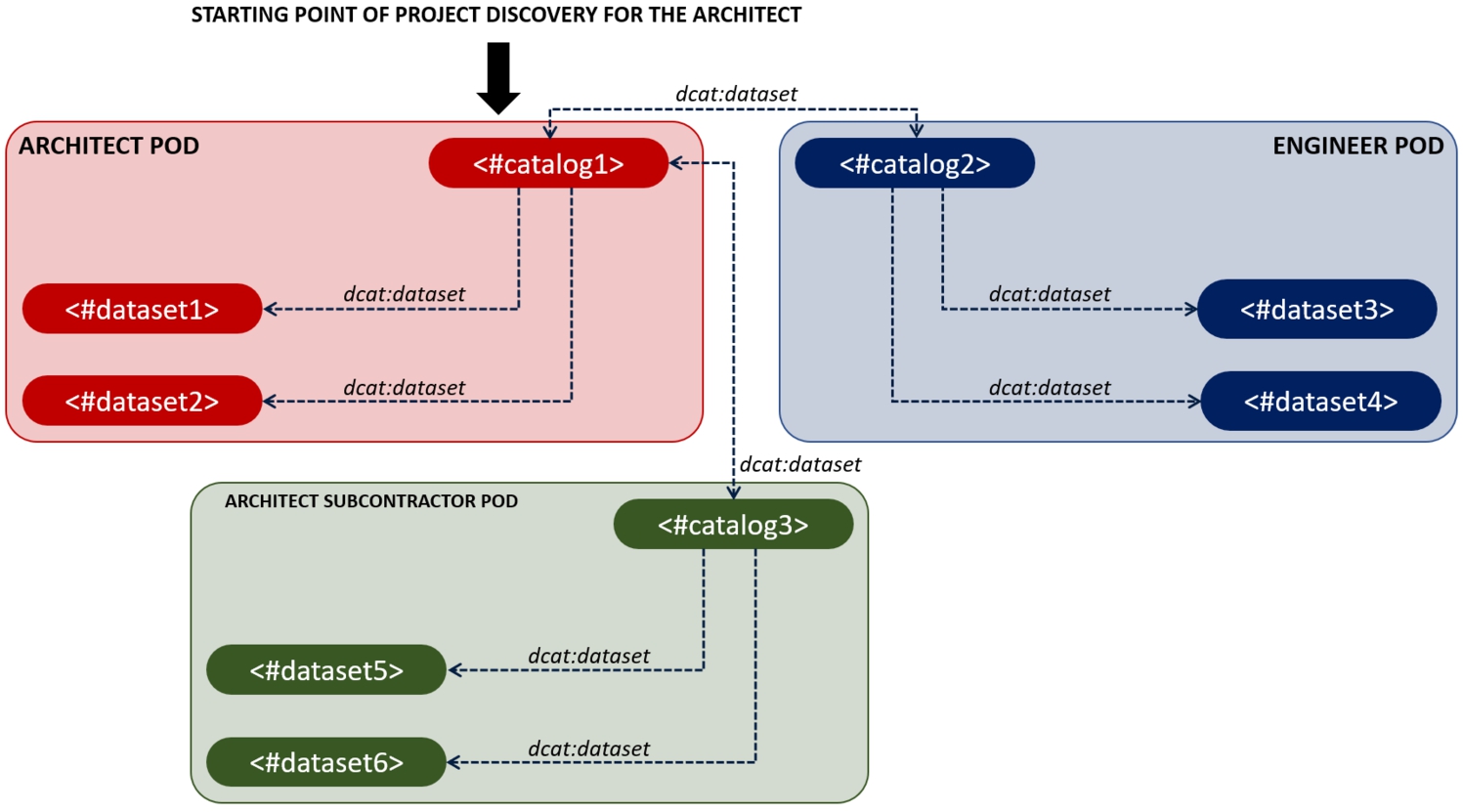
Starting from one Dataset Aggregator in a specific data vault, it is possible to recursively find all datasets in the federated project. Because bi-directional links may be present, looping should be avoided in the query process.
Higher-level aggregations will work in exactly the same way, and allow for a scalable, discovery-based approach of nested DCAT catalogs, which define a project’s boundaries. This means that those boundaries will be very flexible: a ‘project’ can then range from single-building level over neighbourhoods or a geographically scattered group of buildings from the same typology (‘all public schools in Flanders’, ‘all bridges in Germany’). No matter the depth level of a catalog, it should eventually lead to discovery of all resources in the aggregator. As all aggregations are indicated with the
Comunica Feature Link Traversal:

Recursive query to discover the metadata records of all datasets in an aggregator. Using this query, engines that use link traversal can find all federated datasets in a project. In this example, the catalog URL refers to a Web resource that describes a multi-asset aggregator for ‘schools in Flanders’. Each of those projects will be a set of nested catalogs on its own, grouping contributions from various people
A stakeholder office might be the legal entity responsible for some tasks in the project, but the human employees are the ones who divide the workload and do the eventual work. An office might decide to have a central office data vault, where all employees contribute, but it might also be the case that every employee maintains their own vault, or alternatively that the office creates a dedicated vault for its specific roles in the project. The above described catalog breakdown structure allows both situations to be easily integrated without changing the basic infrastructure. In that case, the office’s project access point just aggregates the catalogs created in the employee vaults (Fig. 3).
Similarly, an office might appoint a subcontractor for specific tasks in the project. These subcontractors will not work on the stakeholder’s main data vault, but will have their own vaults to store their contributions. Often, a project counts a few ‘main contractors’ (e.g. an architect, structural engineer, HVAC engineer, owner). From an organizational perspective, not everyone should include all subcontractors of all other stakeholders. The breakdown structure simply allows any of the stakeholders to aggregate their subcontractor access points, making them discoverable to the other stakeholders as well, provided they have the correct access rights.
Integrating project-external information
A resource belongs to a ConSolid project from the moment it is described in a dataset that is, in turn, aggregated in a dataset aggregator. In this paper, we primarily consider resources hosted on the same Pod as the dataset’s distribution. However, a dataset indicates its distributions via their URL – which means these can be located anywhere on the Web. Hence, when project-external resources (e.g. geospatial or governmental) should become part of the overall multi-model, it suffices to create a DCAT metadata record (dataset) that has this external dataset or database as a distribution. Client applications can now discover this dataset and present it to the end user as part of the project.
Implementation
A prototypical API to interact with the basic setup described in Section 3.4 using the above mentioned patterns for storage and discovery of data, was created in context of this paper. The API is available on Github20
Daapi (Github):
Daapi (NPM):
The recursive catalogs described in Section 4 offer a way to allocate datasets and their content in a distributed catalog. However, other mechanisms are needed to align and reference information from different, potentially federated datasets on a sub-document level. Sub-document identifiers of project resources will in many cases not be natively expressed using RDF. For example, a 3D element will probably have a sub-document GUID, and a particular pixel zone of the image will need to be described externally, as it is not defined in the image resource. In turn, a semantic indication that an element corresponds with a wall can be expressed using domain-specific RDF statements. To relate all these sub-document identifiers as manifestations of the same ‘thing X’ is not only relevant from a data management perspective, but also to facilitate user-friendly interaction with project data: any identifier in any project resource can then be used to access all available information about ‘thing X’ in the project, independent of the mediatype of the resource that describes this information. This principle is illustrated in Fig. 4.
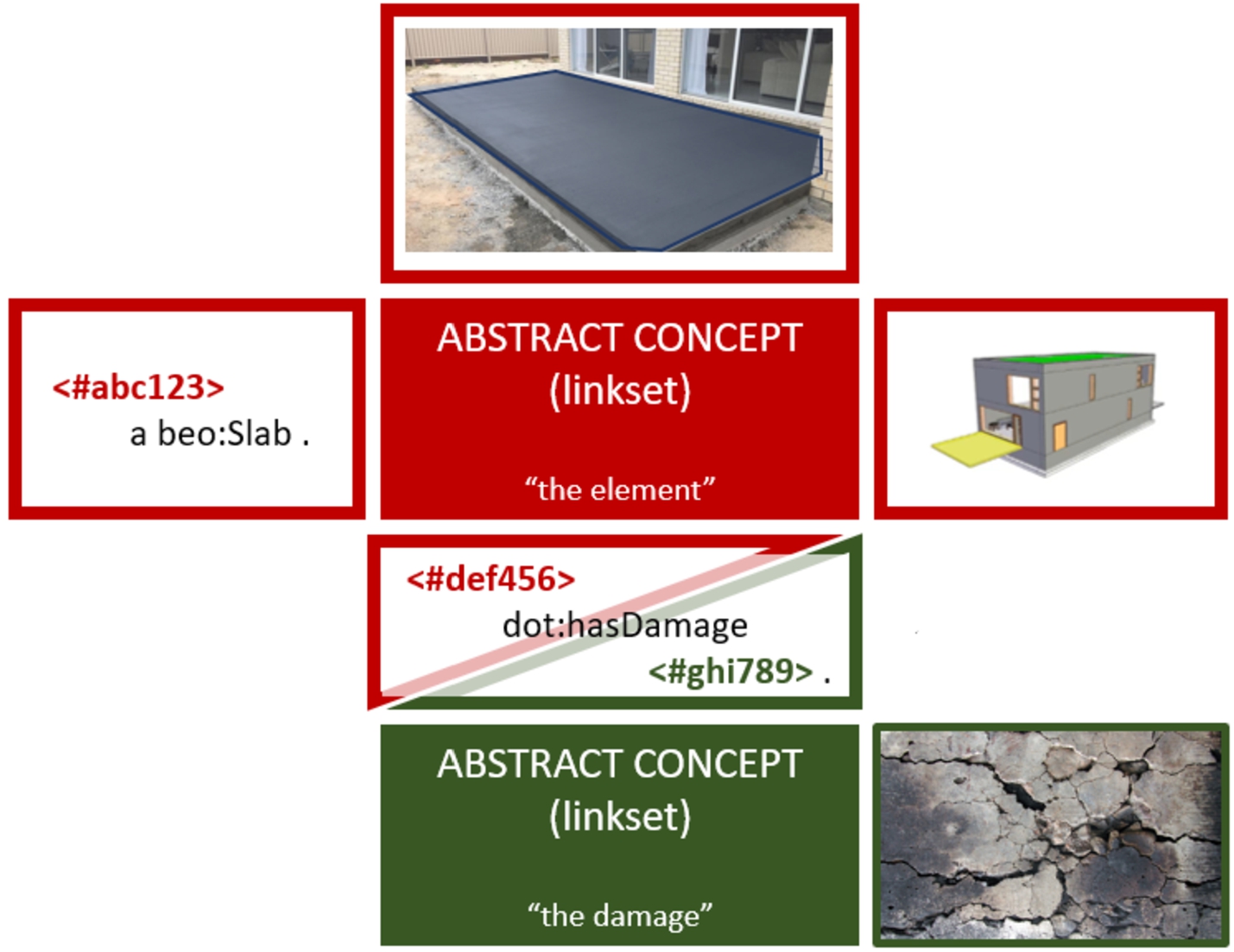
Document-specific representations of two concepts. Any relationships between those concepts will also be expressed via representations, i.e., the concepts themselves will not be enriched directly with project data.
Information creation and information alignment can happen asynchronously amongst stakeholders. For example, indicating that a pixel zone on a picture identifies the same element modeled in the 3D model, and that, moreover, this element identifies a wall instance (stored in an RDF resource), can happen either (semi)instantly when uploading the picture (i.e. when the 3D object is used as a proxy to create and immediately align a local concept, used to ‘enrich’ the actual element) or later in the project, when someone (person or digital service) recognizes that the 3D object and the image actually represent the same element. Also, a scalable, federated infrastructure as proposed in this paper should allow a local project (see Section 4) to function independently from other potential partial projects – as an office cannot oversee all external aggregations of their datasets. One should therefore acknowledge that there will always exist different, federated aliases of the same concept, rather than having one unique identifier for a concept that is potentially managed by other actors.
Lastly, it should be possible to differentiate between digital knowledge about the ‘real-world asset’ and knowledge about the digital representations themselves. For example, if someone identifies a pixel zone on an image, which represents a damaged area, one may want to use this pixel zone as an interface to further enrich the damaged area (“caused by erosion”), but also to comment on the pixel zone itself (“The damage is actually larger than the zone you identified – please extend”). The data patterns that address these challenges will be introduced in the following section, using the concept of ‘Reference Aggregators’, based upon the same aggregation principles as the Dataset Aggregators described in Section 4.
We can generally define a Reference Aggregator (
We can use a minimal pattern to ‘lift’ identifiers from a heterogeneous dataset and make it available for aggregation within a Reference Aggregator. This pattern breaks down references into three parts, and is inspired by the destructuring mechanisms in the Information Container for Linked Document Delivery (ICDD) (ISO 21597) [19]:
A Reference Aggregator (
A Reference level, used to determine that a given identifier in a given file is referenced and relate metadata (e.g. creation date) to the reference (
An identifier level; a higher-level URI used to ‘even the field’ between RDF and non-RDF resources. This higher-level URI relates the value (
The three-level pattern is visualized in Fig. 5. These patterns are demonstrated with a real-world example in Section 6 (Listings 15 and 16).

RDF patterns from Reference Aggregator to sub-document identifier.
Different Reference Aggregators can be aggregated themselves in a single named graph on the vault, called a Reference Registry, which helps in discovery of the references present in a local project. Using the storage patterns devised in Section 3, this means that besides the RDF resource that semantically defines the aggregators, a metadata record is created describing a
Higher-level identifiers (
As illustrated in Fig. 5 (and Listing 15), the recursive property
The basic queries given in Listings 11, 12 and 13 allow to find the references aggregated by the same Reference Aggregator. The first query (Listing 11) is to be executed on the project Reference Registry in the vault where the metadata of the active document is registered – to base upon the location of the metadata instead of on the location of the actual document allows retrieval of references to project-external resources on the Web (e.g., regarding contextual data). This query yields the Reference Aggregator identifier and its aliases, which can now be used to find other representations of this concept in the vaults of the consortium members. This is illustrated in the second query (Listing 12), which is executed on the same vault as the query in Listing 11 – the retrieved local references (?local) are further resolved to find other documents (?doc), identifiers (?value) and metadata (?meta) of other local references. Finally, in the third query (Listing 13), the retrieved aliases are used to find remote references (including documents, identifiers and metadata), thus executed on the respective vaults where these aliases reside, which can be easily derived from the alias’ URL.

Query pattern to find the local references of a specific Reference Aggregator given a known reference, and the potential remote aliases of this concept

Recursive query to find all local representations, identifiers and datasets for a given selected concept

Recursive query to find all remote representations, identifiers and datasets for a given selected concept
Additional metadata filters may be applied to only retrieve specific references. This can be done by attaching a metadata triple pattern to the query, commented out in Listings 12 and 13.
The activity of linking references to an alias of the same concept will largely depend on the project, and is not directly handled by the ecosystem, which only provides the patterns to do so. Depending on the goal and size of the project, alignment can either be done manually or (semi-)automatically. A manual alignment makes sense if a dedicated GUI is available, and documentation happens on-the-go – whilst enriching existing project resources or setting up a project in the ecosystem from its conception. For example, a case of damage enrichment as documented in Section 6 can happen step-by-step by linking pictures to geometry, during the operational phase. When large-scale projects are imported, however, a manual concept alignment is not possible, given the amount of existing concepts. For diagnosing many aliases of the same concept, mapping algorithms such as proposed in [25] can be used in certain situations. With the advances made in the fields of Machine Learning and image recognition, third-party services are expected to provide opportunities here as well. However, as semantic relationships between elements do not happen at the level of references, but at the level of documents and resources, this is considered within the realm of domain-specific applications, and therefore outside the scope of this paper.
Enriching sub-document identifiers
References can not only be used to for aggregation of heterogeneous information related to the physical counterpart of the digital twin. They should also be usable to reference (comment, enrich, …) datasets, documents and sub-document references as well, in their capacity of being digital documents. This is, for instance, of use to create issues concerning modelling practice, to allow comments on due project deliverables, etc. Because the references themselves are URLs, a new (‘higher-level’) reference can be made elsewhere that has the first reference’s URL as a
Implementation
A prototypical API to create and interact with Reference Aggregators and Reference Registries was created in context of this paper. As it makes use of the data patterns described in Section 4, this API depends on the lower-level implementation discussed in Section 4.4, Daapi. The API is available on Github22
Raapi (Github):
Raapi (NPM):
This section demonstrates the usage of the ecosystem with a real-world example. This proof of concept illustrates the ecosystem’s ability to combine federated, heterogeneous and multi-disciplinary datasets in a global multi-model. We estimate the Technology Readiness Level (TRL) [26] of the ecosystem at TRL 3, which corresponds with ‘Analytical and experimental critical function and/or characteristic proof of concept’ [40]. Because the ecosystem is highly experimental, the stakeholders mentioned in this proof of concept did not use the ecosystem in a real-world project, which would require a much more mature graphical user interface (GUI). However, the two stakeholders involved in the eventual enrichment case, namely the Facility Management office of UGent and Bureau Bouwtechniek (BE), were contacted to confirm the validity of the scenario, which involves enriching the federated project with damage record data.
The case of damage enrichment is considered an exemplary scenario, as it covers both the use of heterogeneous data sources (RDF, imagery, geometry) and sources from multiple stakeholders are involved in the process. Damage assessment is a frequently occurring activity in the operational phase of a building or heritage object. As an illustration, Monumentenwacht Vlaanderen, an initiative to monitor the state of heritage in Flanders, performs more than 1000 inspections per year, resulting in a multitude of reported damages [41]. However, it is a cumbersome activity which is carried out in a largely manual fashion [14], and, if digitized at all, the resulting reports are most often spreadsheets or form results [41], detached from other digital information about the asset. Indeed, the use of BIM (Building Information Management) models in this regard is scarce [24,35], also because BIM models are often not updated or documented to reflect the as-built state [44]. Semantic Web-based documentation of damages, which allows a more interdisciplinary approach, is the idea behind the Damage Topology Ontology (DOT)24
DOT:
We present the actual building case and stakeholder constellation; then we explain which datasets and distributions have been created. We end the section with a brief validation of the case, from the perspective of a GUI oriented towards damage enrichment.

Use case setup and model IPR.
Every stakeholder maintains their own Solid Pod and associated WebID and a SPARQL satellite. We consider three stakeholders: Bureau Bouwtechniek, Arcadis, and the Facility Management office of Ghent University, since it concerns a University Building. Each of them maintains their own contributions to the project in their Pod. Corresponding with their Intellectual Property Rights (IPR), Bureau Bouwtechniek hosts the architectural model, Arcadis the three others. At this starting point of the operational phase, the FM office does not host anything yet. This setup is visualized in Fig. 6.
As a preparation step, the original Autodesk Revit partial BIM (Building Information Modelling) [11] models25
Partial models are sub-models for an AECO project related to a particular discipline and created by specialist stakeholders.
The Industry Foundation Classes are the international open standard for digital description of built assets, developed by buildingSMART International.
glTF:
Each converted semantic RDF model and geometric glTF model is stored as a distribution with attached metadata (dataset) on the creator’s Pod. Metadata records for all project resources are automatically mirrored as named graphs on the SPARQL satellite, as are the RDF-based semantics, derived from the partial models and structured using the Linked Building Data (LBD) ontologies that are implemented in the IFCtoLBD converter [5]: the Building Topology Ontology (BOT)28
BOT,
BEO:
Access control to project data is regulated by giving the office that created and owns a certain model full access control rights (
Upon project participation, a Reference Registry can be created for each of the four stakeholders. When data is uploaded, this registry can be populated with abstract concepts that link corresponding entities in the semantic and geometric models. We use the conversion methodology described in [25] to automatically link RDF concepts with their GUID-based counterpart in the 3D model. However, in current industry practice, partial BIM models are created as separate models within the same coordinate system, but cross-document links are generally lacking. The elements in one partial BIM model are thus not yet connected with those in another one.
We will discuss a scenario where the Facility Manager localizes damages on a regular building element and documents it in their Pod, thereby referencing the external federated models of other stakeholders (in this case Bureau Bouwtechniek as creator of the architectural BIM model) and semantically enriching the overall project. The following heterogeneous datasets will be linked: federated semantics (a building graph at and a damage graph) with a 3D element in a geometric model and an image pixel zone. The involved resources are managed by different stakeholders. The demonstration is reproducible with the software prototypes mentioned in earlier sections, executing the scripts at
Duplex dataset:

Protoype UI to navigate and enrich resources in the ConSolid ecosystem. Included modules in the depicted setup are a 3D Viewer (based on the Xeokit SDK), a Query Module for finding and activating federated project datasets and a Damage Enrichment Module. Since data and applications are fundamentally separated, specialized UI modules can be created and combined depending on the use case.
Below, we describe the raw data structures created by these steps. However, it should be clear that an agent will never initiate these interactions directly but use a dedicated GUI for every purpose. A prototypical GUI for the case of damage enrichment is illustrated in Fig. 7.
The first step for the Facility Manager to undertake in the process of documenting the damages, is to create a metadata record on their Pod (see respectively the prefixes
At first, two graph-specific identifiers are created, namely one for the damaged element (

Triples in the distribution of the Damage dataset, maintained by the FM. The metadata graph will be similar to the one listed in Listing 3

Linking the local identifiers in the damage documentation graph to a ‘Reference Aggregator’, i.e. a neutral concept in the Reference Registry of the stakeholder
After defining the damages, the Facility Manager can start mapping the digital references needed to enrich the original project with the newly asserted damage data. A local concept (
Enrichment of sub-document identifiers: Pixel region
The FM office will now further document the damage with an image, and does so by creating a new metadata description for this photograph (
IIIF:

An image region annotator helps in interacting with the ecosystem in a non-technical way, implementing domain-specific views on top of it.
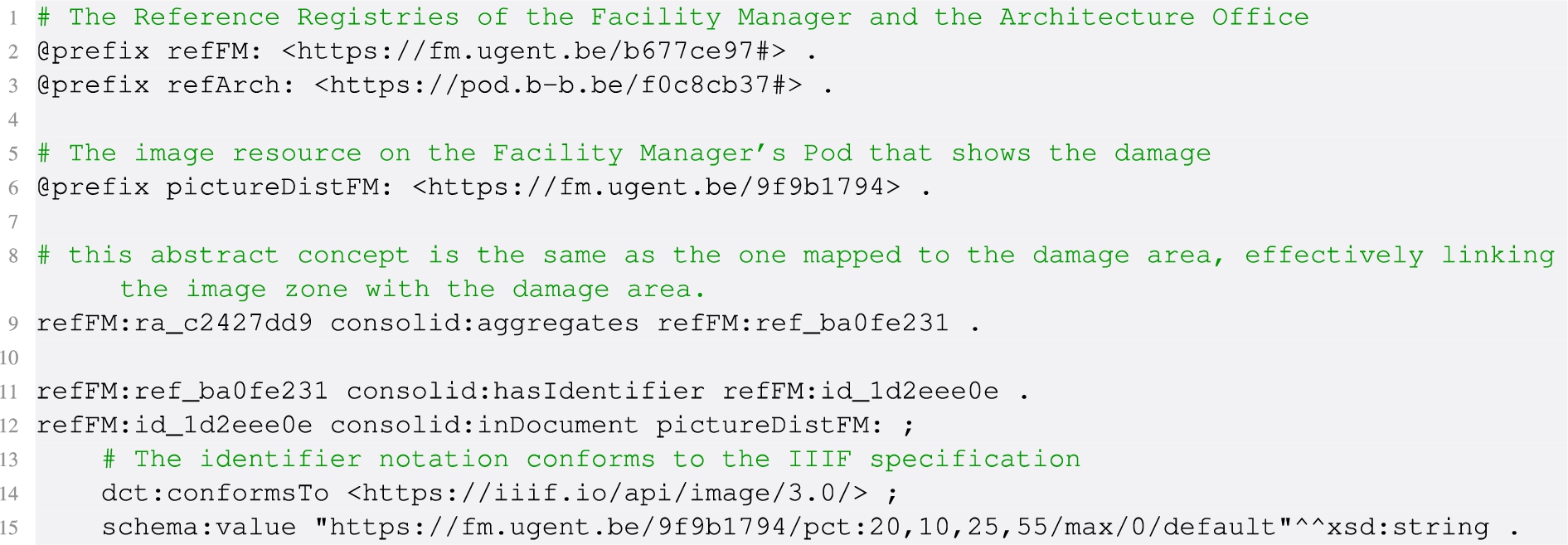
Defining an image’s pixel zone as a specific representation of an abstract concept, identified by a Reference Aggregator
This concludes the enrichment scenario. All stakeholders in the project can now discover and query this information starting from their own project access point.
A client can now query the set of federated project resources to search for product information of damaged elements. The semantic graphs are used for querying; the reference registry delivers the corresponding abstract concepts and their identifiers, and the non-semantic resources (e.g., 3D models, imagery) can be used to visualize the results and access knowledge about an object documented in other resources via dedicated GUIs. In the above described case, a GUI that offers a perspective of damage management would allow an agent to perform the following steps:
Authenticate with a Solid WebID.
Select the project (access point) of interest and discover the SPARQL satellites (Section 3.4) of its aggregated catalogs in order to query the permissioned union graphs containing these catalogs.
SPARQL Query to find the elements that have been damaged. Other references and aliases of this element can then be found by querying the Reference Registries of the project
Results of the query in Listing 17. In this case, the prefix damageDistFM corresponds with the result of the ‘?doc’ variable
Concept identifier and representation identifiers for the results of the query in Listing 17
Results of the query in Listing 17. In this case, the prefix damageDistFM corresponds with the result of the ‘?doc’ variable
Query the project (via the satllite) for damage assessments (Listing 17) and find the damaged element. In Listing 17, this corresponds with the variables ‘?el’ and ‘?doc’. Results are included in Table 3.
Inject the query results for ‘?el’ and ‘?doc’ in the query templates given in Listing 11. This will identify the concept that aggregates the identifier of the damaged element in this specific resource, along with its local and remote representations. With the query results from Table 3 as input, this yields the data indicated in Table 4.
Inject the query results given in Table 4 for ‘?local’ into the query pattern of Listing 12. The result of this query is given in Table 5.
Inject the query results given in Table 4 for ‘?alias’ into the query pattern of Listing 13. The result of this query is given in Table 6.
The concept and its file-specific representations are the union of the results in Tables 5 and 6. This information can now be visualized in a GUI.
Resulting concept alias and its two external references data on the scale of the federated project
* = identifiers not indicated in earlier listings, hosted in resources on the Pod of Bureau Bouwtechniek
These steps are generally applicable for retrieving heterogeneous sub-document identifiers in aggregated projects, based on a combination of domain-specific queries (Listing 17) and ConSolid data patterns (Listings 11 and 12 and 13).
With the setup described in Section 3.4 and the demo scripts available on Github,32
ConSolid demo;
In this section, we evaluate the ecosystem against the original research question and the objectives mentioned in Section 1.2. We also indicated in Section 1.4 that there are significant parallels between interdisciplinary digital twins and open data: although the project-specific part of the former will often consist of access-restricted datasets, the general multi-disciplinary context in which the industry operates, along with its federated nature, has as a result that it heavily benefits from data being findable, accessible, interoperable and reusable. Therefore, evaluation of the ecosystem against these principles makes sense. Hence, the framework will also be evaluated against the FAIRification principles indicated in [12].
Objective 1: Federation
One of the core goals of the ecosystem is to address the double patchwork of stakeholders and projects in a way that naturally mirrors knowledge production in the AECO industry. Based upon the Solid ecosystem and the concept of WebIDs, access to the information generated by individual stakeholders remains under full control by those offices, as well as its legal ownership and intellectual property rights over those documents. Semantic enrichment and alignment of digital twin concepts can take place in an asynchronous way, using concept aliases.
Objective 2 and 3: Discipline-agnostic data patterns and URL stability
The ecosystem fully works on metadata level, both for describing project resources and discovering them via an expressive, query-based procedure. The application of query-based views eliminates the need for implicit semantics in the URL and allows a more flexible aggregation of project resources, depending on the task at hand. Furthermore, changes in document statuses or other metadata will not break the resource’s URL, guaranteeing stability during the resource’s publication life cycle.
Objective 4, 5 and 6: Sub-document linking of heterogeneous datasets
Resources in the ecosystem can use of any (domain-specific) file schema or RDF ontology. Membership of one or more ConSolid projects does not affect the content of a resource, e.g., a BIM model can still be opened in the authoring tool that was used to create it. The heterogeneity challenge is also related to the ability to connect identifiers on a sub-document level. When resources use open standards, sub-document linking is rather straightforward, as identifiers are often embedded in a publicly documented JSON (e.g., glTF) or XML (e.g. COLLADA33
COLLADA:
Autodesk Platform Services:
A federated approach for managing the built environment allows many actors to make statements about a built asset or its context. Adoption of the proposed ecosystem by third parties who provide contextual datasets is beyond the control of a project consortium. However, the metadata-based discovery described in Section 4 allows project members to include external datasets (RDF and non-RDF) in the federated project catalog, hence making them discoverable within the project, and clarify their purpose in the project. Sub-document references can be made to such external datasets as well (Section 4.3).
FAIR principles
In [12], the FAIR principles are subdivided into sub-requirements for each principle. This section lists these sub-requirements and explain them from the perspective of the ConSolid ecosystem.
Discussion and conclusion
In this paper, we proposed an architecture for organising federated datasets for the AECO sector. The Solid infrastructure forms the core of the project, but we extended this infrastructure both in terms of microservice architecture and (meta)data patterns (using DCAT instead of containers). For the microservices, we discussed the benefits of an access-controlled SPARQL interface to a Pod, mainly aiding in resource discovery, and provided a viable approach to establish such interface. Based on this SPARQL endpoint, virtual views can be constructed to group similar resources in ‘virtual containers’ or present data according to a specific industry standard, using domain-specific interfaces. Concerning the (metadata) patterns, we proposed to avoid implicit semantics in resource URLs and only indicate relationships between resources using semantic links in metadata records. Using recursive DCAT catalogs, which we called ‘Dataset Aggregators’, we have shown that nested project data which is hosted by different stakeholders is easily discoverable with a single triple pattern. This introduces a flexibility to fine-grainedly include relevant datasets at the level of individual project partners (e.g., subcontractor datasets, visitor datasets, etc.). In the same move, a scalable approach for interacting with multiple projects becomes possible: for example, public aggregators can be created and aggregate large sets of projects according to parameters like typology (public bridges, libraries, …) or building phase (construction, demolition, …).
In such a federated context, where every stakeholder can define the convenient extents of the project(s) from their point of view, sub-document identifiers should be kept decentrally as well. We argued that every stakeholder should be able to construct links between identifiers in heterogeneous datasets, independent from other participants in the project. Using recursive Reference Aggregators, clients that have access to a project access point can easily combine those aliases into a set of links, all referring to the same abstract ‘thing’. Since both Dataset Aggregators and Reference Aggregators function on metadata level, the content of project resources remains untouched, so compatibility with their original authoring tools remains. This combination of federated data organization and heterogeneous enrichment of abstract things was illustrated with a use case building in Ghent. As a proof of concept, we listed some typical interactions between actors in this project, using the scenario of damage enrichment. The evaluation section showed that the ecosystem is in line with existing efforts towards FAIR data creation and management. To make the ecosystem more mature and industry-ready, its performance needs to improve. We indicated several possibilities to achieve such improvements, for querying (meta)data in general and for concept retrieval specifically.
Eliminating the hard-coded hierarchy of folders on a Solid Pod brings the benefits of flexible aggregation, but also introduces new challenges that can only be partly addressed by the existing Solid specifications. For example, when a resource can be aggregated in multiple catalogs, access control requirements will change, as inheritance would become very chaotic and prone to errors. In this paper, this was solved by allowing each resource to have its own ACL file, although this is not an ideal solution. Future research needs to focus on alternative solutions, e.g., establishing inheritance of ACL rules via metadata-based reasoning.
Over the course of the text, we described concepts such as virtual views and aggregation patterns as domain-agnostic as possible, using small examples from the AECO industry as illustrations. Future research should make the concepts put forward in this paper more tangible, showing use cases for different tasks during the life cycle of a project. Furthermore, the interaction of domain-specific third party services with the ecosystem remained largely untouched, and the layering of (modular) interfaces to the project(s) should be further investigated. As different standards exist for any type of heterogeneous resource, a flexible way for configuring GUIs needs to be set up to match the many combinations that may exist for source documents representing a certain concept. Future research needs to focus on how this can be achieved.
When flexible combinations of access-controlled, interdisciplinary datasets are to be made, taking a decentral approach from the beginning offers benefits not only regarding IP and data sovereignty but also regarding scalability and data integration on the Web. With the concepts outlined in this paper, we hope to show how an environment that has data federation as its core principle can facilitate this, both regarding project-specific information, managed on data vaults, and contextual information, leveraging the enormous amount of knowledge on the Web.
Footnotes
Acknowledgements
This research is funded by the Research Foundation Flanders (FWO), as a Strategic Basic Research grant (grant no. 1S99020N). The authors acknowledge the support of the DigiChecks project, which has received funding from the European Union’s Horizon Research and Innovation Program under grant agreement no. 101058541, and of SolidLab SolidLab Vlaanderen (Flemish Government, EWI and RRF project V023/10). We thank Bureau Bouwtechniek and Arcadis for granting permission to use their models in this paper, and the Facility Management office of UGent for giving insights into their current workflows.
Prefixes used in this paper
Listing 18 contains a list of prefixes used throughout this paper, which refer to ontologies. Prefixes related to a data vault or a specific resource on a data vault are included in the individual listings that mention them.