




Abstract
Small and medium-sized organisations face challenges in acquiring, storing and analysing personal data, particularly sensitive data (e.g., data of medical nature), due to data protection regulations, such as the GDPR in the EU, which stipulates high standards in data protection. Consequently, these organisations often refrain from collecting data centrally, which means losing the potential of data analytics and learning from aggregated user data.
To enable organisations to leverage the full-potential of the collected personal data, two main technical challenges need to be addressed: (i) organisations must preserve the privacy of individual users and honour their consent, while (ii) being able to provide data and algorithmic governance, e.g., in the form of audit trails, to increase trust in the result and support reproducibility of the data analysis tasks performed on the collected data.
Such an auditable, privacy-preserving data analysis is currently challenging to achieve, as existing methods and tools only offer partial solutions to this problem, e.g., data representation of audit trails and user consent, automatic checking of usage policies or data anonymisation. To the best of our knowledge, there exists no approach providing an integrated architecture for auditable, privacy-preserving data analysis.
To address these gaps, as the main contribution of this paper, we propose the WellFort approach, a semantic-enabled architecture for auditable, privacy-preserving data analysis which provides secure storage for users’ sensitive data with explicit consent, and delivers a trusted, auditable analysis environment for executing data analytic processes in a privacy-preserving manner. Additional contributions include the adaptation of Semantic Web technologies as an integral part of the WellFort architecture, and the demonstration of the approach through a feasibility study with a prototype supporting use cases from the medical domain. Our evaluation shows that WellFort enables privacy preserving analysis of data, and collects sufficient information in an automated way to support its auditability at the same time.
Introduction
In Europe, the GDPR [22], in effect since May 2018, stipulates high standards in data protection and imposes substantial fines for non-compliance. Moreover, security breaches have the potential to go beyond financial impact and ruin an organisation permanently, as lost reputation and trust cannot be regained easily. Hence, the organisations not only have to make sure that the data analysis techniques fulfil guarantees of privacy of the individuals representing the underlying records [42], but they also need to ensure that the use of data is compliant with the user consent. This is especially important to keep track of explicit consent for sensitive user data as defined in GDPR art. 9.
Furthermore, to enable accountability, and transparency of systems used for data analysis through auditability, we must capture and understand the broad context in which the system operates: data sources and algorithms, as well as processes and services that the deployed systems depend on [12]. In our context, we define auditability as the ability of an auditor to receive accurate results for inspection and review. Goal of an audit can be to check compliance of an organisation with pre-defined rules and/or standards and regulation. However, without a strong background in IT security and big budgets, providing a secure platform for data storage and analysis is often beyond capabilities of small and medium-sized organisations.
As a consequence, organisations often refrain from collecting data centrally and, for example, offer applications that analyse data locally, on the device that collects the data, instead. While this reduces the attack surface, it means losing on the potential of data analytics and learning from the entire collected data, and thereby hinders innovative services and research. As an example, identifying trends over cohorts of users is not possible.
Some approaches, such as Federated Learning, allow analysis of data distributed among multiple sources by computing a common result without having to centralise the inputs (data). However, most of these approaches are well explored only when data is horizontally partitioned. In our scenario, we generally have a setting with vertical partitioning, i.e. we have data records describing different aspects of the same individual(s), which still poses some challenges (cf. Section 7). Further, auditability is more difficult to achieve in the federated setting. Therefore, we focus on the centralised setup proposed in our paper.
To this end, the main research problem discussed in this paper can be formulated as follows: How to enable auditable, privacy-preserving data analysis systems?
Further, we divided the problem into a number of research questions as follows:
What are the key characteristics of auditable, privacy-preserving data analysis systems?
What are the key elements of an architecture for auditable, privacy-preserving data analysis systems?
How can Semantic Web technologies be used to enable auditable, privacy-preserving data analysis systems?
Recently, research on applying Semantic Web technologies to address challenges related to auditability and user privacy has been intensified. On the one hand, the emergence of the W3C PROV-O recommendation [39] has been well-received in the community as a de-facto standard for RDF representation of provenance trails, forming a basis for auditability. As a result, the development of methods and tools around PROV-O are growing rapidly, summarised in a recent survey paper [62]. On the other hand, the research on representation and compliance checking for user consent and personal data handling also gained traction. Semantic Web technologies, with ontologies and reasoners as key resources, have been proposed to facilitate representing [38,52,54] and automated compliance checking [6,23] on usage policy, which are key to enable consent-check mechanisms for privacy-preserving data analysis.
In a wider research community, privacy-preserving data analysis is an active research area. Various approaches that have been proposed for privacy-preserving data analysis can be categorised according to the data lifecycle they are applied to, for example: privacy-preserving data publishing (PPDP) and privacy-preserving data mining outputs (PPDMO) [44]. In our work we rely on the methods from PPDP and PPDMO. PPDP relies on anonymising data records before publishing. The most prominent method is k-anonymity [61], including its extensions, l-diversity and t-closeness. Approaches towards PPDMO include query inference control, where either the original data or the output of the query are perturbed and query auditing where some queries are denied because of potential privacy breach. DataSHIELD [27] is an example of such a system, which applies both of the later techniques to a number of data mining functions.
Despite research on isolated topics, to the best of our knowledge, no integrated architecture for auditable privacy-preserving data analysis exists. The lack of such an approach can be attributed in part to the contradicting goals of collecting as much data as possible for auditability, while aiming for reduced data collection to minimise the impact of a data breach.
To fill in this gap, we propose a novel approach called WellFort, a semantic-enabled architecture for auditable, privacy-preserving data analysis which (i) provides secure storage for users’ sensitive data with explicit consent, and (ii) delivers a trusted analysis environment for executing data analytic processes in a privacy-preserving manner. Our approach is novel, because organisations do not have direct access to individual data, but only access it in an aggregated or anonymised form. Organisations on the one hand can benefit from a large groups of individuals that are potentially willing to share their data for broader analytics tasks, such as those required by e.g., medical research. Users, on the other hand, benefit from a privacy-preserving and secure platform for their data, and can contribute to analytics/research projects in a secure manner. Finally, analysts (such as researchers) may obtain a detailed source of microdata, if data subjects give the corresponding consent.
The contribution of this paper is three-fold:
We propose WellFort, a semantic-enabled architecture for auditable privacy preserving data analysis,
We adapt Semantic Web technologies as an integral part of the architecture, including: (a) ontology-based data representation of provenance, dataset metadata, and usage policies, (b) ontology development and extension methods, as well as (c) automatic usage policy compliance checking with OWL2 reasoning, and
We demonstrate the feasibility of our approach on real-world use cases in the medical domain.
The rest of the paper is structured as follows. Section 2 presents the requirements for the architecture. Section 3 describes the WellFort conceptual architecture and the processes it supports. Section 4 reports on the Semantic Web methods adoption to support the architecture. Section 5 presents the prototype implementation. Section 6 investigates the feasibility of a WellFort-based prototype in four use cases, and Section 7 presents related work. Finally, conclusions and an outlook are given in Section 8.
Requirements
In this section, we introduce the main functional and non-functional requirements for our platform. These iteratively refined requirements are based on privacy regulations, such as GDPR [22] as well as use cases and discussions with partners from the WellFort project.1
In the following, we describe a scenario (cf. Fig. 1) to exemplify and motivate the requirements for auditable privacy-preserving data analysis described in the following sub-sections. Later, in Section 6, we will derive four concrete use cases from this scenario to conduct feasibility studies of our approach.

WellFort overview scenario.
Andrea is a user of two health apps, one from Company H, which monitors her heart rate, and another one from Company M, which records her cholesterol level. She wants to collect her data from both apps, link and share her data, but only for research purposes. She also considers sharing her data for specific commercial purposes, like getting product recommendations, but wants to decide about it later.
However, since Company H and Company M are small companies, they do not want to manage the data themselves. They plan to store their users’ data in a cloud platform without having to develop and run the platform themselves.
Barbara, a researcher from TU Wien, is planning to develop a machine-learning model on the relationship between heart rate and cholesterol level for her research. She is looking for suitable data for her model, but at the same time, she wants to make sure that she is compliant with regulations.
Later on, Andrea asks Claudia, an auditor of the cloud platform, regarding the use of her data. Since Andrea’s data is used as part of Barbara’s research, Claudia provides Andrea with the information on the research setup.
In the scenario above, the data captured by the application providers (i.e., Company H and M) can be categorised in the special category of personal data in GDPR art. 9. Thus, the cloud platform should facilitate users like Andrea to define explicit consent to their data. Furthermore, due to privacy reasons, application providers and researchers like Barbara should not get direct access to user data repositories, but still should be able to conduct data analysis in a privacy-preserving manner without compromising user consent. Claudia, in the other hand, should be able to provide the audit information to Andrea, without having access to the content of her personal data.
Data analysis. The platform must enable data analysts to conduct privacy-preserving analysis without disclosing individual user data. To reduce the attack surface, input and intermediate data beyond the analysis must not be persisted by the platform. It should be possible to analyse data originating from the same application (organization) and also to conduct cross-application (cross-data owner) analysis (e.g., correlating heart rate with cholesterol level, even though each was collected from a different application).
Finally, all data analysis computation on raw individual data must take place inside the platform and the analysis environments can be stored only for a limited period of time, as defined by the data retention policy of the platform.
Data publishing. Analysts must not download any data in its original form, to fulfil regulatory requirements, and to minimise the surface for privacy attacks, such as user re-identification. Instead, for offline analysis, the platform should offer anonymized downloads, and the generation of synthetic data [3]. The platform must provide measures to prohibit downloading similar data multiple times by a single analyst, since this provides the channel for disclosure of sensitive information.
Usage Policy Management. Data analysis requires fine-grained consent from the involved users [22], and access control has to ensure that only authorised analysts can work with the data. To this end, usage policies, which include both user consent and data handling setup need to be represented in a machine-readable format. Further, a mechanism to conduct an automatic usage policy checking between consent and data handling is required.
Auditability
Provenance data capture and tracing. Provenance of data must be traced in the whole data lifecycle within the platform. Automated collection of by who, when, and how data has been accessed, processed and analysed needs to be recorded, ranging from high level to precise trails. Traces must be easily accessible by auditors to check which data was used and how results were computed to identify irregularities or do checks. Finally, analysts must not be able to acquire or infer personal or otherwise sensitive data via the provenance trail.
Provenance data inspection and analysis capability. Collected provenance data streams must be accessible to users with auditing privileges through an interface, to be able to answer audit questions concerning data and its upload, usage, and analysis. Such a question could be to inspect which studies involved a user’s personal data, for what purposes, and how it was analysed. Auditors should be able to access the data while preserving the privacy of users, therefore, no personal data must be acquired by the provenance feature.
Metadata-retention after deletion. Even after users revoke their consent due to their right to be forgotten, consent for past studies is still valid. In order to fulfil the requirement of providing proof of correct data capturing and data analysis, minimum necessary meta-information must be kept in the provenance module for past studies that were conducted and based on now deleted information.
Conceptual architecture
In this section, we describe the conceptual architecture of the platform for auditable privacy-preserving data analysis, which addresses the requirements defined in Section 2. More on the technical details will be described on Section 4 and Section 5.

WellFort conceptual architecture.
The conceptual architecture of the platform is depicted in Fig. 2. There are three distinct actors:
User – store their data in the platform and give consent to analyse it. They use an application provided by the organisation and do not interact with the platform directly, e.g., using a dedicated user interface.
Analyst – can run experiments in the platform. They define what types of data will be used in the analysis and perform the actual analysis.
Auditor – can analyse evidence collected to answer specific audit questions that depend on the purpose of the audit, e.g., a litigation case, or simple usage statistics for users wanting to know when and by whom their data was used.
The architecture consists of three component groups, each serving a different purpose:
Secure Repository– stores data uploaded by a user and allows the selection of data to be used in experiments by the analyst. There are no components in this group allowing analyst to directly view or analyse raw data.
Trusted Analysis Environment– selected data that fulfils experiment criteria, e.g., consent, fit for purpose, etc. is duplicated to this component for further analysis. This part of the platform provides mechanisms allowing the analysts to conduct their experiments in a privacy-preserving manner. Data selection is usually expressed via queries.
Audit Box– collects and manages provenance data to support the auditability of processes within the secure repository and trusted analysis environment. The Knowledge Base can be accessed via an interface to answer audit-related questions on personal data access and usage.
In Fig. 2, we use dashed lines to indicate the division into these three groups. Figure 2 further depicts four typical processes executed in the platform:
User data upload – the process starts when a user’s application sends data to the platform. It extracts metadata from the data, and stores it together with the data and the consent indicated during the upload in the platform. Thus, every dataset uploaded to the platform is linked to a minimal set of information that allows for its retrieval. Data selection – analysts define the search criteria for data they want to use in their experiments. If the platform has enough data fulfilling their criteria (and also consent for usage), then the process loads the actual data into the Trusted Analysis Environment where the analyst obtains accurate aggregate results without having access to individual datasets. The search for data relies only on high-level information provided in the metadata. For example, BloodGlucose, which is one of the attributes in the actual user data, has only a boolean value in the corresponding metadata to indicate whether the dataset contains information on BloodGlucose. Furthermore, Analysts can download anonymised data and analyse it outside (offline) of the platform. However, anonymisation can substantially reduce the quality of the data and the results of the offline data analysis thereupon. Data analysis – analysts process the data and produce results by submitting code to the platform. The platform will ensure that the analysts will not be able to identify or infer data subjects from the analysis. Audit – provenance information obtained from each component of the platform is sent to an independent component and organised in a knowledge base. Auditors query experiment details.
We numbered the steps of each process and marked them with colours: green (user data upload), orange (data selection), blue (data analysis), and pink (audit). We describe now each of the processes in detail to explain the role of each of the components.
Following the terminology set by the Open Archival Information System (OAIS) reference model [33], this process is equivalent to the ingest process that transforms and enriches data uploaded by users, so that it can be later located and accessed according to the corresponding user consent.
The process starts by a user’s application sending data together with the consent to the Data Repository. The Data Repository creates a record in which it stores the persistent identifier (PID), consent, and location of the received data. The PID is unique and never changes. Following the FAIR (Findable, Accessible, Interoperable, Reusable) principles [68], even if the data is deleted, the PID is kept, and the record is updated with information on why and when the data was removed.
The platform automatically creates metadata and stores it together with the consent in the Triplestore. The Extractor component receives the PID of the dataset and accesses the data. The generated metadata consists of a list of key-value pairs, where each key corresponds to an attribute located in data, e.g., heart rate, while the value is always boolean, i.e. true or false. Thus, the Triplestore contains PIDs of datasets, together with a high-level description of the presence of certain types of contents, and consent given. The Triplestore does not contain any user specific information. We provide more details on the metadata and consent representation in Section 4.1.1 and Section 4.1.2 respectively.
It would be possible to use only a Data Repository and omit the Triplestore. However, the current design has two major advantages. First, data is decoupled from its metadata, and thus analysts can query the Triplestore, while the actual data can be kept offline, e.g., due to security measures. Second, by using the semantics provided by the underlying ontology, we can run advanced queries to identify suitable data for an experiment that go beyond simple string matching, e.g., by using subsumption reasoning for query expansions and usage policy compliance checking.
Data selection
Analysts use the Experiment Setup Interface to define their experiments. They specify the purpose of the experiment, and which data attributes they want to use in their analysis. Based on this input, the Controller automatically generates a query and sends it to the Triplestore. The Triplestore returns a list of dataset PIDs that fulfil the criteria (cf. Section 4.1 for details on how the result is produced). If the number of available datasets fulfils the requirements of the analyst (so that the study is meaningful from a statistical point of view), they can decide to start a new study and load the data into the Trusted Analysis Environment.
Each study has its own PID and links with the list of dataset PIDs, as well as metadata about the experiment. Similar to the PIDs used for datasets, the study PID allows us to refer to experiments in an unambiguous way.
The Loader receives the study PID and fetches the data from the Data Repository. Depending on the actual implementation of the Trusted Analysis Environment, the Loader transforms the data into a suitable format, e.g., database, pivot tables, etc. When the data is loaded, analysts receive information via the Experiment Setup Interface on how to access the Trusted Analysis Environment, e.g., an access URL, username and password.
Analysts can also decide to download either the k-anononymised data or synthetic data. To do so they use the Experiment Setup Interface to define their experiment. All the steps are the same as before, yet the data is not loaded in the Analysis Database but transformed by the Privacy Preserving Data Publishing component and made available for download.
Data analysis
Analysts use the Analysis Interface to communicate with the Analysis Server, which in turn has access to the data stored in the Analysis Database. The Analysis Interface allows submitting code for data analysis and viewing the processing results. It also logs every activity of the analyst. The Analysis Interface can be realised as a web application running on a server side.
The Analysis Server inspects the code submitted by analysts and protects data from direct access. For example, the server allows only aggregation functions to be executed, and blocks requests to list properties of specific datasets (users). If the submitted scripts pass such requirements for privacy-preservation, then the results are calculated on the original data and returned to the Analysis Interface.
Please note that the Analysis Interface is part of the platform, and a direct access to the Analysis Server is not possible. Such a design is more secure, and allows to better track the analysis process.
A data analysis process can only be executed when the data has been loaded into the Trusted Analysis Environment, and when the analysts received their connection details. The Analysis Database receives only the data required for the specific study, keeps it for a limited time, and deletes it after the study is completed. During the analysis, there is no need to access the Secure Repository. Hence, thanks to loose coupling, each group of components can be instantiated by deploying them on different nodes with varying levels of security, access, as well as computational power.
Audit
The Secure Repository and the Trusted Analysis Environment push provenance information to the Provenance Collector to separate this information from the components processing data, in which the provenance was captured. Such a design increases security of provenance information, because it prevents from non-authorised modification of provenance when one of the user-facing components is compromised.
Provenance capturing can be implemented in different ways and the captured information can be structured differently, hence, it is necessary to align representation of provenance information before loading it into the Knowledge Base.
The Knowledge Base stores provenance for each of the processes supported by the platform, specifically:
User Data Upload – a persistent identifier of a dataset, consent, an automatically generated metadata summarising contents of the dataset, a timestamp.
Data Selection – an identifier of the analyst, an identifier of the submitted query, query attributes (e.g. timestamp, study purpose, study description), query results, consent check results, and an identifier of the analysis (only if the consent check was successful and the analyst decides to analyse the data).
Data Analysis – an identifier of the analysis (created in the previous step to link the query with the analysis), information on software environment and dependencies (e.g. operating system, software libraries, environment variables), script parameters, results of the analysis.
Auditors use the Auditor Interface to get access to provenance information organised in the Knowledge Base. They define queries to retrieve relevant provenance information when performing an audit, which we will describe in the next section.
Semantic-web methods for auditable privacy-preserving data analysis
In this section, we describe in detail how Semantic Web technologies contribute to the overall architecture presented in Section 3, in particular for consent and metadata management (Section 4.1) and auditability (Section 4.2). Note that from here on, for consistency reasons we will use the prefixes and namespaces introduced in Table 1.
The list of predefined prefixes and namespaces
The list of predefined prefixes and namespaces
In this section, we describe the mechanism to manage and utilise consent and metadata with Semantic Web technologies, to ensure that experiments can be executed with a sufficient amount of data without compromising the user consent of the datasets. The mechanism mainly resides within the Secure Repository, where the analysts interact with the system to setup their experiments.
When an analyst interacts with the Experiment Setup Interface, she needs to describe the Data Handling setup, which contains information about the required category of personal data, purpose, processing, recipient, and expiry time of the experiment. This information allows the data selection process to be conducted as the following:
Step 1. Finding datasets with matching categories, where we query the Triplestore for datasets. As a part of the step, the RDFS reasoning is used to expand the dataset selection based on the subsumption relations between data categories.
Step 2. Usage policy compliance check. In this step, we determine whether the Data Handling setup of the analyst is compliant with the user consent of datasets collected from Step 1. Therefore, it is necessary to automate the compliance check in order to speed up the process.
From the steps above, we identify three necessary components that need to be defined in order to facilitate the consent and metadata management, namely (i) Dataset metadata representation, (ii) Usage policy representation, and (iii) Automated compliance checking mechanism.
Metadata representation
There are several suitable ontologies that can be used to represent dataset metadata, and we therefore only need to adapt and extend those where required, e.g., Data Catalog Vocabulary (DCAT) [69] or VOID [13]. In our approach, we decided to base our metadata representation2
We adopt two classes from DCAT,
These two relations imply the use of the Data Privacy Vocabulary (DPV) [54] in our architecture that we will explain in the next subsection.

An excerpt of dataset metadata on WellFort
We provided an example metadata in Listing 1, which shows the single catalog in the platform and dataset-303, which contains personal information on heart rate and age. We deliberately removed the relation between users and datasets in our metadata.
One of the main requirements of our approach is to ensure that the personal data can be used for analysis without compromising user consent. To this end, there is a clear need to represent usage policies, both for user consent and analyst data handling, in a clear and concise manner. In recent years, a number of ontologies has been proposed to represent usage policies, e.g., DPV [54], PrOnto [52], SPECIAL [8] and SAVE [38], among others.
For our approach, we decided to use DPV as our basis for usage policy representation, due to (i) the community-based development of the vocabularies, and (ii) DPV does not recommend a specific mechanism to use its concepts, providing adopters with a high degree of freedom to use and adapt it for their purpose. Furthermore, the DPV Community Group3
We adapt the SPECIAL Policy Language [8] to structure DPV as usage policy. In this structure, a usage policy is composed of one or more basic usage policies each of which is an OWL2 expression of the form shown in Listing 2. We implement a small adjustment to the original structure by replacing the storage information with an explicit expiry time of policies, which is simpler but provide the necessary time limit on the use of data. We argue that the current structure is inline with the GDPR, which defines that policies shall specify clearly (i) which data are collected, (ii) what is the purpose of the collection, (iii) what processing will be performed, (iv) whether or not the data will be shared with others, and (v) for how long the data will be stored.

DPV adaptation of SPECIAL policy language for WellFort
Within our approach, we use the
Furthermore, there are a number of properties that we deemed necessary to be included in the consent and data handling setup:
While the generic concepts provided by DPV vocabularies cover a wide range of subjects, they might not cover the requirements for the fine-granular consent definition in domain-specific use cases. To address this issue, we adopt the vocabulary extension approach we previously developed in [24], where we adapted and extended the SPECIAL vocabularies in the smart-city domain. We reuse a similar mechanism to extend DPV concepts with use case specific concepts to allow usage policy matching on fine-granular user consent for our evaluation in Section 6. An excerpt of the extended DPV4
Full version is available online:

An excerpt of the extended Data Privacy Vocabulary (DPV).
In SPECIAL [8], policies and log events are described in semantically unambiguous terms from the same taxonomies defining usage policies, hence it facilitates automatic compliance checking. To allow automatic compliance checking, the usage policy enforced by a data controller contains the operations that are permitted within the data controller’s organisation.
In this work, we reuse the same mechanism as in SPECIAL approach [6], where the usage policy
The reasoning behind reusing the SPECIAL usage policy compliance checking mechanism for our approach is two-fold: (i) the approach is compatible with DPV, which is mainly due to the fact that DPV is developed based on the SPECIAL vocabularies, and (ii) our successful experience in adopting the SPECIAL approach in several of our prior works [18,23,24].
Auditability
In this subsection, we explain the extension made to accommodate auditability concerns and questions. First, we describe the methodology on how to capture the provenance data in our architecture (Section 4.2.1). Next, we present a list of predefined provenance-focused competency questions from our scenario and requirement analysis (Section 4.2.2). In the following, we report on our extensions to the PROV-O data model, which are tailored to these concerns (Section 4.2.3). Finally, we explain our approach to handle the mapping and query translation for provenance data captured from the system (Section 4.2.4).
Methodology
Miles et al. [47] offer a methodology for developing provenance-aware applications, arguing for the identification of actors and data flows of applications. We apply and adapt a condensed form to define our auditability needs:
Definition of provenance competency questions: These questions are to validate that the correct information pieces have been gathered to answer them and will be provided in Section 4.2.2. Identification of main actors, activities and entities: During the definition of provenance questions, we identified the main actors, activities and entities. Extension of provenance data model: We have chosen PROV-O as the foundation for our auditability. However, adaptations are needed to answer our defined competency questions. The process from Step 2 and 3 will be described in Section 4.2.3. Mapping of system data sources to provenance data: In this step, audit data artefacts from the system have to be analysed and mapped accordingly to the extended PROV-O. Translation of competency questions into queries on the data: This step is concerned with the translation of questions defined in Step 1 into queries. We will briefly describe the process from Step 4 and 5 in Section 4.2.4
Auditability competency questions
This subsection deals with the identification of audit-related questions from our scenario and requirements described in Section 2. In the process, we discussed the questions with both project members as well as our use case partners.
We group the questions according to the main actors: 1) user-centric that are relevant for users to gain trust in the system, e.g.: how data was used, which consent was provided,etc., 2) analyst-centric, focusing on search parameters, system variables and the software environment of the analyst.
User-centric questions:
If user data has been analysed, in which studies was it used?
If user data has been analysed, which purposes did the study serve?
What user consent was given for a dataset at a specific time?
Which entities have analysed user data?
What processing was conducted on user data?
Which user data types were used for analysis?
Analysis-centric:
Which search attributes were specified for a certain study? Which software dependencies, deployment settings and software versions have been used when conducting a study? Are there differences in the results between two queries with the same search parameters but at a different time? Can these differences be related to user consent, additional data upload or a change in the platform/software environment? Which data transformation operations were conducted on data? Which software was used to analyse user data? What scripts were used to analyse user data?
Audit data model
We decided to adopt PROV-O5
One of the related works with regards to our Audit data model is GDProv [53], an effort to model provenance based on PROV-O and P-Plan to enable GDPR-related compliance queries. However, due to the auditing requirements in our use cases that are beyond consent, e.g., to model system configurations, analysis scripts and search parameters, we still need to extend GDProv to cater our needs.
During the definition of provenance questions, we identified two main processes that need to be modelled as plans (
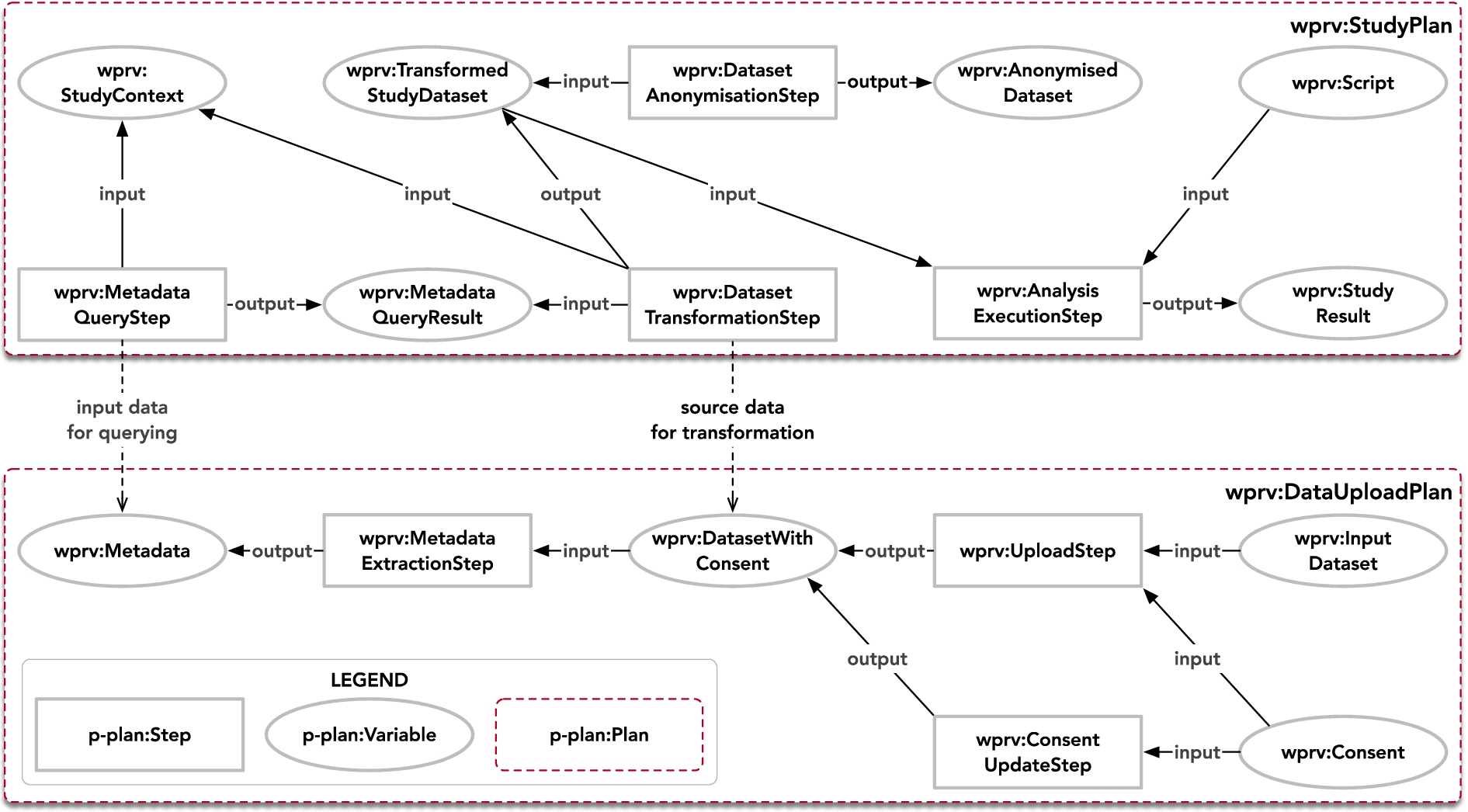
Study and data upload plan of WellFort audit data model.
Data upload plan (
Upload (
Metadata extraction (
UpdateUserConsent (
Study plan (
Metadata Query step (
Dataset transformation (
Data anonymisation (
Data analysis (
We do not depict the agents and entities in Fig. 4 for ease of readability. Relevant agents are the analysts (
The Audit Box component in WellFort architecture provides a basic building block for audit data management previously explained in Section 3.4.
In the provenance collector of the Audit Box, we define a set of mappings between the raw provenance data provided by the other two components of the architecture, namely Secure Repository and Trusted Analysis Environment, and our extended PROV-O data model to ensure that we can retrieve and collect the provenance data properly. Potential mapping technologies include RML for structured data [14] or ONTOP [9].
Since we store the provenance data as RDF graphs, we naturally rely on the SPARQL query language to formulate auditor queries to the system. To this end, we support the auditors by implementing the competency questions described in Section 4.2.1 as pre-defined queries and provide it to the user in the Auditor Interface. Furthermore, it is also possible for auditors with advanced SPARQL capabilities to implement their own SPARQL queries on their audit process.
Prototype
Our overall guidelines when implementing the prototype of our platform were as follows:
For data handling, we re-use proven data formats, standards, and ontologies as much as possible, to avoid common pitfalls when designing from scratch, and to foster re-use and interoperability with other systems. For software components, we re-use existing, well proven and tested components, e.g., for the basic repository system, database servers or analysis platform, and focus our effort on orchestration and integration of these components into a functional platform serving the intended purpose of providing auditable, privacy-preserving data analysis.
In the following, we provide details on our prototype and the technologies utilised.
Secure data repository
We implemented the Data Repository using the Invenio framework,8
We implemented the Extractor and Controller modules as Flask9
The core part of the Triplestore component is built using SparkJava11
To this end, we developed a Usage Policy Compliance Check engine to complement the Triplestore with a compliance check mechanism, which is built using the OWL-API14
The Privacy-Preserving Data Publishing module is implemented using open-source tools for data anonymisation. There are two methods enabling privacy-preserving download: (i) k-anonymisation [61] and (ii) synthetic data generation. For k-anonymisation we utilise ARX Data Anonymisation Tool.15
The Trusted Analysis Environment contains the mechanisms for secure and privacy-preserving data analysis. The mechanism is provided by the analysis server, the analysis database, where the study data are temporarily stored, and the analysis interface, which allows the Analyst to interact with the data.
Analysis server
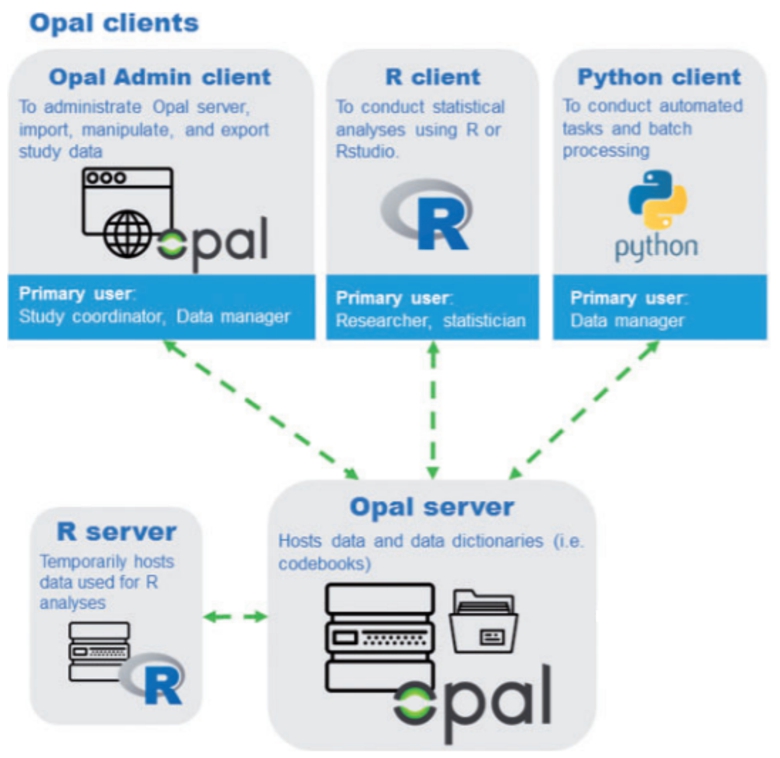
Connection between opal and clients [16].
For this component, we rely on Opal,17
Opal is open-source and freely available at www.obiba.org under a General Public License (GPL) version 3, and the metadata models and taxonomies that accompany them are available under a Creative Commons licence.
Opal is built on REST web services, which allows connections from different software web clients using the HTTPS protocol, as shown in Fig. 5. These clients are designed to ensure a broad range of specialised tasks to be achieved by different users. For example, a Python client allows data managers (in this case our platform administrator) to automate repetitive tasks such as data imports and access permission management. An R client, e.g., RStudio, allows conducting statistical analysis of the data stored on Opal. Opal provides the access to the Analysis Database to the authenticated users. The Loader sets the user permissions for the data tables loaded into Analysis Database so that the Analyst can access them thought the Analysis Interface. This allows the Analysts to operate only on the data that has been retrieved for studies they initiated. Client authentication is performed using either certificates, username/password, or token mechanisms.
Analysis database In the Trusted Analysis Environment, Opal is connected to the Analysis Database, a PostgreSQL18
The details about the data formats within the Analysis Database are provided in Section 5.4.2.
Analysis interface In our prototype platform, we utilise the R client of Opal as an interface where the Analyst conducts her studies on selected data using R DataSHIELD packages. DataSHIELD [27] is an open-source software that provides a modified R statistical environment linked to an Opal database. It was originally developed for remote, non-disclosive analysis of biomedical, healthcare and social-science data, although it can be used in any setting where microdata (individual-level data) must be analysed but cannot or should not physically be shared with the research users for various ethico-legal reasons, or when the underlying data objects are too large to be shared. DataSHIELD implements >100 statistical methods19
RStudio Server20
The Audit Box collects and integrates provenance data from the entire platform, and provides an interface for Auditors to audit processes within the platform. The Audit Box consists of three components of which the implementation will be described in the following.
Provenance Collector. The task of this component is retrieving and transforming raw provenance data into an integrated RDF graph. In our prototype, we implement this component as a set of REST services. The services accept raw provenance data in JSON format from various components in the Secure Repository and Trusted Analysis Environment and transform it into PROV-O compliant RDF graphs.
Specifically for Trusted Analysis Environment, we rely on an existing tool to collect provenance from R-Scripts.21
We provide an example of raw provenance data produced by the Secure Repository in Listing 3 and the respective RDF graph result in Listing 4. These examples capture the provenance of the upload process, where a user finished uploading her personal data with a consent to the Secure Repository. Both the upload activity and the uploaded dataset are captured as instances of

An example of raw provenance data

The resulted RDF graph from Listing 3
Knowledge Base. We collected the provenance graph from the Provenance Collector into the Knowledge Base component. This component stores and manages the provenance data, which is necessary to support Auditors in conducting their tasks. Similar to the metadata store in the Secure Repository, we utilise GraphDB as our Knowledge Base for Audit Box. The communication between GraphDB and the Provenance Collector is handled using Eclipse RDF4J24
Auditor Interface. In our current prototype, the Auditor Interface relies on the SPARQL user interface of GraphDB, both for storing the pre-defined queries for the audit-related competency questions described in Section 4.2.1 and to allow auditors to formulate their own queries related to their tasks.
This section explains the data model used in our prototype implementation: (i) a domain-specific vocabulary on health record and (ii) the analysis data model for our Analysis Database.
Domain specific vocabularies: Health record
The proposed conceptual architecture does not impose limitations on the formats of the data used in the Data Repository and therefore, the data model depends on the specific use case. For the prototype presented in this paper, we consider the following characteristics for our health record data model:
Based on these criteria, we decided to use the Fast Healthcare Interoperability Resources (FHIR) developed by Health Level 7 International (HL7) as the data format in our Data Repository for our prototype. HL7-FHIR is the latest standard by HL7 for electronically exchanging healthcare information based on emerging industry approaches [25]. FHIR offers a number of advantages for prototype development, such as its solid foundation in Web Standards and supports for RESTful architectures.
In our use case, we used FHIR to represent Patient, Diagnostic Report, and Observation. While FHIR recommends the use of LOINC25
The privacy-preserving nature of the Trusted Analysis Environment comes with the price of reducing the data utility and flexibility of an Analysis compared to full data access. Another challenge is that the data originating from different sources needs to be transformed to the same common format, while keeping the data intuitive for Analysts to work with. Therefore, in the Analysis Database we aim to keep the most relevant data for the analysis in a rather concise but comprehensive format.
The database consists of two default tables defined by the types of FHIR resources Patient and Observation:
– Patient: provides information about the users included in the study, such as sex, age and country.
– Observation: contains information about the specific measurements for a user. A biomarker can be any attribute contained in the source databases, for instance, blood sugar, activity level, etc. Each biomarker is represented with its code (biomarkerCode) and full name (biomarker). A patient can have multiple measurements of the same biomarker measured at a different moment in time, so the attribute issued provides the information of when the specific measurement has been taken.
The two tables are connected by a foreign key Observation:patientId–Patient:id. The database schema can be seen in Fig. 6.

Analysis Database schema.
As specified by Opal, each table is represented by (i) one CSV file called data table and (ii) one JSON file called data dictionary.

An excerpt of data table CSV file for table Observation.
- Data table: the columns of this table correspond to the attributes in the actual table Patient/Observation. Each row is one data entry. An example data table file is shown in Fig. 7.
- Data dictionary: this file is used to describe one data table. These tables must follow the scheme defined by Opal which imposes a set of fields such as entityType, index, name, unit, valueType, etc. for describing each of the attributes form the data table.
In this section, we demonstrate the platform through representative use cases. In the summary we assess how well the demonstrated scenarios answer to the requirements posed in Section 2.
Data
For the evaluation we use data originating from two sources, both from SMEs that provide a health-care or lifestyle related application to end-users. For confidentiality reasons, we denote these sources as Company (or Datasource) M and Company H. A subset of the attributes provided by these two data sources are shown in Table 2. We generated 1100 synthetic datasets for 600 users based on the original data from both companies with varying consent configurations. Each dataset contains a single record for patient data (e.g., ID, age, and country) and health observation attributes (cf. Table 2) that we observe in the use cases for a single day. The synthetic datasets are generated using the Synthetic Data Vault (SDV)26
Attributes of evaluation data
Synthetic users and datasets for the evaluation
We define four use cases which will be processed in our platform:
UC1: Descriptive analysis of data from a single data source
UC2: Descriptive analysis of data from multiple data sources
UC3: Predictive modelling
UC4: Data publishing
UC1, UC2 and UC3 describe scenarios of using Trusted Analysis Environment, while UC4 describes the purpose of Privacy-Preserving Data Publishing component. UC1 and UC3 deal with data originating from a single data source, while presenting the spectrum of functionalities provided to the Analyst. UC2 focuses on a study utilising data from multiple sources. Within each use case, we provide a discussion on privacy concerns of the respective analyses.
We simulate the following scenario to introduce dynamic aspects:
Initial state: all user datasets are uploaded and collected in the Secure Repository.
Day 1 (05-01-2021): UC1 and UC2 are executed. UC1 analysis setup (expiry: 05-01-2021; processing:
Day 2 (06-01-2021): User consent from 50 users expired (u0-u49). Furthermore, 50 users (u200-u249) removed
Day 3 (07-01-2021): UC3 and UC4 are executed. Due to the changes and expiration of some user consents, UC3 analysis setup (expiry: 07-01-2021; processing:
The flow for each of our use cases shares some common steps:
The the the user consent that needs to match with the Analyst’s study purpose the expiry date of For each study, after initialisation, the For each study the When the study is initiated, the
The number of the available datasets needs to exceed the predefined threshold, otherwise the analysis is considered to be potentially disclosive and the platform terminates the study setup. For our evaluation, we set the threshold to 10.
UC1: Descriptive analysis of data from a single source

UC1 (single source use case example): average PRQ of patients.
In our first use case, we assume the Analyst wants to conduct a set of descriptive studies to visualise selected attribute values across the population of platform users. Let this attribute be Pulse/Respiration-Quotient (PRQ) originating from the database of Datasource H. The Analyst then wants to study how the PRQ values differ between age groups and sex.
In our evaluation, the platform finds 450 participants with a set of records of the selected attributes, therefore the Patient table contains 450 records of users’ age and sex. and Observation Table 450 records of PRQ.
Figure 8 shows the results of the analysis, i.e. the average PRQ for different age groups (under 40, 40-60 and over 60) for male and female participants separately. The averages of PRQ are obtained by DataSHIELD functions and then plotted using the native R plotting package Joining tables via Subsetting via Mean function via
The listed DataSHIELD functions for subsetting and calculating the mean value are potentially disclosive functions. For example, applying subsetting repeatedly might lead to revealing the actual values from the table. DataSHIELD achieves privacy-preserving versions of these functions by prohibiting subsetting and calculating simple statistics, such as mean, on less than 4 data samples. Functionality for joining tables is implemented such that the method does not return any value to the Analyst, except for potential error messages. The joined table is persisted on the server in a variable, which the Analyst can use in other functions only by name, therefore no values can be disclosed in the process.
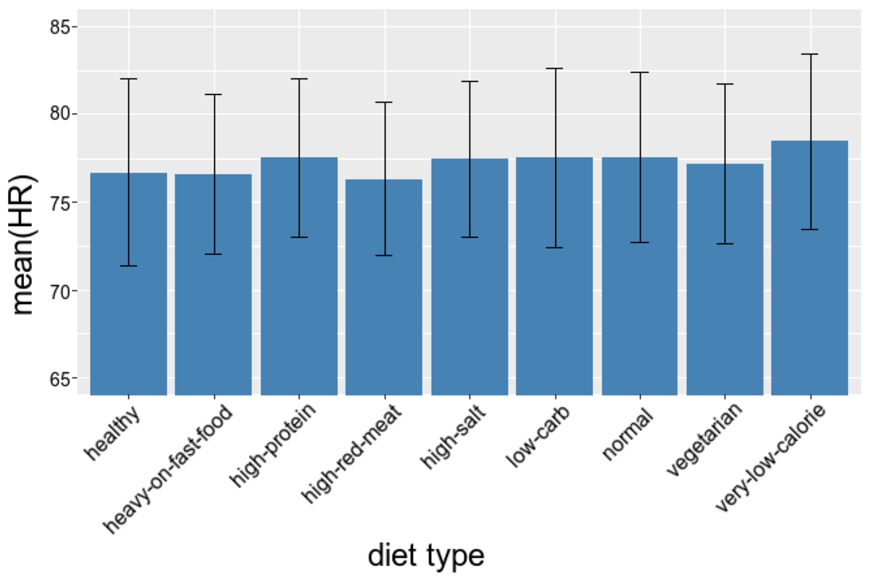
UC2 (multiple source use case example): mean and standard deviation of heart rate of users with different dieting profiles.
In this use case, the Analyst wants to conduct a study on attributes that are originating from separate data sources. For example, the Analyst wants to compare the resting heart rates of people with different dieting profiles, such as vegetarian diet, low-carbohydrate diet, etc. For that, the platform needs to collect the data from two applications. Datasource M provides the attribute diet and Datasource H provides the attribute heart rate. This analysis is only possible on users which use both applications. Users control the linking of their data and have to enable linking between those applications upon data submission (in their applications).
In our evaluation, the Patient table contains 400 user records and Observation table contains 800 records for these 400 users; 400 records of heart rate and 400 of diet type. The Analyst groups the patients by their diet type, and then for each dieting group calculates the mean and standard deviation of the heart rate values. To highlight a few steps, let us list the specific DataSHIELD functions that allow these operations:
Subsetting via
Joining tables via:
Aggregation via
The resulting analysis is shown in Fig. 9. It shows the mean and standard deviation of the heart rate value for individuals in different dieting groups.
From the privacy-preserving perspective, the function
The Analyst wants to conduct a more sophisticated study to predict the value of the Vitality Index (a measure of the resources that are available to the organism for activity and health maintenance). To that end, the Analyst wants to learn and apply a generalised linear model (GLM) that describes the linear combination of the attributes sex, parasympathicus activity and sympathicus activity and enables predicting the expected value of the attribute Vitality Index of a person. Such a predictive model functionality is provided as a DataSHIELD function, and thus readily available.
Datasource H provides the data about vitality index, sympathicus and parasympathicus activity and sex of its patients, thus this analysis task is a single source setting. The Patient table contains 350 records and Observation Table 1050 records of vitality index, parasympathicus activity and sympathicus activity for the same set of patients.
The Analyst is now free to use any type and number of DataSHIELD and native R functionalities to obtain privacy-preserving results. We single out some specific DataSHILED methods used in this study:

UC3: univariate GLM for target attribute vitality index and predictive attribute sympathicus activity.

UC3: output of multivariate GLM for target attribute vitality index and predictive attributes sympathicus activity, parasympathicus activity and sex.
Generalised Linear Model via
Visualisation via
One option for the Analyst is to examine the relationship between Vitality Index and one of the aforementioned attributes by fitting a univariate GLM. The Analyst chooses sympathicus activity as a predictor attribute for Vitality index and Gaussian error distribution. Figure 10 shows the distribution of data points and the estimated linear model for target attribute Vitality Index, using Sympathicus Activity as a predictive attribute.
Furthermore, to fit a more complex model, i.e. multivariate GLM, the Analyst in addition includes more predictive attributes: sex and parasympathicus activity. Figure 11 shows the output of the DataSHIELD function
For both univariate and multivariate analysis, the output of
Original dataset
Original dataset
In this use case, the Analyst wants to download anonymised data so that they can perform an offline analysis on the given data, using other data analysis tools rather than the Trusted Analysis Environment. Reasons for this might be of technical nature, such as programming language preference, familiarity and reliance on another analysis framework, required functionalities that are not covered by DataSHIELD, etc. Furthermore, the Analyst might be interested in the structure of the data and particular data values rather than statistical analysis, or wishes to avoid being time-constrained for conducting their studies. The Analyst, however, needs to be aware of the utility loss that anonymised data introduces, which manifests in the reduced quality of the analysis conducted on such data [71].
The Analyst chooses attributes Sex, Age, Country and Total Cholesterol provided by the Company M. In the k-anonymised dataset the direct identifiers such as user full name or any kind of IDs are not displayed at all. Other indirectly identifying attributes with personal information such as user country, age and sex, i.e. quasi-identifiers, are generalised according to the hierarchies predefined by the platform for quasi-identifying attributes as discussed in Section 5.1:
Sex
Level 1: * (i.e.fully generalised)
Age
Level 1: [20,40[, [40,60[, [60, 81[
Level 2: [20, 81[
Country
Level 1: SE (South Europe), SEE (South-east Europe), CE (Central Europe),…
Level 2: *
Furthermore, the exact values of non-identifying attributes such as Total Cholesterol remain in their original form, since the possibility of re-identify people from the database based on this information is minute. Tables 4 and 5 show a subset of data before and after applying k-anonymisation, respectively, where only the later is the output of this analysis.
Anonymised dataset
In this subsection, we focus on the evaluation of consent and provenance mechanisms that enable auditability of the platform within the context of the previously described use cases.
Auditor queries We stated in Section 2.2 that provenance data must be automatically captured from each platform component to cover the whole data lifecycle within the platform. Here, we demonstrate the capability of the system in using the captured provenance data to answer Auditor queries.
We selected four questions that arose from the context of the use cases to verify our designed provenance and consent capabilities. Several questions, i.e., Q1–Q3, are parts of the common auditability competency questions described in Section 4.2.1. However, in some cases, Auditor may require more complex queries that are not in the pre-defined list. On these cases, the auditor can formulate her own SPARQL queries, such as in the case of Q4.
Q1: In which experiments was a dataset used?
Q2: Which software has been used to analyse data in a specific study?
Q3: Which query parameters were used for the selection of data in experiments?
Q4: What is the ratio between analysed datasets in a study and the total number of datasets in the triplestore?

Q1 – Experiments in which a specific dataset was used
Results Q1 – In which studies was a dataset used
Q1 demonstrates the capability of an Auditor to establish such a connection between a study, user id, user dataset metadata, and consent attached to the dataset. Table 6 shows the answer to Q1, linking a dataset used in a specific study to a user. Based on this information, an Auditor can inform concerned users on which studies their data was used and under which purposes, similar to the situation described in the scenario provided in Section 2.1.
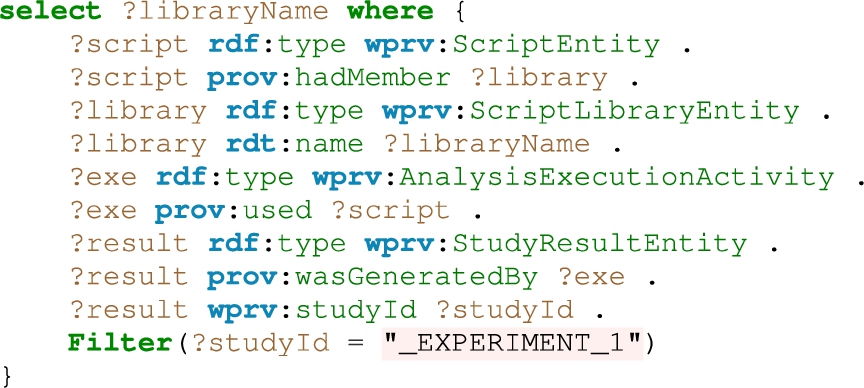
Q2 – Used libraries in a study
Results Q2 – An excerpt of used libraries in a study
In our prototype, the provenance trails of the libraries, environment, and scripts executed on the R-server are collected using the RDT-extension and stored in the Audit Box. Q2 provides an answer to the question of which software libraries are used in a specific study, with example results shown in Table 7. The purpose of retrieving such information is to increase the study reproduceability and also to ensure the legitimate existence of the analysis results.
Before being able to conduct an analysis, an Analyst has to provide details on which data categories of personal data are required for her analysis (e.g. Gender, Age, heart rate etc.; we also called them as search parameters) to check the availability of the data. This parameter, together with rest of the data handling setup, which includes the purpose of the analysis and expiry time, among others, are captured and stored in the Audit Box. Using this provenance information, we can retrieve specific search parameters used for a Query (see Table 8 for answers to Q3). This information can be used by an Auditor to check whether there are any suspicious activities conducted by certain analysts, e.g., if there are too many queries with varying search parameters by one analyst during a short amount of time.
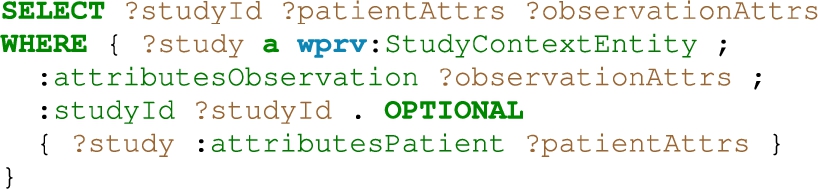
Q3 – Retrieving search parameters used in an Analyst query
Results Q3 – Search parameters Analyst queries

Results Q4 – Retrieving the ratio between data sample and general user population
Ratio of datasets analysed in a study compared to total datasets
In this section we described the behaviour of our platform throughout the concrete scenario that encompasses the dynamic aspects of the data and consent management, and 4 different data analysis use cases. The coherent user story allowed us to explore the application of our platform in a holistic manner, i.e. covering the behaviour of all components of our platform through one process and showing the feasibility of the proposed auditable privacy-preserving data analysis platform.
To summarise the evaluation, we now assess our platform according to the requirements defined in Section 2.2, targeting particular components of the platform. In Table 10, we explicitly list the requirements and indicate to which extent they are satisfied by the described scenario: fully, partially or unsatisfied. The listed requirements follow the structure from Section 2.2, therefore
Evaluation on the requirements
Evaluation on the requirements
Requirements R1.1, R1.2 and R1.5 are fully satisfied in the platform, which is shown by each use case from our evaluation. The data for analysis is stored in the transformed format inside the analysis database only, and the outputs of the analysis are shown to the Analyst and not stored in the platform at all. Both of these intermediate products of data analysis are part of the analysis environment and are deleted together with the environment, which is defined by the data expiry. UC1 and UC3 directly support the requirement R1.2. R1.3, however, faces the limitations regarding user linkage across different platforms that we already discussed in the scope of UC2. Our platform offers the infrastructure to combine data with different schemes of data originating from different sources. However, record linkage methods impose some privacy and accuracy concerns [11], therefore we give the user full control over linking their data. As our solution depends on user engagement, we evaluate it as partially satisfied. Furthermore, requirements R1.6, R1.7 and R1.8 are described via UC4. R1.9 aims to address the potential surface for privacy attacks, when a malicious user has the access to multiple datasets, either similar anonymised or synthesised. We will address this issue as part of the future work by employing a query-auditing method. R1.10 and R1.11 are discussed in Sections 4.1 and 5.2, respectively. The fulfilment of R1.12 was demonstrated in the data selection scenario in Section 6.2, where the number of retrieved dataset for each UC depends on the data handling setup and the dynamics of user consent.
The second part of requirements concerns the auditability and provenance of the system: R2.1, R2.2 and R.2.5 are fully satisfied, shown through the automated capturing of provenance trails and the provenance management and analysis capabilities of the audit box. The Secure Repository and Trusted Analysis Environment both send log files in a predefined format, which is then mapped on our provenance model. R2.3 is currently enabled through RDT-Lite, a library capturing provenance in R-Scripts. R2.4 is also enabled through RDT-Lite, capturing the script as a directed graph. In the future, we are planning to extend its support to enable improved analysis capabilities, especially when heterogeneous data traces from other analysis environments, e.g. python scripts are integrated. Regarding R2.6, the audit box is a separate component of our architecture, where only qualified users have access to. Furthermore, it only captures metadata, hence no personal data can be acquired by auditors through the audit box, which addresses R2.7. R2.8 and R2.9 are concerned with past studies: only data with valid consent is analysed through the platform. However, it may occur that users whose data has been analysed revoke their consent after a study has been conducted. In this case, the applicable data will be removed, and only pointers will remain for past studies.
This section discusses related work from three perspectives: privacy-preserving data analysis (Section 7.1, auditability (Section 7.2), and consent management (Section 7.3).
Privacy-preserving data analysis
For achieving privacy-preserving data analysis, often two complementary approaches are considered – privacy-preserving data publishing (PPDP) [26], and privacy-preserving computation, such as secure-multiparty computation (SMPC) or homomorphic encryption.
Regarding PPDP, early approaches include e.g., k-anonymity [61], where data is transformed so that individual records can not be distinguished from
Differential privacy [17] aims at maximising the accuracy of responses to queries to databases, while minimising the likelihood of being able to identify the records used to answer them – whether a specific instance is included in the dataset should not increase the privacy of the individual represented. Systems implementing differential privacy include e.g., GUPT [48], PINQ [43], Airavat [60].
Recently, synthetisation of data, which creates an artificial dataset that however still preserves global properties of the original data, is emerging as an alternative method [3]. One approach is e.g., the Synthetic Data Vault (SDV) [55]. SDV builds a model of the data based on estimates for the distributions of each column. In order to preserve the correlation between attributes, the synthesizer applies a multivariate version of the Gaussian copula and, subsequently, computes the covariance matrix. This model is then used to generate new, synthetic samples.
While these solutions provide building blocks of privacy-preserving data analysis, they do not provide a complete system comprising data collection, consent management, data transformation and the actual privacy-preserving data analysis. We will review related work that addresses these aspects to some degree. A recent report on Trusted Research Environments [66] elaborates on requirements for such environments in the health domain.
A system utilising block-chain to trace the usage of federated data sources in an analysis process is presented in [37], also providing a mechanism to check for consent.
The DEXHELPP project [58] focuses on safe-haven like settings, e.g., allowing the user a relatively unrestricted access to data inside a specific remote computing environment, but does not address issues of data integration, or consent management.
DataSHIELD [27] is a system allowing analysis of data from federated sources, enabling privacy by restricting the analyst to only executing aggregate queries. It does not address aspects of data and consent management. In our prototypical implementation, we utilise DataSHIELD to provide the functionality of the Trusted Analysis Environment. A similar system is ViPAR [10], a secure analysis platform for federated data. The system offers a central server host where the data is virtually pooled via the Secure Shell protocol from remote research datasets hosted by research institutions. The data can then be used for analysis through a secure analysis portal, and it is deleted once the analysis is done. The central pooling component is the major difference between DataSHIELD and ViPAR. DataSHIELD applies the analysis to each of the remote sources separately and then combine the analysis results, while ViPAR combines the data itself.
BioSHaRE project [15] (Biobank Standardisation and Harmonisation for Research Excellence in the European Union) is a collaborative European project focused on developing tools for data harmonisation, database integration and federated analysis to enable large-scale studies across multiple institutions. BioSHaRE includes DataSHIELD as a privacy-preserving analysis tool. Others systems used in the project are DataHSaPER for database federation and harmonisation and OBiBa as information technology tools.
If data is distributed among multiple sources, computing a common result without having to share the inputs (data) can solve privacy requirements. For example, secure-multiparty computation provides a cryptographic protocol to compute the output without the need of a third party. Other more light-weight approaches such as Federated Learning [41] have been proposed as a potential solution. Federated Learning generally aims to learn a global model by aggregating locally learned models; this way, raw data does not need to leave the device where it is stored.
However, most approaches, such as Federated Learning, are mostly explored when data is horizontally partitioned, i.e. when there are multiple sites that hold data that is described by the same attributes, but contains different individual records. In our scenario, when combining data from multiple origins, we generally have a setting of vertical partitioning, i.e. we have data records describing different aspects of the same individual(s). Such an integration and linkage of multiple data sources, considering also consent checking, still poses challenges, such as keeping membership secret [63]. Further, auditability is more difficult to achieve in the federated setting. Therefore, we focus on the centralised setup proposed in our paper.
Auditability
Traditionally, system logs have been collected and analysed to conduct system audits and hence, making the underlying systems more transparent. However, the analysis of such logs is cumbersome and tedious. Moreover, the right to explain, as postulated by the European Union General Data Protection Regulation (GDPR) [22], demands better suited methods to provide context and reasoning. Therefore, semantic technologies seem to be a promising method to capture and manage data lineage in a structured way and to provide support in addressing auditability questions.
Various frameworks and solutions to capture workflows, such as Taverna [50] or data models to collect provenance data such as PROV-DM [2] enable improved analysis and management. Provenance data can also support the reproduceability of research results by capturing the experiment context, for example by using ontologies [29,40,46].
Language-specific solutions, such as noworkflow [57] for python scripts, or rdt for R scripts among others have been developed and offer richer support such as visualisation [20]. Prov-O serves as a fundamental building block for capturing provenance-related data. Its generic nature however, calls for extension and adaption to specific contexts to be able to benefit from contextual information.
ProvStore, developed to be the first public repository of provenance documents showcases the need for such improved data management [30]. Use cases related to auditing and provenance include the possibility to prove adherence to legislative regulation (e.g. GDPR) as suggested by [65] to visualisation of dependencies or debugging capabilities [56]. However, so far, most tools and approaches are very specific to certain environments or setups without integrating heterogeneous provenance trails, applicable to our use case.
Consent management
The European General Data Protection Regulation (GDPR) [22] defines a set of obligations for controllers of personal data. Among other requirements, GDPR requires data controllers to obtain explicit consent for the processing of personal data from data subjects. Furthermore, organisations must be transparent about their processing of personal data and demonstrate that their systems comply with usage constraints specified by data subjects.
The traditional representation of user consent in the form of human-readable description does not allow for automatic processing. Formal policy languages are designed to unambiguously represent usage policies, which makes it possible to automatically verify whether data processing is covered by consent given by data subjects. Here, we will briefly review the current alternatives for (i) usage policy representation, and (ii) GDPR compliance tools.
Usage Policy Representation. There are several potential candidates for the formal representation of usage policies. KAoS [67] is a general policy language which adopts a pure ontological approach, whereas Rei [34] and Protune [5] use ontologies to represent concepts, the relationships between these concepts and the evidence needed to prove their truth, and rules to represent policies. PrOnto [52] is another ontology developed based on GDPR to represent a legal knowledge modelling of GDPR conceptual cores, i.e., privacy agents, data types, types of processing operations, rights and obligations. SPECIAL,27
GDPR compliance tools. [53] extends Prov-O and P-Plan with GDPR-specific concepts aiming to describing the provenance of data and using SPARQL to formulate compliance related queries over the data lifecycle. The Information Commissioner’s Office (ICO) in the UK [32], Microsoft [45], and TrustArc28
For automatic usage policy compliance checking, other than the SPECIAL compliance check mechanism [6] that we use in our approach, MIREL32
In this paper we discussed the problem of enabling auditable privacy-preserving data analysis systems, inspired by the challenges faced by many small and medium-sized organisations in acquiring, storing and analysing personal data due to data protection regulations. We detailed the problem into a number of research questions that we addressed in this paper. We discuss each of the research questions and our approach to address it in the following.
What are the key characteristics of auditable privacy-preserving data analysis systems? We described a scenario to exemplify the requirements for auditable privacy-preserving data analysis and motivate a number of functional and non-functional requirements for our approach listed in Table 10. These are the results of our iterative process of identification and refining the requirements based on privacy standards as well as use cases and discussions with partners from the WellFort project.
What are the key elements of an architecture for auditable privacy-preserving data analysis systems? We proposed a novel approach called WellFort, a semantic-enabled architecture for auditable privacy-preserving data analysis which provides secure storage for users’ sensitive data with explicit consent as well as a trusted analysis environment for executing data analytics processes in a privacy-preserving manner.
How can semantic web technologies be used to enable auditable privacy-preserving data analysis systems? We detailed how we select and utilise a set of Semantic Web technologies to support our conceptual architecture for auditable privacy-preserving data analysis systems. We found that for some tasks, e.g., the automatic usage policy compliance checking, the technology already has a high-level of maturity. For others, some adaptations are still required. Nevertheless, it is encouraging to see that research results can be adapted for real-world use cases.
In our evaluation, we demonstrated the feasibility of our approach on four real-world use cases in the medical domain. We show that the platform prototype is able to track the entire data lifecyle, starting from the deposit of data, to producing results in a scientific study. Thus, the architecture provides means to inspect which data was used, whether the consent was granted, or which specific libraries and code were used to produce the results. This, in turn, increases reproducibility and trust in the results, and can be used as evidence in litigation cases to discharge claims.
The future work will focus on adoption of the proposed platform to application domains in which auditability and privacy are the key concerns. This will require changes in the data model used in the repository and development of methods to automate knowledge graph generation from new types of data.
Another branch of future work is to investigate the possibility of adopting Semantic Web technologies for the Trusted Analysis Environment. Recent works in this direction have emerged in the Semantic Web community, e.g., on privacy-aware query processing [21,64]. Additionally, we will focus on improving the quality of the Trusted Analysis Environment. This includes embedding privacy-preserving record linkage to improve the analysis of data originating from different companies, and extending the repertoire of DataSHIELD functionalities with new types of analysis a data analyst can perform. Moreover, the privacy-preserving data publishing component will be enhanced by an additional data protection measure that allows identifying the recipient of a leaked data copy, by applying data fingerprinting [70].
Furthermore, we plan to continue our work on the Audit Box to develop a multi-purpose RDF-based audit toolbox to support auditability of data analysis systems. Such toolbox facilitates capturing and auditing provenance trail data from heterogeneous sources, e.g., NoWorkflow [57] for python scripts. To this end, we also consider the possibility of linking the toolbox with our prior work on RDF data generation from security log data [19].
Footnotes
Acknowledgements
This work was sponsored by the Austrian Research Promotion Agency FFG under grant 871267 (WellFort) and 877389 (OBARIS). SBA Research (SBA-K1) is a COMET Centre within the COMET – Competence Centers for Excellent Technologies Programme and funded by BMK, BMDW, and the federal state of Vienna. The COMET Programme is managed by FFG. Furthermore, this work was sponsored by the Austrian Science Fund (FWF) and netidee SCIENCE under grant P30437-N31 and the Vienna Business Agency (VasQua Project). The authors thank the funders for their generous support.