The paper discusses a small ontology to describe the features of the execution techniques of inscriptions, based on a recent contribution discussing the classification methodologies. The modeling is done on the basis of existing recent attempts to model epigraphic documents and not on a general evaluation of existing ontologies. The ontology described is used in parallel to enrich and further structure the EAGLE Vocabularies for Execution Technique, which uses SKOS, with possibly immediate impact on the many projects using the concepts contained there.
An ancient written artefact which may be defined as inscription2
See for a discussion of the many definitions [18].
carries a text which has been produced in a way or another. The execution technique used to produce such artefact has been the object of a recent contribution by Silvia Evangelisti [3], where the author discusses the inadequacy of current classifications in use in epigraphical projects, in respect to the complexity of the information to be described.3
It is not the aim of this paper to recapitulate or translate those considerations in English, only the results which are directly relevant to the presented ontology will be recalled.
In this contribution we start from the existing proposals of models for this type of information related to epigraphy. We then revise the use of the EAGLE Vocabularies in this context [14 ,15],4
to move on and propose a small ontology to model this specific type of information in more detail, following the idea put forward in [17] according to which this is the task of domain specialists, namely, in this case, epigraphists. We discuss both the extension of the model with this ontology and the enrichment of the EAGLE Vocabularies. The need for a general Epigraphic Ontology has been expressed repeatedly and, hopefully, this contribution will help the community to move towards the already existing efforts,5
A dedicated conference was held in Oxford in November 2018, and a further meeting was carried out in the context of the IV Epigraphy.info meeting in Hamburg in February 2020 with a dedicated working group as an outcome https://currentepigraphy.org/2020/04/03/epigraphy-info-iv-short/.
or provide a further trigger for a discussion on how to model information about execution techniques in aggregation projects or for the construction of configurations and mappings.6
For example this could inform mappings in a XTriples configuration file, see [11] and [19]; or help to produce mappings in Ontop.
The paper will start discussing the existing models for the representation of inscriptions,7
See [12] for an overview of the existing attempts in this direction. A limited epigraphic ontology, too scarcely documented to be evaluated, was already proposed in [1]. The little or no success of this proposal, which dismissed both CIDOC-CRM and EpiDoc with little cause, is not relevant for this paper in as far as it appears that the ontology did not even have an interest in this aspect of execution.
There is no attempt in this paper to fully evaluate the many existing models and ontologies which may have dealt with similar issues. We have only taken into consideration those modeling attempts which we know to have dealt directly with concerns of the epigraphic domain.
like the one used by the Economic and Political Network (EPNet) project [2]11
http://www.romanopendata.eu/
and the one used by the Epigraphische Datenbank Heidelberg (EDH) [10],12
execution technique is not yet modeled as such. The paper will then expand on this, to describe how a small ontology and the use of some of its classes in the EAGLE Vocabulary for Execution Techniques,13
https://www.eagle-network.eu/voc/writing.html, which has been concisely and deceivingly named ‘writing’ only in its URL pattern, although it contains information on the execution technique.
and for the description of the written artefacts allow a much more structured classification of information related to the techniques used to produce a written text on a given artefact. Other approaches may result in mixing tools, methods, and aspects of the results obtained with an execution technique, all in one point of the model. In general we think the typology should be assigned to the interaction with the object and not just as a different type of activity.
Existing epigraphic models and execution technique
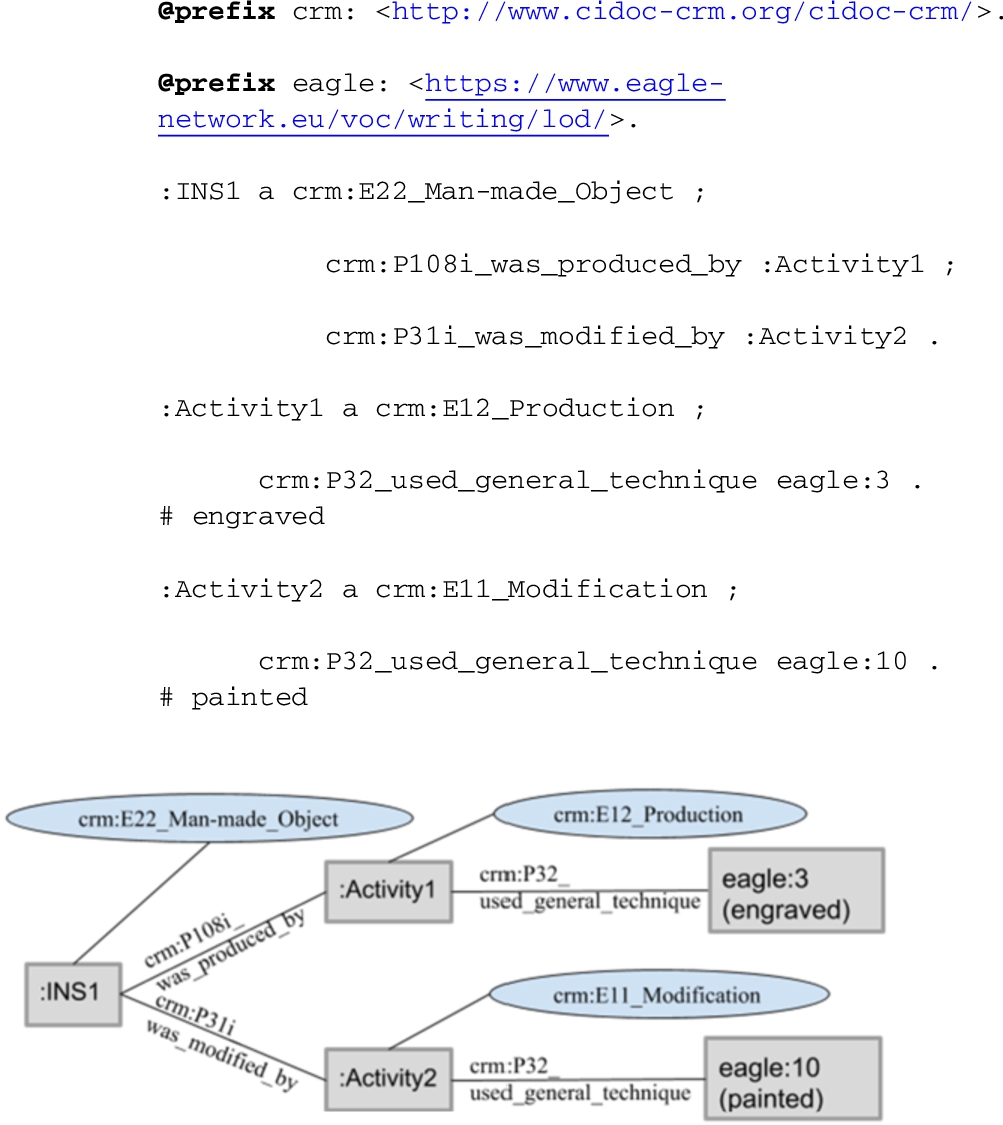
In the EAGLE model [16] for inscriptions, based on CIDOC-CRM, the information related to the execution technique of an inscription would be expressed by relating the object (E22 Man-Made Object) via P31 has modified (was modified by) or the more specific P108 has produced (was produced by) with a E11 Modification entity or one of its subclasses (E12 Production, E79 Part Addition, E80 Part Removal). Because any E11 Modification is a subclass of E7 Activity this can be related via P32 used general technique (was technique of) to a value in the EAGLE Vocabulary for Execution Techniques which is a SKOS Concept and thus a E55 Type class in CIDOC-CRM.14
An implication of this is that also Tools and Colors defined in this vocabulary are SKOS Concepts.
This way of modeling already allows, theoretically, for several modifications which are distinct from the production and might be obtained with different techniques. Using this model, i.e. plain CIDOC-CRM, would already be an improvement in comparison to the current state of most of the digital representations available, where some information in this respect is given once and with a value which may be referring either to a tool or to a result of the process of execution. We will take the following theoretical example and use it in this section to look at the modeling: an inscription, which we will identify as INS1, which was engraved and then painted. In most existing databases, this information would be given omitting one or the other of its parts, depending on many factors, which is not useful to recall here. Using CIDOC-CRM as suggested in the EAGLE modeling effort, we would represent this piece of information as follows.
(Execution technique using CIDOC-CRM as discussed in the EAGLE model).
Because E7 Activity is indirectly a subclass of E4 Period, each of the activities in this representation (a E12 Production and a E11 Modification) can be additionally qualified with a precise time span. Nothing prevents P32 used general technique (was technique of) from being used several times, although, in the current practice, there is usually only one piece of information regarding execution technique. Engraved (Caelo), for example will be used omitting the following painting phase, or deferring this clarification to a note elsewhere or another field of the description. The EAGLE model fits the current practice as required but still presents all the limitations which come with some enrichments in the possibilities offered by the model.
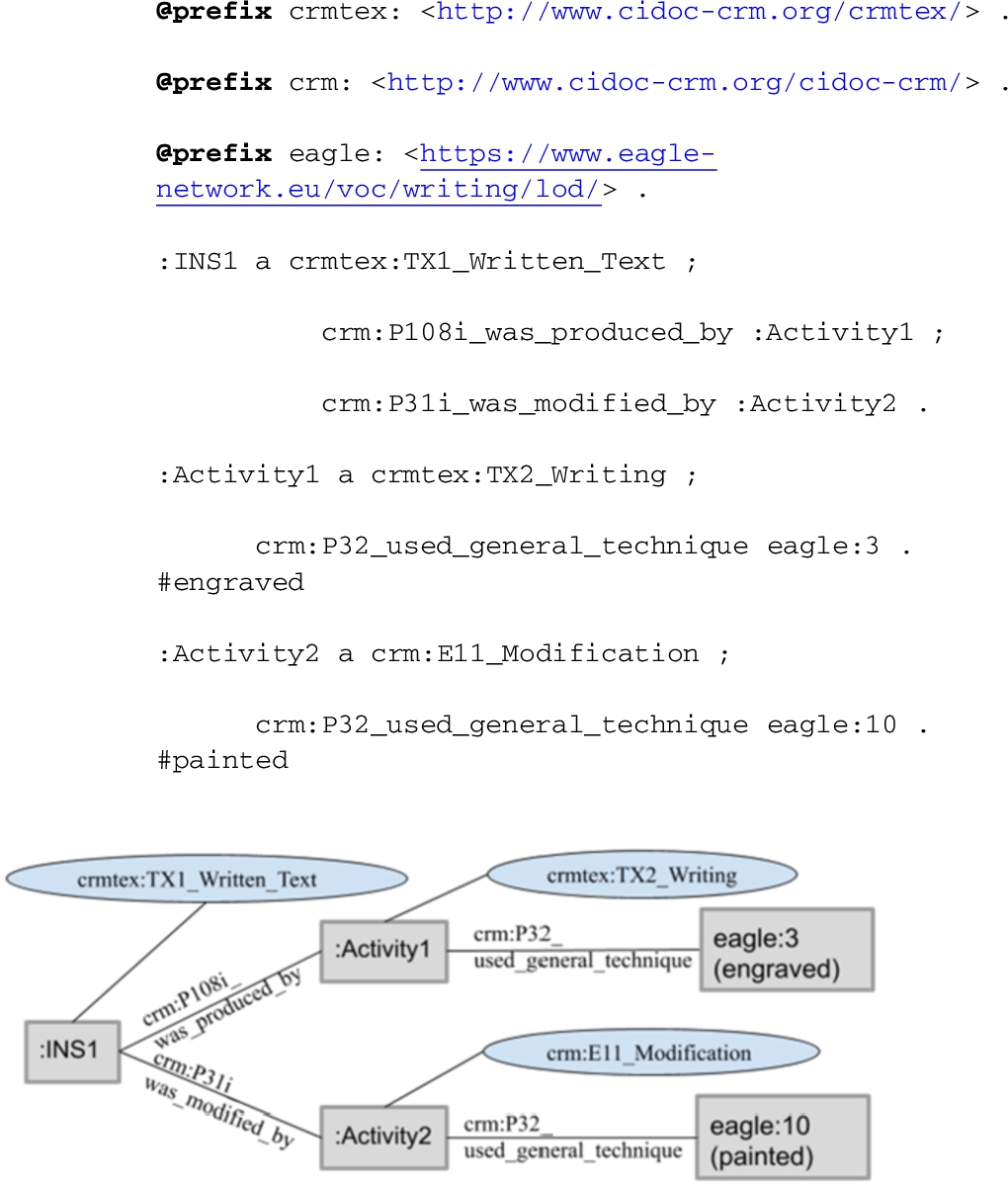
extension of the CIDOC-CRM model uses more specific classes going further in the definition of a representation of inscriptions, which is consistent and connected with the general reference model. The main class TX1 Written Text is a subclass of E25 Man-Made Feature, a subclass of E24 Physical Man-Made Thing, which contains also E22 Man-Made Object, the class preferred by the EAGLE model. The second most important class, TX2 Writing, is a subclass of E12 Production thus leaving out modifications which, in this case, can be qualified as above. By providing dedicated classes, the CRMtex already achieves a more precise definition, although our example would look like the following, and thus would not be significantly different from the previous one, as we would expect, since both refer directly to CIDOC-CRM:
(Execution technique using the CRMtex extension of CIDOC-CRM).
The use of either or a mix of these models would already provide descriptions for the execution technique of inscriptions which are specific to this type of object and offer the possibility to model multiple activities, with a clear improvement with respect to a field where one value out of an arbitrary list is provided, as it now happens in most digital representations of inscriptions.16
In this case also an XML – EpiDoc encoded description of an inscription does not offer a complete solution, although one can describe the execution technique and add links to the EAGLE vocabulary or other authority lists, the relations are not formally defined and it remains possible to mix tools, results and techniques in the encoding. Aligning the authority lists used by a database or an XML-encoded epigraphic project is already a step forward for interoperability and interchange from the use of local lists.
The fact that the EAGLE Vocabulary for Execution Technique has been until now only a flat list of SKOS Concepts, all-inclusive, has encouraged in a way the mixed use of values which are very different from one another. If the description of the inscribed object is usefully modeled, so is also the information in this sector-specific vocabulary of concepts and a single ontology can model both the relations between the object and the execution technique as well as those classes and properties which are specific to the execution technique, even when unrelated to the object.
The ontology presented here is thus used primarily to classify the values in the SKOS vocabulary for Execution Techniques produced during the EAGLE project and currently maintained by IDEA and defines the relations between the various Concepts, the list of which has been expanded accordingly, to achieve this layer of complexity. This EAGLE Vocabulary for Execution Technique is based on the authority lists used by the databases which were part of the EAGLE project. It contains values which refer to several different aspects of execution technique, depending on the use made during the last thirty years and more by the databases: some refer to the tool used, some to the final aspect of the inscription, etc. The proposed ontology defines these different classes and is used in the vocabulary to classify the concepts.
A concept in the EAGLE Vocabulary of execution techniques simply looked like this:
Adding a simple triple (see below for the discussion of the property) we could specify the connection with a specific tool, the brush, also defined in the same Vocabulary.
By adding these statements, based on the execution technique ontology, as default information in the EAGLE Vocabulary for Execution Technique, projects using the vocabulary directly benefit from the classification and its improved precision. However, in cases where the same activity is carried out with a different tool, a statement will be possible which specifies further the one defined in the vocabulary.
The execution technique ontology
In the previous section we have seen what the existing resources for modeling the execution technique of an inscription are, namely two models based on the CIDOC-CRM and a specific vocabulary in SKOS. We will now look at how a small additional modeling effort with an ontology specifically dedicated to execution technique can allow to model complex phenomena related to this specific area of interest.
Following the classification and argument proposed in [3], the execution technique definitely needs to be described in relation to the inscribed object and not to the text of the inscription. The inscribed text, however, is better specified, in the definition of the subclass in CRMtex, as a feature of the object, and this is a further improvement which can be inherited, thus referring the execution technique exactly to that feature of the inscribed object which is its text. We are thus able to give information not about the execution technique of the statue or of the monument on which an inscription may be, but only about the execution technique of the feature of the object (an object as well) which is defined as a written text (TX1 Written Text).
If we look at the activities involved in the production of this written text, we may call them in a more specific way the different “execution phases” of the written text. These need to be further modeled in order to use the three main classifications which are proposed in [3]:
The execution techniques;
The tool used;
The actual characteristics of the letters.
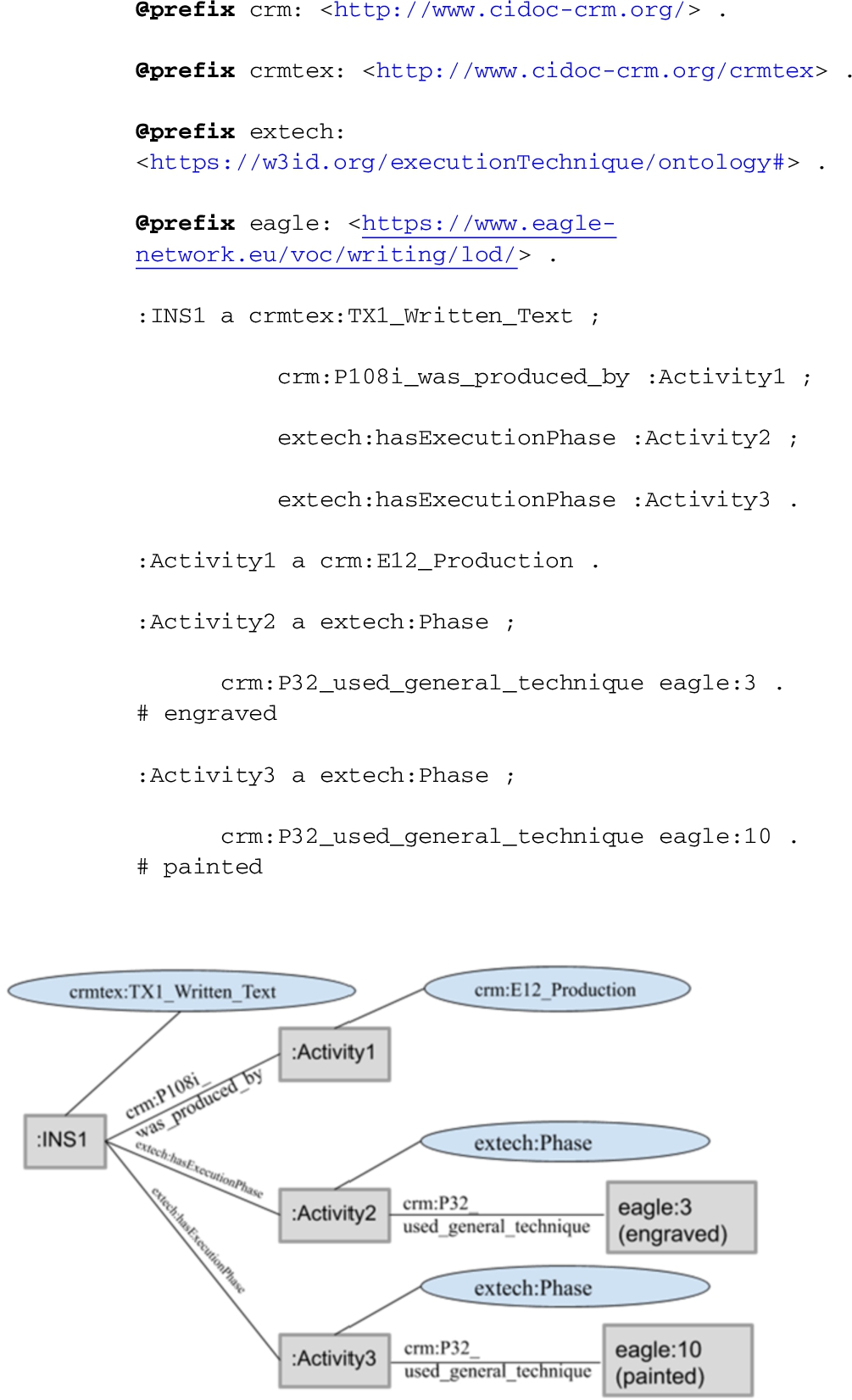
An inscription, among the many possible modifications it may have incurred over time, could have several Phases of execution, which we defined in the execution technique ontology as extech:Phase, a subclass of E11 Modification, linked by a more specific property extech:hasExecutionPhase (subproperty of crm:P31i_was_modified_by) to the concepts in the EAGLE Vocabulary for Execution Technique.17
The definition of the inverse property exec:isExecutionPhaseOf has also been defined in the ontology as a subproperty of crm:P31_has_modified, on the kind suggestion of the reviewer, Andreas Vlachidis and may be useful for exemplifications, for example, or for rare cases where a given single activity affects the execution of more written artefacts.
These more specific classes and properties would only grant the possibility to reach directly the desired type of modification among others which are not related to the execution technique. We have declared the production activity as distinct from the following modifications classified as extech:Phase in order to highlight this, but this distinction could easily be omitted, and a single modification could be a production and an execution phase at the same time. Our example of triples describing our example INS1 to this point, far from being different from the previous two, would look like the following when using these more specific classes and properties:
(Execution techniques modeled with the execution technique ontology).
This imposes a distinction of the execution techniques from the production act of the carrier, unless the production activity is associated to a parallel man-made object.
Also the CRM property P32 used general technique could be further specified with subclasses to extend on the CIDOC-CRM. The specific definition of a property extech:uses_technique would also link to a more specific class for the Execution Technique itself (extech:Technique). The latter is defined, according to the definition given in [3], as
The effect that an instrument has on the support, which reacts to this tool on the basis of its specific nature, quality and morphology.
The new class extech:Technique requires to be then further specified with four subclasses, as defined in [3], for each type of execution techniques distinguished by the type of interaction with the supporting material:
extech:ArsSubtractiva for the techniques which involve the subtraction of material from the support;
extech:ArsAddictiva for the techniques which involve the addition of material to the support;
extech:ArsPlastica for the techniques which involve the alteration of the support without adding or removing;
extech:ArsMixta for the techniques which involve different interactions.
In the EAGLE Vocabulary of Execution Technique each of the listed techniques have been associated to one of these four classes, thus achieving a layer of organization of the concepts in the vocabulary. Additionally, tools have been listed in the EAGLE Vocabulary for Execution Technique (and made part of the class extech:Tool), as well as the colors (extech:Color) and the result types (extech:ResultType), which are detailed below. This resulted in a list of values to be added to the vocabulary to distinguish a tool from a technique using this tool and the assignation in the vocabulary via rdf:type of each concept to one of the execution technique classes or another class of information relative to this, as defined in the ontology.
In our view, this is a very important improvement in the general possibilities for modeling this information, allowing, with a simple classification in the SKOS Vocabulary, for a clear distinction of these values. This will be useful also in context of use of the vocabulary which do not make use of the rest of the model, but simply point to Concepts in the EAGLE Vocabulary for Execution Technique.
The class extech:Tool is defined to describe any tool or instrument used in any activity of modification of the inscription, and is especially defined with reference to the EAGLE Vocabulary. An extech:Tool can be, for example, Scalprum, a chisel.
The class extech:Color is instead used to define the color resulting from a specific modification. If interested, one could definitely get into details of colors if interested, eventually using values from specific vocabularies, however, we have limited the values in the EAGLE Vocabularies which are instances of this Class to the most common (black, white and red) and each can be obtained by virtue of a mixture of modification, or simply in one of the phases.
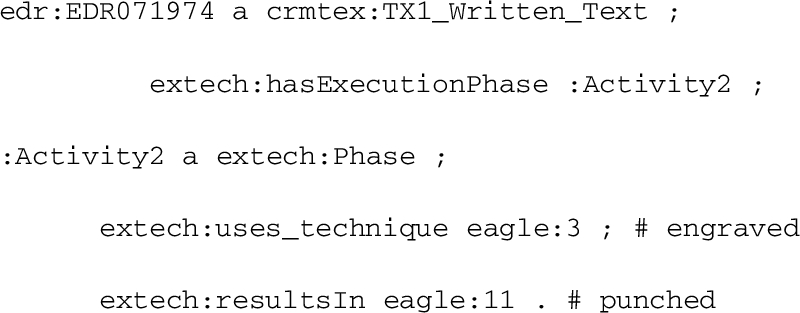
The class extech:ResultType holds concepts which relate to the description of the resulting inscription. The concepts in the EAGLE Vocabulary for Execution Technique, which have been made into instances of this Class are the ones referring to the resulting effect of the activity of writing. For example, punctim refers to an inscription where the letters are made with points, which can be in turn obtained with different tools or can be made on different materials. This effect can be obtained not only by removing material with a tool like a chisel, but sometime with small metal drops welded to a metal support.
To come back to our example INS1, the description of its execution technique could now be expanded to look like the following:
(Enriching with classification from the EAGLE Vocabulary for Execution Technique).
The classes are actually specified in the vocabularies directly, because their classification is defined in [3], thus eventually removing the need to make them explicit in a dataset describing an inscription. The range of extech:uses_technique had to be limited to a superclass of the four defined above, extech:Technique, to prevent the modeling in this position, for example, of concepts which define tools, which will be included in the class extech:Tool. The extech:Technique Class can be consequently linked by a set of properties to other descriptive features, in the same way as for tools, as follows:
extech:usesTool will have as range extech:Tool
extech:hasColor will have as range a extech:Color
These properties relate SKOS Concepts in the vocabulary and are not intended as sub-properties of crm:P2_has_type.
The extech:Phase will instead be characterized by a result using extech:resultsIn having as domain a extech:ResultType, e.g. litteris ageminatis, U cut or V cut, which have been defined in the EAGLE Vocabulary for Execution Technique.
This distinction and classification of values increases the precision of the description of the execution technique, thus opening up to further research questions, and resolving the issue of having to look for different values, guessing more or less what the user may have done, in pursue of a single phenomenon, i.e. looking for engraved inscriptions to sort out the U and V cut.
Because of the definition of extech:Phase as a subclass of E11 Modification, the property P126employed (was employed in) could be used to link to a E57Material, allowing to distinguish, for example, the material added while painting. One would then have the following:
(Additional information about tools, type of result and color).
Instead of the literal value “red”, one could have used the URI of the concept “rubro” (eagle:208).
This Execution Technique ontology would then be simply representable as in Fig. 1.
Classes and properties in the execution technique ontology.
Concrete examples
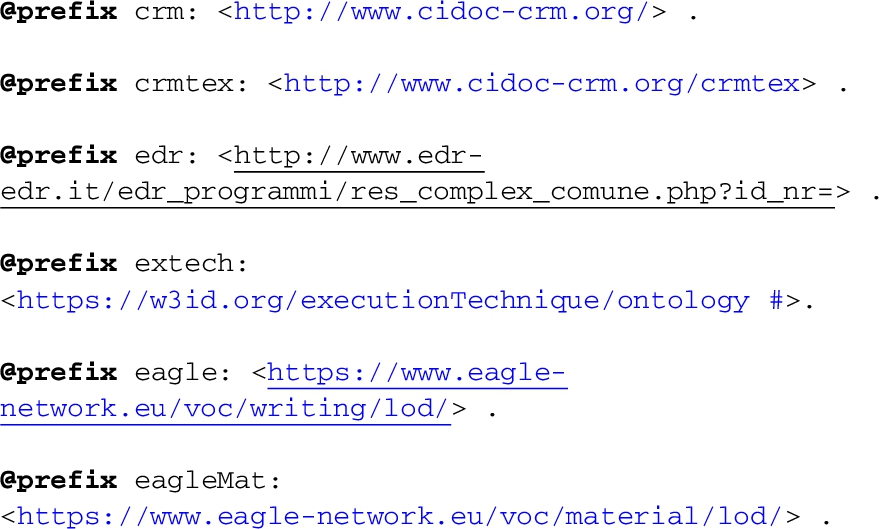
In this section we provide examples of the use of the presented small ontology for execution technique, to show how this could serve the presentation of simple as well as more complex phenomena, which are currently not represented or misrepresented by databases which only assign a single value for execution technique in general. For all the examples, which are the same and in the same sequence as in [3] the following prefixes are always used:
The inscriptions in the examples are all present in the Epigraphic Database Roma (EDR),18
http://www.edr-edr.it/index.php
and can be easily retrieved by their identifier on the EDR website, on the EAGLE website19
C.I.L. IX 1123 pars (EDR132130): ars subractiva, scalpro, litt. sulcis angulatis.
eagle:203 is a skos:Concept for litt. sulcis angulatis, which, in the EAGLE Vocabulary for Execution Technique is assigned to the Ars Subtractiva class (so that this needs not to be added with the edition of the inscription) and the tool used is also given a URI and is linked to this extech:Technique, so that this additional information can be reused also by all those projects which employ this concept in their classifications. In the vocabulary these triples can be found as follows:
C.I.L. I2 359 (EDR071974): ars subractiva, caelo, punctim.
PACI 2007, pp. 220–222 n. 1 (EDR108760): ars addictiva, carbone.
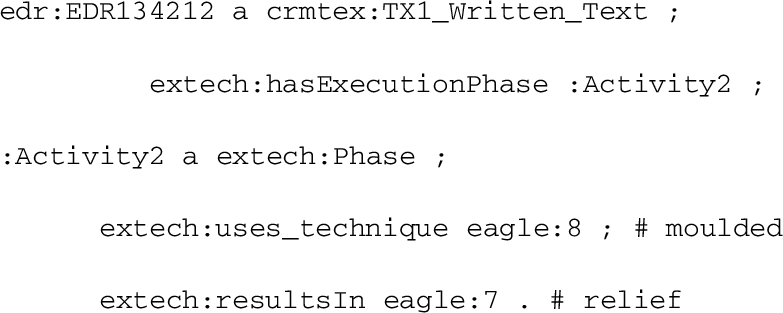
Ann. épigr. 1997, 535 (EDR134212): ars plastica, forma, litt. eminentibus.
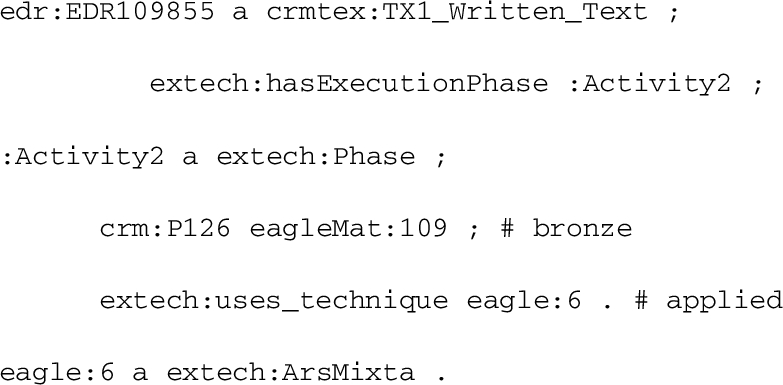
C.I.L. I2 2443 (EDR109855): ars mixta, litt. adplicitis, aere.
In this last example, the material used in the execution phase has been further specified using crm:P126 employed (was employed in) to link to a concept Aes (bronze) in the EAGLE Vocabulary for Materials. The value from the Eagle Vocabulary is also specified locally with a different Ars (technique), from the one registered in the vocabulary.
Furthermore, the model allows for the distinction between inscriptions produced by preparing a slot within which the letters are fitted (litteris applicitis in alveolis insertis) and those where the letters are simply fixed with holes to the support (litteris applicitis ipsae lapidi). In the first case, there would be two extech:Phase, the first describing the production of the alveoli with one or the other of the extech:ResultTypes eagle:201 (in alveolis insertis) and eagle:202 (ipsae lapidi); the second related to eagle:6 (litteris applicitis). In the second case, the latter could be sufficient.
From these triples, stored in a triples store or otherwise aggregated, queries could be made on the various values attached to each extech:Phase, distinguishing, for example, those inscriptions with more than one extech:Phase or fetching all the ones whose extech:Technique is an Ars Subtractiva, opening the way for the study of this neglected area of interest and its complexities, which are, however, vital for the understanding of the epigraphic practice.
Conclusions
There is no prescription effort or rule enforcement in the presented ontology, so that the limitations highlighted for the models on which it is based, the EAGLE and CRMtex ones, are fully inherited. If one has only one piece of information, this is still acceptable according to this ontology as well, and it can be described. However, the use of values in the Eagle Vocabulary for Execution Technique implies an indirect reference to a classification, achieved with classes and properties of this ontology as discussed above, thus having an immediate, although silent, effect of improvement for all users of the EAGLE Vocabulary for Execution Technique.
The use of this ontology allows a user to provide information on execution technique in a precise way which is consistent with the CIDOC-CRM and builds on existing models.
By extending in this way the existing proposed models with this small ontology, one can make use of the description of the execution technique of an inscription by making the separate pieces of information relate to each other, instead of mixing concepts and providing in crm:E55_Type sometimes a concept which refers to the tool used, sometimes a concept which is the description of the visible result of this process. This requires also an effort in improving the EAGLE Vocabulary for Execution Technique, which needs to be able to contain and classify the concepts needed and remains open for further modifications and contributions by any interested party. This is still only a proposal, with no current applications beside its use in the EAGLE Vocabulary for Execution Technique, as indeed are also the models from which it starts. However, looking forward to the resources which will be built around the Epigraphy.info group [7–9], it is hoped that it will be of use. Eventually, nothing prevents this ontology to be used in the future for other written artefacts, like coins, manuscripts, papyri, etc., also in conjunction with other ontologies based on cutting-edge field studies [13].
References
1.
F.-L.Álvarez, E.García-Barriocanal and J.-L.Gómez-Pantoja, Sharing epigraphic information as linked data, in: Metadata and Semantic Research. 4th International Conference, MTSR 2010, Proceedings, Alcalá de Henares, October 20–22, 2010, S.Sánchez-Alonso and I.N.Athanasiadis, eds, Springer Verlag, Berlin–Heidelberg, 2010, pp. 222–234. doi:10.1007/978-3-642-16552-8_21.
2.
D.Calvanese, P.Liuzzo, A.Mosca, J.Remesal, M.Rezk and G.Rull, Ontology-based data integration in EPNet: Production and distribution of food during the Roman Empire, in: Engineering Applications of Artificial Intelligence, Vol. 51, Elsevier Ltd, Amsterdam, 2016, pp. 212–229. doi:10.1016/j.engappai.2016.01.005.
3.
S.Evangelisti, Scrittura epigrafica, alcune riflessioni, in: Colonie e Municipi Nell’era Digitale. Documentazione Epigrafica per la Conoscenza delle Città Antiche. Atti del Convegno di Studi (Macerata 10–12 Dicembre 2015), S.Antolini, S.M.Marengo and G.Paci, eds, Edizioni Tored, Tivoli, 2017, pp. 163–178.
4.
A.Felicetti and F.Murano, CRMepi and CRMtex Updates, 2016. https://www.academia.edu/27889385/CRMepi_and_CRMtex_Updates.
5.
A.Felicetti and F.Murano, Scripta manent: A CIDOC CRM semiotic reading of ancient texts, International Journal on Digital Libraries 18 (2017), pp. 263–270. doi:10.1007/s00799-016-0189-z.
6.
A.Felicetti, F.Murano, P.Ronzino and F.Niccolucci, CIDOC CRM and epigraphy: A hermeneutic challenge, in: Extending, Mapping and Focusing the CRM 2015. Proceedings Workshop EMF-CRM2015, Poznań, September 17, 2015, P.Ronzino, ed., 2016, pp. 55–68. http://ceur-ws.org/Vol-1656/paper5.pdf.
7.
F.Feraudi-Gruénais, J.Cowey, T.Gheldof, F.Grieshaber, A.Kurilić and P.Liuzzo, Report on the second Epigraphy.info workshop held in Zadar, December 14–16, 2018 (Department of History, University of Zadar), Heidelberg Dokumentenserver (heiDOK), 2019, pp. 1–7. doi:10.11588/heidok.00026330.
8.
F.Feraudi-Gruénais and F.Grieshaber, Digital Epigraphy am Scheideweg?/Digital Epigraphy at a crossroads? Heidelberg Dokumentenserver (heiDOK), 2016, pp. 1–8. doi:10.11588/heidok.00022141.
9.
F.Feraudi-Gruénais and F.Grieshaber, Empfehlungen für eine offene kollaborative Plattform für die antike Epigraphik – epigraphy.info/Recommendation for an open collaborative platform for ancient epigraphy – epigraphy.info, Heidelberg Dokumentenserver (heiDOK), 2018, pp. 1–6. doi:10.11588/heidok.00024674.
10.
F.Grieshaber, Epigraphic Database Heidelberg – Data Reuse Options, Heidelberg Dokumentenserver (heiDOK), 2019, pp. 1–16. doi:10.11588/heidok.00026599.
11.
T.Kollatz, EPIDAT – research platform for Jewish epigraphy, in: Crossing Experiences in Digital Epigraphy: From Practice to Discipline, A.De Santis and I.Rossi, eds, De Gruyter Open Access, Warsaw–Berlin, 2018, pp. 231–239. doi:10.1515/9783110607208.
12.
P.M.Liuzzo, Digital Approaches to Ethiopian and Eritrean Studies, Aethiopica. Supplements, Vol. 8, Harrassowitz, Wiesbaden, 2019.
13.
P.M.Liuzzo, Linked Open Data based on La Syntaxe du Codex for Manuscripts in Beta maṣāḥəft, in: Linked Ancient World Data: An Open Access Cookbook, S.Bond, P.Dilley and R.Horne, eds, New York, forthcoming.
P.Manghi, A.Mannocci, M.A.Sicilia, J.Gomez Pantoja, J.Rubiro Fuentes, E.Rivero Ruiz and F.Zoppi, EAGLE metadata model specification – Second Release, 2015. https://www.eagle-network.eu/wp-content/uploads/2013/06/EAGLE_D3.1_EAGLE-metadata-model-specification_v1.1.pdf.
17.
D.Oldman, M.Doerr and S.Gradmann, Zen and the art of linked data: New strategies for a semantic web of humanist knowledge, in: A New Companion to Digital Humanities, S.Schreibman, R.Siemens and J.Unsworth, eds, Wiley-Blackwell, Malden, MA–Oxford–Chichester, 2016, pp. 251–273. doi:10.1002/9781118680605.ch18.
18.
S.Panciera, What is an inscription? Problems of definition and identity of an historical source, in: Zeitschrift für Papyrologie und Epigraphik, Vol. 183, Dr. Rudolf Habelt GmbH, Bonn, 2012, pp. 1–10.