




Abstract
Hybrid annotation techniques have emerged as a promising approach to carry out named entity recognition on noisy microposts. In this paper, we identify a set of content and crowdsourcing-related features (number and type of entities in a post, average length and sentiment of tweets, composition of skipped tweets, average time spent to complete the tasks, and interaction with the user interface) and analyse their impact on correct and incorrect human annotations. We then carried out further studies on the impact of extended annotation instructions and disambiguation guidelines on the factors listed above. This was all done using CrowdFlower and a simple, custom built gamified NER tool on three datasets from related literature and a fourth newly annotated corpus. Our findings show that crowd workers correctly annotate shorter tweets with fewer entities, while they skip (or wrongly annotate) longer tweets with more entities. Workers are also adept at recognising people and locations, while they have difficulties in identifying organisations and miscellaneous entities which they skip (or wrongly annotate). Finally, detailed guidelines do not necessarily lead to improved annotation quality. We expect these findings to lead to the design of more advanced NER pipelines, informing the way in which tweets are chosen to be outsourced to automatic tools, crowdsourced workers and nichesourced experts. Experimental results are published as JSON-LD for further use.
Introduction
Harnessing the rapid increase in the generation of data has led to advances in the Semantic Web and the Web of Data vision [3]. A first step in making sense of the data necessitates information extraction and annotation of datasets. This has led to the availability of training datasets for Natural Language Processing algorithms from research such as ACE [18], MUC [10] and CoNLL [42]. An important task in this context is the identification of named entities – the people, places, organisations, and dates referred to in text documents – and their mapping to Linked Data URIs [47]. State-of-the-art technology in entity recognition achieves near-human performance for many types of unstructured sources; most impressively so for well-formed, closed-domain documents such as news articles or scientific publications written in English [29,33]. It has been less successful so far in processing social media content such as microblogs, known for its compact, idiosyncratic style [16]. Human computation and crowdsourcing offer an effective way to tackle these limitations [45], alongside increasingly sophisticated algorithms capitalising on the availability of huge data samples and open knowledge bases such as DBpedia and Freebase [38].
Advances in natural language processing has led to an understanding of textual structure which can be easily processed by computers (e.g., well formed news-wire articles with sufficient disambiguation context). Essentially, hybrid workflows have therefore led to pipelines which first selects text for machine annotation, passing the residue to the crowd (such as the approach by [14]). These hybrid approaches to NER (named entity recognition) [16] that seamlessly bring together human and computational intelligence are however far from being the norm. While the technology to define and deploy them is on its way – for instance, tools such as GATE already offer built-in human computation capabilities [7,40] and CrowdDB attempts crowd powered query engines [46] – little is known about the overall performance of crowd-machine NER workflows and the factors that affect them. Besides various experiments reporting on task design, spam detection, and quality assurance aspects (e.g., [17,45,53]), at the moment we can only guess what features of a micropost, crowd contributor, or microtask platform will have an impact on the success of crowdsourced NER. The situation is comparable to the early stages of information extraction; once the strengths and weaknesses of particular methods and techniques had been extensively studied and understood, the research could then focus on overcoming real issues, propose principled approaches, and significantly advance the state of the art.
In our work, we posit that just as certain textual features (such as proper syntax and sufficient context) make them amenable to automatic NER, certain features also lead to higher quality named entity annotation by crowd workers. This could lead to the design of more advanced workflows as shown in Fig. 1 where the initial processing divides tweets between automatic tools and the crowd, and subsequently between the crowd and experts. This paper offers an in-depth study of the factors which influence the performance of the crowd in hybrid NER approaches for microposts. We categorise these features in 2 broad classes: 1) content features inherent in the tweets such as – number of entities, types of entities, length of the tweet and the tweet sentiment; and 2) crowdsourcing features and factors observed during annotation such as – skipped true-positive posts, average time spent to complete the tasks, accuracy of the answers and the worker interaction with the user interface. We analyse the impact of these features on the accuracy of the results, the timeliness of their delivery and their distribution in correct and incorrect annotations. In order to fully understand these factors, we also studied the importance of annotation guidelines vis-à-vis the debate on the role of detailed guidelines as a means of improving human annotation [2].

Hybrid workflow.
We run experiments on three datasets from related literature and a fourth newly annotated corpus using CrowdFlower and our own game-with-a-purpose (GWAP) [49] called Wordsmith.1
Structure of the paper In Section 2 we first discuss the related literature in context of the annotation of micropost data, and review existing proposals to add human and crowd computing features to the task. In Section 3 we introduce the research questions and describe the methods, experimental set-up, and data used to address them. We then present our results based on the experiment conducted and summarize the core findings in Section 7. We expect these findings to lead to the design of more advanced NER pipelines, informing the way in which tweets are chosen to be outsourced or processed by automatic tools. We make a first step in this direction by revisiting the most important lessons learnt during the experiments, framing them in the context of related literature, and discussing their implications in Section 8. We conclude with Section 9 with an overview of our contributions and an outline for future work.
Previous publications of this work This is the extended version of an eponymous paper, which was accepted for publication at ESWC2015. Compared to the original conference submission, the current paper covers a much more detailed description of the experiments, reports on additional experiments examining the same research questions as the ESWC2015 version, and expands the first study with new experiments. The new experiments look at the effect of additional detailed annotation guidelines on entity recognition accuracy and the role of sentiment analysis in crowdsourced NER. It also presents a review of a heatmap analysis which seeks to understand crowd workers behaviours in annotating entities.
Research data The results of our experiments are published as JSON-LD for further use by the research community. The download is available at https://webobservatory.soton.ac.uk/wo/dataset/#54bd90e6c3d6d73408eb0b88.
Crowdsourced NER
Several approaches have been applied to build tools for entity extraction, using rules, machine learning, or both [27]. An analysis of the state of the art in named entity recognition and linking on microposts is available in [16]. The authors also discuss a number of factors that affect precision and recall in current technology – current limitations tend to be attributed to the manner of text e.g., vocabulary words, typographic errors, abbreviations and inconsistent capitalisation, see also [19,37].
Crowdsourcing has been previously used to annotate named entities in micropost data [21]. In this study, Finin et al. used CrowdFlower and Amazon’s Mechanical Turk as platforms. Crowd workers were asked to identify person (PER), location (LOC) and organisation (ORG) entities. Each task unit consisted of 5 tweets with one gold standard question, with
A similar approach has been used to carry out NER tasks on other types of data. Lawson et al [26] annotated 20000 emails using Mechanical Turk. Their approach incorporated a bonus system which allowed the payment of a bonus in addition to the base amount contingent on worker performance. The workers were also required to annotate person (PER), location (LOC), and organisation (ORG) entities. By incorporating a bonus system based on entities found and inter-annotator agreement, they were able to improve their result quality considerably. The results were used to build statistical models for automatic NER algorithms. An application in the medical domain is discussed in [52]. The crowd workers were required to identify and annotate medical conditions, medications, and laboratory tests in a corpus of 35385 files. They used a custom interface (just as we do with Wordsmith) and incorporated a bonus system for entities found. [50] presented a hybrid approach where expert annotators identified the presence of entities while crowd workers assigned entity types to the labels. [14] proposed a hybrid crowd-machine workflow to identify entities from text and connect them to the Linked Open Data cloud, including a probabilistic component that decides which text to be sent to the crowd for further examination. Using hybrid systems to offer crowd based query processing has also been studied by [46]. Their work leveraged on the crowd to improve recall scores in open ended questions and how a mixed crowd can help converge on an accurate answer. Other examples of similar systems are [8] and [40]. [40] also discussed some guidelines for crowdsourced corpus annotation (including number of workers per task, reward system, task quality approach, etc.), elicited from a comparative study. A similar set of recommendations based on task character, human participation and motivation, and annotation quality was presented by [51].
Compared to the works cited earlier, we perform a quantitative analysis based on controlled experiments designed specifically for the purpose of exploring performance as a function of content and crowdsourcing features. The primary aim of our research is not to implement a new NER framework, but rather to understand how to design better hybrid data processing workflows, with NER as a prominent scenario in which crowdsourcing and human computation could achieve significant impact. In this context the Wordsmith game is seen as a means to outsource different types of data-centric tasks to a crowd and study their behavior, including purpose-built features for quality assurance, spam detection, and personalized interfaces and incentives.
Crowd worker performance
One of the earlier works focusing on utilising the crowd for annotation tasks was by [45] where they used a pre-computed gold standard to improve annotator quality. Several other approaches has been presented to improve the quality of task output by crowd workers. These include using detailed annotation guidelines; engaging multiple annotators [26] and relying on results with high inter-annotator agreements. A set of guidelines for corpus annotation, distilled from existing literature was presented by [7]. Of note are the sections on in-task quality, contributor evaluation and aggregation where various approaches such as the use of gold standards, majority voting, active learning and average reliability are mapped to their adoption in literature. The role of uncertainty arising from worker annotation was addressed by [35] by looking at inter-annotator agreement loss. Also of importance in crowdsourced annotation is the role of worker diversity [46] which improves recall by unearthing patterns which could not be seen by a homogeneous set of limited experts. Further factors also affect worker quality beyond the presence of a diverse crowd. Some extrinsic factors affecting annotation quality were presented by [12].
Research questions
Our basic assumption was that particular types of microposts will be more amenable to crowdsourcing than others. Based on this premise, we identified two related research hypotheses, for which we investigated two research questions:
How do the following features impact the ability of non-expert crowd contributors to recognize entities in microposts: (a) the number of entities in the micropost; (b) the type of entities in the microposts; (c) the length of micropost text; (d) the micropost sentiment?
Can we evaluate crowd workers preferences for certain types of tasks by observing and measuring (a) the number of skipped tweets (which contained entities that could have been annotated); (b) the precision of answers; (c) the amount of time spent to complete the task; (d) the worker interface interaction (via a heatmap)?
Experiment design
To address these research questions we ran a series of experiments using CrowdFlower and our custom-built Wordsmith platform. We used CrowdFlower to seek help from, select, and remunerate microtask workers; each CrowdFlower job included a link to our GWAP, which is where the NER tasks were carried out. Wordsmith was used to gather insight into the features that affect a worker’s speed and accuracy in annotating microposts with named entities of four types: people, locations, organisations, and miscellaneous. The term GWAP here is used lightly – as we did not design Wordsmith within the context of this study to include features which occur in traditional games (or gamified systems) such as points, badges and leaderboards. Wordsmith however supports more bespoke functions which could not be easily achieved by using CrowdFlower. We describe the platform in more detail in Section 6.
The four datasets used in our experiments
The four datasets used in our experiments
We took three datasets from related literature, which were also reviewed by [16]. They evaluated NER tools on these corpora, while we are evaluating crowd performance. The choice of datasets ensures that our findings apply to hybrid NER workflow, in which human and machine intelligence would be seamlessly integrated and only a subset of microposts would be subject to crowdsourcing. The key challenge in these scenarios is to optimize the overall performance by having an informed way to trade-off costs, delays in delivery, and non-deterministic (read, difficult to predict) human behavior for an increase in accuracy. By using the same evaluation benchmarks we make sure we establish a baseline for comparison that allows us not only to learn more about the factors affecting crowd performance, but also about the best ways to combine human and machine capabilities.The three datasets are:
(1)
(2)
(3)
(4)
The four datasets contain social media content from different time periods (2008, 2010, 2013, 2014) and have been created using varied selection and sampling methods, making the results highly susceptible to entity drift [22]. Furthermore, all four used different entity classification schemes, which we normalized using the mappings from [16]. Table 1 characterizes the data sets along the features we hypothesize might influence crowdsourcing effectivity. We further refer the interested reader to an even more recent dataset – [15] by the authors of [16].
Experimental conditions
We performed two experiments for each dataset; this means we evaluated 7665 tweets.
For each tweet we asked the crowd to identify four types of entities (people, locations, organisations, and miscellaneous). We elicited answers from a total of 767 CrowdFlower workers, with three assignments to each task. Each CrowdFlower job referred the workers to a Wordsmith-based task consisting of multiple tweets to be annotated. Each job was awarded $0.05 to annotate at least 10 tweets with no bonus incentive. We will discuss these choices in Section 6. The workers were provided with annotation instructions detailing the various entity types and how to identify them. More details on the annotation guidelines are discussed in Section 6.2.
The second experiment condition built on the first with the same basic setup. For each tweet we asked the crowd to identify four types of entities (people, locations, organisations, and miscellaneous). Each CrowdFlower job referred the workers to a Wordsmith-based task consisting of multiple tweets to be annotated. Each job was awarded 0.05 USD to annotate at least 10 tweets with no bonus incentive. However, in the second condition, workers were presented with (i) more annotation instruction; (ii) entity type disambiguation instruction and (iii) an updated interface which presented the additional instructions before annotation and inline during annotation. Effectively, we sought to understand the impact more detailed instructions would have on worker accuracy (annotation speed, precision and recall).
We also carried out basic sentiment analysis on the tweet corpora, following in the steps of [23,41]. We hypothesized that particularly polarised tweets might have an effect on the entity annotation [32]. For example, do workers annotate tweets with positive sentiments faster and more accurately compared to tweets about wars, outbreaks and tragedy. We used AlchemyAPI,2
The outcome of the experiments were a set of tweets annotated with entities according to the four categories mentioned earlier. We measured the execution time and compared the accuracy of the crowd inputs against the four benchmarks. By using a number of descriptive statistics to analyse the accuracy of the users performing the task, we were able to compare the precision, recall, F1 scores for entities found within and between the four datasets. We also aggregated the performance of users in order to identify a number of distinguishing behavioural characteristics related to NER tasks. Our outcomes are discussed in light of existing studies in respects to the performance of the crowd and hybrid NER workflows. For each annotation, we measured data points based on mouse movements every 10 microseconds. Each point had an x and y coordinate value which was normalized based on the worker’s screen resolution. These data points were used to generate the heatmaps for our user interface analysis. For each annotation, we also recorded the time between when the worker views the tweet to when the entity details are submitted.
Entity types
We understood that the experiment settings would benefit from an harmonisation in the definitions of the entities. This is necessitated by the disparate nature of the entity type schemes used in the annotations of the different corpora.
Definitions and mappings
We used the NERD ontology [38] to normalise these definitions even though the results were slightly different from the entity mappings adopted by [16]. Our mappings (see Table 2) assigned musicartist as person (PER), distinguishing it from musicband which we assigned as organisation (ORG). The gains in using the NERD ontology in spite of this slight mismatch meant we could have a reference baseline when dealing with more ambiguous cases e.g., organisation-location mismatches.
Entity mappings across the datasets
Entity mappings across the datasets
Organisation vs. location In our preliminary experiments and gold standard creation, we noticed a number of cases that caused inter-annotator debate and disagreement. For example, given the tweets, I am on my way to walmart and My local walmart made a lot of money last thanksgiving, deciding the entity type of Walmart in context becomes difficult, even for expert annotators. This extends to other classes such as museums, restaurants, universities and shopping malls. Our disambiguation approach is presented in Table 3.
Adopted organisation-location disambiguation
Adopted organisation-location disambiguation
Software vs organisation We also noticed a number of tweets which mentioned software which were eponymous with their parent company. For example, ‘Facebook bought the photo-sharing app, Instagram’ and ‘I just posted a photo on facebook :)’. The NERD ontology assigns pieces of software as a sub-class-of
Typos, abbreviations and colloquialisms Consider the tweet ‘Road trip to see one of the JoBros’ house w/ friends WHAT! WHAT!’. The musical band Jonas Brothers has been replaced with a collapsed urban form. Other examples which underscore the difficulty of the task are tweets such as ‘Marry jane is the baby tho’ where ‘Mary’ was misspelled as ‘Marry’ (which is another name for the psychoactive drug, marijuana). Similarly, ‘Jack for Wednesday’, considering the capitalisation might refer to a footballer named Jack for the football club Sheffield Wednesday, or having Jack Daniel’s whiskey for Wednesday night drinks.
Nested entities Consists of entities which which overlap and could potentially be annotated in multiple ways. For example, consider the following tweet from the Ritter corpus: ‘Gotta dress up for london fashion week and party in style !’. The correct entity in this case would be the event london fashion week, whereas, the workers might just annotate London as a location. This is also similar to identifying partial entity matches. For example, consider this tweet from the Wordsmith dataset ‘Nice pass over New York City’. The correct entity identifies New York City as opposed to a partial entity match targetting just New York.
In this section, we would present an overview on our crowdsourcing approach. This includes details on our bespoke platform, our recruitment methodology using CrowdFlower, our reasons for not adopting a bonus system, our data and task model as well as our quality assurance strategy. We also elaborate on the annotation guidelines as it relates to the 2 experiment conditions, how we created our gold standard, and our approach to computing inter-annotator agreement scores.
Overview
Crowdsourcing platform: Wordsmith As noted earlier, we developed a bespoke human computation platform called Wordsmith to crowdsource NER tasks. The platform is designed as a GWAP and sources workers from CrowdFlower. A custom design approach was chosen in order to cater for an advanced entity recognition experience, which could not be obtained using CrowdFlower’s default templates and markup language (CML). In addition, Wordsmith allowed us to set up and carry out the different experiments introduced in Section 3.

Wordsmith interface.
The main interface of Wordsmith is shown in Fig. 2. It consists of three sections. The annotation area is at the center of the screen with sidebars for additional information. The tweet under consideration is presented at the top of the screen with each text token presented as a highlight-able span. The instruction to ‘click on a word or phrase’ is positioned above the tweet, with the option to skip the current tweet below it. Custom interfaces in literature included radio buttons by [21] and span selections by [8,26,50]. We opted for a click-and-drag approach in order to fit all the annotation components on the screen (as opposed to [21]) and to cut down the extra type verification step by [8]. By clicking on a tweet token(s) the user is presented with a list of connector elements representing the entity text and the entity types. Contextual information is provided in line to guide the user in making the connection to the appropriate entity type. When the type is selected, the type definition is displayed on the right hand side. The left sidebar gives an overview of the number of tweets the user has processed, and the total number of entities found. Once the worker has annotated 10 tweets, an exit code appears within the left side bar. This is a mechanism used to signal task completion in CrowdFlower, as we will explain in more detail later.
Recruitment We sourced the workers for our bespoke system from CrowdFlower. Each worker was invited to engage with a task as shown in Fig. 3, which redirected him/her to Wordsmith. After annotating 10 tweets via the game, the worker was presented with an exit code, which was used to complete the CrowdFlower job. We recruited Level 2 contributors, which are top contributors who account for

CrowdFlower interface.
Bonus system Unlike [26,52], we did not use any bonuses. The annotations carried out in [26] were on emails with an average length of 405.39 characters while the tweets across all our datasets had an average length of 98.24 characters. Workers in their case had the tendency to under-tag entities, a behavior which necessitated the introduction of bonus compensations which were limited and based on a worker-agreed threshold. The tasks in [52] use biomedical text, which according to them, ‘[is] full of jargon, and finding the three entity types in such text can be difficult for non-expert annotators’. Thus, improving recall in these annotation tasks, as opposed to shortened and more familiar text, would warrant a bonus system.
Input data and task model Each task unit refers to N tweets. Each tweet contains
Output data and quality assurance Workers were allowed to skip tweets and each tweet was covered by one CrowdFlower job viewed by three workers. Hence, the resulting entity-annotated micropost corpus consisted of all 7665 tweets, each with at most three annotations referring to people, places, organisations, and miscellaneous. Each worker had two gold questions presented to them to assess their understanding of the task and their proficiency with the annotation interface. Each gold question tweet consisted of two of the entity types that were to be annotated. The first tweet was presented at the beginning, e.g., ‘do you know that Barack Obama is the president of USA’ while the second tweet was presented after the worker had annotated five tweets, e.g., ‘my iPhone was made by Apple’. The workers are allowed to proceed only if they correctly annotate these two tweets. We display the second tweet at a fixed point in order to simplify our analysis and remove bias arising from workers viewing the tweet at random intervals.
In each task unit, workers were required to decide whether a tweet contained entities and annotate them accordingly. As a baseline for both experiment conditions, we adopted the annotation guidelines from [21] for person (PER), organisation (ORG) and location (LOC) entity types. We also included a fourth miscellaneous (MISC) type, based on the guidelines from [37].
In computational linguistics, annotation guidelines present arbitrary and often debatable decisions [35] as seen from the varying choices in our experiment datasets. The decision to annotate (or not to) #hashtags, @mentions and MISC types represent the beginning of choices which extends to guidelines on specific entity types. Some authors have argued that more detailed guidelines do not improve annotation quality [2]; while some others skip the guidelines altogether when dealing with experts [35]. The latter category rely on the experts to make adhoc consensual judgements amongst themselves to address hard cases.
In our study, we experimented with 2 guideline conditions to observe the results of varying the amount of annotation guidelines. Instructions were presented at the start of the CrowdFlower job via the Wordsmith interface and inline during annotation. Whenever a worker is annotating a word (or phrase), the definition of the currently selected entity type is displayed in a side bar. These instructions included the following: the task title, stated as Identifying Things in Tweets; an overview on the definition of entities (with a few examples); a definition of the various entity types (PER, ORG, LOC, MISC), including examples of what constitutes and does not constitute inclusion into the type categories. In condition 2, we provided more instructions. This included the title, stated as Identifying Named Things in Tweets and details on ways to handle 7 special cases. The special cases were (i) disambiguating locations such as restaurants and museums; (ii) disambiguating organisations such as universities and sport teams; (iii) disambiguating musical bands; (iv) identifying eponymous software companies; (v) dealing with nested entities by identifying the longest entities; (vi) discarding implicit unnamed entities such as hair salon, the house, bus stop; (vii) identifying and annotating # hashtags and @mentions. These instructions were placed as in Condition 1, with the addition of an interface update, which allowed the workers to review the additional instructions during annotation.
The gold standard used for our Wordsmith dataset was curated by 3 expert annotators among the paper authors. We manually tagged the tweet entity types using the Wordsmith platform. The Wordsmith corpus consisted of 3380 tweets, sampled between January 2014 to June 2014. Each tweet was annotated with the 4 designated entity types (PER, ORG, LOC, MISC). Unlike the other 3 datasets, we chose to annotate #hashtags. This decision was partially motivated by the nature of the dataset which had a significant number of event based #hashtags corresponding to the FIFA World Cup. Similarly, unlike the Ritter and MSM2013 datasets, we also annotated the @usernames. Our choices comprised of a separation of entity types such as musical artists and musical bands as person (PER) and organisations (ORG) respectively.
Inter-annotator agreement
The inter-annotator agreement describes the degree of consensus and homogeneity in judgments among annotators [34] and is seen as a way to judge the reliability of annotated data [36]. Setting an inter-annotator threshold can enhance the precision of results from the crowd. It can be further used to shed light on our research question about crowd worker preferences for NER tasks (H2 RQ2.1). Various scores such as the Kappa introduced by Cohen [11] have been used to calculate inter-rater agreement.
The inter-annotator agreement (or degree of disagreement) can also serve as a measure of the difficulty of the task – and can draw light unto ‘hard cases’ which might require further attention [1,35]. Annotator disagreement is not limited to crowd workers only but extends to experts also. The authors of [1] argue that inter-annotator disagreement is not noise, but signal; and, [35] incorporates it in the loss function of a structured learned for POS tagging and NER.
We use the approach by [5] to determine the pair-wise agreement on an annotated entity text and types. Given I as the number of tweets in a corpus, K is the total number of annotations for a tweet, H is the number of crowd workers that annotated the tweet and S is the set of all entity pairs with cardinality
Given a tweet i and an annotated entity k where
Therefore, for a given tweet i the average agreement over all assigned annotations is
Results
Overview
Overview of annotations Table 4 gives an overview into how workers performed at the tweet level across the various datasets. The results suggests consistently that workers correctly annotate tweets with fewer entities. This result was consistent across the four datasets. We did not see any strong connection between the length of the tweet and the likelihood of it being annotated correctly or incorrectly as the differences were not significant. The length of the tweet however determines the whether the tweet would be selected for annotation or not – and we discuss this in detail in a later section.
Experiment results – correct and incorrect annotations
Experiment results – correct and incorrect annotations
Experiment results – Precision and Recall on the four datasets
Correct annotations The results of our experiment with condition 1 and 2 are summarised in Table 5. The first set of results in Table 5 contains precision, recall and F1 values for the four entity types for all four datasets. The results in the 2 experiment conditions (C1 and C2) show the same result patterns with matching entity types yielding the top precision and recall values. The results also show an average decrease in precision, recall and F1 scores from C1 to C2. This is in spite of the additional annotation guidelines presented in C2. This result is in line with Myth 3 presented by [2] which states that detailed guidelines do not always yield better annotation quality. The results show highest precision scores in identifying PER entities. The only exception to this was in the Ritter dataset where the highest precision scores were in identifying LOC entities. The highest recall scores were split in between PER entities in the Ritter and MSM2013 datasets and LOC entities in the Finin and Wordsmith datasets. However, the margins were less than 2% with a higher score recorded for PER entities in the C2 for the Finin dataset.
We further observe from Table 5 that the precision and recall scores vary quite markedly across the different datasets. There are a number of factors that contribute to this, most of which would be discussed in the ensuing sections and summarised in Section 7.2.1. Particularly, we point out the low scores for the Ritter dataset. It is important to note that the dataset does not annotate Twitter @usernames and #hashtags (given that many @usernames are labelled as people and organisations). It can also be attributed to the annotation schema as noted by [16] – for example, Ritter assigns the same entity type musicartist to single musicians and group bands.

Incorrect annotations.
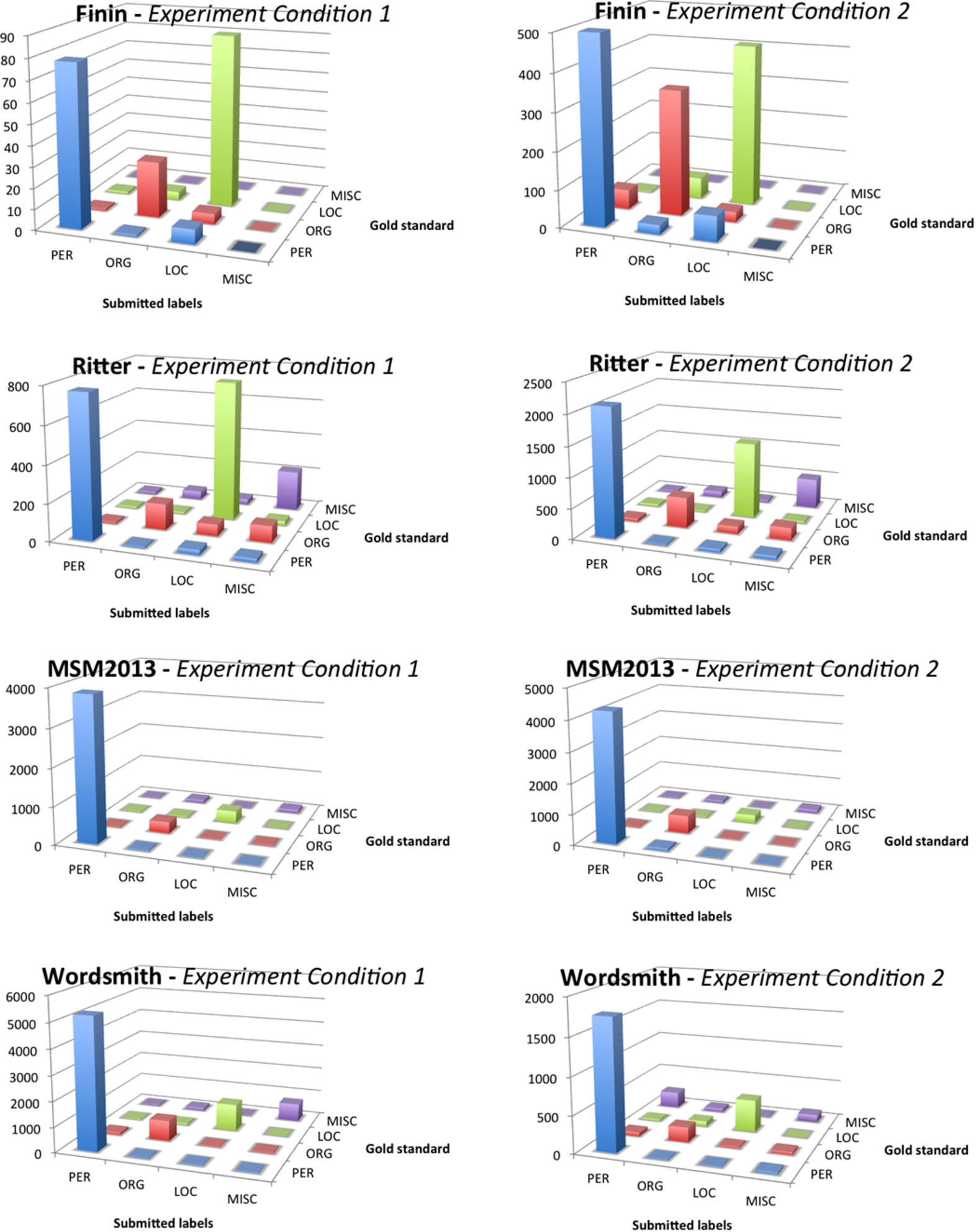
Experiment results – Confusion Matrix on the four datasets.
Incorrect annotations Figure 4 illustrates the entity types which were wrongly annotated by workers. Across all the datasets, we observe that the ORG and MISC entity types were consistently wrongly annotated. This was the case across the four datasets. This suggests that workers had the greatest difficulties in either identifying these entity types, or were mis-assigning them to other entity types. We computed a confusion matrix (presented in Fig. 5, and discussed hereafter) to have a clearer insight into what entity types were wrongly annotated, and how they were wrongly annotated.
Mismatched annotations We included a confusion matrix in Fig. 5, highlighting the entity mismatching types e.g., assigning Cleveland as location when it refers to the basketball team. The matrix layout is inspired by the confusion matrix diagrams illustrated in [48] which utilises a 3 dimensional columnar graph to draw attention to the relationship between the worker submitted labels and the gold standards. The height of each bar corresponds to the number of submissions for that entity type. The x-axis represents the worker submissions, the z-axis identifies the gold standard while the diagonals indicate the intersection of the worker annotations and the gold labels.
The results suggest that the entity type ORG was mostly wrongly annotated as PER (in the Wordsmith dataset) and as MISC (in the Ritter dataset). The entity type LOC was most confused as the entity type ORG across all datasets (with the exception of the Ritter corpus). The typical confusion of the ORG and LOC types is a case of metonymy where these entities have to be especially handled in context [30]. This is seen where an organisation is associated with its location e.g., Wall Street and Hollywood. This phenomenon occurred in both experiment conditions even when more detailed instructions were given. In all dataset results, the MISC type was wrongly assigned the ORG entity type. The confusion matrix on the PER entity type was spread across all the other entity types. The Finin and Ritter showed the least confusion variance on the entity types across the two experiment conditions.
In comparison with the precision and recall scores earlier presented in Table 5, the numbers presented in the confusion matrix of Fig. 5 represent the total annotation count by the participating workers as opposed to an aggregate. This excludes malicious workers, spammers and other outliers that might distort the overall results.
Experiment results – Skipped true-positive tweets
Skipped tweets: Tweet overview Our guidelines encouraged workers to skip tweets for which they could not give confident annotations. Table 6 gives further insight into the dynamics of skipped tweets. The table presents, for C1 and C2, and across all datasets, the average number of entities present in a skipped tweet, as well as in an unskipped annotated tweet. The table also summarises, for both experiment conditions, and all datasets, the average number of characters in a skipped tweet and unskipped tweet. The tweets under consideration in the table are skipped true positive tweets i.e., tweets that were not annotated despite the presence of at least one entity.
The results highlight across all datasets, that workers skipped tweets that contained more entities than the ones they annotated on average. The results present evidence that workers on average skipped longer tweets. The results were consistent across the four datasets and between the two experiment conditions. The tweet length was least significant in the MSM2013 experiment (with the number of characters between the skipped and unskipped tweet differing by less than 1 character), once again due to the comparatively well-formed nature of the dataset and the least standard deviation in the tweet lengths. The tweet length feature feature was most significant in the Ritter dataset, with workers systematically skipping tweets that were significantly longer than the average tweet length; it is worth mentioning that this corpus comprised the highest average number of characters per micropost.
We do not report a high level metric on the number of tweets skipped as this might have been misleading. For example, given 10 tweets annotated by 3 workers, the tweets skipped by each worker might have been annotated by another. We therefore present fine grained results on the distribution of entity types present in tweets skipped by individual workers and the tweet sentiment. We also report aggregate findings on the average number of entities present in, and the average length of skipped tweets.
Skipped tweets: Entity types More results on the skipped true-positive tweets are presented in Fig. 6 and Table 7. It contains the distribution of the entities present in the posts that were left unannotated in each dataset according to the gold standard. On average across all four datasets, people tend to avoid recognizing organisations, but were more keen in identifying locations. In the MSM2013 dataset, person entities were least skipped due to the features of the dataset discussed earlier (e.g., clear text definition, consistent capitalisation etc.). The entity types in the Wordsmith dataset (apart from the LOC type) were all skipped with equal likelihoods.
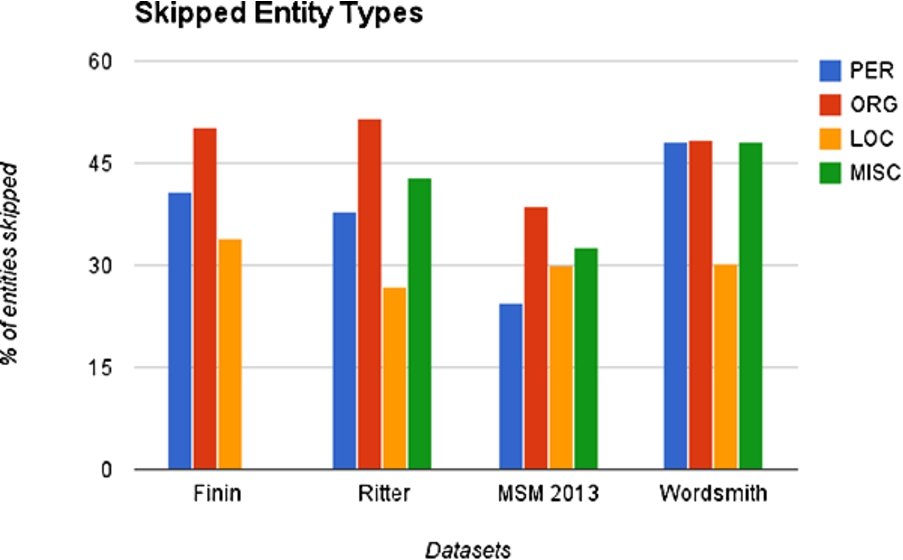
Skipped tweets: entity types in skipped tweets.
Skipped Tweets – Skipped tweets containing entities
Sentiment Analysis – General distribution
We posit this to be as a result of two factors: our uniform sampling method which did not bias the presence of a single entity type (e.g., as in the MSM2013 dataset) and increased use of @mentions and #hashtags in the dataset. This result is also in line with those presented in Fig. 5 that ORG was the most misidentified entity type. This result was consistent across both experiment conditions with crowd workers still skipping tweets with organisation entities when more instructions were given on how to disambiguate them.
Skipped tweets: Sentiment analysis Table 8 summarises the sentiment distribution of positive, negative and neutral tweets in the different datasets. The results present the Finin, Ritter and MSM2013 corpora as having slightly more positive than negative tweets. The Wordsmith corpus had more tweets with negative sentiments than positive. It is worth noting here that the tweets marked negative did not necessarily have to be an aggressive or abusive tweet. An example of a tweet with a negative sentiment from the Ritter dataset is ‘It’s the view from where I’m living for two weeks.
Skipped Tweets – Sentiment analysis distribution of skipped tweets
Experiment results – Average accurate annotation time
Annotation time: On correct annotations Table 10 contains the average time taken for a worker to correctly identify a single occurrence of the different entity types. The results for the Finin, Ritter and MSM2013 datasets consistently present the shortest time needed corresponds to annotating locations, followed by person entities. In the Wordsmith dataset, workers correctly identified people instances in the shortest time overall, however, much longer times were taken to identify places. This result was consistent across the 2 experiment conditions with workers consistently taking shorter times to identify location and person entities. The results however note that workers took shorter time in identifying all entity types in C2 as compared to C1. Workers took on average 1 second less to identify entities in C2. In both experiment conditions, the miscellaneous entity type took the longest time to be identified taking almost 2 seconds longer on the average as compared to location entities. We posit that the extended annotator guidelines contributed to the decrease in annotation time. As this was the variable in this condition, our hypothesis is that a more detailed level of annotation guidelines leads to an anchored and increased confidence amongst the annotators. This in turn leads to mechanistic annotations – i.e. spotting a text and annotating it according to the guideline without discerning the relevant context. This can explain for the increase in speed which did not necessarily result in an increase in annotation quality.

Wordsmith Heatmaps across the 4 datasets.
Interface and heatmaps Figure 7 visualises the result of our datapoint captures via heatmaps. The results presents mouse movements concentrated horizontally along the length of the tweet text area. Much activity is also around the screen center where the entity text appears after it is clicked. The heatmaps then diverge in the lower parts of the screen which indicate which entity types were tagged. From a larger image of the interface in Fig. 2, we can reconcile the mouse movements to point predominantly to PER and LOC entities in proportions which are consistent with the individual numbers presented in Table 5.
A corollary to the visualisation presented in the heatmaps is the result outlined in Table 11. The results contain the average position of the first entity in the dataset gold standard and the average position of the first entity annotated by the workers. From the results we note that although the average positions in the gold standards vary from the 14th character in the Wordsmith dataset to the 35th character in the MSM2013 dataset, the average worker consistently tagged the first entity around the 21st to 24th character mark. This result was consistent across all the four dataset and in variance with the results from the gold standards. We would shed more light into this in the discussion section.
Inter-annotator agreement Table 12 summarises the average inter-annotator agreement scores across the four datasets. Based on our design choices, workers were allowed to skip tweets which they could not confidently annotate. Workers were required to annotate at least 10 tweets and each tweet was annotated by at least 3 annotators. The results presented here represents the inter-annotator agreement on tweets which were annotated by 3, 4, 5 and 6 workers each. At a high level, the results show that agreement begins to break down as consensus is required amongst more workers. This is not surprising as a base agreement between 2 out of 3 workers is equivalent to
Experiment results – Average position of first entity
Experiment results – Average Inter-Annotator Agreement
The inter-annotator agreement scores were clearly highest in the MSM 2013 dataset (
Experiment results – Entity level inter-annotator agreement
In Table 13, we drill further into the inter-annotator agreement on the entity level. The results presented in this table were based on the results of 3 annotators per tweet (extrapolated from the first column in the results within Table 12). The results are in line with earlier results presented i.e. workers are better at identifying PER and LOC entities (as these entity types receive the highest scores), and have greater difficulties with ORG and MISC entities.
An agreement threshold of 2 workers was beneficial for the precision of identifying all the entity types across all datasets. This effect was strongest in the Wordsmith dataset where a minimum threshold of 2 raised the precision scores of identifying organisations by
Increasing the agreement threshold to at least 3 workers showed a further surge consistent with the results from setting a threshold of 2. The highest precision scores are also from the Wordsmith dataset in identifying organisations which had a boost of about
Overview
The low performance values for the Ritter dataset can be attributed in part to the annotation schema (just as in [16]). For example, the Ritter gold corpus assigns the same entity type musicartist to single musicians and group bands. More significantly, the dataset does not annotate Twitter @usernames and #hashtags. Considering that most @usernames identify people and organisations, and the corpus contained 0.55 @usernames per tweet (as listed in Table 1), it is not surprising that scores are rather low. The result also reveals high precision and low confusion in annotating locations, while the greatest ambiguities come from annotating miscellaneous entities.
The Finin dataset has higher F1 scores across the board when compared to the Ritter experiments. The dataset did not consider any MISC annotations and although it includes @usernames and @hashtags, only the @usernames are annotated. Here again, the best scores were in the identification of people and places.
For the MSM2013 dataset highest precision and recall scores were achieved in identifying PER entities. However, it is important to note that this dataset (as highlighted in Table 1) contained, on average, the shortest tweets (88 characters). In addition, the URLs, @usernames and #hastags were anonymized as _URL_, _MENTION_ and _HASHTAG_, hence the ambiguity arising from manually annotating those types was removed. Furthermore, the corpus had a disproportionately high number of PER entities (1126 vs. just 100 locations). It also consisted largely of clean, clearly described, properly capitalised tweets, which could have contributed to the precision. Consistent with the results above, the highest scores were in identifying PER and LOC entities, while the lowest one was for those entities classified as miscellaneous.
Our own Wordsmith dataset achieved the highest precision and recall values in identifying people and places. Again, crowd workers had trouble classifying entities as MISC and significant noise hindered the annotation of ORG instances. A number of ORG entities were misidentified as PER and an equally high number of MISC examples were wrongly identified as ORG. The Wordsmith dataset consisted of a high number of @usernames (0.55 per tweet) and the highest concentration of #hashtags (0.28 per tweet).
Disambiguating between ORG and LOC types remained challenging across all datasets as evidenced in the confusion matrices in Fig. 5. Identifying locations such as London was a trivial task for contributors, however, entities such as museums, shopping malls, and restaurants were alternately annotated as either LOC or ORG. Disambiguating tech organisations was not trivial either – that is, distinguishing entities such as Facebook, Instagram, or YouTube as Web applications or independent companies without much context. In the Wordsmith dataset, however, PER, ORG, and MISC entity tweets were skipped with equal likelihood. This is likely due to a high number of these entities arising from @usernames and # hashtags, as opposed to well-formed names. As noted earlier, this was a characteristic of this dataset, which was not present in the other three.
Analysis of tweet features
We now discuss our results in light of H1 RQ1.1 which states that specific features of microposts affect the accuracy and speed of crowdsourced entity annotation. We present these results in light of tweets which were annotated correctly, incorrectly and skipped tweets. We focus on four main features (a) the number of entities in the micropost; (b) the type of entities in the microposts; (c) the length of micropost text; (d) the micropost sentiment.
Number of entities From the results in Table 6 we see that the number of entities in a tweet affect the likelihood of annotation by a worker i.e., regardless of whether the annotations are accurate or not, a tweet with fewer entities was more likely to be selected. We note that workers were more likely to annotate tweets which had fewer entities than the dataset average as contained in Table 1. This is further seen in the lower recall scores (as compared to precision) in Table 5; workers are more likely to annotate one entity in a tweet, or completely ignore tweets which have more entities than the dataset average. Longer tweets were therefore more frequently skipped by workers.
The results in Table 4 give further insight into the role of the number of entities in correctly and incorrectly annotated tweets. The results show consistently across the 4 datasets that once a tweet has been selected for annotation, it is more likely to be annotated correctly and completely if it has fewer entities, while tweets with more entities were wrongly annotated. In summary, skipped tweets (more entities), incorrect tweets (less than skipped tweets), correct tweets (even less than both).
Entities types Figure 6 and Table 7 give details on skipped true positive tweets and the corresponding entity distributions. The table indicates for each dataset the total entity type encounters by the crowd workers and how many were skipped. For the first experiment condition C1 with the baseline annotation guidelines, workers skipped tweets that contained ORG entities with the highest frequency. Comparing this with our dataset overview in Table 1, we observe that even though the ORG type was not the most common entity type in any of the datasets, yet it was the most skipped. The next most skipped entity type was the MISC entity type in the MSM2013 and Ritter corpora (there were no MISC annotations in the Finin gold standard). The Wordsmith dataset had the PER, ORG and MISC entity types skipped with equal frequency. For the Wordsmith dataset, as discussed earlier, this can be attributed also to entities arising from @usernames and #hashtags. The other datasets either exclude them or do not annotate them in their gold standards.
In the second experiment condition C2, in which workers were given further instructions on how to disambiguate entity types such as restaurants and museums as LOC; and universities, sport teams and musical bands as ORG, workers were then less likely to skip this entity type. Even though this did not raise precision and recall scores (as seen in Table 5), workers did not skip the ORG entity types as often as they did without the instructions. Overall, 3 of the 7 extra instructions explained in some form how to identify ORG entities and this likely contributed to them being skipped less. In C2, the MISC entity type was the most skipped on the average. People-related tweets were skipped more in the Finin and Wordsmith dataset, but this is a function of the high number of entities of this type (see also Table 1) rather than an indicator of crowd behaviour. The MSM2013 dataset had a high number of PER entities, however, these were not skipped as the tweets were from well structured texts e.g., quotes with the author attribution at the end.
Micropost text length The resuslts presented in Table 4 and Table 6 suggest that the tweet length was a factor in determining whether it was selected for annotation or not (since workers were free to select what tweet they annotated). However, after the tweet has been selected, there was no strong connection between the length of the tweet and the annotation accuracy. The standard deviation of the datasets was 5.65 characters, however, the standard deviation of tweets selected for annotation was 3.41 characters. As a result, at the selection stage, the tweet length played a role in the likelihood of a worker deciding to annotate, however, the length did not further matter as most of the tweets were of similar lengths.
Table 6 reveals that workers prefer tweets with fewer characters. The Ritter dataset with a mean tweet length of 102 characters had workers annotating posts which hovered slightly above this average length. The MSM2013 dataset had the shortest tweets with an average length of 88 characters, however, workers were willing to annotate annotate tweets with up to 9 characters above the corpus average. The Finin and Wordsmith datasets both had tweets with an average length of 98 characters with workers annotating similarly around this average point.
These results are reinforced in C2 with workers annotating tweets in the 98–99 character length set and discarding tweets over 100 characters. This result was consistent in all datasets asides the Ritter dataset which had an overall set of longer tweets. From this we observe that regardless of the dataset (such as the MSM2013 dataset with an average length of 88 characters), workers would be willing to annotate up to a certain threshold before they start skipping.
These results might not be unconnected with the user interface design. Revisiting our interface in Fig. 3 gives an insight into how the tweets appear in the annotation interface. Shorter tweets would fit squarely in the task box with minimal text wrapping. This layout is similar to [6] in that the GATE annotation tool also lays out the tweet horizontally (for workers to annotate from left to right) unlike [21] which lays the tweet vertically (for workers to annotate from top to bottom). Interpreting this further in the light of the results in Table 11 might suggest that workers were annotating entities immediately within their field of vision since they consistently started annotating at a given point across all the datasets.
Micropost sentiment Our experiments indicate marginally that tweets with a positive sentiment were more likely to be skipped. This is inconclusive as it does not show a polarised set as a result of the sentiment distributions. It might be possible to study the effect of tweet sentiment in annotations by carrying out granular sentiment analysis, categorising tweets as nervous, tense, excited, depressed, rather than assigning the generic positive, negative and neutral labels. Sentiment features might also be prominent in a dataset that features deleted tweets, flagged tweets or reported tweets. Other potential classes might be tweets posted to celebrities or tweets during sporting events and concerts.
Analysis of behavioral features of crowd workers
We now discuss our results in light of H2 RQ2.1, which states that we can understand crowd workers preferences based on (a) the number of skipped tweets (which contained entities that could have been annotated); (b) the precision of answers; (c) the amount of time spent to complete the task; and (d) the worker interface interaction.
Number of skipped tweets Tables 6, 7, and 9 give insights into the skipped tweets. The results show that across the datasets, the number of entities and the length of the tweet were two factors that contributed to the likelihood of a skipped tweet. Table 7 further highlights the role entity types play on workers choosing to annotate a tweet or not. At this time we cannot present conclusive remarks on the effect of the tweet sentiment on a workers probability of annotating it.
Apart from these high level features such as the number and type of entities, and the micropost length, we also discovered some other latent features which might contribute to workers skipping tweet. For example, a closer look at the Wordsmith dataset (which was the most recent corpus) revealed that workers skipped the various entity types with almost equal likelihoods. We reported this as being tied to an increase in the use of #hashtags and @mentions. Furthermore, the corpus contained #hashtags referencing events such as the #WorldCup2014 and #LondonFashionWeek which created annotation ambiguity. In the second experiment condition C2, workers spent less time annotating and skipped fewer entities due to the availability of detailed guidelines. As noted earlier, this helped workers disambiguate some entity types (e.g. handling entities from #hashtags), however, it did not result in an overall improvement in annotation quality.
Accuracy of answers From the results in Table 5 we note that the crowd workers were better at identifying PER and LOC entities, and poor at characterizing MISC entity types. Figure 5 gives further insights into the mismatching between organisation and locations (e.g., restaurants), organisations and persons (e.g., musical bands) and organisations and miscellaneous entities.
Amount of time spent to complete the task As shown in Table 10 locations and people are quickly identified. In addition, the tagging speed goes up with an expansion in annotation guidelines (although the accuracy remains constant or even declines slightly). Tweets with MISC entities took the longest time to be annotated.
Worker interface interaction We presented the findings from our heatmap datapoints in the result section and visualised them in Fig. 7. Table 11 further shows us that workers tend to start annotating around a specific start point. In our experiments, we discovered that regardless of the dataset, workers started labelling entities that occurred around the 21st to 24th character. The Finin and Wordsmith dataset however had much lower start points in their gold standard (after 15 characters) while the Ritter and MSM2013 corpora had much higher ones (after 35 characters). We took into consideration the responsive nature of the interface which could have presented the annotation text slightly different on varying screen resolutions and with screen resizing, and ensured that the micropost texts were presented in the same way on various screens.
Implicitly named entities In our investigation we paid special attention to those entities that were annotated by the crowd but that were not covered by the gold standard. As a result of a manual inspection of these cases one particular category of entities stands out, which we call implicitly named entities. By that term we mean those entities that were represented in the text by a proxy phrase that – if the user’s contextual assumptions are known – one can infer an actual named entity. A particular example for this is the annotated phrase ‘last stop’, which, if one would know the place, direction and means of transportation to contextualize the annotation, could be resolved to one explicit stop or station.
Discussion
In this final section we assimilate our results into a number of key themes and discuss their implications on the prospect of hybrid NER approaches that combine automatic tools with human and crowd computing.
Crowds can identify people and places, but more expertise is needed to classify other entities Our analysis clearly showed that microtask workers are best at spotting locations, followed by people, and finally with a slightly larger gap, organisations. When no clear instructions are given, that is, when the entity should be classified as MISC, the accuracy suffers dramatically. Assigning entities as organisations seems to be cognitively more complex than persons and places, probably because it involves disambiguating their purpose in context e.g., universities, restaurants, museums, shopping malls. Many of these entities could also be ambiguously interpreted as products, brands, or even locations, which also raises the question of more refined models to capture diverse viewpoints in annotation gold standards [1]. To improve the crowd performance, one could imagine interfaces and instructions that are bespoke for this type of entities. However, this would assume the requester has some knowledge about the composition of his corpus and can identify problematic cases. A similar debate has been going on in the context of GWAPs, as designers are very restricted in assigning questions to difficulty levels without pre-processing them [43]. One option would be to try out a multi-step workflow (such as the hybrid workflow proposed by [39]) in which entity types that are empirically straightforward to annotate are solved by ‘regular’ workers, while miscellaneous and other problematic cases are only flagged and treated differently – be that by more experienced annotators, via a higher number of judgements [45], or otherwise.
Crowds perform best on recent data, but remember people All four analyzed datasets stem from different time periods (Ritter from 2008, Finin from 2010, MSM from 2013, and Wordsmith from 2014). Most significantly one can see that there is a consistent build-up of the F1 score the more recent the dataset is, even if the difference is only a couple of months as between the MSM2013 and the Wordsmith cases. We interpret that the more timely the data, the better the performance of crowd workers, possibly due to the fact that newer datasets are more likely to refer to entities that gained public visibility in media and on social networks in recent times and that people remember and recognize easily. This concept known as entity drift was also highlighted by [16,22]. The only exception for this is the PER entity type, which was the most accurate result for the MSM2013 dataset. However, in order to truly understand this phenomenon we would need more extended experiments, focusing particularly on people entities, grounded in cognitive psychology and media studies [9,31].
Partial annotations and annotation overlap The experiments showed a high share of partial annotations by the workers. For example, workers annotated london fashion week as london and zune hd as zune. Other partial annotations stemmed from identifying a person’s full name, e.g., Antoine De Saint Exupery was tagged by all three annotators as Antoine De Saint. Overlapping entities occurred when a text could refer to multiple nested entities e.g., berlin university museum referring to the university and the museum and LPGA HealthSouth Inaugural Golf Tournament which was identified as an organisation and an event. These findings call for richer gold standards, but also for more advanced means to assess the quality of crowd results to reward partial answers. Such phenomena could also signal the need for more sophisticated microtask workflows, possibly highlighting partially recognized entities to acquire new knowledge in a more targeted fashion, or by asking the crowd in a separate experiment to choose among overlaps or partial solutions.
Spotting implicitly named entities thanks to human reasoning Our analysis revealed a notable number of entities that were not in the gold standard, but were picked up by the crowd. A manual inspection of these entities in combination with some basic text mining has shown that the largest set of these entities suggest that human users tend to spot unnamed entities (e.g., prison or car), partial entities (e.g., apollo versus the apollo), overlapping entities (e.g., london fashion week versus london), and hashtags (e.g., #WorldCup2014). However, the most interesting case were the ones we call implicitly named entities. Examples such as hair salon, last stop, in store, or bus stop give evidence that the crowd is good at spotting phrases that refer to real named entities implicitly depending on the context of the post’s author or a person or event this one refers to. In many cases, the implicit entities found are contextualised within the micropost message, e.g., I’ll get off at the stop after Waterloo. This opens up interesting directions for future analysis that focus only on those implicit entities together with features describing their context in order to infer the actual named entity in a human-machine way. By combining text mining and content analysis techniques, it may be possible to derive new meaning from corpora such as those used within this study.
Closing the entity recognition loop for the non-famous Crowd workers have shown good performance in annotating entities that were left out by the gold standards and presented four characteristic classes of such entities: (i) unnamed entities, (ii) partial entities, (iii) overlapping entities, and (iv) hashtags. It is noteworthy that we observed an additional fifth class that human participants mark as entities, which refer to non-famous, less well-known people, locations, and organisations (e.g., the name of a person who is not a celebrity or a place in a city that would not fall into the category of a typical point of interest). This is an important finding for hybrid entity extraction pipelines, which can benefit from the capability to generate new URIs for yet publicly unknown entities. This can play an important role in modern (data) journalism [28] and complements the findings about the entity annotation behavior of technical non-experts on longer texts presented in [24] and [25].
Wide search, but centred spot Our heatmap analysis indicated that we had a very wide view along the text axis, and a consistent pattern that the likelihood of annotating in the center is higher even though they seem to search over the entire width of the text field. This correlates with statistics about the average position of the first annotation, which remained constant in the user annotations as compared to the varying positions in the gold standard. Workers started off by annotating entities at the beginning of the tweet then around the middle of the tweet before the tagging recall dropped. This might mean that people are more likely to miss out on annotating entities on the right edges of the interface or at the end of the text. A resolution could be to centralize the textbox and make it less wide hence constraining the worker’s field of vision as opposed to [21] where workers were required to observe vertically to target entities.
Useful guidelines are an art Our study seems to indicate that additional instructions do not always produce better tagging quality. We noted, however, that it has the following effects: (i) it speeds up the annotation process as we noted that workers on the average spent less time annotating entities; (ii) it makes people more willing to undertake choice-based work – tweets with ORG entities were less skipped after the introduction of more detailed guidelines. However, this did not affect the accuracy scores, which were in fact reduced in a few places. The new guidelines did not remove worker bias towards identifying implicit unnamed entities. Workers continued to tag concepts such as room, gym and on the road as entities even when the instructions tried to discourage them to do so. While giving effective feedback is an ongoing research problem in crowdsourcing, one approach which we could investigate more is crowd-based feedback and crowd sociality, using synchronous work by workers who are completing tasks in the same time. A previous study we carried out [20] points out that crowd workers appreciate features which offer continuous feedback mechanisms and a view into how other workers are performing with the task. Another interesting question would be if we could leverage the efforts people invested in tagging things we were not looking for. While it is clear that crowdsourcing, at least on paid microtask platforms, is goal-driven and that the requester is the one setting the goals, it might make sense to consider models of co-creation and task autonomy, in which as the tasks are being completed, the requester takes into account the feedback and answers of the crowd and adjusts the goals of the project accordingly. Literature on motivation tells us that people perform best when they can decide what they are given the freedom to choose what they contribute, how, and when, and when they feel they are bringing in their best abilities [13]. These aspects might not be at the core of CrowdFlower and others, which focus on extrinsic motivation and rewards, but they are nevertheless important and could make experiments more useful in several ways.
Revisiting the role of experts Some of the results presented here might ferment questions on the usefulness of the crowd in carrying out high quality named entity recognition on noisy microposts. Indeed, the crowd is but one step in the workflow required to achieve the Web of Data vision and understanding how to harness their unique capabilities is of utmost importance. Automatic annotation processes have continued to improve and this has been in part due to the availability of pre-annotated corpora – carried out by experts and the crowd. We believe our work would form one of the missing components in addressing the design of more advanced workflows which could necessitate the reintroduction of experts into the loop – fitting in to disambiguate where the crowd falls short.
In addition, the crowd helps to shed further light into what might have been overlooked by a trained set of experts, opening up potentials out of scope of predefined research questions. For example, in our case, the potentials of implicit entities could help in the design of conversational AI assistants which could resolve last stop, in store, or bus stop based on context.
Conclusion and future work
In this paper we studied an approach to finding entities within micropost datasets using crowdsourced methods. Our experiments, conducted on four different corpora, revealed a number of crowd characteristics with respect to their performance and behaviour of identifying different types of entities. In terms of the wider impact of our study, we consider that our findings will be useful for streamlining and improving hybrid NER workflows, offering an approach that allows corpora to be divided up between machine and human-led workforces, depending on the types and number of entities to be identified or the length of the tweets. Future work in this area includes (i) devising automated approaches to determining when best to select human or machine capabilities; (ii) examining implicitly named entities in order to develop methods to identify and derive message-related context and meaning; as well as (iii) looking into alternative ways to engage with contributors using real-time crowdsourcing, crowd feedback, multi-steps workflows involving different kinds of expertise to improve tagging performance for organizations and other ambiguous entities, and giving the contributors more freedom and autonomy in the annotation process.