In this paper we introduce the Publishing Workflow Ontology (PWO), i.e., an OWL 2 DL ontology for the description of workflows that is particularly suitable for formalising typical publishing processes such as the publication of articles in journals. We support the presentation with a discussion of all the ontology design patterns that have been reused for modelling the main characteristics of publishing workflows. In addition, we present two possible application of PWO in the publishing and legislative domains.
Keeping track of publication processes is a crucial task for publishers. This action allows them to produce statistics on their goods (e.g., books, authors, editors) and to understand whether and how their production changes over time. Organisers of particular events, such as academic conferences, have similar needs. Tracking the number of submissions in the current edition of a conference, the number of accepted papers, the review process, etc., are important statistics that can be used to improve the review process in future editions of the conference.
Some communities have started to publish data, e.g., the Semantic Web Dog Food1
Semantic Web Dog Food: http://data.semanticweb.org.
Semantic Web Journal: http://semantic-web-journal.com.
as RDF statements in the Linked Open Data Cloud, that allow software agents and applications to check and reason on them, and to infer new information. However, the description of processes, for instance the peer-review process or the publishing process, is something that is not currently handled – although sources of related raw data exist (e.g., EasyChair metadata). Furthermore, a flexible model for describing these data, developed according to guidelines for guaranteeing its reusability in different domains, is also needed. Having these types of data publicly available and described according to such model would result in:
increasing transparency of the (publishing) process;
enabling the use of such data for statistical analysis;
facilitating the integration, alignment and adaptation of both the data and the model according to the needs and constraints of different domains (publishing, academic conferences, research funding, etc.).
In this paper, which extends our work presented at the 5th International Workshop on Ontology and Semantic Web Patterns [9],3
This paper was selected by the members of the organising committee as one of the best papers of the workshop for being part of a fast-track submission to the Semantic Web journal’s Special Issue on Ontology Design Patterns. However, more than proposing a new pattern, our work extends the published workshop paper and focuses on the reuse of design patterns for developing an ontology for publishing workflows. The additional material provided in this revised version concerns: the description of the design pattern adopted, which has been extended in order to clarify several parts and that now includes a precise specification of the requirements for such model; the extension of the section describing our ontology, that now includes some statistics and definitions that were not present in the original article, as well as the introduction of several new parts of the ontology that have been added as consequence of reviews and comments we received during the workshop; the introduction of a new example of use in the legislative domain, and an example of SPARQL queries for answering some relevant questions within the publishing domain.
we introduce the Publishing Workflow Ontology (PWO), that we developed in order to reach the aforementioned goals. This ontology is one of the Semantic Publishing and Referencing (SPAR) Ontologies4
[20] (which have been created for the description of different aspects of the publishing domain), and allows one to describe the logical steps in a workflow, as for example the process of publication of a document. Each step may involve one or more events that take place at a particular phase of the workflow (e.g., authors are writing the article, the article is under review, a reviewer suggests to revise the article, the article is in printing, the article has been published, etc.). This ontology has been developed in order to allow its use with other SPAR Ontologies as well as other models and existing data.
The rest of the paper is organised as follows. In Section 2 we discuss some related works on workflows within the Semantic Web domain. In Section 3 we provide the definitions of workflow we have used as starting point for modelling our ontology, and discuss the use of some existing ontology design patterns for addressing the modelling issues related to the main characteristics of workflows. In Section 4 we introduce PWO, describing how it extends the aforementioned patterns in order to handle the main components of workflows. In Section 5 we show how to use PWO for modelling data related to the publication process of an article of the Semantic Web Journal and to the codification process of laws in US legislation. Finally, in Section 6 we conclude the paper sketching out some future works.
Workflows and the Semantic Web
The use and managing of workflows is a relevant aspect in different applicative domains. For instance, formalised approaches for workflow definitions and executions have been adopted in industrial applications for managing and delivering products,5
In the last years the Semantic Web community have also started on working and proposing models for the formalisation and description of generic workflows, and have shown several applications of these models/theories within the publishing domain. Maybe the first huge-impact project on these topic has been Wf4Ever (STREP FP7-ICT-2007-6 270192)7
[12]. This project addresses challenges related to the preservation of scientific experiments through the definition of models and ontologies for describing scientific experiments, to the collection of best practices for the creation and management of Research Objects8
Research Object website: http://www.researchobject.org.
[2], and to the analysis and management of decay in scientific workflows.
As already stated, one of the outcomes of the project has been the proposal for workflow-centric Research Objects [1], i.e., an OWL ontology9
Research Object OWL ontology: http://purl.org/wf4ever/ro.
for linking together scientific workflows, the provenance of their executions, interconnections between workflows and related resources (e.g., datasets, publications, etc.), and social aspects related to such scientific experiments.
Another interesting proposal for describing workflows is the work done by Garijo and Gil [11]. In this work, they describe a framework to publish computational workflows, which includes the specification of a particular OWL ontology, i.e., the Open Provenance Model for Workflows (OPMW),10
Open Provenance Model for Workflows: http://www.opmw.org/ontology/.
for the description of workflow traces and their templates. Along the lines of the aforementioned work, the same authors recently published the Ontology for Provenance and Plans (P-Plan).11
Ontology for Provenance and Plans: http://purl.org/net/p-plan#.
P-Plan is an OWL 2 DL ontology that extends the Provenance Ontology [16] in order to represent the plans that guided the execution of scientific processes, describing how such plans are composed and their correspondence to provenance records that describe the execution itself.
Finally, among the other proposals for describing workflows, it is worth mentioning the OWL ontology proposed by Sebastian et al. [28] for describing generic workflows, which reuses existing ontologies such as the Change and Annotations Ontology (ChAO) [18], and the SCUFL2 Core ontology12
http://ns.taverna.org.uk/2010/scufl2.
that has been used to describe workflows in Taverna,13
http://www.taverna.org.uk.
an open source and domain-independent Workflow Management System [29].
The first stable version of the Publishing Workflow Ontology (PWO) has been released in 2010 as part of the SPAR Ontologies. It was pattern-based but it did not include any of the entities introduced in the aforementioned ontologies, since some of them were (as far as we knew at the time) either not available or not released in stable form. Some of the modelling ideas presented in papers have been considered and in many cases followed.
Of course, since the first release, PWO has been extended and the version presented in this article is the result of such evolution. However, in order to foster its reuse and interoperability with the aforementioned OWL ontologies, an initial alignment path with PWO has been created and it is available online.14
http://purl.org/spar/pwo-alignment.
Foundational material: Design patterns
In order to design an ontology for modelling (publishing) workflows, we have to understand what are the minimal characteristics that such ontology should address, and if we can reuse existing modelling solutions. In order to gather minimal requirements, we take into account both general definitions of workflows, and existing workflow models, as, e.g., generalised in [27]. Minimal requirements will then be used to retrieve or create appropriate ontology design patterns [10], which have proved to substantially improve ontology design quality [3], due to their ability to address the semantics of requirements, and to their modularity.
Definitions are quite convergent, e.g., the Oxford Dictionaries site defines workflow as follows:
“The sequence of industrial, administrative, or other processes through which a piece of work passes from initiation to completion.”15
From this definition it is possible to identify some important characteristics (listed as R1, …, Rn requirements) of any workflow, i.e., the fact that:
it involves a sequence of processes [R1];
each process allows one to initiate and then complete a piece of work during a specifiable time interval[R2].
The definition of the SearchCIO website is still more specific:
“Workflow is a term used to describe the tasks, procedural steps, organisations or people involved, required input and output information, and tools needed for each step in a business process.”16
From this definition we can spot other crucial aspects:
the structure of a workflow is organised in procedural steps [R3];
each step describes tasks [R4];
each task is performed by organisations or people [R5];
each task requires some input information in order to produce an output [R6].
Control flow patterns [27] address additional requirements on the possible structure of the steps:
sequencing [R7];
parallel splitting [R8];
synchronization [R9];
exclusive choice [R10];
simple merging [R11].
Using the eleven requirements extracted from definitions and models, we can retrieve ontology design patterns that most closely address (typically in an abstract way) the notions related to workflows.
is a simple pattern to describe processes, events, or states (in the class Event), and to specify the various objects (in the class Object) that participate in these events.
This pattern seems to be very useful to define events or actions within workflow executions, involving people, organisations, places, and other objects as participants [R5], as well as to link actions to the expected steps in a workflow [R4].
is an abstract pattern that generalizes over arbitrary (spatial, temporal, conceptual, logical) sequential orderings. It can be used between tasks, processes or time intervals, in order to define sequences of such objects through direct (i.e., directlyFollows and directlyPrecedes) or transitive relations (i.e., follows and precedes), which are linked by means of the transitive reduction logical pattern (each direct relation is a subrelation of a transitive relation, e.g., directlyFollow owl:subPropertyOf follows).
For workflows, it results useful to describe the logical organisation of steps in a workflow [R1][R7], or the temporal ordering of actions or events in a workflow execution.
is an OWL representation of some of the control flow patterns defined in the Workflow Patterns20
The Workflow Patterns page is: http://www.workflowpatterns.com.
repository (cf. [27]). The control flow pattern imports other patterns: task execution, task role, sequence, participation.21
Similarly available from the ontologydesignpatterns.org portal.
The pattern represents either action tasks (typically event types), or control tasks (e.g., branching, concurrency, looping, cf. [R8–R11]). Their sequential ordering [R7] is represented by means of the sequence pattern. Tasks are distinct from actions, which are supposed to be executed based on the task structure: Individual: submission Types: ActionIndividual: review Types: ActionIndividual: submission-task Types: ActionTask Facts: taskex:isExecutedIn submissionIndividual: reviewing-task Types: ActionTask Facts: taskex:isExecutedIn review , sequence:follows submission-taskThe control flow pattern is supposed to be composed with the basic plan22
patterns. Basic plan reuses the foundational descriptions and situations pattern to relate task compositions (plans) and organised actions (plan executions). A comprehensive presentation is provided in [8] (the general axiomatization of plan models and execution, and control flows), in [25] (a description of the above mentioned patterns), and in [7] (an application of plan models to social ontology and norms). Since OWL semantics is open world, in order to enforce sequencing constraints on actions classified by a task, rules should be defined which provide integrity checks, cf. the error ontology below.
These patterns are needed to describe the kinds of steps (the term used here for tasks) in publishing workflows [R3, R4]. The action and control tasks from the control flow pattern are not specialised in the publishing workflow pattern, because they are expected to work as they are (by typing the steps according to their workflow semantics), when the need for control flows emerges in a planned workflow.
allows the description of a situation – i.e., the class TimeIndexedSituation presented as a view on a set of entities linked to it through the property isSettingFor – that is explicitly indexed at some time specifiable through the property atTime linking a time interval (i.e., an instance of the class TimeInterval).
This pattern combines perfectly with plan execution in order to provide a temporal ordering to actions [R2] organised into a plan.
is a unit test that produces an inconsistent model if a particular (and incorrect) situation happens. It works by means of a data property, error:hasError, that denies its usage for any resource, as shown as below (in Manchester Syntax [13]):
A resource that has an error makes the ontology inconsistent, since its domain is “all those resources that do not have any error:hasError assertion”.
This model is very useful in our context in order to define constraints on the input/output objects needed by the steps of a workflow [R6]. For instance, we could use it to deny the specification of a certain object as input of a step if it will be produced only as output of one of the following steps.
PWO: The Publishing Workflow Ontology
In order to accommodate workflow requirements, we developed the Publishing Workflow Ontology27
As already introduced in Section 2, in PWO we do not directly reuse any particular entity defined in the ontologies described in Section 2 on purpose. This was due to a particular design choice during the development of PWO, i.e., we wanted to rely only on a pattern-based supported ontology development, while the alignment to existing ontologies is available in a separate file from http://purl.org/spar/pwo-alignment.
which is entirely based on the ontology patterns introduced in Section 3. This ontology enables the description of the logical steps in a workflow, as, e.g., the process of publication of a document. Each step may involve one or more events (or actions) that take place in a particular phase of the workflow (e.g., authors are writing the article, the article is under review, a reviewer suggests to revise the article, the article is in printing, the article has been published, etc.). Currently (March 14, 2016) the ontology:
imports eight ontologies (seven of which describing existing patterns);
defines four new classes (pwo:Workflow, pwo:WorkflowExecution, pwo:Step, pwo:Action);
defines twelve new object properties (pwo:exe-cutes, pwo:hasStep, pwo:hasFirstStep, pwo:in-volvesAction, pwo:needs, pwo:produces, and the related inverses);
does not introduce new data properties.
Graffoo representation [6] of the Publishing Workflow Ontology (PWO).
As shown in Fig. 1, PWO is based on two main classes pwo:Workflow and pwo:Step. pwo:Workflow represents a sequence of connected tasks (i.e., steps, by using the property pwo:hasFirstStep and pwo:hasStep, which are ordered by means of pwo:hasNextStep). pwo:Workflow is a subclass of plandesc:Plan. We can use the class pwo:WorkflowExecution to represent the aggregate of the actions (class pwo:Action) executed in the steps defined in a workflow. We can then abstract from the execution of individual steps, by saying that a certain workflow execution executes a workflow.29
If we want to check if a workflow has been actually executed, we need to aggregate the rules that check the execution of all the individual steps from a workflow.
The formal representation of the class pwo:Workflow and the related entities is introduced as follows (in Manchester Syntax):
Class: pwo:Workflow SubClassOf: plandesc:Plan, pwo:hasFirstStep some pwo:StepObjectProperty: pwo:hasStep SubPropertyOf: plandesc:definesTask Domain: pwo:Workflow Range: pwo:StepObjectProperty: pwo:hasFirstStep SubPropertyOf: pwo:hasStep Range: not (pwo:hasPreviousStep some pwo:Step)ObjectProperty: pwo:hasNextStep SubPropertyOf: sequence:directlyPrecedes Domain: pwo:Step Range: pwo:Step InverseOf: pwo:hasPreviousStepClass: WorkflowExecutionSubClassOf: tisit:TimeIndexedSituation, planex:PlanExecution, pwo:executes some pwo:Workflow, pwo:involvesAction some (pwo:Action that taskex:executesTask some pwo:Step)ObjectProperty: pwo:executes SubPropertyOf: plan:satisfies Domain: pwo:WorkflowExecution Range: pwo:Workflow
The other main class of PWO is pwo:Step. A step is an atomic unit of a workflow, and subclass of taskrole:Task; it is characterised by (required) temporal parameters (parameter:hasParameter) describing the expected duration (time:DurationDescription) of executed actions, and it is associated with one or more (time-indexed) executed actions by using the property taskex:isExecutedIn. A workflow step usually involves some input information, material or energy needed to complete the step (i.e., pwo:needs), and some output information, material or energy produced by that step (i.e., pwo:produces). In the case of a publishing workflow, a step typically results in the creation of a publication entity, usually by the modification of another pre-existing publication entity, e.g., the creation of an edited paper from a rough draft, or of an HTML representation from an XML document. The formal representation of the class pwo:Step and its related properties is the following (in Manchester Syntax):
A summary of the main entities of PWO which have relations to some entities introduced in the patterns used
PWO entity
Pattern entity
Description
Workflow
Plan (basic plan description, via basic plan)
The class of descriptions (cf. description and situation pattern) aggregating steps that describe a conceptual workflow structure, composed by a sequence of steps
WorkflowExecution
PlanExecution (basic plan execution, via basic plan)
The class of situations “executing a workflow”, i.e., aggregating entities pertaining to a real-life work, and complying to the sequence of steps in the corresponding workflow model
Step
Task (task role, via control flow)
The class describing specific tasks that form the workflow model, and that are executed by actions within particular time intervals
Action
Action (task execution and plan execution) TimeIndexedSituation (time-indexed situation)
The class of any (time-indexed) action with at least one agent that is participant in it and that is linked to a workflow execution by means of the property involvesAction and to a step of the related workflow description by means of the property isExecutedIn (defined in task execution)
executes
satisfies (basic plan)
The object property linking an execution of a workflow to the related workflow description
hasStep
definesTask (basic plan description)
An object property linking a workflow model to a component step
hasFirstStep
definesTask (basic plan description)
A sub-property of hasStep which identifies the starting step of a workflow
hasNextStep
directlyPrecedes (sequence)
An object property linking a step in a workflow with the step that directly follows it
hasPreviousStep
directlyFollows (sequence)
An object property linking a step in a workflow with the step that directly precedes it
needs
isDefinedIn o describes (basic plan description)
The object property linking a workflow step to anything required to undertake that step, e.g., an entity participating in an action of that step, or an entity participating in another action described (cf. the description and situation pattern) by the same workflow model (e.g., executing another step in that workflow)
produces
isExecutedIn (o hasParticipant) (task execution and participation)
The object property linking a workflow step to anything the step produces, creates or results in, e.g., an entity participating in an action of such step
Class: pwo:Step SubClassOf: taskrole:Task, taskex:isExecutedIn only pwo:Action, plandesc:isTaskDefinedIn only pwo:Workflow, parameter:hasParameter exactly 1 time:DurationDescriptionClass: pwo:Action SubClassOf: planex:Action, taskex:Action, tisit:TimeIndexedSituationObjectProperty: pwo:involvesAction Domain: pwo:WorkflowExecution Range: pwo:Action SubPropertyChain: pwo:executes o pwo:hasStep o taskex:isExecutedInObjectProperty: pwo:needs Domain: pwo:Step Range: owl:ThingObjectProperty: pwo:produces Domain: pwo:Step Range: owl:Thing
PWO has been implemented according to the aforementioned ontology patterns. As shown in Table 1,30
In the last two rows of the table, we indicate a mapping to a property chain, though this is not allowed in OWL2 description logic fragment, which only accepts the logical pattern: <PropertyChain> SubPropertyOf <ObjectProperty>, while there we would need the inverse pattern: <ObjectProperty> SubPropertyOf <PropertyChain>.
such patterns have been used as follows:
basic plan to describe workflows as plans, and their executions;
time-indexed situation to describe the actions executing a step, that involve a duration and that are characterised by events and objects (among which those that are needed for or produced by steps);
sequence to define the order, in which steps appear within a workflow;
control flow to describe the specialisation and nature of steps at planning time;
participation to describe events (and eventually agents involved) taking part in the actions carried out according to the steps.
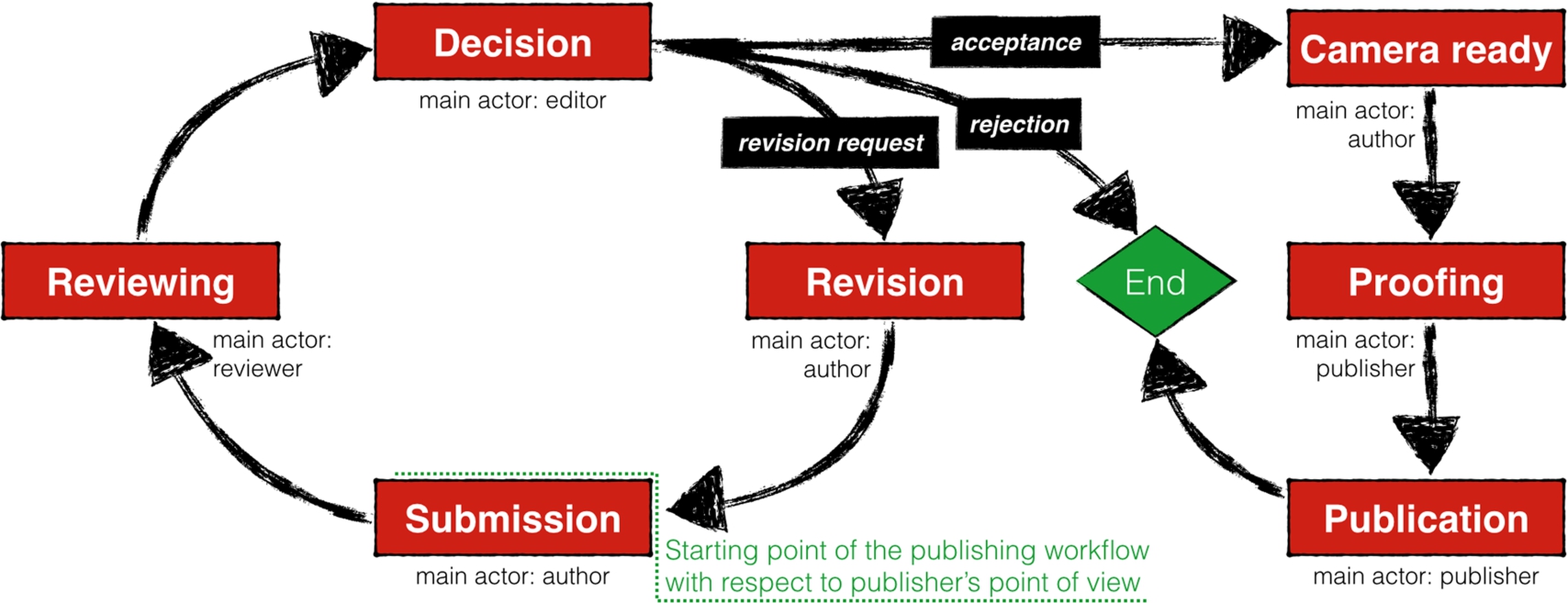
A diagram describing the typical publishing workflow of a journal article – note that it does not take into account any withdrawing action by the author, nor any comment made by users on publisher’s website before/after article publication.
In addition, by means of the Error Ontology, we generate an inconsistency when the steps of a workflow are not arranged in the correct temporal order. In particular, an error is raised when a step requires (property pwo:needs) a particular object to be produced (e.g., from the property pwo:produces) as consequence of another sequent step. The following excerpt shows the implementation of this constraint in a SWRL rule [14]:
Step(?step1) , Step(?step2) ,needs(?step1,?resource) ,produces(?step2,?resource) ,sequence:precedes(?step1,?step2) -> error:hasError(?step1,"A step cannot need a resource that will be produced by a following step"^^xsd:string)
It is worth mentioning that the final two properties introduced in Table 1, i.e., pwo:needs and pwo:produces, are associated to the description-level of the workflow, since they are related to the class pwo:Step. However, the particular specification of what is needed/produced by a step is not yet available when one develops a workflow description. Such specification will be provided dynamically at execution time and will depend strictly on the objects that will be really used during such execution. Basically speaking, by using PWO for modelling workflows, the statements that will be specified for a particular workflow execution will (and must) populate dynamically both the workflow execution and the related workflow description.
Applying PWO to the publishing and legislative domains
In the next subsections we show how to describe the process of publication of a journal article, as well as the process of codification laws of US legislation step by step. The examples apply PWO to existing data from the Semantic Web Journal31
Semantic Web Journal data: http://semantic-web-journal.com/sejp.
[15], DBPedia [17], and other SPAR ontologies, such as PSO [24], C4O [5], FaBiO and CiTO [23].
A typical publishing workflow of a journal article
From the publisher’s perspective, the first step of any workflow leading to a new journal publication starts with a formal submission of a manuscript written by someone, hereinafter the author. This action expresses, at the same time, interest on the topics of the journal, and may acknowledge, indirectly, the quality of the journal itself – since authors (usually) would like to publish articles in a venue that they consider respectful and qualitatively worth for different reasons (e.g., appropriateness of topic, quality of reviews, journal impact factor, definite timing of the publishing process). Then, in the next step, i.e., the reviewing phase, the person (designated by the publisher) in charge of the quality of submitted material, hereinafter the editor, invites other people (hereinafter the reviewers) to assess the quality of the submitted manuscript. The opinions returned by the reviewers are the fundamental input that the editor uses to decide upon the fate of the manuscript during the next step, i.e., the decision phase. Finally, if the manuscript has been considered worth of publication in the present form, the editor will acknowledge the author of the acceptance of his/her work – and the next steps of the workflow will be in charge of the publisher itself. Otherwise, if the article is not ready for being published, the editor either may ask for its rejection, thus terminating the workflow, or (s)he can return a list of issues to be addressed to the author in order to deserve publication. In this latter case, the revision phase starts, and the author revises the paper according to reviewers’ comments and editor’s suggestions, and the workflow continues with a new submission phase.
The whole publishing workflow we have described (summarised in Fig. 2) can be formally represented by means of PWO. In the following excerpt (in Turtle [26]) we create an instance of the class pwo:Workflow as composed by a definite (we consider only the first four steps in this example) number of steps:32
The full Turtle sources of this example are available in [22].
:workflow a pwo:Workflow ; pwo:hasFirstStep :step-one ; pwo:hasStep :step-two , :step-three , :step-four .:step-one a pwo:Step ; # Submission step pwo:hasNextStep :step-two .:step-two a pwo:Step ; # Reviewing step pwo:hasNextStep :step-three ; parameter:hasParameter [ a time:DurationDescription ; time:weeks "5"^^xsd:decimal ] .:step-three a pwo:Step ; # Notification step pwo:hasNextStep :step-four .:step-four a pwo:Step . # Revision step
In the next sections we show how to describe the first four steps of such workflow by taking into account real publication data available in the Semantic Web Journal Linked Data repository concerning [4].
Submission
The first step of the workflow concerns the submission of a manuscript by one of its authors, in this case Paolo Ciccarese. When executing this step, the manuscript receives the “submitted” status, and it is made available to the journal editor and the reviewers for the next step of the workflow. In order to describe all the aspects concerning the first step, we use several entities defined in the ontology patterns imported by PWO, as well as a number of other entities from another SPAR ontology, i.e., the Publishing Status Ontology (PSO)33
http://purl.org/spar/pso.
[24]. PSO describes the status held by a document or another publication entity at each of the stages in the publishing process. In addition, existing entities of the Semantic Web Journal Linked Data repository (e.g., people and manuscripts) are reused in order to demonstrate the flexibility of PWO in working with other existing models and data, as shown below:
# Workflow execution:workflow-execution a pwo:WorkflowExecution ; pwo:execute :workflow .# Executing step 1: Submission:workflow-execution pwo:involvesAction :submission-action .:step-one taskex:isExecutedIn :submission-action ; pwo:needs swj-node:432 ; pwo:produces :submitted-status .# The event in which one of the authors# submits the manuscript:submission-action a pwo:Action ; dcterms:description "Paolo Ciccarese submits the paper" ; tisit:atTime [ a ti:TimeInterval ; ti:hasIntervalStartDate "2013-01-21T10:08:28"^^xsd:dateTime ; ti:hasIntervalEndDate "2013-01-21T10:08:28"^^xsd:dateTime ] ; part:hasParticipant swj:paolo-ciccarese , swj-node:432 .# The new status ’submitted’ associated# to the paper after the submission:submitted-status a pso:StatusInTime ; pso:isStatusHeldBy swj-node:432 ; pso:isAcquiredAsConsequenceOf :submission-action ; pso:withStatus pso:submitted ; tvc:atTime [ a ti:TimeInterval ; ti:hasIntervalStartDate "2013-01-21T10:08:28"^^xsd:dateTime ] .
Reviewing
The step regarding the reviewing phase begins with the action of the editor, Giancarlo Guizzardi in the working example, who looks for appropriate reviewers. Once reviewing requests are accepted, reviewers download the manuscript, review it, and write down their comments that are eventually sent back to the editor. In order to describe all the aspects concerning the second step, we use several entities defined in additional SPAR ontologies, i.e., the Citation Counting and Context Characterisation Ontology (C4O)34
[23], in order to express the content of reviews and to explicitly link them to the reviewed manuscript. In the following excerpt we introduce the formalisation of the second step in PWO:
# Executing step 2: Reviewing:workflow-execution pwo:involvesAction :choosing-reviewers-action , :reviewing-action , :reviews-notification-sending-action .:step-two taskex:isExecutedIn :choosing-reviewers-action , :reviewing-action , :reviews-notification-sending-action ;# The review process can start only when# a manuscript has been submittedpwo:needs swj-node:432 , :submitted-status ;pwo:produces :review-1, :review-2, :under-review-status, :reviewed-status.:choosing-reviewers-action a pwo:Action ; dcterms:description "The editor, Giancarlo Guizzardi, chooses Csaba Veres and Fernando Naufel do Amaral as reviewers of the manuscript" ; tisit:atTime [ a ti:TimeInterval ; ti:hasIntervalStartDate "2013-02-18T17:04:32"^^xsd:dateTime ; ti:hasIntervalEndDate "2013-02-18T17:09:56"^^xsd:dateTime ] ; part:hasParticipant swj:csaba-veres , swj:fernando-naufel-do-amaral , swj:giancarlo-guizzardi , swj-node:432 .:reviewing-action a pwo:Action ; dcterms:description "Reviewers review the manuscript" ; tisit:atTime [ a ti:TimeInterval ; ti:hasIntervalStartDate "2013-02-26T12:00:07"^^xsd:dateTime ; ti:hasIntervalEndDate "2013-04-01T05:53:24"^^xsd:dateTime ] ; part:hasParticipant swj:csaba-veres , swj:fernando-naufel-do-amaral , swj-node:432 .:reviews-notification-sending-action a pwo:Action ; dcterms:description "The reviews are sent to the editor" ; tisit:atTime [ a ti:TimeInterval ; ti:hasIntervalStartDate "2013-03-14T11:16:34"^^xsd:dateTime ; ti:hasIntervalEndDate "2013-04-01T05:53:24"^^xsd:dateTime ] ; part:hasParticipant swj:csaba-veres , swj:fernando-naufel-do-amaral , :review-1 , :review-2 , swj:giancarlo-guizzardi .# Review 1 by Csaba Veres:review-1 a fabio:Comment ; frbr:realizationOf [ a fabio:Review ] ; cito:reviews swj-node:432 ; frbr:realizer swj: csaba-veres ; c4o:hasContent "The paper addresses a very practical..." .# Review 2 by Fernando Naufel do Amaral:review-2 a fabio:Comment ; frbr:realizationOf [ a fabio:Review ] ; cito:reviews swj-node:432 ; frbr:realizer swj:fernando-naufel-do-amaral ; c4o:hasContent "The paper presents the Collection Ontology (CO)..." .# The paper has been assigned to the# under-review status for a while:under-review-status a pso:StatusInTime ; pso:isStatusHeldBy swj-node:432 ; pso:isAcquiredAsConsequenceOf :reviewing-action ; pso:isLostAsConsequenceOf :reviews-notification-sending-action ; pso:withStatus pso:under-review ; tvc:atTime [ a ti:TimeInterval ; ti:hasIntervalStartDate "2013-02-26T12:00:07"^^xsd:dateTime ; ti:hasIntervalEndDate "2013-04-01T05:53:24"^^xsd:dateTime ] .# The paper status has changed in ’reviewed’# after reviewers’ comments:reviewed-status a pso:StatusInTime ; pso:isStatusHeldBy swj-node:432 ; pso:isAcquiredAsConsequenceOf :reviews-notification-sending-action ; pso:withStatus pso:reviewed ; tvc:atTime [ a ti:TimeInterval ; ti:hasIntervalStartDate "2013-04-01T05:53:24"^^xsd:dateTime ] .
Decision
During the third step, the editor is responsible for the fate of the paper and provides a decision for it, according to reviewers’ comments. Once the decision is formalised, a decision letter is sent by email to the corresponding author (Paolo Ciccarese in the example), and the status of the paper is changed to “minor revision”. In the following excerpt we introduce the formalisation of the third step in PWO:
# Executing step 3: Notification:workflow-execution pwo:involvesAction :decision-action , :notification-action .:step-three taskex:isExecutedIn :decision-action , :notification-action ; pwo:needs swj-node:432 , :review-1 , :review-2 ; pwo:produces :minor-revision-status , :decision-letter .:decision-action a pwo:Action ; dcterms:description "The editor decides for acceptance or not" ; tisit:atTime [ a ti:TimeInterval ; ti:hasIntervalStartDate "2013-04-01T05:53:24"^^xsd:dateTime ; ti:hasIntervalEndDate "2013-06-10T17:47:53"^^xsd:dateTime ] ; part:hasParticipant swj:giancarlo-guizzardi , :review-1 , :review-2 , swj-node:432 .:notification-action a pwo:Action ; dcterms:description "The editor notifies his decision to the corresponding author (i.e., Paolo Ciccarese)." ; tisit:atTime [ a ti:TimeInterval ; ti:hasIntervalStartDate "2013-06-10T17:47:53"^^xsd:dateTime ; ti:hasIntervalEndDate "2013-06-10T17:47:53"^^xsd:dateTime ] ; part:hasParticipant swj:giancarlo-guizzardi , :decision-letter , :review-1 , :review-2 , swj:paolo-ciccarese , swj-node:432 .# The decision letter written by the editor:decision-letter a fabio:Letter , fabio:Email ; frbr:realizationOf [ a fabio:Opinion ] ; cito:citesAsRelated swj-node:432 ; frbr:realizer swj:giancarlo-guizzardi ; c4o:hasContent "Dear authors, Thank you for your interest in..." .# The minor revision status assigned to the paper after editor’s decision:minor-revision-status a pso:StatusInTime ; pso:isStatusHeldBy swj-node:432 ; pso:isAcquiredAsConsequenceOf :decision-action ; pso:withStatus swj:minorRevision ; tvc:atTime [ a ti:TimeInterval ; ti:hasIntervalStartDate "2013-06-10T17:47:53"^^xsd:dateTime ] .
Revision
During the fourth step, the authors work in order to revise the content of the previous version of the paper according to reviewers’ comments and editor’s suggestions. At the end of the execution of this step, the main result is the creation of a new version of the paper (e.g., swj-node:506 in our example) that is submitted to the next step. In the following excerpt we introduce the formalisation of the fourth step of in PWO:
In Section 1 we have claimed that the explicit description of publishing process data according to appropriate models, such as PWO, may result in increasing the transparency of the (publishing) process, and in enabling the use of such data for statistical analysis.
In order to show how to query the data introduced in the previous sections in view of the aforementioned goals, we introduce a typical scenario in the scholarly publishing domain. We are interested in understanding if the estimated time for completing a certain step in a workflow is enough for completing all the actual actions related to such step. As a subtask of this quite generic scenario, we could check whether the actual time needed by reviewers for reviewing a paper is within the time range originally estimated by the editors-in-chief of the journal.
Addressing such query by means of SPARQL over PWO-designed data is quite straightforward. For instance, the following SPARQL query returns all the steps described in the example, with their estimated duration (if specified), accompanied by the actual duration needed to address all the actions related to such step.
PREFIX ti: <http://www.ontologydesignpatterns.org/ cp/owl/timeinterval.owl#>PREFIX time: <http://www.w3.org/2006/time#>PREFIX pwo: <http://purl.org/spar/pwo/>PREFIX taskex: <http://www.ontologydesignpatterns. org/cp/owl/taskexecution.owl#>PREFIX tisit: <http://www.ontologydesignpatterns. org/cp/owl/timeindexedsituation.owl#>PREFIX dcterms: <http://purl.org/dc/terms/>PREFIX parameter: <http://www.ontologydesignpatterns.org/cp/owl/parameter.owl#>SELECT ?execution ?step ?original_duration (sum(?dur_action) as ?actual_duration)WHERE { { SELECT ?execution ?step (min(?dateStart) AS ?start) (min(?dateEnd) AS ?end) WHERE { ?step a pwo:Step ; taskex:isExecutedIn ?a . ?a tisit:atTime ?time . ?execution a pwo:WorkflowExecution ; pwo:involvesAction ?a . ?time ti:hasIntervalStartDate ?dateStart ; ti:hasIntervalEndDate ?dateEnd } GROUP BY ?execution ?step ?time } OPTIONAL { ?step parameter:hasParameter [ time:weeks ?weeks ] . BIND (?weeks * 7 as ?original_duration) } BIND (day(?end - ?start) as ?dur_action)}GROUP BY ?execution ?step ?original_durationORDER BY ?start
A diagram exemplifying the workflow of the codification of Title 41 of the United States Code. This diagram is not intended as a complete representation of any codification process of US titles, but rather as a graphical representation of the example introduced in this section.
Looking at the result of this query, it is straightforward to see that the second step (i.e., the reviewing phase) took fifteen days more than the estimated time, while the step that took most time to be executed was the third one (i.e., the decision phase).
An example of workflow in the legislative domain
Although PWO had been thought to describe workflows related with the scholarly publishing domain, it has been developed on purpose as an ontology for the description of generic publishing workflows. To this end, in this section we show how to use PWO to describe a workflow that concerns the process of codification of a particular law of the United States legislation, i.e., the codification of Title 41 of the United States Code, as described in an introductory webpage of the Office of the Law Revision Counsel.36
Positive law codification of title 41 of the United States Code: http://uscode.house.gov/codification/t41/index.html.
A graphical summarisation of such codification process is shown in Fig. 3,37
The full Turtle sources of this example are available in [21].
while a PWO exemplification of the workflow description is presented as follows:
# Initial workflow description:workflow a pwo:Workflow ; pwo:hasFirstStep :step-one ; pwo:hasStep :step-two , :step-three , :step-four .# Introduction of the codification bill:step-one a pwo:Step ; pwo:hasNext :step-two .# The bill was reported by the# Committee Judiciary House:step-two a pwo:Step ; pwo:hasNext :step-three .# The bill was passed by# the House of Representatives:step-three a pwo:Step ; pwo:hasNext :step-four .# The bill became Public Law 111-350:step-four a pwo:Step .
Introduction
The first step of this workflow is the introduction of a new codification, in our example the codification bill “H.R. 1107” by Chairman Conyers and Ranking Member Smith on February 23, 2009. The result of the first step is the production of a first version of such bill. The step is rendered through PWO as follows:38
The RDF representation of the agents involved in this and in the following examples are taken from DBpedia, where the prefix dbpedia stands for http://dbpedia.org/resource/.
# Executing step 1: Introduction:workflow-execution pwo:involvesAction :drafting-action .:step-one taskex:isExecutedIn :drafting-action ; pwo:produces :hr-1107-bill-first-version .:drafting-action a pwo:Action ; dcterms:description "Drafting the codification bill H.R. 1107" ; tisit:atTime [ a ti:TimeInterval ; ti:hasIntervalEndDate "2009-02-23T00:00:00Z"^^xsd:dateTime ] ; part:hasParticipant dbpedia:John_Conyers , <http://dbpedia.org/resource/Adam_Smith_( politician)>:hr-1107-bill a fabio:Work ; frbr:realization :hr-1107-bill-first-version .:hr-1107-bill-first-version a fabio:Expression ; frbr:realizer dbpedia:John_Conyers , dbpedia:Adam_Smith_(politician) .
Referring
The second step of the process concerns the establishment of a Committee, in the leading example, the Committee on the Judiciary of the House of Representatives, which referred the codification bill. In particular, H.R. 1107 was ordered favourably reported by the Committee on March 18, 2009. The step is rendered through PWO as follows:
# Executing step 2: Reporting by CJS:workflow-execution pwo:involvesAction :referring-bill-committee-judiciary-house .:step-two taskex:isExecutedIn :referring-bill-committee-judiciary-house ; pwo:needs :hr-1107-bill-first-version ; pwo:produces :hr-1107-bill-amended , :hr-1107-bill-reported-by-committee-judiciary-house .:referring-bill-committee-judiciary-house a pwo:Action ; dcterms:description "Referring the codification bill H.R. 1107" ; tisit:atTime [ a ti:TimeInterval ; ti:hasIntervalStartDate "2009-02-23T00:00:00Z"^^xsd:dateTime ; ti:hasIntervalEndDate "2009-03-18T00:00:00Z"^^xsd:dateTime ] ; part:hasParticipant dbpedia: United_States_House_Committee_on_the_ Judiciary , :hr-1107-bill-first-version .:hr-1107-bill-amended a fabio:Expression ; frbr:realizationOf :hr-1107-bill ; frbr:realizer dbpedia: United_States_House_Committee_on_the_ Judiciary ; frbr:revisionOf :hr-1107-bill-first-version ; pso:holdsStatusInTime :hr-1107-bill-reported-by-committee-judiciary- house .:hr-1107-bill-reported-by-committee-judiciary-house a pso:StatusInTime ; pso:isStatusHeldBy :hr-1107-bill-amended ; pso:withStatus :reported ; tvc:atTime [ a ti:TimeInterval ; ti:hasIntervalStartDate "2009-03-18T00:00:00Z"^^xsd:dateTime ] ; pso:isAcquiredAsConsequenceOf :referring-bill-committee-judiciary-house .:reported a pso:Status .
Agreeing
The third step of the process concerns passing a codification. In the example, the bill was passed by the House of Representatives on May 6, 2009. H.R. 1107 was referred to the Senate Judiciary Committee on May 7, 2009. H.R. 1107 with amendments was passed by the Senate by unanimous consent on December 2, 2010. Then, a message on the Senate action was sent to the House of Representatives. The House of Representatives agreed to the Senate amendments on December 17, 2010. The step is rendered through PWO as follows:
# Executing step 3: Agreeing:workflow-execution pwo:involvesAction :passing-by-hr , :receiving-bill , :referring-bill-committee-judiciary-senate , :sending-message-to-house-representatives .:step-three taskex:isExecutedIn :passing-by-hr , :receiving-bill , :referring-bill-committee-judiciary-senate , :sending-message-to-house-representatives ; pwo:needs :hr-1107-bill-amended , :hr-1107-status-reported-by-committee-judiciary -house ; pwo:produces :hr-1107-status-passed-by-committee-judiciary- senate , :message-on-senate-action , :hr-1107-status-agreed-by-house-representatives .:passing-hr a pwo:Action ; dcterms:description "Passing the codification bill H.R. 1107 by the House of Representatives" ; tisit:atTime [ a ti:TimeInterval ; ti:hasIntervalStartDate "2009-05-06T00:00:00Z"^^xsd:dateTime ; ti:hasIntervalEndDate "2010-12-17T00:00:00Z"^^xsd:dateTime ] ; part:hasParticipant dbpedia:United_States_House_of_Representatives , :hr-1107-bill-amended .:receiving-bill a pwo:Action ; dcterms:description "Receiving the codification bill H.R. 1107" ; tisit:atTime [ a ti:TimeInterval ; ti:hasIntervalStartDate "2009-05-06T00:00:00Z"^^xsd:dateTime ; ti:hasIntervalEndDate "2010-12-17T00:00:00Z"^^xsd:dateTime ] ; part:hasParticipant dbpedia:United_States_Senate .:hr-1107-status-passed-by-committee-judiciary- senate a pso:StatusInTime ; pso:isStatusHeldBy :hr-1107-bill-amended ; pso:withStatus :passed ; tvc:atTime [ a ti:TimeInterval ; ti:hasIntervalStartDate "2010-12-02T00:00:00Z"^^xsd:dateTime ] ; pso:isAcquiredAsConsequenceOf :referring-bill-committee-judiciary-senate .:referring-bill-committee-judiciary-senate a pwo:Action ; dcterms:description "Referring the codification bill H.R. 1107" ; tisit:atTime [ a ti:TimeInterval ; ti:hasIntervalStartDate "2009-05-06T00:00:00Z"^^xsd:dateTime ; ti:hasIntervalEndDate "2010-12-17T00:00:00Z"^^xsd:dateTime ] ; part:hasParticipant dbpedia: United_States_Senate_Committee_on_the_ Judiciary , :hr-1107-bill-amended .:hr-1107-status-agreed-by-committee-judiciary- senate a pso:StatusInTime ; pso:isStatusHeldBy :hr-1107-bill-amended ; pso:withStatus :passed ; tvc:atTime [ a ti:TimeInterval ; ti:hasIntervalStartDate "2010-12-02T00:00:00Z"^^xsd:dateTime ] ; pso:isAcquiredAsConsequenceOf :referring-bill-committee-judiciary-senate .:sending-message-to-house-representatives a pwo: Action ; dcterms:description "Sending a message to the House of Representatives about Senate action on of H.R. 1107" ; tisit:atTime [ a ti:TimeInterval ; ti:hasIntervalStartDate "2009-05-06T00:00:00Z"^^xsd:dateTime ; ti:hasIntervalEndDate "2010-12-17T00:00:00Z"^^xsd:dateTime ] ; part:hasParticipant dbpedia:United_States_House_of_Representatives , :hr-1107-status-passed-by-committee-judiciary- senate , :message-to-house-representatives .:message-on-senate-action a fabio:Expression ; frbr:realizer dbpedia: United_States_Senate_Committee_on_the_ Judiciary ; frbr:realizationOf [ a frbr:Work ; frbr:subject :hr-1107-status-passed-by-committee-judiciary -senate , :referring-bill-committee-judiciary-senate ] .:hr-1107-status-agreed-by-house-representatives a pso:StatusInTime ; pso:withStatus :agreed ; pso:isStatusHeldBy :hr-1107-bill-amended ; tvc:atTime [ a ti:TimeInterval ; ti:hasIntervalStartDate "2010-12-17T00:00:00Z"^^xsd:dateTime ] ; pso:isAcquiredAsConsequenceOf :referring-bill-committee-judiciary-senate .:passed a pso:Status .:agreed a pso:Status .
Signing
In the latest step of the process the signature of the President of U.S. is required to get a codification its legal status. H.R. 1107 was signed by the President on January 4, 2011, and became Public Law 111-350, which was codified in Title 41 of the United States Code.
# Executing step 4: Signing:workflow-execution pwo:involvesAction :hr-1107-passing-by-president .:step-four taskex:isExecutedIn :hr-1107-passing-by-president ; pwo:needs :hr-1107-bill-amended , :hr-1107-status-agreed-by-house-representatives ; pwo:produces :hr-1107-status-signed-by-president , :public-law-111-350 , :title-41-enacted-by-public-law-111-350 .:hr-1107-passing-by-president a pwo:Action ; dcterms:description "Passing the codification bill H.R. 1107 by the President for signing it" ; tisit:atTime [ a ti:TimeInterval ; ti:hasIntervalStartDate "2010-12-17T00:00:00Z"^^xsd:dateTime ; ti:hasIntervalEndDate "2011-01-04T00:00:00Z"^^xsd:dateTime ] ; part:hasParticipant dbpedia:President_of_the_United_States , :hr-1107-bill-amended .:hr-1107-status-signed-by-president a pso:StatusInTime ; pso:isStatusHeldBy :hr-1107-bill-amended ; pso:withStatus :signed ; tvc:atTime [ a ti:TimeInterval ; ti:hasIntervalStartDate "2010-12-17T00:00:00Z"^^xsd:dateTime ] ; pso:isAcquiredAsConsequenceOf :hr-1107-passing-by-president .:public-law-111-350 a fabio:Work ; frbr:adaptationOf :hr-1107-bill-amended ; frbr:realization [ a fabio:Expression ; cito:providesExcerptFor :title-41-enacted-by-public-law-111-350 ] .:title-41 a fabio:Work ; frbr:realization :title-41-negative-law , :title-41-enacted-by-public-law-111-350 .:title-41-enacted-by-public-law-111-350 a fabio:Expression ; frbr:revisionOf :title-41-negative-law .:signed a pso:Status .
Conclusion
In this paper we introduced the Publishing Workflow Ontology (PWO), i.e., an OWL 2 DL ontology that is part of the Semantic Publishing and Referencing (SPAR) Ontologies [20]. PWO enables the description of publishing workflows in RDF. The whole ontology is entirely founded on existing ontology design patterns that allow us to satisfy the identified requirements by reusing best practices. We have shown two applications of PWO: describing a real publishing workflow for the publication of an article [4] in the Semantic Web Journal, and the process of codification of laws within U.S. legislation – in which we have reused entities and data from existing resources such as the Semantic Web Journal Linked Dataset.
Although PWO was designed for modelling publishing-related workflows, it can be easily reused of generic workflows, since it stands on top of abstract, off-the-shelf ontology design patterns. PWO is aligned to other workflow-related models, e.g., PROV-O, the Research Object ontology and the ontologies described in Section 2. In addition, we are studying the applicability of PWO to other domains, e.g., for describing workflows of computational or data manipulation in scientific applications. Finally, we also plan to develop some APIs in order to facilitate the adoption of PWO within existing publishing platforms.
References
1.
K.Belhajjame, O.Corcho, D.Garijo, J.Zhao, P.Missier, D.R.Newman, R.Palma, S.Bechhofer, E.García, J.M.Gómez-Pérez, G.Klyne, J.E.Ruiz, S.Soiland-Reyes, D.De Roure and C.Goble, Workflow-centric research objects: A first class citizen in the scholarly discourse, in: Proc. of the 2nd Workshop on Semantic Publishing (SePublica 2012), A.Garcia Castro, C.Lange, F.van Harmelen and B.Good, eds, CEUR-WS.org, Aachen, Germany, 2012, http://ceur-ws.org/Vol-903/paper-01.pdf.
2.
K.Belhajjame, J.Zhao, D.Garijo, K.M.Hettne, R.Palma, O.Corcho, J.M.Gómez-Pérez, S.Bechhofer, G.Klyne and C.A.Goble, The research object suite of ontologies: Sharing and exchanging research data and methods on the open web, in: The Computing Research Repository (CoRR), 2014, abs/1401.4307. http://arxiv.org/abs/1401.4307.
3.
E.Blomqvist, A.Gangemi, E.Daga and V.Presutti, Experimenting with eXtreme design, in: Proc. of the Conference on Knowledge Engineering and Knowledge Management (EKAW 2010), P.Cimiano and H.S.Pinto, eds, Springer, Heidelberg, Germany, 2010, pp. 120–134. doi:10.1007/978-3-642-16438-5_9.
4.
P.Ciccarese and S.Peroni, The collections ontology: Creating and handling collections in OWL 2 DL frameworks, Semantic Web5(6) (2014), 515–529. doi:10.3233/SW-130121.
5.
A.Di Iorio, A.G.Nuzzolese, S.Peroni, D.Shotton and F.Vitali, Describing bibliographic references in RDF, in: Proc. of 4th Workshop on Semantic Publishing (SePublica 2014), A.Garcia Castro, C.Lange, P.Lord and R.Stevens, eds, CEUR-WS.org, Aachen, Germany, 2014, http://ceur-ws.org/Vol-1155/paper-05.pdf.
6.
R.Falco, A.Gangemi, S.Peroni and F.Vitali, Modelling OWL ontologies with Graffoo, in: ESWC 2014 Satellite Events – Revised Selected Papers, V.Presutti, E.Blomqvist, R.Troncy, H.Sack, I.Papadakis and A.Tordai, eds, Springer, Cham, Switzerland, 2014, pp. 320–325. doi:10.1007/978-3-319-11955-7_42.
7.
A.Gangemi, Norms and plans as unification criteria for social collectives, Autonomous Agents and Multi-Agent Systems17(1) (2008), 70–112. doi:10.1007/s10458-008-9038-9.
8.
A.Gangemi, S.Borgo, C.Catenacci and J.Lehmann, Task taxonomies for knowledge content, METOKIS Deliverable D7, 2004, http://metokis.salzburgresearch.at/files/deliverables/metokis_d07_task_taxonomies_final.pdf.
9.
A.Gangemi, S.Peroni, D.Shotton and F.Vitali, A pattern-based ontology for describing publishing workflows, in: Proc. of the 5th International Workshop on Ontology and Semantic Web Patterns (WOP 2014), V.de Boer, A.Gangemi, K.Janowicz and A.Lawrynowicz, eds, CEUR Workshop Proceedings, Vol. 1302, CEUR-WS.org, Aachen, Germany, 2014, pp. 2–13, http://ceur-ws.org/Vol-1302/paper1.pdf.
10.
A.Gangemi and V.Presutti, Ontology design patterns, in: Handbook of Ontologies, S.Staab and R.Studer, eds, 2nd edn, Springer, Heidelberg, Germany, 2009, pp. 221–243. doi:10.1007/978-3-540-92673-3_10.
11.
D.Garijo and Y.Gil, A new approach for publishing workflows: Abstractions, standards, and linked data, in: Proc. of the 6th Workshop on Workflows in Support of Large-Scale Science (WORKS 2011), ACM, New York, New York, USA, 2011, pp. 47–56. doi:10.1145/2110497.2110504.
12.
K.Hettne, S.Soiland-Reyes, G.Klyne, K.Belhajjame, M.Gamble, S.Bechhofer, M.Roos and O.Corcho, Workflow forever: Semantic web semantic models and tools for preserving and digitally publishing computational experiments, in: Proc. of the 4th International Workshop on Semantic Web Applications and Tools for the Life Sciences (SWAT4LS 2011), 2012, pp. 36–37. doi:10.1145/2166896.2166909.
13.
M.Horridge and P.F.Patel-Schneider, OWL 2 Web Ontology Language: Manchester syntax, 2nd edn, W3C Working Group Note, 11 December 2012, 2012, http://www.w3.org/TR/owl2-manchester-syntax/.
14.
I.Horrocks, P.F.Patel-Schneider, H.Boley, S.Tabet, B.Grosof and M.Dean, SWRL: A Semantic Web Rule Language combining OWL and RuleML, W3C Member Submission, 21 May 2004, 2004, http://www.w3.org/Submission/SWRL/.
15.
Y.Hu, K.Janowicz, G.McKenzie, K.Sengupta and P.Hitzler, A linked-data-driven and semantically-enabled journal portal for scientometrics, in: Proc. of the 12th International Semantic Web Conference (ISWC 2013), H.Alani, L.Kagal, A.Fokoue, P.Groth, C.Biemann, J.X.Parreira, L.Aroyo, N.Noy, C.Welty and K.Janowicz, eds, Springer, Heidelberg, Germany, 2013, pp. 114–129. doi:10.1007/978-3-642-41338-4_8.
16.
T.Lebo, S.Sahoo and D.McGuinness, PROV-O: The PROV Ontology, W3C Recommendation, 30 April 2013, 2013, http://www.w3.org/TR/prov-o/.
17.
J.Lehmann, R.Isele, M.Jakob, A.Jentzsch, D.Kontokostas, P.N.Mendes, S.Hellmann, M.Morsey, P.van Kleef, S.Auer and C.Bizer, DBpedia – A large-scale, multilingual knowledge base extracted from Wikipedia, Semantic Web6(2) (2015), 167–195. doi:10.3233/SW-140134.
18.
N.F.Noy, A.Chugh, W.Liu and M.A.Musen, A framework for ontology evolution in collaborative environments, in: Proc. of the 5th International Semantic Web Conference (ISWC 2006), I.Cruz, S.Decker, D.Allemang, C.Preist, D.Schwabe, P.Mika, M.Uschold and L.Aroyo, eds, Springer, Heidelberg, Germany, 2006, pp. 544–558. doi:10.1007/11926078_39.
19.
C.O’Connor, S.Haenel, A.Gnanapiragasam, M.Hepp and T.Fleischer, Building an automated XML-based journal production workflow, in: Proc. of the Journal Article Tag Suite Conference 2015 (JATS-Con 2015), National Center for Biotechnology Information, Bethesda, Maryland, USA, 2015, http://www.ncbi.nlm.nih.gov/books/NBK279927/.
20.
S.Peroni, The semantic publishing and referencing ontologies, in: Semantic Web Technologies and Legal Scholarly Publishing, Springer, Cham, Switzerland, 2014, pp. 121–193. doi:10.1007/978-3-319-04777-5.
21.
S.Peroni, Example of use of PWO: Legislative domain, 2015, Figshare. http://dx.doi.org/10.6084/m9.figshare.1449044.
S.Peroni and D.Shotton, FaBiO and CiTO: Ontologies for describing bibliographic resources and citations, Web Semantics17 (2012), 33–43. doi:10.1016/j.websem.2012.08.001.
24.
S.Peroni, D.Shotton and F.Vitali, Scholarly publishing and linked data: Describing roles, statuses, temporal and contextual extents, in: Proc. of the 8th International Conference on Semantic Systems (i-Semantics 2012), 2012, pp. 9–16. doi:10.1145/2362499.2362502.
25.
V.Presutti, A.Gangemi, S.David, G.Aguado, M.C.Suárez-Figueroa, E.Montiel-Ponsoda and M.Poveda, A Library of Ontology Design Patterns, NeOn deliverable D2.5.1, 2008, http://neon-project.org/deliverables/WP2/NeOn_2008_D2.5.1.pdf.
26.
E.Prud’hommeaux and G.Carothers, Turtle – Terse RDF Triple Language, W3C Recommendation, 25 February 2014, 2014, http://www.w3.org/TR/turtle/.
A.Sebastian, N.F.Noy, T.Tudorache and M.A.Musen, A generic ontology for collaborative ontology-development workflows, in: Proc. of the 16th International Conference on Knowledge Engineering and Knowledge Management (EKAW 2008), A.Gangemi and J.Euzenat, eds, 2008, pp. 318–328. doi:10.1007/978-3-540-87696-0_28.
29.
K.Wolstencroft, R.Haines, D.Fellows, A.Williams, D.Withers, S.Owen, S.Soiland-Reyes, I.Dunlop, A.Nenadic, P.Fisher, J.Bhagat, K.Belhajjame, F.Bacall, A.Hardisty, A.N.de la Hidalga, M.P.B.Vargas and C.Goble, The Taverna workflow suite: Designing and executing workflows of Web Services on the desktop, web or in the cloud, Nucleic Acids Research41(W1) (2013), W557–W561. doi:10.1093/nar/gkt328.