




Abstract
Public procurement or tendering refers to the process followed by public authorities for the procurement of goods and services. In most developed countries, the law requires public authorities to provide online information to ensure competitive tendering as far as possible, for which the adequate announcement of tenders is an essential requirement. In addition, transparency laws being proposed in such countries are making the monitoring of public contracts by citizens a fundamental right. This paper describes the PPROC ontology, which has been developed to give support to both processes, publication and accountability, by semantically describing public procurement processes and contracts. The PPROC ontology is extensive, since it covers not only the usual data about the tender, its objectives, deadlines and awardees, but also details of the whole process, from the initial contract publication to its termination. This makes it possible to use the ontology for both open data publication purposes and for the overall management of the public contract procurement process.
Introduction
In the context of public procurement, advertising has always been an essential part of the process, as it fulfils a dual purpose: on the one hand, it is a resource for improving competitive tendering, and on the other, it constitutes an instrument for transparency and for the monitoring of the behaviour of the contracting authorities [9]. This second purpose is becoming increasingly important because one of the third-generation human rights is free access to public sector information, which is now included in the laws of the majority of developed countries [1].
With the progress of electronic government, the publication of information regarding contracting procedures increasingly began to be performed using electronic means. For instance, some European directives from 2004 (Directives 2004/17/EC and 2004/18/EC)1
Today replaced by the directives of the European Parliament and of the Council: 2014/24/EU, of 26 February 2014 on public procurement and repealing Directive 2004/18/EC; and 2014/25/EU, of 26 February 2014, on procurement by entities operating in the water, energy, transport and postal service sectors and repealing Directive 2004/17/EC.
However, their use has been severely limited by the major functional and technical differences between the different profiles of different public authorities and the lack of interoperability among them, which makes the integrated processing of the information published on them very hard (for instance, aggregating the total income being awarded to a specific company across all the public authorities in a group of countries). One of the currently adopted solutions for this heterogeneity problem consists in forcing all public authorities to publish on a single website the announcements regarding tender procedures. In Spain, this site is the Public Sector Contracting Platform (PSCP).2
This solution may be sufficient in order to comply with the needs of competitive tendering, because it is enough to publish a limited set of announcements. However, transparency requires giving citizens much more information and, in addition, transparency practices can vary greatly depending on the policies followed by each authority. Therefore, from the perspective of transparency, the solution involves preparing standards that may be used by public administrations to publish all the information that they consider appropriate. This is the main reason why we have created the PPROC ontology.3
The rest of the paper is structured as follows. We start with a comment about the data models used in public e-Procurement applications (Section 2). In Section 3 we analyse existing ontologies in this domain (namely PCO, LOTED2 and MOLDEAS). Then we describe the ontology development method used (Section 4) and the structure and main components of PPROC, as well as its relationships with other ontologies (Section 5). In Section 6 there is a description of its usage, including the experience of two Spanish public administrations that have been early adopters of this ontology and are now using it in their production environments to publish structured information about public contracts in their buyer profiles. In the conclusion, we describe future works and make some observations about the influence of the adoption of the ontology on the information system of these public administrations.
The Zaragoza City Council (666,000 inhabitants) and the Provincial Government of Huesca – which assists 202 small municipalities in the province – publish nowadays the information about their contracts using PPROC. Prior to this, one of the tasks was the analysis of the information used in their contract management applications. In this analysis, we observed that the structure of the databases of these management systems was closely related to the temporal succession in which the information was being generated or received by the management bodies. This leads to an organization of data that we may call “process-oriented”. Even though the relational databases used by public administrators can be very diverse since they have been created by different software providers, we believe that this type of organization appears very often, because is closely related with the way of working of civil servants.
The electronic communication between the agents involved in public procurement is every day more important. There are various initiatives whose purpose is to create standards for this communications, as CEN BII,4
CEN Workshop on Business Interoperability Interfaces for public procurement in Europe (
The Tenders Electronic Daily (
Unlike the above situations, the development of ontologies should not be based on elements associated exclusively with the procedure – such as the sequence in which information or communication actions are created – or with the exchange of messages, but with a general, all-encompassing view of the reality to be represented. In our case, we have not aimed at the creation of models of general legal concepts, as happens in some core legal ontologies [2], but at the modelling of a specific social mechanism, used to connect the contracting process of public sector entities. From the perspective of the philosophy of law, this objective is related to the concept of a “legal institution” through which the physical, social and legal elements that comprise a given “social mechanism” are identified and described – such as marriage or contracts, for example – focused on the attainment of a defined objective.
According to an approach based on the “theory of the institution”, the central focus of the model would be public procurement, considered a legal institution whose purpose is the attainment of a “product”: a public contract [8]. We have considered this approach appropriate because considering public procurement (i.e. the domain to be represented) as a legal institution consisting of a group of resources focused on the attainment of an objective is closely associated with the functional aspects of organizations, as is the case with computer applications or tools. For all these reasons, we can state that the PPROC ontology is “institution-oriented”.
In PPROC the semantic relationships of the model are organized according to the role that each concept plays within the “institution” that is represented. The science of the law has been used in order to identify and define these semantic relationships, which is devoted to studying and organizing the legal elements that comprise institutions and the relationships between them. Therefore, the institution-oriented perspective is appropriate for developing a model whose structure will be in accordance with that defined by legal doctrine. In this way, using dogmatic categories, we have differentiated in PPROC, on the one hand, the objective elements, including the purpose of the contract, from the subjective elements (the parties), and, on the other hand, the material elements, which are the elements related to the merits of the matter, from the formal elements, which are the ones related to the proceeding. In accordance with these classification criteria, the ontology is divided into four blocks, as described in Section 5.
Furthermore, the concepts defined by the legal doctrine in each country are fairly uniform. In consequence, one of the benefits derived from this strategy can be to avoid the very different levels of granularity and the lack of consistency between the data models of different public administrations that we have observed in our work.
In [4] an exhaustive study about the numerous initiatives implemented for the use of semantic technologies in e-Procurement was presented. Among these, some have focused on the announcement of information regarding public contracts. In the European context, the first experience was LOTED2 [6], which expanded the LOTED ontology [15] with the goals of (a) expressing the main legal concepts of the public contract announcements defined in legal sources, (b) supporting rich semantic annotation, indexing, search and retrieval of tender documents, (c) making it possible to reuse semi-structured data extracted from the TED system and (d) enabling the integration with other ontologies and vocabularies about related domains. The ontology bases most of its content on the two directives (2004/17/EC and 2004/18/EC), which at the time of development regulated public contracts in Europe, and is the result of a thorough study of legal documents. This means that the legal content of European procurement is heavily present and rigorously represented in LOTED2.
Another initiative focused on public procurement is MOLDEAS (Methods On Linked Data for E-procurement Applying Semantics) [3], an ontology focused on the representation of information contained in the announcements about public tenders. The objective of this ontology was to provide a pan-European standard about public procurement data, enriching it with the classifications of already-existing products and publishing it by following established open data guidelines.
A third initiative in the EU is the Public Contracts Ontology (PCO),7
PCO and MOLDEAS use diverse sources of information, trying to identify an information core of the domain of public contracts, describing the main concepts of public procurement without delving much into detail. On the contrary, LOTED2 is focused on defining a complete legal ontology and its main sources of information are European directives. As a result, these ontologies differ also in their complexity. PCO defines most of the information that a public contract may need, but some specific relations, roles or behaviours are not strictly represented (e.g. the contracting body or the distinction between objective and subjective award criteria). For its part, LOTED2 represents almost every aspect of public procurement, including the properties needed to label information from the TED website, with the result that this model is closely related to the text of the 2004 directives.
After studying these ontologies, the decision to develop the PPROC ontology was taken: on the one hand, because two of them (PCO and MOLDEAS) did not have the degree of detail required for our purposes, and on the other, because the LOTED2 model was considered too complex and excessively centred in legal texts. Nevertheless, the main reason for undertaking a new development was that the main objective we chased with the use of the ontology was to improve the transparency of public contracting processes. From this perspective, none of the three ontologies studied were satisfactory, because transparency was not their primary goal. In consequence, they did not detail many of the public procurement concepts that are necessary for transparency purposes and they were not designed to facilitate the understanding by citizens of the information provided in the buyer profile.
For the design of PPROC we applied techniques that are actually supported by most existing methods (e.g. the one proposed by Noy [13]) and the followed strategy was basically bottom-up. Firstly, we defined the domain – which was given by the goals, especially by transparency – and the territorial scope: the European Union. Afterwards we specified the final users and identified the ontological and non-ontological resources. The enumeration of the relevant terms was performed by legal experts from universities and public administrations, and by members of a software company. The latest task was a review, which was carried out when PPROC started being used to label the data of two buyer profiles.
Requirements
The first step was to define a clear scope of the size and complexity suitable for dealing with the development of the ontology. In a first approximation, the knowledge required to express the information actually published in the buyer profile was identified. Moreover, we include some information needed for transparency and not covered by other ontologies. This information relates to issues such as the reasons for choosing a specific procedure, members of the committees, the changes in the contract that are allowed, and the legal remedies and their resolution. As a result, it is possible to inform citizens about the entire life of the contract and not just about the procurement process.
We also defined the territorial scope, which was the European Union. However, as this is a fairly detailed model, there are terms (approximately 20%) that refer to particular features of Spanish law and even regional particular features within this. This does not represent an obstacle to the use of the ontology in other EU countries, as we basically describe the model established through directives, and users can ignore or adapt the particular features when there are none or when they are applied differently in their country. Similarly, the ontology can be used in Latin American countries, as there is a fairly close affinity between Spanish legislation and their legislation, which also includes an announcement mechanism that is equivalent to the buyer profile [10]. With regard to the possible use of PPROC in other countries, the international regulatory text with the greatest scope is the Agreement on Government Procurement of the World Trade Organization,8
In the specification of final users, we considered the following: contract authorities, suppliers, citizens, control authorities, and researchers and agencies interested in the study and analysis of public procurement. Below, we identify several of the competency questions [7] that the ontology should solve, provided by several stakeholders who wanted to make use of the data that was going to be published for different purposes.
First 50 contracts with most budget
List of the latest contracts awarded
List of contracts by type
List of contracts by procedure
List of contracts grouped by managing department (i.e. water and sewer, gardening)
List of suppliers that worked with public authorities in the year 2014
List of steps taken by a contract
Number of formalized contracts between 11/11/2011 and the current date
Actual price of all the contracts started, awarded or formalized in 2011, 2012 and 2013
Total price of the formalized contracts with the supplier MULTITEC
Identifier, subtype and date of the formalized contracts with the supplier URBANCO
URI and name of the managing department with the largest amount of contracts
Finally, we identified the ontological and non-ontological resources to be used. The non-ontological resources included the Common Procurement Vocabulary (CPV).9
We have made available the Ontology Requirement Specification Document (ORSD), which we initially built following our ontology engineering methodology, in figshare.16
The enumeration of the relevant terms for the model was performed with two sets of stakeholders. On the one hand, the company iASoft, which has developed the buyer profiles of numerous Spanish administrations, compiled the fields included in the various documents published on buyer profiles. On the other hand, several legal experts analysed the annexes of the European directives and Spanish legislation that specify the announcement models for their publication. Then, the ontology development team consolidated this information and used it as a basis to prepare an initial list of entities, including cardinality, domain and range for properties. This list had 111 first-level entities, and the team divided some of them into several second-level entities, of which there were 42 in total. This approach was completed and validated by the contracting managers of three public administrations: the Zaragoza City Council, the Provincial Government of Huesca and the Regional Government of Aragón.
At the same time, the classes and properties present in other ontologies that may be used to describe entities at a higher level were identified. Later, in order to link this set of entities to each other, in a joint task between ontology developers and legal experts, classes and properties were defined to organize the contents according to their nature and function. Therefore, although the strategy was basically bottom-up, as it started from the most detailed elements present in the buyer profiles and in the annexes to prepare an initial approximation of the ontology, an effort was also made to make them consistent with the highest-level concepts defined in other ontologies. Finally, the ontology was implemented in OWL.
Another question to be determined during ontology development was which classes should be declared as being of mandatory use and which of recommended use. The sources of knowledge used did not resolve the question, as laws do not establish that there are fields that must necessarily be published and the practice of the different administrations varies considerably. In the absence of these sources, the CODICE standard was taken as a reference for Spain. Here, the properties that relate to the following ontology classes are declared as mandatory:
These tasks were carried out during 2013 and the beginning of 2014. In April 2014, two of the aforementioned public administrations (Zaragoza City Council and the Provincial Government of Huesca) started labelling their buyer profiles according to the PPROC ontology, producing instances of the different classes and properties of the ontology. This activity served as a basis for a review of the ontology, which was carried out jointly by the legal experts, the public administrations and the ontology development team. The objective of the review was to fulfil the labelling expectations of the public administrations whilst maintaining the legibility of the model. Finally, at the end of 2014, the PPROC 1.0.0 version was published.
Ontology description
The PPROC ontology is composed of 78 classes and 129 properties that make it possible to represent the contract and the procedure for its preparation. The class

Classifications of the

Representation in JSON-LD of some properties linked directly to the
The class
Public contracts may belong to many different categories. Initially, we considered two different alternatives for categorizing these types of public contracts: SKOS classification schemes (e.g. the PCO ontology uses two of them for this purpose:
Furthermore, contracts are not only classified according to their administrative type. Contracts can also be extendable, harmonized (i.e. reach the threshold of regulation of European procurement directives), private or multiannual, etc. (see Fig. 1). In addition, contracts may be subdivided into lots. Each lot is a contract in itself, with a defined object, which can be awarded separately but that forms part of a main contract. PCO instantiates contracts, with or without lots, and lots as
As an example of the use of the ontology, we include the representation in JSON-LD of a supply contract for the acquisition of training equipment for the fire brigade of the Zaragoza City Council (see Figs 2, 4, 6 and 8). The representation begins with some properties linked directly to the
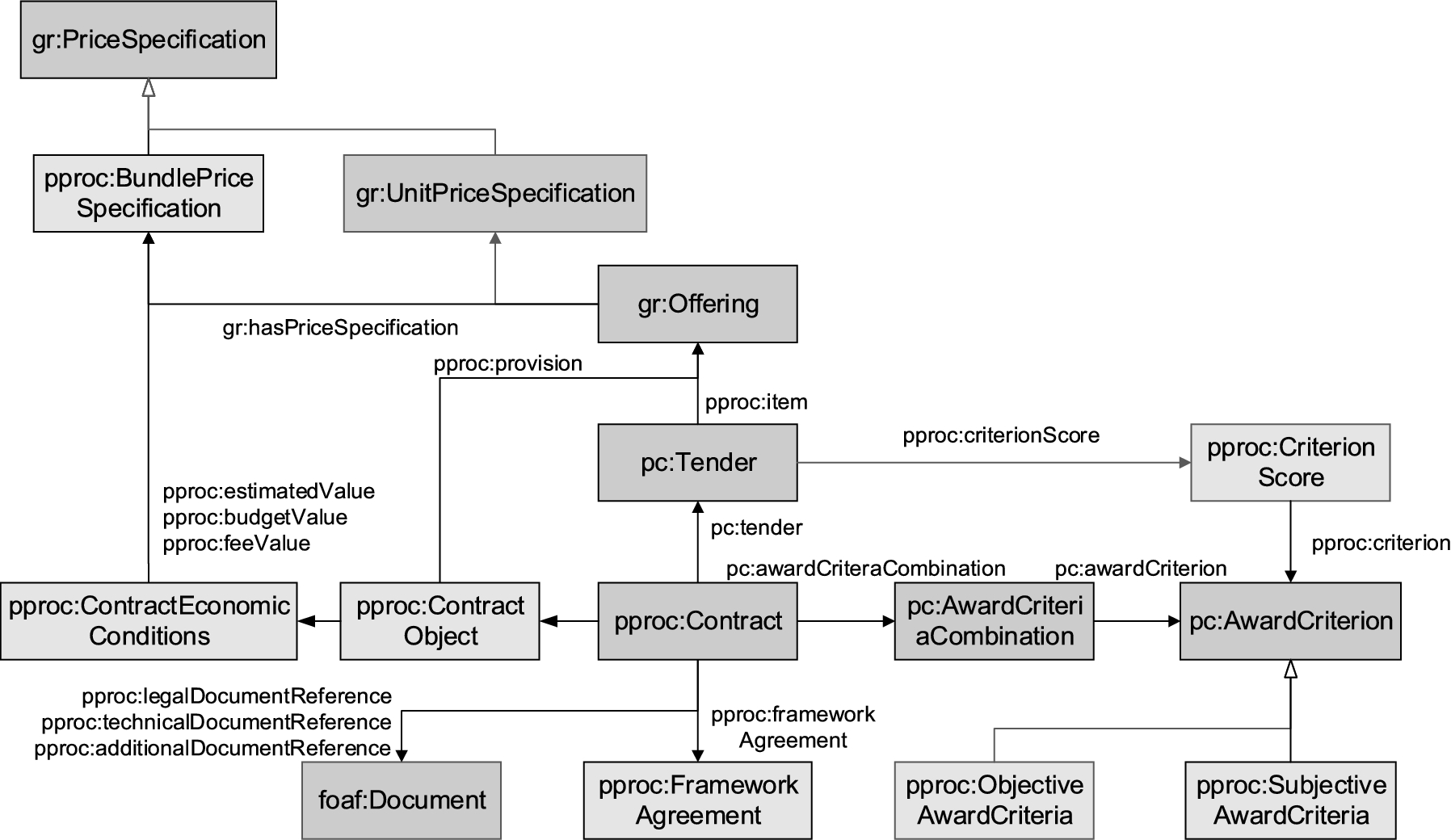
Contract object-related classes.
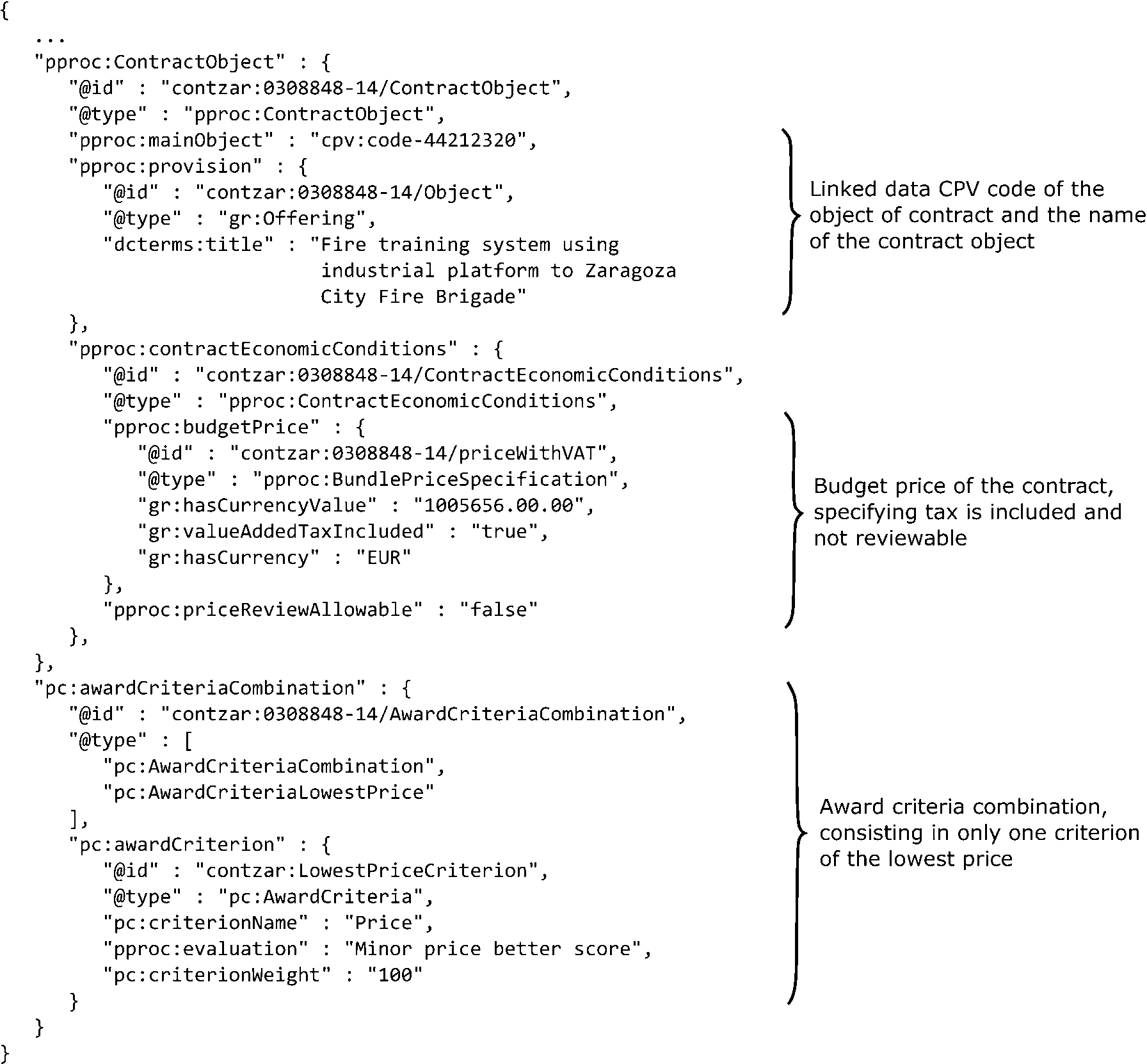
Representation in JSON-LD of the contract object of a supply contract.
Two different (non-exclusive) approaches can be used to define the product or service that forms the contract object. The first one consists in using the
To describe prices and payment options we use the
Finally, the classes that describe the criteria that will be used to award the tender also form part of this block. These are divided into objective criteria (such as the price and the delivery period), which can be quantified and applied through automated systems or by holding auctions, and subjective criteria, which are valued by experts.
Contract parts
To describe the parts involved in a public procurement procedure we use the Organization Ontology, which includes the classes and properties needed to describe organizational structures and their hierarchy, through the
To describe the persons grouped together to perform a task of the procedure, we use the
Next, the class

Parts-related classes.

Representation in JSON-LD of the contract parts of a supply contract.
Another block of information refers to the procedure followed during the procurement process. The first aspect to represent is the kind of procedure and, in contrast to the decision made while classifying contracts and tenders, we use SKOS to define the kind of procedure and its urgency, using two concept schemes (
We included in PPROC all the information about it that could be useful to suppliers, such as tender requirements and briefing meetings. However, the information about the procedure is very important for the control of contracting and, therefore, the ontology also includes classes to describe other points, such as the people that participate in the procedure or possible resources and their result (see Fig. 7). It is also necessary to know whether the type of procedure used is the one related to the contract, and the ontology has specific properties to do this, such as
Also, the term of the contract does not end with the execution, which is the time when the contracting procedure is considered to be finished. Contracts are often modified at a later time through specific procedures, which often change points such as the price or the term for completion. These modifications can be used to breach the principles of the contracting and, therefore, a fourth block is dedicated to this phase, which we call fulfilment. This contains classes that make it possible to represent the conditions and limitations that possible modifications to the contract are subject to. If these occur, they can also be represented through the
Regulation regarding these classes varies in the different territorial scopes. For example, the legislation for the Aragon region requires the publication of modifications to contracts, which is not the case with the Spanish legislation (although it will probably require it in the next reform of the law), or with European legislation. However, in any case, the block was considered necessary because the publication of modifications should be considered as good practice in terms of transparency.

Procedure-related classes.

Representation in JSON-LD of the contract procedure and fulfilment of a supply contract.
PPROC is already being used by two public authorities of different size and scope (Zaragoza’s City Council and the Provincial Government of Huesca), which are publishing open data about their public contracts so that they can be used not only by potential tenderers but also by citizens for transparency purposes. In both cases the corresponding PPROC-based RDF data is stored in a SPARQL endpoint,17
With regard to its future use by local administrations, it is important to mention that PPROC is recommended as the ontology to be used by smart cities offering their public contract data according to the proposed technical norm of the Spanish Association for Standardization and Certification (AENOR), UNE 178301 on Open Data for Smart Cities.19
The ontology is also used to publish information about public sector contracts in Spain as a whole. To do this, a mapping with the CODICE XML standard has been performed, and a continuous transformation process is being carried out. These are published in a SPARQL end point,20
Results of the query “Count of Contracts by Type” executed with the SPARQL endpoint that contains the public sector contracts in Spain
All of the competency questions about the contracting procedures defined in the ORSD have been transformed into SPARQL and can be resolved using the ontology.21
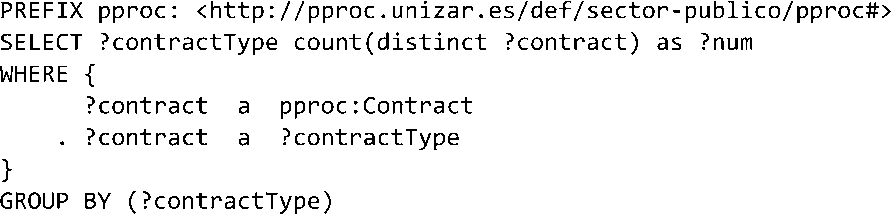
This query executed with the SPARQL endpoint that contains the public sector contracts in Spain, provides the result shown in Table 1.
However, as we have already mentioned, the information available in the different administrations varies greatly. Thus, while all these competency questions can be solved in the Zaragoza City Council’s SPARQL end point, in the case of the Provincial Government of Huesca, only the first four questions can be answered.
The Spanish Law 19/2013, regarding transparency, access to public information and good governance establishes a set of indicators and data that public entities have to publish on their websites. Some administrations also have their own rules about transparency, such as the Ordinance of Transparency and Free Access to Information of Zaragoza City Council,22
Budget volume in percentage of contracts awarded by each of the procedures provided for in the legislation.
A list of all contracts awarded by the City, classified by type and amount, indicating the object, the amount of the bid, the award and the final cost, the procedure for the award, the instruments through which they have been published where appropriate, the number of participating tenders, the awarded tenders, the duration or timing of planned and actual implementation, modifications, and any other information of special interest to the public.
This is all covered now at the buyer profile of Zaragoza City Council (see footnote 18).
In this paper we have described PPROC, an ontology for the description of public procurement that we have created with the aim of publishing, in a structured and standardized manner, public procurement information on the buyer profiles of public authorities. This ontology has the potential to improve efficiency (for example, since it enables computerized consultations of the profiles of the various administrations) and to increase transparency (including, for example, information about the committee members or the contract modifications).
PPROC has been developed following standard practices in ontology development, identifying competency questions with different stakeholders (public authorities, companies already working for them and legal experts), and published according to well-established recommendations for Linked Data vocabulary publishing. In this regard, it has been included at lov.okfn.org.23
With regard to future actions to be taken, one is to make the mapping between PPROC and the Open Contracting Data Standard (OCDS) that is being developed by the World Wide Web Foundation.24
Other initiatives focus on the use of the ontology as a resource for the integration of information about contracting procedures [11]. In this regard, work is being carried out in partnership with the Observatory of Public Procurement,25
The appraisal made by the final users of the ontology has been positive. Its adoption has resulted in a major improvement, not only regarding information provided to suppliers and to citizens, but also to the information system of the organizations. Specifically, it has facilitated the integration of information about contracts, which used to be managed in various services and through different applications, and has made it possible to give information a structure that is closely linked to the knowledge and terminology used by experts in procurement. PPROC has been developed with a perspective oriented to the legal institution, and that makes interdisciplinary work between engineers and legal experts easier during the development of the ontology and, once it is finished, more understandable for legally trained users and possibly for everyone else too.
Footnotes
Acknowledgements
PPROC was developed through the project “Optimization of public procurement using semantic technologies (ContSem)”, led by the company iASoft (Oesia) and funded by the Spanish Ministry of Industry, Commerce and Tourism (TSI-020606-2012-4). The authors would like to thank Miguel Angel Bernal (co-author of the ontology), and Carlos Bobed and Carlos Becana (contributors) for their cooperation in the development of PPROC, and also those responsible for procurement and the buyer profile and the technicians of the participating administrations in the project: the Zaragoza City Council (Maria Jesús Fernandez, Ana Budría, Laura Fernando, Victor Morlán and Rubén Notivol), the Provincial Government of Huesca (Cristina de la Hera, Montserrat Rodríguez and Javier Casado) and the Regional Government of Aragón (Ricardo Cantabrana, José María Subero and Eva Sanz).