




Abstract
A Semantic Web approach for an advanced access to legislative documents is presented in terms of a model of normative provisions and related axioms. In particular, relations between provisions are identified and modeled by introducing patterns able to describe Hohfeldian legal fundamental relations. Moreover, a query-based approach able to deal with relations between provision specific instances is described. Examples of semantic annotation of legal textual resources using RDF/OWL standards, as well as advanced access and reasoning facilities over provisions using SPARQL, are shown. The main benefit of the approach is represented by the ability to keep the complexity of the problem within a description logic computational tractability.
Keywords
Introduction
The legal domain is one of the most challenging areas for developing applications based on the Semantic Web principles, because of the complex nature of legal information and document workflow, as well as the peculiarities of legal users’ information needs, which require advanced information retrieval and reasoning services. As regards legislation, in particular, users are mainly interested in accessing norms rather than simply documents; they are particularly interested in knowing the relations between norms, having support to legal reasoning and consultancy services, as well as instruments to check procedures compliance with respect to specific statutes and regulations.
The development of advanced retrieval and reasoning services over norms can benefit from the description of the legislative texts semantics at different granularity levels: at the level of terms, thus describing the concepts actually expressed; at the level of the whole document, thus providing information on the subject matter of the act; at the specific level of norms, thus identifying duties, rights, sanctions, permissions, procedures, etc., such documents may contain, as well as actors and actions involved. Such semantic description allows legal practitioners and citizens to retrieve not only documents concerning a particular domain (for example the consumer law domain), but also the norms addressed to a specific actor or about specific actions.
Let’s consider a user who is willing to subscribe to a “distance contract”, for example through the Internet, in order to buy a financial service: the user might be interested to know which are his rights (as for example the right of withdrawal), either explicitly expressed or implicitly inferred because expressed in the form of a duty of the supplier towards the consumer, which are actually rights of the consumer himself. In this respect it would be useful to have a system able to retrieve the specific portions of legislation reporting the norms of interest, and also able to infer the norms that are implicitly expressed concerning the same type of rules. A similar scenario is the one in which a local public administration has to draft a Regulatory Impact Analysis (RIA) document. In this case the analysis of the impact on the legal order of the proposed norms, from the point of view of their compliance with the Constitution and the powers of the local authorities, will benefit from an advanced access and reasoning system on legislation.
One of the pre-conditions for implementing such services is to rely on legislative texts properly marked-up according to structural and semantic models for the Law. In literature several models (classification) of legal norms have been proposed, from the traditional Hohfeldian theory of legal concepts [20] until more recent legal philosophy theories [5,17,21,23,25], while related computational models have been implemented [16,19]. Nevertheless such computational models deal with ontologies and rules, whose combination is usually undecidable [18], without addressing the problem of identifying the reasoning schemas over norms that can be managed within a Description Logic (DL) computational complexity. Reasoning over norms within a DL framework guarantees the computational tractability of the problem and the possibility to rely on available automatic reasoners, without the need to implement tailored ones.
In this paper an approach for the development of advanced access and reasoning facilities on legislation within a DL computational tractability is presented. It is based on a definition of a semantic model for legislation in terms of normative provisions, presented in Section 2, which can be used to provide semantic description refinement to legislative resources available at a minimum level of structural mark-up. In particular, according to a view proposed in [6,7] specifically anchored to the structure of legislative texts, laws and regulations may be seen as a set of provisions, carried by speech acts [24,28]. Following this perspective, fragments of a legislative text are, at the same time, sentences, paragraphs, or provisions, according to whether they are seen from a formal or semantic view-point. In this context, in Section 3 possible kinds of relations between provisions are described. In Sections 4 an extension of the normative provisions model through Description Logic patterns able to deal with relations between provisions, as the Hohfeldian fundamental relations [20], are presented. In Section 5 an example of how this approach can support Hohfeldian inferences for improving provisions accessibility within a Description Logic framework is presented with respect to a European directive excerpt. In Section 6 specific relations which can be identified between provision instances are discussed, while in Section 7 an implementation of reasoning facilities over provision instances with respect to the same European directive excerpt is shown. Finally, in Section 8, some conclusions are reported.
A model of normative provisions
According to the model of normative provisions presented at first in [6] and [7], provisions can be described in terms of provision types (as Term Definition, Procedure, Duty, Right, Power, as well as more technical ones as Insertion, Abrogation, Substitution, etc.) and related attributes1
Also called arguments in [6].
The details of the Provision Model are widely described in [6] and [7]; in this paragraph the semantic organization of the model is briefly recalled.
In the Provision Model, provision types are organised into two main groups: Rules (introducing entities or expressing deontic concepts) and Rules on Rules (different kinds of amendments). Adopting a typical law theory distinction, well expressed by Rawls [23], Rules consist in:
Constitutive rules, which introduce or assign a juridical profiles to entities of a regulated reality; Regulative rules, which discipline actions or their substantial and procedural defaults (remedies).
On the other hand, Rules on Rules can be distinguished in:
Content amendments, which modify literally the content of a norm, or their meaning without literal changes;
Temporal amendments, which modify the times of a norm (come-into-force and efficacy times);
Extension amendments, which extend or reduce the cases on which the norm operates.
The values of provision attributes can be expressed by lexical units, or by concepts derived from thesauri/ontologies, able to provide additional information on the entities of the regulated domain [3,19].
For example, the following fragment (article 5, paragraph 1) of the European Directive 2002/65/EC, concerning the distance marketing of consumer financial services:
The supplier shall communicate to the consumer all the contractual terms and conditions and the information referred to in Article 3(1) and Article 4 on paper or on another durable medium available and accessible to the consumer in good time before the consumer is bound by any distance contract or offer.
An example of ontology for the European consumer law has been developed within the DALOS project2
Relations between provisions can be identified in order to highlight the meaningful links between different types of norms and to pave the way for reasoning over norms, expanding information actually selected by a norms retrieval system. Two kinds of relations between provisions can be identified: logical relations and technical relations.
Logical relations are relations between provisions which are necessary from a logical point of view, as the classical Hohfeldian relations. Hohfeld [20] identifies two relational schemes between provisions. The first logical relations scheme involves deontic concepts in terms of correlative relations between Right and Duty, as well as No-right and Privilege, and opposite relations between Right and No-right, as well as Duty and Privilege (Fig. 1).

Deontic concepts and their relations.
For example, if A has a right towards B, this is equivalent to B having a duty towards A. Similarly, if B has a privilege towards A, which means that B can do whatever he or she wants because B has no duty to refrain from doing it, A has no right to prohibit B from doing so.
The second logical relations scheme involves potestative4
Also called ‘anankastic’ in [11], expressing necessity conditions.

Potestative (anakastic) concepts and their relations.
For example if A has a power towards B, this is equivalent to B having a liability (namely a subjection) with respect to A. Similarly, if B has an immunity with respect to a liability (subjection to a power of A), it means that A is disabled to limit B’s immunity.
Technical relations between provisions, on the other hand, are relations not necessary from a logical point of view, but they derive from legislative techniques considerations; this means that they are possible and can be identified in legislative texts provided that the legislative drafter follows specific legislative technique recommendations in expressing such provisions. An example of such relations is the one existing between a Term Definition, introducing a concept identified by the attribute Definiendum, and all the other provisions having, as an attribute value, the value of such Definiendum. Another example can be the relations between the Duty of a specific Bearer to accomplish a specific Action towards a given Counterpart, as well as the Procedure to fulfill it.
While logical relations can be described at the level of Provision Model (see Sections 4–5) and are inherited by the related instances, technical relations can be identified and described at the level of provision instances only, because linked to the provision instances content (see Sections 6–7). As reported in [7] technical relations between provisions can be established directly by the legislator through references, within or out of the including act, or can be deduced by reasoning over provisions content, expressed by provisions attribute values. The relations established by the legislator through references can be easily detected and assume specific roles especially in handling amendments, in particular as regards automatisms that can be conceived to produce consolidated versions of legislative texts, as well as a guide in their consultation. The relations that can be deduced by reasoning, either logical or technical ones, are obviously more difficult to identify. This difficulty represents one of the main sources of ambiguities in the application of the law, therefore they will be discussed in Sections 6 and 7.
Logical relations between provisions can be described as axioms on provision types and attributes, as the Hohfeldian fundamental relations regarding Right/Duty, Liberty/No-right, Power/Liability, Immunity/Disability, as well as the relation between the Duty of a subject (duty Bearer) towards a Counterpart, which can be viewed as an implicit Right of the duty Counterpart towards the duty Bearer.
As previously discussed, a description of legislative texts in terms of provisions allows advanced access services on legislation, able to give reasoning facilities based on the theory of norms. A typical example can be a service able to exploit the previously mentioned logical relations by accessing the rights of a subject, either explicitly expressed or inferred. This can be obtained by describing the logical relations between Duty and Right at the level of the Provision Model.
For example article 5 paragraph 1 of the European Directive 2002/65/EC reported in Section 2, can be considered a provision of type Duty involving ‘Supplier’ and ‘Consumer’. In terms of Provision Model, such Duty of the ‘Supplier’ towards the ‘Consumer’ can be expressed in functional notation5
In this notation provision types are binary functions between provision attribute-value pairs as functional variables.
Duty(hasBearer=‘Supplier’,hasCounterpart=‘Consumer’)
Right(hasBearer=‘Consumer’,hasCounterpart=‘Supplier’).
This Hohfeldian relation underlines an equivalence between Duty and Right, representing the logical correlation between them, as long as the values of the duty Bearer and Counterpart are swapped, assuming symmetric roles in the Right provision, therefore involving equivalence relations between provision types and attributes. However, describing these relations in the Provision Model by establishing the equivalence relations Duty ≡ Right, as in [9], and hasBearer ≡ hasCounterpart would imply equivalence relations between any duties and rights, irrespective to the attribute types and values, as well as between all the provision types sharing equivalence relations between such attributes, which might produce inconsistent results in a provisions retrieval system.
For example a query aiming to retrieve provisions having Right(hasBearer = ‘Supplier’), would also give back Duty provisions having Duty(hasBearer = ‘Supplier’) because they satisfy the axiom Duty ≡ Right. Similarly, the previously mentioned query would retrieve back Right provisions having Right(hasCounterpart = ‘Supplier’), since they satisfy the axiom hasBearer ≡ hasCounterpart.
To avoid these problems, while relying on Description Logic6
Decidable subset of the First-Order Logic.
Decidable specialization of Ontology Web Language (OWL) implementing the Description Logic.
Firstly provision attributes are specified according to the related provision types, for example hasBearer and hasCounterpart attributes are distinguished in terms of
Hereinafter, provision types as OWL classes (starting with capital letters) and provision attributes as OWL properties (starting with lowercase letters) are written in serif font. The namespace is omitted for simplicity.
A model extension at the level of provisions type can also be provided by observing that a Right, in correlative correspondence with a Duty, is actually not explicitly expressed in the text, but represents an implicit provision, basically a different view of the Duty itself, where the values of the related bearer and counterpart attributes are swapped. Therefore, the Provision Model can be extended in terms of
Attributes can also be specified as regards both implicit and explicit provisions, so that
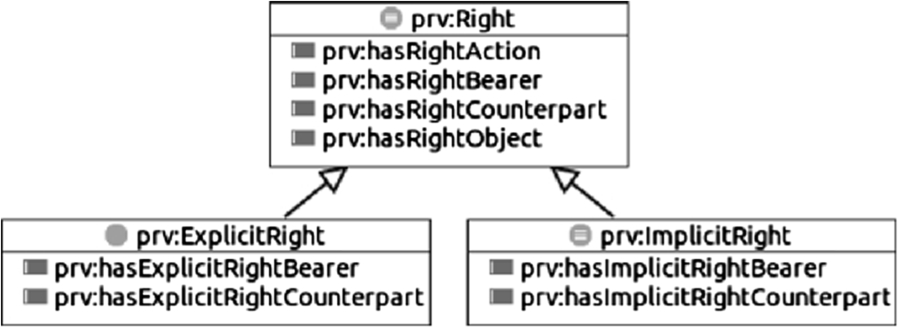
Extended Right attributes.
For each attribute (property) both domain and range can be specified: domain specifies the type of individuals a provision attribute applies to (e.g. the individuals of the class
Note that only explicit provision classes (and consequently explicit properties) will be used to mark-up textual provisions, as they are the only provisions actually (explicitly) expressed in legislative texts, while implicit provision classes act as a sort of “abstract” classes, which will be used for reasoning.
As an example of logical relations implementation in the Provision Model, let’s consider the following Hohfeldian relations:
the couple Duty/Right as examples of correlative deontic concepts;
the couple Power/Liability as examples of correlative potestative concepts9
Also called ‘anankastic’ in [11], expressing necessity conditions.
Similar considerations can be given for the deontic couple Liberty/No-right and the correlative potestative one Disability/Immunity, because they can be derived as negation of the opposite deontic and potestative couples, respectively.
To represent the Hohfeldian fundamental relations between

Sub-class and asserted equivalence relations between
As for the couple Duty/Right, an equivalence between Power and Liability represents an Hohfeldian relation as long as the values of Bearer and Counterpart of a Power are swapped, assuming symmetric roles in the Liability provision, therefore involving, in the Provision Model, equivalence relations between provision types and attributes. Such group of relations is isomorphic to the one between
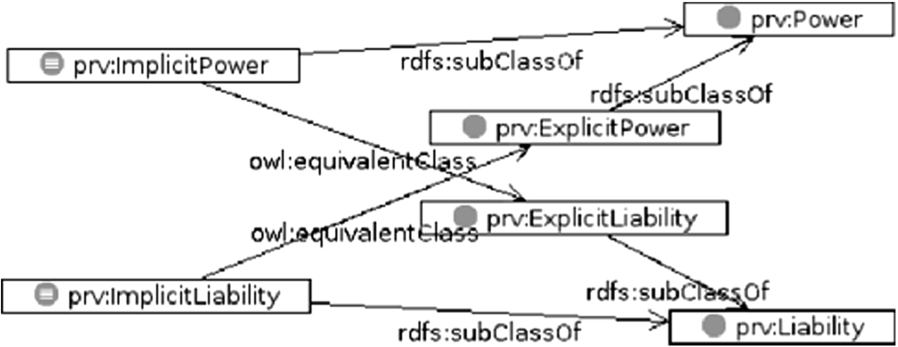
Sub-class and asserted equivalence relations between
Moreover, equivalence relations between implicit/explicit

Asserted sub-property and equivalence relations between
The reader can imagine a symmetric view for the relations between a right bearer and a duty counterpart, as well as between a liability bearer and a power counterpart in their explicit and implicit views.10
A first OWL 2 DL release of the Provision Model, limited to demonstrate this approach is available at http://godel.ittig.cnr.it/ontologies/ProvisionModel.owl.
Note that the proposed patterns do not interfere with the equivalence relation between
Therefore provisions properties are preserved, but the expressivity of the model is improved to provide enhanced retrieval and reasoning services. The proposed pattern in fact aims to introduce:
Properties equivalence, allowing direct swapping on attributes contents for addressing provision relations, without the need of using conditional statements (ex: if the value of
Abstract classes (namely classes not used for mark-up, in our case “implicit” classes) so to provide different views (implicit and explicit views) on the same provision, as well as retrieval services able to access implicit provisions only (ex: provision instances where
Moreover, by providing equivalence relations between symmetric implicit and explicit classes and attributes, the proposed pattern is able to avoid inconsistent deductions (as for example that bearers and counterparts freely mix in the same provision), producing on the other hand inferential deductions (for instance attribute mixing) which keep semantic consistency. For example, given the following explicit right:
ExplicitRight(hasExplicitRightBearer = ‘Consumer’) ExplicitRight ≡ ImplicitDuty hasExplicitRightBearer ≡ hasImplicitDutyCounterpart ExplicitRight(hasImplicitDutyCounterpart = ‘Consumer’) ImplicitDuty(hasExplicitRightBearer = ‘Consumer’) ImplicitDuty(hasImplicitDutyCounterpart = ‘Consumer’)
given that:
the following consistent deductions, describing the same provision instance, can be obtained:
which are semantically consistent. For example, being “Consumer” an explicit bearer of an explicit Right, it is also to be considered an implicit counterpart of the same provision, viewed as an implicit Duty.
Finally, it is worth to stress that the introduced axioms are not dealing with relations between different provision instances expressed in a legislative text (which could be better described in terms of existential restrictions, as for example: ‘for every explicit duty there is an implicit right where bearer and counterpart are swapped’, or in terms of relations between attribute values (Section 6)), but they deal with different views (explicit and implicit views) of the same provision instance. In this perspective all the deductions derived from the established equivalence relations between classes, as well as the deductions derived from mixing provision qualified properties, are valid, as previously discussed.
In this section an example of how this approach can be used for a provision retrieval system able to deal with logical relations is shown. In particular an example of Hohfeldian reasoning over provisions is described.
Semantic annotation
Let’s first consider an excerpt of Directive 2002/65/EC,11
Here the URN-LEX convention for fragments identification is used (
Semantics of Directive 2002/65/EC excerpt in functional notation
Having defined the
According to the recommendations given by the European Commission in “Study on persistent URIs, with identification of best practices and recommendations on the topic for the MSs and the EC”, within the ISA Programme.
XML serialization of the Resource Description Framework language for semantic annotation of the resources.
Having an OWL-DL description of the Provision Model and provision instances, a provisions management system can be given inference facilities through an OWL-DL reasoner able to derive an inferred model. In this example the Pellet16
Query language for RDF.
In case the non-inferred model is queried, no provisions are retrieved since only
In case the inferred model is queried, all the inferred provisions are retrieved, either annotated as
Virtual SPARQL query expansion corresponding to inferences on provision axioms. The [≡ prv:hasExplicitDutyCounterpart] expression represents the equivalence relation
Moreover, the distinction between implicit/explicit provisions and attributes allows to select, for example, among the Rights of a Bearer, only those not explicitly expressed in the text. The related query will be:
As previously introduced (Section 3) another kind of relations between provisions can be identified: we call them technical relations because they are not necessary from a logical point of view, but they are possible and derive from legislative techniques considerations. Such relations can be detected at the level of provision instances only.
An example of them can be the relation existing between a Duty of a Bearer to accomplish a specific Action towards a Counterpart, the Procedure describing how to fulfill such duty, the Exceptions to it, as well as the Sanction such Bearer may face if he does not fulfill such duty. In the excerpt of Directive 2002/65/EC in Section 5.1, Art. 5 paragraph 1 and 2 represent a Duty and the correlated Procedure (see also Table 1).
Another example of technical relations between provisions can be the one existing between a Term Definition introducing a specific entity through its Definiendum and other provisions involving the same entity. In the excerpt of Directive 2002/65/EC in Section 5.1, Art. 2 paragraph 1 letter c) and Art. 5 paragraph 1 and 2, as well as other provisions involving the ‘Supplier’, represent correlated provision instances.
In terms of Provision Model such relations can be established by the legislator through references or deduced by reasoning over provisions content and detected through the identity between a number of values in corresponding attributes of different provisions. In this respect [7] distinguishes between strong and weak relations between provision instances according to whether there is identity between all the values in corresponding attributes (strong relations) or only between some of them (weak relations). The number of attributes and values in identity relation gives the degree of strength/weakness of the relation itself [7].
Technical relations between provision instances are particularly interesting for providing users with advanced retrieval services. For example, while querying for his duties, a supplier might be also informed about the procedures to fulfill such a duty and possible sanctions in case of non-compliance.
Provision technical relations example
In this section a possible reasoning implementation dealing with technical relations between provisions is shown. On the basis of the semantic annotation proposed in Section 5.1, an example of a SPARQL query able to retrieve the supplier’s duties is:
Firstly, in case the inferred model is queried, the paragraphs with
This query will retrieve the
Conclusions
The combination of Provision Model and domain ontologies can represent an approach for semantic annotation of legislative texts, with the aim of providing advanced retrieval and reasoning facilities over norms by exploiting relations between provisions. In this paper an approach has been proposed to describe logical relations between provisions, as the Hohfeldian fundamental relations, using OWL-DL: it is implemented by extending the Provision Model to represent either implicit or explicit provision types and attributes. Similarly, an approach dealing with technical relations between provisions, involving provision types, attributes and attribute values, has been presented.
At this stage of development this work represents a contribution to identify reasoning schemas that can be dealt within a DL computational tractability by OWL-DL, thus exploiting existing DL reasoners, without using SWRL or RIF as in [19] or rules description using specific XML schemas, as in [16]. The identification of the sufficient conditions within which legal reasoning can be kept within a DL complexity represents a possible future development of this work.
On the other hand a drawback of the approach is the need to rely on legislative texts properly marked-up into fragments or formal partitions (structural mark-up), as well to qualify them in terms of provisions (semantic mark-up). The availability of XML mark-up of legislative texts into formal partitions is being implemented at institutional levels within several legislative XML projects [13,27] and more recently within Linked Open Data initiatives. In order to guarantee the scalability of the approach, the use of software tools supporting the activity of structural mark-up is highly recommended: they can be word processors (editors) able to support mark-up activities [2,22,29], or textual parsers able to detect legislative documents structure [4]. The qualification of such resources in terms of provisions semantics (semantic mark-up) is a more complex task, that can represent a burden for legislators or for documentalists, because it is an intellectual activity which is subject to different interpretation especially as regards the identification of the actual meaning of the norms. Therefore, it is not a task that can be accomplished by an (semi-)automatic transformation of a formal XML markup into RDF,18
For example
The approach presented in this paper can be effectively used to provide a semantic annotation refinement to legislative documents, published according to the Linked Open Data principles, thus delegating to different actors, as public administrations, the burden of providing legislative documents at a minimum level of interoperability, including XML structural mark-up.