Stem cell-derived tissues that recap endogenous physiology are key for regenerative
medicine. Yet, most methods yield products that function like fetal, not adult tissues.
Organoids are typically grown in constant environments, while our tissues mature along
with behavioral cycles. Here, we show that inducing circadian rhythms in pancreatic islet
organoids, by entraining them to daily feeding-fasting cycles, elicits their metabolic
maturation. Our results show that rhythms can be harnessed to further functional
maturation of organoids destined for human therapeutics.
Islet transplantation can cure insulin-dependent diabetes, but is curbed by scarcity of
acceptable islets [1]. Stem cell-derived islet
organoids offer an unlimited islet supply, yet an immature physiology limits their
therapeutic use [2]. To find maturation-driving
mechanisms, we studied regulatory dynamics during their stepwise formation from human
pluripotent stem cells [3].
MATERIALS AND METHODS
Human cell lines, primary samples, and rodent strains are detailed in [3]. We devised flow sorting strategies to purify cells
at successive stages of differentiation into the islet lineage [4]. These included stem cell-derived β (SC-β), insulin+
glucagon+ polyhormonal (PH) cells, and their progenitors. Cells were subject to
whole-genome bisulfite sequencing (WGBS), assay for transposase-accessible chromatin by
sequencing (ATAC-seq), chromatin immunoprecipitation sequencing for two histone marks
(H3K27ac and H3K4me1), and directional total RNA sequencing (RNA-seq), as detailed in [3]. Computational methods are described elsewhere
[3, 5–7]. Animal
studies were conducted as described in [8]. Cell
culture methods and assays are detailed in [3].
RESULTS
Our studies reveal mechanisms controlling cell fate during islet organoid development and
show that organoids are amenable to functional improvement by circadian modulation.
Regulatory dynamics during organoid formation. (A) Islet organoid
formation recapitulates human islet development [3]. Pluripotent stem cells are sequentially differentiated into endoderm,
pancreatic and endocrine progenitors, which generate islet cells (insulin+ β
or insulin+ glucagon+ polyhormonal counterparts). (B)
We devised tools for purification of live islet lineage intermediates [4]. Sorting SC-β from PH cells by flow cytometry,
based on staining for the indicated markers. Typical population purities, assessed by
fixing sorted cells followed by staining for C-peptide and GLP2 (byproducts of
proinsulin and proglucagon processing), are shown to the right. This enabled
comprehensive molecular profiling during stepwise organoid differentiation.
(C) We used H3K27ac enrichment to define enhancer domains, and examined
their chromatin accessibility, modification, methylation and transcription dynamics
during organoid formation. Tracks show normalized ATAC, H3K4me1, H3K27ac, RNA, and WGBS
signal over a region 1.5x greater than the enhancer domain shown below. Heatmaps display
relative signal over the enhancer domain. The data link enhancers to the control of
stage-specific gene expression.
Epigenetic priming predicts lineage potential. (A-B) The competence to
execute specific cell fates can be linked to a gain of H3K4me1 before H3K27ac deposition
at lineage-specific enhancers (9). We find that α-specific enhancers
are selectively H3K4me1-marked in PH cells (A). Following transplantation under the
kidney capsule of immunocompromised mice, PH indeed resolve toward α
cells, as evidenced by graft staining for insulin (green)/glucagon (red). SC-β cells (B)
show the opposite trend, as expected. Thus, epigenetic priming steers PH toward an
α cell fate.
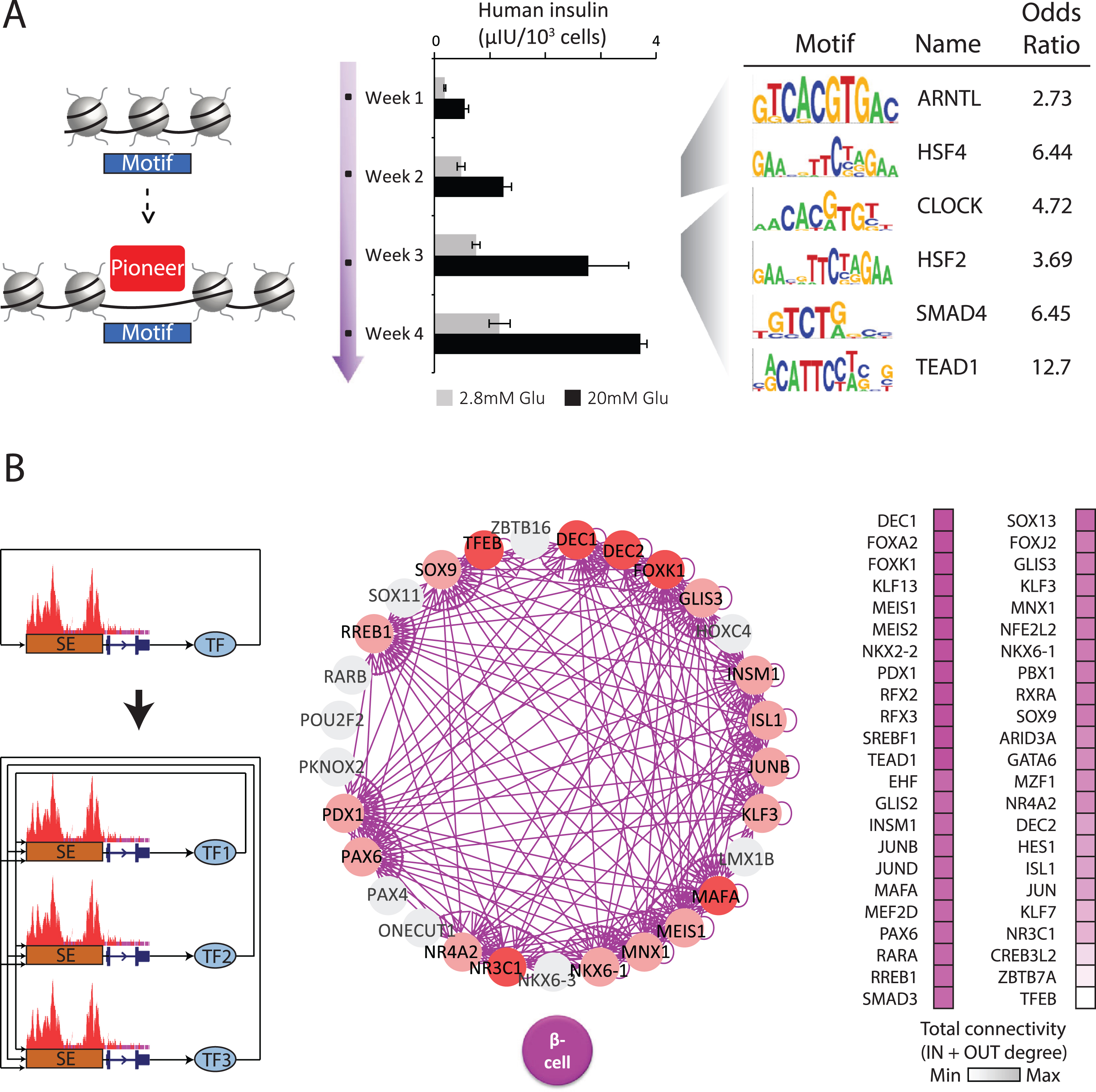
Organoid maturation pioneers & regulatory circuits. (A) Developmental
competence is endowed by chromatin-opening pioneer factors (10). To find maturation
pioneers, we examined chromatin openness over a 4-week time course when organoids
develop glucose-coupled insulin secretion (center). Recognition motifs within newly
opened chromatin sites (left) identify CLOCK and ARNTL/BMAL1 among the top-enriched TFs
(right), casting them as pioneers during the onset and refinement of β cell function.
(B) Stable cell states are set by TFs via autoregulatory loops involving
joint formation of extended or super enhancers (SEs) (7). A cell’s core regulatory
circuit (CRC) can thus be modeled by finding SE-driven TFs in interconnected
autoregulatory loops (left). Using this logic, we generated CRC models that effectively
capture known master β cell regulators (center). Nodes represent stage-specific TFs that
partake (pink) or not (gray) in the β cell CRC. Edges represent predicted
transcriptional regulatory relationships between TFs within the same CRC. TFs unique to
β cells are highlighted in red. Ranking CRC TFs by their connectivity (right) highlights
the circadian regulator DEC1/BHLHE40 as the mostinterconnected.
Circadian entrainment triggers organoid maturation. (A) We asked whether
clock entrainment can foster in vitro organoid maturation. Entrainment
to daily feeding/fasting rhythms using various stimuli (glucose, arginine, forskolin, or
insulin) was followed by glucose-stimulated insulin secretion (GSIS) assays over 72 h
(top). Following entrainment (middle), organoids gain rhythmic GSIS (red) with
significantly expanded stimulation capacity relative to parallel mock-treated
counterparts (gray). Oxygen levels in the medium of unstimulated cultures following
entrainment also cycle (bottom), as measured by partial O2 pressure (blue).
This links GSIS oscillations to metabolic rhythms. (B) Circadian
entrainment enhances single-cell glucose responsiveness. Calcium staining using Fluo4-AM
reveals that entrained cells (red) flux significantly more calcium in response to
stimulation than most ( 75%) mock-treated counterparts (gray). Thus, enhanced
responsiveness reflects new cellular states.
Maturity-driven genomic rhythms & in vivo function.
(A) We investigated how circadian entrainment promotes organoid
maturation. RNA-seq reveals >10,000 genes (31% of all detected) that oscillate
(p < 0.05, harmonic regression test for rhythmicity) specifically
upon entrainment (left). These enrich for functions in energy metabolism (right),
consistent with metabolic rhythms. We also detect antiphasic insulin/ glucagon
expression (top), recalling in vivo priming of their secretion in
anticipation of diurnal/nocturnal demand. This provides a molecular basis for circadian
variation in insulin responses, via rhythmic control of its synthesis, transport, and
secretion. (B) Differential gene expression analysis reveals upregulation
of core clock TFs (blue triangles) in entrained vs. parallel mock-treated counterparts,
indicating that entrainment not only synchronizes but also activates islet organoid
clocks. Entrainment also induces maturity-linked factors (green triangles) and machinery
involved in energy metabolism and insulin secretion (rest of triangles), consistent with
enhanced GSIS capacity. (C) To study how genomic/function rhythms persist
following entrainment, we used ATAC-seq to detect thousands of newly opened chromatin
sites 12 h post-entrainment, most of which remain after 72 h. These are overrepresented
at maturity-linked genes such as IAPP (shown) and direct GSIS effectors, suggesting that
circadian control of genes enabling mature GSIS persists as a result of stable chromatin
changes. (D) We tested whether maturation in vitro leads
to better function in vivo. Entrained organoids were transplanted under
the kidney capsule of immunocompromised mice, and serum human insulin was assayed
before/30 min after a glucose injection. Robust GSIS (>2 mIU/ml,>1.5-fold
stimulation) was evident as early as 3 days post-transplant, and remained 24 days
after.
DISCUSSION
This work provides a proof-of-principle that circadian control can drive functional
maturation of stem cell-derived organoids destined for human therapeutics. Islet maturity
develops between birth and weaning, along with onset of circadian behavioral (sleep,
feeding) cycles. We show that recreating fasting/feeding cycles recapitulates metabolic
maturation in islet organoids. Entrained organoids develop a capacity to anticipate diurnal
changes in insulin demand, and are functional within days—rather than weeks—of
transplantation. Circadian entrainment may be harnessed to further functional maturation of
other stem cell-derived products, consistent with the ability of clock regulators to bind
distinct targets in distinct tissues. Thus, our general approach may inform attempts to
control the fate and function of any human cell type.
CONCLUSIONS
Epigenome dynamics show how epigenetic priming steers endocrine cell fates.
Modeling maturation regulatory circuits uncovers roles for circadian controllers.
Circadian entrainment triggers organoid maturation via clock-controlled metabolic
cycles.
Entrained organoids gain stable genomic changes and function within days of
transplant.
ACKNOWLEDGEMENTS
The authors thank Deanne Watson, Dani Swain, Jeff Davis, Ramona Pop, and Samantha Collins
for reagents and assistance with experiments; the HSCRB histology and flow cytometry, BPF
next-gen sequencing, and Bauer flow cytometry and sequencing core facilities at Harvard
University for technical support and critical discussions. J.R.A-D. is a Howard Hughes
Medical Institute Fellow of the Life Sciences Research Foundation. D.A.M. is an investigator
of the Howard Hughes Medical Institute. This work was supported by the Max Planck Society
and NIH grants DP3K111898 and P01GM099117 (A.M.) and by grants from the Juvenile Diabetes
Research Foundation, Helmsley Charitable Trust, and the JPB Foundation.
AUTHORSHIP
J.R.A.-D., J.D., N.R., J.H.R.K., and A.H. performed experiments. J.R.A.-D., J.D., J.C., and
J.R.S. conducted bioinformatics analyses. J.R.A.-D., J.D., J.H.R.K., A.M., and D.A.M.
designed the research, interpreted results, and wrote the manuscript.
CONFLICT OF INTEREST/DISCLOSURE STATEMENT
D.A.M. is a founder and scientific advisory board member for Semma Therapeutics. All other
authors have no conflict of interest to report.
CONFERENCE INFORMATION
15th Annual Harvard Stem Cell Institute Retreat: Translating Science to the Clinic, Virtual
(Wednesday May 20, 2020).
SneddonJB, TangQ,
StockP, BluestoneJA, RoyS,
DesaiT, et al.
Stem Cell Therapies for Treating Diabetes: Progress and Remaining
Challenges. Cell Stem Cell.
2018;22(6):810–23.
3.
Alvarez-DominguezJR,
DonagheyJ, RasouliN, KentyJHR, HelmanA, CharltonJ, et
al. Circadian Entrainment Triggers Maturation of Human In Vitro
Islets. Cell Stem Cell.
2020;26(1):108–22e10.
4.
RasouliN, MeltonDA, Alvarez-DominguezJR.
Purification of Live Stem-Cell-Derived Islet Lineage
Intermediates. Curr Protoc Stem Cell Biol.
2020;53(1):e111.
5.
Alvarez-DominguezJR,
ZhangX, HuW.
Widespread and dynamic translational control of red blood cell
development. Blood.
2017;129(5):619–29.
6.
Alvarez-DominguezJR,
KnollM, GromatzkyAA, LodishHF.
The Super-Enhancer-Derived alncRNA-EC7/Bloodlinc Potentiates Red Blood
Cell Development in trans. Cell Rep.
2017;19(12):2503–14.
7.
Saint-AndreV,
FederationAJ,
LinCY, AbrahamBJ, ReddyJ,
LeeTI, et al.
Models of human core transcriptional regulatory
circuitries. Genome research.
2016;26(3):385–96.
8.
PagliucaFW, MillmanJR, GurtlerM, SegelM,
Van
DervortA, RyuJH,
et al. Generation of functional human pancreatic beta cells
in vitro. Cell.
2014;159(2):428–39.
9.
CreyghtonMP, ChengAW, WelsteadGG, KooistraT, CareyBW, SteineEJ, et
al. Histone H3K27ac separates active from poised enhancers and
predicts developmental state. Proc Natl Acad Sci U S A.
2010;107(50):21931–6.