



Abstract
Between 2018 and 2022, the Friedrich-Ebert-Stiftung (FES, lead agency) in cooperation with the International Labour Organization (ILO) and the German Institute of Development and Sustainability (IDOS) conducted an empirical research project on ‘informal employment, social security, and political trust in sub-Saharan Africa’. Our opinion poll provides novel insight into informality and sheds light on the views and perceptions of people informally employed with regard to health issues, views on trust in state and government, self-organization, and interest in trade unions. The project improves the understanding of access to public goods and their provision; offers entry points for policymaking to provide social protection for the large (informal) majority of the African labor force; and establishes findings about distributional justice.
Keywords
Introduction
The Friedrich-Ebert-Stiftung (FES, lead agency), in cooperation with the International Labour Organization (ILO) and the German Institute of Development and Sustainability (IDOS), conducted an empirical research project on “informal employment, social security, and political trust in sub-Saharan Africa” to provide novel and substantial empirical insight into informality in African societies [1]. While statistics on informality have become available in recent years [2] and we get a better understanding of the prevalence, trends, and structure of the informal economy, we still know very little about the political and societal context of informal labor, the distribution or adequacy of public goods provisions to people in informal employment, the expectations of and trust in states’ ability to assist them, or how people organize to pursue common goals. This black box becomes a burden in particular to policymaking if it tries to take account of the needs of informal workers, and the barriers to overcome when addressing their general vulnerability and poverty.
The collaborative research project sheds new light on the social situation of people informally employed and their views and perceptions with regard to health issues, trust in the state and government, self-organization, and interest in trade unions. A first round of countrywide representative studies was implemented in Benin (2018), Kenya (2018), Senegal (2019), Zambia (2019), Côte d’Ivoire (2020), and Ethiopia (2020). Two countries (Kenya 2020; Senegal 2022) were surveyed twice to care for changes occurring during the COVID-19 pandemic [3]. National survey institutes that are part of the Afrobarometer network were the implementing partners in the survey countries. Additional technical support, including data management, was provided by the Institute for Development Studies (IDS), University of Nairobi. Members of these institutions met on various occasions to jointly develop the questionnaire and to agree on the details of the survey protocol.

Demand for better state services by priority (top priority).
The project improves the understanding of access to public goods and their provision; offers entry points for policymaking to provide social protection for the large (informal) majority of the African labor force; and establishes findings about distributional justice.
The study may possibly be the first ever representative opinion poll on the informally employed in sub-Saharan Africa. To allow for a wide variety of sub-group building, data on informal households was collected with regard to members’ income, age, gender, and education, as well as health status, working time, and working conditions. Beyond understanding the views and motivations of the informally employed, the data can be used to analyze socio-economic profiles such as class formation and income inequality. Some of the findings have already been published [4]. The data are put into open access and are available to researchers for further exploration [5].
The sample was designed as a representative cross-section of all informally employed residents aged 15 or older in a given country. The selected sample was achieved by random selection methods at every stage of sampling and the application of probability sampling based on population size [4, chap9]. Interviews were conducted as face-to-face interviews in vernacular languages, and answers were documented on tablets, which were preloaded with the questionnaire consisting of 143 main questions.
Overall, 11,829 households with 64,154 members were surveyed. Persons in employment were 22,602, of which 1,194 were in formal employment and 21,408 in informal employment. 1,062 households were mixed households, with some members in informal employment and others in formal employment, while the remainder were pure informal. The questionnaire included screening questions establishing whether the household members were in employment or not and, if so, whether this was formal or informal employment. For those households with at least one member in informal employment, additional questions were asked in relation to this person(s). Households with all members in formal employment, and those with all members engaged in farming for their own final use were thereby not asked this second stage of the questionnaire and were therefore excluded from the sample.

Membership in health insurance schemes, free access to national health services, and direct financing by the employer (figures in percentage). Notes: Proportions can be added as each additional mechanism is assessed to take into consideration workers not yet covered by other arrangements to avoid any double counting. The assessment of coverage by (tax-financed) national health services should be read as “workers in informal employment living in households where at least one household member, in need of health care, had access to free medical care”. *The question on direct payment of health expenditure by the employer was not available in Benin and Kenya and not usable in Ethiopia. **No additional coverage by national health services was captured in Benin.
Informal employment was categorized into four main groups. Employers and own-account workers were considered informal when their business was not registered in the national registry for company taxation; they were separated by having at least one regular employee. Employees were grouped as informal if employers did not pay contributions to social insurance schemes [6]. Contributing family workers were defined as informal by default [7, 8].
In this section, we present some of the findings (Chapter 2) that the participating institutions consider particularly important. Due to space limitations, we restrict ourselves to six such findings. We add a short discussion (Chapter 3) on methodological points that may be seen as particularly important for all empirical research on informal employment.
The demand for better access to health is the most important expectation for the delivery of state services
To understand the expectations of the informally employed on access to state services and to identify the personal needs hierarchy, we presented a list of eight services [9] considered ‘key responsibilities’ of the state to society. Respondents were first asked to assess in each case whether the government should improve a respective service on the list. Then, they were asked to rank the services according to their personal priorities.
In a six-country average, improved health services were considered the top demand (31.5%), ahead of better schools and education (23.4%). Better pensions for the elderly and better police services were placed at the bottom (see Figure 1). Unsurprisingly, the personal needs hierarchy correlated negatively with the factual supply side. When access to health services improved, other services moved ahead in the need’s hierarchy. On various indicators [10], Kenya, Zambia, and Ethiopia fared better in providing health services to their populations than the other three countries, and, consequently, the urgency for further improvement declined, and, in their cases, better schools and education or better water supply became the top priorities. In countries, where access to health services was perceived as particularly bad, as was the case in Senegal, Côte d’Ivoire, and Benin, the call for state action in regard to health outranked others by far.
Willingness of workers in informal employment (non-members) to join a health insurance scheme.
Interestingly, the personal needs hierarchy in regard to health is hardly dependent on urban-rural residence, income, age, or gender. In Zambia and Kenya, the age cohort 65+ does rank pensions higher than younger age cohorts, but health issues remain ahead of calls for pensions [4, pp. 13-15][11].
Overall, socio-economic factors are not yet at work to develop a differentiated class-based need structure, and the ranking appears to be typical for the informally employed as a whole. Given the weight of the informal economy, the prioritization of needs can be seen as a reflection of general significance within a country.
Social health insurance coverage [12] differs considerably between the survey countries and ranges from 2.3 percent in Benin to 44.3 percent in Zambia, but all countries reveal a critical coverage gap, and the majority of the informally employed remain outside of any financial protection schemes (see Figure 2). Where financial protection is available, it may not be sufficient, and many who go for medical treatment still rely on personal savings. When risky sources like borrowing money or selling assets become the main means for covering medical bills, many are forced to forego treatment not because medical services are not available but because they do not have the means to pay for them.
Against this background, it may not be surprising that a majority of the informally employed who do not have social health insurance expressed their interest in taking membership even when it ‘means contributing …on a regular basis in order to receive financial compensation when needed’. Between 56 percent in Benin and 81 percent in Côte d’Ivoire declared their willingness to join a contributory health protection scheme (see Figure 3). The gap between urban and rural residents is typically small or nonexistent. The need for financial protection from the risks of falling sick can be called a general requirement, independent of the place of living.
Without reference to a particular package of covered health benefits, respondents were asked to indicate the level of premium they would be willing to pay. The answers can be taken as a rough estimate of what respondents consider reasonable in regard to their personal financial situation. With the exception of a few individuals who were unwilling to pay anything, there is, on average, little variation among the six countries in the proposed per capita amounts. “Converted into US dollars per month, workers in informal employment interested in joining a scheme would be ready to pay the equivalent of around one US dollar per month in Zambia, Benin, and Ethiopia and up to around two dollars in Senegal, Kenya, and Côte d’Ivoire” [4, p. 33]. When comparing the ’proposed contribution level’ in a reality test to existing schemes in three countries, 20 percent in Benin, 20 to 25 percent in Kenya, and 57 percent in Senegal opted for a premium that would allow them to join an already existing scheme. Others would need at least partial subsidization of contributions.
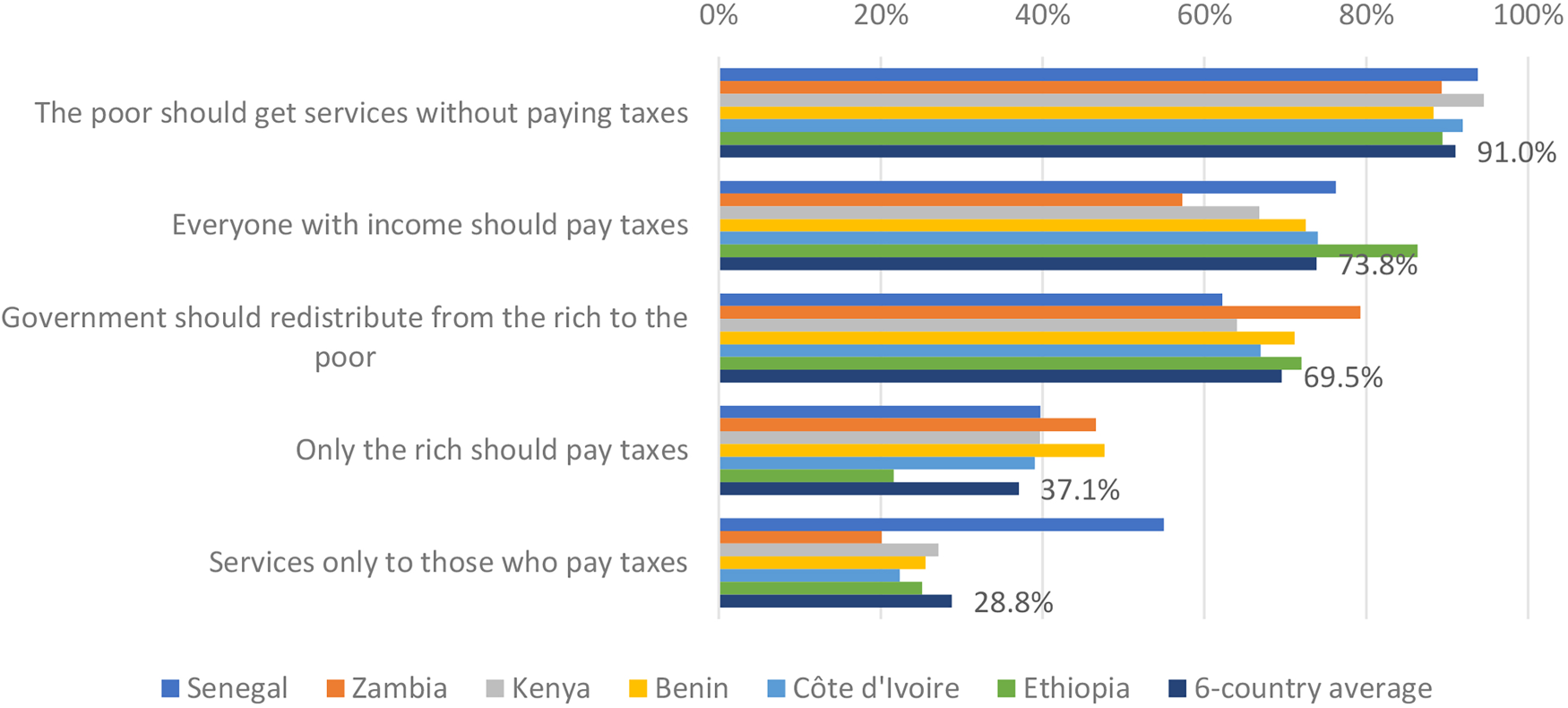
Rates of agreement to various statements on taxation and public service delivery.
Do people in informal employment consider it legitimate for the state to collect taxes? Who should pay taxes? And, on the other side of the coin, who should benefit from state services financed by collected taxes? To better understand how people in informal employment would like the state to act and how this corresponds to the perceived factual situation, different “opinions” were included in the form of statements.
The first statement is directed towards the broadening of the tax base (see Figure 4). A clear majority (73.8%) in the six countries supports the view that everyone earning an income should pay taxes. The understanding by implication is that people in informal employment should be taxed as well and should contribute to finance state activities.
A second statement captures the request for a social state. In all countries, the overwhelming view (91%) is that the state should support the poor regardless of their inability to contribute. A strong majority opposes, accordingly, the demand that only tax payers should benefit from state services.
A third statement outlines the scope and limits of the state’s redistribution of income. On average, only a minority (37.1%) subscribes to the view that only the rich should be taxed. The majority objects to the suggestion that the state should exclusively or primarily be financed by the rich, but it supports (69.5%) the idea that the rich should have a larger burden in financing state services. This can be interpreted as substantial support for progressive taxation.
A fourth statement describes the readiness to accept a higher personal tax burden if additional revenues are used for different outcomes (see Figure 5). On average, a majority (61.5%) is prepared to pay more taxes or fees “if I benefit.” The majority increases (74.6%), if people “poorer than me benefit”. As a result, it seems people are ready to pay more if they see their financial contribution coming to ‘a good end’.
There is a considerable spread in the level of readiness for taxation, with Kenya and Benin showing ‘the highest level of reservation’ to accept additional taxes and Senegal and Ethiopia showing the ‘highest support’ for sharing the costs of state spending geared towards desirable goals. But all countries indicate a majority in favor of higher personal taxes, if used to finance free health services.

Readiness to pay more taxes (rates of agreement to statements).
Confronting the vision of a fair tax state with reality, the perception changes somehow (see Figure 6). Taking the six countries together, opinions are split into two fairly equal camps as to whether the wealthy already contribute enough taxes (49.1%) or should be taxed more (44.2%). In Senegal (40.1%) and above all in Kenya (27.0%), only a minority approves of the current tax load for the wealthy and wants them to pay more, while in Côte d’Ivoire (59.1%) and Ethiopia (60.2%), a majority declares satisfaction with the current contribution by the wealthy. Views of informal labor in Benin and Zambia are split in the middle.

Views on the fairness of current taxation and service delivery (rates of agreement to statements).
The same can be said about the perception of the fairness of the existing public service delivery in exchange for taxes and fees (see Figure 6). Overall, about half of respondents (46.5%) consider current public service supply to oneself as fair in relation to their own tax contributions, while the other half perceive delivery as discriminatory and not balanced. Senegal is the outlier, in that 60 percent of respondents declare satisfaction with what they get as state service, while in other countries, satisfaction hovers between 36 percent and 51 percent. Overall, two opposing sentiments with nearly similar support can be observed. One sentiment views government as ignoring informal labor and being discriminative; the other sentiment sees government in a balanced fiscal relationship with informal labor and services are provided in a fair exchange against taxes.
People in informal employment are not tax evaders or want to be freeriders. They have a clear understanding that state services can only be provided if they are paid for by the people [13]. Legitimacy and acceptance of taxation depend, however, on several issues: In redefining tax systems, certainly the capacity to pay should be observed, but also, the spending side should be taken into account. It appears that if the quality of services is improved and the targeting is expanded, people in informal employment are pretty open to paying even more taxes.
The survey also covered whether, how, and why people in informal employment are organized in groups or associations, the organizational strength of such groups, and their typology. Figure 7 shows that on average, 54.3 percent of informally employed persons are organized, but the degree varies significantly, with Benin (36.0%) ranking lowest and Senegal (70.5%) highest. Most respondents are members of more than one group.

Organizational density.
Four types of groups predominate: savings clubs (also known as rotating savings and credit associations, or ROSCAs); faith-based associations; neighborhood groups; and cooperatives (including credit unions). Together, they represent some 85 percent of all member-based groups (see Figure 8).

Types of groups (6-country average). Note: figures do not add up to 100%, as neighborhood groups were included as an option in four countries only and sports associations in two countries only. Hence, the respective averages relate to four, respectively, two countries only.
Informal economy groups have various organizational features [4, pp. 61–63]. Most are small in membership size, locally rooted, and confined in their geographic outreach to a market or a village, with religious groups sometimes showing a regional, if not national, presence. The ‘life-expectancy’ of most groups exceeds five years, while some, in particular religious groups, have a much longer lifespan. The impact of socio-demographic and socio-economic features such as income, gender, employment status, age, and education on group membership is negligible. A cross-cutting feature is the high level of satisfaction that members associate with the performance of their groups. Statements such as ‘services are useful’, ‘services are timely’, ‘leadership is competent’, ‘leadership is honest’ and ‘membership fees are reasonable’ are supported by around 90 percent of all respondents across all countries and organizational types, indicating that groups meet their members’ expectations.
Most respondents joined their groups in quest of economic opportunity, social security, or shared identity, less so from the desire for societal empowerment. Groups are often multi-functional; they may focus primarily on the provision of economic or financial services while also providing social services and social assistance.
Group members are socioeconomically heterogeneous, which indicates that class formation is not a common bond and social polarization within informal employment is not a major driver for getting organized. The quest for social security through risk-pooling and mutual assistance is a cross-cutting concern that drives organizing efforts in the informal economy (see Figure 9). This comes from the lack of access by the informally employed to formal arrangements for social security.

Group assistance to members in case of an emergency.
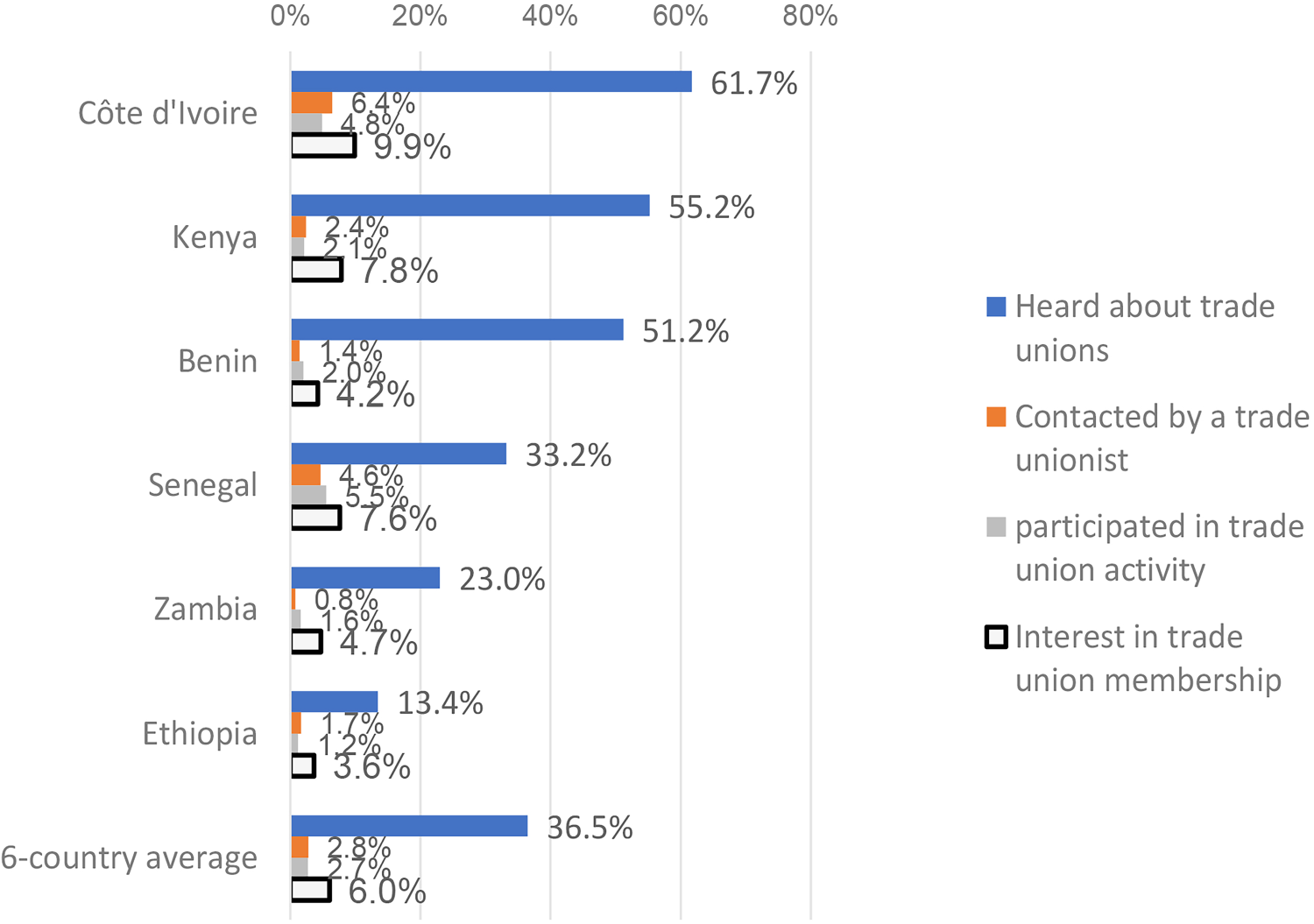
Knowing trade unions and interest in membership. Note: ‘Heard about trade unions’ assembles three distinct sub-groups, namely: (a) I have heard of trade unions but do not know what they do’; (b) ‘I know a little about trade unions’ (c) I know what trade unions are doing’.
Informal employment is no easy recruitment terrain for trade unions [14]
Are people in informal employment a future recruitment terrain for trade unions? The debate refers to whether trade unions, in order to turn declining membership around, should open themselves up to hitherto ignored segments of the labor market and start organizing the informally employed. Our survey is possibly the first representative empirical study that sheds light on the willingness of the informal labor force to cooperate with trade unions or even join them as members [15].
Testing the level of knowledge of people in informal employment at trade unions immediately curtails the hopes of easy organizational success. On a six-country average, a mere 36.5 percent of people in informal employment have ever heard that trade unions even exist, and of those who did, only a tiny fraction appear to know “what they are doing.” The level of knowledge about trade unions varies substantially between the countries, but in no case can trade unions assume that large segments of the informal labor force are ‘waiting for them’.
The low level of knowledge points to a structural distance between the informal labor force and trade unions. The interaction between the two is more or less nonexistent. On average, under 3% of people in informal employment were ever contacted by a trade union or participated in a trade union activity.
Those who have heard about trade unions, however, perceive the role trade unions play in their country as fairly positive and express a fairly high interest in becoming members. Interest in individual trade union membership as a share of all informal labor varies from 3.6 percent (Ethiopia) to 9.9 percent (Côte d’Ivoire) [16]. As little as these percentages may sound, when turned into absolute figures, they amount to more people than trade unions currently have as members of the formal economy.
For what reasons would people in informal employment want to join trade unions? The first reason that comes to mind is linked to work status. If trade unions are perceived to engage in organizing employer-employee relations and to bargain for a better deal for wage earners, informal employees may have a higher inclination to move closer to trade unions. This argument becomes negligible, however, for several reasons. Informal employment is composed predominantly of forms of self-employment, and employees make up only about 15% of informal labor (see Appendix: Table 1). Furthermore, an overwhelming number of employers are owners of micro-enterprises employing 1–2 people, and only a tiny fraction employ 10 employees or more. Most enterprises sit on the borderline of self-employment, and the business proprietor remains the owner-worker who adds some little wage labor to his or her own labor. Finally, the work status is rather fluid. Operators may be self-employed for a few months, turning into employers when good business opportunities arise by hiring assistants, or falling into the status of employees, when markets turn sour and they have to look for paid work somewhere else. The separation of capital and labor has not gone fully forward, and the ‘easy crossing’ between work roles impedes the emergence of a wage-labour based articulation of class interest. Informal employees do not have a higher interest in membership in trade unions than the other work status groups have.
The motivation for membership is approached by asking for the profile of perceived beneficiaries of trade union activities. In all countries, with the exception of Ethiopia [17], the informally employed perceive trade unions to mostly care for ‘employees of the government’, ‘employers in the private sector’, and ‘the government’ itself (see Figure 11). A majority is convinced that trade unions hardly care for ‘workers in the informal economy’, ‘the poor’, ‘own-account workers’, and others. The perceived beneficiaries of trade union activities can be grouped under ‘actors of the formal economy’, raising the key question: why should people in the informal economy want to join trade unions, which are seen as actors in the formal economy?
A possible explanation, which our study did not examine in depth, emphasizes the perception of trade unions anchoring in the formal economy. People in informal employment may be motivated to join trade unions because they (wrongly) perceive them as a possible transmission belt, a sort of job-placement agency, and thereby, their chance to enter the formal economy with better-paid jobs. Joining trade unions for economic benefits may be a general motivation for all members. But expecting trade unions to allocate jobs in the formal economy may be a misplaced hope. Whenever trade unions design a strategy to recruit members from the informal economy, this (possible) strategic calculation [18] should be reflected to avoid misplaced expectations from the beginning.
Our study allows us to characterize informal employment along socio-economic features of which income distribution is of particular interest. To get an indication of income inequality, we inquired about the disposable income of a single person in informal employment [19] and clustered it in multiples of the statutory minimum wage [20]. The results are presented in Figure 12.
Income inequality within informal employment is substantial. The Gini index [21] for informal labor in the survey countries hovers between 48 percent (Côte d’Ivoire) and 54 percent (Senegal, Zambia). We have no calculation of income inequality for formal employment and cannot compare the two [22]. We have, however, no reason to argue that income inequality within informal employment differs substantially from income inequality in other segments of the economy.
Measuring monthly income as multiples of the statutory minimum wage impedes inter-country comparison [23] but provides a good reference to assess income levels within countries. In all survey countries, people in informal employment earn, on average, substantially less than what is paid in the formal economy. Between 72 percent (Côte d’Ivoire) and 85 percent (Zambia) just reach the minimum level set for formal labor or fall below; between 36 percent (Côte d’Ivoire) and 63 percent (Zambia) do not even earn half of what formal labor gets at the minimum level.
While there is indeed a “significant overlap between working in the informal economy and being poor” [24, 25] informal labor cannot be equated with poverty, and some segments earn significantly higher incomes. If the legal minimum wage is defined as the entry point for the middle-income earning class, 5 percent (Zambia) to 28 percent (Côte d’Ivoire) of informal labor would be members of that class. If the entry point is raised to twice the legal minimum wage, the shares fall accordingly to 3.5 percent and 5.8 respectively. Considering that formal labor makes up a mere 10 percent to 20 percent of total employment while informal labor covers 80 percent to 90 percent, it becomes obvious that informal labor is a strong, if not the dominant, group within the middle-income earning class of a country.
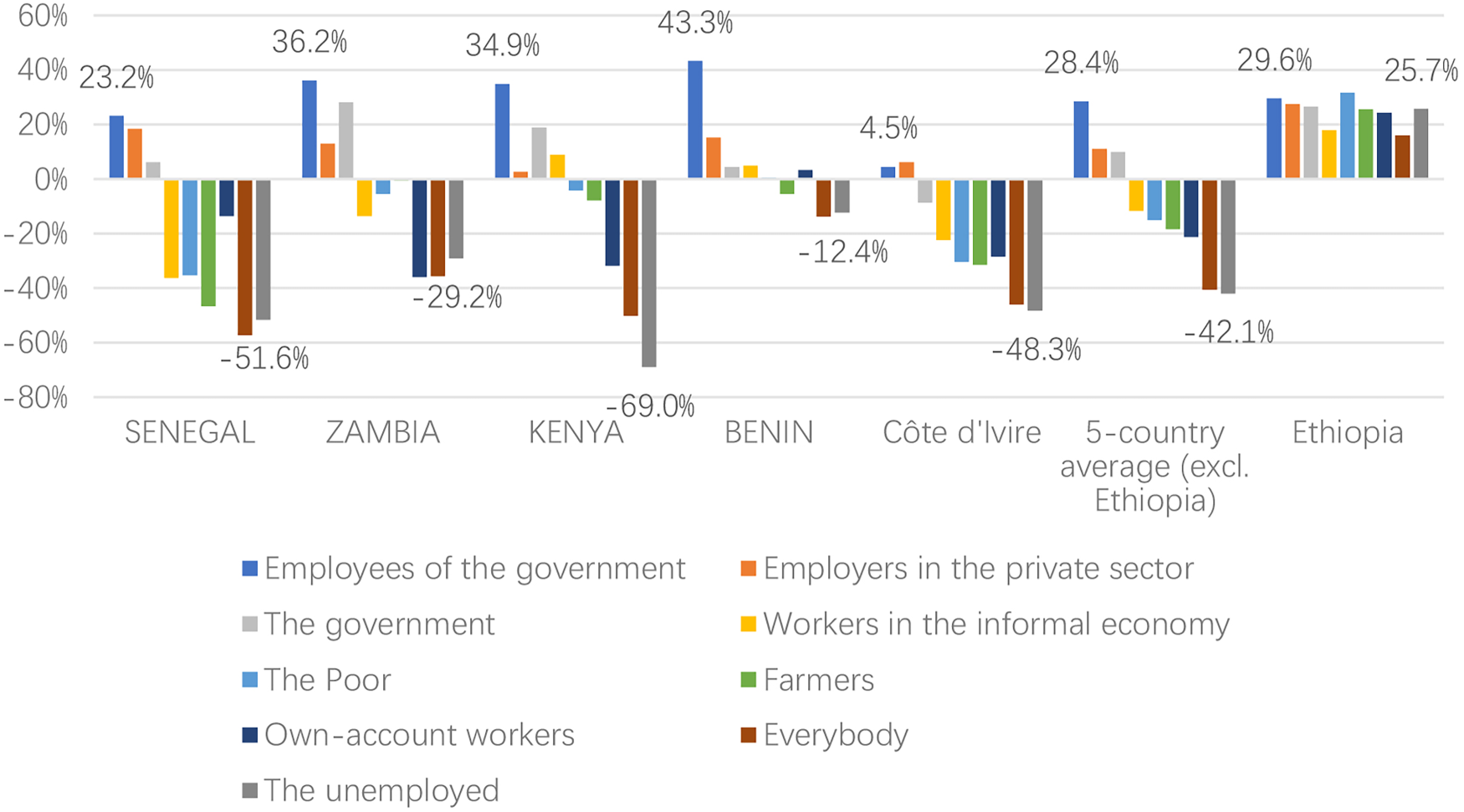
Groups perceived to benefit from trade union activities. (Values express differences: agree (fully+mostly) – disagree (fully+mostly).
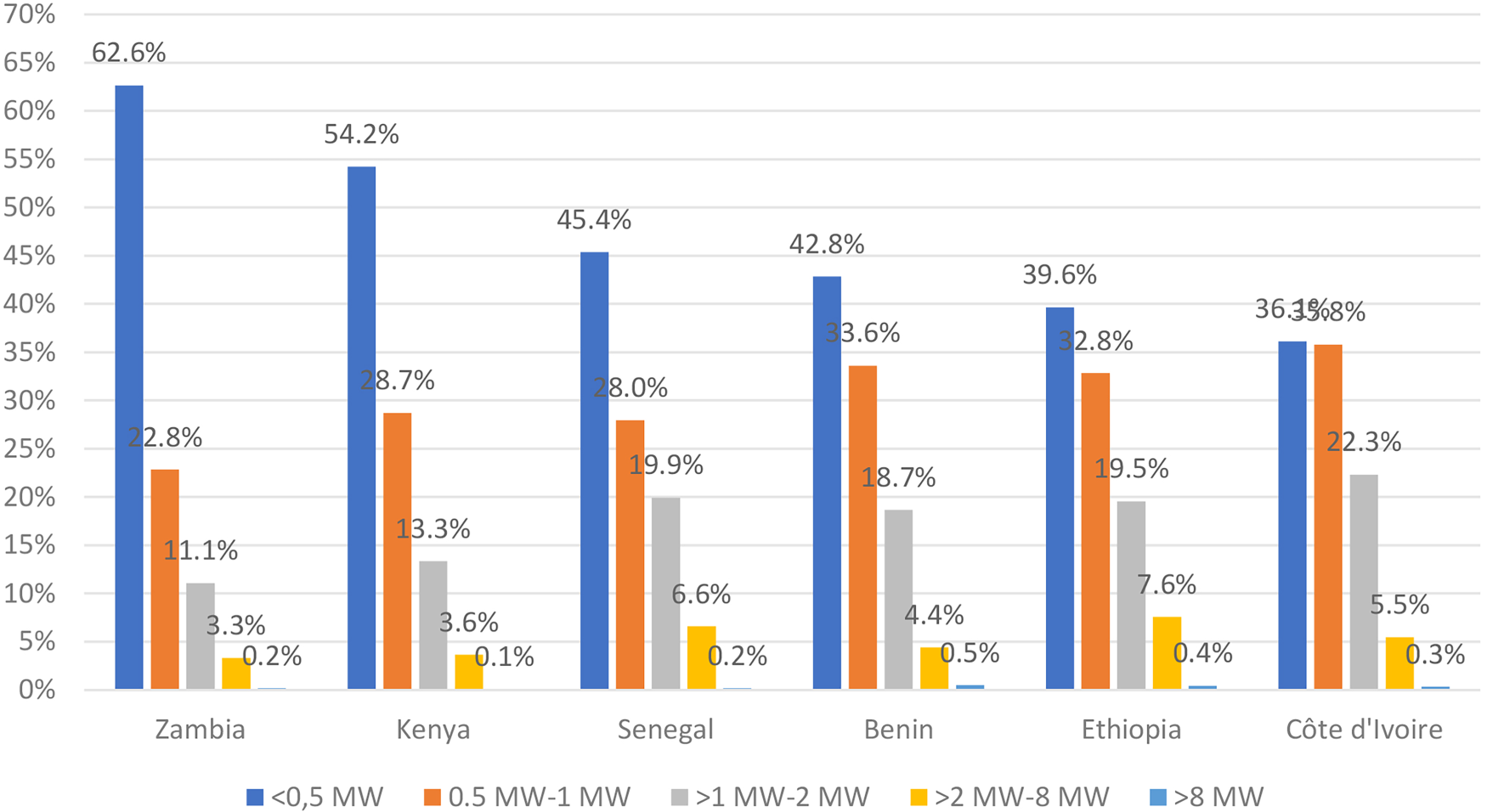
Monthly individual income as a multiple of the minimum wage (MW). Note 1: The statutory minimum wage for the countries at the time of inquiry was: Senegal: 55,000 XOF; Zambia: 1,500 ZMW; Benin: 40,000 XOF; and Côte d’Ivoire: 60,000 XOF. Kenya has no uniform MW. Reference is 13,000 KES, see footnote 18; Ethiopia has no statutory MW. Reference is public sector minimum pay at 1,500 ETB. Note 2: Gini index: Senegal 53.79%; Zambia 53.69%; Ethiopia 53.27%; Benin 49.87%; Kenya: 49.87%; Côte d’Ivoire 48.31%. For the method of calculation, see [21].
Gender inequality is a driving feature of income inequality in informal employment. Calculated at the level of mean monthly individual income, the earning gap in favor of men was 31.8 percent in Kenya (December 2020) and 43.2 percent in Senegal (April 2022) (see Figure 13).
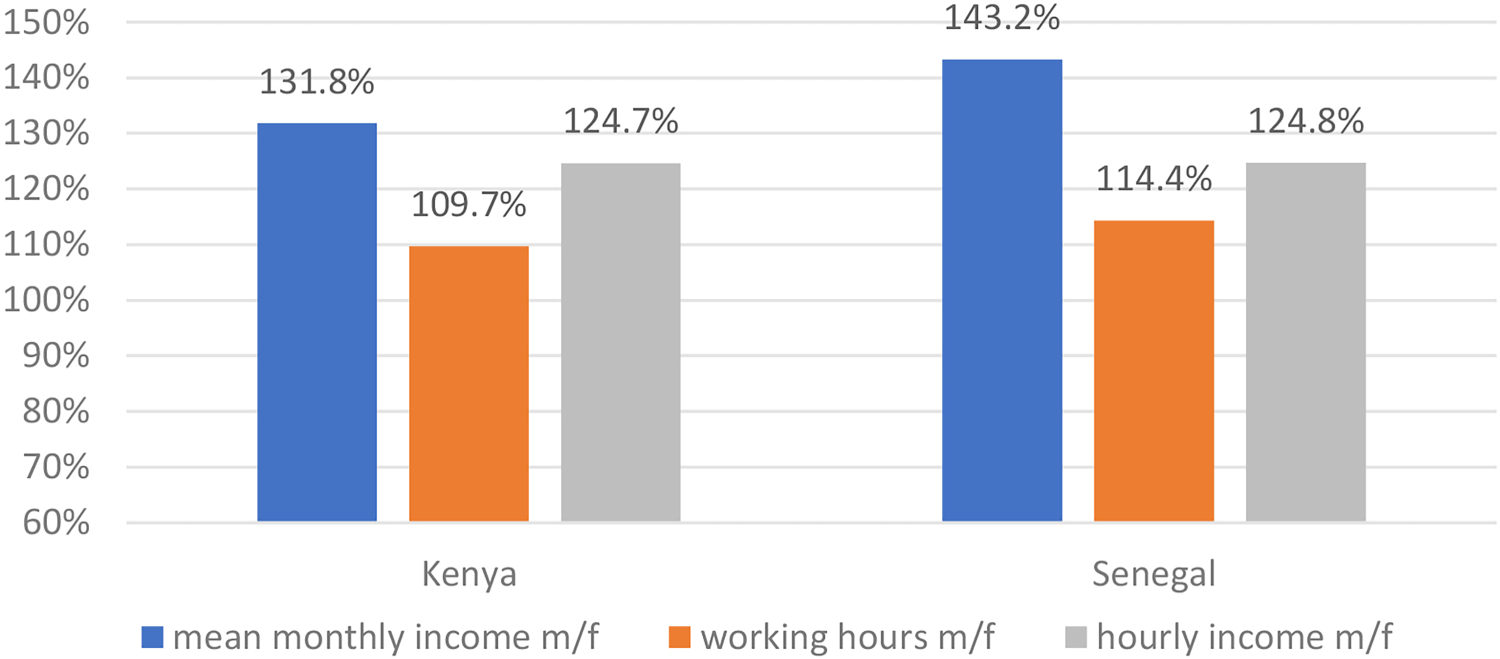
Income gap by gender (male/female).
Some of the gap is explained by differences in working time, with women on average spending 10 percent to 15 percent fewer working hours in informal employment. Taking this into consideration, the gender income gap calculated at hourly earnings drops to about 25 percent for both countries. Our data base is too small to calculate the effect of occupational discrimination, but we have strong indication that women are turned towards lower earning professions while high paying jobs such as transportation are usually a male monopoly.
Informal employment is the dominant segment of the economy in terms of the number of income earners, but much of its dynamic is not generated internally but through interaction with the formal economy and the subsistence economy. For gaining a livelihood, many people are rotating between the segments of the economy, from subsistence to informal employment and possibly formal employment, and may be forced to move back when a crisis strikes. The government is a key feature of this segmentary structure, coming up with formal arrangements that are applied in the formal economy but (partly) not in the informal economy and (partly) irrelevant for people living in subsistence outside the monetary economy.
A study that looks at informal employment without focusing on the inter-segmentary dynamics and interactions with the formal and subsistence economies may produce shortcomings. We limit ourselves to two such shortcomings for our own study.
Inequality and the interplay with the subsistence economy
Inequality measured in monetary terms does not fully capture the inequality at play. People working merely ten hours a week to earn an income may do so because no work is available and they spend most of the non-working time looking for paid jobs. Or they may have land at their disposal and move into informal employment to complement their subsistence work, which provides most of their food. Calculating inequality only from income, as we did, does not take care of ‘the value of food’ that is directly consumed. If added, we may get a (partly) different picture of poverty in a society.
The same can be said for gender inequality. In our own study, we found women spend on average 10 percent to 15 percent less working time in informal employment than men do. But we have no reason to believe that women in total work less than men do. Calculating a gender income gap based on hourly earnings, which reflect only working time in informal employment, may be misleading. Without ‘measuring’ working time spent for subsistence work (agriculture, household work, child upbringing, etc.), the full dimension of gender inequality cannot be captured. Gender migration between subsistence and paid work should be included to get a comprehensive picture of inequality.
How do we reflect on informal employment when the government comes up with universal social security instruments?
Informality is defined as “all productive activities carried out by persons or economic units that are, in law or in practice, not covered by formal arrangements” [26]. Following this logic, our study grouped employees as informal if employers did not contribute to social insurance schemes. But how to handle the case of a country where access to social protection is not only provided through the work contract but also through universal schemes, like, for example, Namibia, which has in place a universal pension scheme to cover all citizens at the age of 60 and above.
It is certainly possible to use the availability of an upgrade version as a criterion for informality and have a situation where the universal provision cares for access to basic benefits while the employment contract mandates a higher-up version. Or switch the criterion to other formal arrangements in regard to a work contract, like the availability of a job-related health insurance scheme or access to paid leave and paid sick leave, both possibilities recognized in the new 21st ICLS resolution. But if universal protection schemes are not reflected in the definition of informality, we may end up with a situation, where the statistical measurement of informality remains unchanged while the social situation of the informally employed has substantially improved through government policies. This underlines two important points, the need to operationalize the criterion of an employer’s contribution to social insurance, taking the national social protection system into account, and the need to provide additional information regarding general access to social protection (universal, job-related, or other) for both informal and formal workers.
Government policies are the main reference for informality (formal arrangements), but they become relevant for defining informality only through social protection regulations and labor laws (for employees). But when the government moves to an implementation policy, not through the world of work but in a universal manner for all citizens, government (social) policies need to be taken into account in relation to statistics on the informal economy.
Summary
Our empirical findings contribute to a better understanding of the social situation of people in informal employment in a wide range of areas, of which we have listed here six main results. But the findings show as well that the concepts used to define and measure informal labor have a normative bearing that has to be critically examined at all times. If the purpose is to improve the working conditions and the social protection of people in informal employment, various strategies can be of help. Our survey shows that ‘the majority of people working in the shadows’ are organized in groups for mutual assistance; they are eager to join health protection schemes; and they are ready to be taxed if the state provides fair services to them. Quite clearly, government policies are key determinants. But the ‘what and how’ may not be derived from a universal recipe from which to deliver and will have to be decided in the interchange between the state and informal labor at the national and local level.
Footnotes
Appendix
Informal employment categories of the selected (interviewed) person.

| Employers | Own-account worker | Employees | Family worker | |
|---|---|---|---|---|
| Senegal | 10.5% | 74.4% | 14.4% | 0.8% |
| Zambia | 4.7% | 81.8% | 9.4% | 4.1% |
| Kenya | 7.5% | 56.0% | 34.2% | 2.3% |
| Benin | 9.4% | 78.3% | 10.3% | 2.0% |
| Côte d’Ivoire | 9.3% | 70.1% | 18.3% | 2.3% |
| Ethiopia | 4.3% | 86.4% | 6.2% | 3.1% |
| 6-country average | 7.6% | 74.5% | 15.5% | 2.4% |