




Abstract
Contemporary evidence-informed policy-making (EIPM) and societies require openly accessible high-quality knowledge as input into transparent and accountable decision-making and informed societal action. Open Science1 supports this requirement. As both enablers and logical consequences of the paradigm of Open Science, the ideas of Open Access, Open Data, and FAIR publishing principles revolutionise how academic research needs to be conceptualised, conducted, disseminated, published, and used. This ‘academic openness quartet’ is especially relevant for the ways in which research data are created, annotated, curated, managed, shared, reproduced, (re-)used, and further developed in academia. Greater accessibility of scientific output and scholarly data also aims at increasing the transparency and reproducibility of research results and the quality of research itself. In the applied ‘academic openness quartet’ perspective, they also function as remedies for academic malaises, like missing replicability of results or secrecy around research data. Against this backdrop, the present article offers a conceptual discussion on the four academic openness paradigms, their meanings, interrelations, as well as potential benefits and challenges arising from their application in data-driven research.
Introduction
“Science in the recent past promised to society to contribute to the grand challenges of the United Nations, UNESCO, WHO, the EU agenda and national agendas for change and improvement of our life” [1]. Through “this social contract between science and society” [1, see also 2], science contributes to society by providing an indispensable part of the knowledge foundation of contemporary evidence-informed policy-making (EIPM). The world of scientific research and the world of societal-political practice are hence interconnected by the production and use of knowledge. In this perspective, science (in its mission to ‘create and disseminate knowledge’) and EIPM as well as societies (in their request for ‘knowledge injection and use’) are more and more interlinked: EIPM and societies rely on academic research to inform better policies and academically produced knowledge benefits from the practical application that confirms its quality and societal value. Based on the philosophical ideas of pragmatism, Miedema argues here, that “knowledge, insights and experience have to be translated into interventions and actions. Only when knowledge is ‘reduced to practice’, its social robustness and value will be determined” [1].
Providing robust and reliable knowledge for transparent, legitimate, and accountable science advice in democratic policy-making, Open Science has become a key enabler and a new, internationally promoted paradigm of academic research in the 21st century. Its “large-scale popularization and application …have become an inevitable shift of knowledge dissemination from closed silos of knowledge towards more openness for collaboration and innovation” [3].
By adopting a joint perspective on the ‘academic openness quartet’ guiding contemporary research, that is on Open Science, Open Access, Open Data, and FAIR publishing principles, the article focuses on four main points: It (a) provides institutional framings of the overall role of science in society from which the call for openness derives; (b) portrays the four paradigms and discusses their individual relevance and mutual dependency; (c) reflects on their benefits for data-driven research and academia as well as societies; and (d) sheds light on barriers and problems to their success.
Institutional framings of the role of open science in society
The relevance of science has been acknowledged by several international institutions’ and stakeholder communities’ framing of science as an enabler of participatory societies, the most prominent of which being the Universal Declaration of Human Rights. In Article 27, the declaration proclaims that “Everyone has the right freely to participate in the cultural life of the community, to enjoy the arts and to share in scientific advancement and its benefits” [4]. While acknowledging every person’s right to benefit from academic research, the declaration also protects authors’ rights in the scientific knowledge they created by stating that “Everyone has the right to the protection of the moral and material interests resulting from any scientific, literary or artistic production of which he is the author” [4]. The conflict between the right to use scientific knowledge freely and the right to intellectual property protection is a point of contestation in the debate on Open Science that will be further discussed below.
The United Nations Educational, Scientific and Cultural Organization (UNESCO) takes up this prominent global governance reference to the openness of science for public use by holding that by “promoting science that is more accessible, inclusive and transparent, open science furthers the right of everyone to share in scientific advancement and its benefits as stated in Article 27.1 of the Universal Declaration of Human Rights” [5]. In an encompassing definition, the UNESCO ‘Recommendation on Open Science’ defines Open Science as “an inclusive construct that combines various movements and practices aiming to make multilingual scientific knowledge openly available, accessible and reusable for everyone, to increase scientific collaborations and sharing of information for the benefits of science and society, and to open the processes of scientific knowledge creation, evaluation and communication to societal actors beyond the traditional scientific community” [6]. This definition includes all academic disciplines and elements of the academic process and rests on five “key pillars: open scientific knowledge, open science infrastructures, science communication, open engagement of societal actors and open dialogue with other knowledge systems” [6].
While a single, universal regulatory framework for Open Science in the European Union’s (EU’s) research and innovation policies is missing, the EU explicitly promotes Open Science “in a holistic and integrated way, covering all aspects of the research cycle from scientific discovery and review to sharing knowledge, publishing, and outreach” [7]. It does so “in a co-design and co-development mode with the key scientific stakeholders [in which it] developed a holistic policy to promote the changes needed for making open science a European reality” [7]. As the foundational basis of this approach, the EU places the ‘freedom of the arts and sciences’ prominently on its fundamental rights agenda. Article 13 of the ‘Charter of Fundamental Rights of the European Union’ declares that the “arts and scientific research shall be free of constraint. Academic freedom shall be respected” [8]. Accompanying this freedom is a high esteem for research integrity, ethical practices and accessibility of scientific results as laid out in the 2005 ‘Commission Recommendation on the European Charter for Researchers and on a Code of Conduct for the Recruitment of Researchers’ requesting that researchers “should ensure that their research activities are made known to society at large in such a way that they can be understood by non-specialists, thereby improving the public’s understanding of science” [9]. In 2011, the European Science Foundation (ESF) and the European Federation of Academies of Sciences and Humanities (ALLEA) developed the ‘European Code of Conduct for Research Integrity’ [10] that the European Commission recognises as a reference for research integrity in EU-funded research projects. In its December 2015 Conclusions on ‘Research integrity’, the Council of the EU recognised “the importance of open science as a mechanism for reinforcing research integrity, while, at the same time, research integrity contributes to open science” [11] highlighting the mutual relevance of Open Science and research integrity to reinforce each other.
In 2007, the Council of the EU reacted to the European Commission’s communication ‘on scientific information in the digital age: access, dissemination and preservation’ [12] by inviting the Commission to “experiment with open access to scientific data and publications resulting from projects funded by the EU Research Framework Programmes” [13]. Furthermore, it requested action on the topic to be taken by EU member states. In 2008, the EU’s ‘Seventh Framework Programme for Research and Innovation’ established an Open Access policy as an enabler of Open Science. In its 2012 Recommendation on ‘Access to and preservation of scientific information’ and its 2012 Communication on ‘Better access to scientific information: boosting the benefits of public investments in research’ [14, 15], the European Commission underlined the importance of scientific information for the EU’s knowledge-based economy as well as innovation capacity and announced to experiment further with Open Access publishing to boost the uptake of existing knowledge and research data. The subsequent ‘Horizon 2020’ research funding programme introduced an Open Data policy for EU-funded projects in 2014 [1, 16], making Open Access to peer-reviewed EU-funded project publications mandatory [17]. The current ‘Horizon Europe’ programme requires immediate Open Access and defines Open Science targets to promote the transition towards the new academic paradigm across Europe [see generally 18, 19, 20]. These targets include the obligations for funded projects to make their publications openly accessible, to publish research data in compliance with FAIR publishing principles as open data, to produce data management plans, and to respect limitations to open data, such as data privacy.
Also in 2014, the European Commission launched a public consultation on ‘the potential impact of Science 2.0 and the desirability of policy action’ [2], with ‘Science 2.0’ understood as “an on-going evolution in ways of doing and organising research …enabled by digital technologies, .. driven by globalisation and growth of the scientific community as well as the need to address the grand challenges of our time” [2]. In its summary report on the consultations, the Commission described the transition to Open Science “impact[ing] the modus operandi of the entire research cycle, from the inception of research to its publication, as well as the way this cycle is organised” [2]. Open Science in this sense “could have profound implications for the scientific landscape as a whole” [2], among them increased reliability and efficiency, greater research integrity, stronger connection between science and society with increased responsiveness of science to societal challenges, and more data-intensive science boosting the speed of innovation. Related to the latter, the May 2015 Council of the EU underlined the relevance of Open Science and Open Access for both publicly funded research results and data. It highlighted the potential of open research data to enhance public funding efficiency and acknowledged the need to develop new science metrics to increase incentives to publish through Open Access [21]. It asked for “adequate sharing, use, re-use and interoperability of data, based on common standards as well as .. a good balance between data-driven research and innovation and the protection of privacy [and underlined] the need for development of data skills for academia, researchers and the wider community” [21]. In May 2016, the Council furthermore highlighted the required “transition towards an Open Science system” [22]. It stressed the potential of Open Science “to accelerate advancement of knowledge by making it more reliable, more efficient and accurate, better understandable by society and responsive to societal challenges, and …to enable growth and innovation through reuse of scientific results by all stakeholders at all levels of society” [22]. In April 2022, the Council issued recommendations on ‘building a European Strategy for the Cultural and Creative Industries Ecosystem’ [23]that focused on the relevance of open-source solutions to, inter alia, enhance interoperability and data sovereignty in European research and higher education activities. Finally, in 2023, the Council confirmed the EU’s dedication to Open Science and ‘high-quality, transparent, open, trustworthy and equitable scholarly publishing’ [24].
Within many of these activities, the EU also promotes the development of alternative measures for quality assessment in academia that reflect new Open Science priorities, the involvement of citizens in research projects, and the European Open Science Cloud (EOSC) as an open platform for access to research results and data see [25, 26]. The EOSC provides joint standards for the exchange of research results, such as for metadata. Finally, the European Commission manages the Open Research Europe (ORE) as a publication platform that facilitates Open Access publishing from EU-funded research. Open peer review applies to the platform and publication costs are covered by the EU research funding.
For the European University Alliance (EUA), “Open Science embodies some of the main values of scientific research, notably: freedom of thought and research, individual and institutional autonomy, integrity, ethics, creativity, cooperation, the drive to surpass the current state of the art, the importance of debating contradictory ideas and of refutation …, and responsibility in conducting research” [27]. In its ‘Open Science Agenda 2025’, the EUA defines three priorities of Open Science, two of which link directly to Open Access, Open Data and FAIR publishing principles: “Universal and perpetual Open Access to scholarly outputs, in a just scholarly publishing ecosystem” and “Findable, Accessible, Interoperable and Reusable (FAIR) research data” [27]. As a member of UNESCO’s ‘Global Open Science Partnership’, the EUA moreover supports a global approach to the implementation of Open Science.
These institutional and stakeholder framings of the role of Open Science in society set the institutionalized backdrop against which the paradigmatic development and operationalization in the area unfolds.
Meanings and interrelations: Four openness paradigms – One objective
Open science
Based on such institutional framing and stakeholder definitions [see 2], Open Science is an evolving paradigm that embraces various aspects and depends on enabling instruments. In this sense, “‘Open science’ is an umbrella term used to refer to the concepts of openness, transparency, rigor, reproducibility, replicability, and accumulation of knowledge” [28], which should be regarded as a “complex ecosystem with the potential for knowledge co-creation and social innovations” [17].
The idea of Open Science centers around important questions about the conduct and practice of science: credits and recognition for the open publication of research data, meaning and standards of data sharing, and comparability of research results and data [1]. It moreover supports democratic practices as the “emergence of the open science system unchains and democratizes any work (academic or non-academic), information, and pieces of knowledge or resources in digital form so that more people can access, produce, and distribute, collectively and individually, free of charge” [3].
With this focus, Open Science affects both research processes and the dissemination of academic output. In structural-procedural terms, it champions open access to academic methodologies, publications, and research data. It also opens up scientific quality control by requesting open peer review to increase transparency in the academic evaluation of research, results, and funding proposals [29]. Insights into research methodologies and protocols, reproducibility and validation of results, greater reliability, new ways of openly assessing academic excellence and good scientific practices, improved knowledge transfer, broader participation, and an enhanced embedment of science in societal activities and decision-making are what shall follow from the innovations of Open Science [17].
The objective of Open Science is to make academic knowledge and results openly available for everyone, ultimately facilitating dissemination and inspiring cooperation in knowledge production [30]. This is not the least, because science is viewed to have “a moral obligation to engage with the major societal problems and challenges of their time” [1] and Open Science to “make science more efficient, reliable, and responsive to societal challenges” [7].
While Open Science is a transformative idea capable of guiding “another scientific revolution” [31], its conceptual openness “does not refer to one set of specific rules; instead, it is a collection of several research practices that variously manifest themselves in different research contexts” [28].
Research practices of open science. Source: Foster portal, 2023, Creactive Commons Attribution 4.0 International License.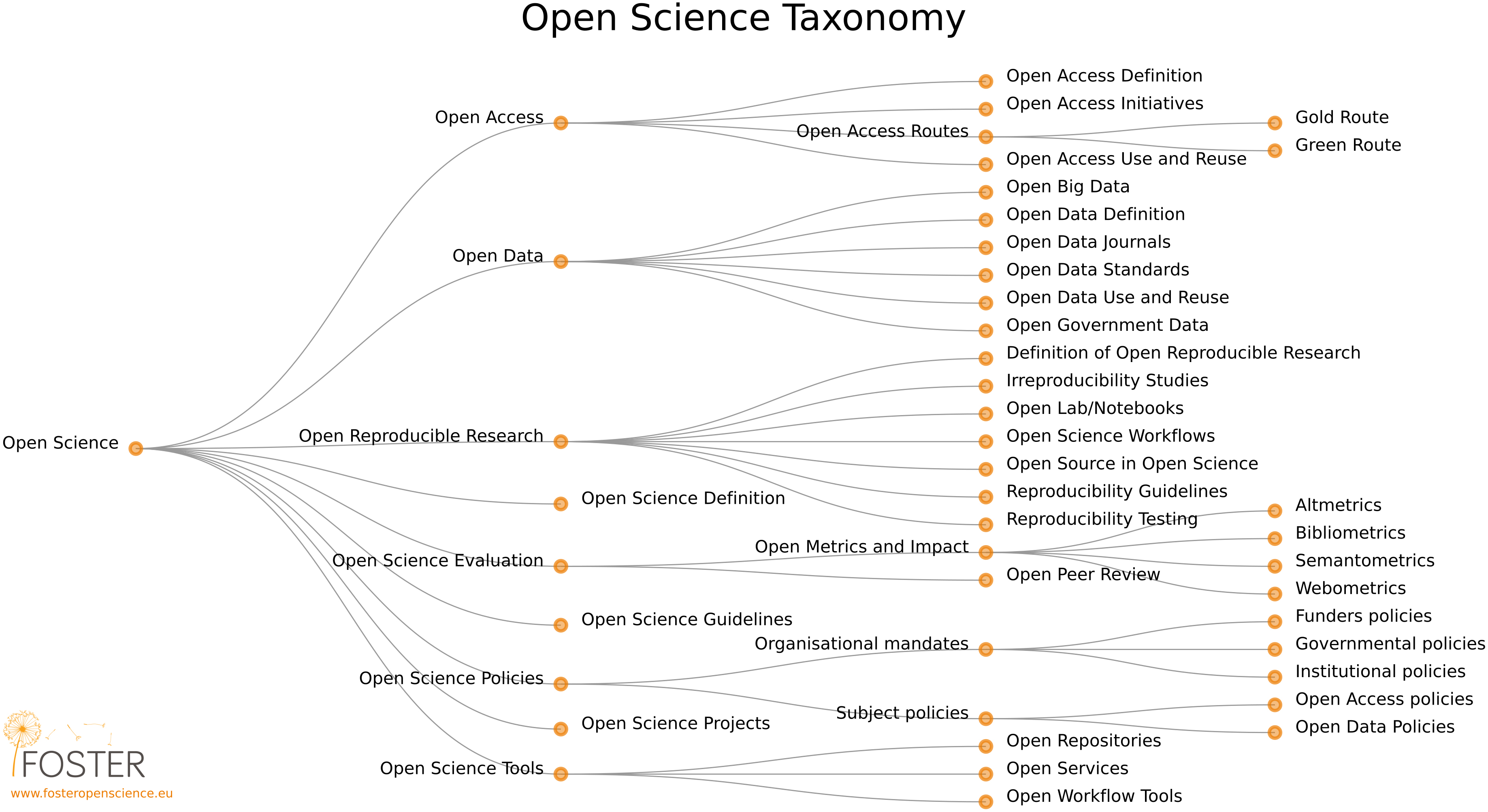
This is where the implementation of Open Science depends on Open Access, Open Data and FAIR publishing principles for research data. This dependence materialises the interrelation of the four paradigms, which is the ‘academic openness quartet’ discussed in this article, positioning the latter as enablers and components of the former. In this perspective, Open Access, Open Data and FAIR publishing operationalise Open Science’s vision of open and accessible research, give guidance to its implementation and specify each other.
Together with the above-mentioned institutional framings, some early stakeholder initiatives promoted the Open Access paradigm across different scientific disciplines, among them prominently the 2001 Budapest Open Access Initiative [32], the 2003 Bethesda Statement on Open Access Publishing [33], and the 2003 Berlin Declaration on Open Access to Knowledge in the Sciences and Humanities [34, 35]. They define Open Access as the provision of unrestricted public access to research results, data, and academic publications of different formats independent of a user’s institutional affiliation, technical capabilities, or financial means [35]. Key aims of Open Access are to provide quick and direct access to scientific research results allowing everybody to read, use, reuse and (re-)distribute the results, for instance in derivative works. This approach to academic publishing is meant to increase the visibility and impact of research and enhance global accessibility of scientific knowledge [36]. With these objectives, Open Access is a counter-model to traditional academic publishing with long production pipelines and restricted access through subscription or paid access policies [37]. Its new approach to openness aims to reform a dated system of academic communication, that could critically be described as “a leviathan feeding on an interaction of market forces within and outside science” [36], representing a system that does not satisfy current and future needs of academic knowledge dissemination. Trade-offs between the two publishing systems will be further discussed below.
Various forms of Open Access can be differentiated according to their guiding publishing principles [see 38,39,15,40,41]. ‘Gold Open Access’ entails accessibility of the academic output directly after publication with publication fees covered by the author or by institutional funds. ‘Diamond or Platinum Open Access’ is ‘Gold Open Access’ for which no fees are charged either for readers or authors. ‘Green Open Access’ includes self-archiving or secondary publication under embargo rules, special terms of use, or copyright conditions. It foresees the publication of a manuscript or an article’s pre- or post-print version in an openly accessible repository, while access to the final article can be restricted by for-pay provisions. ‘Hybrid Open Access’ is constituted by licensed open access in otherwise subscription-based journals, ‘Bronze Open Access’ by license-free open access in subscription journals characterized by read-only rights; and ‘Black Open Access’ by non-legal or pirate publishing, for instance through websites like Sci-Hub [42, 43, 44, 15].
Open data
“Data provides the evidence for the published body of scientific knowledge, which is the foundation for all scientific progress” [45]. Sharing research data and making it openly available is an accelerator of scientific progress and the Open Data paradigm is one of its gateways. While the current academic publishing system does not unconditionally favour open dissemination of research data, Open Data practices prioritise timely and free-of-charge publishing of raw and processed research data [46], accompanied by metadata and documentation, to increase transparency of research, reproducibility of results, and academic collaboration. The idea of Open Data is based on the understanding of data as a public, multipurpose resource [47]. It foresees their accessibility and availability without legal, financial, or functional limitations for unrestricted use, reuse, and redistribution [47]. These objectives of Open Data are meant to incentivise co-creation through use and reuse of existing data. Additionally and relevant to data science, the development of machine-readable formats and open-source software is prioritised to increase interoperability and technical innovation in data analysis through co-development [47, 36, 48].
FAIR publishing principles
The FAIR publishing principles “were published in 2016 to ideologically drive the adoption of several guiding principles for publishing scientific and open data” [49] to tackle challenges in research data accessibility and interoperability. Helping to implement the Open Data paradigm, the FAIR publishing principles offer guidelines for research data management and publication for researchers and institutions to increase the quality and impact of research data and to create a more collaborative research ecosystem [50].
In line with the three other paradigms of academic openness analysed above, FAIR publishing principles seek to make research data more transparent, accessible, and usable for both the scientific community and the public. They define 15 aspects of data management and publication that request openly published data to be findable (containing unique dataset identifiers and rich metadata), accessible (providing access protocols, authentication and authorisation information, metadata access), interoperable (using common data standards and formats, vocabularies and ontologies, essential variable description), and reusable (explaining provenance, data quality, terms of use, licensing, and restrictions to (meta-)data reuse).
The academic openness quartet: Benefits for data-driven research
It is evident that the academic openness quartet conceptually discussed in this article provides common values and, what some authors call a “moral framework” [39] for academic research and for the interrelation between science and society. It champions “free access to knowledge universally, regardless of either the wealth or the social status of the potentially interested readers” [51]. It hence enables access to academic research regardless of the economic status of a country, community or individual. In that, it is an essentially democratic tool of individual and collective empowerment through which it facilitates the improvement of knowledge transfer into societal activities [52, 53]. It nurtures various aspects of solidarity, equity, and fairness as well as human rights. Solidarity of societies providing public research funding and engaging with research outcomes; equity and fairness within the research community making scientific results freely accessible as a contribution to inclusive knowledge production and use for the public good; and rights of access to essential knowledge resources to enable critical, fact-based thinking in evidence-informed practices. From a global perspective, this can foster inclusivity and is therefore regarded by some as “an essential breakthrough for developing countries” and global science in general [51, 36, 54, 55]. Therefore, for some, the “case for open access to research data is made on the basis that it delivers scientific, moral, economic, political, professional, social and security benefits” [39]. While a positive view on the impact of academic openness paradigms seems to prevail in the Global North, academics in the Global South also “critically interrogate the neocolonial nature of hegemonic OS [Open Science], arguing that the processes to build OS into disciplinary structures enact new forms of extraction, co-optation, and erasure that reproduce disciplinary whiteness” [53].
In view of opening academic practices, the academic openness quartet fosters dissemination and more inclusive collaboration, innovation, and interdisciplinary research [on geopolitical caveats see 53, 56]. It can enhance the visibility and accessibility of research outputs and individual academic work [57] regardless of the prestige of the publication outlet or the author’s institutional affiliation. It can also “increase productivity through reducing duplication, allowing more research from the same data and multiplying domestic and global participation” [52]. The integration of “different types of research output – articles, databases and other digital material – to form a single, integrated information resource and to create new, meaningful and useful information from it” [36] is seen to offer huge potential to increase research efficiency and innovation potential through an unrestricted uptake of academic insights [39]. Academic openness also facilitates interdisciplinarity by offering free access to bodies of research across disciplines and academic fields, it shortens publication production periods and opens the academic process to broader assessment and validation of research results [36]. Finally. it increases societal participation as it engages stakeholders and citizen science in research processes supporting the co-creation and dissemination of academic knowledge.
Normatively, academic openness links to the above-discussed institutional framings of research integrity which it fosters by underlining ethical concerns, such as the imperative of reproducibility, and by offering guidelines for reliable, transparent academic practice. The urgency of this focus on research integrity is confirmed by “problems with the research process that allow … weak data-sharing norms, secrecy, limited incentives to carry out replications or pre-specify statistical analysis and the pervasive publish-or-perish culture in academia” [58]. Openness of methodologies and data is an essential enabler of both reproducibility [see 57] and transparency and a shift in academic cultures towards more inclusivity, collaboration and collectivity can increase confidence in published research results.
Because of its relevance for data-driven research, academic openness has a particularly transformative impact on how data-driven research is conceptualised, conducted, disseminated, and published. This is especially true for the “adoption of reporting standards and disclosure practices that structure the presentation of data and the design of studies” [58] and hence generally for how research data and statistical information are created, annotated, curated, managed, shared, reproduced, (re-)used, and further developed. Greater accessibility of scholarly data fosters the availability of underlying datasets, data collection methodologies and comprehensive metadata which offer both research and educational resources. Apart from progress in data-driven research, it hence also impacts skills development, teaching and training in data science and analysis.
A significant way in which the four paradigms, and among them especially FAIR publishing, influence data-driven research is by increasing the emphasis on data sharing and reuse which optimise efficient resource use [39]. “Data sharing serves at least two distinct scientific purposes, one evaluative and the other generative. The evaluative purpose of sharing data is to increase the credibility of findings by allowing the evidence to be directly verified and interrogated …The generative purpose is to enable other investigators to pursue new questions and thereby maximize the total potential research contribution of data” [58, emphasis by original authors]. Openly accessible and interoperable research data allow for comparisons between data-driven research approaches and methodologies. This transparency supports ethical scrutiny and accountability in data-driven research. Open Data also allows for collaboration under common frameworks for data sharing that facilitate innovation using automated processes or algorithms that interact with existing datasets [39]. The later build upon published research data, reusing and repurposing them for new studies and the acceleration in data insight. As mentioned above, interoperability standards, formats and common vocabularies allow for data integration from various sources, institutions, and across disciplines for more robust and holistic data-driven research designs and data-driven workflows, also potentially helping to mitigate data gaps and biases [36]. It requires clear information of data and metadata quality and provenance as well as specific licensing terms to facilitate trustworthy reuse and re-distribution. This inspired the development of specific new publishing models and platforms, such as data repositories, open-access journals, or preprint servers. Additionally, FAIR principles are impacting academic writing by encouraging greater attention to metadata and data management [59]. Research data is expected to be accompanied by detailed and standardised metadata descriptions to make their context, limitations, and potential biases more understandable to other researchers. This requires a greater focus on data curation practices, such as creating identifiers and standardised data formats, and developing clear documentation and data-sharing policies.
The academic openness quartet: Challenges for data-driven research
The application of the academic openness quartet yet also creates challenges for data-driven research [60]. Open Science itself is an extraordinarily complex paradigm, embracing not only Open Access, Open Data and FAIR publishing principles. It also subsumes Open Reproducible Research, Open Science Evaluation, Open Science Policies and Open Science Tools, each of which is defined by a plethora of different concepts and instruments [61]. This complexity can be exceedingly difficult to navigate for the individual researcher. Beyond this intrinsic complexity, individual aspects of academic openness can render open data-driven research difficult. Below, such challenges are exemplified by discussing critical aspects of data sharing and quality, as well as the academic professional and publishing ecosystems due to their direct impact on academic production and research.
The potential of data sharing can be affected by data privacy and security concerns. Trade-offs between open research data and data protection, particularly in social science, biomedical or healthcare research including sensitive personal information [62], can raise ethical concerns that potentially impact the ability to make data openly available. Moreover, security risks in sensible research areas and the danger of data misuse, such as related to military studies or the analysis of critical infrastructure [39], can limit the ability of researchers to apply the four academic openness paradigms to their research data or might increase the need for extended documentation and context information. In this context, Smith and Sandbrink [63] point out three challenges to research data sharing. The first one relates to the risk of misuse. Through Open Data, potentially sensitive data would be better accessible and hence less protected against misuse. These risks might also affect open access to research methodologies and tools. The second challenge affects mitigation strategies and relates to regulation and exemptions. Access to sensitive datasets might in their view need to be restricted to code-only access or become subject to some form of access control. Data holding dual-use potential might be subject to exemption. The third challenge concerns opportunities for infrastructure development and coordination. Here, the authors propose differentiated sharing patterns according to risk assessment, the creation of access-controlled repositories and the respect for FAIR publishing principle through curated repositories.
Apart from the common harmonisation of standards for metadata and data interoperability, data sharing can be affected by concerns over data ownership and control over data use and analysis once research data is made openly accessible. One of these hesitations rests in the view “that sharing data may be perceived as undermining the incentive for researchers to undertake the work of collecting data themselves” [58] potentially leading towards the decline in data collection and the rise in data mining for data analysis. Such hesitation is also nurtured by concerns over intellectual property rights [see 57] and aspects of licensing that might fuel reservations to apply academic openness to research data, especially in cross-border, international research contexts in which regulatory frameworks multiply or in view of the commercialisation of research results. These potential issues not only affect data providers by the loss of their exclusive access privileges to datasets created for their own research and academic qualification. They might also roil data users as the reuse and re-distribution of data can be clouded by doubts over the originality of derivate research based on existing datasets or the original copyright [62, 40]. Given these challenges to ownership in data, Christensen et al. suggest that “rights over data may be viewed as necessary to spur the ambitious data collection efforts that science needs to make progress” [58] and propose “three measures to protect incentives: extract sharing, data embargoes, and data citation” [58].
Implementing FAIR publishing principles requires substantial investment in data management processes, standardization of data and metadata formats and the establishment of data infrastructures for interoperability [60]. Building and maintaining digital resources, data repositories and data management for data sharing can also be challenging and resource-intensive, limiting the individual and/or institutional capacity to engage in sustained data sharing, including the maintenance and update of individual datasets [62] in order not to lose existing research data over time.
Also data quality raises challenges to open research data [36]. Accuracy and completeness are key elements of data quality. Biases or mistakes in data collection can impact the representativeness of data, the absence of which can create critical issues for data reuse, reliability, reproducibility, and the creation of derivate works from existing datasets. Missing quality control mechanisms and the lack of standardised practices create loopholes for the dissemination of such inaccurate or inappropriate data.
Open Science, Open Access, Open Data and FAIR publishing principles create frictions also to existing academic practices and “economic, legislative and regulatory, organisational, technical, patrimonial, behavioural” [27] obstacles pave the way to their implementation. For the academic professional and publishing ecosystemssuch obstacles translate into challenges on several levels. First of all, does the change to embracing the academic openness quartet for research data require cultural change within the academic profession [64]. Not least due to public and private spending on academic activities and institutions, measuring their quality has become a central control and steering tool. This scrutiny requires standardized and comparable metrics to evaluate academic knowledge production. Academic quality assessment so far yet predominantly relies on the use of bibliometric data, such as journal impact factors, which represent a focus on written academic output and its uptake in traditionally peer-reviewed journals in which open access does not play a major role [see 36]. Most journals used for this type of academic quality evaluation follow closed, subscription-based publishing logics. Open Science, Open Access, Open Data and FAIR publishing principles are largely incompatible with these established assessment systems for academic quality. Depending on the type of Open Access chosen for publication (see above), researchers wanting to embrace academic openness for research data currently do so with only a loose safety belt for academic recognition, such as in professional promotion processes. Reluctant uptake of open practices and disincentivized usage can be consequences that hinder their widespread implementation [see 57]. Stronger openness and incentives from within the academic (reward) system could substantially increase to use of Open Access publishing.
Another cultural change required relates to knowledge of Open Science practices. Many institutions and researchers might still not be fully familiar with the details and implications of the academic openness quartet discussed in this article. Missing capacity and literacy for the use of academic openness still prevents many academic institutions and researchers from sharing their work openly, missing the opportunity for wider dissemination, uptake, and collaboration [27]. Adding to such reduction of opportunity spaces is insufficient access to technology and capabilities to use it. The implementation of the four paradigms of academic openness for research data strongly depends on the use of electronic platforms and repositories. Internet access is an indispensable enabler of participation. Academic institutions and researchers in less technologically advanced regions are hence underprivileged in the global academic community both in terms of recognition of their work and access to research data. These disparities are also potentially mirrored by the missing financial ability to cover fees for Open Access publications. “Moreover, like any major ambition, openness can also lead to misuse. This includes increasing pressure to publish (the famous “publish or perish”), the demand for immediacy when research requires a steady ripening of ideas, the erroneous interpretation of research results that have not been fully validated…, the dissemination of fake scientific news, the usurpation of ideas, etc.” [27]. The cultural shift required from the academic community therefore includes a conscious prioritisation of and vocal esteem for open and collaborative research data practices, including also stronger institutional engagement in changing established priorities for academic publishing models.
For traditional academic publishing, academic openness requires transformative change, too. The transition to Open Access publishing is currently accompanied by “the disappearance of the traditional publication on paper and its progressive replacement by electronic publishing, a new paradigm implying radical changes in the whole mechanism” [51]. Traditional subscription-based publication practices are hence in contrast to many of the Open Access models described above [36]. Especially ‘Diamond or Platinum Open Access’ (no publication fees) challenge this business model, while ‘Gold Open Access’ raises long-term questions about equality in academia based on access to financial resources. The Gold Open Access model, championed by funders of academic research like the EU, requires the payment of article processing charges by the individual author or their academic institution. This approach makes Gold Open Access dependent on economic capabilities and discriminates against financially less equipped researchers and institutions which might be therefore prevented from publishing in Open Access journals [37]. The practice of article processing charges as a revenue source for Open Access journals thus raises questions about new limitations to publishing and new publication privileges based on financial variables.
While attention to the impact of financial capabilities on the ability to publish Open Access is important, it is also “important to note that the transparency and robustness added by many open science practices do not always guarantee increased rigor” [28]. Open Access publishing is still a heterogeneous practice and ecosystem. Journals and repositories have their own editorial and peer review standards [see 57] and quality criteria. Broader standardisation and the development of common evaluation criteria would help increase comparability among Open Access journals, repositories, and publication outlets. This, in turn, might mitigate “potential unintended consequences [of Open Access publishing, such as] …a risk that editorial decisions may be perceived as being shaped by the author’s affiliation, as such affiliation may influence the ability to pay publishing fees; .. a risk that authors lose the freedom to decide where to submit their work due to their institutions’ selective agreements with publishers or research council instructions; and …a risk that journals’ financial viability becomes increasingly dependent on the quantity of articles for which Open Access fees are charged, rather than the quality of curation” [37].
The development of alternative business models in academic publishing is hence important for the move towards academic Open Access publishing and the engagement of established subscription-based publishers in this transition is essential [see 57]. As the pace of transition might be slow due to the change aversion of an established business sector, the engagement of the academic community in the co-creation of future academic Open Access publishing formats is required for an informed implementation of academic openness. Understanding academic publishing as a community of practice of academics and academic publishers is the starting point for the participatory development toward academic openness. Transition periods for change management are a key contemporary problem that requires attention as are the development of sustainable funding models, additional business activities, quality assurance and the overall interrelation between the academic publishing ecosystem and academia.
Conclusion
The academic openness quartet for data-driven research discussed in this article holds the transformative potential to make academic output ever more transparent, accessible, and reproducible. It also holds the potential to empower less visible academic actors, schools and research areas and to provide the public with open access to research evidence. While offering a challenging combination of new ideas on academic openness designed as a “continuum of practices” [57], the four paradigms Open Science, Open Access, Open Data, and FAIR publishing principles lay out a future of research that reaches out to both the academic community and the wider public to offer open access to high-quality academic knowledge. This engagement with and beyond academia can strengthen solidarity, equity, fairness, and rights in the academic profession and societies in multiple ways as discussed above. It can feed into academic progress, fact-based decision-making and informed citizenry. Knowledge sharing and access to quality information are safeguards for resilient participatory democracies. An essential bridge to a desired and desirable future for collaborative and engaged data-driven research is offered by research data literacy [65, 66, 67, 68]. It responds to the Council of the EU’s 2015 request for enhanced data skills for academia, researchers and the wider community by developing the ability not only to use data, but also to understand and assess the value of data use for academic and societal progress. When embarking on mitigating and overcoming the challenges discussed in this article, academic openness paradigms are on a promising way to build this bridge in a findable, accessible, interoperable and reusable way to maximise benefits for the academic profession and societies in general.