




Abstract
Operational since 2019, the 50x2030 Initiative to Close the Agricultural Data Gap is working with partner countries to produce and use timely, high-quality agricultural and rural data, with a focus on helping them track their progress toward meeting priority indicators of the Sustainable Development Goals on zero hunger and gender equality, and strengthening agricultural data systems, among others. This paper provides an overview of how 50x2030 works toward its vision of strong national agricultural and rural statistical systems in low- and lower-middle-income African, Middle Eastern, Asia-Pacific and Latin American countries. It explains the Initiative’s guiding principles, discusses its approach to robust data production and use, and provides examples of its early impact using the experience of three partner countries, Cambodia, Senegal and Uganda.
Keywords
Introduction
Recent years have seen an explosion of readily available data on various topics, yet there remains a dearth of accurate, high-quality and complete data that policy stakeholders need and can use to respond to pressing global and national challenges. Take for example the data for monitoring progress in meeting Sustainable Development Goal (SDG) 2 on ending hunger. The Food and Agriculture Organization (FAO) notes that “the ideal type of farm-level information required, allowing to identify the population of small-scale producers and measure progress in the two indicators of target 2.3, is seldom availabl” [1]. The SDG 2.3 target involves doubling the agricultural productivity and incomes of small-scale food producers by 2030. The same challenge applies to SDG 5 on promoting gender equality [2].
To address the need for the above-mentioned data, leading global development actors launched the 50x2030 Initiative to Close the Agricultural Data Gap in 2018. The 50x2030 Initiative strives to empower 50 countries – 30 in sub-Saharan Africa and the Middle East and North Africa, 15 in East Asia and the Pacific and Central and South Asia, and 5 in Latin America and the Caribbean – that fall under the World Bank classification of low- and lower-middle-income economies to generate and use high-quality agricultural and rural data in a timely manner [3, 4]. These economies invest $957 billion per year in agriculture [5], yet they continue to experience significant food insecurity [6].
The cost of implementing the vision of the Initiative is estimated at $500 million over 10 years, taking into account both donor and country resources. The 50x2030 Initiative is implemented through a unique inter-agency partnership between the World Bank, FAO and the International Fund for Agricultural Development (IFAD). The data produced under the Initiative come in the form of official statistics, which in addition to informing SDG 2 and 5 indicators, will be also used to enable countries in Africa to monitor national policies and programs on agricultural and rural development and track their progress toward meeting the Comprehensive African Agricultural Development Programme (CAADP) indicators. The latter measure how countries are meeting the goals of the Malabo Declaration on Accelerated Agricultural Growth and Transformation for Shared Prosperity and Improved Livelihoods by 2025. According to the second biennial review report on the Malabo Declaration,“[c]onsiderable efforts have gone into improving the quality of the data, with more countries reporting in this round [compared to the first review period], and there is an overall positive trend in the performance of countries, even though only four countries achieved the required milestone to be on-track” [7]. The 50x2030 Initiative, as such, seeks to allow all African countries to make greater strides in improving their reporting performance.
In this paper, we outline how, since becoming operational in July 2019, the 50x2030 Initiative helps close the data gaps on SDG 2 and 5 and CAADP indicators and more broadly advance stronger national agricultural and rural statistical systems. The paper is structured as follows: Section 2 details the Initiative’s vision, including its guiding principles. Section 3 discusses the 50x2030 survey programs and explains what the Initiative is doing to enable countries to produce and use high-quality, timely data, while Section 4 talks about the early impact of 50x2030.
A vision of robust national agricultural and rural data systems
The vision of the 50x2030 Initiative is for its partner countries to have robust national agricultural and rural statistical systems. This means the countries have the capacity – both financially and technically – to produce, disseminate and use more timely official agricultural and rural survey data that are of high quality and sufficiently disaggregated. It also connotes the ability of these countries to identify what data they need to solve for the challenges they face as well as for increased and sustained evidence-based decision-making in agriculture and more broadly for economic, human and social development.
To achieve its vision of strong national agricultural and rural statistical systems in partner countries, the 50x2030 Initiative adheres to eight key interrelated principles. They are:
Data quality. High-quality data is essential to effective policymaking. The quality of data relies on various components of the survey process, including questionnaire design, sample selection, implementation methods, data analysis and dissemination. The 50x2030 Initiative designs the instruments for survey questionnaires based on evidence and previously tested instruments to limit bias from the questionnaire design. It provides guidance on sample design and selection to address possible quality limitations emanating from sampling, and, most of all, prioritizes building the capacity of the staff at national statistical systems to improve quality across all stages of the survey process. Integration. The 50x2030 Initiative pursues integration in several ways. First, it adopts an integrated approach to survey design in the tradition of the FAO’s Agricultural Integrated Survey (AGRIS) program and the World Bank’s Living Standards Measurement Study Integrated Surveys on Agriculture (LSMS-ISA). The approach features an integrated sampling design and a harmonized set of data collection instruments [8]. It gathers agricultural data in the household and non-household sectors alongside socio-economic data, thus generating data that extend beyond traditional agricultural statistics and in turn enabling agricultural and rural analyses that can underpin policies and related programs [9]. Second, the 50x2030 Initiative integrates the use of modern technologies, for instance, sensors and the satellite-based global positioning system or GPS, in microdata collection to ensure that this exercise is objective and cost-effective. Third, it develops methods that enable the integration of survey data and other data sources, including censuses and geospatial systems, to optimize the value of survey data in research and analysis that aim to inform policies. Summary of themes and characteristics covered by 50x2030-supported surveys Note: Adapted from “Producing, Using, Innovating: How 50x2030 is Closing the Agricultural Data Gap,” part of the technical note series of the 50x2030 Initiative to Close the Agricultural Data Gap,
Cost-effectiveness. Acknowledging the considerable burden that national statistical systems face, the 50x2030 Initiative seeks to balance the need for comprehensive, high-quality data to inform national policymaking with the need for cost-effective implementation of the survey programs. It emphasizes rotating topics over time so as not to carry out data collection more often than needed and makes optional extensions available to countries that can invest more in high-quality data on specific areas, such as objective yield measurement.
Data disaggregation. The 50x2030 Initiative commits to support its partner countries in collecting data that are sufficiently disaggregated and of high quality. One focus of the Initiative’s surveys is disaggregation by sex. Doing this would allow for the reporting and assessment of the rights to and ownership of land and other assets, along with intra-household decision making, control over production and use of income. These are necessary for formulating policies that foster gender equality and in monitoring how the countries fare in meeting SDG 5.a.1(a) and (b) indicators.
Comprehensiveness. The surveys undertaken under the 50x2030 Initiative are meant to include crop and livestock activities for the household sector and the non-household sectors, as well as fishery and forestry activities of those engaged in crop or livestock production. Holdings in the household sector refer to those that household members operate, while holdings in the non-household sector refer to those that corporations, cooperatives and government institutions operate. The surveys collect data on activities on these holdings as well as for all the crops and types of livestock that are relevant to a particular context. Table 1 summarizes the different themes that 50x2030 surveys cover and their respective characteristics
Sustainability. The 50x2030 Initiative supports long-term rather than standalone survey programs, wherein the collection of data occurs annually and efforts to build the technical capacity of national statistical systems happen continuously. It envisions that partner countries integrate the survey programs into their national statistical systems as well as progressively take over the financing of these survey programs and the development and maintenance of staff capacity in national statistical systems. Tables 2 and 3 present the criteria for the funding support that the Initiative provides to partner countries as well as the levels and years of proposed funding arrangements, including the financing that partner countries are expected to commit over the lifetime of the 50x2030 program.
Parameters for assessing agricultural statistics capacity
Note: Extracted from the 50x2030’s “Country engagement protocol 2020”.
Proposed funding arrangement and years of 50x2030 support to countries
Note: Extracted from the 50x2030’s “Country engagement protocol 2020”.
Innovation. The 50x2030 Initiative takes advantage of technological and methodological innovations that can enhance the quality of agricultural survey data while guaranteeing the feasible implementation of survey programs. One of its key components involves validating improved methods for data collection. These include, as noted previously, remote sensing and GPS. The 50x2030 Initiative has integrated validated methods found to be scalable to the national level into its questionnaire instruments.
Open data and dissemination. The 50x2030 Initiative strives to maximize access to and use of the data gathered through its survey programs. It believes that open access to the anonymized microdata and related documentation accelerates the use and enhances the value of the data. During the survey preparation phase, the 50x2030 Initiative works with partner countries to prepare tabulation plans, develop a calendar to disseminate data, support the development of open data policies and the implementation of national data portals, and prepare analytical products arising from the surveys. Apart from building the technical capacity of national statistical systems, the Initiative supports these systems in promptly delivering agricultural indicators and other products.
The core activities of the 50x2030 Initiative comprises are grouped into three components: methods and tools development, data production, and data use. We discuss below what each component involves and how they enable partner countries to have stronger agricultural and rural statistical systems.
Methods and tools development
One of the key features of the 50x2030 Initiative is the development of survey methods and tools that are based on evidence and consider the context of partner countries. Led by the World Bank, this workstream also involves empowering these countries to adopt these tools. Over the long term, the methods and tools development work will (a) lead to improved measurement and understanding of agricultural productivity and rural livelihoods; (b) contribute to SDG monitoring, with a specific focus on agricultural and rural statistics; and (c) go beyond indicators, to produce actionable, analytical research that can inform policymaking and program development.
Coverage of the 50x2030 survey models.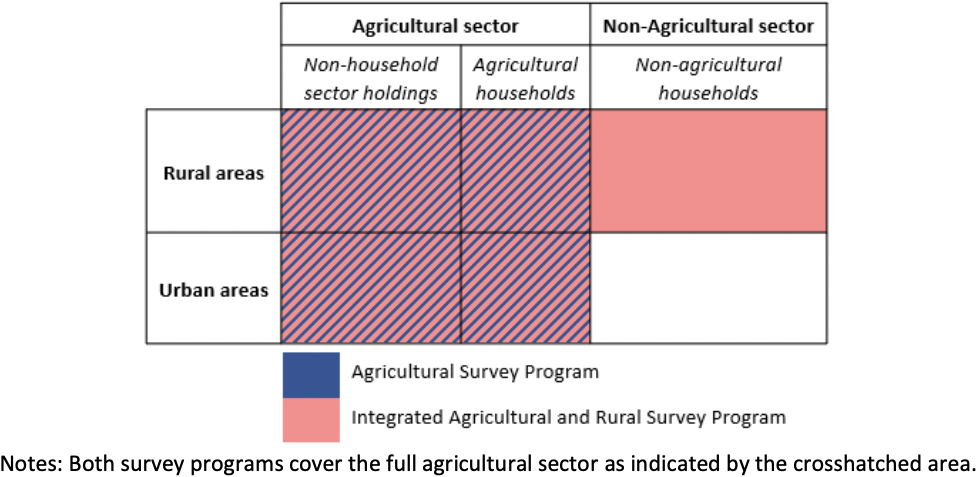
The methods and tools development work of 50x2030 is divided into three pillars. The first pillar explores the integration of survey approaches. It looks to develop, validate and document recommended approaches [10] to implementing the integrated survey systems that the Initiative promotes, such as the design of survey instruments, the sampling approach, and the dissemination and analysis of the integrated surveys. The second pillar looks at the use of technology to update methodologies for measurement. This will improve the landscape of data on agricultural production processes, such as (a) the measurement of survey data in the areas of agricultural labor, non-labor inputs, damage and losses, land area, land tenure, soil fertility, climatological conditions, crop variety and post-harvest losses, (b) the measurement of women’s empowerment in agriculture, and (c) the development of a survey management system. The third pillar works on the integration of 50x2030 survey data with other data sources. It looks to further the value of agricultural survey data through integration with Earth observation and other data sources, including administrative data.
Together, these pillars will enhance the sustainability of the data production systems supported by the Initiative and the accuracy, relevance and timeliness of survey data underlying evidence-based decision making. They will emphasize translating rigorous methodological research into practical guidance for survey practitioners in the form of guidelines and capacity development activities, which will feed directly into the data production workstream.
Another core component of the 50x2030 Initiative is the production of timely and high-quality agricultural and rural data. To realize this, the Initiative enhances the capacity of partner countries to implement their choice of modular, integrated survey programs depending on their needs. The 50x2030 Initiative specifically supports two survey models, both developed under the methods and tools development workstream: the agricultural survey program and the integrated agricultural and rural survey program. They are rooted, as mentioned above, in the AGRIS and LSMS-ISA survey programs and use peer-reviewed, evidenced-based and cost-effective tools.
The 50x2030 survey programs do differ in their coverage: Whereas the agricultural survey program targets household and non-household farms in urban and rural areas, the integrated agricultural and rural survey program is broader because it also encompasses rural non-agricultural households. Figure 1 depicts the coverage of both 50x2030 survey programs, while Fig. 2 provides a representation summarizing the two survey models.
Tools of the 50x2030 survey programs
Tools of the 50x2030 survey programs
Note: Adapted from the 50x2030’s “A guide to the 50x2030 data collection approach: Questionnaire design”.
The 50x2030 agricultural and integrated agricultural and rural survey programs.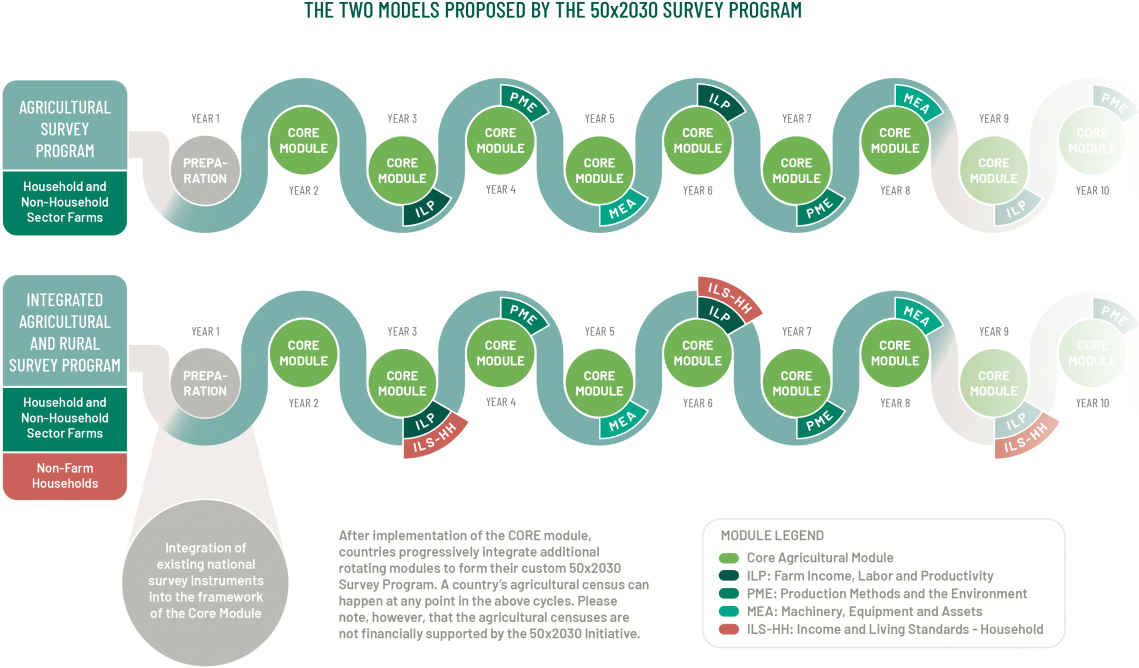
Both survey programs comprise an annual core tool covering crop, livestock, aquaculture, fishery and forestry production and a set of specialized rotating tools exploring topics, such as costs and farm income; labor and productivity; gender decision-making in agriculture; production practices; and environmental aspects of farming. Table 4 outlines the different tools of both survey programs and their recommended frequency. It also specifies the SDG and CAADP indicators that these tools target – Table 5 defines these indicators – as a key goal of the program is to produce the critical data missing for reporting on global and regional goals [11, 12]. In particular, very few countries report on indicators that 50x2030 data will help them report on. Data from FAO indicate that no county is reporting on the SDG 2.4.1 target on land under sustainable agriculture [13], while, less than a dozen countries record progress on the SDG 5.a.1 target on women’s tenure rights over agricultural land [14].
SDG and CAADP indicators the 50x2030 Initiative aims to inform
Note: Adapted from the 50x2030’s “A guide to the 50x2030 data collection approach: Questionnaire design”.
Partner countries decide which survey program to implement depending on the data they need, the resources they have, and their ability to eventually take over the survey programs financially and technically. A partner country can indicate its preference in its 50x2030 program implementation plan, a document that outlines the country’s vision of a more conducive environment for the sustainable, robust production and use of agricultural and rural survey data.
For the 50x2030 Initiative, the meaning of data use goes beyond uptake by national policymakers of the data it generates. IFAD, which leads data use activities, terms data users as either data intermediaries or decision makers. Data intermediaries refer to individuals or entities that use, analyze and interpret existing summary reports, summary tables and microdata sets to respond to questions and possibly recommend actions. They include analysts at agriculture ministries and development organizations, journalists and academic researchers. Decision makers, meanwhile, apply data to develop solutions in the agricultural and food security sectors and are thus the ultimate 50x2030 data consumers. They include staff at agriculture and other relevant government ministries, development organizations and corporations, as well as entrepreneurs and stakeholders at the national, regional and international levels. A big part of what the Initiative does is to ensure that decision makers have the motivation, access and capacity to use 50x2030 data. Similar to the component on data production, the 50x2030 Initiative promotes data use based on evidence [15]. It maps the agricultural data ecosystem, which entails identifying the relevant actors or stakeholders, data assets and the structures that govern the ecosystem. To accomplish this, the Initiative undertakes a series of activities that involve the participation of agricultural data stakeholders in-country. It starts with a desk review, followed by (a) stakeholder interviews and surveys; (b) a visual exercise to create a preliminary map, which locates the stakeholders and the data assets with which they interact, along with the barriers to data use; and (c) workshops, whether virtual or traditional, to validate the preliminary map. The resulting country data ecosystem map and report not only visualizes the current state of the data ecosystem but also envisions a future or ideal state, which can be realized by implementing the steps that the report recommends. The mapping exercise provides the basis for stakeholders to jointly develop an approach for promoting data use over the lifetime of the 50x2030 country program. The program implementation plan reflects this approach, including the technical assistance, training and workshops envisioned to improve the data ecosystem, enhance data sharing and communication practices, and track data use.
For the 50x2030 Initiative, data production and data use are equally important in creating strong national agricultural statistical systems and fostering data-smart agriculture in partner countries. In particular, the Initiative acknowledges that supply-driven data production alone would not be enough to boost the use of evidence in decision-making. Figure 3 illustrates the interaction between data use and data production activities in the context of the 50x2030 program, while Table 6 enumerates the metrics for monitoring the 50x2030 country program in terms of data production and data use.
Metrics for monitoring the 50x2030 country program
Metrics for monitoring the 50x2030 country program
Note: Adapted from the 50x2030 Initiative’s “Program implementation plan template”.
Interaction of data use and production activities along the data cycle. The diagram is extracted from “A guide to promoting data use under the 50x2030 Initiative,” 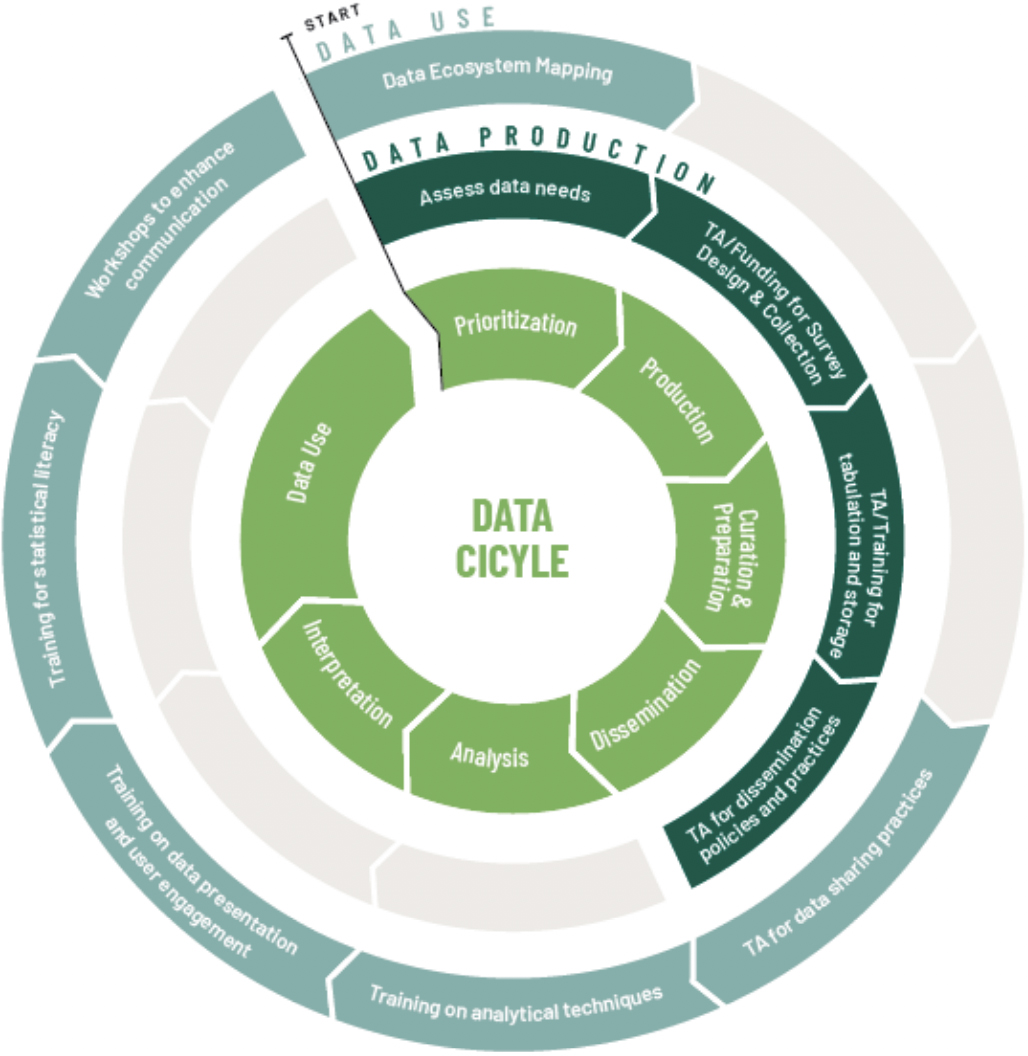
Two years since the 50x2030 Initiative became operational, early reports from countries suggest inroads in efforts to make national agricultural and rural statistical systems in partner countries more robust. We present below some examples of the Initiative’s early impact, particularly in filling the gaps on data to inform priority SDG indicators in partner countries, as well as discuss the importance of the data gathered through the 50x2030-supported surveys in informing national programs, strategies and indicators.
Projected timeline for the computation of SDG indicators relevant to 50x2030
Projected timeline for the computation of SDG indicators relevant to 50x2030
Note: Adapted from FAO’s country briefing titled “Use of AGRISurvey data for computing SDG’s and national indicators Experience in three countries,”
Cambodia. A lower-middle-income country, Cambodia released the report on its Inter-Censal Agriculture Survey 2019 (CIAS 2019) in April 2021. CIAS 2019 constitutes the first large-scale survey of the country’s agricultural sector since 2013, when Cambodia conducted its maiden agricultural census. CIAS 2019 used a methodology that aligned with the guidelines and standards of FAO’s AGRISurvey program. The 50x2030 Initiative provided support to government partners in collecting, cleaning and disseminating data. The National Institute of Statistics notes that “[t]he data collected and generated from this survey effort will help reflect progress towards the 2030 Sustainable Development goals for the agricultural sector,” focusing on certain goals, including SDGs 2 and 5 [16]. In May 2021, FAO published a country brief confirming that CIAS 2019 produced data necessary to calculate SDG 2.3.1 indicator on labor productivity of small-scale producers [17]. It is expected that the Cambodia Agricultural Survey 2020 will generate data that would be adequate to calculate SDG 5.a.1 indicator on women’s land tenure rights and that the computation for the country of SDG 2.4.1 indicator on productive and sustainable agriculture, which assesses resilience, would be possible in 2023 (Table 7). CIAS 2019 actually offers data on resilience: It delves into the types and severity of shocks that agricultural households in Cambodia have experienced, such as typhoons, floods, and drought and food insecurity, as well as how they have coped with them. This particular data set is important given the significant climate change risk that Cambodia faces. According to a joint assessment by the World Bank and the Asian Development Bank, the country “is projected to experience warming of 3.1 Senegal. Classified as a low-income food-deficit country [19], Senegal has reported and concluded four annual agricultural surveys – from 2017–2018 to 2020–2021 – since joining the 50x2030 Initiative. Officially known as Enquête Agricole Annuelle (EEA), the annual survey uses the integrated AGRISurvey program with a modular approach that 50x2030 recommends [20]. The 50x2030 Initiative rendered technical assistance to government partners in relation to data cleaning, processing and analysis, and supported the Ministry of Agriculture through its DAPSA, in developing the infrastructure dedicated to disseminating agricultural data surveys. According to DAPSA, the data generated through the EAA intend to inform the design and implementation of policies, improve market efficiency and support research, and the surveys, thus, would provide direct and indirect information for calculating certain SDG indicators [21]. Similar to Cambodia, Senegal now has data that would be adequate to calculate SDG 2.3.1 indicator on labor productivity of small-scale producers [17]. Moreover, the EEA has generated data to estimate SDG 2.3.2 indicator on the average income of small-scale holders and SDG 5.a.1 indicator on women’s land tenure rights [17]. Calculating all these SDG indicators are especially important to Senegal given its aspiration, as per the country’s 2015–2035 food security and resilience strategy, to cut its dependency on food imports by diversifying its food production activities and to empower women, as well as the youth, so they can be more active participants in the agricultural, livestock and fishing value chains [22]. Uganda. A low-income economy experiencing high food insecurity [4, 6], Uganda reported the results of its Annual Agriculture Survey (AAS) 2018 in June 2020. The 50x2030 Initiative provided government partners with support on processing, analyzing and disseminating data from the integrated, modular survey as well as in using such data for economic analyses. The Uganda Bureau of Statistics notes that the AAS 2018 data are “used to produce a set of tables and indicators for tracking and evaluating the impacts of government and development programs on agriculture, and to compute SDG and CAADP indicators related to food and agriculture” [23]. Indeed, Uganda was able to report on SDG 5.a.1 indicator on women’s land tenure rights through the survey: Findings show that although more Ugandan women work on the farm than men, the former do not own the same rights over the agricultural land [17]. A computation on SDG 2.3.1 indicator on labor productivity and 2.3.2 indicator on the average income of small-scale producers in Uganda is expected in 2021 [17]. In addition, there is evidence of uptake of the AAS data within the government and the research community. The Ugandan Ministry of Agriculture, Animal Industry and Fisheries’ draft Annual Performance Report for the fiscal year 2019–2020 noted the AAS as a basis for tracking the country’s performance on productivity against 2014 as the base year, such as the percentage change of farming households that have adopted commercialized agriculture, the percentage increase in yields of priority and strategic commodities and the percentage change in production and productivity of priority and strategic commodities [24]. Also, several papers have cited the 2018 AAS since the latter’s release. The publications covered issues in farm work on smallholder family farms [25], explored agricultural intensification processes over time and their sustainability [26] and looked at the challenges that young women face and the opportunities they have in the agribusiness sector in Uganda [27].
Table 7 summarizes the timeline for the computation of relevant SDG indicators among the above-mentioned 50x2030 partner countries, per the FAO, the 50x2030 implementing partner tasked to track the performance of countries toward meeting agriculture-related SDGs.
Since becoming operational in July 2019, the 50x2030 Initiative has worked to address the need for high-quality, timely agricultural and rural data that could inform analyses and policies toward zero hunger, gender equality and other sustainable development outcomes in low- and lower-middle-income African, Middle Eastern, Asian and Latin American countries. This work extends beyond supporting long-term survey data production because the Initiative is also keen to innovate the way data are being collected by using modern, rigorous but cost-effective methods, and it strives to increase evidence-based data use among national, regional and international stakeholders.
Experience in some partner countries indicates that the work is already paying off: Surveys reported and conducted under the 50x2030 Initiative have allowed for the computation of SDG 2.3.1 indicator on labor productivity of small-scale producers in Cambodia and Senegal and enabled Uganda to report on SDG 5.a.1 indicator on women’s land tenure rights. It is estimated that in the years ahead, through their continued collaboration with the Initiative, these countries will be able to report on more priority SDG 2 and 5 indicators. The goal of the Initiative is to see more partner countries tread a similar path, realizing its vision of eliminating data gaps and producing strong national agricultural statistical systems not only through the generation of agricultural data but also capacitating countries to make adequate use of these data in their policies and programs. This would usher in data-smart agriculture for data-driven decision making, a necessary ingredient toward optimizing an average annual investment of nearly a trillion dollars in agriculture across the globe [5] and in turn creating a future where there is zero hunger and where sustainable food production prevails.
Footnotes
Acknowledgments
The authors would like to thank Christophe Duhamel and Masako Hiraga for their valuable feedback during the drafting process.