




Abstract
Data science is a concept to unify statistics, data analysis, machine learning and their related methods in order to analyze actual phenomena with data to provide better understanding. This article focused its investigation on acquisition of data science skills in building partnership for efficient school curriculum delivery in Africa, especially in the area of teaching statistics courses at the beginners’ level in tertiary institutions. Illustrations were made using Big data of selected 18 African countries sourced from United Nations Educational, Scientific and Cultural Organization (UNESCO) with special focus on some macro-economic variables that drives economic policy. Data description techniques were adopted in the analysis of the sourced open data with the aid of R analytics software for data science, as improvement on the traditional methods of data description for learning and thus open a new charter of education curriculum delivery in African schools. Though, the collaboration is not without its own challenges, its prospects in creating self-driven learning culture among students of tertiary institutions has greatly enhanced the quality of teaching, advancing students skills in machine learning, improved understanding of the role of data in global perspective and being able to critique claims based on data.

Introduction
Data science is a “concept to unify statistics, data analysis, machine learning and their related methods” in order to “understand and analyze actual phenomena” with data. It employs techniques and theories drawn from many fields within the context of mathematics, statistics, computer science, and information science.
Data Science has spread its branches through several quintessential fields in modern day learning. It has emerged as a global phenomenon that has revolutionized industries and has increased their performances substantially [1]. Given the vast increase in the volume and complexity of data and the new technologies that have been developed to process and analyze this information, it can be argued that there is an increased need for statistical thinking in the context of working with data [2]. Key statistical reasoning topics that are critical for Data Scientists to know at a deep level include but are not limited to the following: developing clear statements of the problem/scientific research question; ensuring acquisition of high-quality data; understanding the process that produced the data, to provide proper context for analysis; allowing domain knowledge of the problem to guide both data collection and analysis; approaching modeling as a process that requires an overall strategy.
The modern day “romance” between Data Science and Statistics cannot be overemphasized (see Fig. 1). Statistics can be a powerful tool when performing the art of Data Science. From a high-level view, statistics is the use of mathematics to perform technical analysis of data. A basic visualization such as a bar chart might give some high-level information, but with statistics one gets to operate on the data in a much more information-driven and targeted way. The analysis involved helps to form concrete conclusions about our data rather than just guesstimating. Using statistics, we can gain deeper and more fine grained insights into how exactly our data is structured and based on that structure, optimally apply other data science techniques to get even more information [3].
The interactive disciplines of data science.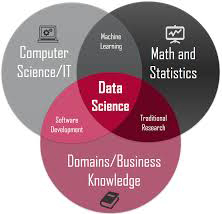
Education is the key to shaping the lives of people. Since the dawn of civilization, humans have evolved through education and have developed mechanisms to improve education. In the 21st century, where data is omnipresent in every walk of life, education is no exception. With advancements in computing techniques, it is possible to imbibe all the information through powerful big-data platforms [4]. Various Schools have to keep themselves updated with the demands of the industry so as to provide appropriate courses to their students. Furthermore, it is a challenge for the Schools to keep up with the growth of industries. In order to accommodate this, Schools are using Data Science systems to analyze growing trends in the market [5]. Using various statistical measures and monitoring techniques, data science can be useful for analyzing the industrial patterns and help the course creators to imbibe useful topics. Furthermore, using predictive analytics, Schools can analyze demands for new skill sets and curate courses that address them [6].
The performance of students depends on the teachers. While there are many assessment techniques that have been used to assess the performance of teachers, it has been mostly manual in nature. With the breakthrough in data science, it is possible to keep track of the teacher performance. This is not only valid for recorded data but also real-time data. As a result, with real-time monitoring of teachers, rigorous data collection is possible, along with its analysis. Furthermore, we can store and manage unstructured data like student reviews on a big data platform.
A growing number of students are completing bachelor’s degrees in statistics and entering the workforce as data analysts. In these positions, they are expected to understand how to use databases and other data warehouses, scrape data from Internet sources, program solutions to complex problems in multiple languages, and think algorithmically as well as statistically [7]. This increase in the number of undergraduates may help address the impending shortage of quantitatively trained workers. Statistics graduates at the bachelor’s level often work as analysts, and as a result need training in statistical methods, statistical thinking and statistical practice; a foundation in theoretical statistics; increased skills in computing and data-related technologies; and the ability to communicate [6, 7]. Computing skills to enable processing of large data sets are particularly relevant, as noted in the recent London Report on the Future of Statistics. Much of the statistics education literature focuses on the introductory statistics course and statistics before college. Given the relatively few decades since the establishment of undergraduate statistics programs, this is not surprising. While there has been impressive growth in the number of students taking introductory statistics, there has been a relative dearth of articles on the curriculum beyond the introductory course [8].
The digital age is having a profound impact on statistics and the nature of data analysis, and these changes necessitate revaluation of the training and education practices in statistics. Computing is an increasingly important and necessary aspect of a statistician’s work, and needs to be incorporated into statistics [9]. Successful statisticians must be familiar with the computer, for they are expected to be able to access data from various sources, apply the latest statistical methodologies, and communicate their findings to others in novel ways and via new media. In addition, researchers exploring new statistical methodology rely on computer experiments and simulation to explore the characteristics of methods as an aid to formalizing their mathematical framework [10, 11, 12].
Thus, for the field of statistics to have its greatest impact on policy and science, statisticians must seriously reflect on these major changes and their implications for statistics education. Faculty of science in African higher institutions needs to indicate to students that computing and data science is an important element of their statistics education, and it must be taught with an intellectual foundation that provides students with skills to reason about important computational tasks and continue to learn about new computational topics in statistics and Data science. Instead of teaching similar concepts with varying degrees of mathematical rigor, statisticians need to address what is missing from the curricula and take the lead in improving the level of students’ data competence. It is our responsibility, as statistics educators, to ensure our students have the computational understanding, skills, and confidence needed to actively and whole-heartedly participate in the computational arena.
Based on the discussion above, traditional statistics is the basis of data science, but there should be some improvement in the statistics curriculum. These changes are necessary in order to attract and prepare future statisticians, and to keep pace with the rapidly changing “big science” fields. As the practice of science and statistics research continues to change, its perspective and attitudes must also change so as to realize the field’s potential and maximize the important influence that statistical thinking has on scientific endeavors.
Materials and methods
Materials
Social-economic panel data spanning between year 1999 and 2018, consisting of variables GDP at Purchasing Power Parity (PPP) per capita (constant 2011 international $), GNI per capita based on PPP and Official Exchange rates of sixteen Eq. (16) West African countries as published by United Nations Educational, Scientific and Cultural Organization (UNESCO), was used for data description and visualization in R-statistical software for data science. This made the dataset (named as social.csv) to contain 320 rows and 4 columns. The data frame includes the following columns with description:
Variable Country relates to each of the West African countries as two letters abbreviation. A factor with levels: BJ, Benin; BF, Burkina Faso; CV, Cape Verde; GM, Gambia; GH, Ghana; GN, Guinea; GW, Guinea Bissau; CI, Cote d’Ivoire; LR, Liberia; ML, Mali; MR, Mauritania; NE, Niger; NG, Nigeria; SN, Senegal; SL, Sierra Leone; and TG, Togo was used to represent those countries as published by UNESCO. Variable GDP at PPP per capita is the Gross Domestic Product adjusted for inflation. It relates to the total monetary or market value of all finished goods and services produced within countries borders in a specific period of time divided by the average (or mid-year) population for the same year. Variable GNIPC based on PPP (US$) is referred to as the Gross National Income Per Capita based on the Purchasing Power Parity rates. It is the gross national income, converted to US dollars using the PPP rates. Variable ER is shortened as Exchange Rate. It is the value of the selected West Africans currencies in relation to the United States’ (US$) currency.
These variables were used to explain the data description techniques to the students, which also serves as a mean of driven their knowledge on the usefulness of socio-economic indicators.
Methods
For grouped data, we have
Where
Equation (3) is used when the number of observation is odd. But when the number of observation is even, we have
For grouped observations with corresponding frequencies
Where;
For ungrouped data, we have
Square root of Eqs (6) and (2.2) give the standard deviation.
Where
Where
However, the corresponding
Equating
If
where
And
The dataset was extracted in MS-excel and was saved as a “comma delimited (
w_africans
However, the w_africans dataset was inspected for correctness before commencing the analysis using the commands stated below and the output is as given in Table 1.
Output of the first 15 observations of the w_africans dataset
Output of the first 15 observations of the w_africans dataset
#Displaying the first 15 observations of the w_africans dataset
print(head(w_africans, n=15))
The nature of the columns (variables) in the w_africans dataset was also explored, using
ls(DATAVAR) or names(DATAVAR), where DATAVAR represent the dataframe name to be explored using the commands given below, with the subsequent results.
#Dataset variable names can be viewed using names (dataset) or ls(dataset)
ls(w_africans)
[1] “Country” “ER” “GDPPC_PPP” “GNIPC_PPP”
#Viewing the number of rows and columns in the w_ africans dataset; use ncol(dataset) and nrow(dataset)
ncol(w_africans); nrow(w_africans)
[1] 5
[1] 320
From the results output, the w_africans dataset contains 4 variables and 320 rows as explained earlier
#A more advanced way to view the structure of the dataset is by using str(DATAVAR)
str(w_africans) #Data structure
data.frame’: 320 obs. of 5 variables:
$ Country: Factor w/16 levels “BF”,“BJ”,“CI”,..:2 2 2 2 2 2 2 2 2 2…
$ period: int 1999 2000 2001 2002 2003 2004 2005 2006 2007 2008…
$ GDPPC_PPP: num 1622 1666 1703 1729 1735…
$ GNIPC_PPP: int 1260 1320 1380 1410 1450 1510 1540 1600 1690 1770…
$ ER: num 615 710 732 694 580…
The w_africans data.frame includes 2 numeric variables, 2 integer variables and 1 categorical variable
The Mean value of each of the variables is computed using the commands:
#Calculate the mean of variable with mean(DATAVAR$ VAR): mean of GDPPC_PPP variable
mean(w_africans$GDPPC_PPP, na.rm=TRUE)
[1] 2258.119
#mean of GNIPC_PPP variable
mean(w_africans$GNIPC na.rm=TRUE)
[1] 2117.962
#mean of ER variable
mean(w_africans$ER, na.rm=TRUE)
[1] 857.6926
Here, the average GDP at purchasing power parity per capita, GNI at purchasing power parity per capita and exchange rate (ER) for the 16 West African countries between years 1999 and 2018 is about $2258.12, $2117.962 and 857.6926 per US$ respectively.
Note: The
For the standard deviation, the following commands subsist; and the results represent the spread of the variables.
sd(w_africans$GDPPC_PPP, na.rm=TRUE)#Standard deviation of GDPPC_PPP
[1] 1331.402
[1] 1341.855
sd(w_africans$ER, na.rm=TRUE)#Standard deviation of ER
[1] 1596.375
Continuing in the same terrain for the Range computation, minimum and maximum are computed on a single variable using the min(VAR) and max(VAR) formula. Students were taught how to calculate minimums and maximums using the codes below:
#Minimum and maximum GDP of the selected w_ african countries
min(w_africans$GDP, na.rm=TRUE); max(w_africans $GDP, na.rm=TRUE)
[1] 754.86
[1] 6661.99
From the output, the minimum GDP at purchasing power parity per capita is $754.86 and the maximum is about $6,661.99. This indicated a large gap in GDP per capita taking distribution among the West African countries in response to their purchasing power parity into consideration.
[1] 600
[1] 7330
It can be inferred that the Gross National Income at PPP per capital of all West Africa is between $600 and $7330 inclusive.
#Minimum and maximum ER of the selected w_african countries
min(w_africans$ER, na.rm=TRUE); max(w_africans$ ER, na.rm=TRUE)
[1] 0.27
[1] 9088.32
It is evidenced within the studied periods that Ghana’s economy has not been adversely affected by external forces as shown from their cedis minimum exchange rate to the US$ while the maximum exchange rate of 9088.32 is attributed to Guinea. We can infer that African countries as a nation is still developing and may take some time to meet up with other continents currency rates.
The command “range(VAR)” is used to summarize the minimums and maximums on individual variables. These computations are demonstrated in the following codes:
#Calculate the range of a variable with range(VAR)
range(w_africans$GDPPC_PPP, na.rm=TRUE)#Range of variable GDP
range(w_africans$GDPPC_PPP, na.rm=TRUE)#Range of variable GNDPPC_PPP
[1] 754.86 6661.99
range(w_africans$GNIPC_PPP, na.rm=TRUE)#Range of variable GNIPC_PPP
[1] 600 7330
range(w_africans$ER, na.rm=TRUE)#Range of variable ER
[1] 0.27 9088.32
Students have been taught that a quartile is a value computed from a collection of numeric measurements, showing observation’s rank when compared to all other present observations. Quartile can also be alternatively expressed as a percentilepercentile, as it is identical but on a scale of 0 to 100. Thus, we used
quantile(VAR, prob=c(prob value1, prob value2, …, prob valuei))
#Calculate the 25th, 50th, 75th percentilepercentile for GDP per capita at PPP
quantile(w_africans$GDPPC_PPP, na.rm=TRUE, prob =c(0.25, 0.50, 0.75, 0.95))
25% 50% 75% 95%
1369.780 1728.700 2851.580 5361.187
From the output, it easily observed that 25% of average GDP at PPP per capita was $136.780 with median (50
#Calculate the 25th, 50th, 75th percentilepercentile for
quantile(w_africans$GNIPC, na.rm=TRUE, prob=c (0.25, 0.50, 0.75, 0.95))
25% 50% 75% 95%
1195 1680 2625 5435
#Calculate the 25th, 50th, 75th percentilepercentile for
quantile(w_africans$ER, na.rm=TRUE, prob=c(0.25, 0.50, 0.75, 0.95))
25% 50% 75% 95%
83.060 494.040 591.740 4528.037
Pooled descriptive statistics
Source: Extracted from R-console output.
Variables normality test
Source: Extracted from R-console output.
Students were also taught how to use summary(x) function, where x can be any number of objects, including datasets, variables, and linear models to generate the descriptive statistics of the variables in the dataset. The code is written below for the w_africans dataset with the subsequent results presented below it.
The summary outputs provides the descriptive statistics of all objects in the sample dataset and is explicitly presented in Table 2. Further exploration was carried out on the data by checking their respective distributions through Skewness, kurtosis and further test such as the Shapiro wilk test of normality. These were done using the “
library(moments)
skewness(w_africans$GDPPC_PPP, na.rm=T) #Skewness coefficient of GDP per capita at PPP
[1] 1.353004
skewness(w_africans$GNIPC_PPP, na.rm=T) #Skewness coefficient of GNIPC at PPP
[1] 1.517567
skewness(w_africans$ER, na.rm=T) #Skewness coefficient of ER
[1] 3.283139
kurtosis(w_africans$GDPPC_PPP, na.rm=T) #Kurtosis coefficient of GDP per capita at PPP
[1] 4.226773
kurtosis(w_africans$GNIPC_PPP, na.rm=T) #Kurtosis coefficient of GNIPC at PPP
[1] 4.940481
kurtosis(w_africans$ER, na.rm=T) #Kurtosis coefficient of ER
[1] 13.80796
shapiro.test(w_africans$GDP)#GDP test of Normality
Cross-section data description on average
Values in parentheses [ ] represent standard deviation. Source: Extracted from R-console output.
Shapiro-Wilk normality test
data: w_africans$GDPPC_PPP
W
shapiro.test(w_africans$GNIPC)#GNIPC test of Normality
Shapiro-Wilk normality test
data: w_africans$GNIPC_PPP
W
shapiro.test(w_africans$ER)#ER test of Normality
Shapiro-Wilk normality test
data: w_africans$ER
W
Positive coefficients of 1.353, 1.518, and 3.283 indicated that the econometric variables of GDP, GNIPC and ER is highly skewed to the right and may not be normally distributed. As the Kurtosis measure the fourth moments, selected West Africans exchange rate was found to be normally distributed (kurtosis
Normal Q-Q plots of GDP at PPP per capita of some selected West African countries.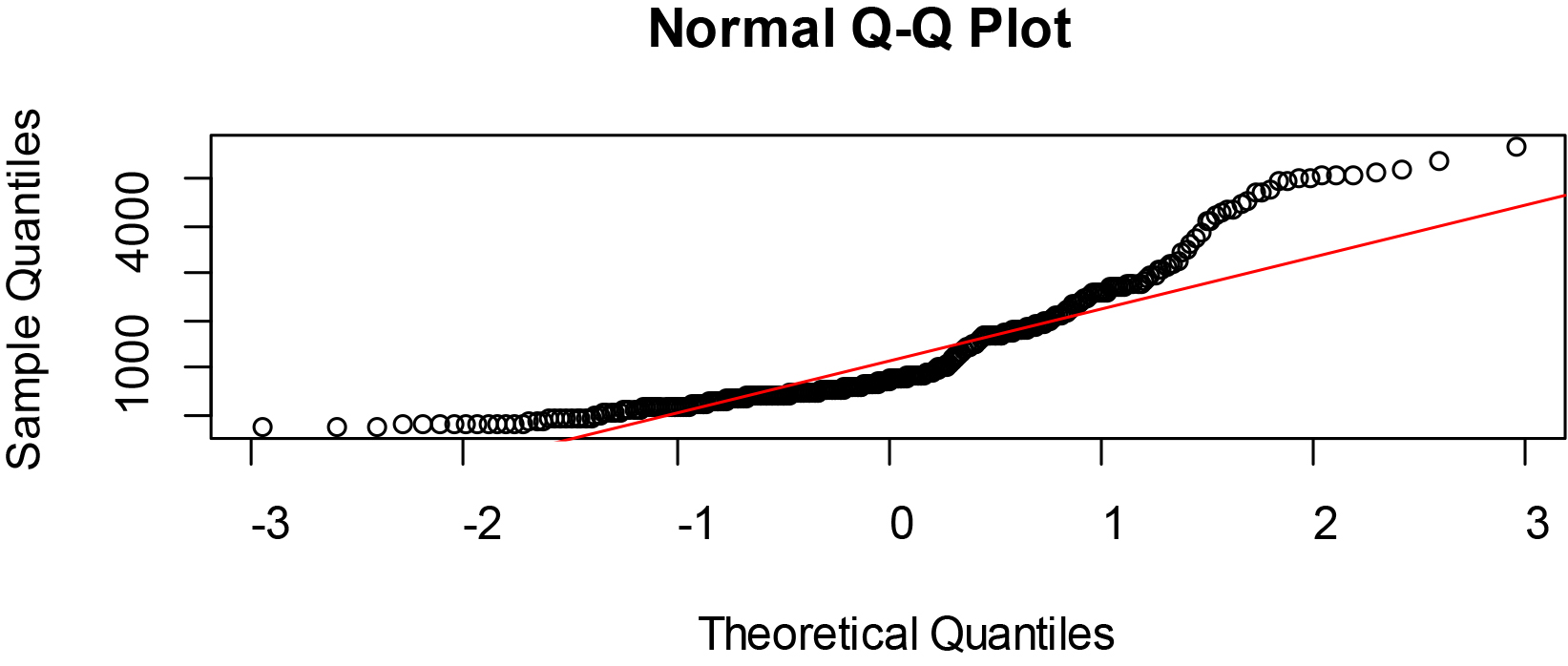
Normal Q-Q plots of GNI at PPP per capita of some selected West African countries.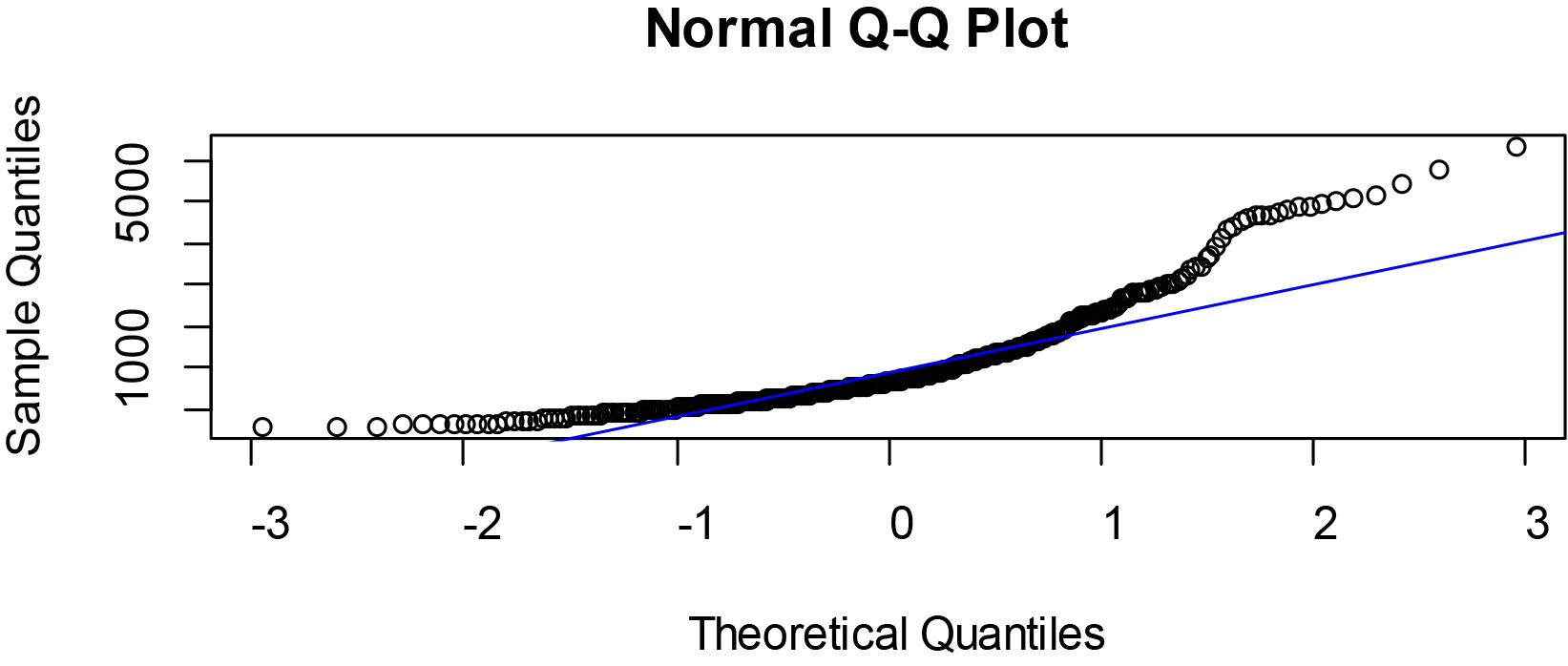
Normal Q-Q plots of ER of some selected West African countries.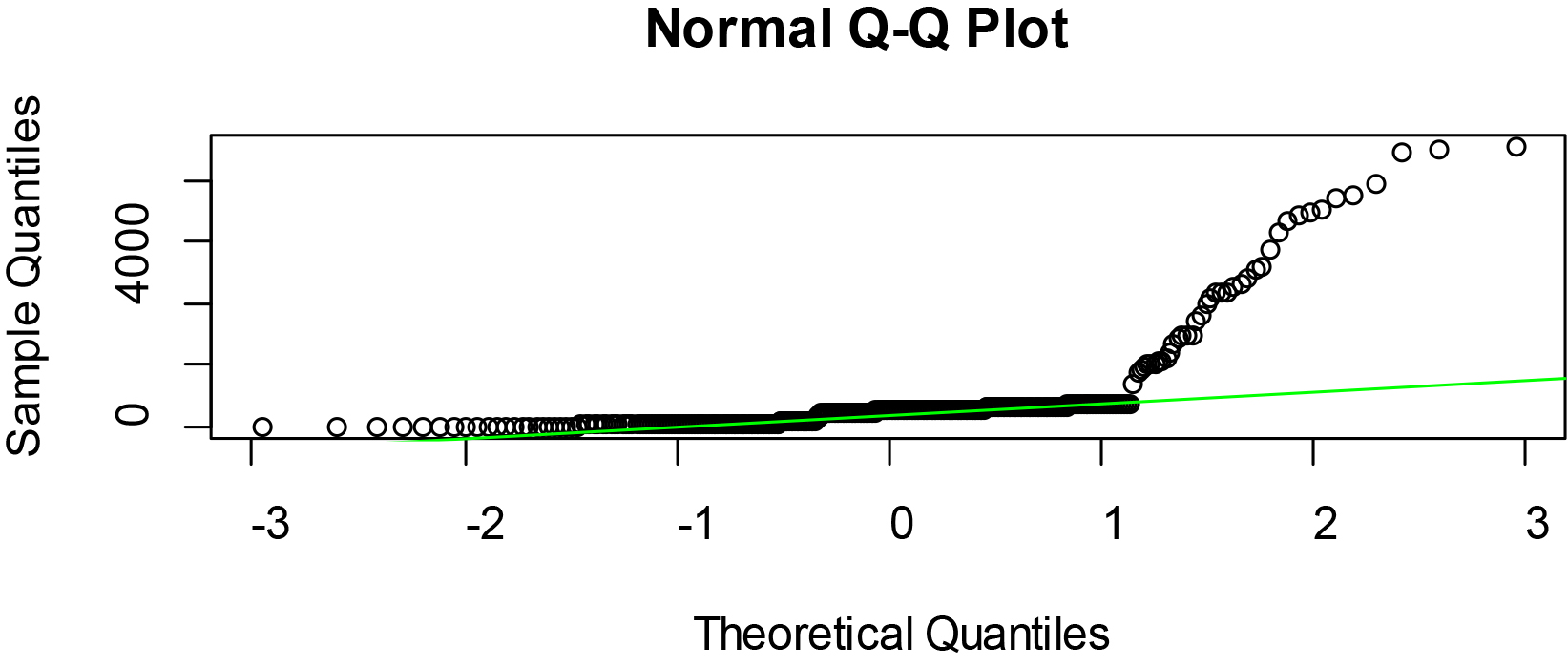
Bar chart of average GDP per capita based on PPP rates of selected West African countries.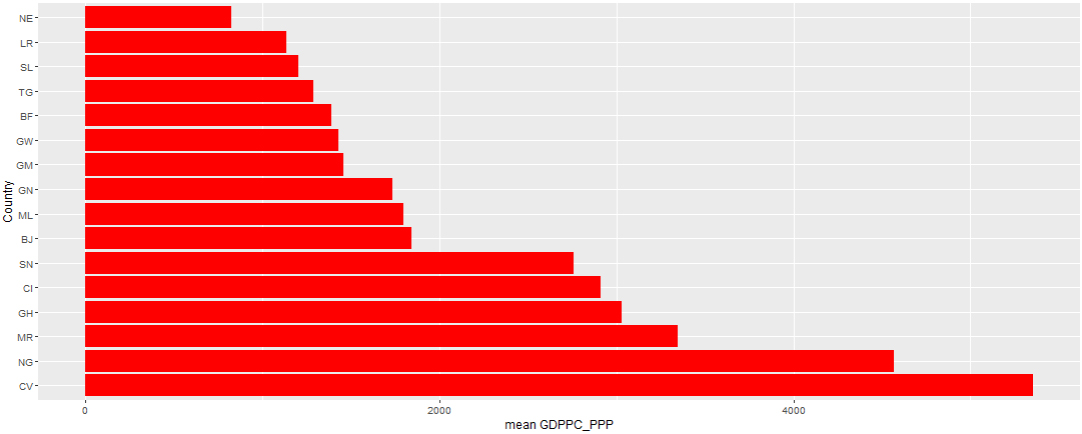
Bar chart of average GNIPC based on PPP rates of selected West African countries.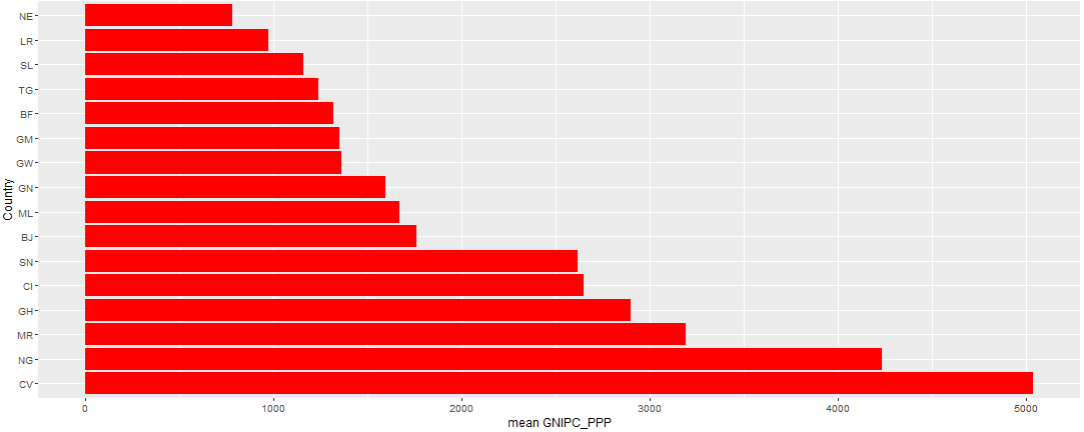
Bar chart of average ER of selected West African countries.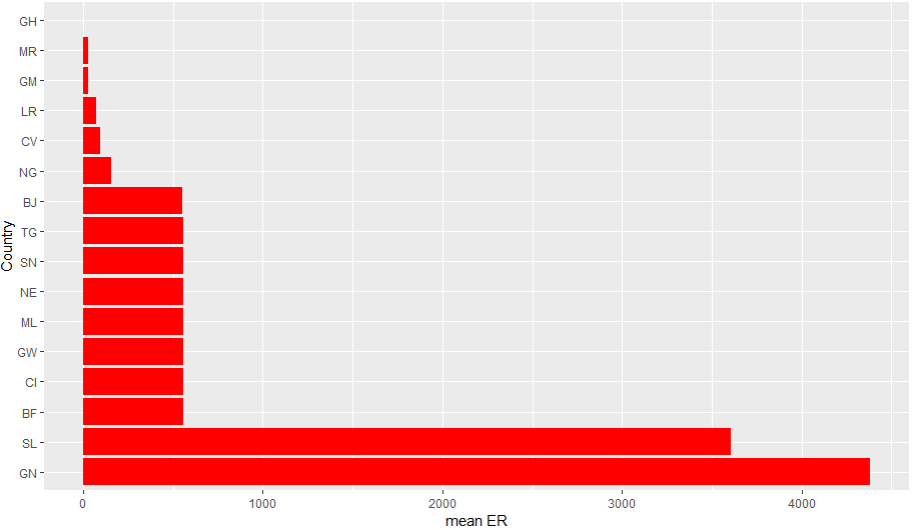
Quantile plots visualize the distribution of the data per variable and details generated by the below commands are as given in Figs 2–4 respectively
par(mfrow=c(2,2)) #Partitioning of plots space
#Quantile plot of GDP per capita at PPP rates
qqnorm(w_africans$GDPPC_PPP);qqline(w_africans$ GDPPC_PPP,col=“red”)
#Quantile plot of GNI per capita at PPP rates
qqnorm(w_africans$GNIPC_PPP);qqline(w_africans$ GNIPC_PPP,col=“black”)
#Quantile plot of Exchange rate
qqnorm(w_africans$ER);qqline(w_africans$ER,col= “green”)#Quantile plot of ER
The Figs 2–4 showed that the quantile plots of the selected variables do not lie on the theoretical normal line. Thus, the variables are not precisely normal but may not be too far off.
Students were also introduced to data splitting in R using dataframe_name[n:m,]. This method was used due to the fact that the data structure was paneled in nature with the first 20 observations on row-wise which represents republic of Benin followed by Burkina Faso, among others. The command line used is given below with the results output presented in Table 4.
benin_d
The data was further explored using
library(ExPanDaR)
ExPanD(df=w_africans)
The Figs 5–7 showed that Cape Verde (CV) recorded the highest average GDP (per capita) and GNI (per capita) taking into consideration purchasing power parity among the West African countries followed by Nigeria (NG). Cape Verde (CV) also has the highest average GNIPC at purchasing power parity rates and Ghana (GH) possess the strongest currency rate among other west African nations taking the US$ exchange rate into consideration. Niger (NE) recorded the lowest average GDP per capita and GNIPC at PPP and Guinea (GN) with the weakest currency rate within the selected timeframe. This can also be evidenced from Table 4 with an associated variability from the mean.
This paper presented students learning experience on the introduction of data science skills for curriculum delivery in Africa using social-economic data extracted from UNESCO website. The interactive session helped students on how to use R software for analyzing for descriptive statistics, and appropriate interpretation of results based on the type of data used for analysis. This bridged the gap between the traditional method of data analysis and the conventional form especially in the area of big data. Findings from the analysis showed that economic growth varies from countries to countries as shown from the pictorial representation of data and respective spread of observation from the mean. However, this result is an indication that Cape Verde (CV) among other West African countries is better off in terms of their economic growth taking purchasing power parity into consideration. This indicated that Nigeria economic growth may be marred by inflation, resulting to the devaluation of her naira note in the international market, among other developing countries. Hence, West African countries in general are far from being developed compared to countries in Asia, America, and Europe to mention a few.
Conclusion
Introducing beginner students in statistics to data science is a vexatious task, especially in African countries where regular supply of power is a luxury and uninterrupted internet facilities are quite expensive and almost impossible. The developing nature of most Africa countries has created a paradoxical approach to achieving reasonable success in students’ learning of data science. However, for the purpose of this research, great achievement was made in introducing the students to data description using R software for data science, thereby equipping them with a career in data analysis. From the beginning, students offering introductory statistics gain reasonable experience of what constitutes both the practical and conceptual aspects of the working life of a data scientist, as they were able to run simple codes on exploratory data analysis using the focused data. The students equally enhanced their knowledge in deducing reasonable inference from the output of data analysis. 200 level students were able to run with ease, R codes to estimate basic descriptive statistics within a 1 hour lecture period. The activities was carried out without much supervision on the part of the tutor. Comparison was made per member countries on their developmental rate taking their respective Gross Domestic Product, Gross National Income per capita, and Exchange Rate into consideration.
It is of the opinion that topics covered in data science courses can and should be brought into a variety of statistics courses at undergraduate level, while adequate facilities provided for its teaching and learning. Thus, key data science skills need to be introduced, reiterated, and reinforced throughout the undergraduate statistics curriculum.
Though, the exercise is not without its own challenges, but its prospects in creating self-driven learning culture among students of tertiary institutions has greatly enhance the quality of teaching, advancing students skills in machine learning, improved understanding of the role of data in global perspective and on the spot ability of the students to be able to critique claims based on data.
Footnotes
Acknowledgments
The authors are grateful to Federal Polytechnic Ilaro and the students of Mathematics & Statistics department for creating the enabling environments suitable for the data science activities carried out in this research.
Appendix 1: Data
GDP per capita PPP, GNI per capita PPP, and Exchange Rate of selected 16 west African countries.
Country
Period
GDP per capita, PPP (2011 international $)
GNI per capita, PPP ($)
Exchange rate
BJ
1999
1621.9
1260
615.47
BJ
2000
1666.47
1320
710.21
BJ
2001
1703.02
1380
732.4
BJ
2002
1728.7
1410
693.71
BJ
2003
1734.7
1450
579.9
BJ
2004
1757.9
1510
527.34
BJ
2005
1735.97
1540
527.26
BJ
2006
1752.96
1600
522.43
BJ
2007
1805.62
1690
478.63
BJ
2008
1841.19
1770
446
BJ
2009
1831.88
1770
470.29
BJ
2010
1818.78
1770
494.79
BJ
2011
1820.89
1820
471.25
BJ
2012
1855.94
1880
510.56
BJ
2013
1934.62
1990
493.9
BJ
2014
2001.05
2100
493.76
BJ
2015
1987.14
2110
591.21
BJ
2016
2009.66
2160
592.61
BJ
2017
2069.29
2260
580.66
BJ
2018
2151.54
2400
555.45
BF
1999
1086.62
840
615.7
BF
2000
1075.4
850
711.98
BF
2001
1114.2
900
733.04
BF
2002
1129.74
930
696.99
BF
2003
1183.09
990
581.2
BF
2004
1200.42
1030
528.28
BF
2005
1266.36
1120
527.47
BF
2006
1305.92
1200
522.89
BF
2007
1338.84
1260
479.27
BF
2008
1393.7
1340
447.81
BF
2009
1392.2
1340
472.19
BF
2010
1423.38
1360
495.28
BF
2011
1472.72
1420
471.87
BF
2012
1521.45
1520
510.53
BF
2013
1562.3
1590
494.04
BF
2014
1582.33
1620
494.41
BF
2015
1596.33
1650
591.45
BF
2016
1642.48
1710
593.01
BF
2017
1696.23
1810
582.09
BF
2018
1755.59
1920
555.72
CV
1999
3472.6
2660
102.7
CV
2000
3896.96
3020
115.88
CV
2001
3915.16
3150
123.21
CV
2002
4053.37
3270
117.26
CV
2003
4157.15
3440
97.79
CV
2004
4513.97
3820
88.75
CV
2005
4759.13
4090
88.65
CV
2006
5071.86
4470
87.93
CV
2007
5768.87
5320
80.62
CV
2008
6078.55
5690
75.34
CV
2009
5929.44
5600
80.04
CV
2010
5943.35
5570
83.28
CV
2011
6102.41
5860
79.28
CV
2012
6090.55
5940
86.32
CV
2013
6061.31
6070
83.07
CV
2014
6021.63
6050
83.03
CV
2015
6007.22
6180
99.39
CV
2016
6214.08
6470
99.69
CV
2017
6387.1
6790
97.81
Country
Period
GDP per capita, PPP (2011 international $)
GNI per capita, PPP ($)
Exchange rate
CV
2018
6661.99
7330
93.41
GM
1999
1416.72
1060
11.4
GM
2000
1448.62
1110
12.79
GM
2001
1484.89
1150
15.69
GM
2002
1391.43
1080
19.92
GM
2003
1440.18
1160
28.53
GM
2004
1493.71
1240
30.03
GM
2005
1434.39
1230
28.58
GM
2006
1407.03
1240
28.07
GM
2007
1415.08
1290
24.87
GM
2008
1452.45
1360
22.19
GM
2009
1500.82
1410
26.64
GM
2010
1551.59
1470
28.01
GM
2011
1440.79
1390
29.46
GM
2012
1476.06
1460
32.08
GM
2013
1500.51
1520
35.96
GM
2014
1442.1
1490
41.73
GM
2015
1481.48
1540
42.51
GM
2016
1443.69
1530
43.88
GM
2017
1465.34
1580
46.61
GM
2018
1516.69
1680
48.15
GH
1999
2193.1
1670
0.27
GH
2000
2219.21
1710
0.54
GH
2001
2252.13
1790
0.72
GH
2002
2296.58
1860
0.79
GH
2003
2357.33
1940
0.87
GH
2004
2428.26
2050
0.9
GH
2005
2507.59
2210
0.91
GH
2006
2600.79
2370
0.92
GH
2007
2644.72
2480
0.94
GH
2008
2813.21
2690
1.06
GH
2009
2875.42
2770
1.41
GH
2010
3026.36
2920
1.43
GH
2011
3368.8
3260
1.51
GH
2012
3595.64
3480
1.8
GH
2013
3769.94
3830
1.95
GH
2014
3791.28
3880
2.9
GH
2015
3786.96
3990
3.67
GH
2016
3830.5
4060
3.91
GH
2017
4051.46
4340
4.35
GH
2018
4211.85
4650
4.59
GN
1999
1515.65
1150
1387.4
GN
2000
1518.52
1180
1746.87
GN
2001
1541.09
1210
1950.56
GN
2002
1588.79
1300
1975.84
GN
2003
1577.93
1230
1984.93
GN
2004
1583.62
1270
2243.93
GN
2005
1598.17
1290
3644.33
GN
2006
1582.66
1360
5148.75
GN
2007
1653.28
1470
4197.75
GN
2008
1682.66
1500
4601.69
GN
2009
1626.17
1450
4801.08
GN
2010
1666.49
1530
5726.07
GN
2011
1721.45
1600
6658.03
GN
2012
1783.67
1710
6985.83
GN
2013
1812.88
1780
6907.88
GN
2014
1836.56
1880
7014.12
GN
2015
1859.74
1930
7485.52
GN
2016
2007.34
2130
8959.72
Country
Period
GDP per capita, PPP (2011 international $)
GNI per capita, PPP ($)
Exchange rate
GN
2017
2213.46
2420
9088.32
GN
2018
2337.95
2480
9011.13
GW
1999
1365.77
1000
615.7
GW
2000
1410.92
1090
711.98
GW
2001
1411.49
1100
733.04
GW
2002
1367.12
1110
696.99
GW
2003
1343.98
1100
581.2
GW
2004
1349.35
1140
528.28
GW
2005
1374.03
1200
527.47
GW
2006
1372.44
1250
522.89
GW
2007
1383.12
1300
479.27
GW
2008
1392.52
1320
447.81
GW
2009
1403.55
1340
472.19
GW
2010
1430.97
1400
495.28
GW
2011
1506.7
1520
471.87
GW
2012
1442.15
1480
510.53
GW
2013
1450
1470
494.04
GW
2014
1425.77
1560
494.41
GW
2015
1474.24
1610
591.45
GW
2016
1526.81
1690
593.01
GW
2017
1576.75
1740
582.09
GW
2018
1596.36
1790
555.72
CI
1999
3132.64
2310
615.7
CI
2000
2989.15
2160
711.98
CI
2001
2922.03
2100
733.04
CI
2002
2810.19
2030
696.99
CI
2003
2714.01
1940
581.2
CI
2004
2690.74
2070
528.28
CI
2005
2679.79
2300
527.47
CI
2006
2662.33
2350
522.89
CI
2007
2650.49
2400
479.27
CI
2008
2657.67
2460
447.81
CI
2009
2682.04
2500
472.19
CI
2010
2673.01
2520
495.28
CI
2011
2495.5
2400
471.87
CI
2012
2696.19
2660
510.53
CI
2013
2864.05
2840
494.04
CI
2014
3038.84
3130
494.41
CI
2015
3225.19
3340
591.45
CI
2016
3395.09
3650
593.01
CI
2017
3564.6
3760
582.09
CI
2018
3733.05
4030
555.72
LR
1999
41.9
LR
2000
1317.87
930
40.9
LR
2001
1307.93
880
48.59
LR
2002
1325.38
900
61.75
LR
2003
910.1
610
59.38
LR
2004
916.49
650
54.91
LR
2005
940.16
700
57.1
LR
2006
981.89
780
58.01
LR
2007
1034.29
870
61.27
LR
2008
1063.37
930
63.21
LR
2009
1076.11
960
68.29
LR
2010
1101.48
980
71.4
LR
2011
1154.41
1090
72.23
LR
2012
1211.05
1120
73.51
LR
2013
1281.55
1200
77.52
LR
2014
1257.63
1190
83.89
LR
2015
1225.93
1190
86.19
Country
Period
GDP per capita, PPP (2011 international $)
GNI per capita, PPP ($)
Exchange rate
LR
2016
1176.19
1160
94.43
LR
2017
1175.64
1170
112.71
LR
2018
1161.18
1130
144.06
ML
1999
1508.48
1160
615.7
ML
2000
1465.76
1150
711.98
ML
2001
1642.35
1270
733.04
ML
2002
1643.04
1270
696.99
ML
2003
1738.13
1410
581.2
ML
2004
1710.11
1430
528.28
ML
2005
1763.9
1520
527.47
ML
2006
1786.31
1580
522.89
ML
2007
1788.03
1640
479.27
ML
2008
1812.05
1700
447.81
ML
2009
1835.97
1740
472.19
ML
2010
1875.19
1760
495.28
ML
2011
1877.89
1810
471.87
ML
2012
1808.01
1770
510.53
ML
2013
1796.77
1800
494.04
ML
2014
1868.31
1920
494.41
ML
2015
1922.43
2010
591.45
ML
2016
1974.31
2070
593.01
ML
2017
2019.44
2170
582.09
ML
2018
2055.62
2230
555.72
MR
1999
2922.44
2320
20.95
MR
2000
2833.93
2280
23.89
MR
2001
2813.65
2230
25.56
MR
2002
2755.18
2370
27.17
MR
2003
2839.11
2480
26.3
MR
2004
2918.42
2610
26.43
MR
2005
3090.86
2840
26.55
MR
2006
3570.52
3200
26.86
MR
2007
3567.26
3300
25.86
MR
2008
3503.27
3350
23.82
MR
2009
3367.49
3310
26.24
MR
2010
3426.47
3300
27.59
MR
2011
3483.52
3380
28.11
MR
2012
3578.1
3510
29.66
MR
2013
3685.7
3690
30.07
MR
2014
3779.09
3810
30.27
MR
2015
3722.7
3830
32.47
MR
2016
3690.24
3890
35.24
MR
2017
3696.35
4000
35.79
MR
2018
3724.41
4160
35.68
NE
1999
793.78
610
615.7
NE
2000
754.86
600
711.98
NE
2001
779.6
630
733.04
NE
2002
774.09
630
696.99
NE
2003
785.6
650
581.2
NE
2004
757.75
650
528.28
NE
2005
762.87
680
527.47
NE
2006
777.48
710
522.89
NE
2007
772.37
730
479.27
NE
2008
815.04
780
447.81
NE
2009
778.98
750
472.19
NE
2010
812.3
790
495.28
NE
2011
799.26
790
471.87
NE
2012
859.79
860
510.53
NE
2013
870.4
880
494.04
NE
2014
900.14
930
494.41
Country
Period
GDP per capita, PPP (2011 international $)
GNI per capita, PPP ($)
Exchange rate
NE
2015
903.42
940
591.45
NE
2016
912.03
960
593.01
NE
2017
920.63
990
582.09
NE
2018
931.99
1030
555.72
NG
1999
2996.94
2270
92.34
NG
2000
3069.44
2230
101.7
NG
2001
3170.44
2440
111.23
NG
2002
3565.39
2760
120.58
NG
2003
3731.46
2910
129.22
NG
2004
3973.62
3190
132.89
NG
2005
4121.5
3390
131.27
NG
2006
4258.59
3830
128.65
NG
2007
4421.36
3990
125.81
NG
2008
4597
4220
118.55
NG
2009
4835.95
4450
148.9
NG
2010
5085.41
4710
150.3
NG
2011
5213.84
4920
153.86
NG
2012
5290.63
5130
157.5
NG
2013
5494.52
5420
157.31
NG
2014
5687.59
5810
158.55
NG
2015
5685.93
5910
192.44
NG
2016
5448.91
5760
253.49
NG
2017
5351.44
5710
305.79
NG
2018
5315.82
5700
306.08
SN
1999
2398.95
1840
615.7
SN
2000
2417.83
1890
711.98
SN
2001
2468.53
1980
733.04
SN
2002
2424.87
1970
696.99
SN
2003
2523.67
2100
581.2
SN
2004
2605.44
2230
528.28
SN
2005
2682.44
2370
527.47
SN
2006
2677.93
2450
522.89
SN
2007
2736.88
2570
479.27
SN
2008
2772.55
2660
447.81
SN
2009
2754.75
2640
472.19
SN
2010
2775.7
2690
495.28
SN
2011
2739.34
2700
471.87
SN
2012
2800.41
2810
510.53
SN
2013
2799.96
2850
494.04
SN
2014
2902.51
3010
494.41
SN
2015
3001.82
3140
591.45
SN
2016
3104.24
3260
593.01
SN
2017
3232.31
3460
582.09
SN
2018
3356.34
3670
555.72
SL
1999
875.35
660
1804.2
SL
2000
908.71
700
2092.13
SL
2001
820.7
650
1986.15
SL
2002
993.28
800
2099.03
SL
2003
1036.66
860
2347.94
SL
2004
1057.69
890
2701.3
SL
2005
1063.91
930
2889.59
SL
2006
1073.92
970
2961.91
SL
2007
1129.38
1120
2985.19
SL
2008
1162.41
1200
2981.51
SL
2009
1172.86
1230
3385.65
SL
2010
1208.05
1200
3978.09
SL
2011
1255.45
1240
4349.16
SL
2012
1413.88
1490
4344.04
SL
2013
1669.13
1720
4332.5
Source: Extracted from UIS.stat report (uis.unesco.org).
Country
Period
GDP per capita, PPP (2011 international $)
GNI per capita, PPP ($)
Exchange rate
SL
2014
1707.1
1760
4524.16
SL
2015
1326.21
1400
5080.75
SL
2016
1376.4
1330
6289.94
SL
2017
1403.79
1500
7384.43
SL
2018
1425.34
1520
7931.63
TG
1999
1282.72
970
615.7
TG
2000
1235.46
960
711.98
TG
2001
1182.2
940
733.04
TG
2002
1140.99
930
696.99
TG
2003
1167.5
970
581.2
TG
2004
1162.34
990
528.28
TG
2005
1145.91
1010
527.47
TG
2006
1161.06
1050
522.89
TG
2007
1156.06
1080
479.27
TG
2008
1170.78
1120
447.81
TG
2009
1202.52
1160
472.19
TG
2010
1241.92
1210
495.28
TG
2011
1286.47
1360
471.87
TG
2012
1334.66
1360
510.53
TG
2013
1379.4
1440
494.04
TG
2014
1423.55
1520
494.41
TG
2015
1467.25
1620
591.45
TG
2016
1501.12
1640
593.01
TG
2017
1529.52
1680
582.09
TG
2018
1565.46
1760
555.72