




Abstract
This study is grounded in the growing significance of environmental sustainability and the widespread adoption of RFID technology across various industries and is aimed to explore the influence of RFID implementation in supply chains by developing a tool that calculates the net balance of CO2 annual emissions. The tool, known as “Return on the Environment” (EROI), is based on a widely accepted environmental assessment method and it calculates the Global Warming Potential (GWP100) incurred and avoided at various stages in the supply chain strictly related to RFID technology introduction. To validate the tool, two RFID deployments have been assessed: one involving a pharmaceutical product tagged on its secondary packaging to monitor the flow of products through the distribution channel, and another a medical device tagged on both primary and secondary packaging to oversee product flow from the supplier distribution center to the hospital operating theatres. In both cases, the results indicate that implementing RFID technology reduced GWP100 compared to the scenarios without RFID. This was primarily due to decreased product shrinkage, lower missing or expired products, and reduced additional transportation due to shipping errors. The tool is versatile and it could be applied to any type of product, serving as a source of inspiration for those who want to assess the sustainability of RFID technology not only from an economic perspective, i.e. ROI calculation, but also from an environmental view. Future work will address the third level of sustainability, RFID social sustainability, that is the impact RFID deployments may have on empowering people, improving staff and employees working conditions, and creating possibilities for high-value job opportunities.
Introduction
Climate change stands as a pressing global challenge, demanding the collective efforts of individuals, businesses, and nations in the coming decades (Otto, et al., 2020). The anthropogenic change of earth system balance has been increasingly studied and reported, leading to the elaboration of the planetary boundaries framework, in which six of the nine boundaries within which humans can safely operate and prosper, have been already surpassed (Richardson, et al., 2023). The international community has laboriously recognized the pressing need for a systematic shift towards sustainability: the Paris Agreements and the issuance of the Agenda 2030 have pointed the direction that broadly all sectors of human activity should take in order to safely land in the safe space for growth (Coenen, Glass, & Sanderink, 2021) (O’Neill, Fanning, Lamb, & Steinberger, 2018). In particular, it is necessary to reduce the amount of greenhouse gas emitted by each country of the world, in order to reduce the environmental, social, and economic effects of the climate change and its consequences (United Nations, 2016). Therefore, it has become increasingly important to fill the knowledge gap that stands between climate scientists and decision-makers. For instance, quantitative tools such as Material Flow Analysis or Input-Output Analysis have been consistently rolled out to empower companies in the understanding of the impacts and waste flows of their activities (Lütje & Wohlgemuth, 2020). Among all, the Life Cycle Assessment (LCA) is the most adopted methodology to evaluate the potential environmental impacts of products, processes and systems thanks to its standardized and yet flexible and holistic approach (ISO, 2021). Software, such as GaBi or SimaPro, and databases with background assessments, such as Ecoinvent, can be adopted to estimate their climate change, acidification, water scarcity, fossil fuels consumption, eutrophication potentials (and many more), supporting the management in taking informed decisions (Hellweg, Benetto, Huijbregts, Verones, & Wood, 2023). Besides, a quest for integrated tools is now taking the lead as it is necessary to make sure that companies take care of their impacts while not sabotaging their economic activity. Ever more Value Stream Mapping and Lean Manufacturing concepts are paired with sustainability pillars since reducing waste and increasing efficiency are common objectives (Lodgaard, Brøgger, & Sørumsbrenden, 2023). In this context, also new technologies belonging to the so called Fourth Industrial Revolution seem able to improve not only the performances of products and machines, but also help in the sustainable developments (Stefanini & Vignali, 2023). Among the new Industry 4.0 innovations, Radio Frequency Identification (RFID) technology resulted extremely useful and promising. Utilizing radio waves for object identification and tracking, it has been successfully applicated across various sectors, such as food (Ruiz-Garcia & Lunadei, 2011) (Bertolini, Ferretti, Montanari, Rizzi, & Vignali, 2012) (Bertolini, Bottani, Rizzi, Volpi, & Renzi, 2013) and agriculture (Quino, et al., 2021) (Varriale, Cammarano, Michelino, Caputo, & M., 2023), the textile industry (Cilloni, Leporati, Rizzi, & Romagnoli, 2019) (Benouakta, Hutu, & Duroc, 2022), transportation (Zadorozhnyi, Murayskyi, Shesternyak, & Hrytsyshyn, 2022) (Mindur, 2017), healthcare (Profetto, Gherardelli, & Iadanza, 2022) (Abugabah, AL Smadi, & Houghton, 2022) (Ali, AlAhmad, & Kahtan, 2023), and pharmaceuticals (Whipple, Aliakbarian, Verter, Beernelly, & Zinkel, 2022) (Saha, Rathore, Parida, & Rana, 2022). According to the existing literature, RFID utilization could offer the potential for substantial social, economic, and environmental sustainability advantages (Gladysz, Ejsmont, Kluczek, Corti, & Marciniak, 2020). The social advantages associated with RFID are notably conspicuous. One key aspect is the enhancement of working conditions for logistics operators by for example reducing the necessity for manual product handling to scan barcodes. Furthermore, RFID technology opens avenues for the creation of high-value job opportunities, encompassing roles in RFID system design, installation, and maintenance. Within healthcare, in particular, RFID plays a pivotal role in elevating product quality and patient safety. For instance, in healthcare settings, RFID applications are employed to accurately match blood samples with patients, an imperative procedure where precision is of utmost importance (Attaran, 2012). Furthermore, RFID extends its utility to the management of medical equipment and medications, ensuring patients receive the correct dosage of prescribed medications at the designated times. In conjunction with Blockchain technology, RFID could bolster traceability in the healthcare sector (Chanchaichujit, Balasubramanian, Min Charmaine Ng, & Tan, 2020).
From an economic standpoint, RFID technology offers the potential to automate and streamline various operations, notably in inventory management, resulting in reduced operational expenses, increased efficiency, and enhanced sustainability ( Purandare &Aliakbarian, 2023). The healthcare and pharmaceutical sectors have been prominent users of RFID technology (Paaske, Bauer, Moser, & Seckman, 2017). In the realm of healthcare, notable enhancements have been observed with the integration of RFID technology into operating rooms. In literature, a notable rise in patient identification verification, from 75% pre-implementation to a full 100% post-implementation, is reported (Ku, Wang, Su, Liu, & Hwang, 2011). Moreover, physician time-out completion rates saw an improvement, rising from 43% to 70%. Instances of instrument loss decreased significantly from 0.146% to 0.089%. A time motion study was conducted (Ohashi, Ota, Ohno-Machado, & Tanaka, 2010) and revealed substantial reductions in medication administration times by 61.5% using RFID-equipped medication carts compared to standard programs. Blood sampling procedures also witnessed a remarkable 67% reduction in time through RFID technology. Surgical time delay rates decreased significantly from 4% to 1%, with the average delay time plummeting from 25 to 10 minutes with the adoption of RFID systems (Ku, Wang, Su, Liu, & Hwang, 2011). In another instance, University Hospital Cruces in Spain conducted a six-month pilot program with the goal of enhancing product traceability to bolster stock availability and diminish the staff time allocated to inventory management (Del Carmen León-Araujo, Gómez-Inhiesto, & Acaiturri-Ayesta, 2019). The study, published in 2019, detailed the utilization of StocKey smart cabinets in cardiothoracic surgery. RFID labeling was conducted in the hospital’s warehouse, and products were stored in the StocKey cabinets. The results of the pilot program showcased zero stockouts, discrepancies in stock, or improper stock assignments to patients during surgeries. Moreover, the implementation led to a remarkable 50% reduction in staff time dedicated to logistics.
Although RFID technology’s environmental consequences have garnered less research attention, their potential importance cannot be underestimated. In one study conducted in 2008, RFID tags have been used to generate personalized environmental assessments for retail products, with variations contingent on their point of sale (Thomas, 2008). That author emphasized the significance of RFID sensors along the product’s path from the factory to the distribution center and ultimately to the store enabling data collection including details about transportation modes. The author illustrated that once the data is collected and consolidated in a database, it can be processed by automated environmental lifecycle assessment software to calculate the product’s environmental impact (Thomas, 2008).
Nevertheless, the literature lacks comprehensive studies assessing the environmental advantages resulting from RFID implementation. Specifically, exploring a traditional identification scenario versus an innovative one involving RFID tags to monitor primary, secondary, or tertiary packaging in transit through the supply chain presents an intriguing inquiry. Exploring this further, it’s essential to address key questions: do RFID implementations contribute to additional or reduced potential impacts? Furthermore, considering the aspect of climate change, can the RFID system mitigate the emission of greenhouse gases along the product supply chain?
Building on these foundations, this study aims to bridge the existing literature gap by constructing a framework to evaluate the Environmental Return on Investment (EROI), with a specific focus on the Carbon Footprint, associated with RFID technology deployments in the supply chain. The following section outlines the development and structure of this framework, followed by a presentation of the tool’s testing and validation through two case studies in healthcare and pharmaceutical supply chains. Finally, the main results are reported, discussed, and summarized to conclude this work.
Methodology
To assess the EROI of RFID technology deployment in a supply chain, all the negative and positive impacts involved in the RFID implementation should be analysed.
Considering the life cycle of an RFID tag applied on a product, the additional impacts are associated, firstly, with the RFID tag itself. For instance, the raw materials and the energy required for its creation, transportation and disposal, as well as all the emissions that occur during those processes, should be considered as a negative impact. Moreover, also the RFID data management, namely the storage of the captured data, should be taken into account. Overall, the RFID tags and RFID data management have negative impacts, being responsible for additional environmental impacts in comparison to a traditional scenario of products identification with barcodes. The negative annual contribution of RFID equipment (printers, fixed and mobile readers), from preliminarily analysis has been found negligible compared to the former ones, therefore it will be neglected.
On the other hand, according to the literature analysis presented in the previous section, RFID systems can have several environmental positive impacts which are listed below.
Expired products
RFID technology plays a pivotal role in minimizing losses caused by expired products. By enabling efficient management of product rotation on a First Expiring First Out (FEFO) basis, RFID ensures that items close to their best-before date are identified through regular cycle counts, prompting timely consumption. For example, Spagnol et al. asserted that sensor-integrated RFID chips enhance the transportation and handling of perishable goods by providing precise and continuous readings of storage conditions. These readings are interpreted by mathematical models, assessing the remaining shelf life, and transitioning from the traditional First In First Out (FIFO) approach to a more effective First Expiring First Out (FEFO) strategy. This shift towards better understanding shelf life has resulted in a notable reduction in expired products (Spagnol, Silveria Junior, Pereira, & Filho, 2018). As another application of this concept, Nascimento Nunes et al. found that differences in pre-cooling and transportation temperatures caused significant variations in the quality of blackberries. This resulted in 57% of the fruits received at the packing house not having sufficient shelf life to be sent to more distant markets (Nascimento Nunes, Nicometo, Emond, Melis, & Uysal, 2014). They argue that by adopting the FEFO approach and distributing the fruits to closer markets, significant losses can be avoided. In the pharmaceutical field, RFID application can be used to prevent the sale and administration of the expired drugs. For example, should an RFID reader scan an expired drug, it will display a signal indicating that the drug has expired and should not be sold (Potdar, Chang, & Potdar, 2006).
Losses/Stolen products
Product losses in the supply chain often stem from inadequate visibility, especially at the junctures where two actors interact. In a non-transparent supply chain, we observe product losses between an upstream entry point and a downstream exit point. Unfortunately, the lack of visibility into the events occurring in between hinders the ability to trace the root causes of these losses. Stocked products are also vulnerable to losses and theft, and despite annual inventory counts, identifying and mitigating the underlying causes remains challenging. RFID technology enhances supply chain transparency by effectively addressing both these issues and minimizing losses or stolen products. It enables prompt tracing of products at every stage of the supply chain, especially during crucial linking processes and connections between various actors (outbound/inbound processes). This real-time visibility makes instances of theft and disappearances instantly detectable, providing clear insights into the related causes. Bertolini et al. deployed a pilot project on a fast moving consumer goods retail supply chain and demonstrated that a retailer could reduce the out of stock, shrinkage and capital holding costs thanks to efficient RFID data management (Bertolini, Ferretti, Vignali, & Volpi, 2013). In another context, namely in a coal mine, Roupesh et al. demonstrated that a developed RFID system, able to extract and check the number plates of vehicles that transport coal, allowed to prevent coal theft (Roupesh, Sujith, Swatha, Jagadeeswari, & Padmapriya, 2023). As stated by Thrasher in 2013, nearly half of all retail shrinkage, specifically 43%, is attributed to employee theft. Real-time inventory tracking enabled by RFID disrupts the ease with which employees can pilfer products, as the origin of the theft would be rapidly associated with the staff working during that specific shift. Consequently, identifying the perpetrator would involve a swift process of elimination (Thrasher, 2013).
Shipping errors
RFID technology can eliminate two types of errors: preparation errors during order fulfilment and shipping errors. The first ones are committed whenever prepared orders do not correspond to the expected list of products in terms of mix and quantity. Preparation errors are due to errors in picking, sorting or packing processes in reader fulfilment. Rinaldi et al. proved that RFID technology reduces errors in the operations and picking processes, and elaborated a model able to evaluate logistics RFID-based investments in the apparel field, quantifying also the saved labour cost related to errors of picking (documentation, identification, type and quantity of items) (Rinaldi & Bandinelli, 2015). The second type of errors previously mentioned occur in the shipping phase, when the wrong shipping unit is loaded onto the wrong vehicle. These errors are known as mis-shipment errors. For instance, Novitasari et al. demonstrated that RFID label technology can overcome errors and increase process time efficiency in shipping goods on courier services, especially in pre-delivery activities (Novitasari & Anwar, 2022). In another study focused on the general cargo handler logistics, the significant benefit of RFID implementation in terms of correction of man-made errors consequences was identified (Giusti, et al., 2019). In this study, the risk assessment analysis showed a daily benefit of 288.63 (euro/working day) for the scenario with RFID implementation compared to the non-RFID implemented scenario.
In summary, both preparation and mis-shipment errors can impose adverse environmental consequences. These errors necessitate extra and dedicated trips to transport missing products, return unnecessary items, and ship mis-shipped products between different actors. Additionally, shipping errors may result in product losses, as the mistakenly sent product, often undeclared, is prone to being lost.
Inventories
RFID technology makes the supply chain transparent and in particular, allows stock levels to be shared between the actors involved in the supply chain processes. Moreover, collaborative stock management processes like CPFR (Collaborative Planning, Forecasting and Replenishment) or VMI (Vendor Managed Inventory) are enabled by RFID data sharing. The main consequence is inventory levels optimization, both in terms of cycle stocks and safety stocks. It is not necessary to hold inventories at every level, but inventories can be reduced and replaced by a pull flow of products, synchronized with the demand. The environmental benefits are not so much to be found in the quantity of product introduced into the supply chain, which is the same, but rather, in the reduction of stock levels, with a consequent reduction in the space required. Especially in the case of warehouses with a controlled temperature of 0–4°C or frozen (–18°–27°C), the environmental savings in terms GWT can be notable, since it has been demonstrated that higher is the refrigerated areas in a warehouse, higher is the environmental impact (Burek & Nutter, 2018).
In another case study the incremental benefits of RFID technology over barcodes for managing pharmaceutical inventories was assessed (Çakící, Groenevelt, & Seidmann, 2011). In this study related to the inventory management of radiology practice, the cost-benefit analysis showed that the internal rate of return (IRR) of the investment in RFID and Business Process Redesign (BPR) was 54.06%. The RFID technology resulted in a highly profitable for the radiology practice by reducing the intense human involvement for the management of contrast media.
Reuse/recycle
Whenever the RFID tag is not disposable but is permanently embedded into the product, the information encoded can be useful to enable product reuse and/or the recycling of product components and/or materials. For instance, luxury fashion items or a household appliance are just a few examples. In the case of the former, the RFID tag ensures the authenticity of the garment, facilitating its resale on the second-hand market. As for the latter, the RFID tag allows the tracing of reusable and/or recyclable components or modules, enabling their disassembly and recovery. This application is exemplified by Ullah & Sarkar, who introduced RFID devices to enhance the end-of-life management of cell phones (Ullah & Sarkar, 2018).
All of these aspects can be seen as environmental savings allowed by RFID technology, and therefore are considered as positive impacts. Based on these premises, a framework able to include and quantify all positive and negative impacts associated with the RFID implementation has been developed.
Framework development
A framework could be applied considering different environmental impact categories: in fact, as the Life Cycle Assessment suggests, many categories could be analysed to assess the environmental sustainability or unsustainability of a product, process or organisation, such as the water consumption, the terrestrial acidification, the eutrophication, the stratospheric ozone depletion potentials and others. However, today it is known that global warming is a highly urgent and current environmental problem. As discussed in the introduction, companies should make substantial efforts to address and mitigate the greenhouse gas emissions associated with their processes Therefore, an EROI tool was created in Microsoft Excel to evaluate the climate change potential of the generated and avoided greenhouse gas emissions related to the RFID deployment comparing with a traditional scenario without RFID implementation. in its reduced form, the framework able to assess the Global Warming Potential (GWP) of the RFID implementation can be represented as follows (Equation 1):
Where ΔGWPRFID implementation is the environmental advantage, if ΔGWP < 0, or disadvantage, if ΔGWP > 0, of RFID system deployment; X represents the environmental impacts of RFID, namely the additional environmental impacts, and therefore is a positive factor; Y resumes the environmental savings enabled by RFID (negative factor). ΔGWPRFID implementation, X and Y are thus expressed in kg CO2 equivalent.
Starting from equation (1), some considerations on the X and Y factors should be done: the tool includes the following supply chain stages: I) RFID tag production, transport, data management and storage during the RFID system use; II) product flows (forward, backward) as well as inventory levels in the supply chain; III) the product and tag disposal at their end of life. Considering these life cycle phases, the potential generated (X) or avoided (Y) greenhouse gas emissions associated with the RFID deployment in a supply chain are listed in Fig. 1.
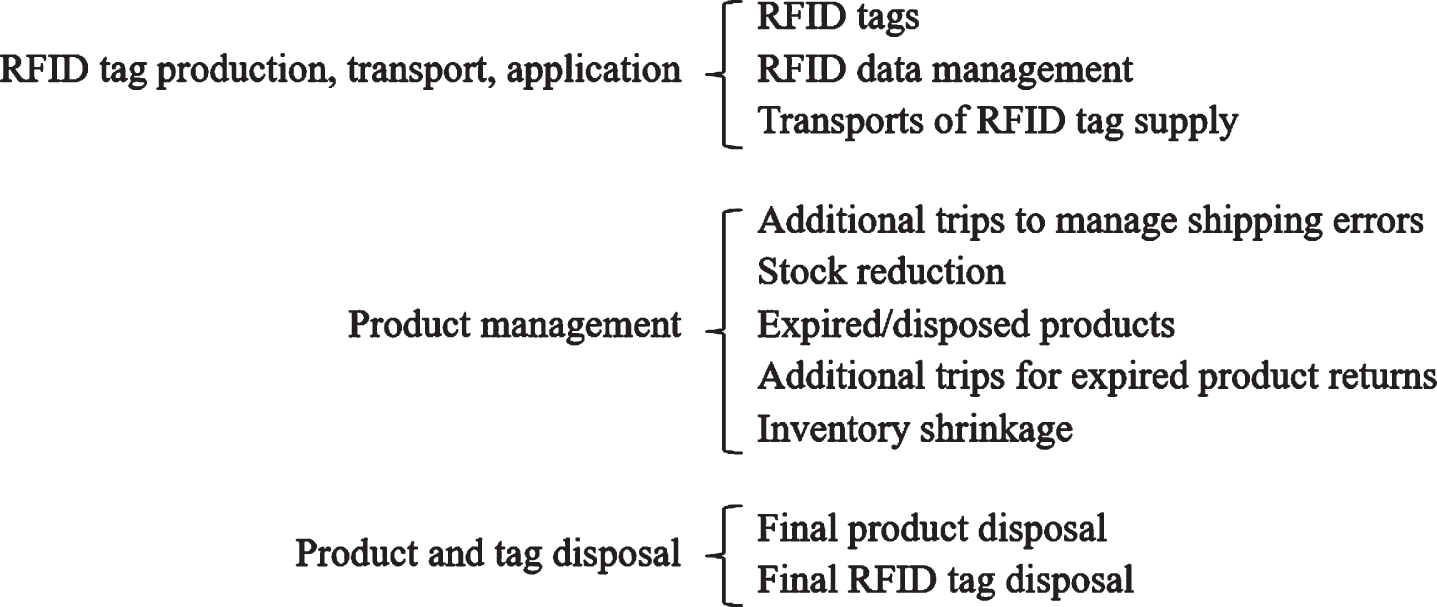
Contribution to the overall impact of RFID tags implementation.
If ΔGWPRFID implementation results negative, it means that the greenhouse gas savings allowed by the RFID implementation are higher than the additional impacts related to the use of the technology itself, demonstrating its convenience from an environmental point of view (EROI > 0). On the other hand, if ΔGWPRFID implementation results a positive value, it means that the RFID implementation was not able to avoid enough greenhouse gas emissions to compensate the impacts of the technology itself. The following sub-sections describe how to calculate the GWP of each life cycle stage included in the X and Y factors, as presented in Fig. 1, considering one year of RFID tag application on a generic product.
RFID tags
To evaluate the GWP of the first phase of the RFID life cycle on a product, the RFID tag creation and application on the overall number of products tagged in one year should be considered. If the tag is applied on primary packaging, the following equation can be used to assess the GWP of the annual tags:
To assess the GWP of an RFID tag, the LCA methodology can be used considering the raw materials extraction and production, manufacturing, packaging and transport. In literature, the GWP of a UHF standard tag resulted in 0.0147 kg CO2 eq, if we exclude the impact of the end of life that in the tool is considered separately (Aliakbarian, Ghirlandi, Rizzi, Stefanini, & Vignali, 2023). Therefore, using this secondary data from the scientific literature, 0.0147 kg CO2 eq can be multiplied by the number of packages tagged in a year to evaluate the GWP of the RFID application on primary packaging in this case study. On the other hand, if the tag is applied on a secondary or tertiary packaging, the following equation should be used:
In this case, the impact of a tag should be divided by the number of primary packaging contained in the secondary or tertiary packaging, since one tag can help to track the items inside, and finally multiplied by the number of secondary or tertiary packaging used in one year.
This factor takes into account the energy consumption for maintaining bytes in a data center for one year, and is calculated as follows:
Where GWP kWh represents the CO2 emission related to 1 kWh in a specific country, kWh for 1 GB of storage is 0.02 kWh/GB (Viana, Cheriet, Nguyen, Marchenko, & Boucher, 2022) and the GB stored represents the result of multiplying the bytes related to a tag reading, which according to data retrieved from multiple RFID projects experience it is 500 bytes and the number of readings in a year. In the present study the GWP kWh is the Italian one of 0.338 kg CO2 eq/kWh, which was elaborated through cross-referencing data by IEA, GSE and Terna and harmonizing them into the standard LCI table of Ecoinvent (IEA, 2021) (GSE, 2022) (TERNA, 2022).
The tags are transported from the RFID producer to the company that will use them to tag their products. To evaluate the GWP of the tag supply, the tag weight, the travelled distance, the GWP of the transport such as truck, ship, airplane, and the number of transported tags in a year should be considered as follows:
The RFID tag weight should be expressed in kg: a standard PP tag usually is 7.90E-04 kg according to primary data retrieved from a previous work (Aliakbarian, Ghirlandi, Rizzi, Stefanini, & Vignali, 2023). The traveled distance is expressed in km and the number of RFID tags is referred to a period of one year. The GWP of the transports could be calculated thanks to environmental database available in Life Cycle Assessment software. For instance, Table 1 summarizes the GWP of the transport calculated with Ecoinvent 3.9.1, with the Environmental Product Declaration (EPD 2018) methodology.
Impact of transports
Additional trips to manage shipping errors
As thoroughly addressed in paragraph 2.3, one of the main environmental benefits of RFID adoption is the reduction of shipping errors, and therefore, the consequent elimination of shipping error trips, as well as additional trips which could include to ship missing items, or to return/transship mis-shipped products. Therefore, these benefits achievable with RFID deployments can be quantified using the equation 7:
In which:
In other words, the number of additional trips in a year should be considered, as well as the average travelled distance expressed in km, the weight of the product shipped and finally the GWP of the truck, ship, or aircraft, as previously described.
As thoroughly described in paragraph 2.4, stock levels in the supply chain can be optimized thanks to the stock level visibility enabled by RFID adoption and data sharing among business partners, and thus less space for inventory is required. To estimate this aspect, we propose to assess stock levels without RFID, and multiply it by a stock reduction percentage, enabled by RFID adoption. Then, the resulting value is multiplied by other factors: the GWP of the product multiplied by the percentage of the annual storage impact. The latter percentage takes into account that, during the life cycle of a product, a small proportion of its impact is associated with storage, such as electricity usage for lights or refrigeration in stock. Therefore, to quantify the environmental impact of the product during its storage, some secondary data were retrieved. The percentage of annual storage impact was considered equal to 19.5% if the stock is 100% refrigerated (Burek & Nutter, 2018), and it is assumed close to zero (0.05%) in a 100% non-refrigerated supply chain. The GWP of the product is calculated thanks to a Life Cycle Assessment approach, directly or indirectly if a GWP evaluation of that product is already available in the scientific literature. Finally, the resulting values of the mentioned calculation are multiplied by the number of products in a package (if the tagged product is a secondary or tertiary packaging). The equation 11 resumes the presented factors.
RFID helps decrease the number of expired products through effective management of product expiration dates. RFID deployments facilitate product rotation based on FEFO rules, thereby reducing the quantity of expired and wasted products in the supply chain. Furthermore, RFID inventory counts can identify products nearing their best-before date, signaling the need for timely picking, shipping, or usage. In order to quantitatively assess the environmental impact of RFID technology, the number of disposed products per year in a scenario without RFID is multiplied by the estimated disposed reduction percentage with RFID, by the GWP of the product and the number of products in a tagged packaging:
In some cases, in addition to the environmental impact of the expired products, the environmental impact of the additional trips required for returning these expired products has to be considered.
In other words, if RFID technology is applied, not only does the amount of expired product reduce, but trips are no longer necessary to return the returned product. Therefore, the following equation 13 calculates the GWP of this reduction, considering the trips for expired products per year, with and without RFID, their average traveled distance [km], the weight of returned products and the GWP of the truck, or rarely ship or aircraft involved.
Finally, shrinkage due to either stolen or lost products must be considered. The following equation takes into account the number of shrinkaged packages in a non-RFID scenario, the estimated percentage reduction of shrinkage thanks to RFID deployment, the GWP of the product, and, in the case of secondary and tertiary packaging, the number of items per tagged packaging.
Final product disposal
RFID tags could help to better manage products the end-of-life, enabling product reuse or components recycling. Therefore, the environmental contribution to the EROI takes into account the number of products whose incineration or deposition into the landfill can be avoided thanks to RFID deployment.
Considering the Ecoinvent 3.9.1 database, the GWP of 1 kg of product disposed in landfill is 0.621 kg CO2 eq, and 0.515 kg CO2 eq in incineration.
The last factor in our analysis is the Global Warming Potential associated with the RFID tags disposal. The number of tags per year is multiplied by the weight of a tag and its end-of-life scenario, which depends on the percentage of tags recycled, landfilled or incinerated:
Considering all the above-mentioned factors, the overall equation ΔGWPRFID implementation = X –Y results as follows:
Therefore:
The numerical result of the tool is expressed in kg CO2 eq. However, it could be also translated into other equivalent units of measure, easily understandable by potential end users of the tool itself. Some equivalences can be found in literature. Table 2 illustrates the equivalences together with the corresponding source.
Environmental conversions from kg CO2 eq
As mentioned, the tool is of general purpose, and can be applied to any product and any RFID deployment.
In order to validate it, we applied the EROI tool to two RFID deployment scenarios, one in the healthcare industry and one in the pharmaceutical one.
The authors have been following these deployments in the last years and have a deep knowledge of the manifold benefits achieved thanks to RFID implementation. Numerical data have been gathered thanks to the collaboration with Murata ID Solutions, the system integrator that deployed the systems, and the end users that adopted the technology.
In the next paragraphs, we detail the application of the EROI tool to these two projects, and comment on the results achieved.
Testing EROI in the medical device supply chain: the manufacturer use case
We tested the EROI tool in a healthcare application developed by a major manufacturer of devices.
For confidentiality reasons, the name of the manufacturer is kept hidden. The system was designed and implemented by Murata ID Solutions, that supported this research program, and that provided us with the data required for the EROI calculation.
In this project, RFID technology is deployed at the item level. Therefore, each medical device shipped to an RFID-enabled hospital is tagged with the RFID at the manufacturer’s distribution center (DC).
Outbound and inbound flows at the DC and the hospitals are tracked through RFID fixed and mobile readers.
In the hospital, RFID technology enables accurate and real-time inventory management, thanks to automatic loading and unloading of inventories as well as periodic cycle counts through handheld readers. Furthermore, RFID is the key to automatically link the patient, the surgeon, the surgery, and the medical devices used.
Captured data are stored in Murata’s Id Bridge cloud-based repository, which ensures accurate, selective, and real-time traceability of each medical device throughout the whole supply chain.
In addition to traceability, the project use cases are manifold. They include inbound/outbound logistics flows optimization, inventory management at the hospital, theft and shrinkage reduction, and expired products reduction.
Thanks to supply chain visibility, inventories at the hospital are optimized since they are managed through VMI (Vendor-Managed Inventory) policies.
No more additional trips are needed to handle returns or undelivered products due to shipping errors.
The project is implemented in about a hundred hospitals around the world. More than a million items are tracked every year.
The range of products managed with RFID is extremely wide, from sutures, to trocars, from emosthatic sponges to implants. Since punctual LCA analyses are not available for every single reference, we decided to assume a stapler as a “representative” product, whose LCA data are available in literature. Its Global Warming Potential resulting in 0.620 kg CO2 eq (Freund, Gast, Zuegge, & Hicks, 2022). On average, we assumed that every tagged box contains 12.85 equivalent tagged items. The input data considered in the analysis are summarized in Table 3.
Input data for the equivalent medical device case study
Input data for the equivalent medical device case study
We then calculated the different contribution to EROI calculation, according to equations presented in paragraphs 3.1.1, 3.1.2 and 3.1.3. Results are shown in Table 4.
Results of the EROI calculation in medical device supply chain
Figure 2 applies the environmental conversion of Table 2: it illustrates the contribution of different factors on the EROI in terms of trees planted or cut per year per hospital associated with the RFID deployment described above.
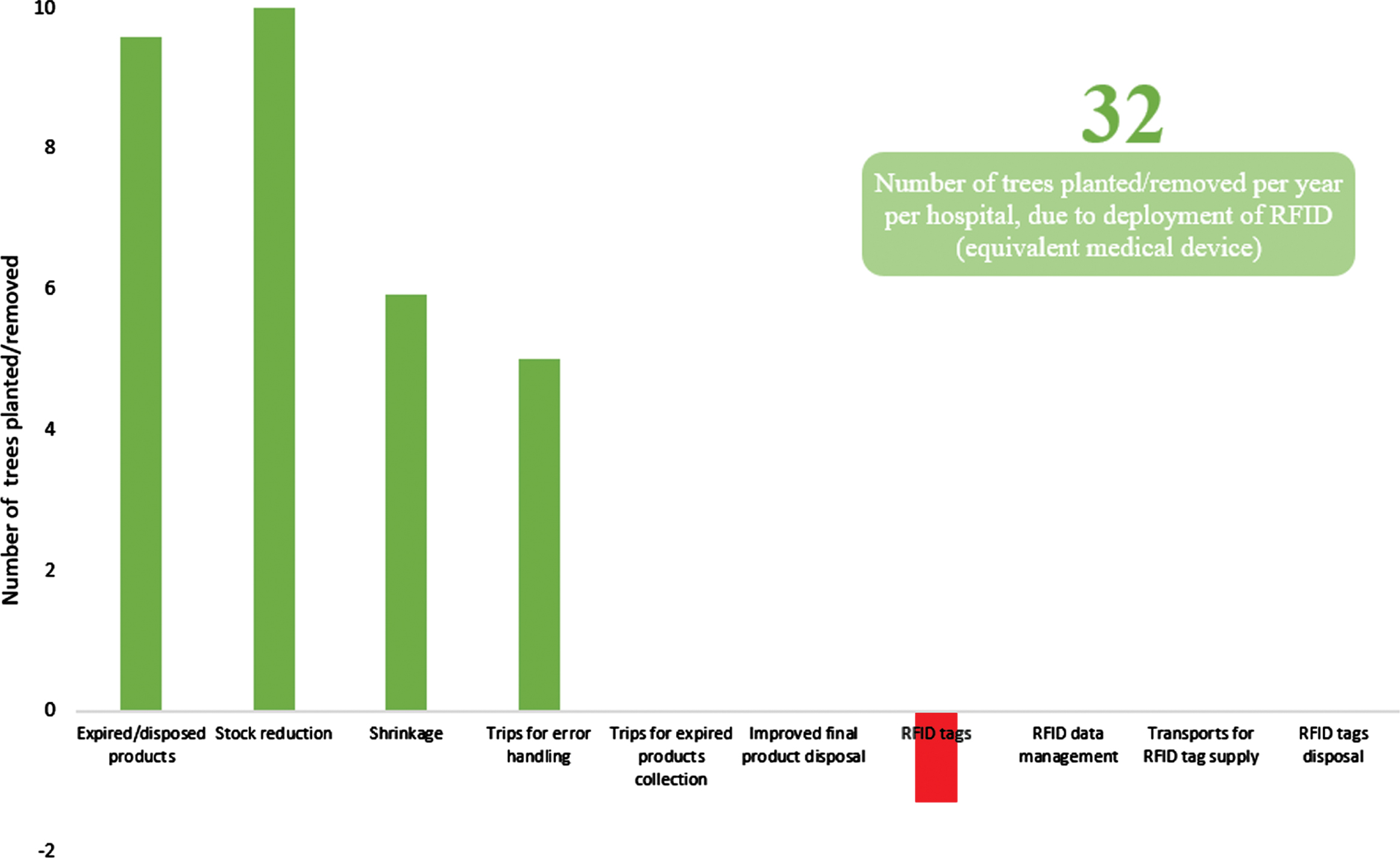
Equivalent trees planted or removed in a year thanks to RFID tags implementation on a medical device supply chain.
First of all, it can be well noted that the implementation of RFID technology in the healthcare supply chain positively contributes on the environment in terms of reduction of expired products and storage space at the hospital, accounting for 10 trees/year/hospital and 6 trees/year/hospital respectively. Other important savings can be achieved thanks to shrinkage reduction (6 trees/year/hospital) and by cutting additional trips to handle shipping errors (5 trees/year/hospital).
On the other hand, RFID tags applied to boxes and items only account for 1 tree per year per hospital. The contribution to EROI in data storage and management is negligible, as is the impact of tag transportation and disposal at the end of the supply chain process (assuming the tag is disposed of together with the packaging material). Overall, in this case study, we estimate in 32 trees/year/hospital the net positive contribution of RFID deployment to manage the targeted medical devices in a hospital.
To assess the applicability and practical implications of the tool presented in the previous paragraphs, it was further applied to a project in the pharmaceutical sector The project was developed in 2019 by Bayer, the German multinational pharmaceutical company in collaboration with Murata ID solutions, an integrator of RFID solutions presents in Italy. The project has been presented in several conferences and events (Murata, 2021), and awarded as best supply chain implementation in 2020 by Assologistica. The Bayer RFID project is a supply chain project that aims to increase visibility in the distribution chain, reduce shrinkage and errors, and increase the productivity and accuracy of processes. The actors involved are Chiapparoli logistics, Bayer’s 3PL, and the transporter EDF. The latter, through its network of primary and secondary hubs, deals with the distribution of the product through a network of Transit Points. RFID is deployed at case level during the preparation of orders by the 3PL, in one of the two hubs, one serving northern Italy and one for central and southern Italy. This is where Bayer’s product stock is located, which is used to fulfill orders from pharmacies and hospitals. The preparations are then delivered to the transporter for its distribution. Every single case is real time tracked as it leaves hub of the 3PL hubs, and in inbound/outbound transits through the 20 transits points of the transporter, who deals with distribution. The main benefits that guaranteed the economic return on the investment are the following: On the one hand, product shrinkage has been extremely reduced thanks to timely tracking of cases and pallets at each point of passage of the distribution chain, and a clear definition of product responsibility between the actors (chain of custody). To that extent a blockchain pilot has been also implemented. Secondly, shipping and receiving flows have been automated, reducing manual inbound/outbound order checks and reconciliation activities. Thirdly, all shipping errors which very often lead to the return of the product and its destruction when the integrity is no longer guaranteed have been reduced.
Again, for the application of the environmental impact assessment tool of the investment, we used an equivalent product for which the environmental impact and GWP value was found from the literature. The mentioned product consists in 10 pills of 400g ibuprofen analgesic packaged in a paper box, related to the potential emission of 0.145 kg CO2 eq (Siegert, et al., 2020). The input data considered in the case study are summarised in Table 5. All values are referred to the whole supply chain flows, encompassing 1 DC of the 3PL and 20 transit points of the transport company, as thoroughly described above.
Input data for the equivalent pharma product case study
Input data for the equivalent pharma product case study
The assumed RFID tag to track this product is a traditional UHF tag, with the same weight as the previous case, applied only on the secondary packaging, namely a box containing 15 primary packaging. In a year, 1352000 boxes are tagged. Thanks to the data provided by the management of the end users involved, and the evidence of the project, which was followed personally by the authors of the article, it was possible to obtain the individual contributions for the calculation of the environmental impact. The values obtained by applying the model are reported in Table 6, while the graph in Fig. 3 highlights the individual contributions expressed in trees cut or planted per year.
Results of the EROI calculation in pharmaceutical product supply chain
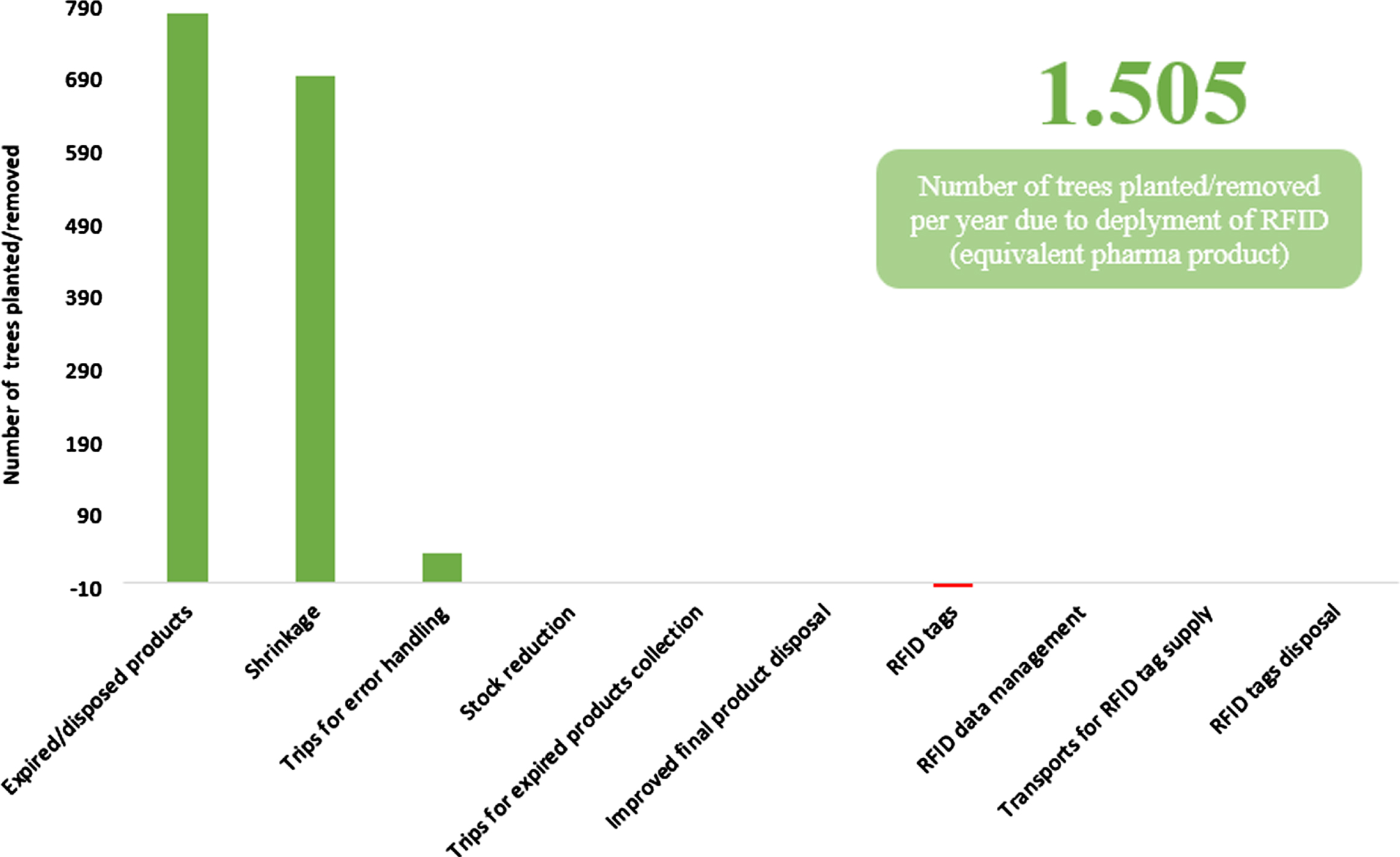
Equivalent trees planted or removed in a year thanks to RFID tags implementation on a pharmaceutical product supply chain.
As can be seen from the application of the EROI tool to the Bayer RFID case, the overall contribution in the application of RFID technology to the pharmaceutical supply chain is largely positive, for around 1505 trees per year. The main contribution, equal to approximately 781 trees per year, is given by the elimination of shrinkage. In fact, thanks to the introduction of RFID technology, shrinkage linked to product theft and losses, have been reduced. The reduction of shipping errors, also plays a significant role in assessing the environmental impact, with a positive contribution of around 695 trees per year. The positive environmental impact of reducing additional trips to manage product returns is an order of magnitude lower than the first two (+39 trees/year).
Compared to these contributions, the negative environmental impact of tags RFID used for tagging product cases, equal to -8 trees/year, is negligible, just as the negative environmental contribution for data management (-0,002 trees/year). To that extent, it should also be underlined that the ratio number of tags/number of items involved in a project of this type is much lower compared to the healthcare deployment seen before, being the RFID application at case level.
Finally, Table 7 illustrates the environmental impact results of the two case studies considering other greenhouse gas emissions equivalences.
Greenhouse gases emissions equivalence
As mentioned before, the application of the EROI tool requires using a substantial simplification which is to consider the equivalent product, instead of the whole range of products. In other words, while several references are processed in the supply chain, from a few dozen to potentially hundreds, for the implementation of the EROI tool it is assumed that the flows managed with RFID technology refer to a single representative reference.
This simplification allows us to overcome two major obstacles. Firstly, if we were to consider individual references managed with RFID, it would be necessary to know the value of the Life Cycle Assessment (LCA) for each reference, rendering the application of the tool extremely expensive and cumbersome, almost impractical in the real world. Even if we could determine the LCA for each reference, sharing the benefits derived from RFID deployment by reference would be necessary. However, even if we can estimate the overall RFID impacts in terms of benefits and costs, dividing these terms by reference becomes practically impossible. For example, while it is easy to quantify the overall reduction in shrinkage, it is challenging to determine how much is attributed to one reference compared to another, thus assessing their relative impacts. For these reasons, the EROI analysis performed with an equivalent representative product that does not exist in practice must be followed by a sensitivity analysis. This analysis helps to understand how the overall impact changes as the LCA of the representative product increases or decreases.In the analysis carried out in the medical device and pharma case, we varied the impact of the LCA of the representative product by +–30%, and we analysed the oscillations of the EROI value, to understand the sensitivity of the environmental convenience indicator to the value of the environmental impact of the representative product.
The results are shown in the following graphs. For the medical device application, the GWP of the RFID implementation was equal to 32 planted trees but considering a + /- 30% impact of the product, it can be 23 or 40, in both cases resulting in a benefit of RFID implementation (Fig. 4).
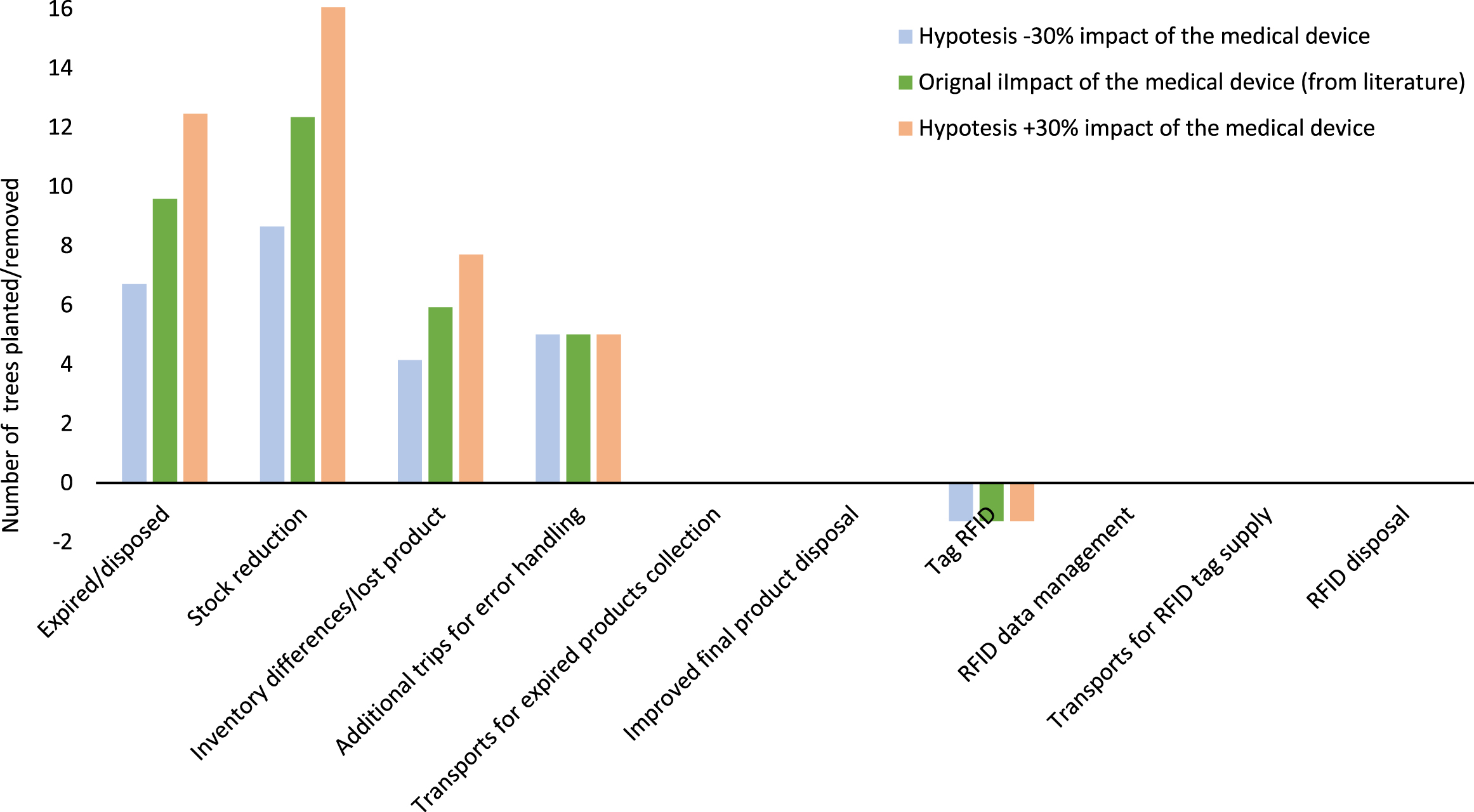
Sensitivity analysis: hypothesis of +30% and –30% of the medical device impact, represented in the number of trees planted or removed.
As regards the pharmaceutical product, the result can vary from 1062 planted trees in the -30% product GWP hypothesis, to 1948 trees for the +30% GWP hypothesis, again confirming the environmental advantage achieved with RFIDs (Fig. 5).
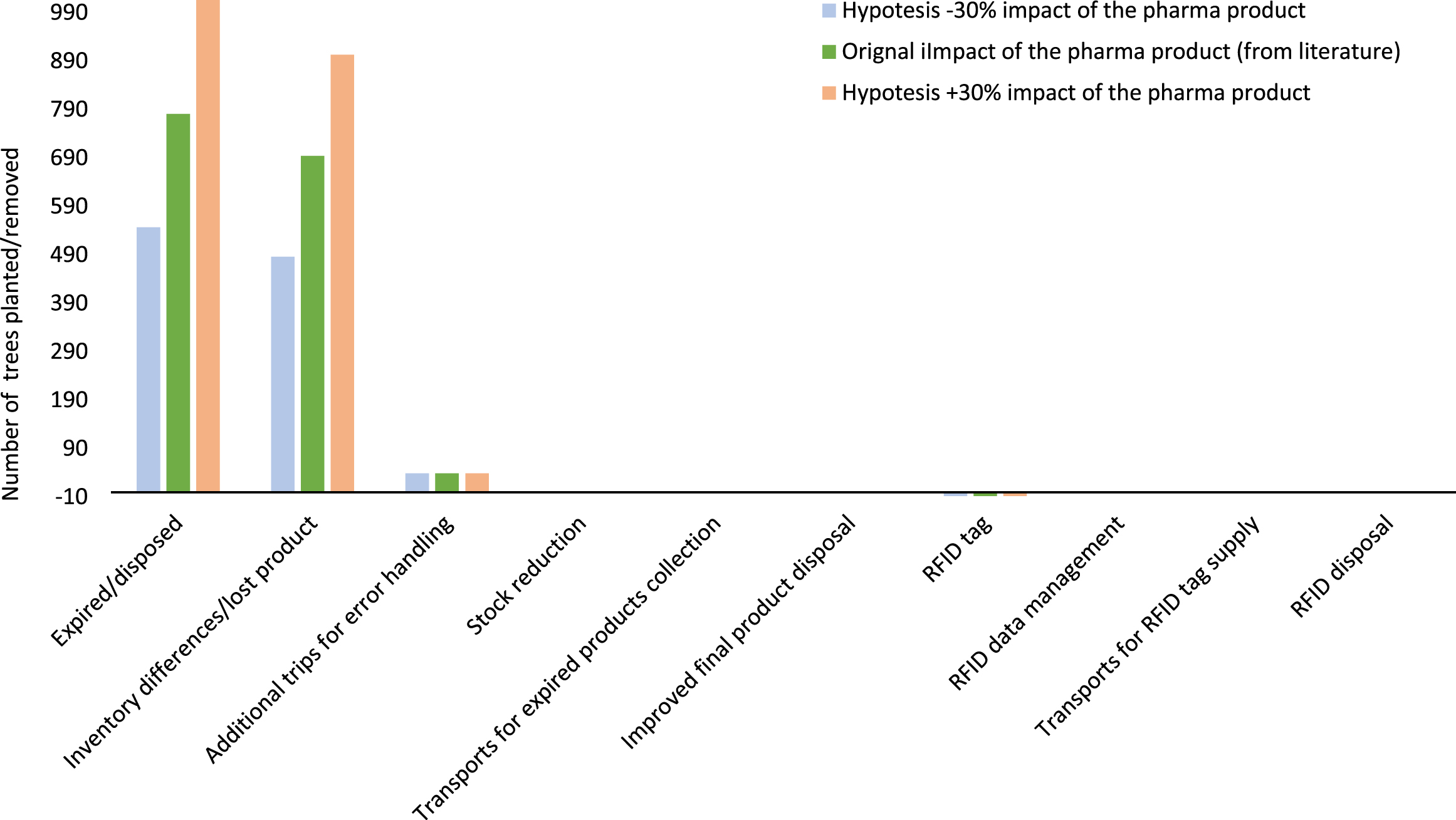
Sensitivity analysis: hypothesis of +30% and –30% of the pharmaceutical product impact, represented in the number of trees planted or removed.
It is evident that, even with a 30% reduction in the LCA of the representative product, the EROI index remains significantly positive. This underscores the continued environmental benefits of implementing RFID technology in both healthcare and pharmaceutical scenarios. The variation in the environmental impact aligns quite linearly with the changes in the LCA of the representative product, at least in percentage terms. This correlation is due to the primary contributions in both cases being linked to the quantity of product “saved” through the adoption of RFID technology
Over the years, the evaluation of RFID projects has predominantly centered on economic considerations, scrutinizing cash flows to determine feasibility. This paper pioneers a fresh approach to assessing RFID technology projects by shifting the spotlight from purely economic perspectives to encompass environmental sustainability.
The proposed method introduces a groundbreaking synthetic indicator known as EROI (Environmental Return on Investment), quantifying the kilograms of CO2 per year introduced or avoided through an RFID deployment. This versatile tool, applicable across industries and RFID projects, strategically balances the drawbacks of deployment— primarily associated with RFID tags and data management— against a plethora of positive environmental impacts. These include, foremost, the streamlining of product flows, achieved by reducing inventory discrepancies, theft, and the occurrence of expired products resulting from incorrect shelf-life management (product shrinkage). Additional favorable factors encompass the prevention of extra trips required to handle mis-shipped products, such as returns or supplementary transport. Furthermore, the potential to ensure product recycling and reuse rather than disposal adds to the positive aspects. Notably, the reduction of stocks and the subsequent decrease in storage requirements, particularly for products necessitating high impact refrigerated warehouses, constitutes a significant aspect within the EOI tool. A primary challenge in applying the tool lies in accurately quantifying the life cycle assessment of each individual reference managed through RFID technology. To address this obstacle, we proposed an approach based on an equivalent product, creating a single reference in the supply chain. A sensitivity simulation was also incorporated into the analysis, varying the environmental impact of the equivalent product within a range to explore the potential outcomes if the considered product had a different environmental impact.
The tool’s effectiveness has been validated through practical applications in the pharmaceutical and medical device industries, involving real RFID deployments overseen by the authors. The applications underscore the tool’s user-friendly nature and its ability to yield significant results. The EROI analysis in both cases revealed substantial benefits in terms of kilograms of CO2 saved per year due to RFID deployment.
Notably, in economic terms, the source cost of the RFID tag significantly influences the initiative’s overall balance, requiring either a significant cost reduction or an increase in turnover for compensation. Conversely, when considering environmental terms, the environmental impact associated with the introduction of an RFID tag is comparatively easy to offset through the manifold environmental benefits linked to improved product management. These benefits primarily include reduced shrinkage, lower transportation needs, and decreased inventories in the supply chain. Looking ahead, future work will focus on analyzing RFID technology investments from the perspective of social sustainability. While economic and environmental sustainability are integral, social sustainability, representing the third pillar of sustainability, will be explored. The introduction of Industry 4.0 technologies, particularly the Internet of Things and RFID, is known to significantly empower people and enhance working conditions by shifting focus from low-value-added jobs to higher-value activities. Therefore, a supplementary indicator will be essential to assess RFID investments in terms of their impact on the quality of life and work for individuals, running in parallel with ROI and EROI considerations.
Footnotes
Acknowledgments
The authors would like to thank MURATA ID Solution S.r.l. which fund the research project.