




Abstract
Several scientific evidences show that oxidative stress is associated with the origin, progression and severity of chronic noncommunicable diseases. Due to the longer duration of life, sarcopenia, osteopenia, osteoporosis and cachexia are considered emerging syndromes for dogs and cats. The objective was to investigate the impact of a supplementation with resveratrol and α-tocopherol (JUVENIA®) on the harmful effects of oxidative stress in adult dogs. The study was able to demonstrate this supplementation was able to positively modulate creatine phosphokinase and alkaline phosphatase, which are considered useful biomarkers for sarcopenia, bone formation and speed in bone remodeling. As a result of the longer life of domestic animals and, in particular dogs, the use of food supplements with antioxidant activity could play a critical role in reducing/delaying the onset of chronic-degenerative diseases. On the basis of the present study, the use of products containing resveratrol and α-tocopherol acetate seems to be a promising approach for improving the health of dogs.
Introduction
The incidence of cardiovascular, metabolic, neurodegenerative diseases and cancer has increased significantly in the last ten years [1] and it has been shown that the oxidative stress is one of the most important risk factors in the development of these pathologies [2, 3]. The metabolic processes depend on the permanent contribution of energy through the synthesis of ATP, by mitochondrial oxidative phosphorylation. The obtained ATP is the energy carrier for all cellular systems, but mitochondria in the same biological activity produce more than 95% of reactive oxygen species and free radicals present in the organism [4].
The chemical instability of free radicals, which have one or two unpaired electron in its external atomic orbital, is responsible for their strong oxidative properties versus all biological molecules, such as DNA, RNA, proteins, carbohydrates and structural lipids, representing the starting point for most chronic diseases [5]. During the evolution of the species, biological systems developed a battery of enzymatic and non-enzymatic antioxidant tools in order to counteract the dangerous effects of free radicals. This evolutionary adaptation is not always enough to protect the biological molecules, since the redox balance can shift towards oxidative stress [6].
It is kown that the bone mass and ability to repair fractures in humans decreases after 30 years of age [7]. These parameters are inversely associated with the oxidative stress in both animals and humans [8, 9].
The incidence of non-infectious diseases is increasing also in pets; among them, sarcopenia, osteopenia and cachexia are considered emerging important syndromes for dogs and cats [10–12]. Several authors suggested biological markers for sarcopenia in dogs; among others, creatine phosphokinase and aspartate aminotransferase were suggested by Tvarijonaviciute, [13]. Sarcopenia is the decline of muscle function, which is frequently observed in elderly both in humans and animals. Sarcopenia is the results of different and interacting biological mechanisms.
The International European Working Group on Sarcopenia defined sarcopenia as a progressive and widespread skeletal muscle disorder, which is associated with a higher probability of morbidity such as falls, fractures, physical disability and mortality [14]. In humans after 30 years of age, strength and skeletal muscle mass gradually decrease every year by approximately 1 to 2% [15].
Some authors [16, 17] described very clearly how oxidative stress and chronic inflammation could contribute to sarcopenia; in fact, some pathways can be activated or inactivated during oxidative stress and inflammation. One of the critical steps of the suggested pathway is the increased production of damaged (oxidized) molecules, such as oxidized DNA, proteins and lipids. The oxidative processes that contribute to sarcopenia reduce satellite cell (myogenic stem cell) number and function. Satellite cell’s function is affected by oxidative stress, which is elevated in aged muscles. Nutritional intervention could be a relatively new strategy to improve the satellite cell environment and systemic factors, with the objective to optimize satellite cell function in aging muscles [18]. there Several molecules have been proposed as biomarkers for oxidative stress. For their easy quantification, some of them seem particularly interesting to evaluate this state in dogs: alkaline phosphatase for the speed of bone remodeling [19] and 8-hydroxy-deoxy-guanosine (8(OH)dG) as a marker of DNA damage [20, 21].
On these bases, the aim of this study was the evaluation of the possible protective effects of a nutritional intervention on oxidative stress and, consequently, on the incidence of sarcopenia. Among the possible dietetic solutions, a product containing resveratrol and
Materials and methods
Animals
Dogs included in this study were 22; they were medium-sized adults (5.4±1.4 years old), including 10 males and 12 females, castrated and wormed; their weight was 19.4±4.4 kg (average±standard deviation). Animals were free from diseases as established by clinical examination and biochemical assays. The dogs of this study were identified with photographic and descriptive cards also supported by microchips compatible with all ISO standards DATAMARS brand. The microchips were placed subcutaneously in the area of the cross (at the beginning of the chest or the end of the neck). Dogs were maintained in the same hygienic conditions and diet with or without addition of the food supplement object of the study. No other medication or food supplement was allowed. At the day 0 of the study (D0) a baseline clinical examination was performed; a sample of venous blood was withdrawn for biochemical assays. During the following 45 days, dogs received twice a day the supplement, whose composition is reported in Table 1. Dogs received a dose/meal of 5 g of JUVENIA® DOGS (Microsules Argentina SA Laboratory; US patent required: 62659885), containing 30 mg of resveratrol and 20 UI of
Composition of the dietary supplement JUVENIA ® DOGS
Composition of the dietary supplement JUVENIA ® DOGS
Composition of dietary supplement based on JUVENIA® DOGS. In the first column is shown, the composition in active principles; in the second column it is shown, in percentages; The third column shows, the amounts per dose/meal administered to each dog.
Measurement of DNA/RNA oxidative damage
Both DNA and RNA are damaged by oxidation during aging and in a variety of disease states. The repair processes that are initiated to correct this damage release multiple oxidized guanine species into the blood and urine. An immunoassay (DNA/RNA Oxidative Damage kit) from Cayman Chemical (Cayman Chemical item No.589320). was used to quantify biomarkers of DNA/RNA oxidative damage: all three oxidized guanine species; 8-hydroxy-2’-deoxyguanosine from DNA, 8-hydroxyguanosine from RNA, and 8-hydroxyguanine from either DNA or RNA. The serum of the dogs were maintained at –80°C and analyzed according to the kit instructions.
Results and discussion
In this trial, animals were observed for two consecutive periods of 45 days, where the basic diet was added or not with a food supplement containing antioxidants (30 mg resveratrol and 20 UI
As reported above, creatinine phosphokinase is considered a good biomarker for sarcopenia in dogs.
Regarding the effects observed on alkaline phosphatase, our hypothesis is that the nutritional intervention can modify the speed of bone remodeling, modulating the balance between the bone formation and resorption. In the absence of liver disease or pregnancy, alkaline phosphatase is an indirect biomarker of bone formation; since blood sampling was performed always at the same hour, the bone remodelling was evaluated without interference by the circadian rhythm. Different investigations showed that after starting a treatment with drugs to decrease bone resorption, there is a significant decrease in both the resorption biomarkers (between 4 to 6 weeks), and in bone formation biomarkers (between 2 and 3 months). In a large number of cases a valley value is reached at 2 or 3 months from the beginning of treatment and remains constant while treatment continues. Therefore, the modifications will depend on the therapeutic agent used and the biomarker studied. [23–25]. In young subjects, a high alkaline phosphatase value indicates that there is bone remodeling with predominance of formation; in adults with oxidative or postmenopausal stress, alkaline phosphatase is still high, but remodeling is associated with a net predominance of resorption [19].
From the results of statistical elaboration, it has been shown that food supplementation with antioxidants (resveratrol and

Serum Creatine phosphokinase at different times and treatments. Animals were observed for two consecutive periods of 45 days, where the basic diet was added or not with a food supplement containing antioxidants (30 mg resveratrol and 20 UI
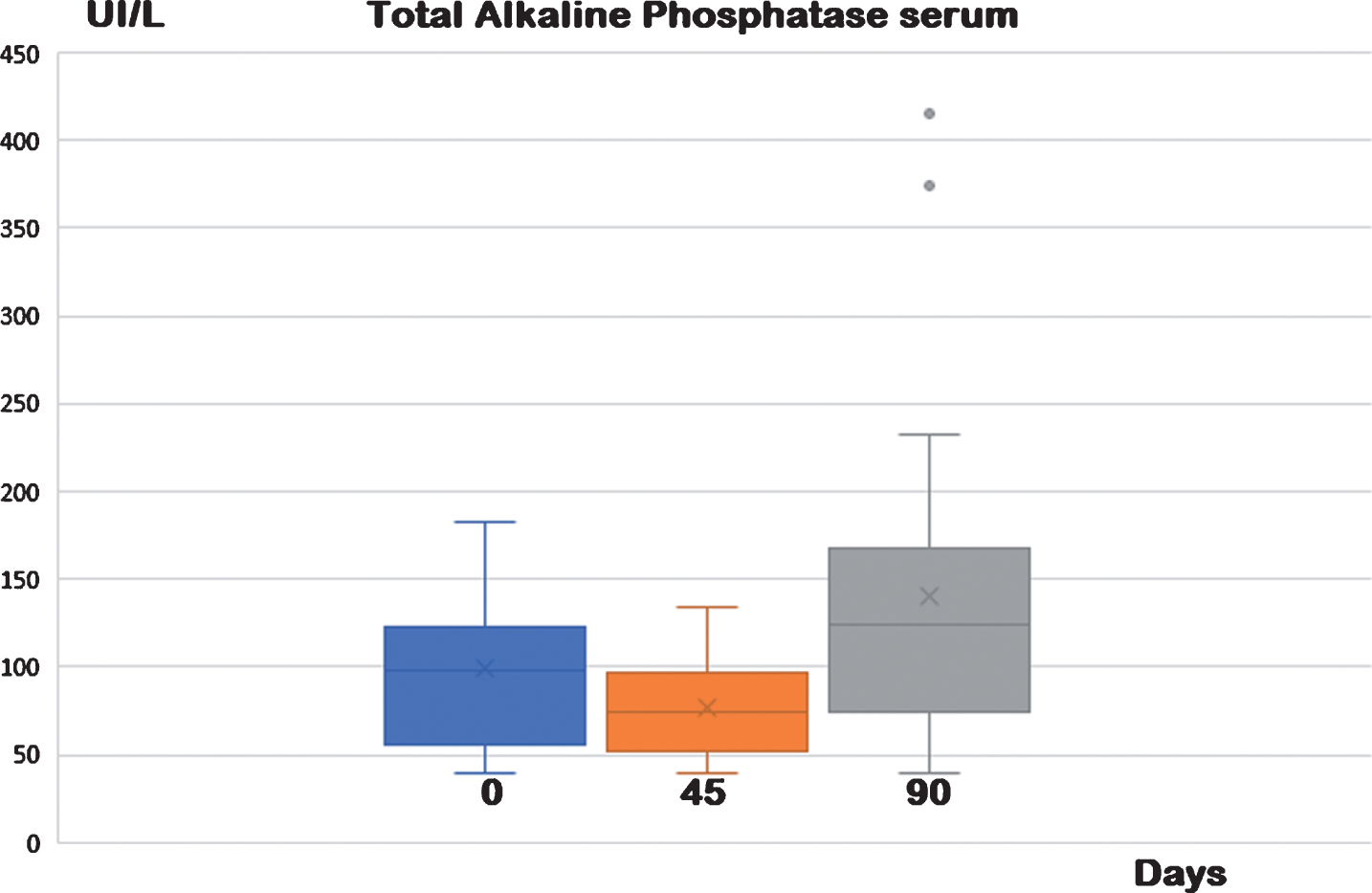
Serum Alkaline Phosphatase at different times and treatments. Animals were observed for two consecutive periods of 45 days, where the basic diet was added or not with a food supplement containing antioxidants (30 mg resveratrol and 20 UI
Results. The values expressed are the mean±standard deviation
The concentration of the serum biomarkers of sarcopenia (Creatin phosphokinase), bone remodeling (alkaline phosphatase), and DNA damage (8(OH)dG) evaluated at the end of each period is shown. Basal on day 0, end of day 45 (with resveratrol and
The changes in alkaline phosphatase values were different in males and females: the basal values of alkaline phosphatase were higher in females, where the nutritional intervention influenced significantly the rate of bone remodeling at D45. Males showed a decrease in alkaline phosphatase concentration at the same time, but statistical significance was not reached. After the withdraw of the supplementation, a significant increase in the rate of bone remodeling was observed at Day 90 in both subgroups (Fig. 4 and Fig. 5). All the dogs were castrated and free from liver disease, therefore the decrease observed in Total Alkaline Phosphatase values at D45, should be due to the decrease in the speed of bone remodeling as a result of the antioxidant activity of the nutritional supplementation with Resveratrol and α-Tocopherol. This hypothesis was confirmed by fact that values measured at D90, after 45 days of diet without supplementation (control), returned at at baseline. Also, in this case the increase was statistically significant, while no difference was observed between baseline and data at day 90 (Table 2). Although not statistically significant, a reduction of 13% of 8-Hydroxy-deoxy-guanosine [8(OH)dG] was also observed between day 0 and 45 (3266.7±1966 versus 2856.1±1380.6 pg/mL, p = 0.4273); the high variability (standard deviation) of data was probably responsible for this result (Fig. 3). Moreover, oxidative processes on DNA probably need longer periods of treatment.
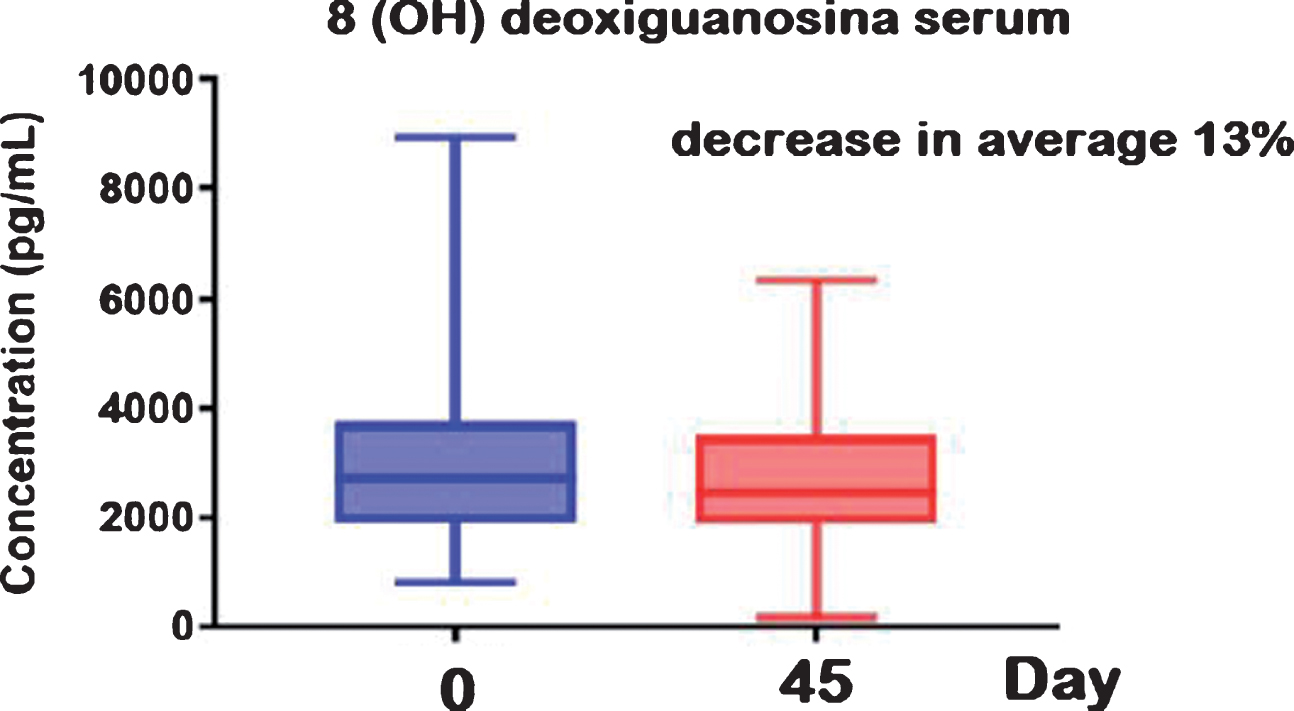
Serum 8(OH)dG at different times and treatments. Animals were observed for two consecutive periods of 45 days, where the basic diet was added or not with a food supplement containing antioxidants (30 mg resveratrol and 20 UI

Alkaline Phosphatase in males at different times and treatments. D0 vs D45 NS: D45 vs D90 < 0.05: D0 vs D90 < 0.05. Serum alkaline phosphatase in males. After 45 days of supplementation, serum concentrations of total alkaline phosphatase decreased but did not reach statistical significance. These values returned to the beginning after 45 additional days of basal diet without supplementation (control). In this case, the increase in values from D45 to D90 was statistically significant, whereas no differences were observed between the baseline and the data on day 90, (see Table 2).

Alkaline Phosphatase in females at different times and treatments. D0 vs D45 < 0,05: D45 vs D90 < 0,05: D0 vs D90 NS Serum alkaline phosphatase in females. After 45 days of supplementation, there was a statistically significant reduction of serum concentrations of alkaline phosphatase These values returned to baseline after a further 45 days of basal diet without supplementation (control). Also, in this case the increase was statistically significant, while no difference was observed between baseline and data at day 90, (see Table 2).
Urquiaga I. et al. [26] showed that moderate wine consumption (containing resveratrol) to both an occidental or a Mediterranean diet increases plasma antioxidant capacity, decreases oxidative DNA damage, and normalizes endothelial function. The results were more significant in the group consuming occidental diet. The improvement of feeding and veterinary care has allowed a considerable extension of the life span of pet animals, and of dogs and cats. Therefore, dogs show more frequently a decreasing ability in reacting to stress, a more frequent homeostatic imbalance and an increased risk of diseases. There is a body of scientific evidences that nutrition influences the epigenome. This dynamic relationship between nutrition and genes throughout the life of an organism has been recognized as a subfield called Nutritional Epigenomic or Nutrigenomics. It provides promising information to improve health and prevent diseases [27–29].
Numerous evidences show the decrease of oxidative stress and sarcopenia by resveratrol supplementation, thanks to an increasing mitochondrial biogenesis, an improved control of the mitochondrial fusion/fission quality, an increase of the synthesis of antioxidant enzymes via SIRT1, and the effects similar to that of caloric restriction [30–33]. Some studies have shown that the antioxidant effect of α-tocopherol acetate is directly correlated to a decrease in intracellular oxidative stress and improvement of strength and muscle mass [34]. This research on dogs was conducted in a biology that ages approximately 7 times faster than people [35] and supports the hypothesis that sarcopenia and the increased speed of bone remodeling, which frequently affect older dogs, can be at least partially prevented by the supplementation with antioxidants. The present study, we believe opens interesting questions for future research in the field of human aging and animals that would require longer intervention times with Resveratrol alone or in combination with other polyphenols. In fact, the supplementation with Resveratrol and
In conclusion, the present investigation has shown that the supplementation of the diet with a formula containing resveratrol and
Funding
The authors report no funding.
Conflict of interests
The Authors declares that there is no conflict of interest.
Footnotes
Acknowledgments
We would like to thank Microsules Argentina SA for the contribution of the JUVENIA ® DOGS dietary supplement, that allowed us to carry out this study.