




Abstract
At its core, copula theory focuses on constructing a copula function, which characterizes the structure of dependence between random variables. In particular, the creation of extreme value copulas is crucial because they allow accurate modeling of extreme dependence that traditional copulas can ignore. In this article, we propose theoretical developments on this subject by proposing two new extreme value copulas. They aim to extend the functionalities of the so-called Tawn copula. This is of interest because the Tawn copula is known to be a powerful tool in modeling joint distributions, particularly in capturing asymmetric and upper tail dependences, making it valuable for analyzing extreme events and tail risk. The proposed copulas are designed to go beyond these attractive features. On the mathematical side, they are derived from new Pickands dependence functions; one modifies the Pickands dependence function of the Tawn copula by using a polynomial-exponential function, and the other does the same but by introducing a power function. The proofs are based on diverse differentiation, arrangement, and inequality techniques. Overall, the created copulas are attractive because (i) they possess modulable levels of asymmetry, (ii) they depend on several tuning parameters, making them very flexible in terms of upper tail dependence in particular, and (iii) they benefit from interesting correlation ranges of values. Several figures and value tables support the theoretical findings.
Introduction
The concept of copulas in probability originated in the pioneering work of Sklar in the 1950s. Indeed, Sklar proposed a way to separate the joint distribution of random variables into marginal distributions and a function called a copula (see Sklar, 1959; Sklar, 1973). In a nutshell, copulas provide a flexible way to capture various types of dependence structures, which makes them widely used in finance, risk analysis, and other fields. They can be classified into three large families: the Archimedean, elliptical, and extreme value (EV) families. See Nelsen (2006), Joe (2015) and Durante and Sempi (2016). A brief overview of these families is provided below to set the framework of this article.
First of all, the Archimedean family is based on the theory of the so-called Archimedean generator functions. Such a generator function determines the shape and strength of the dependence structure in each Archimedean copula. The most commonly used Archimedean copulas include the Clayton, Gumbel, and Frank copulas. The Clayton copula is suitable for modeling positive dependence, while the Gumbel copula captures both positive and negative dependence. The Frank copula allows for both positive and negative dependence, with a different shape compared to the Gumbel copula. On this topic, the basis can be found in Nelsen (2006) and Durante and Sempi (2016). Recent developments are given in Susam (2020), Kularatne et al. (2021) and Chesneau (2023), among others. With a completely different construction scheme, the elliptical family is derived from elliptically symmetric distributions. They are mainly characterized by a correlation matrix that determines the strength and direction of the dependence between the random variables. The Gaussian copula is the most well-known and widely used elliptical copula. It assumes a multivariate normal distribution and allows for modeling both positive and negative dependence. We may refer to Nelsen (2006) and Durante and Sempi (2016). For some contemporary works, see Frahm et al. (2003), Touboul (2011) and Huang and Wang (2018).
On the other hand, the EV family is specially designed to model the dependence structure of extreme events, with a focus on the tails of the distribution. It is based on the EV theory. The notion of Pickands dependence function (PickDF) plays a central role in the EV family (see Pickands, 1981). The Gumbel copula is an important EV copula that is derived from the Gumbel distribution. It is known for its ability to model positive tail dependence and has been widely used in hydrology, particularly for analyzing the joint behavior of extreme floods and droughts. It has also found applications in finance, such as modeling extreme joint losses in risk management. We may refer the reader to Joe (2015), and the pioneer references Tawn (1988), Adam and Tawn (2011) and Adam and Tawn (2012). The Tawn copula is based on an asymmetric transformation of the Gumbel copula. This transformation makes it able to capture asymmetric and upper tail dependences while keeping the attractive properties of the Gumbel copula. For more information on the Tawn copula, see Tawn (1988), Adam and Tawn (2011) and Adam and Tawn (2012). Clearly, creating new EV copulas promotes innovation and advancements in statistical modeling. As our understanding of extreme dependence evolves, new copulas can be developed to better capture the complexities of extreme events. These advancements contribute to the elaboration of more accurate and reliable models, enhancing our ability to make informed decisions in complex scenarios. Important references on the EV family include Pickands (1981), Deheuvels (1991), Genest et al. (2011), Zhang et al. (2008), Stephenson (2003), Adam and Tawn (2011), Adam and Tawn (2012) and Susam (2022).
In this article, we provide a contribution to the EV family. More precisely, we create two new and different EV copulas that modify or extend the functionalities of the Tawn copula, and the Gumbel copula as well. To be more precise, some mathematical details of the Gumbel and Tawn copulas are necessary. In a direct manner, the Gumbel copula can be expressed as
where
where
with
with
In this article, we develop two new PickDFs from which we derive two original EV copulas based on Eq. (1). They have mainly theoretical motivations, which can be described as follows:
The first proposed PickDF modifies the functional structure of Eq. (3) by fixing the power parameter as The second proposed PickDF extends the PickDF in Eq. (3) by introducing a two-parameter power function term of the form
Beyond the theoretical contributions of the article, we thus create original multiparameter PickDFs and copulas to offer alternative options to the practitioner. For simplicity reasons, their complexity can be reduced by setting some of the parameters to chosen constants (in order to not overparameterize the corresponding copula models). But in any case, the given mathematical guarantees remain at the heart of the appropriate choices. Overall, our results lay the theoretical groundwork for new modeling of extreme dependence and original mathematical insights for a better understanding of certain extreme value phenomena.
The rest of this article is planned as follows: Section 2 is devoted to the first EV copula, along with its main properties. Section 3 is the analogue to Section 2 but with the other EV copula. A conclusion is formulated in Section 4.
Before describing the first proposed asymmetric EV copula, a retrospective on the notion of Pickands dependence function is necessary.
Pickands dependence function
As sketched in the introductory section, the PickDFs play a crucial role in characterizing the tail dependence structure of the EV copulas. Introduced by James Pickands in 1981, these functions provide a powerful tool for quantifying the extremal dependence between the considered random variables. By analyzing the PickDF, researchers and practitioners can better understand the extremal behaviors and risks associated with multivariate data.
From a mathematical viewpoint, a PickDF is an univariate function that satisfies the precise conditions described in the definition below (see Pickands, 1981).
.
A PickDF
In other words, a PickDF is a function that has a more or less skewed U or V shape that relies the points
Examples of PickDF include the Gumbel PickDF given in Eq. (2), the Tawn PickDF indicated in Eq. (3), the Marshall-Olkin PickDF defined by
with
with
with
with
By developing new PickDFs, we expand the repertoire of available tools for modeling extreme dependence structures. Different functions offer distinct characteristics and tail behaviors, allowing for a more accurate representation of complex dependence structures. In this article, we continue on this path.
The following proposition describes a new PickDF derived from the Tawn PickDF with an original functional definition involving the polynomial-exponential function.
.
Let
Then
We have
and
The condition of the first item in Definition 1 is demonstrated. Let us now show that
On the other hand, for any
Therefore, since
The condition of the second item in Definition 1 is proved. After tedious differentiations and diverse arrangements, we obtain
where
Since
As a result, we have
We conclude that
In the rest of this section, it is supposed that the conditions in Proposition 1 hold.
For the purposes of this article, the PickDF in Eq. (4) is called the modified Tawn (MT) PickDF. To the best of our knowledge, the MT PickDF is one of the rare PickDFs involving a (one-parameter) polynomial-exponential function, perhaps the first one. This can be inspirative for the future creation of new PickDFs. In order to understand its shape possibilities, Fig. 1 displays the MT PickDF for the following configurations:
These configurations were selected after several tests in order to offer a visual sketch of a maximum of different shapes. There is, however, a bit of arbitrariness in their choices. In it, the inverted triangle shapes are those of the special Marshall-Olkin PickDF
Plots of the MT PickDF for selected values of the parameters 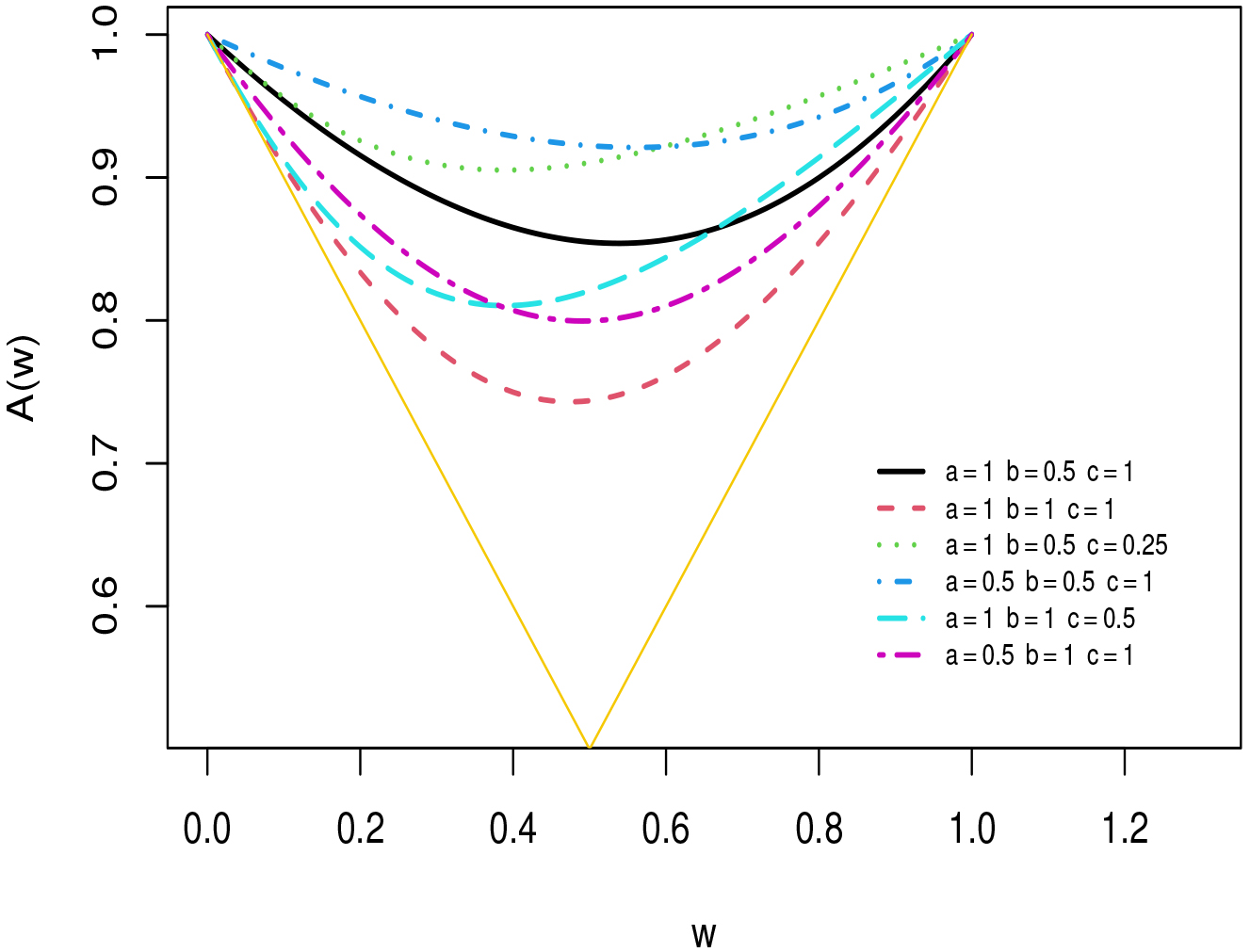
This figure reveals the flexibility of the MT PickDF. In particular, various levels of asymmetry are reached, depending on the values of the parameters.
Some PickDFs of special interest derived from the MT PickDF are described below.
By taking
which can be viewed as an asymmetric modification of the Gumbel PickDF. In addition, by taking By taking
which reduces the parameter complexity of the MT PickDF while maintaining an acceptable level of flexible asymmetric properties.
The two simple special cases above are interesting because it is well known that a linear convex combination of PickDFs is also a PickDF (see Tawn, 1988). Therefore, their functional abilities can be combined. For instance, the following function:
with
.
As a matter of fact, convex functions play a crucial role in mathematics, providing valuable tools for optimization and analysis. Their geometric properties ensure efficient solutions and enable the study of a wide range of mathematical problems with clear and powerful mathematical techniques. Since the MT PickDF is a convex function, it can be used in other branches of mathematics.
For the purposes of this study, we call the copula associated with the MT PickDF the MT copula. Based on Eqs (1) and (4), it is expressed as
The novelty of the MT PickDF is transposed; the MT copula is a new EV in the literature. Like the Tawn copula, but with different asymmetric capacities, it is designed to be used for modeling upper tail dependence, making it particularly valuable for capturing extreme events in the upper tail of a bivariate distribution. It offers flexibility in modeling asymmetric tail dependences. In theory, this allows for more accurate risk assessment and decision-making in fields such as finance, insurance, and environmental studies. We emphasize these aspects below.
In order to provide a visual proof of its versatility in terms of asymmetric shapes, Fig. 2 displays some contour-intensity plots of the MT copula for
Contour-intensity plots of the MT copula for 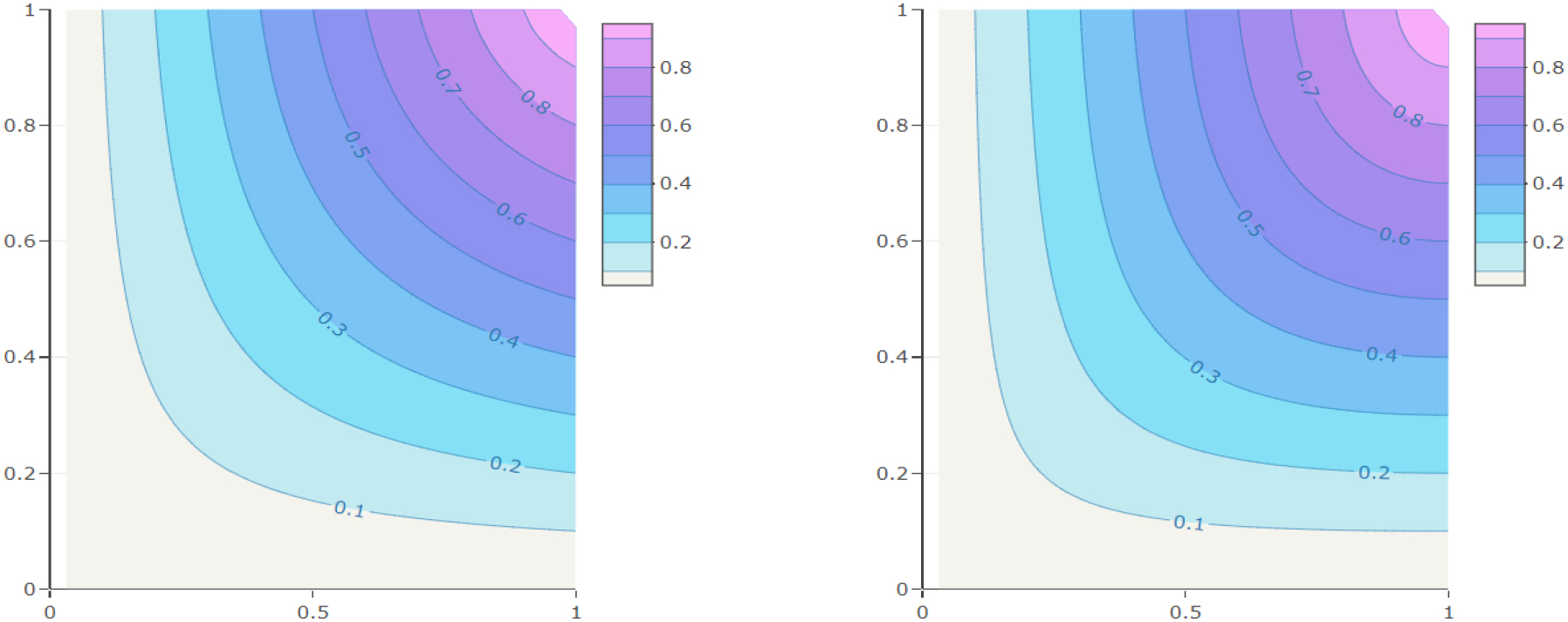
We thus observe the mathematical validity of the MT copula, and also, its nuanced asymmetric contours when the involved parameters vary.
Some of the basic properties of the MT copula are now examined. First, it is absolutely continuous; the copula density exists and can be expressed as
implying the non-diagonal symmetry of the MT copula. The MT copula is not associative since, for example, for
Because of this non-associativity, the MT copula is not Archimedean. As for any EV copula, the MT copula satisfies the following list of properties (see Joe, 2015):
In addition, based on the EV copula theory (see Joe, 2015), some correlation measures have simplified expressions. For instance, the Blomqvist
and the Spearman
The integrated term is too complex to get a simple expression of
Table 1 presents some numerical values of
Some values for
Based on this table, for the considered values of
.
A similar study can be made for another well-known dependence measure: the Kendall
See Ghoudi et al. (1988) and Joe (2015). Despite the integral being non-developable due to the complexity of the expression of
Some secondary results are given below. Based on the MT copula, another natural copula is obtained as
It can be viewed as the exchanged version of the MT copula. Other techniques can be used to create new copulas based on
On the other hand, we can use the MT copula as a generator of bivariate distributions. Thus, based on two cumulative distribution functions (CDFs)
For selected choices of lifetime CDFs, see Taketomi et al. (2022). With the above general CDF, we can create bivariate distributions of great interest due to their ability to capture tail dependences and model extreme events accurately. They enable a more comprehensive understanding of the joint behavior of quantitative variables, facilitating risk assessment and decision-making in fields such as finance, insurance, and environmental sciences.
The rest of this article is devoted to the second new EV copula, which proposes an alternative modification of the Tawn copula.
At the basis of the second proposition of EV copula, there is a new PickDF presented in the next subsection.
New PickDF
We introduce an original extension of the Tawn PickDF in the result below.
.
Let
Then
We have
and
The condition of the first item in Definition 1 is proved. Let us now show that
On the other hand, for any
The condition of the second item in Definition 1 is proved. After laborious differentiations and many arrangements, we achieve
where
and
Since Since Since As a result, under the conditions (i) or (ii), we have
We conclude that
In the rest of this section, it is supposed that the conditions in Proposition 2 hold.
For the purposes of this article, the PickDF in Eq. (6) is called the modified Tawn 2 (MT2) PickDF. Under the parameter condition (i), it corresponds to the original Tawn PickDF as described in Eq. (3). So the main originality of the MT2 PickDF remains for the parameter condition (ii). In this case, it follows the spirit of the BB5 PickDF by modifying the functional structure of the Gumbel PickDF while using the Tawn asymmetry scheme, but with a total new power modification, i.e.,
Plots of the MT2 PickDF for selected values of the parameters 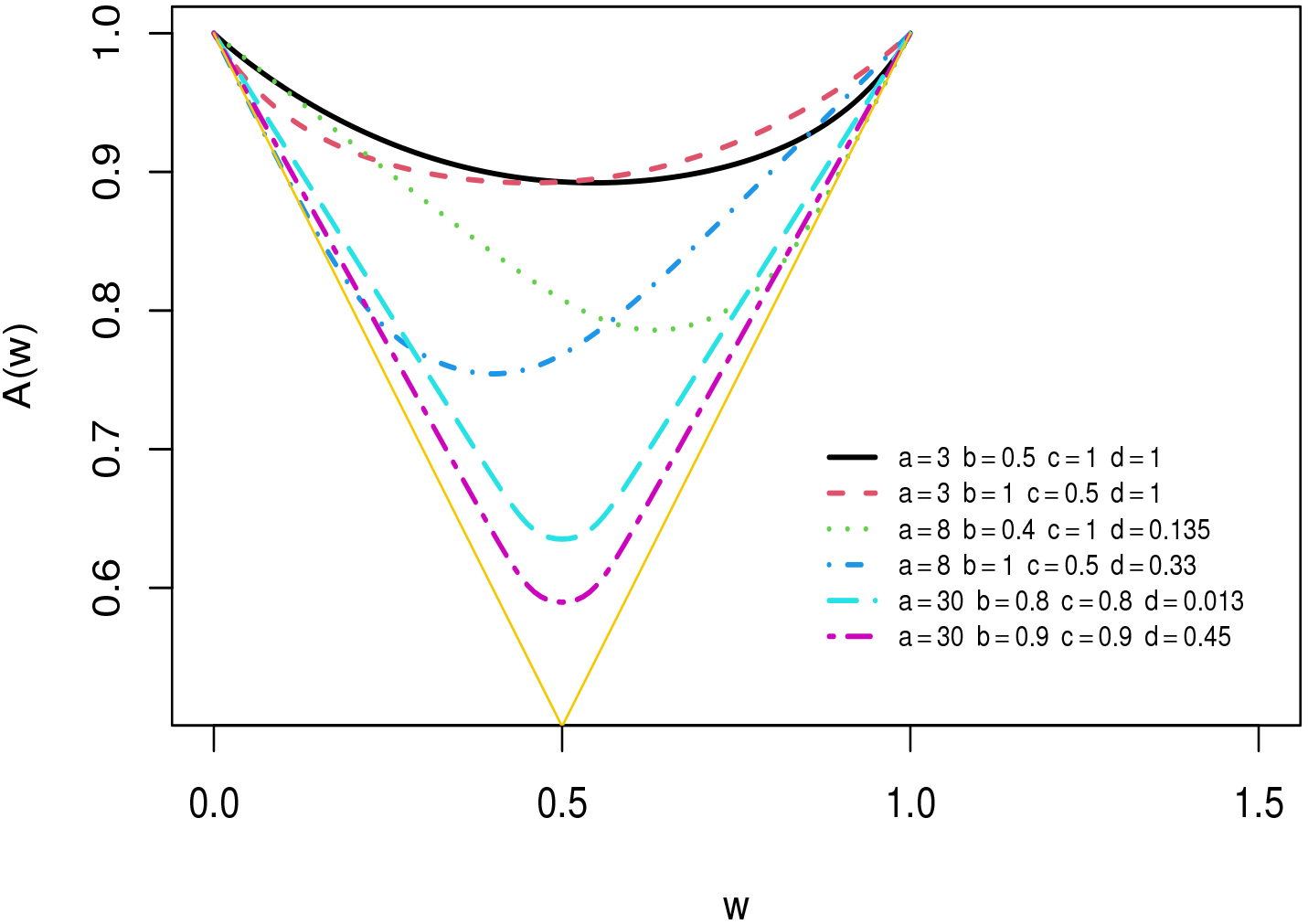
In order to understand its shape possibilities under the condition (ii), Fig. 3 displays the MT2 PickDF for the following configurations:
Like in Fig. 1, these configurations were selected after several tests in order to offer a visual sketch of a maximum of different shapes. There is, however, a bit of arbitrariness in their choices. Again, the inverted triangle shapes are those of the special Marshall-Olkin PickDF
This figure reveals the flexibility of the MT2 PickDF. In particular, various levels of asymmetry are reached, depending on the values of the parameters. Thanks to the parameter
Some special PickDFs derived from the MT2 PickDF are described below.
By taking
which can be viewed as a new modification of the Gumbel PickDF for By taking
which reduces the parameter complexity of the MT2 PickDF while maintaining an acceptable level of flexible asymmetric properties. The same comment holds by taking
As already mentioned for the MT PickDF, the three special cases above are interesting because it is well known that a linear convex combination of PickDFs is also a PickDF (see Tawn, 1988). We can thus combine the functionalities of the well-referenced and new PickDFs.
.
The MT2 PickDF, like the MT PickDF, can be used independently in various areas of mathematics because of its convex nature.
For the purposes of this study, we call the copula associated with the MT2 PickDF the MT2 copula. Based on Eqs (1) and (6), it is expressed as
The novelty of the MT2 PickDF is transposed; the MT2 copula is a new EV copula in the literature. Thanks to the addition of the power function, it can be viewed as a direct modification of the Tawn copula. Hence, it is designed to model upper tail dependence, especially when the Tawn copula does not give satisfying results. In theory, it is ideal to capture extreme events in the upper tail of a bivariate distribution. It offers flexibility in modeling asymmetric tail dependences, allowing for more accurate risk assessment and decision-making in various applied fields. We will emphasize these aspects below.
Figure 4 displays the contour-intensity plots of the MT2 copula for
We thus illustrate the mathematical validity of the MT2 copula, and also, its nuanced contours when the involved parameters varied.
Among the basic properties of the MT2 copula, it is absolutely continuous, not symmetric for
Concerning the main correlation measures, the Blomqvist
and the Spearman
A straightforward equation of
Table 2 presents some numerical values of
Some values for
and
for fixed values of
and
and varying values for
, and
Some values for
Contour-intensity plots of the MT2 copula for 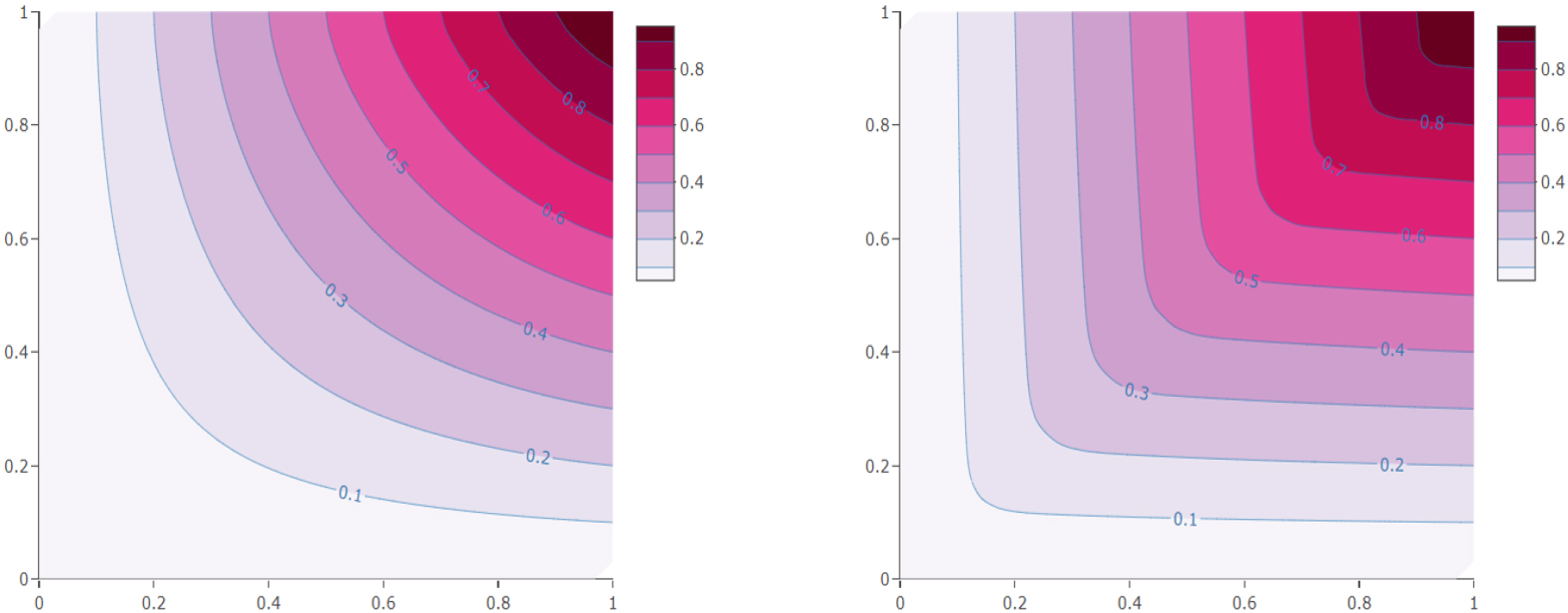
Thus, based on this table and the considered values for
Some secondary results are given below. Based on the MT2 copula, another natural asymmetric copula is obtained as
As for the MT copula, we can also create other copulas based on the MT2 copula via the radial, mixture or flipping techniques as described in Nelsen (2006).
On the other hand, as for the MT copula, we can use the MT2 copula as a generator of bivariate distributions. Thus, based on two CDFs
The obtained distributions are of interest when those generated by the Tawn copula fail to efficiently analyze data in an EV setting.
The EV copulas are crucial in modeling and analyzing extreme events by capturing the tail dependence structure and quantifying the joint behavior of rare events accurately. In this article, following the spirit of Adam and Tawn (2011), we developed the theory of two new EV copulas based on new PickDFs that modify or extend the famous Tawn PickDF. We demonstrated their attractivity, with an emphasis on their modulable levels of asymmetry, flexibility in terms of upper tail dependence in particular, and wide correlation ranges of values. All the theory was given in detail, along with computer material to support it. These developments help to consider dependence models that are more accurate, improving our capacity to make wise choices in complex situations.
A possible limitation of the MT and MT2 copulas is the number of parameters involved, which can lead to an overparameterization phenomenon in some applications. However, depending on the nature of the data, this limitation can be circumvented by setting some of the parameters to fixed constants relative to the valid domains found in the article.
The perspectives of this work are (i) the application of the MT and MT2 copulas to the analysis of real-world data, (ii) the use of our mathematical techniques for more contributions in the field of EV copulas, and (iii) the extensions of the MT and MT2 copulas in a
Footnotes
Acknowledgments
The author would like to thank the reviewer for his thorough comments on the article.