




Abstract
BACKGROUND:
The road to employment can be uncertain for millions of adults with intellectual disability and their families. It is important to understand how they navigate this journey and the challenges they experience.
OBJECTIVE:
We examined the pathways taken by four families in their pursuit of integrated employment, as well as the complexities they encountered along the way.
METHOD:
In this longitudinal, multiple case study, we followed families across one year. They (and their mentors) completed questionnaires at the beginning of the project, we checked in with them monthly, and we interviewed them at the conclusion of the project.
RESULTS:
Five primary findings emerged from their experiences: pursuing employment is a family affair, it is an extended journey, each family’s journey is different, mentorship matters, and multifaceted support is needed.
CONCLUSION:
Families need ongoing support and guidance to navigate their journey toward competitive employment. We offer recommendations for research and practice aimed at supporting families in this important pursuit.
Introduction
Early adulthood can be a time of great excitement and exploration as young people leave secondary or postsecondary school and enter the workforce. Launching one’s career is both a rite of passage and an opportunity to access an array of valuable benefits. For example, a good job offers a source of income and insurance, provides connections to others and the community, contributes to purpose and meaning, and fosters personal development (Bailey et al., 2019). Not surprisingly, most (94%) young people with intellectual disability aspire to obtain a paid job in their community in early adulthood (Lipscomb et al., 2017). Like anyone else, they want to find a satisfying job aligned with their interests and needs (Voermans et al., 2019).
Many parents also hope their family members with intellectual disability will find paid employment after graduation. In their survey of more than one thousand parents of children and youth with intellectual and developmental disabilities (IDD), Blustein et al. (2016) found that 80% considered it somewhat or very important for their child to work part-time for pay in the community after high school (63% said the same about full-time work). Indeed, parents want their family members to experience meaningful work that matches well with their interests, provides opportunities for growth, and is inclusive (Carter, Lanchak, Berry et al., 2023).
Unfortunately, the journey from aspirations to the attainment of integrated employment remains challenging. Although some young adults with intellectual disability do find success in the workplace, the majority do not (Almalky, 2020). Among individuals served by state agencies, less than 20% participate in some form of integrated employment (Winsor et al., 2021).
Families often play a central role in the job pursuits of their members with intellectual disability (Kramer et al., 2018; Petner-Arrey et al., 2016). For example, parents bring unique perspectives on the strengths and needs of their children, they may be able to provide an array of practical supports (e.g., transportation, skill instruction, encouragement, advocacy), and their own social connections can be an asset for job networking. Indeed, engaging families is considered best practice in the pursuit of integrated employment (Butterworth et al., 2017). But family involvement can also emerge out of necessity. Most young adults with intellectual disability live at home and lack access to long-term services and supports (Burns et al., 2022). At the end of school-based transition services, many families find they have limited access to formal services and supports to assist in their pursuit of employment. Even when services are available, families may not be aware of them (Gilson et al., 2018). As a result, employment may be unlikely to materialize unless families take an active lead.
What, then, does pursuit of paid employment look like for these families? Petner-Arrey et al. (2016) interviewed parents about the ways they tapped into personal networks, advocated strategically, and negotiated the right job fit for their family members with IDD. Similarly, Kramer et al. (2020) asked parents to retrospectively reflect on the information, resources, and services they interacted with as they pursued employment for their family members with IDD. However, few studies have examined their experiences over time as they navigate the road to employment. It is unclear how long this pursuit lasts, the challenges that arise along the way, and the ultimate likelihood of success. In-depth, longitudinal studies are needed to capture the course and complexities associated with the search for integrated employment.
The purpose of this year-long, multiple case study was to examine the pathways taken by families in pursuit of integrated employment, the complexities they encountered along the way, and the potential contributions of receiving mentorship from another parent. We addressed two primary research questions: What barriers do parents encounter when pursuing employment alongside their child with IDD? How does parent mentorship impact their employment journey? This pilot study was undertaken as part of a larger mixed-method project focused on developing and evaluating a new family support intervention package comprised of employment training and parent mentoring. We were especially interested in understanding more deeply the experiences of families and the issues that can emerge throughout this often lengthy pursuit.
Method
Participants and recruitment
Descriptions of participating families and mentors are presented in Table 1.
Participant demographics
Participant demographics
aInformation provided by parent.
Data collection
Barriers to employment anticipated by parents
Barriers to employment anticipated by parents
*Denotes a barrier encountered during their employment pursuit.
Preparation for pursuing employment according to parents
For each dyad, we provide a description of the participants and summarize each family’s one-year employment journey, detailing their progress and any challenges they faced each month. We incorporate participant reflections on their experience and the overall impact of parent mentoring. Case studies were derived by compiling the information collected from initial questionnaires, monthly check-ins, and end-of-year interviews described in the prior section. Pseudonyms are used for all participants.
Miller family’s journey
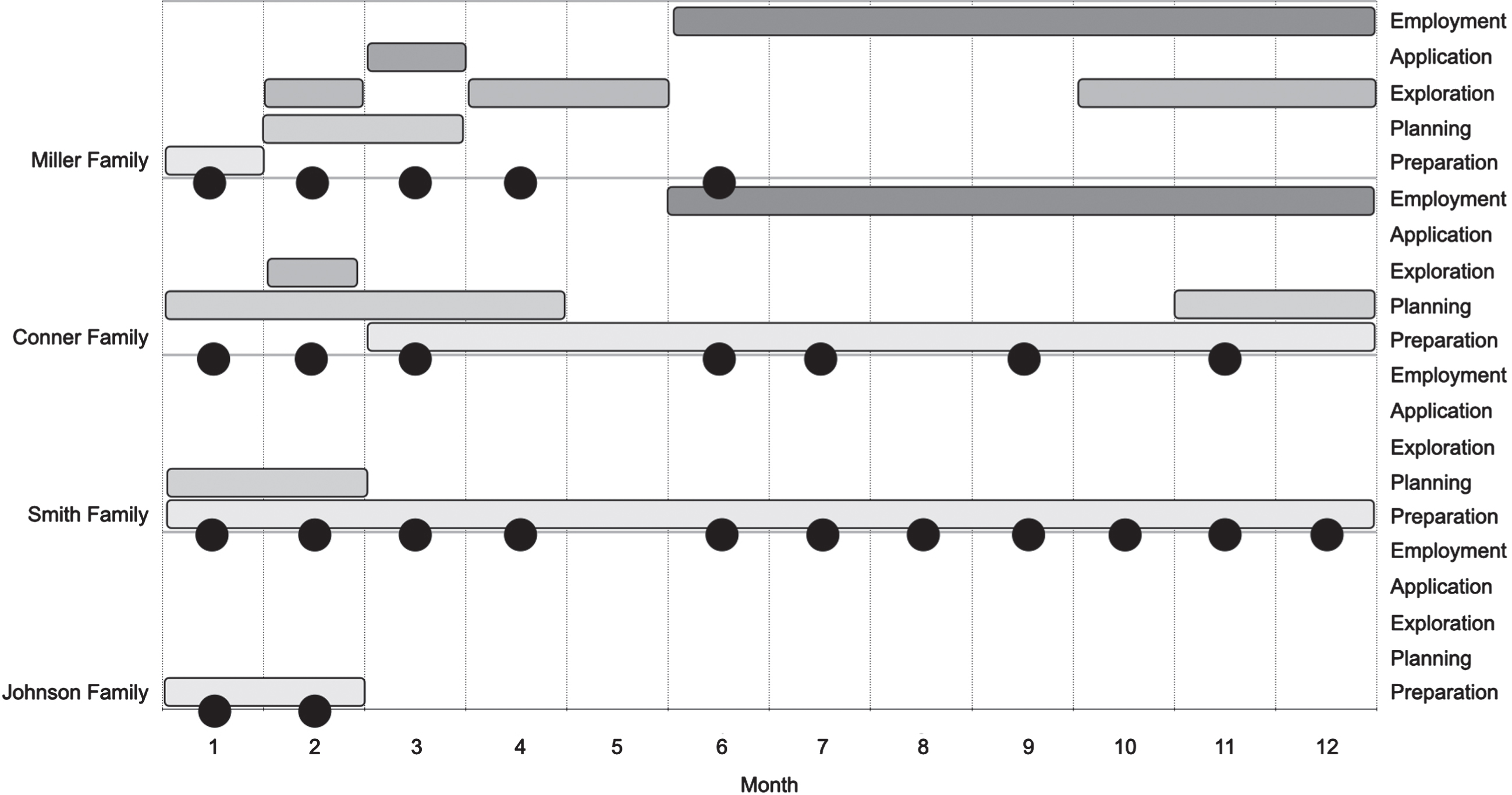
Dyad monthly progress. Closed circles refer to the months in which dyads formally connected. Labels on the right of the figure refer to phases of the employment process.
By month four, Ted had learned that neither interview led to a job offer. Taylor and Mary continued to explore different openings. Taylor was starting to feel discouraged, sharing “It hurts when I see other kids going to work. We’ve tried a lot of things!” Ted continued to volunteer at community events (i.e., marathons, walks, fundraisers) to build job skills and develop social connections. He also began to attend a recreational theater group for young adults with disabilities that Mary had recommended. The pair did not meet in month five. Their fifth mentor session (during month 6 of the partnership) was an exciting meeting because Ted was hired at a craft studio where he prepared materials and supplies for painting classes. Ted was hired to work six hours per week and paid $7.50 an hour. His job coach helped locate the job and supported his application. During their mentoring session, Taylor and Mary reviewed transportation options in the event that Taylor was unable to drive her son to work. They discussed job supports that were in place and other supports that could be possible. Ted’s hours had decreased within a few weeks of starting the position, so Mary encouraged his mother to reach out to his job coach to approach the manager about adding additional hours.
The pair no longer felt they needed to meet formally, but they stayed in contact through email and text for the next six months. Ted continued to work at craft studio two hours per week, but Taylor was feeling frustrated with his low number of hours. She hoped to either increase his hours or find another job that offered more. Other difficulties they faced included short shifts (e.g., 2 hours) and shift cancellations with little notice. Ted’s parents were driving him 30 minutes to and from work. The distance and inconsistent schedule led the family to conclude this position was not a viable long-term option. Ted struggled with loneliness and Taylor wanted to find more activities for him during the day. Mary continued to share recreational opportunities.
The process of employment was frustrating. Number one, just because people were starting to come back from COVID. We’d see a lot of job openings and we would try to apply for those. And of course, they wouldn’t call us or one place set up an interview and then when we went to the interview there was nobody there ... we were basically stood up.
Ted found his job with job coach support, but as his mother explained, “We’re not entirely happy with that opportunity ... It is very frustrating because it’s hard to find fulfilling opportunities for people with special needs.” The Millers were unsatisfied with his hours and felt the position did not fulfill his desire to have a full day of activity around people. Ted’s job responsibilities did not include customer interaction and his manager had to remind him not talk with customers while working. When describing their frustrations, Taylor shared:
I feel like maybe [his boss] doesn’t realize that special needs people need interaction. And the pay. I know she’s paying her other employees about $15.00 an hour. So, paying [Ted] $7.50 an hour, to me it’s like it’s charity work for her. I think he is more valuable than that. He can provide a valuable service. I don’t feel that he should be paid less than the other employees in the business.
It was also disruptive to his parents’ workday who provided transportation for his short shifts.
Taylor valued her mentor meetings, “I enjoyed the in-person lunches with my mentor. They were lots of fun. We talked about the kids and then we would talk about some of things outside of kids, just fun trips or experiences overall with the kids growing up.” When asked about the help her mentor provides, Taylor cited the various recreational program and activities she suggested. She described a theater program Mary recommended, “It was right up his alley. He stuck with it the whole year and every time I picked him up, he was just super excited and happy to go there ... she also helped us find some other opportunities and different resources to look into for [Ted].” Taylor’s mentor also helped her understand the employment process for adults with disabilities, “I think learning about how the job process works for a special needs student was very valuable because outside of the school setting, we really didn’t know what to do ... We had relied on the school district for most of our services.” She expanded, “Just knowing that there’s other parents in the same situation was helpful too.” Ted had recently exited school and his mother spoke to the change in their personal networks after graduating:
When you’re in the school setting, of course you see the other parents on a regular basis. But once you’re outside of school, you just don’t see those parents anymore. Your support is gone. Just having somebody to talk to about various experiences is a good thing.
As they continue to pursue other opportunities for Ted, Taylor shared:
My biggest wish for him is to just have some social outlets where he can interact with other young adults and feel fulfilled. I would also hope that he could have a job at least a couple days a week, that he could go to and feel a sense of belonging and accomplishment.
During their second meeting, the dyad researched possible employers within Donna and Marcus’s neighborhood by creating a community map. They found a few businesses that Donna would look into further. They discussed finding jobs that would not require a job coach, since Marcus was still waiting on services. Donna’s older son joined their meeting and offered to approach his employer about volunteer opportunities for Marcus. Since Donna was concerned about Marcus’s motivation to work, Lauren shared a few videos for him to watch that showed different job examples to help get him excited about work and explore his interests. During the third month, Donna and Marcus were still in the process of establishing services and connecting with a Vocational Rehabilitation counselor. Lauren shared advice on navigating the service system and resources within the community for work preparation and readiness skills that Marcus could join while waiting for services. They did not meet during month four or five.
During month six, Marcus found employment at a car dealership where his older brother also worked. He worked two hour shifts three days a week and earned $8 an hour. His job title was porter assistant where he mainly cleaned up around the office and stocked the service center kitchenette. The position was created for Marcus after his brother talked to the manager. He received job coaching support at work from his Vocational Rehabilitation counselor. Donna was concerned his Vocational Rehabilitation case would be closed since he had found employment. She felt Marcus needed full-time support at work because he loses interest in tasks and requires motivation. Marcus had also started attending an employment readiness program twice a week.
Over the next six months, Donna and Lauren exchanged messages over text and email a handful of times. Lauren gave Donna advice on working with Vocational Rehabilitation and how to advocate for her son’s needs with his counselor. She also helped Donna understand how to utilize long-term services for future job coaching needs once Marcus is off the waiting list. By month 11, Marcus was off the wait list for the Medicaid waiver program and connected to a provider. Donna was hopeful they would provide job coaching and help Marcus find a new position.
In my little fairytale, I thought you’re gonna walk into a job and it’s not gonna be difficult to find. When in reality, we got the job through his brother, but I wouldn’t have thought, “Hey, let’s ask his brother” until my mentor says, “Hey, we used our community resources. We went to church and talked to people we know at church.” Then I’m like, well, the most outgoing person I know on this planet is his brother. And so, his brother made it happen!
Lauren had an impact on Marcus’s employment journey from the start. Donna explained, “She shared her story and the steps she had taken including pitfalls. We utilized the information supplied with our guide and it helped to start us on the correct path.” Donna had envisioned their employment journey going differently than it did. She thought the service system would be integral and connect them to different openings in the community. When that did not happen, she was thankful for Lauren’s support:
I won’t lie to you; he wouldn’t have a job right now if I hadn’t been in this study. It’s just the truth because I wouldn’t have pursued it. Not because I don’t think it’s good for him, but just because I didn’t have that kind of push to say, “Hey, go do this!”
It took several months to connect Marcus to Vocational Rehabilitation services. Donna shared how instrumental Lauren was in this process, “Because of the prep with my mentor, I was aware of what next step were coming and able to be an advocate for my son.”
In the last few months, Lauren guided Donna so that Marcus could continue to receive job coaching and support to look for his next job. Donna explained how Lauren helped her:
... use my own resources that I don’t even realize I had until my mentor says, “Hey, what about this? What about that? Have you tried this?” I don’t even know how else to explain the meetings, besides it builds a friendship and a mentorship with someone that you would not have necessarily known before.
Donna further celebrated her mentor when sharing, “I know if I have a question, she will find the answer. She encouraged me on next steps and kept me organized. She is great to work with and I feel I’ve gained a friend.” Donna acknowledged that her own busy schedule and work demands could impact her availability to follow through on employment tasks. She noted Lauren was always understanding, “The good thing is you’re talking to another parent who has the same or similar experiences and is able to say, ‘It’s okay. It’s okay!” Lauren shared the value of mentoring and how it changed her outlook on the employment process:
I came into it and I’ve always been a huge advocate for [Marcus], but you get tired. And I was in the tired mode. I’m tired of fighting. I’m tired of arguing with people about what to do for [Marcus]. I’m tired, I’m tired, I’m tired. And I feel like we’ve done what we can do for him. This rebuilt my momentum ... that’s the most positive is having someone you can call. I could reach out to any point. I feel like it’s just adding a new network to a network you already have.
Donna and Lauren plan to stay in touch on their son’s jobs and share resources they discover.
Smith family’s journey
Both of their children attended the third meeting. Robin was thrilled to facilitate this connection and friendship between their families. Their focus remained on volunteer work and opportunities to build Sarah’s employment skills and independence. Jenny shared several social opportunities in the community and they discussed applying for government services. Robin opted not to apply for formal support as she felt the service system was overwhelming and confusing. She preferred to network independently and provide Sarah support on her own. Robin anticipated pursuing employment in a few months when her personal life was less demanding. Their family valued having flexible schedules and free weekends and Robin feared they would lose this freedom if Sarah was to begin working. When Robin met with Sarah’s job coach, they discussed the type of employment setting that would be best for Sarah and how to use personal connections to find those opportunities.
Robin’s employment perspective had not changed much by month four. She asserted they were not giving up on employment; their family just did not feel ready. Although employment was no longer the primary focus of their meetings, Robin felt like Jenny’s advice and suggestions had helped Sarah find more ways to engage with and get involved in the community. Robin said their conversations were helping her envision employment for Sarah, which she previously struggled to picture. This led to more family conversations with Sarah about what experiences and types of tasks she liked best. Sarah enjoyed stocking shelves the most, so Robin pictured her working at a small, locally owned business helping with inventory. Sarah’s father also began advocating for turning volunteer opportunities into paid positions at the day program. They were hopeful that involvement in this planning group might open up paid opportunities for Sarah.
By month five, Robin and Sarah were still not actively pursuing employment and instead focused exclusively on volunteering. Robin said they remained open to employment if the right opportunity presented itself, but they were no longer actively searching. Robin explained that their “radar was still on” for possible opportunities in a small setting. Robin and Jenny continued to meet for the last seven months. Their meetings focused more on building a personal friendship and exchanging opportunities for social engagement in the community, rather than pursuing employment. Robin valued her meetings with Jenny, sharing that “chatting with another parent of an adult with challenges on a regular basis has been such a blessing. [My mentor] is a wonderful source of encouragement and a great resource for services and other opportunities for involvement.” Jenny would check in on Robin and Sarah’s interest in employment, but their outlook did not change. At their last meeting. Jenny described the services her son receives through a Medicaid waiver program and how it helps him and their family. She walked Robin through the application process and offered to complete the paperwork with her. Robin was not interested in applying due to her other family commitments and responsibilities.
We talked a lot about [employment]. We talked about concerns and things they would have to consider. She was very responsive, but she just used that information in a different way. She didn’t use it to gain employment for her daughter, but she did use that information to open up some opportunities.
Robin agreed and shared that mentoring “made me more confident in verbalizing and realizing what we could handle.” She is hopeful that when her other family commitments reduce in the future, “if [Sarah] does want to get a job, it’s gonna be more doable.”
Reflecting on the mentoring and employment, Robin shared, “It really has made me feel more connected to the community. And I think we will move in that direction. It’s just, I’m not there yet.” Sarah had been excelling at her volunteer tasks, which include a cleaning role at a restaurant and working on a food truck. Her volunteer work included job training sessions and they were hopeful Sarah would get to be paid after completing training. Robin summarized their employment journey, explaining:
What we’re doing is working towards that goal [of employment], but at our own pace. She’s developing skills that we could then take somewhere else. It also is making me look at, as we’re out in the community, thinking, she could do that and she could do that. That would be really easy for her if she had a job coach.
Johnson family’s journey
When they connected in month four, the partners decided to put mentorship on pause while Lisa focused on her family’s needs. They did not have contact for three months During month eight, Lisa shared that she was experiencing health issues and was still not able to pursue employment with her daughter. At that point, the mentoring relationship ceased.
Discussion
The road of employment is still not assured for millions of adults with intellectual disability. Although most parents desire paid employment for their family members, the route from here to there can often seem uncertain (Gilson et al., 2018). We examined the pathways taken by four families in pursuit of integrated employment, as well as the challenges they encountered along the way. Taken together, these case studies highlight five salient aspects of this pursuit that have implications for policy and practice.
It is a family affair
Apart from seeking occasional advice or connections from family members, most young adults in their twenties pursue jobs primarily on their own. Young adults with intellectual disability, however, often require more intensive and extended support to navigate this pursuit successfully (Wehman et al., 2021). In the absence of high quality and accessible employment services, such support often falls to families. Parents in the four participating families were directly and deeply involved in all aspects of the job search—both by choice and necessity. This required finding ways of folding a job search into their existing work and family commitments. But it also meant decisions regarding whether, where, and when their family member worked required consideration of the entire family’s schedules, resources, and priorities. This interconnectedness within the family unit must be acknowledged and attended to by employment providers. While still prioritizing the goals and preferences of young adults with intellectual disability, providers must also discern whether and how new employment pursuits will both engage and affect an entire family (Carter et al., 2018; Wilson & Campain, 2020).
It is a journey
Although obtaining a job is often depicted as a discrete or time-limited endeavor, it was an extended journey for all four families. The typical entry-level job search in the United States lasts several weeks (e.g., Faberman & Kudlyam, 2019). In contrast, it took the Miller and Conner families five months to secure jobs; the Smiths and Johnson families never did. Moreover, each of their job pursuits had already begun well before connecting to this project. Multiple factors can converge to protract this process, including the motivation of families, their knowledge of employment opportunities and supports, the availability of external assistance, the support needs of their family member, and the local job market, to name just a few (Carter, Lanchak, Guest, et al., 2023). Each of these issues emerged—individually or in combination—across the four families. The prolonged duration of this search could be both surprising and discouraging. Some families may wonder whether the investment of time and effort is feasible or worthwhile (Francis et al., 2014). Expanded access to well-designed employment services could streamline this often-extended process and strengthen supports for interested families. Presently, large numbers of families who want and need employment services endure on lengthy waiting lists (Burns et al., 2022).
Each journey is different
The pathways these four families took and the barriers they encountered were quite distinct (see Table 2 and Fig. 1). In crafting our Roadmap to Employment resource guide, we outlined ten steps toward employment and described strategies related to each: (1) create your support plan, (2) identify skills and interests, (3) explore your community, (4) connect with employers, (5) apply for jobs, (6) prepare for interviews, (7) accept job offers, (8) start a new position, (9) succeed at work, and (10) grow your career. Yet, each family’s entry point into this process differed based on their prior experience, personal knowledge, and service access. Likewise, each family approached these steps in individual ways and paces that aligned with the needs of their family members and changing life circumstances. In each case, the process was far more sinuous than linear—sometimes forward, occasionally backward. For Ms. Johnson—who felt very well prepared to pursue employment at the outset—the death of another child and personal health issues pushed employment pursuits to the backburner. For the Smith family, their early eagerness to obtain employment waned over time as they reconsidered their goals and the impact on their family’s routines. Even for the Miller and Conner families, the ways in which they pursued—and ultimately obtained—employment unfolded in unexpected and unique ways. Although there are best practices and processes for pursuing integrated employment (e.g., Butterworth et al., 2017; Migliore et al., 2012), this is certainly not recipe work. Both families and service providers must be ready to adapt and adjust to ensure a more person-focused process.
Mentorship matters
Studies suggest that most parents are uncertain about how best to support their family members with intellectual disability to obtain meaningful work in the community (e.g., Carter, Lanchak, Guest, et al., 2023; Gilson et al., 2018). The insights of another parent who has navigated the employment process themselves can provide families with much needed guidance and encouragement. Each of the parents in our project highly valued their mentoring relationship for multiple reasons. Such affirmation is consistent with reports of parent mentoring aimed toward other areas of life (e.g., Lee et al., in press; Moody et al., 2018). Even when mentorship did not lead to employment within the scope of a year, parents appreciated the knowledge they gained, the relationship they formed, and the insights they received on other aspects of parenting. Despite this promise, studies rarely incorporate parent mentoring into comprehensive intervention packages (Lindsay et al., 2015; Schutz & Carter, 2022).
Multifaceted support is needed
Although the employment resources and mentorship these four families received were valued and valuable, they were not entirely sufficient for achieving their family member’s goals of achieving a satisfying job. Even within the Miller and Conner families, movement was quickly underway to search for a better job more aligned with the needs and preferences of their family members with intellectual disability. To address these challenges, the subsequent phase of our development project involved revising our written resources, developing a four-part short course on employment, and more fully delineating the mentoring process. At the same time, the experiences of these families also highlighted the need for improving transition programs, addressing service gaps, promoting employer awareness, and addressing transportation problems. Indeed, calls for multi-faceted, community-level interventions have been stressed elsewhere, but rarely materialize (e.g., Carter, Lanchak, Guest, et al., 2023; Wehman et al., 2021). In other words, families should not have to undertake this pursuit of employment on their own and in the absence of strong support services.
Implications for practice
Our findings have implications for supporting families in the pursuit of paid employment. First, parent-to-parent mentoring should be extended into the context of integrated employment. Local communities should explore and evaluate the various ways in which parent experiences can be leveraged to support families considering employment for the first time. In addition to one-to-one mentoring, as adopted in this pilot project, other possibilities include peer networks and parent support groups. Second, parents and mentors will likely benefit from having access to supplemental employment training and resources as they partner together. Although our mentors all brought first-hand experience, they also expressed some uncertainty about guiding fellow parents in areas that they did not navigate themselves. Programs like Family Employment Awareness Training (Gross et al., 2021) and ASSIST (Taylor et al., 2022) could be combined with individualized mentoring in generative ways. Third, most families—including the participants in this study—have limited familiarity with the array of formal and informal supports that could be drawn upon to support employment (Gilson et al., 2018). Local efforts are still needed to compile available resources and share them with families in accessible ways. Creative partnerships between disability-focused and generically available programs could be instrumental in creating and maintaining these much-needed resource guides.
Limitations and future research
Limitations to this study suggest areas for future research. First, our pilot project focused on just four families, all of whom were drawn from a single region of a state. With more than four million working-age adults with intellectual disability in the United States, the journeys of these families cannot capture the breadth of family experiences throughout the country. As we expand the size and diversity of our sample in future project phases, we also encourage other researchers to examine the experiences of additional families from varied backgrounds, locales, and situations. Future research should also examine helping families understand their roles and the roles of paid professionals and how to best work together for successful employment outcomes. Second, we launched this study in the middle months of the COVID-19 pandemic. These unique conditions may have also impacted the ways in which families pursued employment and the job opportunities available to them. Although our next phase—which is already underway—follows families beyond the pandemic, we recommend that other researchers also follow families longitudinally to better understand the nature of their employment pursuits.
Conclusion
Improving employment outcomes for individuals with intellectual disability is an enduring focus of policy and practice. Understanding the experiences of families who are striving toward this goal can provide important insights into the complexities associated with this pursuit. For parents who undertake this journey alongside their family members with intellectual disability, the road to employment may be enhanced—though not ensured—by having another parent by one’s side. We hope our findings will spur further inquiry and investment that lead to the strengthening of services and supports for individuals and families.
Footnotes
Acknowledgments
The authors wish to thank the project advisory board for their critical valuable insights into this project.
Conflict of interest
The authors declare that they have no conflict of interest.
Ethics statement
Ethical approval for this study was obtained from Vanderbilt University (IRB # 210023).
Funding
Support for this study came through a grant from the National Institute on Disability, Independent Living, and Rehabilitation Research (NIDILRR grant number #90RTEM0003). NIDILRR is a Center within the Administration for Community Living (ACL), Department of Health and Human Services (HHS).
Informed consent
All participants were provided a consent form which outlined the risks and considerations of participating. Participants had the opportunity to ask questions before opting to sign the form and participate.