




Abstract
BACKGROUND:
Understanding the cost-benefit of vocational rehabilitation services is critical to improve competitive integrated employment outcomes for individuals with intellectual and developmental disabilities (IDD).
OBJECTIVE:
The purpose of this scoping review was to analyze and synthesize micro and macroeconomic analyses of various types of vocational services which promote the employment outcomes of individuals with IDD.
METHODS:
This scoping review searched peer-reviewed and grey literature sources published between 2000 and 2020, examining both micro and macroeconomic analyses.
RESULTS:
A total of 26 studies met inclusion criteria. The majority of studies reported positive effects for the cost-benefit of integrated service approaches such as supported and customized employment. Conversely, our findings show no cost-benefit for sheltered workshops, and in some cases, negative effects.
CONCLUSION:
Limitations to the included studies as well as implications and recommendations for practice, policy, and future research are discussed.
Introduction
The overall efficacy of any policy or program depends on its relative cost, its outcomes, and the relationship between the two. In recent decades, disability policy in the U.S. has prioritized competitive integrated employment (CIE) as the preferred overall outcome for individuals with disabilities over sheltered workshops and other segregated alternatives in-cluding adult day programs (Wehman et al., 2018). Most notably, the Workforce Innovation and Opportunity Act of 2014 (WIOA) improved access to int-egrated service delivery models for individuals with disabilities, undermined use of 14c subminimum wage waivers, and required state Vocational Rehabilitation (VR) agencies to allocate 15%of funding toward pre-employment transition services for youth with disabilities. Despite such initiatives, rates of CIE for individuals with intellectual and developmental disabilities (IDD) remain low, with only about 18%working in the community (Siperstein, 2013). Further, data from IDD agencies show a steady rise of participation in non-work activities since the 1990s while the engagement of individuals with IDD in CIE has remained roughly flat, hovering around 20%(Winsor et al., 2019). Strides achieved with state and federal policy change have not translated into extensive adoption of CIE practices.
One of the major current policy to practice cha-llenges is the misalignment of funding toward programs and activities that do not directly link to CIE. Collectively, 45 U.S. federal programs confer funding or direct services to promote the employment of individuals with disabilities, totaling more than $4 billion each year (U.S. Government Accountability Office [GAO], 2012). These federal programs serve over 1.5 million people with disabilities, but often with overlapping and fragmented programs which are not oriented around a single employment outcome (GAO, 2012). The distribution of substantial financial resources as a result of disability policy efforts makes it imperative that funding be applied in ways that are economically efficient and conducive to prioritized employment outcomes set forth by those policies. That end requires a careful examination of a multitude of factors which influence the cost-benefit of employment services.
Economics of employment services
Cost analyses have been used for several decades as a method of summarizing the benefit of expenditure at achieving employment for individuals with disabilities (Cimera, 2000). In a literature review of research on supported employment programs from 1980–2000, Cimera (2000) found that cost-benefit analyses were conducted from both workers’ and taxpayers’ perspectives, with many presenting analyses from both perspectives. From worker’s perspectives, a majority of reviewed studies found that the financial benefits received by supported employees exceeded their cost, more than offset government subsidized benefits, and reported greater earnings than sheltered workshops (Cimera, 2000). Findings from a taxpayer perspective were more complex, with studies showing mixed results for the cost-benefit of supported employment in the short-term, but increasing in efficiency over time (Cimera, 2000). Cimera (2000) also found that supported employment, especially when using individual placements, was cost-efficient from both the worker and taxpayer perspectives.
More recent studies in cost-benefit of employment services for individuals with IDD have largely examined the macroeconomic impact by identifying overall trends by aggregating individuals nationally (e.g., Whittenburg et al., 2019) or by state (e.g., Bur-gess & Cimera, 2014). However, to date there have been no reviews conducted more broadly to examine the cost-efficiency of employment services for individuals with IDD beyond supported employment itself. Given the adoption of customized employment in recent policy (i.e., WIOA, 2014), increased emphasis on services for transition-age youth, and persistent use of sheltered workshops (Winsor et al., 2019), it is important to examine the cost-efficiency of employment services from a broader lens. Therefore, we approached the complex issue of cost-efficiency of services to promote CIE for individuals with IDD from two directions; macro- and microeconomic views.
Macroeconomic analyses, such as those used in previous reviews of cost-benefit literature provide important insights into the general efficiency of services relative to overall cost. The macroeconomic lens is necessary to evaluate the impact of different types of service delivery models (e.g., sheltered workshop or other segregated pre-vocational service versus integrated models such as supported employment) and examine benefits to various stakeholders, including the cost-benefit to service recipients, cost-benefit to taxpayers, and cost-benefit comparisons across types of employment service delivery models that lead to CIE outcomes. However, these macroeconomic analyses may gloss over salient details about the component pieces of employment services that lead to their ultimate success. Thus, it is also necessary to evaluate the microeconomics of individual vocational services and their impact on CIE. Microeconomic analysis considers factors such as the duration, intensity or installation of follow-up supports on CIE outcomes.
Purpose of review
The purpose of this scoping review was to analyze and synthesize micro and macroeconomic analyses of various types of vocational services which promote the employment of individuals with IDD. Therefore, a dual-pronged approach to reviewing the literature was utilized—those related to macroeconomic analysis of the overall provision of services as well as microeconomic analyses of the specific type, duration, and intensity of vocational services provided to individuals. Information included in the review allowed for economic cost-benefit analyses to be considered from the perspective of different stakeholders (e.g., people with IDD and taxpayers). The following research questions were developed to guide the review; What are the cost-effectiveness and cost-eff-iciency of VR services from a cost-benefit macro-analysis of overall trends of the CIE outcomes of individuals with IDD? How do the cost, duration, and intensity of VR-funded services (including long-term supports) provided to individuals with IDD relate to improved CIE outcomes?
Method
In order to answer these questions, we conducted two separate searches of the literature; one related to macroeconomic cost-benefit analyses and a second investigating individual (microeconomic) vocational service dosage. Building from the findings of Cimera’s (2000) previous review of cost-benefit analyses of the employment of individuals with IDD, the search was limited to studies from 2000 to 2020. The protocol for this review was adapted from the Preferred Reporting Items for Systematic Review and Meta-Analysis Protocol (PRISMA; Shamseer et al., 2015). Eight research databases were purposefully selected to ensure comprehensive sampling and used for both searches—Academic Search Complete, Business Source Complete, CINAHL, Education Research Complete, EconLit, ERIC, PsychINFO, and PubMed. Table 1 shows terms used to conduct each database search. Additionally, archival and ancestral search strategies were conducted through consideration of cost-efficiency studies cited by the Workforce Innovation Technical Assistance Center (WINTAC; N.D.) and by hand searching references from included studies. Finally, a review of the grey literature was conducted as part of this scoping review, which included a global search strategy using combinations of terms listed in Table 1, as well as more targeted searches of government and organizational websites who frequently evaluate employment services and outcomes of individuals with IDD (e.g., Association of People Supporting Employment First [APSE]; Department of Labor; GAO).
Search terminology
Search terminology
Note. Intervention constructs were searched separated in conjunction with population and outcome construct terms to ensure comprehensive consideration of included studies.
Articles eligible for inclusion were: a) empirical studies (e.g., quantitative and qualitative); b) focused on services provided in the United States; c) focused on youth and adults with IDD; d) examined some type of cost-benefit analysis of vocational services or their type, duration, or intensity; and e) investigated the impact on employment outcomes, including wages, hours, job retention, and employer benefits. Studies examining any type of analysis of cost-benefit were included regardless of methodology. Excluded articles focused on international contexts outside the U.S., conceptual papers, literature reviews, and those studies that were non-specific to individuals with IDD. While several studies have been conducted outside the U.S. which provide compelling analyses of cost-benefit in various international contexts, these were excluded so as to maintain a focus on evidence specific to the implementation of disability employment services in the U.S.
Procedure
After combining items identified through each search procedure, removing duplicates, and uploading all studies using Zotero, a reference management software, coding was conducted in full by the first author and verified with an audit check by two of the co-authors using a sub-sample of studies from each stage. Figure 1 shows the systematic process by which studies sampled in the initial selection processes were screened and reviewed, resulting in the final sample of studies included in this scoping review. In the first stage of coding, inclusion and exclusion criteria listed above was applied in a review of the title and abstracts of all studied identified in the initial search. Interobserver agreement during the title and abstract screening phase was 94.1%. Following title and abstract screening, a total of 103 studies were reviewed through a full-text reading by the first author and audited (subsample of 30%of full sample; n = 31) by two of the co-authors. During the full text phase of review, IOA was 100%. At each stage, all discrepancies between reviewers were discussed between team members to ensure that inclusion and exclusion criteria were applied consistently while also including all relevant literature.
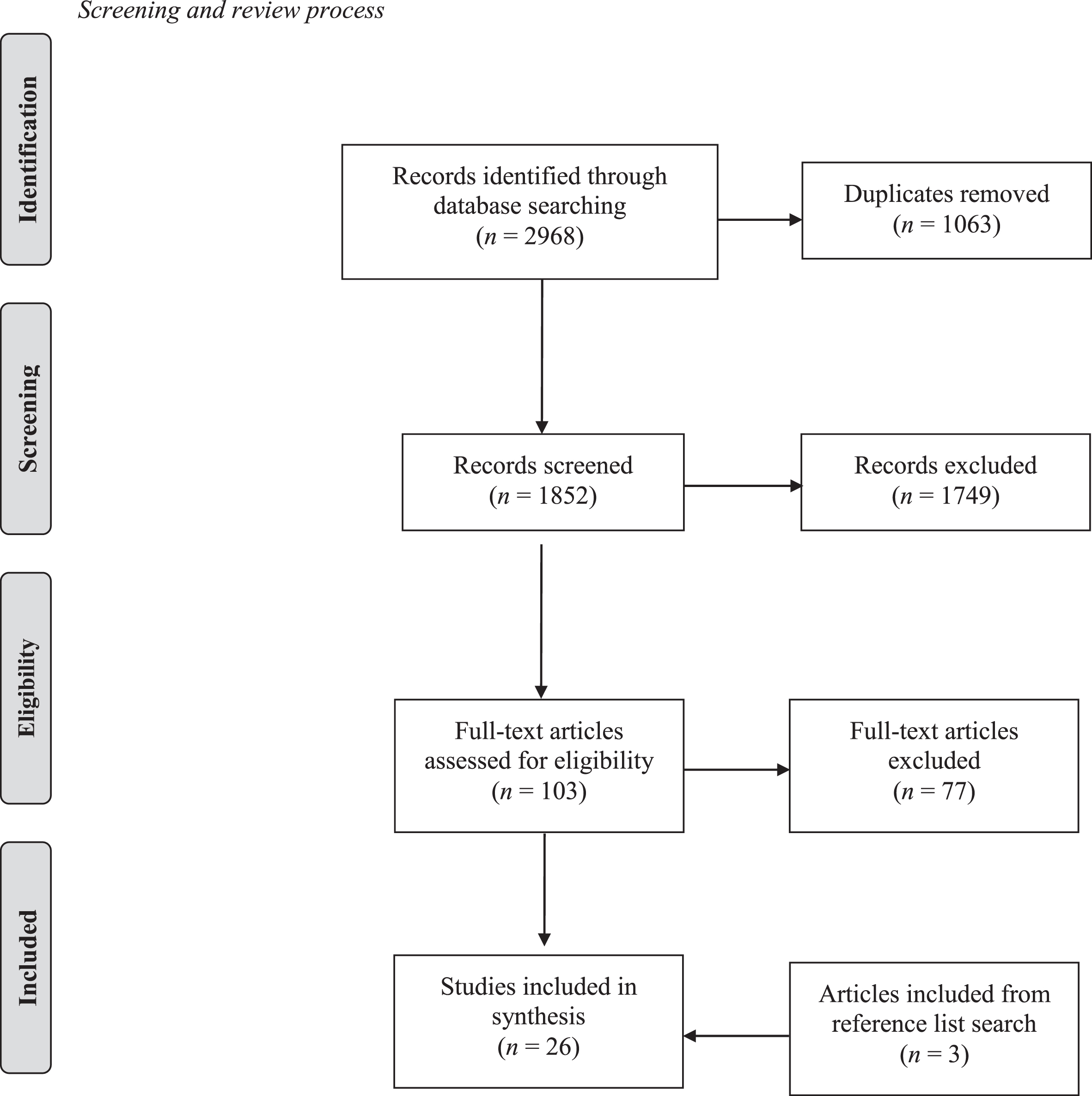
Screening and review process.
This scoping review resulted in a final sample of 26 empirical studies identified for inclusion based on the aforementioned research questions and criteria. Although gray literature was also systematically searched, after analysis of the retrieved documents was conducted, none of these reports, briefs, and white papers met inclusion criteria or related to the specific research questions. Each of the studies in-cluded in the review are summarized in Table 2 with annotated analysis of the population, research design, intervention, components, and outcomes for each study. Of the included studies, 19 focused on macro cost-benefit analysis of employment services for individuals with IDD, whereas 7 used a microanalytic approach. A majority of included research examined the cost-benefit of studies more generally in terms of the overall cost of services or duration in relation to common employment outcomes such as earning, hours, or securing a job (n = 20). However, several studies analyzed cost-benefit from a more specific stakeholder perspective from the standpoint of the job seeker (n = 10), taxpayer (n = 4), and vocational rehabilitation provider (n = 1). Calculation of cost-benefit was conducted using a range of outcome variables across studies including wages (n = 17), hours (n = 13), reduction in public subsidies (n = 17), and job retention (n = 6). Studies included in the review compared service options based on a specific type of vocational service (n = 14), setting (i.e., supported employment v. sheltered workshop; n = 5), transition internship model (n = 3), state policy (n = 3), and age of initiation (n = 2).
Findings from studies evaluating the cost-benefit impact of employment services
Findings from studies evaluating the cost-benefit impact of employment services
Note. ind. = individuals; ASD = autism spectrum disorder; VA = Virginia; micro = micro-analysis of cost-benefit; macro = macro-analysis of cost- benefit; ESO = employment service organizations; LTESS = long-term employment support services; VR = vocational rehabilitation; TAY = transition-age youth (14- 21 years old); SDA = secondary data analysis; SW = sheltered workshops; RSA-911 = Rehabilitation Services Administration Case Service Report (RSA-911) dataset; CE = customized employment; PS + ASD = Project SEARCH with ASD Supports; PSE = postsecondary education; RCT = randomized controlled trial.
While the focus of the review included all IDD diagnoses, reviewed studies primarily focused spec-ifically on service outcomes for individuals with intellectual disability (n = 12) or autism spectrum disorder (ASD; n = 15). Overall, consistent types of demographic variables for participants was provided across studies. Commonly provided demographic information included age (n = 22), gender (n = 20), race and ethnicity (n = 19), additional disability information (e.g., secondary diagnosis, level of severity; n = 17); level of education (n = 4). Only a few studies reported no additional demographic information about participants beyond those used in the analysis (n = 4). Other reported background characteristics reported about participants included source of referral (e.g., Cimera & Cowan, 2009; Cimera et al., 2012), residential living arrangements (e.g., Cimera et al., 2018; Whittenburg et al., 2019), level of interfering behavior (Spreat et al., 2005).
Macro-economic studies included in the review revealed several important findings related to the provision of employment services to individuals with IDD. The first major finding is that supported employment proved to be more cost-beneficial than sheltered workshop services (Cimera, 2007; 2011; 2012). Furthermore, community-based services as a whole led to higher cost-effectiveness than sheltered workshops, specifically for individuals with ASD (Cimera & Burgess, 2011; Spreat et al., 2005). Additionally, not only is supported employment more cost-effective, but two studies indicated that training provided by sheltered workshops prior to CIE provided no cost-benefit (Cimera, 2011; 2012). In fact, individuals who had previously worked in sheltered workshops had worse employment outcomes than those who had no previous history of pre-tra-ining (Cimera, 2011; Cimera et al., 2012), thus soundly rejecting any possibility that sheltered workshops provide any pre-vocational benefit. In contrast, individuals who had previously received supported employment services and were placed in a new position were more cost-efficient than those who had no previous experience (Cimera, 2012). While supported employment was shown to be cost-effective across several studies, use of natural supports had no additional effect on cost-efficiency, underscoring the importance of well-trained employment specialists to the supported employment process (Cimera, 2001).
The second major finding from the macroeconomic literature relates to overall costs to serve individuals with IDD over time. Burgess and Cimera (2014) found that while wages earned by VR service recipients remained relatively flat over time, so did the costs to serve that group. Other literature pointed to an increase in cost-efficiency over time, finding that costs related to supported employment decreased over time (Cimera, 2007) and that this reduction in cost for supported employment was in contrast to static costs for sheltered workshops (Cimera, 2008).
Other emergent themes from the literature related to a diagnosis-specific focus of studies. Several studies reported findings specific to individuals with ASD (n = 12). Since 2000, the number of individuals with ASD receiving VR services increased subs-tantially—doubling between 2002 and 2006—and becoming employed at the third highest rate of any disability category by the end of the decade (Cimera & Cowan, 2009). However, despite these gains in overall rates of employment, individuals with ASD continued to earn less and work fewer hours than their peers with other types of disabilities (Cimera & Cowan, 2009). Furthermore, these wages and hours did not increase over time (Burgess & Cimera, 2014), even as the cost of VR services for those with ASD declined initially (Cimera & Cowan, 2009) and then remained steady (Burgess & Cimera, 2014).
Despite this overall lack of progress over the last two decades for individuals with ASD in terms of wages and hours, specific findings related to pathways to improved outcomes were identified. Provision of transition services for youth with ASD beginning at a younger age showed higher levels of cost-effectiveness (Cimera et al., 2013; 2014). Likewise, youth with ASD who received higher levels of education, including participation in postsecondary education were more cost-effective from a worker perspective and more cost-efficient from a taxpayer perspective in their earnings relative to VR service receipt (Whittenburg et al., 2019). This pattern of cost-effectiveness and cost-efficiency of postsecondary education was also consistent for individuals with ID.
Overall, macro-analytic findings clearly indicated that supported employment was more cost-beneficial than sheltered workshop services (Cimera, 2007; 2011; 2012), and that the cost-efficiency of supported employment increased over time (Burgess & Cimera, 2014; Cimera, 2007; 2008). Additionally, studies reviewed pointed to differential outcomes based on disability diagnosis—those with autism earned less than comparison groups. Finally, promising pathways to greater cost-efficiency were indicated based on earlier receipt of transition services and higher levels of post-secondary education (Cimera et al., 2014; 2013; Whittenburg et al., 2019)
Micro-analytic findings
Findings from micro-analytic research provided more granular recommendations based on the specificity of services and their context. Overall, these findings pointed to the microeconomic effectiveness of individualized approaches to CIE like Project SEARCH+ASD Supports (PS+ASD) for transition age youth (Wehman et al., 2014; 2016; 2017; 2019) and supported and customized employment with long-term supports provided for working age adults (Brooke et al., 2018; Schaller & Yang, 2005). PS+ ASD studies presented a high level of evidence (using randomized control trial designs) to show efficacy of a specific intervention model for transition age youth based around internship rotations in community-integrated business settings (Wehman et al., 2014; 2016; 2017; 2019).
The most prominent emergent theme from mi-cro-analytic findings was that PS+ASD led to significantly improved outcomes for participants with ASD in terms of job placement, wages, and hours (Wehman et al., 2014; 2016; 2017; 2019). The PS+ASD intervention consists of embedded internship supervised by trained employment specialists (ES) employing ABA techniques to promote CIE in transition age youth. PS+ASD studies resulted in high levels of en-gagement in CIE with 73.4%of the treatment group (compared with 17%of the control group) gaining CIE, with a mean hourly wage of $9.61.
The second major finding from the micro-analytic research was that those vocational services and interventions that directly engaged with individuals in community integrated settings—and continued that support through stabilization—led to more cost-ben-eficial outcomes. Schaller and Yang (2005) found that both supported and customized employment led to VR closures in more than half of the sampled cases. Whereas supported employment resulted in a higher rate of closures than customized employment, customized employment resulted in higher wages and more hours in those who successfully secured emp-loyment (Schaller & Yang, 2005). McLaren and coll-eagues (2017) added evidence supporting the in-dividual placement model specifically, showing an association with increased wages, hours, rates of CIE, connection with vocational and mental health prov-iders, and independence. Finally, Brooke and colleagues (2018) found that providing long-term supports through employment specialists to employees with ASD led to long-term job stabilization, thus reducing the need for costly re-placement of emp-loyees.
Overall, the research analyzed regarding the cost, duration, and intensity of VR-funded services pointed to several key service types and patterns shown to lead to improved outcomes. These findings from the micro-analytic research underscore the importance of community integrated services to cost-benefit outcomes, both for transition-age youth (e.g., Wehman et al., 2019) and adults (McLaren et al., 2017). Supported employment was found to be a reliable means of accomplishing stable CIE for individuals across studies (e.g., Brooke et al., 2018; Schaller & Yang, 2005). Another important factor identified within the reviewed research is the provision of individualized supports based on evidence-based practice such as those provided within the PS + ASD framework (Wehman et al., 2014; 2016; 2017; 2019). Micro-analytic results also endorse the provision of long-term supports when required by individuals to sustain employment and job stability (Brooke et al., 2018). As a whole, micro-analytic research in this area provides support for individualized, community-integrated, and evidence-based approaches (e.g., supported employment; PS + ASD) to securing and maintaining CIE for individuals with IDD.
Discussion
The purpose of this scoping review was to examine how cost-benefit analyses have been applied in the research literature to inform the employment of individuals with IDD. The findings of this review provide several key insights into the cost-benefit of services and outcomes. Overall, the primary implication of this review is somewhat simple—employment service models that are integrated in the community provide greater cost-benefit than those which do not (e.g., Spreat et al., 2005). This primary finding holds true from both the worker perspective (e.g., Cimera, 2010b) and the taxpayer perspective (e.g., Cimera et al., 2018). In other words, workers benefit from approaches that engage them directly in real jobs like supported and customized employment compared to contrived pre-training settings (Cimera et al., 2012). Additionally, this review also revealed that integrated services aimed directly at achieving CIE are more cost-efficient in terms of public investment from a taxpayer perspective (Cimera et al., 2018). This finding demonstrating the cost-benefit of integrated employment models comports with Cimera’s (2000) previous review of the research literature which called for a revitalization of supported employment as a primary means of engaging individuals with IDD in CIE.
Conversely, it should also be noted that the findings of this review showed no tangible benefit for sheltered workshops, with all evidence pointing to them being less cost-effective than supported employment (Cimera et al., 2012). Not only were sheltered workshops not cost-effective in comparison to supported and customized employment, research showed that those with previous sheltered workshop experience did no better than their peers who were engaged directly in supported employment; in fact, those with previous history of sheltered workshops were less cost-efficient (Cimera, 2011).
Overall, these main findings strongly confirm previous research showing clear benefit for supported employment and none for sheltered workshops (Cimera, 2000). Taken into context, given the diff-erence in the purposes of these two approaches, it is unsurprising to find that supported employment was shown to be increasingly cost-beneficial over time. Supported employment reflects a frontloaded cost of intensive services at the initial stages of job development, job seeking, and on-the-job training that unwind over time the longer the individual stays employed. As individuals are sustained in CIE, these costs are drastically reduced over time, even in situations where an individual decides to change jobs (Cimera, 2012). Conversely, sheltered workshops represent a constant and unchanging daily cost (Cimera, 2007b), both in terms of tax dollars and wasted human potential as a result of no meaningful expectations for real work through CIE.
Limitations of reviewed studies
Although the reviewed research provides many important insights into the cost-benefit of various vocational services for those with IDD, there are several key limitations of the reviewed studies that should be noted. First, a majority of studies used a secondary analysis of data from the Rehabilitation Services Administration Case Service Report (RSA-911) dataset. Although RSA-911 is composed of VR administrative data, this data may exclude other non-VR employment services and outcomes that may be relevant in evaluating the overall cost-benefit for individuals with IDD. Additionally, the majority of studies included in this review did not employ any type of experimental randomization or statistical control of intervention and comparison groups. Most studies used descriptive analysis overall; thus it is difficult to infer from the research included in this review how this cost-benefit may affect various demographic groups which historically have received poorer outcomes and service patterns (Eilenberg et al., 2019; Sung et al., 2015; Thoma et al., 2016). Finally, few included studies examined longitudinal data points beyond initial engagement in employment. Those that did examine long-term supports found that the provision of long-term support services led to positive employment outcomes (Brooke et al., 2018), thus meriting further investigation.
Implications for research
As a result of these findings and limitations, there is a clear need for more robust research designs that more comprehensively investigate how employment service patterns are not only working for—but also failing—job seekers with IDD. In order to create meaning to the field, research must not only describe what is being done for the 20%, but also what remains to be fulfilled for the 80%. Most significantly, while research exists showing pathways to CIE for individuals with IDD, there are glaring questions about how those pathways operate in practical terms. For example, are those pathways equally open and accessible to all individuals who seek them? What barriers and facilitators exist that may impact individuals as they seek their preferred outcomes?
In order to better understand what pathways and approaches may serve as cost-efficient means of securing preferred outcomes, there is a need to break open the ‘black box’ of VR services and investigate which pieces and parts are essential to achieving those outcomes which are still out of reach for so many individuals with IDD. In order to accomplish this, more granular component analysis of VR service patterns is needed, both in terms of researching what is working as well as what is not—not only for individuals with IDD overall but also within various demographic groups that may experience systemic barriers to employment. Finally, more methodologically rigorous research designs are needed using experimental or statistical control through participant control matching to more rigorously evaluate findings presented in this review.
Implications for practice
Findings of this review point to several important implications for practice as well. As with those discussed in previous sections, the foremost recomm-endation for practice should be to engage individuals with IDD in integrated and individualized vocational services that directly promote their engagement in CIE. Additionally, this review emphasized the impo-rtance of research-based approaches which incorporated job coaching, such as supported and customized employment. Overall, the findings of our review recommend the use of highly-trained ES who are able to implement research-based approaches to employment for individuals with IDD (i.e., supported and customized employment) in integrated employment settings. While the research overwhelmingly showed high levels of cost-effectiveness for use of supported and customized employment, individual placement in CIE led to even higher levels of cost-benefit.
Apart from these more global recommendations, there are several specific recommendations that emerge from the research. As mentioned previously, sheltered workshops show no evidence of cost-benefit compared to other alternatives in promoting CIE. As a result, employment service organizations should shift service models by retraining staff to provide integrated approaches such as supported and customized employment. Those employment service practitioners should also be mindful of findings recommending the cost-effectiveness of long-term supports to stabilize employees and increase prospects for expanded roles and promotion.
Implications for policy
This review has a clear policy mandate—continue and expand legislative commitment to CIE and str-engthen investment in specific policies that promote CIE, while also phasing out those services that do not provide cost-effective pathways to emp-loyment—namely sheltered workshops and other segregated vocational service providers (e.g., adult day programs). This policy goal of CIE was clearly established through WIOA (2014), in alignment with previous legislative and judicial decisions (Olmstead v. L.C., 1999). However, given the disparate nature of policy informing the employment of individuals with IDD, significant and substantial alignment of policy is needed to accomplish these goals.
First, standardized measures of cost-benefit of employment services and outcomes should be established across both governmental and service agencies such as GAO, Department of Labor (DOL), and RSA and advocacy groups such as American Association on Intellectual and Developmental (AAIDD), TASH (disability advocacy organization), Association of People Supporting Employment First (APSE). Future federal and state policy related employment even indirectly (e.g., reauthorization of the Individuals with Disabilities Act, reform of Medicaid Home and Community based waivers) must be aligned with a prioritization of CIE. For example, WIOA’s Pre-ETS provisions have incentivized VR agencies to expand collaboration with school districts and engaging more directly with transition-age youth. In order to fully realize the potential of these initiatives, K-12 policy must be aligned with these desired outcomes and incentivized to participate in these collaborative partnerships (Taylor et al., 2019).
Conclusion
Despite calls for attention and change in the research literature for four decades, there remains a critical need to close the gap as youth with IDD transition from school to adulthood and ensure that all are set on a seamless trajectory to CIE. Although a reform of this magnitude may come at considerable cost, it is important to evaluate continued inaction in contrast to the invisible cost of lost talent if another generation of individuals with IDD continues to receive the same outcomes. After all, if the purpose of our educational investment is to develop capacity of people to contribute to society and our collective good, we must pay more attention to dramatic changes that may be needed to address a system currently leading to over 80%of individuals with IDD absent from the world of real work entirely. This review has summarized some of the findings from the research literature that can guide the process of addressing this issue in research, policy, and practice though much work still remains.
Conflict of interest
None to report.
Funding
This paper is funded by the National Institute on Disability, Independent Living, and Rehabilitation Research (NIDILRR grant number # 90RTEM0003). NIDILRR is a Center within the Administration for Community Living (ACL), Department of Health and Human Services (HHS). Virginia Commonwealth University, Rehabilitation Research and Training Center (VCU-RRTC) an equal opportunity/affirmative action institution providing access to education and employment without regard to age, race, color, national origin, gender, religion, sexual orientation, veteran’s status, political affiliation, or disability.