




Abstract
BACKGROUND:
The global COVID-19 pandemic has forced people to obtain health products and services from home. Similar to other e-commerce, medicines are bought online and delivered using a courier service.
OBJECTIVE:
By being fully concerned to patient safety, this study aims to determine development strategies to increase intention in purchasing prescription drugs through e-pharmacy.
METHODS:
Two stages of measurement are employed in this study, namely confirmatory factor analyis using PLS-SEM and pairwise comparison using AHP method. To discover consumer perception in using e-pharmacy, the basic model of Theory of Planned Behavior (TPB) is employed with several extensions.
RESULTS:
The results of PLS-SEM express that Trust has a major role as an intervening variable to enhance the indirect effect of Subjective Norms and Perceived Values on Purchase Intention. In general, PLS-SEM structural model is declared “fit” (GFI = 0.93 ≥ 0.90; RMSEA = 0.045 ≤ 0.08; SRMR = 0.033 ≤ 0.05). Measurement model test proves that all selected indicators are valid to represent their related constructs (Loading Factor ≥ 0.50), and all selected constructs are reliable to build the whole path model (CR ≥ 0.7; AVE ≥ 05). Meanwhile, the results of AHP indicate that strengthening government policies and regulations is prioritized to increase consumer intention of purchasing prescription drugs through e-pharmacy, followed by protection of user confidential data in the second place. Those two eigenvectors are 0.236 and 0.185 respectively.
CONCLUSION:
Future research is suggested to add perceived risk as latent variable in the study of consumer behavior for any high-risk products.
Introduction
The invention of the internet and websites has had a significant impact on changing the way companies do business and market their products, as well as how consumers behave to meet various needs in everyday life. Currently consumers can shop through many channels, called omnichannel [1]. The phenomenon of electronic transactions has occurred in all industrial sectors, including health. Greater awareness for healthy living, scarcity of public health resources, and the emergence of COVID-19 have accelerated changes in the health industry ecosystem filled with telemedicine, big data, blockchain, artificial intelligence, and virtual health care services [2]. Google, Temasek, and Bain & Co. [3] stated that COVID-19 requires consumers to seek health services via the internet from home. This has encouraged the emergence of many new business players, one of which is e-pharmacy services to provide medicines.
In Indonesia, distribution of medicines via online channels during COVID-19 pandemic has received official permission from the Food and Drug Supervisory Agency (BPOM Regulation No. 8/2020). These regulations are used as a fundamental reference by e-pharmacy operators to run their business. E-pharmacy operators who do not have physical pharmacy facilities, or only act as providers of digital platforms or marketplaces, shall establish partnerships with community pharmacies that will deliver medicines to consumers. These digital-based pharmaceutical services have included the power of e-commerce in the context of communication models, strategies, and business practices to facilitate information exchange and transactions between companies and individuals [4].
Currently, there are 12 e-pharmacy operators listed in the Indonesian government database systems, e.g. Halodoc (www.halodoc.com), Alodokter (www.alodokter.com/), KlikDokter (www.klikdokter.com/), and GoApotik (www.goapotik.com). Those e-pharmacy operators own legal permission to sell both over-the-counter drugs (green and blue mark) and prescription drugs (red mark). In the presence of digital pharmacy service, the government is targeting an even drugs distribution especially to remote areas in Indonesia. In this case, the government is responsible for establishing policies, providing infrastructure facilitation, carrying out promotional and educational, and supervisory functions. To make the government’s plan a success, people in small cities should also be encouraged to learn how to use the internet as well as its features. Meanwhile, study in consumer behavior is important to boost transactions through e-pharmacy, especially by people living in big cities. With no similarities found in previous research, this study aims to analyze consumer perceptions of electronic transactions of prescription drugs through e-pharmacies and determine development strategies to increase consumer purchase intention.
Similar to a traditional pharmacy, an e-pharmacy is required to employ legal pharmacists with a Pharmacist Registration Certificate and Practice License. They must have the ability to suggest drug consumption according to the patient’s clinical condition. For some people who want to maintain their privacy, virtual consultations can be carried out without showing the patient’s face [5]. From a financing point of view, e-pharmacy also has the potential to reduce consumer service costs, where one pharmacist can serve many patients spread across multiple locations. In addition, patients can save money and time to reach traditional pharmacy locations, especially for the elderly and patients with disabilities [6]. Reductions in financing allow drugs to be sold at lower prices through e-pharmacy [5]. Gupta [7], Roshini [8] and Jain [9] conducted surveys in India and revealed that the majority of the population uses e-pharmacy for privacy, ease of access, low cost, and convenience with home delivery facilities.
Although e-pharmacy can give hope for better health services, the actual implementation of e-pharmacy still creates some conflicts. Before the internet developed rapidly, medicine-related information could only be accessed through health professionals, such as doctors and pharmacists. The free access to health information has encouraged some patients to take self-medication, obtain the medicines they need via the internet, without prior consultation and physical examination from an authorized doctor. Such an action is certainly dangerous if the information obtained is incorrect or the medicine is not consumed according to the patient’s clinical needs, both the type and dosage [5].
Bakar et al. [10] stated that ineffective regulation is one of the biggest problems of e-pharmacy practices, where violations of laws and regulations tend to lead to illegal practices [9]. E-pharmacy services are fully facilitated by computer programs, built in the form of websites or applications that can be freely designed and managed according to the developer’s needs. Existing regulations are only made as general provisions instead of technical guidelines. National authorities will likely be difficult to track down and take enforcement action as websites can be taken down at short notice [11].
The use of digital health services continues to increase every year. Based on the Statista report [12], the value of global medicine sales through e-pharmacy is expected to reach $27.6 billion in 2022, and will increase to $52.33 billion in 2027 with a CAGR of 13.65%. With reference to global trends, pharmaceutical practice in Indonesia will also increasingly move towards digitalization. This research adopts the Theory of Planned Behavior approach [13,14] to analyze consumer purchase intention of prescription drugs through e-pharmacy in Indonesia. In total, seven latent variables are selected to be arranged in a path diagram, i.e. subjective norm, attitude, perceived behavioral control, purchase intention, and behavioral intention as five basic variables of TPB, added with trust and perceived value as the extended variables.
Prescription drugs are a type of risk-based product, where consumers will have higher concern and caution compared to purchasing common e-commerce products without risk. Adequate consumer trust and perceived value can reduce perceived risk in purchasing risk-based products. The higher the perceived value and trust in e-pharmaceuticals, the higher the consumer’s intention to purchase, and vice versa [15]. Trust is personal, directly related to, and influenced by culture and environmental factors [16]. Kim and Peterson [17] state that trust is a mediator that plays an important role in converting value in a goods or services to generate intention to use by consumers. In this extended TPB model, trust is directly influenced by subjective norms and perceived values, and trust is used as an antecedent of attitudes and perceived consumer behavior control when purchasing prescription drugs through e-pharmacy. Two stages of measurement are employed in this study, i.e. confirmatory factor analysis using PLS-SEM to determine recursive relationship between latent variables, and pairwise comparison using AHP method to formulate strategies in increasing consumer intention to purchase prescription drugs through e-pharmacy. The theory of dynamic capability is selected to conceptualize the AHP hierarchical chart. Wang and Ahmed [18] explained that dynamic capability, consisting of adaptive, absorptive, and innovative capability components, is essential for a company or organization to adapt to a rapidly changing business environment. This concept can be applied to fast-developing digital health technology around the world.
E-pharmacy is a new phenomenon in Indonesia, where regulations for implementing electronic-based pharmaceutical systems were promulgated in Indonesia in 2019. As a novel study in pharmacy realm, these research findings are expected to contribute in the development of health science and technology, as well as to become practical guidelines for stake holders and practitioners to expand the e-pharmacy industry efficiently and more responsibly towards consumer safety.
Materials and methods
Conceptual foundation
The announcement of COVID-19 as a pandemic in Indonesia in March 2020 had an impact on changes in regulations for administering pharmaceutical services. Similar to other e-commerce products, currently medicines are also available online, including prescription drugs. The permit for electronic transactions for the purpose of drug distribution is confirmed through the Regulation of the Food and Drug Supervisory Agency No. 8/2020. To increase sales through e-pharmacy, consumers must first have intention to shift from the habit of purchasing medicines from a conventional to electronic pharmacy. One explanatory model that is widely used to predict digital consumer behavior is Theory of Planned Behavior (TPB) [14]. According to this theory, intention is a conscious or unconscious decision to do something in a certain way as a result of a stimulus to achieve a goal. TPB itself is a refinement of Theory of Reasoned Action or TRA. According to TRA, desire to perform certain actions is motivated by two factors, namely subjective norms and attitudes toward behavior [19]. Several years later, Ajzen [14] added one factor, namely perceived behavioral control or PBC. The existence of the PBC has created TPB as a development of TRA. In the context of digital trade, attitude refers to the general consumer’s feelings of like or dislike towards online shopping. Subjective norms refer to consumer perceptions about the use of online shopping based on the opinions of reference groups, such as family, friends, and experts, directly via word of mouth or indirectly through mass media. Perceived behavioral control describes consumer perceptions of the availability of knowledge, resources, and opportunities needed to transact electronically [20]. Arekar et al. [21] state that in predicting models of medicine purchasing behavior through e-pharmacy, trust and perceived usefulness are two independent constructs that must exist. Based on TAM [22], perceived usefulness describes the value of an offer, such as personal value and social value. Following this suggestion, this research added those two constructs. The complete PLS-SEM structural model is shown in Fig. 1.
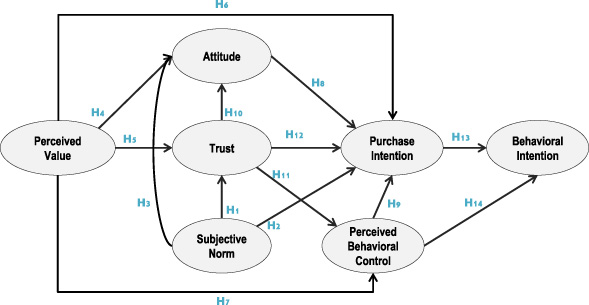
PLS-SEM structural model (main costructs).
In this study, the concept of decomposition of latent variables is employed to determine indicators or manifest variables. Attitude is decomposed into attitudinal belief, complexity, and compatibility as indicators [23–26]. Subjective norm is decomposed into interpersonal influences transmitted through words of mouth from family, friends, colleagues, or superiors; and external factors attained from mass media reports, expert opinions, and other non-personal information [26,27]. Perceived behavioral control is decomposed into self-efficacy and facilitating conditions [26,28,29]. Perceived value is decomposed into utilitarian values and hedonic values [30–33]. Hedonic values are more subjective than utilitarian values, and focus more on feeling happy or excited than real benefits [34]. Trust is decomposed into quality, privacy, and security [35–37]. Quality deficits, user data leaks, and unsecured payments will cause a significant impact on the loss of customer trust [38,39]. Purchase intention is only determined by transactional intention [40] as well as behavioral intention is only determined by realization time [14].
Podnar and Javernik [41] and Wang et al. [42] found that positive suggestions from family, close relative, and the influence of social media had a significant effect on creating attitudes to increase the probability of purchasing certain products. This also applies similarly to the opposite condition, where (negative) complaints about the product will affect attitudes that indicate a decrease in purchase intention. Utami [43] found that subjective norms are covariates of all cultural variables that play an important role in the formation of beliefs, both individual and communal.
Subjective norm has a direct positive effect on trust.
Subjective norm has a direct positive effect on purchase intention.
Subjective norm has a direct positive effect on attitude.
Subjective norm has a positive indirect effect on trust-mediated purchase intention.
Subjective norm has a positive indirect effect on purchase intention mediated by attitude.
Khoi et al. [44] proved that perceived values (utilitarian, hedonic, and social values) have an effect on increasing consumer attitudes and intentions to adopt mobile commerce in Vietnam as a developing country. The higher the consumer’s perception of product value, service value, employee value, and image value, the higher the trust and that will lead to an increase in purchase intention [45]. Ladden et al. [46] argued that the perceived value a person feels in his social and cultural environment as a whole will define and determine his personal values and abilities.
Perceived value has a direct positive effect on attitude.
Perceived value has a positive direct effect on trust.
Perceived value has a positive direct effect on purchase intention.
Perceived value has a positive direct effect on perceived behavioral control.
Perceived value has a positive indirect effect on purchase intention mediated by trust.
Perceived value has a positive indirect effect on purchase intention mediated by attitude.
Eko et al. [47] examined the relationship between trust and attitudes toward online transactions. This study shows that distrust of internet-based platforms still hinders their use for any e-commerce transactions. Meanwhile, Varshney [48] stated that trust can also encourage someone to utilize one’s resources, for example self-efficacy, to reach certain purposes.
Trust has a direct positive effect on attitude.
Trust has a direct positive effect on perceived behavioral control.
Trust has a direct positive effect on purchase intention.
According to Ajzen [49], intention is an indicator of the extent to which a person is willing to perform a certain behavior. Lack of online purchase intention has been identified as one of the initial obstacles to the development of online shopping behavior [50]. According to previous research conducted by Mohammed and Ferraris [51], consumer attitudes substantially influence the intention to shop online through social media. Attitude is an evaluation of various choices of actions that have an impact on the emergence of behavioral intention [52]. Besides attitude, Behjati et al. [53] also found a significant direct effect of perceived behavioral control on purchase intention of online products in their study involving 147 respondents. Behavioral control is a condition in which a person believes how easy or difficult an action is to perform under his management control. When people perceive that shopping online is an inconvenient thing to do, behavioral control performs which makes consumers have no intention of using that services, and vice versa [54].
Attitude has a positive direct effect on purchase intention.
Perceived behavioral control has a direct positive effect on purchase intention.
Purchase intention has a positive direct effect on behavioral intention.
Perceived behavioral control has a direct positive effect on behavioral intention.
This study was designed by combining two stages of research, namely confirmatory factor analysis (CFA) to analyze the causal relationship between variables and pairwise comparison for the decision making process. Both stages require primary data collection which is drawn using an electronic questionnaire. In the first stage, the e-pharmacy consumer behavior questionnaire is distributed via GoogleForm. According to the Indonesian Central Bureau of Statistics [55], the percentage of households that have accessed the internet in the last three months with the aim of purchasing goods or services in urban and rural areas collectively is 22.35%. By using the sample size formula for the infinite population (CI = 95%), the minimum required sample size is 267 respondents. In fact, this study managed to collect 364 specific respondents (purposive sampling) for the first stage of analysis.
Screening criteria that must be met by respondents, i.e. age between 16–64 y.o., conduct online transactions at least once in the last month, and never use e-pharmacy services to buy prescription drugs. The last requirement is included considering that this study still focuses on purchase intention instead of repurchasing prescription drugs through e-pharmacy. Questionnaires were distributed to respondents in several major cities in Indonesia, e.g. Jakarta, Bandung, Yogyakarta, Semarang, Surabaya, Medan, Palembang, Denpasar, etc., where there are e-pharmacy services in those locations. Socio-demographic profile of the respondents is shown in Table 1.
Socio-demographic profiles of respondents
Socio-demographic profiles of respondents
In the second stage, a focus group discussion through the Zoom application is conducted to guide expert respondents to fill in the hierarchical questionnaire for a decision making process in developing strategies to increase purchase intention of prescribing drugs through e-pharmacy. The hierarchical diagram is constructed by considering the results obtained from the first stage analysis as well as references from some previous studies. Ten experts in the pharmaceutical field: two regulators, one producer, one distributor, three e-pharmacy operators, two academics, and one chairman of a pharmaceutical association are involved in completing this hierarchical questionnaire.
This study employs two types of questionnaire. The first one is constructed to analyse consumer perception on purchasing prescription drugs through e-pharmacy. Four-points of Likert scale is employed, ranged from 1 = stongly disagree to 4 = strongly agree (2 = disagree and 3 = agree). Seven groups of question are designed to represent all fisrt order latent variables on the first order used in this research, i.e. NRM (subjective norm), VAL (perceived value), ATT (attitude), TRU (trust), PBC (perceived behavioral control), PUR (purchase intention), and BHV (behavioral intention). Each latent variable in first order is further decomposed into its indicators. NRM is decomposed into INTL (interpersonal influence) and EXTL (external influence); VAL into UTL (utilitarian value) and HED (hedonic value); ATT into ATBL (attitudinal belief), CLXL (complexity), and CMPL (compatibility); TRU into QLTL (quality), PVCL (privacy), and SCRL (security); PBC into EFFL (self-efficacy) and FACL (facilitating condition). PUR and BHV have no decomposed factor, thus indicator(s) of each latent variable represents itself (PURL and BHVL). The operational definition of each latent variable and its associated decomposed indicators are shown in Table 2.
Research operational definition
To conduct a decision making process, a hierarchical questionnaire is arranged in a set of pairwise comparison matrices. Each element in an upper level is used as a basis to compare the elements one level below it. A scale of numbers is used to compare the importance of one element against its pair, ranging from 1 = equally important to 9 = extreme importance (2 = weak or slight; 3 = moderate importance; 4 = moderate plus; 5 = strong importance; 6 = strong plus; 7 = very strong or demonstrated importance; 8 = very–very strong). Pairwise comparison questionnaire is constructed using hierarchical structures shown in the Table 3. It adopts the concept of dynamic capabilities as one of the attributes of organizational capabilities [56–58].
According to Wang and Ahmed [18], dynamic capability can be decomposed into three constituents, i.e. adaptive, absorptive, and innovative capability. Adaptive capability is defined as the company’s ability to recognize and take advantage of existing market opportunities [57]. In a turbulent environment, companies will operate competitively depending on a more adaptive strategy to achieve the best fit between company and new business environment [59]. Absorptive capability is the company’s ability to recognize new value, absorb external information, then assimilate and adopt it for commercial purposes [60]. Innovative capability is defined as a company’s ability to develop new products and/or markets with innovative processes and behaviors [18]. E-pharmacy is a new phenomenon in Indonesia. Thus, innovative capability was chosen as the main concept in the construction of the AHP diagram. Wang and Ahmed [61] identified five areas of corporate innovative capability, namely product innovation, process innovation, behavioral innovation, market innovation, and strategic innovation.
Hierarchical structures of pairwise comparison questionnaire
In general, data analysis techniques are divided into four parts, including descriptive test; multicollinearity test; PLS-SEM; and AHP modelling. Descriptive test carried out in this study include mean, standard deviation, and judgement of agreement based on score range criteria. The data used is collected from a Likert scale questionnaire to measure purchase intention of prescription drugs through e-pharmacy. Multicollinearity test is performed to find out whether there are two or more explanatory variables which have a strong to perfect relationship that indicates multicollinearity issue [62]. PLS-SEM (partial least square structural equation modeling) is used to estimate causal relationship between variables in confirmatory settings. Linear Structural Relationship (LISREL) is selected as the tool to do statistical works. Since the data distribution is not normal, parameter values in PLS-SEM are estimated using the Maximum Likelihood method. Level of acceptance of fit indices is referred to judge overall measure of model fit for PLS-SEM [63,64]. This evaluation involves some types of fit measures, i.e. absolutely fit indices to determine which proposed model that has best fit for all available variables according to some prior studies [65]; incremental fit indices to evaluate the incremental, comparative, or relative model fitness compared to the null model [66]; and parsimonious fit indices to penalize complex or less parsimonious model and favors the simpler one [67]. Indicator reliability, internal consistency reliability, and convergent validity are used to test measurement model or reflective outer model fit evaluation [68,69]. Lastly, path coefficients or critical t-values are used to test structural model or inner model fit evaluation [69,70]. Hypothesis testing is judged based on path coefficient (𝛾 or 𝛽) and p-value. In the condition of 𝛾 and/or 𝛽 > 0 and p-value ≤ 0.05, hypothesis (alternative) is accepted or null-hypothesis is rejected [71].
In the second stage, data of comparison pairwise collected from experts in pharmacy realm is analysed using analytics hierarchy process (AHP) technique and Expert Choice as the tool to summarize the most prioritized alternative solution to work and focus on. AHP [72] is widely used for decision making by combining personal judgments and values into one logical way. AHP is able to break down complex problems into a multi-level or hierarchial structure, from top to bottom sequentially, namely goals, factors, criteria, and alternatives. This method offers assistance to solve promblems in a more understandable and systematic way [73]. AHP provides measurement scales for selecting alternatives, with logical consistency in judgment, to arrange priorities. Value of consistency ratio (CR) shall be smaller or equal to 10%. It indicates that inconsistency is acceptable. If CR > 10%, subjective judgement shall be revised [72].
This section consists of two parts. First, DEA method will result efficiency score, both deterministic and bias-corrected, as well as the scale efficiency score of entire Perhutani’s pine chimcal factory. Second, AHP method will result prioritized dimension operational, obtained and calculated collectively from all consistent responses.
Descriptve statistics
Critera of agreement for each latent variable, shown in Table 4, is determined based on the criteria of score range. Sugiyono [74] formulates the score range as the difference between the maximum score and minimum score which is then divided by the number of criteria. This study uses a Likert scale 1 to 4 with four criteria, i.e. strongly disagree, disagree, agree, and strongly agree. Thus, the range of scores to be applied to the average score of each latent variable is grouped as follows: 1.00–1.75 strongly disagree; 1.76–2.50 disgree; 2.51–3.25 agree; and 3.26–4.00 strongly agree.
Descriptive statistics of research variables
Descriptive statistics of research variables
Note: UTLL = Utilitarian value; HEDL = Hedonic value; INTL = Interpersonal influence; EXTL = External influence; ATBL = Attitudinal belief; CLXL = Complexity; CMPL = Compatibility; QLTL = Quality; PVCL = Privacy; SCRL = Security; EFFL = Self-efficacy; FACL = Facilitating condition; PUR/PURL = Purchase intention; BHV/BHVL = Behavioral intention; VAL = Perceived value; NRM = Subjective norm; ATT = Attitude; TRU = Trust; PBC = Perceived behavioral control.
Table 5 displays indicators’ correlation coefficients in a matrix form. It shows this study has no multicolinearity issue. According to Kim [62], high degree of linear relationship between explanatory variables occur when coefficient of correlation is higher than 0.8. It indicates that multicollinearity does exist.
Correlation matrix of research indicators
Correlation matrix of research indicators
This section will be divided into three parts of analysis: (1) Measurement model or reflective outer model fit evaluation; (2) structural model or inner model fit evaluation; (3) whole model fit evaluation (Goodness of Fit). The structural model diagram with factor or outer loadings and path coefficients (inner model) is shown in Fig. 2 and the diagram of related t-value is shown in Fig. 3.
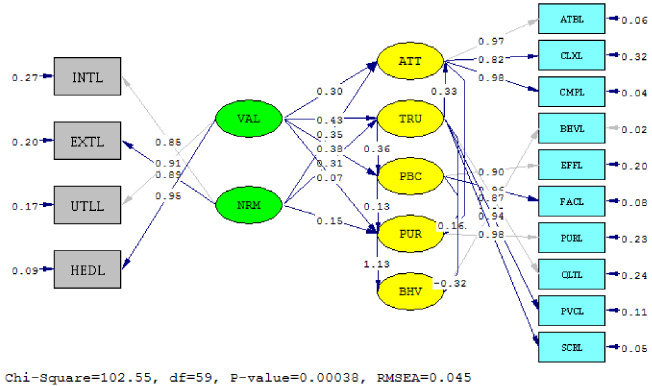
PLS-SEM research model with outer loadings and path coefficients (standardized solution).
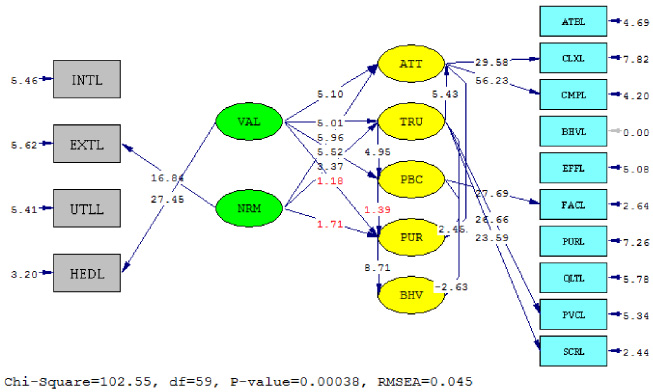
PLS-SEM research model with t-value.
Measurement model or reflective outer model is evaluated using some parameters, such as indicator reliability (outer loading), internal consistency reliability (Cronbach’s alpha), and convergent validity (averge variance extracted or AVE). According to Garson [68] and Hair et al. [75], outer loading (OL) represent the absolute contribution of indicator to its related latent variable. It is valid if outer loadings is greater than 0.6. Internal consistency reliability measures the degree to which the indicators or manifest variables load silmutaneously when the latent variables increase. It is valid if Cronbach’s alpha is greater than 0.6. Convergent validity indicates the degree indicators reflecting a certain construct (factor-loadings) relate to other indicators measuring same of different constructs (cross-loadings) in the same study. It is valid if AVE score is greater than 0.5 [76]. Referring to Fig. 2, Table 6 shows the results of the measurement model evaluation with those three parameters included.
Results of measurement model fit evaluation
Structural or inner models are evaluated to predict causality relationships between latent variables using estimated path coefficients [75]. Path coefficient will indicate magnitude of direct effect of a latent variable to be a cause on another latent variable. Path direction is determined based on some previous studies [68,70]. Its significance is determined by related t-value where 1.96 is used as critical value. Structural equations that explain the causal relationship between the variables in this study is shown in Table 7. According to PLS SEM research model, variables of NRM (subjective norm), VAL (perceived value), ATT (attitude), TRU (trust), and PBC (perceived behavioral control), directly lead to the formation of PUR (purchase intention). The significance of each effect between two variables, dependent and independent, is detrimined by t-value. Equation 4 indicates that only ATT (t-value = 4.55 > 1.96) dan TRU (t-value = 2.45 > 1.96) have significant effects on PUR. Variables of NRM, VAL, and PBC have no direct significant effect on PUR (t-value < 1.96).
Structural equation of pls-sem research model
Lastly on this section, Fit indices obtained from the LISREL Output, shown in Table 8, are used to evaluate how fit the PLS-SEM model is in this study. Chi-square, Goodness-of-Fit Index (GFI), Adjusted Goodness-of-Fit Index (AGFI), Root Mean Square Residual (RMR), Standardized Root Mean Square Residual (SRMSR), and Root Mean Square Error of Approximation (RMSEA) represent absolute fit measures. Normed Fit Index (NFI) and Comparative Fit Index (CFI) represent incremental fit measures. Parsimonious Goodness of Fit Index (PGFI) and Parsimonious Normed Fit Index (PNFI) represent parsimonious fit measures.
Fit indices output
According to Hooper et al. [77], the main criteria that must be met for the fit model is RMSEA. Meanwhile, Hu and Bentler [78] mentioned that SRMR determines whether the model has a good or marginal fit. Referring to LISREL fit indices output in Table 8, both RMSEA and SRMR are detected below its critical value. Hence, it can be concuded that PLS-SEM model proposed in this research has a good fit. The Chi-square value which is greater than the reference (Chi-square distribution table) at a certain degree of freedom, and the p-value that is smaller than 0.05, indicate that the data is not normally distributed. Consequently, Robust Maximum Likelihood option is selected to perform measurement analysis.
In general, hypothesis testing is used to analyze the effect of one or more independent variables on the dependent variable. The null hypothesis (H0) states that there is no effect between the research variables. Conversely, the alternative hypothesis (H1) states that there is an influence between the research variables, where the independent variable has a significant effect on the dependent variable, in a positive or negative (opposite) direction. This study uses a 95% confidence interval so that the threshold for accepting or rejecting the hypothesis is an absolute t-value = 1.96. If |t-value| > 1.96, then H0 can be rejected or H1 can be accepted [71,77]. Thus, the path coefficient can determine the magnitude and direction of the direct effect between variables. The hypothesis testing output for both direct and indirect effect of this study is shown in Table 9. To determine its significance, t-value of direct effect can be obtained in Fig. 3.
Output of hypothesis testing
Output of hypothesis testing
Several findings can be drawn from Table 9, i.e. (1) there are some hypotheses (H2, H6, and H9) which provide non-significant results, where p-value > 0.05 or |t-value| < 1.96. H2 indicates direct effect of NRM (subjectev norm) on PUR (purchase intention). H6 indicates direct effect of VAL (perceived value) on PUR. H9 indicates direct effect of PBC (perceived behavioral control) on PUR. H2 and H6 require intervening variables or mediators TRU (trust) and/or ATT (attitude) to cause a significant effect on PUR, evidenced by H15 and H16 for NRM, and also H17 and H18 for VAL; (2) all significant hypotheses for both direct and indirect effect show positive direction except for H14. The higher one’s PBC (perceived behavioral control) the lower BHV (behavioral intention) to purchase immediately; (3) as an intervening variable, ATT shows a greater effect on PUR in comparison with TRU on PUR. Thus, this research model is appropriate, in which NRM, VAL, and TRU act as independent variables or predictors of ATT to further influence PUR as the ultimate goal.
In this study, the AHP questionnaire is filled in by a total of 10 experts and academics in pharmaceutical realm. Focus group discussion (FGD) is chosen to equate respondents’ perceptions regarding the hierarchical questions. Facilitator will input the respondents’ answers into Expert Choice statistical application to ensure that all answers are consistent (inconsistency < 10%). If inconsistency is grater than 10%, respondents are asked to revise their answers until acceptable consistency limit is met.
Tables 10–12 show the synthesis of eigenvector (E.V.) from combined responses based on each hierarchial level, i.e. Factor, Criteria, and Alternative respectively. The main Goal, symbolized as G1, of hierarchial analysis is to determine strategy development to increase consumer intention of purchasing prescription drugs through e-pharmacy. At the Factor level, there are six factors compared by respondents in pairs (pairwise comparison). These factors include F1 Products and their Attributes; F2 Government Regulations; F3 Supply Center and Distribution Network; F4 Infrastructure and Technology Systems; F5 Information and Communication Media; and F6 Human Resource or Professionals. AHP output indicates that the most prioritized factor is F2 Government Regulations with an eigenvector of 0.359.
Combined eigenvector level factor based on goal
Combined eigenvector level factor based on goal
Combined eigenvector level criteria based on factor
Combined eigenvector at alternative level
At the Critera level, there are three criteria compared by respondents in pairs. These criteria include C1 Value Proposition; C2 Accessibility; and C3 Product and Service Safety. AHP output indicates that the most prioritized criterion is C3 Product and Service Safety with an eigenvector of 0.478.
Lastly, at the Alternative level, there are seven alternative solutions compared by respondents in pairs. These alterntives include A1 Interprofessional Integrative Collaboration; A2 Strengthening Government Policies and Regulations; A3 Guarantee of Product Availability and Quality; A4 Protection of User Confidential Data; A5 Improvement of User Interaction and Engagement; A6 After-sales Service, Feedback, and User Reviews; and A7 Human Resource Training and Development. AHP output indicates that the most prioritized alternative solution is A2 Strengthening Governance Policies and Regulations with an eigenvector of 0.236. Figure 4 shows the chart of combined eigenvector of alternative solution in ascending order, from the highest to the lowest value.
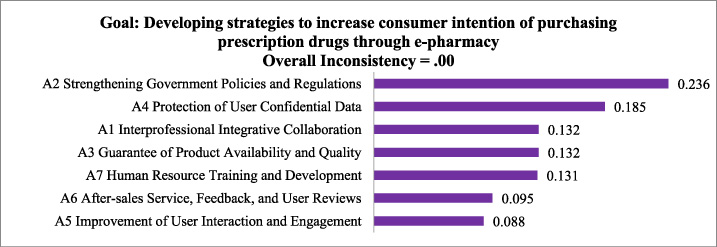
Chart of prioritized alternative solution using Expert ChoiceTM.
In the context of digital trade, the concept of push and pull factors can be adopted as a motivation or driving force of consumer intention to purchase online more frequently. Referring to the research theme, pull factor comes from the value proposition of e-pharmacy which may be considered more beneficial than conventional services. Meanwhile, push factor comes from customers themselves due to their need to purchase prescription drugs through e-pharmacy. This push factor can be intensified by the influence of close relatives (family and friends), as well as news or reviews from the mass media (social media), and a series of promotional and marketing activities.
Value proposition offered from the use of e-pharmacy services, both in terms of benefits (utilitarian value) and pleasure (hedonism value), is expressed as perceived value. Roshini et al. [8], Chordiya and Garge [79], and Jain et al. [9] stated several advantages of e-pharmacy based on these two categories. Utilitarian values include (1) easy access to medicines for patients who stay at home or disable to move; (2) availability of various pharmaceutical products with unlimited variations; (3) easy access to obtain medicine information; (4) there are many choices of medicine with similar quality at a lower cost; (5) more convenience; (6) twenty four hours access a day; (7) time saving; (8) cost savings; (9) guaranteed refund for non-conforming products; (10) fast distribution of medicine; and (12) delivery time and location according to customer request. E-pharmacy services enable suppliers to transact directly with customers, which will reduce the role of distributors and agents. Furthermore, shortening the supply chain is also effective to reduce total production costs [80]. The internet can facilitate faster and easier customer service, feedback, and claims directly to suppliers. Moreover, internet as a global medium can remove geographical barriers to communicate from different locations around the world.
Besides utilitarian value, there are alos several hedonism values offered by e-pharmacy, including (1) private, confidential, and free from shame; (2) the pleasure of getting more convenience, paying lower prices, saving time and effort; (3) new experiences in using virtual telemedicine. Hsieh and Tsao [81] mentioned that some people prefer to take risks and buy medicine online in anonymity rather than visiting their doctor for a legitimate prescription. Not only does the internet demonstrate the potential to save customers money, it can also save them the embarrassment of buying certain products at public pharmacies. Transactions via the internet allow individuals to avoid questions and comments from sellers or other customers during the purchase of certain products that are considered socially embarrassing [82,83].
With regard to subjective norms, Ajzen [14] defines it as social pressure to perform certain behaviors, in which this exogenous variable is decomposed into interpersonal and external influences [26,27]. Chu and Kim [84] stated that interpersonal influences, especially WoM (word of mouth), have a strong influence on preferences to choose a product or service. The WoM effect will be stronger in groups or communities that have similar characteristics (age, gender, education, income, etc.) or are in the same family. The study conducted by Steffes and Burgee [85] also states that information from a homophily is more influential in decision making compared to heterophily. Jalees et al. [86] found a significant impact of homophily on electronic word of mouth in the context of social media and virtual marketing. Aside from being a tool for sharing positive or negative messages, social media is also used as a platform for experts with special skills or expertise to share their knowledge [87]. Research Gilly et al. [88] proved that purchase intention increases when a product or service is reviewed by a competent expert.
Over time, the internet has become a primary need that is almost impossible to separate from people’s lives. Not only beauty, fashion, or household products, purchasing medicines via the internet is also becoming more popular today among online shoppers [89]. However, this trend may pose a significant safety challenge to society, as a number of studies have shown that many products offered in online stores contain poor quality, counterfeit or toxic ingredients [90–92]. Online transactions require high consumer trust. Consumers shall receive proper protection, especially with regard to personal data and financial information. Moreover, the product or service ordered must also be delivered on time and correctly. Customer decisions often depend on the trade-off between perceived value and perceived risk when purchasing products via the internet [93].
Trust is defined as an individual or group expectation that words, promises, oral and written statements from other individuals or groups can be fulfilled in an ethical and socially appropriate manner [94]. Trust plays a fundamental role in confirming attitudes that lead to the formation of consumer intentions to purchase a particular product or service. There is a risk of demanding customer trust before completing a transaction. Synergically, higher perceived risk requires higher criteria to fulfill trustworthiness. Trust is an important parameter in most business relationships, especially for determining various commercial and financial transactions [95]. Because the social atmosphere cannot be completely controlled through rules or regulations, an individual can adopt trust as an important strategy for reducing social complications.
In digital commerce, trust is essential to convert website visitors into buyers amidst the high risk and uncertainty of most online transactions. Before making online transactions, visitors must trust the information provided by e-vendors and assume that they will act in a socially responsible manner. In fact, customers tend to compare the level of perceived risk between online and conventional shopping. Generally, customers perceive a higher risk when purchasing products or services online. However, more online shopping experiences are proven to reduce perceptions of risk, which in turn will increase purchase intention.
With regard to attitude formation, shopping online can provide critical knowledge about platforms, products and brands being marketed. This may increase consumer competence in making comprehensive decisions during purchases efficiently. In fact, sales via the internet are still very small compared to conventional retail [100]. There are two significant psychological factors, namely trust and perceived risk, to explain consumer buying behavior. In research, perceived risk is often measured as a variable that has the opposite meaning to trust. These two relevant issues are examined extensively in the literature [101]. Perceived risk describes the uncertainty that consumers must accept when making a purchase decision. The intensity of perceived risk differs depending on the consumer’s subjective interpretation [102]. Uncertainty can reduce trust and purchase intention. The amount of trust in a product or service is correlated with various parameters, such as consumer demographics, experience in using the internet, product and/or service features, and website or application design and attributes [103].
Ariff et al. [104] categorizes trust into two types: trust in products and online transactions. Trust in the product includes aspects of function and total risk perception. Meanwhile, trust in online transactions is defined as consumer trust in online merchant behavior and the reliability of electronic devices used to protect privacy and financial security during transactions [105]. Li and Zhang [106] categorize prescription drugs as experienced goods, where certain shopping experiences are required for a purchase to occur. This product category deserves special attention because of its fundamental effects on personal and social health, and its fatality in case of misuse. There are a large number of people, who usually shop online, are hesitant in buying medicines online due to the high level of risk associated with this product category.
According to the results of the AHP questionnaire analysis shown in Tables 8 to 10, and Fig. 3, government regulation was chosen as the most prioritized factor to provide fundamental policies for all secure e-pharmacy transactions. Experts believe that the strengthening of government policies and regulations in the pharmaceutical sector needs to be carried out by authorized regulators. Several main regulations have been issued to control e-pharmacy in Indonesia, such as Minister of Health Regulation No. 26/2018 concerning Electronic Integrated Business Licensing Services for the Health Sector, Minister of Health Regulation No. 14/2021 concerning Standards for Business Activities and Products in the Implementation of Licensing Health Sector Risk-Based Business, and Decree of the Minister of Health No. HK.01.07/MENKES/4829/2021 concerning Guidelines for Health Services through Telemedicine during the COVID-19 Pandemic. However, experts assess that this general regulation needs to be drafted in a more efficient and practicable working instruction. Regulatory socialization is important to make people aware of legal websites that operate fully under government supervision [8,9,79,107]. Currently, there are 12 e-pharmacy operators authorized to sell pharmaceutical products including prescription drugs, i.e. Halodoc (www.halodoc.com), VivaHelath (www.vivahealth.co.id), GoApotik (www.goapotik.com), SehatQ (www.sehatq.com), K24Klik (www.k24klik.com), Alodokter (www.alodokter.com), Mandjur (www.mandjur.co.id), KlikDokter (www.klikdokter.com), GoodDoctor (www.gooddoctor.co.id), Lifepack (www.lifepack.id), CenturyPharma (www.century-pharma.com), and Prixa (www.prixa.ai). E-pharmacy can operate for its own needs or for other parties. In the case of an e-pharmacy working for another party, it must cooperate with community pharmacies that will directly handle consumer orders.
The second strategy relates to increasing the security and privacy protection of e-pharmacy consumers. Similar to offline transactions, Indonesian laws for ensuring consumer protection are also applicable to electronic transactions. The focus of supervision is primarily aimed at industry players regarding their responsibilities. In terms of product safety, e-pharmacy operators are required to produce goods that meet the required quality standards (ingredients, composition, weight, volume) in accordance with the information and promises stated on the packaging label. Expiration date, instructions for use, contraindications and allergy warnings must be clearly stated. Consumers are entitled to appropriate compensation when receiving defective or incorrect products. Secure application features must be available to facilitate electronic transactions, for example to support activities to confirm, correct, or cancel orders; continue or stop to the next step; check the success or failure status of transaction, and read the agreement before executing transaction.
With regard to information security, e-pharmacy operators are required to protect the availability, integrity, authenticity, confidentiality and accessibility of electronic information. The working system must prohibit the dissemination of any electronic information or documents. Operational audit records shall be maintained for the purposes of supervision, law enforcement, dispute resolution, verification and other inspections. Meanwhile, the collection of consumer personal data is carried out in a limited and specific manner, legally, fairly, with the consent of the data owner, and according to its purpose. Processing of personal data, including collection; processing; storage; update; transfer; dissemination; and deletion, carried out by protecting the security of personal data from loss, misuse, unauthorized access, and illegal disclosure. If there is a failure in protecting personal data, e-pharmacy operators are required to make a written notification to the data owner, delete all irrelevant information, documents or electronic data, and remove them from search engines (Government Regulation No. 17/2019).
According to Rofiq [108], digital trade penetration in Indonesia is still relatively low. The public’s distrust of the clarity of government regulations and security in online transactions, as well as the lack of education and socialization of the working system has created significant restrictions. This causes reluctance to purchase online, including for pharmaceutical products and services. To overcome consumer concerns and fears, strengthening government regulations must be able to prevent cyber criminals from escaping. Any abuse related to electronic transactions via the internet can be proven. In digital trade, electronic documents have an equal position with those made on paper. Consumer protection through law enforcement in information technology, media and communication can increase public confidence to purchase online. Rofiq [108] describes three main approaches to ensure security aspects in digital trade, namely regulation, technology, and socio-culture. The regulatory approach is absolute as a source of legal certainty in controlling personal and confidential information.
With clear regulations and policies, various potential conflicts that are detrimental to the parties involved can be avoided. First, from a legal perspective, the government is responsible for integrating existing laws and regulations to encourage fair e-pharmacy business competition. Second, from a contractual perspective, the government is responsible for providing standardized guidelines for building a safe and fair e-pharmacy business climate. Third, from an electronic payment (e-Payment) perspective, the government is responsible for providing guidance on system regulation and consumer protection in e-pharmacy transactions. Fourth, from a promotional plan perspective, the government is responsible for encouraging the e-pharmacy business, especially to achieve the mission of equitable distribution of medicines to all regions in Indonesia more efficiently. Fifth, from an intellectual property perspective, the government is responsible for providing guidelines regarding copyright acts, computer program protection acts, domain names, and patents. Sixth, from a consumer privacy and security perspective, the government is responsible for providing consumer protection regulations, including in terms of storing and transmitting data from one electronic device to another, as well as from one party to another (blockchain model).
Conclusion
The internet has become a basic need that can hardly be separated from people’s lives. Advances in internet technology have contributed to the digitization of the pharmaceutical sector which has developed into an online system or e-pharmcy. The discovery of e-pharmacy is expected to be a solution to the problem of the uneven distribution of restricted prescription drugs in Indonesia. Currently, there are 12 official e-pharmacy operators whose activities are all under the supervision of the Ministry of Health and have collaborated with many community pharmacies. However, most Indonesian people do not fully understand the benefits of e-pharmacy which hinder their use. Hence, this e-pharmacy consumer behavior analysis is needed especially for high-to-fatal-risk products such as prescription drugs.
This study proves that trust and attitude play a role as main intervening variables in building intention to purchase prescription drugs through e-pharmacy. The results of the hypothesis test show that the direct effect of subjective norm and perceived value on purchase intention is not significant without being mediated by trust and attitude. In this model, trust acts as a precedent variable to determine attitude which leads further to the institution of purchase intention and behavioral intention. Due to the high level of risk and uncertainty involved in most online transactions, trust is essential to convert a website visitor into a buyer. The level of perceived risk is strongly influenced by product characteristics. Studies show that consumers require a higher level of trust when purchasing products that require a specific experience, such as prescription drugs. The risk inherent in experience goods is added to the general risk during online shopping.
According to experts in the field of pharmaceuticals and information technology, including regulators, business actors and academics, the most prioritized strategy in increasing purchase intention of prescription drugs through e-pharmacy is strengthening government policies and regulations. Until now, the implementation of electronic systems and transactions of e-pharmacy does not have its own technical working instructions. Most e-pharmacy regulations still refer to the telemedicine general law. Experts consider protection of consumer security and privacy, both product and transaction security, to be the most important concern that must be strictly regulated in digital trade. With regard to product safety, all e-pharmacy operators are required to provide products according to quality standards, exact net weight, volume, size, dosage, efficacy, composition, instructions for use, date of manufacture, expiration date, side effects, and certain logos (Halal, HACCP, CPOB, etc.), and other information that must be declared on the packaging label. In relation to system security and consumer data privacy, e-pharmacy operators are required to protect the availability, integrity, authentication, confidentiality and accessibility of electronic information. They must prohibit the dissemination of any confidential electronic information and urgently delete or remove them from search engines when a data leak occurs.
For further research, the research model can be refined by adding perceived risk as a latent variable, especially if the research object is included in a high-to-fatal-risk product category. The risk of misuse of prescription drugs (product risk) as well as issues in ordering and distribution (transaction risk) can have fatal consequences for consumers. Perceived risk is considered important to be a complementary variable of trust.
