




Abstract
We conduct simulations of Spin Echo Small Angle Neutron Scattering (SESANS) by employing Monte Carlo methods to a setup using four magnetic Wollaston prisms. Our primary focus involves the validation of these models, encompassing monochromatic scenarios across various neutron wavelengths to ascertain the reliability of the simulations. Subsequently, we extend this validation to encompass simulations in time-of-flight mode. Our model consistently and precisely predicts the scattering patterns emanating from dilute spheres in both monochromatic and time-of-flight modes. Notably, it also accurately reproduces the intricate encoding associated with scattering occurring between the third and fourth magnetic Wollaston prism, which provides us with another approach to increase the solid angle coverage of a SESANS instrument. This validation process conclusively demonstrates the efficacy of our simulation methods. Importantly, it paves the way for simulating more intricate and realistic instrumental configurations, broadening the horizons for future research endeavours.
Introduction
Since the invention of neutron scattering techniques, there has been a concerted endeavour to enhance the resolution. One avenue for achieving this objective involves exploiting the Larmor precession of neutron spins, whereby slight perturbations in neutron energy or momentum transfer induce notable variations in the Larmor phase [8]. This precession phenomenon is dictated by the magnetic field environment through which neutrons traverse. Diverse magnetic field configurations have been devised to encode a myriad of scattering geometries. However, a fundamental challenge arises from the inherent inhomogeneity in magnetic field distributions, potentially leading to aberrations in the accumulated Larmor phase during neutron traversal.
Recent advancements in finite element-based simulations for magnetic fields afford the opportunity to comprehensively assess and characterise magnetic field performance. Such evaluations facilitate the investigation and subsequent minimisation of aberrations in the Larmor phase of neutron spins, guided by specific criteria. Despite the progress in magnetic field simulations, a commensurate level of sophistication in modelling neutron instrumentation has been lacking – a gap that now beckons attention through simulation methodologies.
This study specifically focuses on the Spin Echo Small Angle Neutron Scattering (SESANS) technique, which utilises a series of inclined magnetic fields to encode scattering into neutron polarisation. For a comprehensive understanding, readers are directed to pertinent references [2,26,27].
With an increasing number of instruments adopting SESANS [3,6,14,22,24–26], there is burgeoning interest in employing Monte Carlo methods to optimise these instruments and associated techniques [4,19]. Until recently, accurate simulation of Larmor labelling for scattering from such instruments was unattainable. However, recent enhancements in scattering models for Small Angle Neutron Scattering (SANS) have rendered this achievable [5]. These advanced models not only predict the scattered beam but also effectively consider the transmitted direct beam. Given the expanding presence of spin echo instruments and routine application of the technique at time-of-flight sources, it becomes pivotal to validate instrument behaviour using detailed Monte Carlo models. SESANS is increasingly finding applications across diverse fields such as colloids [23,32], food science [2,31], composites [9], gravitational studies [7,21] and as a prospective quantum probe [16,30]. This study aims to contribute to these advancements by validating various components and simple setups against established theoretical frameworks.
In this work we utilise the McStas Monte Carlo Ray Tracing software [17,33–36]. The remainder of the structure of this paper is as follows. We first define the established analytical expressions which predict the expected SESANS correlation function and degree of scattering expected. We then test these in various stages in our simulations presented here. We also present a description and parameterisation of the components used in the simulations. The validation steps are as follows:
Validate the sphere model against monochromatic SANS for different neutron wavelengths and both coherent and incoherent scattering.
Validate the sphere model in time of flight (TOF), similar to (1), for both coherent and incoherent scattering.
Validate the model for the Wollaston prism module by simulating this in monochromatic mode for several neutron wavelengths, considering simulations performed using the inclined foils [28].
Combine the TOF setup with the Wollaston prism model to simulate TOF SESANS.
Model a non-standard configuration with the sample between the third and fourth Wollaston prisms and compare against established theory.
Steps (1) and (2) are routine and included in Appendix B.1 for completeness.
Analytical correlation functions for dilute hard spheres
In any SESANS experiment, the measured quantity is the neutron polarisation as a function of the spin echo length. Typically, the polarisation resulting from scattering at the sample is normalised to the instrumental polarisation (
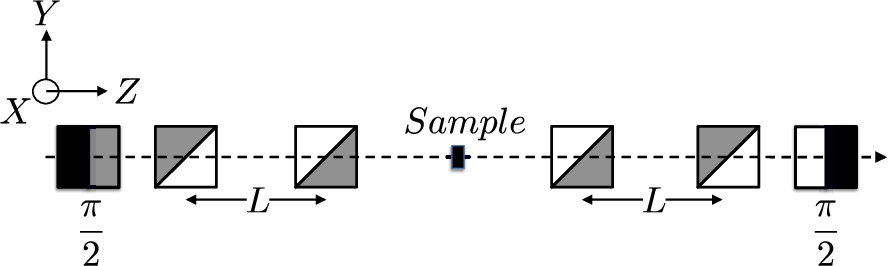
Diagram illustrating a SESANS setup employing MWPs. The magnetic fields within the shaded and unshaded triangles are identical but antiparallel to each other. The solid black regions denote the
In SESANS the measured quantity of the polarisation can be expressed as;
The form of
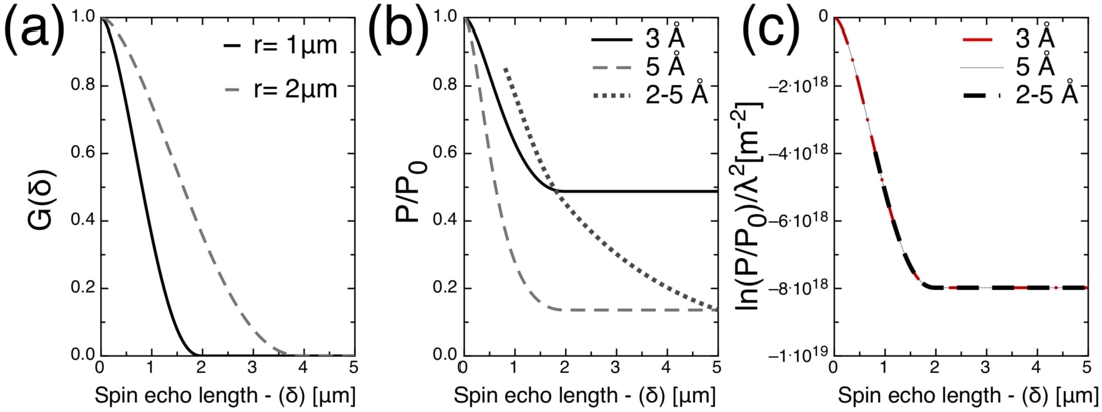
(a), the forms of
We now introduce the various components employed in this work and their associated parameterisation. SANS
The sample is initially utilised to simulate the expected scattering from a Small Angle Neutron Scattering (SANS) instrument, as shown in Appendix B.1. The sample configuration comprises a volume fraction ϕ of 0.001, a difference in scattering length density between the spheres and the solvent, denoted as
Neutrons possess the capability to scatter both coherently and incoherently from the sample. In the SANS
For simulating a monochromatic neutron source, the source
In the TOF setup, the source
Two Monitor components in McStas are utilised, which return a simple count of neutrons. These monitors remain idealised and do not affect the passing neutrons. In the time-of-flight simulation, the monitors are replaced by the wavelength-sensitive monitor L
For the final detector, a Position Sensitive Detector (PSD) of the PSD
Lastly, the setup includes source and sample apertures of the Slit component type in McStas. Circular apertures are employed with radii
Results of the SESANS simulation
The SESANS instrument in McStas is visualised in Fig. 9. Simulations were conducted for both the spin-up (
Starting with the monochromatic case, we conducted simulations where the magnetic field strength in the prisms was systematically varied to scan the spin-echo length (δ). The resulting polarisation is illustrated in Fig. 3 (a), showing good agreement with the anticipated theory discussed in Section 2. These simulations effectively capture both the expected shape of the correlation function
The time-of-flight simulation reproduces the green curve depicted in 3 (a), which is a fixed magnetic field with neutron wavelengths from 2–5 Å neutrons. When compared against the analytical function presented in 3 (b) (bottom green), a notable alignment is evident, signifying robust agreement. These straightforward simulations validate the efficacy of employing both the SANS
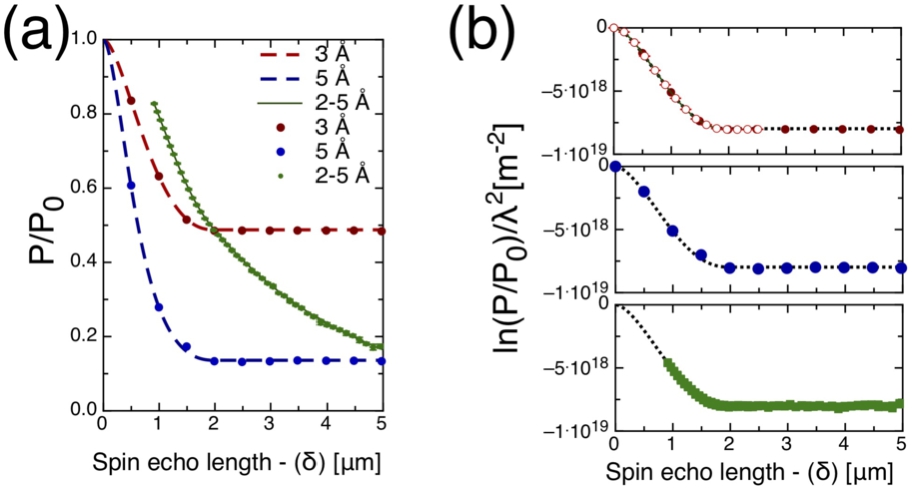
In (a), the simulated polarisations for the two monochromatic neutron wavelengths, as indicated in the legend, are depicted alongside the results from the time-of-flight simulation. Meanwhile, (b) shows the normalised functions, accounting for wavelength and sample thickness effects. These corrected functions are compared with the calculated forms derived from equation (3). Note that the error bars are smaller than the points.
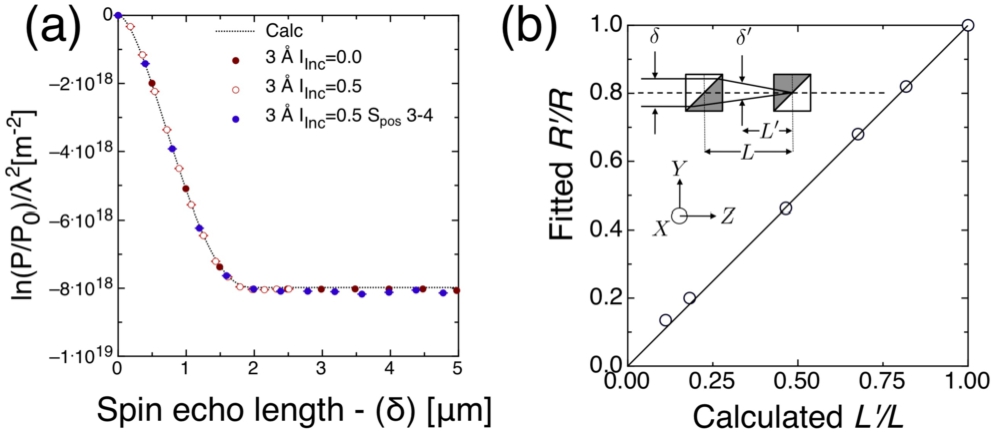
In (a), both the calculated and simulated normalised SESANS polarisations as a function of spin-echo length are depicted. The simulations are conducted with and without an incoherent background, as indicated in the legend, and also account for time-of-flight variations. Meanwhile, (b) demonstrates the corresponding alteration in the ‘apparent’ correlation length when the sample is positioned between magnets three and four. The inset visualises the modified spin echo setup with the different sample position and shows how
In most Small Angle Neutron Scattering (SANS) experiments, incoherent scattering often presents challenges by generating a high background, particularly at high Q values. However, SESANS is less significantly affected by such scattering. This is evident in the simulations presented in Fig. 4 (a), showcasing both monochromatic and time-of-flight simulations with and without incoherent scattering. Previous tests in a standard SANS configuration confirmed the presence of incoherent background scattering, showing reasonable agreement. However, the simulations consistently predict a slightly lower scattering intensity than the calculated values, a trend more pronounced in the time-of-flight case.
In the current Delft SESANS setups, detection of scattering from smaller structures (less than 100 nm), is difficult, due to the low magnetic fields required. Consequently, if the sample is positioned in a secondary location between the third and fourth encoding devices the accessible spin-echo length is reduced and given by;
Where
For a sample placed between prisms three and four, a spin echo length
The comprehensive simulations conducted in this study elucidate various aspects of SESANS setups, affirming the efficacy of McStas in modeling this technique. This research complements prior demonstrations of monochromatic SESANS and SEMSANS [5]. Moreover, recent advancements have highlighted McStas’ capacity to model intricate setups involving a sequence of MWPs [20].
While certain sample characteristics such as absorption and multiple scattering are presently absent, their inclusion would be beneficial. Recent studies investigating multiple scattering effects suggest the feasibility of incorporating these phenomena into the model [13].
It’s important to note that our approach is purely classical, accounting only for the net Larmor phase accumulated by the neutron as it traverses through the instrument. Although quantum descriptions of polarized neutron state interactions are possible [12,16,30], these aspects are not replicated in this Monte Carlo model.
Another significant avenue involves integrating SEMSANS with SANS [29], which offers a comprehensive understanding of hierarchical structures. A straightforward strategy could entail stacking two samples of spheres with different sizes, facilitating simultaneous simulation of scattering at two distinct length scales. This presents an opportunity for more detailed optimization of instrument geometry, focusing on angular acceptance, and potentially yielding a more refined treatment of data compared to our current phenomenological method of transmission corrections [18].
Conclusions
This study successfully validates SESANS simulations across various neutron wavelengths and, notably, for the first time in a TOF setup. These simulations provide a framework for extracting SESANS results, allowing exploration of changes in sample positioning and incorporation of incoherent scattering effects. The anticipated outcome is the utilization of these tools to enhance the precision of the techniques and foster the development of novel and advanced instrumental setups.
Footnotes
Acknowledgements
We acknowledge the valuable discussions with the McStas team. Special thanks to Mads Bertelsen for his assistance with the McStas script interface, installation, and general support. Additionally, we appreciate the contributions of Jasmijn van Arnhem from TU Delft for guiding the direction of this project.
This work is supported by the US Department of Energy (DOE), Office of Science, Office of Basic Energy Sciences, Early Career Research Program Award (KC0402010) with proposal No. (ERKCSA4), under Contract No. DE-AC05-00OR22725.
7.
This manuscript has been authored by UT-Battelle, LLC under Contract No. DE-AC05-00OR22725 with the U.S. Department of Energy. The United States Government retains and the publisher, by accepting the article for publication, acknowledges that the United States Government retains a non-exclusive, paid-up, irrevocable, world-wide license to publish or reproduce the published form of this manuscript, or allow others to do so, for United States Government purposes. The Department of Energy will provide public access to these results of federally sponsored research in accordance with the DOE Public Access Plan (
Guide for the data reduction and simulation Python code
All of the simulations are done using McStasScript
The Wollaston_prism component is also included which is used for the prisms. A more advanced version which allows for variable hypotenuse angle is in preparation and will be sent to the McStas team.
Monochromatic SANS. Monochromatic SANS simulations can be done using the monochromatic class. All relevant simulation parameters can be set when initialising the class. When the class is initialised, the monochromatic_model is called to run the simulation. The monochromatic_model class has the method scatterplot() that creates a scatterplot of the PSD measurement. Furthermore the absolute_calibration() method does the 2D data calibration. Finally the intensity_plot() method does the full data reduction. The function get_q_profile() is called to do the radial averaging and the binning() function is used to do the binning.
TOF SANS. TOF SANS simulations can be done using the TOF class. Allrelevant simulation parameters can be set when initialising the class. When the class is initialised, the TOF_model is called to run the simulation. The TOF class has the method intensity_plot_q(index) to do the full data reduction on each PSD bin, again calling the get_q_profile function to do this. An index has to be passed to this method to tell it which PSD bin index to take. Furthermore the intensity_plot() method that calls the intensity_plot_q(index) for each PSD snapshot and bins them using the binning() function, yielding the final result.
Monochromatic SESANS. Monochromatic SESANS simulations can be done using the SESANS class. All relevant simulation parameters can be set when initialising the class. When the class is initialised, the SESANS_model is called to run the simulation. The SESANS class has the method plot_I to plot the
TOF SESANS. Monochromatic SESANS simulations can be done using the TOF_SESANS class. All relevant simulation parameters can be set when initialising the class. When the class is initialised, the TOF_SESANS_model is called to run the simulation. The SESANS class has the method spin_echo_length() to calculate all the probed spin echo length (δ) and finally the plot_pol_lambda() method can be used to plot the final result.
SANS modelling
SESANS component layout
For the SESANS work, the precise geometry used in these simulations along with the McStas components used is shown in Fig. 9.