




Abstract
McStas ScatterLogger component bundle was adapted for evaluating a contribution to dose rate around neutron guides arising from prompt gamma radiation accompanying neutron capture in the supermirror guide coating upon specular reflection. Thickness of typical shielding materials needed to reduce this contribution to the desired level can be now evaluated directly from running a ray-tracing simulation of the instrument in McStas. An overview of the corresponding modifications to the existing McStas components and description of the newly written supplementary ones is given together with examples and use instructions.
Keywords
Introduction
At contemporary high flux neutron sources the neutrons are transported at rather large distances from the source to the sample position, typically several tens of meters. Effective transport of neutrons over such distances is achieved by using neutron guides with “supermirror” coatings of the walls. A “supermirror” consists of multiple bilayers of materials with strong neutron optical contrast and varying thickness. It allows for an m-fold increase in the angle of total reflection compared to that of nickel. Upon reflection, a neutron typically penetrates to a certain depth in the coating where bilayer thicknesses satisfy the Bragg reflection condition. When considering the low incidence angle of a reflected neutron, this would imply a path length of up to a few millimeters in the materials of the coating. Consequently, a certain fraction of neutrons are captured in the coating materials at each reflection giving rise to high energy prompt photon emission. Its amount along the guide varies depending on transported flux, spectrum and divergence together with m-value and reflectivity of the guide coating. The correct account for this contribution is critical for the guide shielding design.
An idea to use ray-tracing software for accounting for losses of neutrons during transport in order to address production of prompt photons along the guide was put forward some time ago. A special code for use in McStas ray-tracing package [1–3], Scatter Logger bundle, was developed capable of tracking and processing changes in the neutron states upon each reflection in the neutron optics [4]. The original Scatter Logger bundle allowed access to the characteristics of the non-reflected neutrons, such as loss position, incidence angle, energy etc. However, it didn’t implement a full picture of reflection from a supermirror. It was not possible to distinguish between neutrons captured in the materials of the guide coating with the release of high energy prompt gamma radiation and those transmitted into the guide substrate, typically a borosilicate glass, giving rise mostly to a comparatively low energy gamma radiation from capture by boron. Existing implementations of supermirror in PHITS and MCNP transport Monte-Carlo codes suffer from similar deficiencies, although work on improving the situation for MCNP is currently ongoing [5].
Results of a recent calculation of neutron absorption in supermirror coatings [6,7], together with consideration of guide substrate waviness effects on shielding [8], allow to single out the two contributions upon data recorded by the Logger. This opens an opportunity for rigorous calculations of the neutron capture in particular materials and, given the prompt gamma spectra, evaluation of the dose rates and shielding requirements directly from running a ray-tracing model of the neutron instrument. Description of the corresponding modifications to the components of the Scatter Logger bundle which allow to do so, constitute the subject of the present paper.
In Section 2, an overview of results of the studies [6,7] and [8] is given while Section 3 contains details of their implementation in McStas components. In Section 4, we illustrate the use for the particular case of shielding of the ESS BIFROST [9] instrument. Section 5 concludes the article.
Neutron absorption in the guide coating
Reflection with
In [6 ,7] capture probabilities in the multilayer coatings per incident neutron were calculated for multilayer compositions used in commercial production of supermirrors ( Momentum transfer below supermirror cutoff Momentum transfer beyond supermirror cutoff,
Low angle reflection, effect of waviness
At reflection with low momentum transfer neutrons typically don’t penetrate beyond the outermost nickel layer of the coating and the parametric dependencies given by (1) and (2) don’t hold [7]. For momentum transfer at reflection below critical value
The main reason for the low-angle reflectivity loss is however waviness of the reflecting surface which effectively increases beam divergence.1
Author is especially thankful to Marton Marko and Mads Bertelsen for explaining this point.
The waviness is defined as r.m.s. angle between the two vectors normal to the surface averaged over the surface area.
Probability of capture per non-reflected neutron at low angles for an
Wave vector of a neutron in an absorbing medium is complex-valued since a potential entering Schrödinger equation for the neutron wave function acquires an imaginary part which accounts for absorption and diffuse scattering [11].
Correspondingly, for a multilayer coating with
Recording neutron capture
A description of a neutron instrument within McStas ray-tracing Monte-Carlo package is written in a meta-language. It is composed of predefined or user-supplied components placed according to the real setup of the instrument under consideration in a text file. The original Scatter Logger bundle enables logging and processing details of neutron interactions within parts of the instrument contained between
Extending functionality of the Scatter Logger in order to address neutron capture in the coating materials includes several key steps. First, neutron capture probability at reflection depends on the m-value of the coating. Correspondingly, a number of McStas components which are commonly used in construction of the guide systems were customized in order to allow logging of the m-value at reflection point by assigning a value to a global variable at each neutron interaction. The corresponding modifications were made to the following key components:
Second, the original
Finally, in addition to an original iterator component pair which processes the buffer of saved states and returns weight of the non-reflected neutrons, two new iterator components were written,
The syntax of the logger and iterator components is similar to the syntax of the original constituents of the Scatter Logger bundle and the relevant examples of use may be found in the McStas repository.
Dose rate and shielding parameters evaluation from a McStas simulation
In general, there are several contributions to the dose rate around the guide (e.g. high energy neutrons, slow neutron scattered from beam windows or escaping through the gaps between guide segments and others). However, in many cases, for example outside the line of sight to the neutron source, the prompt gammas coming from neutron capture in the guide coating dominate the dose rate. Capture rates of neutrons in the coating material and in the substrate along the guide calculated in McStas can be used to define a corresponding source term for a transport Monte-Carlo simulation. Equivalently, they can be used for a direct numerical evaluation of the prompt gamma contribution to the dose rate and assessment of guide shielding requirements.
For a mono-energetic photon source, the dose rate beyond lateral shielding H can be obtained as a product of uncollided source photon fluence rate, energy dependent fluence to effective dose conversion factor
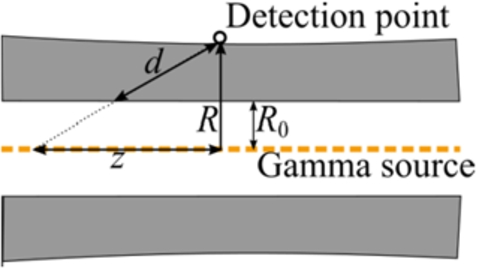
Geometry for the dose rate evaluation outside lateral guide shielding at the surface.
The energy dependent linear attenuation coefficient μ, dose buildup
For the two newly written components in McStas performing dose rate calculations and evaluating shielding needs, it is assumed that the non-reflected neutrons which are not captured in the coating are captured in the borosilicate guide substrate. Although neutron capture in the borosilicate glass occurs presumably by boron atoms, a small fraction of neutrons transmitted to the substrate are captured by other elements, in particular silicon, with release of photons with energy of several MeV. The McStas components thus implement equation (7), interpolation of table values for
The
The components were benchmarked to a measurement of a gamma dose rate along the PSI instruments (mostly
As an illustration of the potential application a result of dose rate calculation along a part of the guide system of BIFROST instrument is presented. BIFROST will be constructed among the first eight instruments at the European Spallation Source. Up to the distance of 28 meters from moderator the guide system passes through a heavily shielded bunker, where it is curved to avoid the line of sight to the neutron source just before the 3.5 m thick heavy concrete wall of the bunker. The curving has a large effect for reducing contribution from fast neutrons to the overall level of ionizing radiation around the guide beyond the bunker wall [18], so the prompt gamma radiation from neutron capture in the coating will dominate the dose rate. The instrument will have a shutter blocking the cold neutron beam at 48 meters to allow maintenance of the chopper placed at 78 meters and operations in the instrument cave at 162 meters from the moderator.
The source of the prompt gamma radiation along the guide was obtained by running a McStas model of the BIFROST instrument developed by Jonas O. Birk and Rasmus Toft-Petersen, with the actual configuration of the neutron optics including the m-value distribution.
A shielding configuration under examination consisted of 10 cm steel followed by 30 cm of heavy concrete for the first 2 meters after the bunker wall and 10 cm steel with 40 cm of regular concrete beyond this point. This configuration was chosen on the basis of an evaluation of thicknesses via
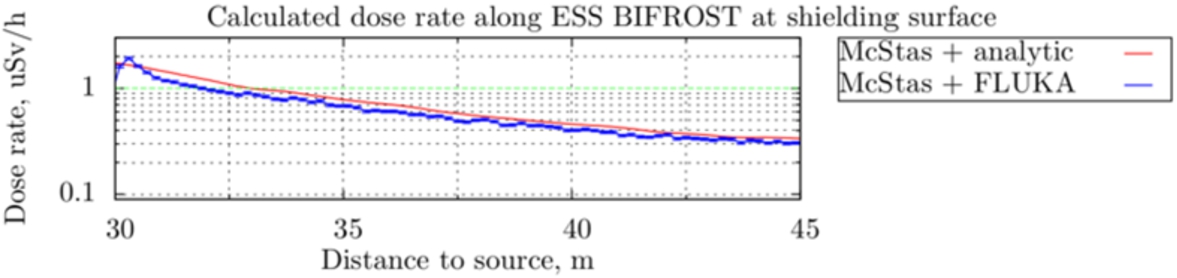
Dose rate along ESS BIFROST guide shielding at the surface calculated according to (7) and using FLUKA.
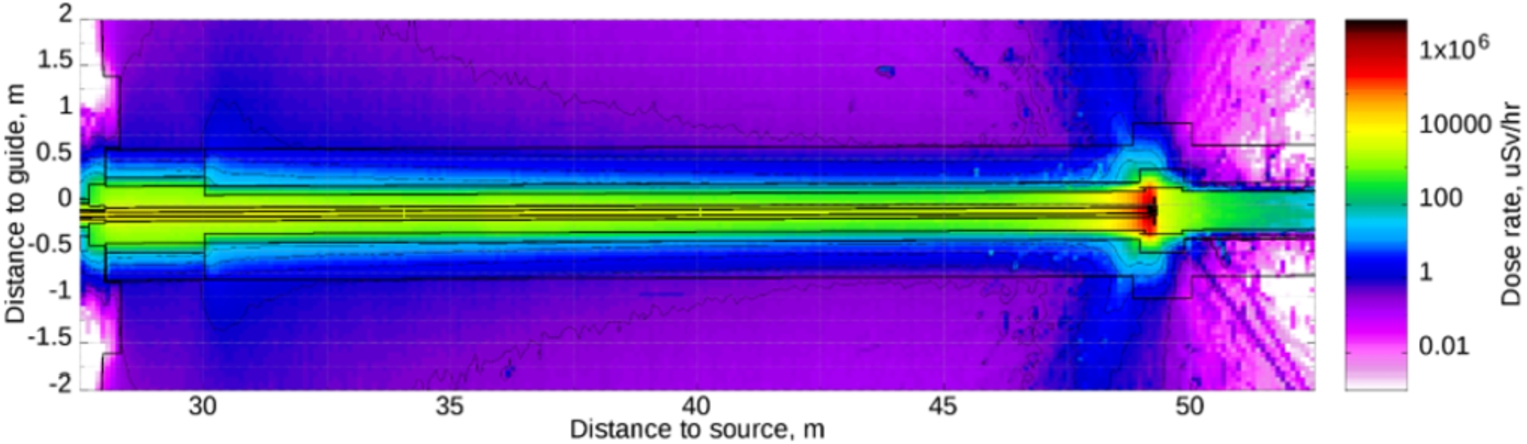
Dose rate distribution in the shielding around BIFROST guide, cut by horizontal plane at guide height.
In Fig. 3 a result of a FLUKA simulation for one of the use-cases of the BIFROST instrument is plotted. Here a neutron beam is dumped into a shutter composed of a B4C followed by a lead plate. The plot is a sum of two contributions. The first one is prompt gamma radiation resulting from neutron capture along the guide as described above. The second one is the neutron beam dumped in the shutter. To evaluate the latter contribution a McStas simulation of the instrument was performed with recording neutron states crossing the guide section at 48 meters in a MCPL format file [21], a capability which is included in standard functionality of McStas. The pre-compiled C-language libraries which contain routines for reading MCPL files were then linked to a FLUKA executable at compilation together with writing another custom user-defined source routine. The routine generated primaries by reading neutron states from the MCPL output of a McStas simulation. The input file for the simulation containing the description of the guide and shielding geometry was prepared with the help of CombLayer [22,23].
The functionality of the McStas Scatter Logger bundle was extended in order to allow for a fast and reliable evaluation of one of the major contributions to dose rate around neutron guides arising from prompt gamma radiation accompanying capture of neutrons of the transported beam in the supermirror guide coating. Calculated capture rates in the coating materials can be used as a source term in a transport Monte-Carlo simulation of the guide shielding.
Footnotes
Acknowledgements
Author is thankful to Peter Böni, Marton Marko, Erik Knudsen, Uwe Filges, Mads Bertelsen, Kim Lefmann, Rasmus Toft-Petersen, Liam Whitelegg, Jonas Birk and other members of BIFROST and HEIMDAL teams for their interest and fruitful discussions. Use of Flair [24] in the course of FLUKA simulation is also acknowledged. This work was presented at the ISTSI2019 Workshop [ ]. ISTSI2019 was part of the “SINE2020” project and funded by the European Commission, Grant Agreement no. 654000.