




Abstract
To improve the effect of immersive animation design, this paper combines digital media technology (DT) to establish an immersive animation design system and analyzes the media digital signal data processing algorithm. According to the advantages and disadvantages of the FHT algorithm and probabilistic algorithm, this paper proposes the FHT-SLM algorithm and the FHT-IPTS algorithm. Moreover, this paper analyzes the basic principle of TPWC transform and M-TPWC and the CO-OFDM system of cascaded FHT algorithm and M-TPWC algorithm. Finally, this paper simulates the CO-OFDM simulation system built by Matlab2018.a and Optisystem. Through the experimental analysis results, the reliability of the algorithm and the system in this paper is verified, and the design effect of immersive animation is effectively improved.
Introduction
The development of DT affects the production and dissemination mode of animation and reconstructs the relationship between creators and audiences. The animation audiences are changing from passive “audiences” to more active “users”. In particular, the emergence and popularization of the Internet have reduced the cost of public participation. The autonomy of users has been stimulated to actively participate in the construction of the animation industry value chain. The increasingly mature digital media content has penetrated into all aspects of animation and has become an essential part of the animation. Moreover, new media has greatly changed the animation production process, creative concept, and dissemination method, bringing new opportunities and platforms for animation creation.
“Motion is one of the phenomena most likely to attract strong visual attention. If the audience is in a stationary environment, they generally do not respond, but when they move, the audience will stare at the direction of their movement”. When an observable target appears in the visual space, the audience is in a state of concentration on the appreciable target. Once multiple targets with activity intentions exist in the area, the audience will be confused and enter the stage of attention distribution, adding to the story. The difficulty of understanding is not conducive to advancing the main storyline. Therefore, while reducing the environmental movement factors, the subject should move fully, the static of the scene and the movement of the characters should be contrasted, and the principle of visual capture should be used to attract the attention of the audience and pull the audience’s thinking into the main line of the story. The picture’s color, brightness, and contour contrast can also highlight the subject. The scene can be used as the substrate of the subject. The hue and the issue form a certain chromatic contrast so that the audience can quickly identify the subject, distinguish the primary and secondary, and clarify the visual center [1].
“Lens language” is a unique form of language in film and television. Photographic works containing stories have reference value in composition, visual focus and emotional expression. It is also full of beauty and storytelling. Among them, the composition of the picture provides psychological hints for the audience, creates a visual focus, and allows the traction lines in the image to guide the vision. In VR animation, in the stage of the conceptual design of the scene, the subject can be placed at the convergence of the traction lines formed by the scene. The radiative rays formed by the scene can give the audience psychological hints, indirectly observing the main content, and play a role of visual guidance [2, 3].
This study consists of four parts. The first part provides an overview and summary of relevant research. The second part is the introduction and analysis of digital media signal algorithms. The third part is the elaboration and experimental analysis of the immersive animation system. The fourth part is a summary and review of the entire study.
Related work
Real life is different from traditional images. “One mirror to the end” in real life is extremely rare in traditional film and television, which determines the degree to which humans receive information through vision. The working principle of the visual system is similar to the central processing unit of a computer, which is to process the input information. The masking effect shows that if there are multiple observed objects in the visual range of the observer at the same time, these observed objects will affect each other, and the difference threshold of the objects when multiple objects coexist is changed compared with that when they exist independently. Domestic and foreign scholars have conducted a lot of research on this topic.In terms of teaching interaction, virtual reality technology and immersive learning experience enrich students’ experiences, and can also improve academic performance and focus. Van Dinther R et al. applied immersive virtual reality technology in teaching environments to improve the interactivity of teaching classrooms [4]. Wu L et al. proposed the use of virtual reality technology to assist students in interdisciplinary learning and connection, aiming to address the issue of immersive interactive teaching for students. By enriching students’ experience in immersive caves, it provides feasibility for immersive virtual environments [5]. Shi A et al. proposed an interactive design game that combines quadratic functions and games to enhance students’ interactive experience and improve their math grades regarding the issue of immersive virtual reality learning environment [6]. McGowin G et al. proposed combining virtual reality technology to improve learning efficiency and increase immersive experiential learning on the technical issues of learning education and training [7]. Vogt A et al. proposed the use of immersive virtual environments combined with text and images to improve learners’ learning proficiency and effectiveness regarding the effectiveness of the learning process [8].
VR technology generally applies to three fields: VR film and television, VR games, and VR industry applications. The application of VR technology in animation vision will subvert the future video industry. In addition, there are many applications for immersive experience design in interactive games and storytelling scenarios. Gao P has gesture recognition issues for immersive interactive games. A naive Bayesian gesture recognition algorithm based on joint vectors is proposed to improve recognition speed and accuracy, thereby enhancing the immersive experience [9]. Taborda Hern á ndez E et al. proposed the use of virtual reality technology and comprehensive immersive content experience design to address the issue of immersive story experience, thereby improving the expression skills of storytelling [10]. Dobre G C et al. proposed using reinforcement learning algorithms to construct models for storytelling and virtual reality technology, in order to enhance the attractiveness of immersive narrative games and enhance the interactive experience [11].
Afterwards, in the interactive design of theme parks and the application of learners, the immersive experience achieved good results and a sense of experience. McSwan A proposes to combine virtual reality and animation design to create immersive animations to enhance the visual creation experience of visually impaired art practitioners regarding their perception issues [12]. Oh J E et al. proposed the integration of theme parks and nostalgic animations through the use of virtual reality technology to create the appeal of nostalgic animations, thereby increasing the audience’s immersive experience and emotional connection [13]. Galezzi F et al. proposed the use of virtual reality technology and 3D immersive narrative systems to enhance the audience’s experience of earthquake stories regarding the technical issues of immersive storytelling [14]. Liu Z et al. proposed the use of immersive virtual reality technology to learn how to make movies, aiming to improve learners’ learning experience and knowledge learning [15].
In summary, domestic and foreign scholars have achieved many results in different fields using virtual reality technology and immersive experience design. However, there is still a lack of algorithm research on the combination of digital media technology and animation design. Therefore, the study combined DT to construct an immersive animation design system, thereby improving the design effect and experience experience of immersive animation.
Digital media signal processing algorithms
Joint algorithm based on FHT and probabilistic algorithm to reduce PAPR
One of the main disadvantages of CO-OFDM systems is high PAPR. High PAPR will not only affect the nonlinearity of optical fibers, but also increase the complexity of CO-OFDM systems and increase system costs. In order to reduce the impact of high PAPR on CO-OFDM system, this chapter firstly introduces Hadamard transform, the basic principle of FHT and the impact of this transform on PAPR of OFDM system. Moreover, this paper proposes an improved selective mapping algorithm based on FHT transform, namely FHT-SLM algorithm. Then, this paper introduces the basic principles of the PTS algorithm. Aiming at the disadvantage of large amount of computation, an improved PTS algorithm, IPTS algorithm, is introduced, and an FHT-IPTS joint algorithm is proposed to further improve the PAPR of the signal. Finally, the PAPR, computational complexity and BER performance of several researched algorithms are analyzed in CO-OFDM system.
Hadamard transformation is embodied in the form of Hadamard matrix. The Hadamard matrix consists only of +1 and –1 and is a square matrix with orthogonal rows (columns). The Hadamard transform is performed on the input signal, in fact, the input signal X is multiplied by the Hadamard matrix. If it is assumed that the matrix H represents a Hadamard matrix of order N, the data sequence after Hadamard transformation can be expressed as:
The Hadamard matrix generated by recursion is expressed as:
Among them, ⊗ is the Kronecker product, and N = 2 a , a ⩾ 2, a ∈ Z+.
Since the Hadamard matrix is a square matrix whose row and column vectors are orthogonal to each other, it can be expressed as:
Among them,
Figure 1 shows the CCDF curve of the input OFDM signal after Hadamard transformation and the original signal. The figure is carried out under the simulation condition of adopting QPSK modulation and 256 sub-carriers. As can be seen from Fig. 1, at CCDF = 10-4, the PAPR value of the input OFDM signal after Hadamard transformation is 0.97 dB lower than the PAPR0 value of the original OFDM signal.
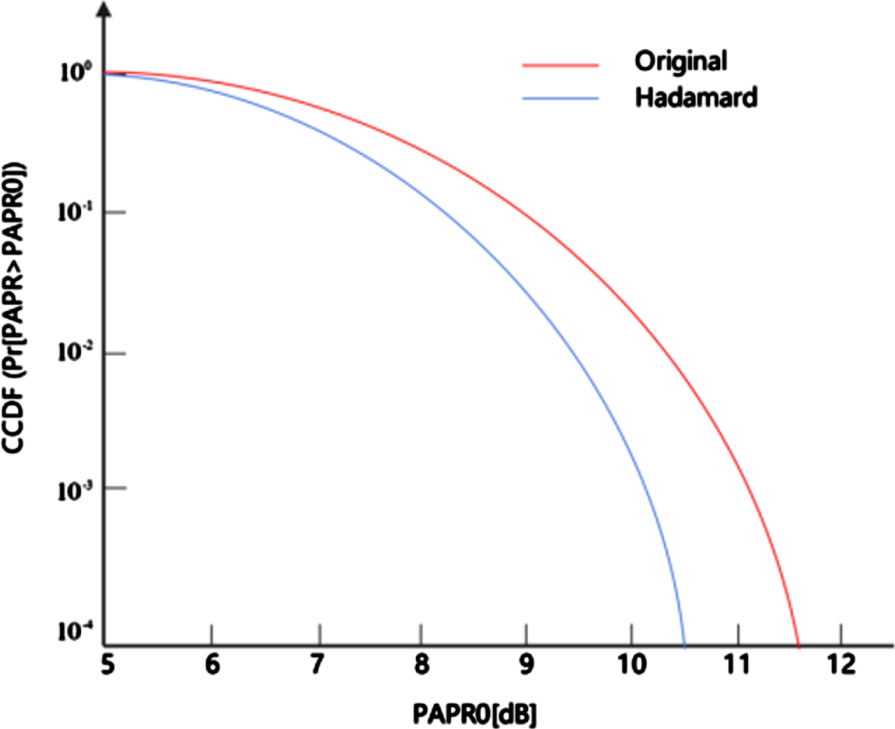
CCDF curve after Hadamard transformation.
The PAPR of the OFDM signal is related to the aperiodic autocorrelation function of the input signal. The Hadamard transform of the OFDM signal is mainly to reduce its aperiodic autocorrelation. The specific operations are as follows:
The discrete-time signal power after IFFT operation can be expressed as:
It can be seen from equation (8) that the PAPR value of the signal is related to the aperiodic autocorrelation function value of the input signal, and the smaller the autocorrelation function value of the signal, the smaller the PAPR value of the signal. Hadamard transform can obtain a new signal with lower aperiodic autocorrelation simply by multiplying the input OFDM signal with the Hadamard matrix. Then, the PAPR value of the signal that can be obtained after the IFFT operation is smaller than that of the signal without Hadamard transform, which can realize the reduction of the PAPR of the signal.
The basic idea of implementing the FHT algorithm is to decompose the Hadamard matrix into a simple matrix product form. Among them, each submatrix is a sparse matrix. That is, each matrix has only two non-zero elements in each row and column, that is, +1 or –1. Then, the decomposed Hadamard matrix is combined with the input signal to realize the fast algorithm of Hadamard transform.
The specific decomposition process of the 8th-order Hadamard matrix is as follows:
It can be seen from the above formula that the complexity of Hadamard transform and FHT transform is caused by the addition and subtraction of complex numbers. The complexity of N-point Hadamard transform is N (N - 1) ≈ N2 times of addition and subtraction, and the complexity of N-point FHT algorithm is N log 2N times of addition and subtraction. For example, the 256-point FHT algorithm reduces the complexity of Hadamard transform from 65536 to 2048, which greatly reduces the amount of computation.
The block diagram of the SLM algorithm used to reduce PAPR is shown in Fig. 2. First, the algorithm performs S/P on the QPSK-mapped frequency domain input data block to obtain X = [X0, X1, ⋯ , XN-1]
T
, and then multiplies it by a random sequence P
v
with V different numbers to obtain the revised data block
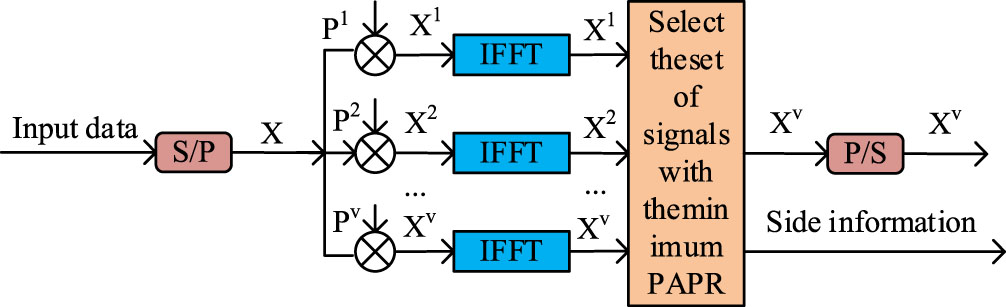
Block diagram of the SLM algorithm.
The SLM algorithm needs to transmit sideband information. Implementing the SLM technique requires V IFFT operations.
Figure 3 is a CCDF curve diagram of the SLM algorithm with 4, 8, and 16 blocks respectively.The PAPR0 value of the original signal that has not been processed by the SLM algorithm is 11.14 dB. However, at the same time, the amount of calculation required will become larger and larger, and the curvature change will become smaller and smaller, that is, the improvement capability of the CO-OFDM system will become smaller and smaller. To sum up, when using the SLM algorithm, considering the system performance and computational complexity, it is more appropriate for V to take 8.
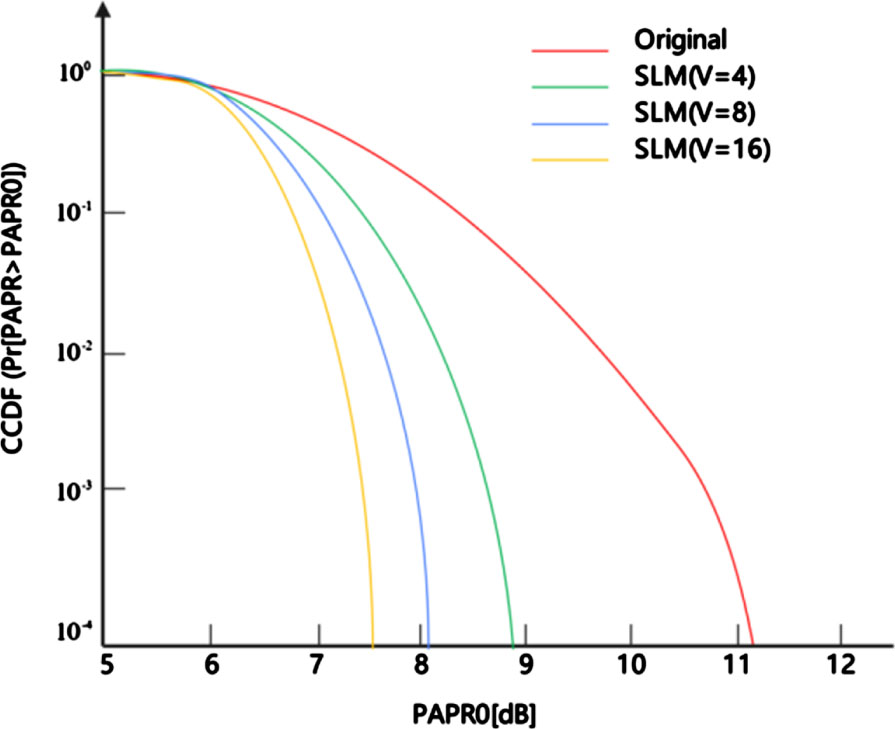
CCDF curves of SLM algorithm with different number of blocks.
The main step of the IPTS algorithm is to divide the input data X into V groups of non-overlapping sub-blocks
By performing IFFT operation on Y, and according to the linearity of IFFT, we can get:
The sub-data blocks are adjusted by rotating the phase factor, so that the PAPR of the OFDM signal generated by the superposition of the adjusted sub-blocks is lower than that of the original signal.
Then, the algorithm selects and transmits a set of optimal phase factor rotation sequences with the lowest PAPR in y, and the sequence search satisfies formula (13):
Among them, arg min(·) is the judgment condition required when the function takes the minimum value. In order to enable the receiver to identify different phases, it is necessary to transmit the sideband information to the receiver. The principle block diagram of the realization of PTS algorithm is shown in Fig. 4.
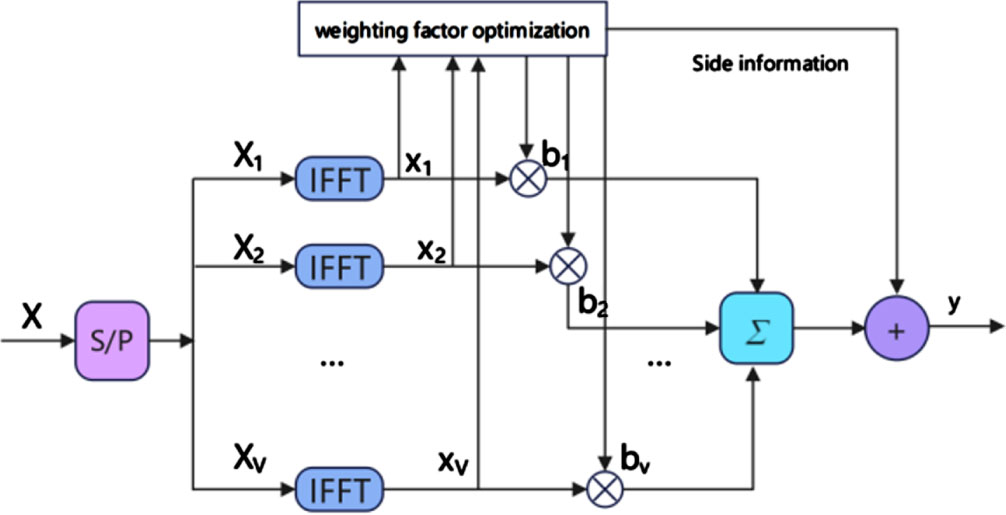
The principle block diagram of PTS algorithm implementation.
However, the above three division methods all follow a principle: each subcarrier can only appear in one PTS, and the number of subcarriers contained in the V PTSs is equal.
The PAPR effect analysis is carried out on the three segmentation methods of the PTS algorithm, and the same simulation conditions are set. Among them, the number of blocks is V = 4, the number of phase rotation factors is W = 2, the number of subcarriers is N = 256, and the modulation method is QPSK. The CCDF diagram of random segmentation, adjacent segmentation, and interleaving segmentation of the PTS algorithm is shown in Fig. 5. It can be seen from Fig. 5 that the PTS algorithms with different partitioning methods have different PAPR suppression effects in the OFDM system. Among them, the random partitioning method has the best PAPR suppression effect, the adjacent partitioning method is second, and the interleaving partitioning method is the worst. However, it is the simplest to realize the adjacent segmentation method, so the subsequent PTS algorithm and IPTS algorithm adopt the adjacent segmentation method for simulation.
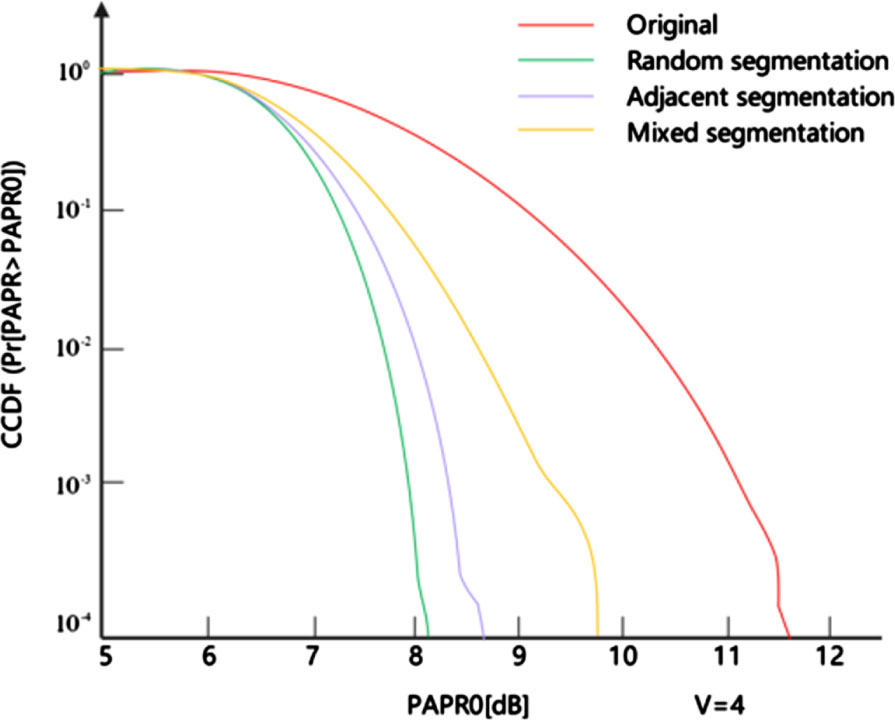
CCDF comparison of three segmentation methods of PTS algorithm.
The IPTS algorithm is an improved algorithm of the PTS algorithm. The main method is to replace the optimal solution with a suboptimal solution for the searched phase factor, which greatly reduces the complexity of the algorithm. The specific implementation flowchart is shown in Fig. 6. Among them, b
v
generally takes the value of {±1, ± j} in practice, and {±1} is used in the simulation in this paper. The specific implementation steps of the IPTS algorithm are: The algorithm selects a segmentation method, divides the input vector The algorithm initializes b
v
= 1, (v = 1, 2, ⋯ , V), calculates the PAPR of the signal at this time, denoted as PAPR0, and set index = 1; The algorithm sets bindex = -1 and calculates the PAPR of the signal at this time; If PAPR < PAPR0, then PAPR0 = PAPR, and b
index
does not change, otherwise, bindex = 1. The algorithm sets the bindex that minimizes the PAPR value as the weighting coefficient; index = index+1. If index < V+1, the algorithm returns to step (3), otherwise, execute step (6); At this time, the algorithm can obtain the optimized weighting coefficient b
v
(v = 1, 2, ⋯ , V) and the minimum PAPR.
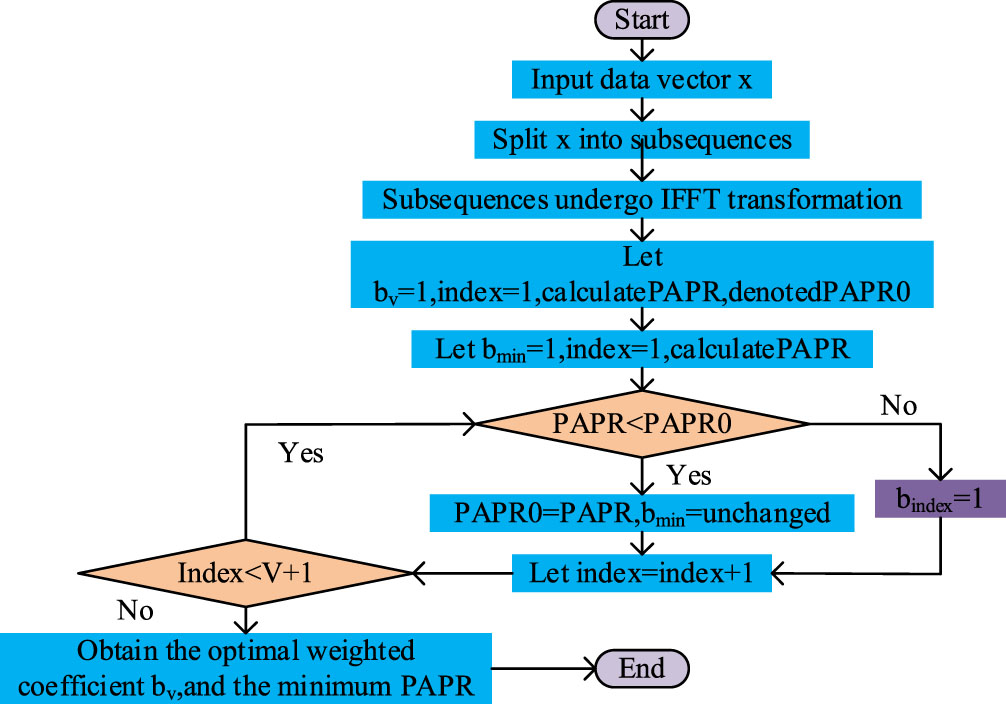
IPTS algorithm operation flow chart.
According to the above analysis, it can be concluded that the PAPR suppression performance of the probabilistic algorithm is better, but with the increase of the number of blocks, the calculation amount and BER will gradually increase. The FHT algorithm can further reduce the PAPR of the signal by reducing the autocorrelation of the signal, and the calculation amount and BER will not increase too much. Therefore, the combination of the FHT algorithm and the probability algorithm is selected for PAPR suppression.
FHT-SLM principle block diagram is shown in Fig. 7. A group of signals with the smallest transmission PAPR is selected. In order to enable the receiver to recover the original data block, additional information must be transmitted.
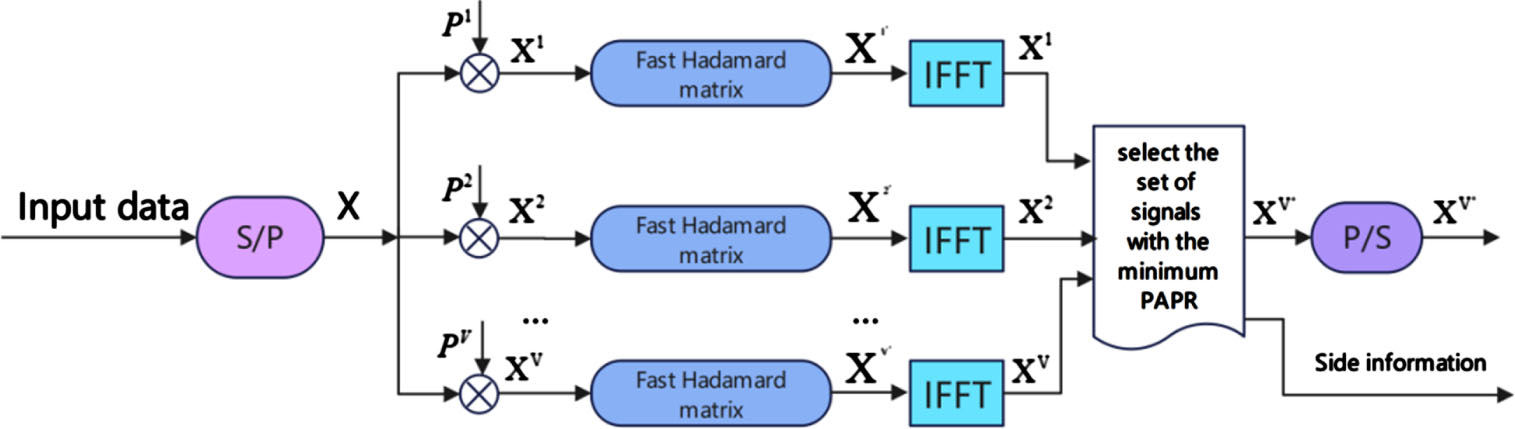
FHT-SLM principle block diagram.
The specific operation steps of the FHT-SLM algorithm are as follows:
Algorithm The OFDM signal is mapped by QPSK to generate the frequency domain signal x = [X0, X1, ⋯ , XN-1], and then S/P is used to obtain [X0, X1, ⋯ , XN-1] T .
The algorithm copies the parallel signal [X0, X1, ⋯ , XN-1] τ by V and multiplies it with V twiddle factors to obtain x′ = [X1, X2, ⋯ , X V ] T .
The algorithm multiplies the candidate signal x′ by the fast Hadamard matrix to further reduce the signal PAPR, and obtains X* = [X1′, X2′, …, XV′] T .
The algorithm performs IFFT transformation on x* to generate x′′ = IFFT (X′′).
The algorithm selects the signal xv* with the smallest PAPR value among the obtained V group signals.
The algorithm further transmits the signal after parallel-serial conversion.
Similar to the principle of the FHT-SLM scheme, the schematic diagram of the FHT-IPTS algorithm is shown in Fig. 8. The algorithm only increases the FHT matrix multiplication, but does not increase the search times of the optimal phase. Also, the matrix elements are only 1 and 1. Therefore, the computational complexity of the FHT-IPTS algorithm is only slightly higher than that of the IPTS algorithm, but much lower than that of the PTS algorithm.
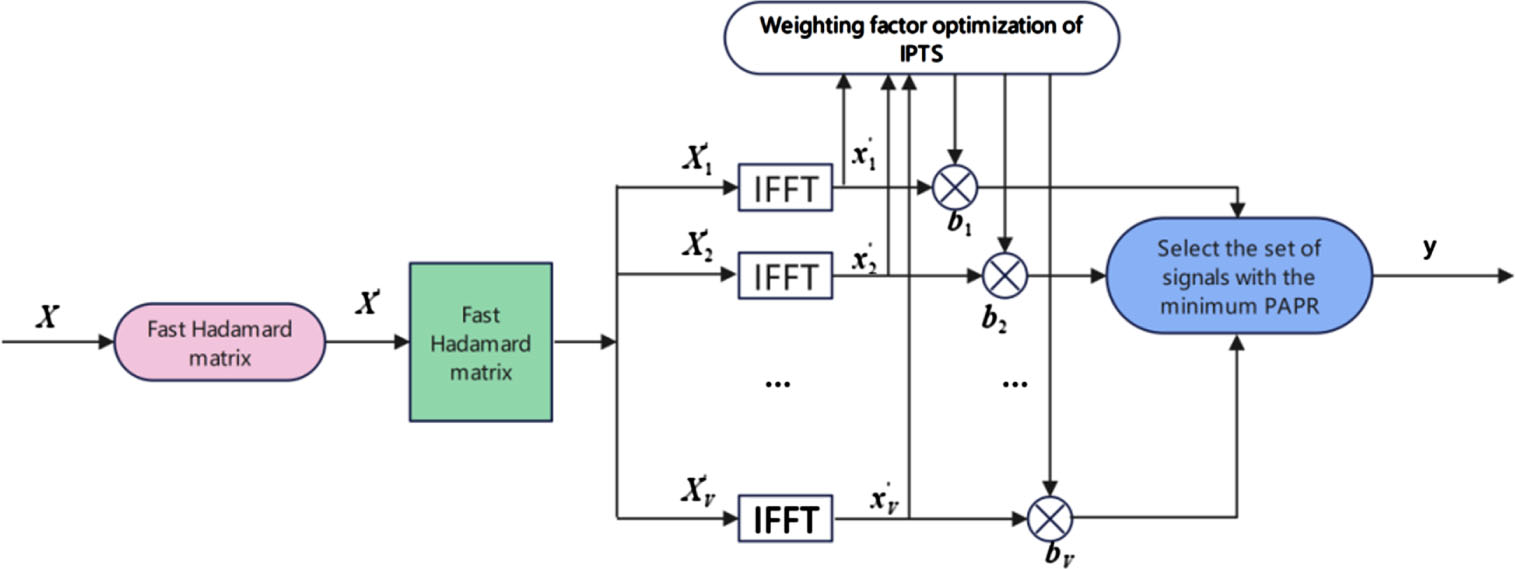
Schematic diagram of the FHT-IPTS algorithm.
The FHT-IPTS method is described as follows: The algorithm takes the data after mapping and S/P as the input signal of the FHT-IPTS scheme, multiplies the Hadamard matrix by the Hadamard transform, and obtains the result. The algorithm adopts series-parallel transformation, and divides x′ into V disjoint sub-blocks by adjacent division. The algorithm performs N-point IFFT transformation on each sub-block to generate x
v
′ = IFFT (X
v
′). All phase factors {b
v
, v = 1, 2, ⋯ , V } are set to 1, and the phase factor of the suboptimal solution of the IPTS algorithm is found according to the introduction. The algorithm multiplies the sub-block by the corresponding phase factor to obtain the candidate signal, which is denoted as The algorithm selects the signal with the smallest PAPR for transmission.
The TPWC algorithm can reduce the PAPR capability of OFDM signals, and the TPWC transformation parameter settings are shown in Table 1.
From Table 1, it is found that the TPWC algorithm performs better by reducing PAPR at lower values. Therefore, the COOFDM system diagram based on the joint algorithm of FHT and probabilistic algorithms is shown in Figure 9.
TPWC companding transformation parameters
TPWC companding transformation parameters
It can be seen from Fig. 9 that the radio frequency OFDM transmitter simulates the baseband OFDM signal in Matlab software. It mainly includes steps such as S/P, QPSK modulation, IFFT, the proposed FHT and probability class joint algorithm. Then, it enters the RTO up-converter to simulate in Optisystem, converts the electrical signal into an optical signal, and then transmits the optical signal to the fiber channel for transmission. The receiver steps are opposite to that of the transmitter.
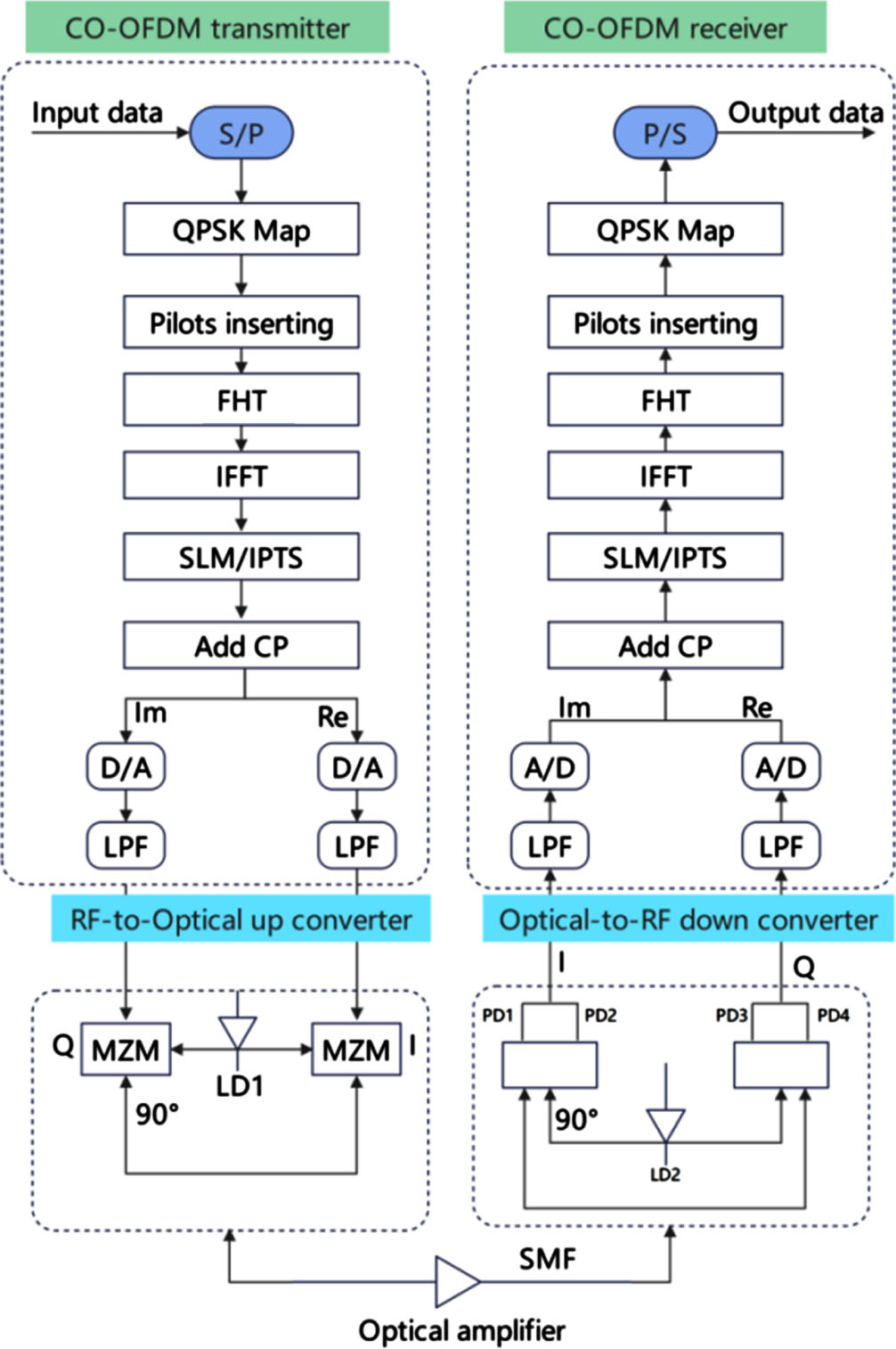
Block diagram of CO-OFDM system based on FHT-probabilistic algorithm.
In order to improve the immersive effect of the animation design system, this paper constructs an immersive animation design system as shown in Fig. 10.
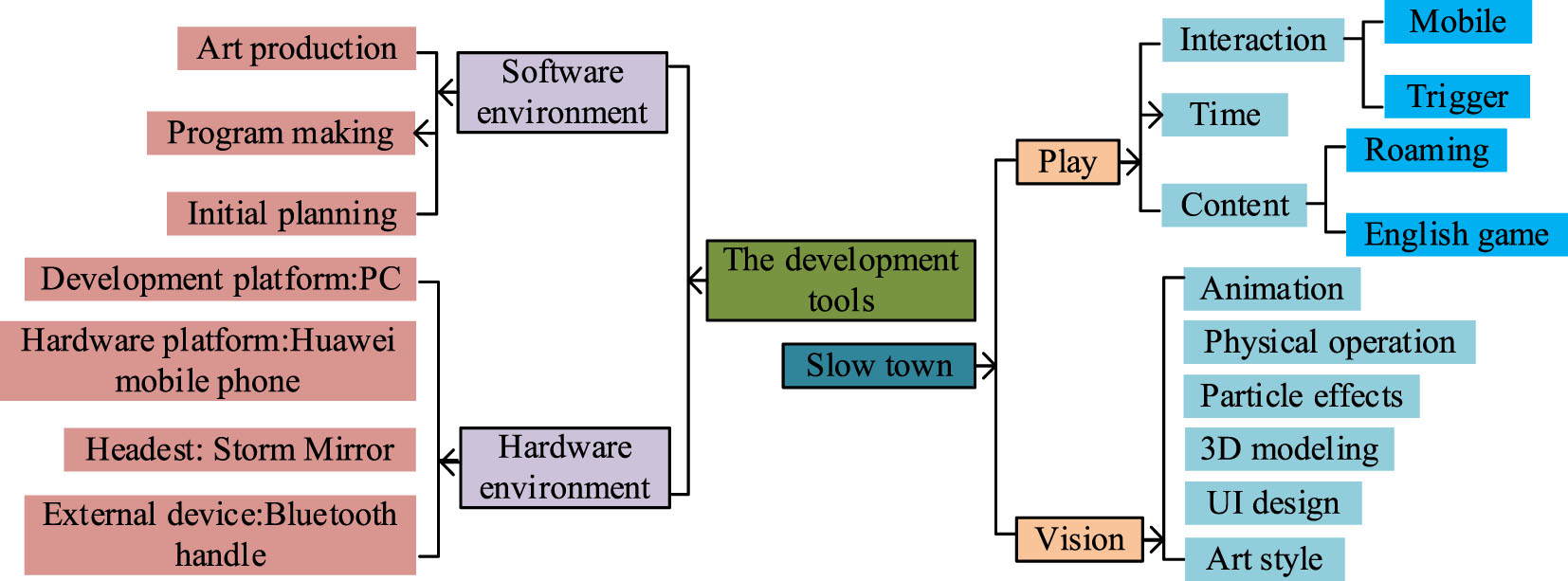
Immersive animation design system.
After the above system is constructed, the effect of the algorithm and system proposed in this paper is verified.
The CCDF simulation diagrams of FHT, FHT-IPTS (V = 8), SLM and FHT-SLM with different number of blocks are shown in Fig. 11. It can be concluded from Fig. 11. By comparing the 9 sets of curves, it can be seen that the FHT-SLM scheme has a better ability to suppress PAPR than the SLM algorithm under the same branch, but with the increase of the number of blocks, the calculation amount increases significantly. Compared with FHT, FHT-IPTS (V = 8) and SLM (V = 8) algorithms, FHT-SLM (V = 8) algorithm has stronger ability to suppress PAPR. The simulation results prove the feasibility of the algorithm.
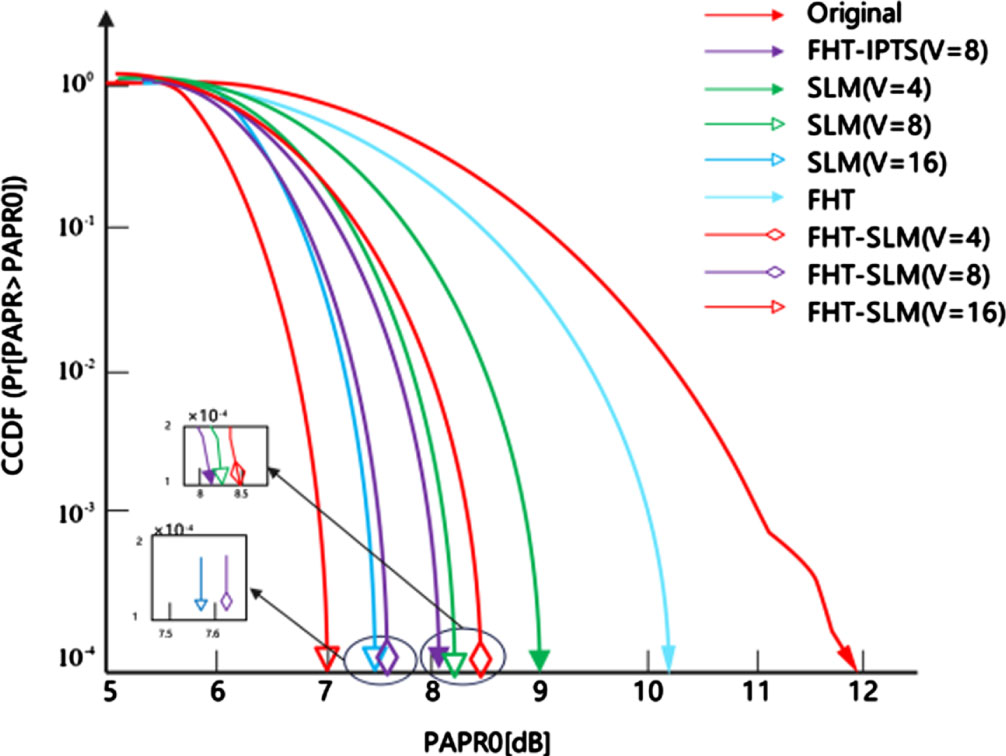
CCDF curves of FHT, FHT-IPTS and FHT-SLM algorithms.
Figure 12(a)-(d) shows the original signal, the time domain waveforms processed by the SLM (V = 4) scheme.
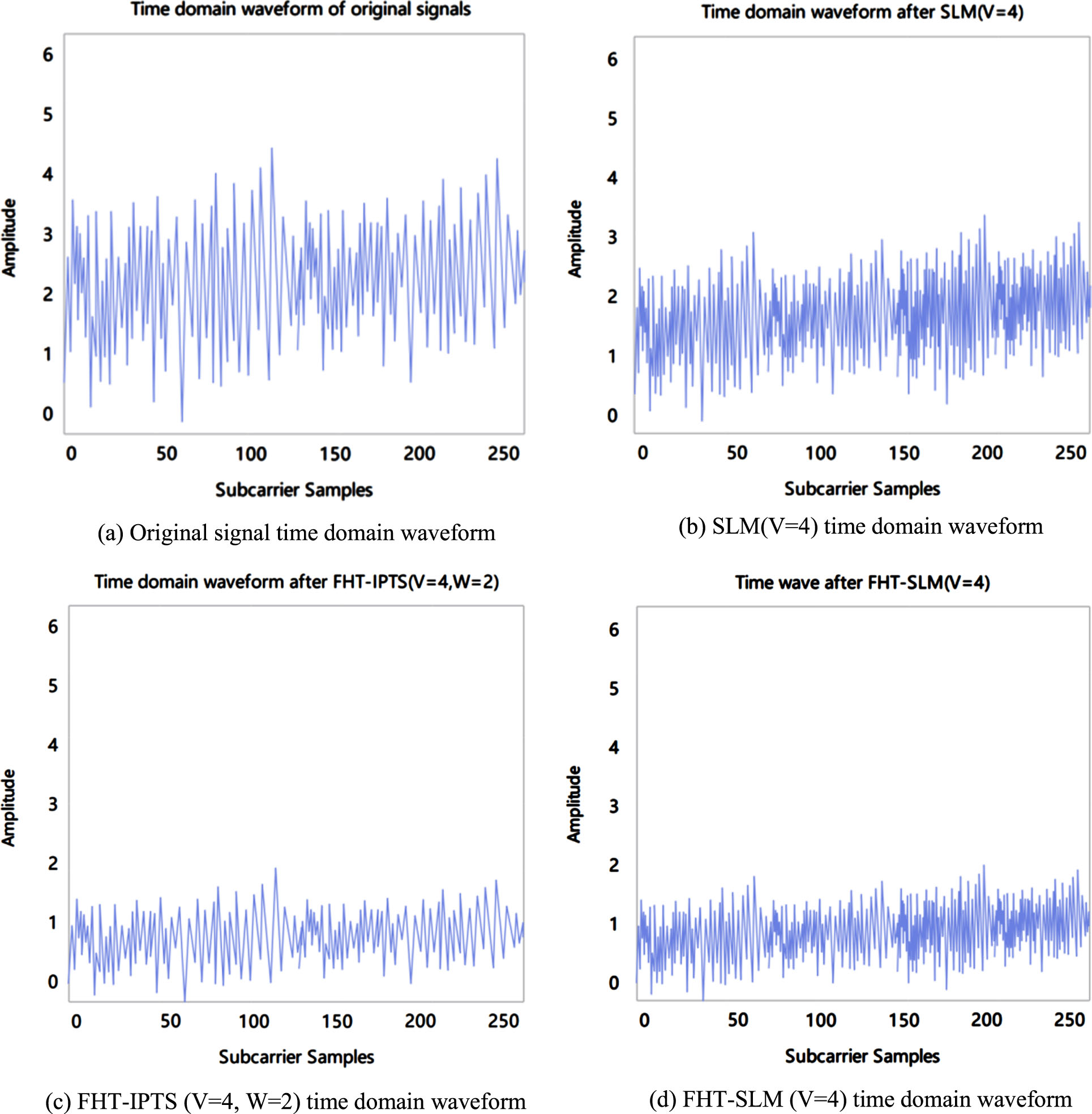
Time-domain waveforms of OFDM signals processed by different algorithms. (a) Original signal time domain waveform. (b) SLM(V = 4) time domain waveform. (c) FHT-IPTS (V = 4, W = 2) time domain waveform. (d) FHT-SLM (V = 4) time domain waveform.
Figure 13 shows the variation of OSNR transmitted by different algorithms on 240 km SMF. It can be seen from Fig. 13 that the BER performance of the FHT-SLM algorithm gradually decreases with the increase of the number of blocks.
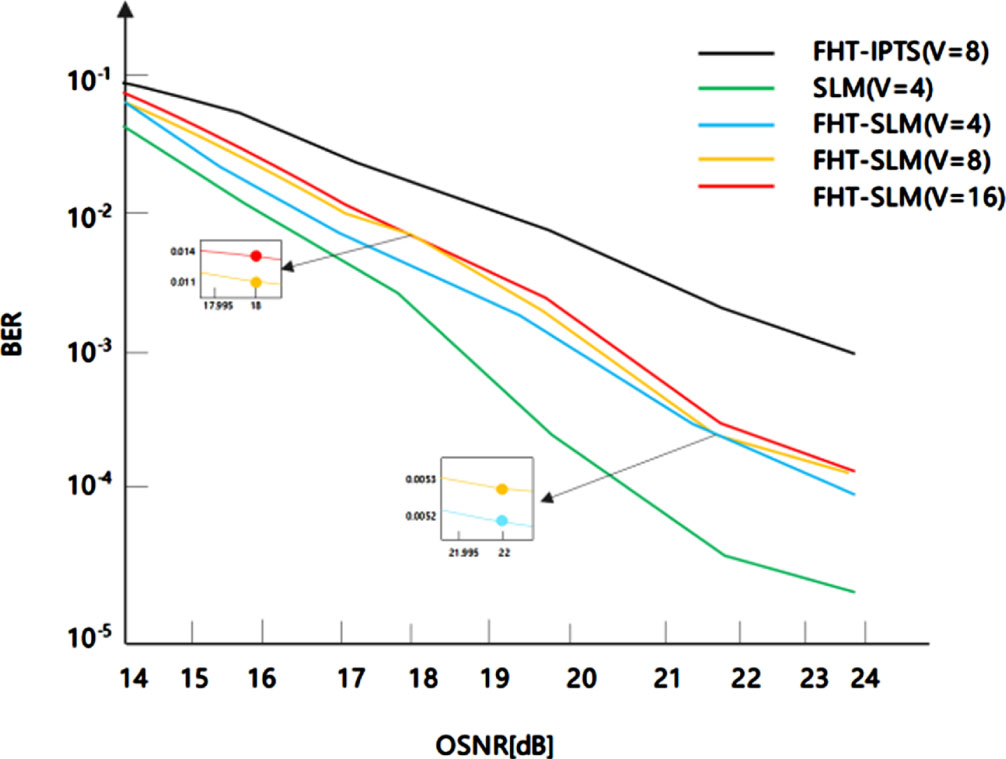
BER curves of different algorithms.
The effect of the model in this paper is verified, the reliability of the model in this paper is counted, and the immersion effect and design effect of the immersive animation design system are evaluated through the simulation platform, and the test results shown in Fig. 14 are obtained.
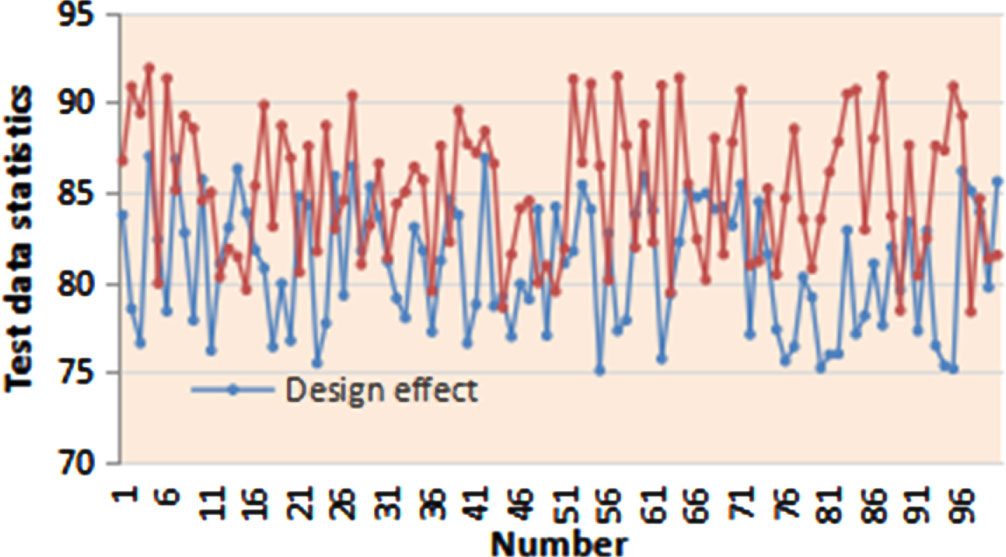
Evaluation of the effect of the immersive animation design system.
Through the above experimental analysis, the reliability of the algorithm and the system in this paper is verified, and the design effect of immersive animation is effectively improved.
In order to improve the effectiveness of immersive animation design, this article combines DT to construct an immersive animation design system to improve the performance of digital media. Based on the experimental results, it is concluded that the FHT-SLM (V = 8) algorithm has stronger PAPR suppression ability, which verifies the feasibility of the algorithm and the reliability of the system. It effectively improves the design effect of immersive animation, showcases excellent visual effects of immersive animation, and provides technical reference for the development of animation design. However, there is a lack of relevant data on the immersive presentation and design effect evaluation of actual animations in research, and further improvement and development are needed in future research.